Sisters’ Festival

Sisters’ FestivalOrigins of the Sisters’ Festival

「 <p>金丹阿姣,相爱受阻,藏饭传情,姊妹佳节。</p> 」

The Miao Sisters’ Festival (苗族姊妹节) traces its origins to the love story of Jindan (金丹) and Ajiao (阿姣), preserved in the ancient Miao narrative song Sisters’ Festival Song (《姊妹节歌》). Their love was obstructed by the traditional…

The Miao Sisters’ Festival is one of the most romantic traditional festivals of the Miao people, combining food, song and dance, social gathering, courtship, and marriage customs. It has often been described as “the world’s oldest Eastern Valentine’s Day.” Women play the central role in planning, organising, participating in, and transmitting the celebration, with mothers passing its customs orally to daughters and each generation preserving them through fixed annual gatherings. The festival celebrated in the Shidong (施洞) area is the most representative and is poetically described as “a festival hidden within the heart of a flower.” According to legend, Jindan and Ajiao—the children of two maternal aunts—grew up together as childhood companions and fell in love as adults, but their families opposed the match. They secretly met and exchanged food hidden in a bamboo basket before eventually overcoming the obstacles and becoming husband and wife, giving rise to the custom of presenting Sisters’ Rice (姊妹饭). The festival’s origin is therefore closely connected with legends of resistance to arranged marriage. Miao ancient songs also record that, in the past, Sisters’ Festival customs were once widespread across many Miao-inhabited areas.

Sisters’ Festival / Origins of the Sisters’ Festival

The Name of the Sisters’ Festival

Origins & Anecdotes · Tracing the Past

“Nongx Gad Liangl”

The Sisters’ Festival has several names in the Miao language, the most important of which is “Nongx Gad Liangl” (垄嘎粮). In Miao, Nongx (垄) means “to eat,” Gad (嘎) means “rice” or “food,” and Liangl (粮) expresses the fulfilment of the wish for sisters and friends to gather together. Taken as a whole, *Nongx Gad Liangl* means “to eat Sisters’ Rice and fulfil the wish to reunite.” The name captures the festival’s two essential dimensions: eating Sisters’ Rice is its material and culinary expression, while reunion among sisters is its emotional and spiritual core.

In Chinese-language contexts, the festival is also known as the “Sisters’ Rice Festival” (姊妹饭节), the “Miao Valentine’s Day” (苗族情人节), and the “oldest Eastern Valentine’s Day.” “Sisters’ Rice Festival” emphasises the celebration’s most recognisable food tradition, while “Valentine’s Day” highlights its theme of freely chosen love and courtship.

From the “Slope Gathering” to the Sisters’ Festival

The Sisters’ Festival did not emerge in isolation. Its predecessor was the ancient Miao “Slope Gathering” (坡会), a traditional form of social interaction in which young men and women met on hillsides, exchanged songs, talked, and became acquainted with one another. Over time, these gatherings gradually developed into a festival centred on women and marked by the preparation and sharing of Sisters’ Rice.

The Sisters’ Festival is observed across a relatively broad area. Among hundreds of villages and more than one hundred thousand Miao people, ceremonial customs vary in complexity and detail, and local legends also differ slightly. Even within Taijiang County (台江县), different Miao branches celebrate the festival at different times, generally between the first and fifth lunar months. Among these, the celebration in the Shidong area of Taijiang County is the most representative and influential. Shidong has long been an important regional centre in eastern Guizhou. With convenient transport links and a large population, it historically became a major gathering place for Miao communities from surrounding villages during important festivals.

Origins of the Festival

Origins & Anecdotes · Tracing the Past

A Legacy of Matrilineal Clan Society

The oldest roots of the Sisters’ Festival can be traced to the era of primitive matrilineal clans and matriarchal social organisation. This represents one of the festival’s deepest cultural foundations.

In matrilineal clan society, women occupied a dominant position in many aspects of social life, and forms of marriage such as visiting relationships and pair marriage allowed relatively free interaction between men and women. The Sisters’ Festival can be understood as a surviving cultural expression of that older social structure. Traditionally, women collectively planned, presided over, participated in, and transmitted the festival. Mothers taught its customs orally to daughters, and the celebration continued through recurring gatherings held at fixed times each year. Across its rituals and customs, sisters and young women remain the central figures: they are the planners and organisers of the festival, while men are expected to follow the arrangements and wishes of the women. This female-centred structure can therefore be seen as a living cultural inheritance from older matrilineal traditions.

The festival also vividly reflects the transformation of human society from matrilineal clan structures toward patrilineal ones, especially in relation to courtship and marriage. Under matrilineal systems, women possessed greater initiative in choosing partners. As patriarchal social structures became established, arranged marriage, marriage transactions, and other restrictive practices increasingly replaced freer courtship. The Sisters’ Festival stands as a living witness to this historical transition: it preserves older traditions in which women actively chose partners, while also reflecting women’s later struggles for freedom of marriage under patriarchal systems. In this sense, the festival has sometimes been described as a “living fossil” of ancient Miao marriage customs. Its central themes—resisting arranged marriage and seeking freedom in love—vividly reflect changes in marriage institutions during the transition from matrilineal to patriarchal social structures.

Memory of Migration

The origins of the Sisters’ Festival are also closely tied to the Miao people’s long and often tragic history of migration. This is one of the festival’s most poignant layers of cultural memory.

In the Taijiang region, an old folk song describes the connection between the Sisters’ Festival and Miao migration:

> “We once lived in the East, > where water and sky stretched into one. > There were girls gathered everywhere, > and every year we ate Sisters’ Rice. > To survive, we journeyed westward, > leaving our married sisters far behind, > not knowing when we might meet again. > When we reached a new land, > we still called one another together; > every year we ate Sisters’ Rice, > so that we would never forget our sisterly bonds.”

This song reveals an important dimension of the festival: it is not only an occasion for young men and women to court one another, but also a time for married sisters to return to their natal homes, reunite with one another, and speak of their longing and separation.

According to oral tradition, the Miao once lived in an eastern homeland “where water met the sky.” As the population grew and living conditions became more difficult, some groups had to migrate westward. Married women could not always return with the migrating group, so families invited them home to gather with their sisters, catch fish and shrimp, share meals, and spend several days together before separating again. Married women returned to their husbands’ families, unmarried women eventually married, and those who needed to migrate continued westward. Thereafter, every spring, sisters would catch fish and shrimp in the rice fields and invite married sisters back to their natal homes to share Sisters’ Rice and express the longing accumulated through separation.

#### Sisters’ Rice

The festival’s central food tradition, Sisters’ Rice (姊妹饭), is itself a culinary symbol of Miao migration memory. Its five traditional colours each carry a meaning: green represents the beauty of the homeland, red symbolises prosperity and flourishing, yellow stands for abundant harvests, purple evokes auspicious fortune arriving from the east, and white symbolises pure love. Each colour tells of attachment to home and the hope for a better life.

The custom of eating Sisters’ Rice was therefore not originally only about romance. It also commemorated sisters separated by migration and marriage. As married sisters moved farther and farther away, they were invited home each spring to reunite, share a meal, and speak of their longing. This spirit of “never forgetting sisterly affection” forms one of the deepest emotional foundations of the festival.

Historical Development

Origins & Anecdotes · Tracing the Past

The Period of Early Society

The Sisters’ Festival can be traced back to the era of primitive matrilineal clans and matriarchal social organisation. In matrilineal society, women played leading roles in social life, and marriage often took forms such as visiting relationships or pair marriage, allowing relatively free interaction between the sexes. The Sisters’ Festival preserves elements of this ancient social structure within festive culture.

Its predecessor, the ancient Miao Slope Gathering, was a traditional occasion for young men and women to meet on hillsides, sing antiphonally, converse, and establish relationships. According to Miao ancient songs and migration epics, such female-centred social traditions already existed when Miao ancestors still lived in the eastern homeland described as “where water and sky joined as one.” The line “girls gathered in great numbers, and every year we ate Sisters’ Rice” suggests that the customs of sharing Sisters’ Rice and gathering among sisters were already imagined as part of a very ancient social world.

The Migration Period

The Miao people experienced a long and often painful history of migration. Their ancestors are traditionally associated with regions around the lower Yellow River and the middle and lower Yangtze, from which various groups gradually moved southwestward due to warfare and other pressures. During this process, sisters became dispersed across different places and reunion became increasingly difficult. In this historical context, the Sisters’ Festival acquired a deeper meaning: “married sisters moved farther and farther away, so every spring they were invited back to their natal homes to reunite, share Sisters’ Rice, and speak of their endless longing.”

> “We once lived in the East, where water and sky stretched into one… > To survive, we journeyed westward, leaving our married sisters far behind, not knowing when we might return.”

This old folk song closely connects the festival’s origin with Miao migration history. What may have begun as a remnant of matrilineal social life gradually became an important means by which a migrating people maintained family bonds and remembered their homeland.

From the Ming and Qing Dynasties to the Republican Period

During the Ming and Qing dynasties, intensified state administration and development in southwest China brought profound changes to Miao society. Han Chinese cultural influence became increasingly visible, but Miao communities continued to preserve a relatively independent traditional cultural system. The Sisters’ Festival remained one of the most important traditional celebrations and continued to develop during this period.

Marriage customs among the Miao were also affected by broader social changes. The Ming and Qing governments implemented the policy known as “gaitu guiliu” (改土归流)—the replacement of hereditary native chieftains with centrally appointed officials—which significantly altered political and social structures in southwest China. Within this context, the festival’s ideal of freely chosen love remained in tension with arranged marriage. The legend of Jindan and Ajiao, with its emphasis on resistance to imposed marriage and pursuit of romantic freedom, gained particular relevance against the background of such social pressures.

During the same period, Shidong gradually developed into an important commercial town in eastern Guizhou because of its location along the Qingshui River (清水江) transportation route. Improved mobility allowed the local Sisters’ Festival to attract communities from an increasingly wide area. Miao people from surrounding villages gathered there during the celebration, and Shidong gradually became the festival’s most representative centre. Its rituals and activities also became increasingly elaborate and standardised.

After the Founding of the People’s Republic of China

After the founding of the People’s Republic of China, the social system in Miao regions underwent fundamental change. Arranged marriage, marriage by purchase, and other remnants of older systems were abolished, and freedom of marriage received legal protection. The Sisters’ Festival’s traditional ideal of free love thus gained institutional support in the new society. It no longer needed to appear primarily as an act of resistance but could continue as a form of celebration.

During the Cultural Revolution (文化大革命), however, traditional festivals including the Sisters’ Festival were condemned as “feudal superstition” (封建迷信) and were prohibited, temporarily interrupting transmission. After the beginning of Reform and Opening (改革开放), the restoration and implementation of ethnic cultural policies allowed the festival to revive and once again be transmitted publicly.

The Contemporary Era

On 20 May 2006, the Miao Sisters’ Festival was approved by the State Council for inclusion in the first national list of intangible cultural heritage, under project number Ⅹ-22. The festival is traditionally practised among Miao communities in areas such as Laotun (老屯) and Shidong (施洞) in Taijiang County, Guizhou Province, and is now recognised as a national-level intangible cultural heritage tradition. Young women stand at the centre of the celebration, whose principal activities include song and dance, traditional dress, youfang courtship, eating Sisters’ Rice, and the exchange of love tokens between young men and women. The festival is large in scale and rich in distinctive cultural content.

Far from declining in contemporary society, the festival has continued to grow in visibility and scale. Each year, from the 15th to the 17th days of the third lunar month, large celebrations are held in the Shidong area of Taijiang County. Young women dress in elaborate costumes and silver ornaments, prepare colourful Sisters’ Rice, exchange songs with young men arriving from distant places, perform drum-stamping dances (踩鼓舞), and exchange symbolic gifts. The festival has become an important cultural event showcasing Miao song, dance, clothing, silverwork, and broader ethnic traditions. Scholars in China and abroad have described the Taijiang Sisters’ Festival as “the world’s oldest Eastern Valentine’s Day” and “a festival hidden within the heart of a flower.”

As society changes, the festival continues to adapt to modern needs. Traditional core customs—eating Sisters’ Rice, youfang courtship songs, drum-stamping dances, and the exchange of tokens—have been carefully preserved, while modern stage performances, tourism, and commercial exchange have also been incorporated. The Sisters’ Festival has become an important platform for presenting Miao culture, strengthening community and interethnic ties, and promoting the integration of culture and tourism. Every year, visitors from across China and around the world travel to Taijiang to experience the distinctive charm of this ancient celebration.
Core Customs

Origins & Anecdotes · Tracing the Past

Sisters’ Rice

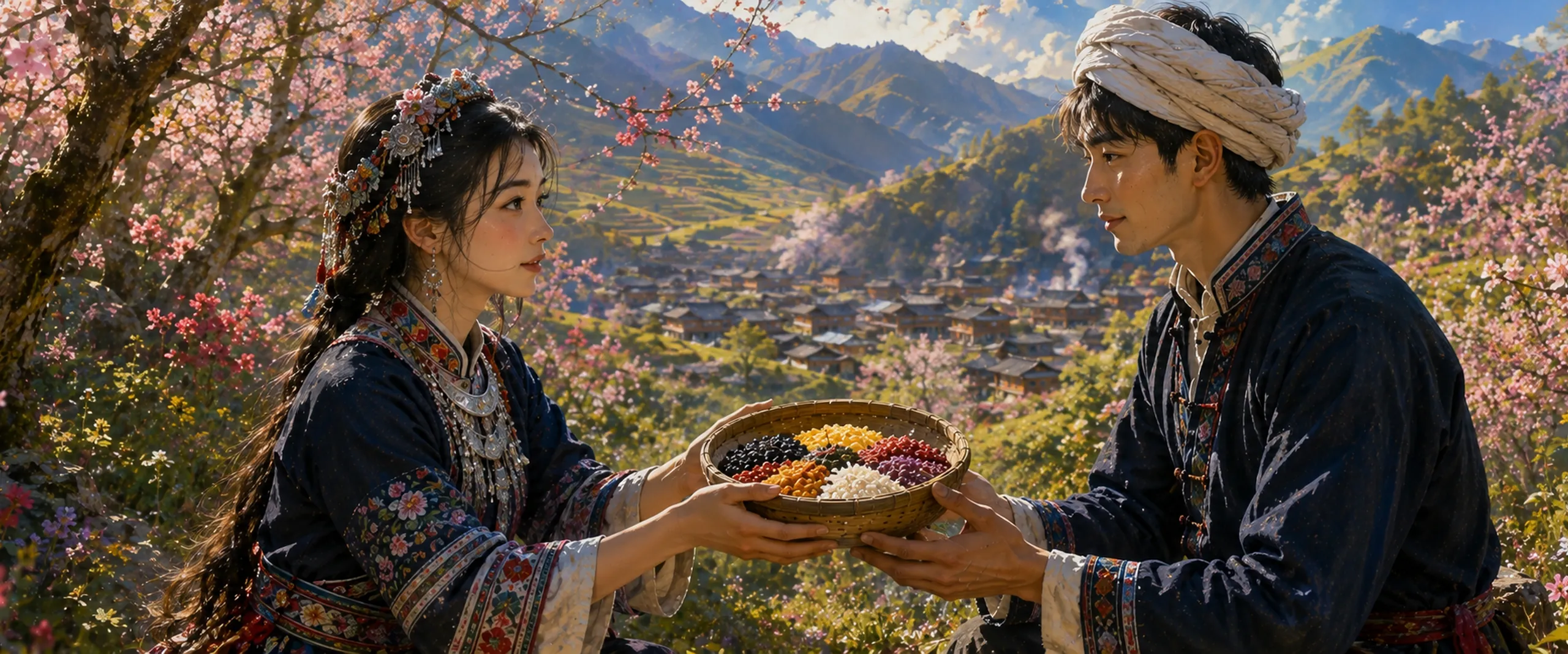
Sisters’ Rice (姊妹饭) is the most recognisable symbol of the festival. As the celebration approaches, young women go into the hills to gather Sisters’ flowers—a local wildflower—and leaves of the Nanzhu shrub (南烛木) and other plants used as natural dyes. Glutinous rice is soaked with these botanical colours and steamed into brilliant multicoloured rice. The five traditional colours each carry symbolic meaning: green represents the beauty of the homeland, red symbolises prosperity, yellow stands for abundant grain harvests, purple represents auspicious fortune arriving from the east, and white symbolises pure love.

Sisters’ Rice is not merely festival food. It is also a love token prepared and given by young women to express their feelings. Different objects may be hidden within the rice to communicate different messages to the recipient. Pine needles may suggest a request for embroidery needles, young Chinese toon shoots can indicate a marriage proposal, while a chilli pepper can signal rejection or the end of a relationship. This system of “expressing feelings through objects” combines food and romance in an unusually intimate way, turning Sisters’ Rice into one of the most distinctive forms of “love letter” in Miao culture.

Catching Fish in the Rice Fields

Catching fish and shrimp in flooded rice fields is another important festival activity. At first light, young women dress carefully and join young men in the paddies, catching fish, splashing in the water, talking, singing, and teasing one another. Girls from one village may arrange to meet young men from another village, using the shared activity of fishing and shrimp-catching as an opportunity for courtship and meeting potential partners.

Why is fishing in the fields part of the festival? The custom is closely connected with Miao agricultural life. The third lunar month falls during the spring farming season, when fish and shrimp are plentiful in the paddies. Catching them is therefore both a festive amusement and a symbolic wish for abundance. More importantly, the open rice fields provide young men and women with a natural and relatively unrestricted space for social interaction.

Drum-Stamping Dance

The drum-stamping dance (踩鼓) is one of the festival’s major community activities. With careful help from their parents, young women dress in their finest festival clothing: silver crowns on their heads, silver earrings, heavy silver neck rings, brightly embroidered garments decorated with silver plaques, silver bracelets on their wrists, and embroidered shoes on their feet. They then gather at the drum ground to dance.

The drum-stamping dance is not only a performance but also a major display of Miao clothing and silver ornament culture. At the drum ground, people can immediately see whose clothing is the most colourful and whose silver jewellery is the most beautiful and abundant. Silver ornaments have traditionally symbolised both wealth and beauty within Miao society. Through the dance, young women display their appearance, craftsmanship, and family prosperity while also attracting the attention of potential partners. Girls may travel from villages dozens of kilometres away to gather at the drum ground. With drums sounding continuously and dancers moving in rhythm, the scene can be extraordinarily spectacular.

Youfang Courtship and Antiphonal Singing

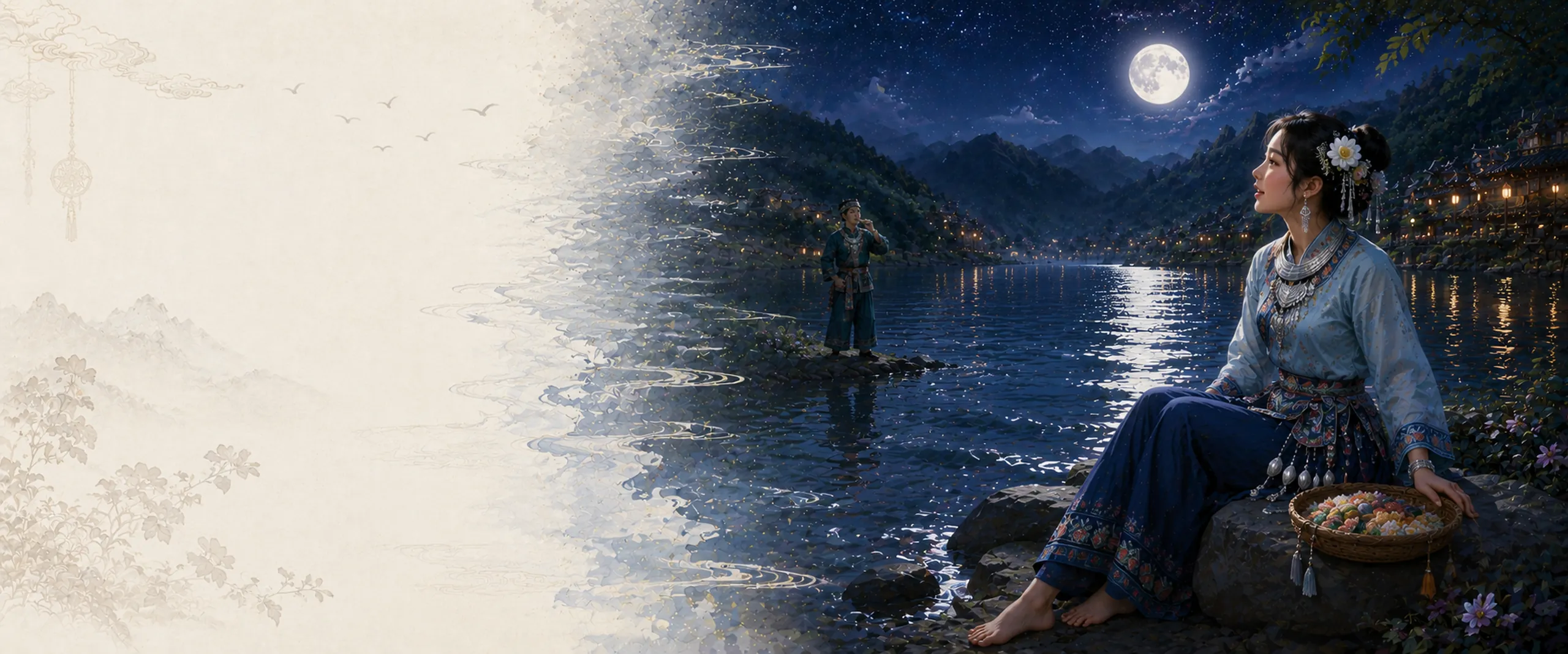
Youfang (游方) courtship and antiphonal singing form the festival’s most romantic social activity. When night falls, young men who have travelled from other places go to a fixed youfang ground in the girls’ village. By blowing leaves or whistling, they signal and invite the young women to gather. The two sides then exchange love songs, one singing and the other answering, building communication through repeated call and response.

If mutual affection develops, the singing may continue until the moon sinks behind the hills. Young women take part in collective activities through distinctive dress, carefully crafted lyrics, symbolic love tokens, and graceful dance, drawing the attention of possible partners and seeking a satisfying relationship. Youfang is therefore much more than the exchange of songs: it is a dialogue between hearts. Through singing, young men and women learn about one another’s talent, personality, temperament, and intentions.

Festival Legends

Origins & Anecdotes · Tracing the Past

*Sisters’ Festival Song*

Among the Miao people is preserved a narrative poem of more than five hundred lines known as Sisters’ Festival Song (《姊妹节歌》). This ancient song is the festival’s central cultural narrative and preserves its most moving love story.

#### Jindan and Ajiao

According to *Sisters’ Festival Song*, long ago there were two children born to maternal aunts: the boy was named Jindan (金丹) and the girl Ajiao (阿姣). They grew up together as childhood companions, innocent and inseparable, and when they reached adulthood their affection deepened into love. Jindan was determined to marry Ajiao, and Ajiao wished to marry no one but Jindan.

Their parents and clan members, however, opposed the relationship. Ajiao’s parents intended for her to marry back into her maternal uncle’s family, following an old Miao marriage custom known as “huan niangtou” (还娘头). Under this traditional system, a maternal uncle could possess a preferential claim in the marriage of his niece. A woman’s marriage required the uncle’s consent and she was often expected to marry one of his sons. Ajiao refused to marry into her uncle’s family and insisted on marrying Jindan. Jindan likewise refused to marry anyone else and continued waiting for her.

To remain faithful to their love, they met secretly every day. Fearing that their parents and village elders would discover them, they arranged to meet outside the village. Each time, Ajiao concealed food inside the bamboo basket she normally used for sewing materials and secretly carried it to Jindan. Year after year, after many hardships and persistent resistance, they finally succeeded in becoming husband and wife.

#### “Hidden Rice” and Sisters’ Rice

Ajiao’s practice of hiding food in a bamboo basket and carrying it secretly to Jindan became the legendary origin of Sisters’ Rice. In Miao tradition, food taken secretly to one’s beloved is called “hidden rice” (藏饭, Gad Liangl), rendered in Chinese as “Sisters’ Rice.” The phrase captures the central image of the love story with remarkable precision: secretly carrying food to the person one loves under the watchful eyes of parents and clan members becomes an expression of love at once humble and courageous.

The story of Jindan and Ajiao became a symbol of the Miao people’s resistance to arranged marriage and their pursuit of freely chosen love. Their relationship is not an effortless fairy tale but a flower of life that grows stubbornly through repeated obstacles. Their perseverance has inspired generations of young Miao men and women to pursue love with courage.

#### The Legend of Eight Hundred Couples

Another legend tells that, after many years had passed, there were eight hundred girls in the Shidong region of Taijiang County who could not find husbands, while in a place called Sanbing Datang (三丙大塘) there were likewise eight hundred young men unable to find wives.

The elders remembered the story of Ajiao, Jindan, and Sisters’ Rice. They advised the girls to follow the same method and invite the eight hundred young men from Sanbing Datang to share Sisters’ Rice. In this way, everyone eventually found the person they loved, and pair after pair became husband and wife. From then onward, eating Sisters’ Rice gradually developed into a festival activity centred on young men and women choosing romantic partners.

Young Miao men and women admired Jindan and Ajiao for their devotion and began imitating them by meeting on the hillsides. According to this legend, the Sisters’ Festival grew from this practice. The story directly connects the romance of Jindan and Ajiao with the formation of the festival, transforming what had also been a festival of reunion after migration into a celebration whose central theme is freedom in love.

Regional Legends

The Sisters’ Festival is celebrated across a wide area, and among the hundreds of Miao villages that observe it, rituals vary in detail and local legends differ somewhat. In addition to the story of Jindan and Ajiao and traditions rooted in migration memory, several other versions are widely known.

#### Yuejiu and Yingjiu

According to scholarly research, a possibly older legend survives around Liangtian Village in Shidong, Taijiang County: the story of Yuejiu (月九) and Yingjiu (英九). This tradition may preserve a deeper layer of historical memory. Compared with the story of Jindan and Ajiao, the Yuejiu-Yingjiu narrative appears closer to earlier social forms and may reflect more archaic systems of marriage and social interaction.

#### The Legend of the Geyi Region

In the Geyi (革一) area, another tradition tells of sisters opening fields and inviting guests. This legend links the Sisters’ Festival with agricultural production and village hospitality, reflecting the multiple roles the celebration played in farming society. It was not only a festival of love but also an occasion for community interaction and cooperation in production.

#### Reunion During Miao Migration

Another tradition is directly connected to Miao migration history. During the long process of migration, sisters became scattered across distant regions. In order to reunite, they agreed to meet every spring, catch fish, prepare food, sing together, and speak of their longing for one another. Over time, this recurring reunion gradually developed into the Sisters’ Festival.

Closing Reflections

Origins & Anecdotes · Tracing the Past

The formation of the Miao Sisters’ Festival is the result of thousands of years of accumulated cultural memory and the continual addition of new meanings across changing historical eras. Its deepest roots lie in ancient matrilineal clans and matriarchal social structures, in which women played leading roles in communal life and relations between men and women allowed greater freedom of personal choice. In the Miao people’s migration epics, the festival gained the collective memory of “never forgetting sisterly bonds.” In the love story of Jindan and Ajiao, it acquired the spiritual core of resisting arranged marriage and defending freely chosen love. In the more than five hundred lines of Sisters’ Festival Song, it found its most profound narrative expression; and in colourful Sisters’ Rice and emotionally charged youfang antiphonal songs, it found its most vivid cultural form.

From the legacy of matrilineal clan society to struggles within patriarchal systems; from the migration memory of “we once lived in the East” to the promise that “every year we will eat Sisters’ Rice”; from the romantic legend of Ajiao secretly carrying “hidden rice” to Jindan to the joyful story of eight hundred pairs finding love through Sisters’ Rice—the festival has undergone a long transformation from matrilineal traditions to patriarchal society, from migration to settlement, from reunion and ritual to celebration, and from a local festival to nationally recognised intangible cultural heritage. It preserves both the Miao people’s cultural memory of older female-centred social structures and their enduring pursuit of freedom in love, while also expressing their most sincere hopes for reunion among sisters and for a good and fulfilling life.

In 2006, the Miao Sisters’ Festival was inscribed on China’s first national list of intangible cultural heritage under project number Ⅹ-22. From the distant world of matrilineal clan society to contemporary national heritage protection, the festival has crossed centuries while continuing to flourish along the Qingshui River through its distinctive cultural vitality. It has been described as “a festival of affection and love, and at the same time a grand occasion displaying the colourful songs, dances, costumes, and profound cultural heritage of the Miao people.”

Like the brilliant colours of Sisters’ Rice, every shade carries a memory and every grain holds a feeling. The Sisters’ Festival is not only a stage on which young women seek love, but also a spiritual home where the Miao people transmit culture, strengthen identity, and express emotion. It may be said to be “hidden within the heart of a flower,” yet from there it continues to bloom with extraordinary cultural radiance.

—

Cultural Spirit

Cultural Core
Sisters’ Festival carries the Chinese people’s longing for a better life and their devotion to family, embodying the cultural spirit of reunion, harmony, gratitude and blessing — it is one of the most enduring traditional festivals in Chinese culture.
Women at the Centre
Resistance to Arranged Marriage
“Never Forget Sisterly Bonds”

Women at the Centre

The most distinctive cultural feature of the Sisters’ Festival is its female-centred structure. From planning and organisation to participation and transmission, women remain at the heart of the festival. It has traditionally been collectively planned, presided over, participated in, and transmitted by women, with mothers teaching daughters orally and each generation preserving the customs through regular annual gatherings.

Across the festival’s many rituals and customs, sisters and young women are the principal figures. They are the organisers and planners, and men are expected to follow the arrangements determined by the women. This female-centred structure represents a living transmission of cultural elements associated with ancient matrilineal society. The Sisters’ Festival is therefore more than simply a celebration: it can also be understood as a cultural history of matrilineal society written through the body and transmitted through song.

Resistance to Arranged Marriage

At the heart of the festival lies the ideal of resisting arranged marriage and pursuing freedom in love. The story of Jindan and Ajiao offers the most powerful expression of this spirit. In order to remain faithful to one another, they continued meeting secretly despite opposition from their parents and clan, and after years of hardship and determined resistance, they finally became husband and wife.

This spirit of resistance is present throughout the festival’s customs. Young women use tokens hidden in Sisters’ Rice to express their feelings toward the men they favour, and through youfang songs they choose partners for themselves. Such practices are themselves a rejection of imposed marriage and an affirmation of romantic freedom. The Sisters’ Festival vividly preserves memories of the passionate emotional lives of young men and women during the long social transition from matrilineal to patrilineal structures.

“Never Forget Sisterly Bonds”

The festival also carries the collective memory expressed in the phrase “never forget sisterly affection.” From the migration song that declares “every year we eat Sisters’ Rice, so that we never forget our bonds as sisters”, to the custom of inviting married sisters back to their natal homes each spring, the festival has always served as an important means of preserving emotional bonds among women and transmitting collective memory.

The Miao are a people shaped by a long history of migration. During those migrations, sisters became scattered across different places, making reunion increasingly difficult. The Sisters’ Festival can therefore be understood as a cultural response to separation. Every spring, sisters return from different directions to their natal homes, share Sisters’ Rice, catch fish together, sing together, and renew their bonds. Through reunion, sisterly affection is remembered; through celebration, the memory of the people is passed on.

Continue exploring Sisters’ Festival culture

Readers’ Comments

Calendar and traditional culture enthusiasts from around the world, sharing the same moon.

Sign in or register to join the conversation. Your comment account is created automatically the first time you use a connected account.