Ancestral Worship
Ancestral worship is the most central and sacred ritual of March Third. Every year on the third day of the third lunar month, Li people dress in festival clothing and gather from every direction carrying Shanlan rice wine (山兰米酒) and fragrant rice cooked in bamboo tubes in order to worship their ancestral founders.
In traditional Li ritual aesthetics, black is associated with beauty and solemnity. On March Third, young women wear long black tube skirts and black headscarves, while young men carry black umbrellas and bring Shanlan wine, glutinous-rice wine, cured meat, and other offerings to an agreed mountain gathering place to worship the ancestors. After the rites are completed, participants share the offerings and celebrate together.
In Sanya, Baoting, Lingshui, and other areas, Li communities use pig heads, rice wine, and rice balls as ritual offerings and travel to places such as Luobi Cave (落笔洞) in Sanya and caves in Ganshiling (甘什岭) to pray for ancestral protection and peace. In the Tongshi region, on the “Ox Day” (牛日) of the third lunar month, Li communities slaughter pigs and prepare feasts at the *mutou* household, gather to beat gongs and drums, and perform ancestral dances to celebrate the blessings brought by spring. Rituals may also be performed to call in a blessing-soul for women who have not yet conceived, with prayers that they may later bear children.
#### The Paolongkou Ancestral Rite
In contemporary March Third celebrations, worship of the Li ancestral figure Paolongkou (袍隆扣) has become an especially important component. Paolongkou is remembered in Li tradition as one of the people’s supreme ancestral deities and a primordial forebear passed down through generations of myth and ritual.
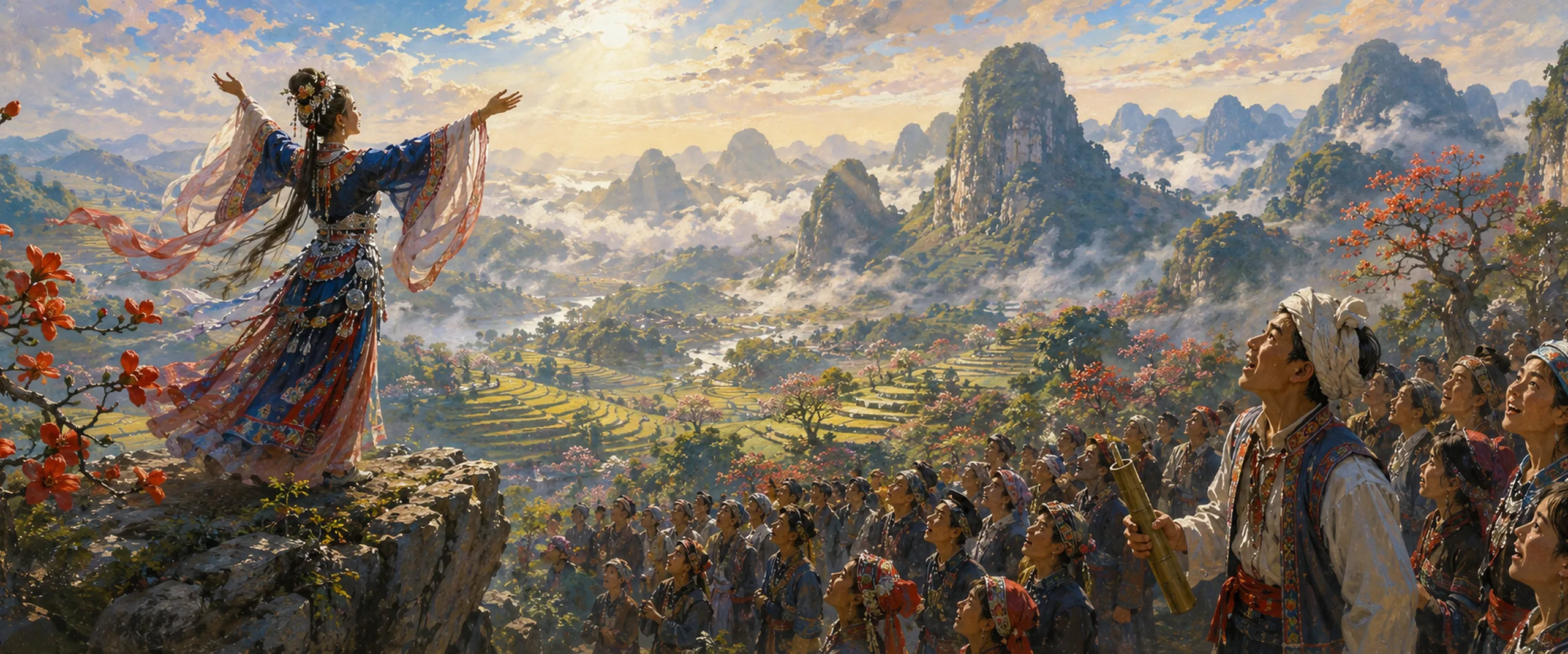
According to Li mythology, Paolongkou held up the heavens to an immeasurable height and shot down six suns and six moons. He used the rainbow as a carrying pole and roads as ropes, gathered sand and stone to create mountains and rivers, kicked mountains upward and carved out valleys, turned his sweat into rivers, and his hair into forests, thereby creating a habitable world for the Li people and all living things. Before his death, fearing that the sky might collapse and injure humanity, Paolongkou stretched out his enormous hand and held up the firmament. Wuzhi Mountain (五指山), the “Five-Finger Mountain,” is said to be the gigantic hand of Paolongkou. It is therefore not only one of Hainan Island’s most recognisable geographical symbols but also a profound spiritual emblem for the Li people: the hand of their ancestral protector extended over his descendants.
Today, in order to provide a unified place for large-scale ancestral worship, a Li-Miao Cultural Park has been established in Shuiman Township, Wuzhishan City. It includes a Li ceremonial hall and a March Third square capable of accommodating collective rites involving many thousands of participants, and has become an important sacred centre for Li ancestral worship. Every March Third, thousands of Li people and members of neighbouring ethnic communities gather there for the grand rite honouring Paolongkou. The ceremony includes horn calls welcoming guests, drums announcing the sacrifice, the formal reading of the ritual address, musical and dance offerings, and homage before the Li ancestor. The entire ritual is solemn, dignified, and highly ceremonial.
Courtship Through Antiphonal Singing
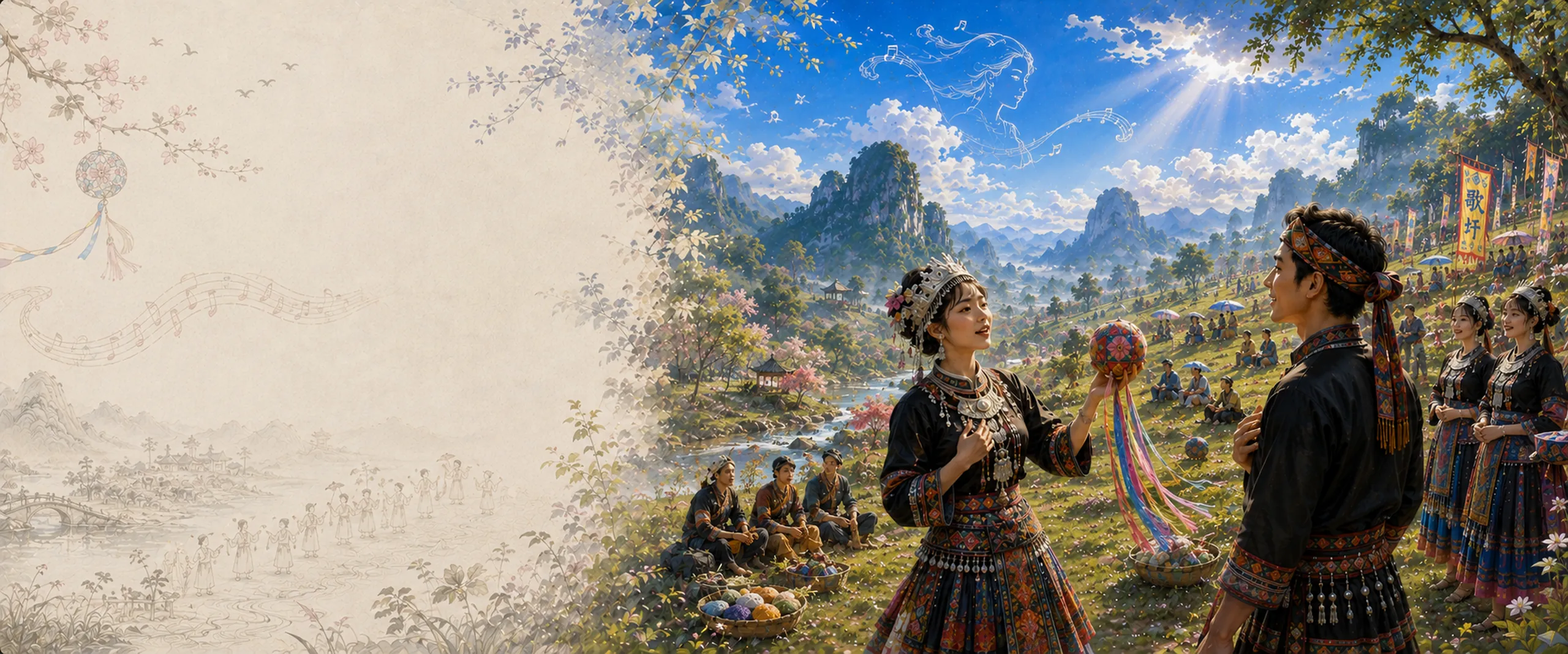
Choosing a partner through antiphonal singing is among the most romantic customs of March Third. Young women hold buren (布任)—the fragrant leaves and branches of a particular tree—in front of their faces and hide among the greenery, while groups of young men take the initiative in inviting them to exchange songs. One sings and the other replies; one asks and the other answers. What begins with greetings gradually develops into expressions of affection, and when two people choose one another, they exchange gifts and may become formally betrothed.
Among Li communities speaking the Meifu dialect (美孚方言), young men and women rise early on March Third, put on festival clothing, and carry baskets, food, umbrellas, and other necessities to a previously agreed forest or open field, called bodang (波当) in the Meifu dialect. They begin by “talking collectively,” asking one another about their villages and names, before turning to antiphonal song. Through these exchanges, the young men and women come to understand one another, and those who discover mutual affection may form a couple.
When night falls, older people gather to drink and reminisce, while groups of young men and women continue to meet. Antiphonal singing may last throughout the night, with emotion communicated through melody and verse. Young people use the festival as an occasion for exuberant celebration, making friends through song and expressing affection through dance, remaining immersed in the atmosphere of courtship until dawn approaches. Only then do they reluctantly part, often promising to meet again the following March Third.
The Bamboo-Pole Dance
The Dachai Dance (打柴舞) is one of the most common collective dances performed during March Third. Its performance structure is distinctive. Two thick round logs are first placed parallel to one another on the ground. Several pairs of slender poles or bamboo rods, each more than two metres long, are then laid crosswise over them with spaces between. Several pairs of young men and women squat beside the poles, facing one another and holding the rods, striking and opening or closing them according to a rhythmic pattern. The dancers, whose number is not fixed, jump and step between the moving poles as they repeatedly separate and come together.
The Dachai Dance is not merely a dance but also a test of skill, courage, timing, and coordination. Dancers must jump precisely at the moment the poles open; a slight mistake may cause their ankles or legs to be caught between the closing poles. The form therefore expresses the value traditionally placed by Li communities on agility, bravery, and bodily coordination.
Traditional Sports and Competitions
March Third also features a wide variety of traditional sporting competitions. Older events include archery, swinging, tree climbing, dagougun (打狗棍) stick contests, cattle riding, “turtle pulling” (拉乌龟), bamboo-raft racing or launching, vine climbing, and traditional gun shooting (粉枪射击). Ball games, board games, track-and-field events, and other modern competitions were later added.
Traditional Li sports display not only individual strength and skill but also the collective spirit of the community. Events such as cattle racing and wrestling recall techniques historically connected with production and everyday life while simultaneously strengthening communal participation and solidarity.
The Long-Table Banquet
The long-table banquet is one of the most representative forms of March Third food culture. Long tables are covered with Shanlan rice wine, fragrant bamboo-tube rice, *zongzi*, cakes, and other festival foods. The banquet is not simply about sharing food; it is also a space for exchanging emotions and strengthening relationships. Seated together along the long table, people drink Shanlan rice wine, taste bamboo-tube rice, and share the happiness of the festival.
Shanlan rice wine (山兰米酒) is a distinctive traditional Li alcoholic drink brewed from Shanlan upland rice. It is known for its mellow taste and characteristic aroma. Fragrant bamboo-tube rice (竹筒香饭) is prepared by placing rice inside sections of bamboo and roasting them, allowing the grain to absorb the fresh fragrance of the bamboo. These foods are not merely material components of the festival but important symbols of Li culinary culture.
Readers’ Comments
Calendar and traditional culture enthusiasts from around the world, sharing the same moon.
Sign in or register to join the conversation. Your comment account is created automatically the first time you use a connected account.
No comments yet
Share your thoughts with readers around the world.