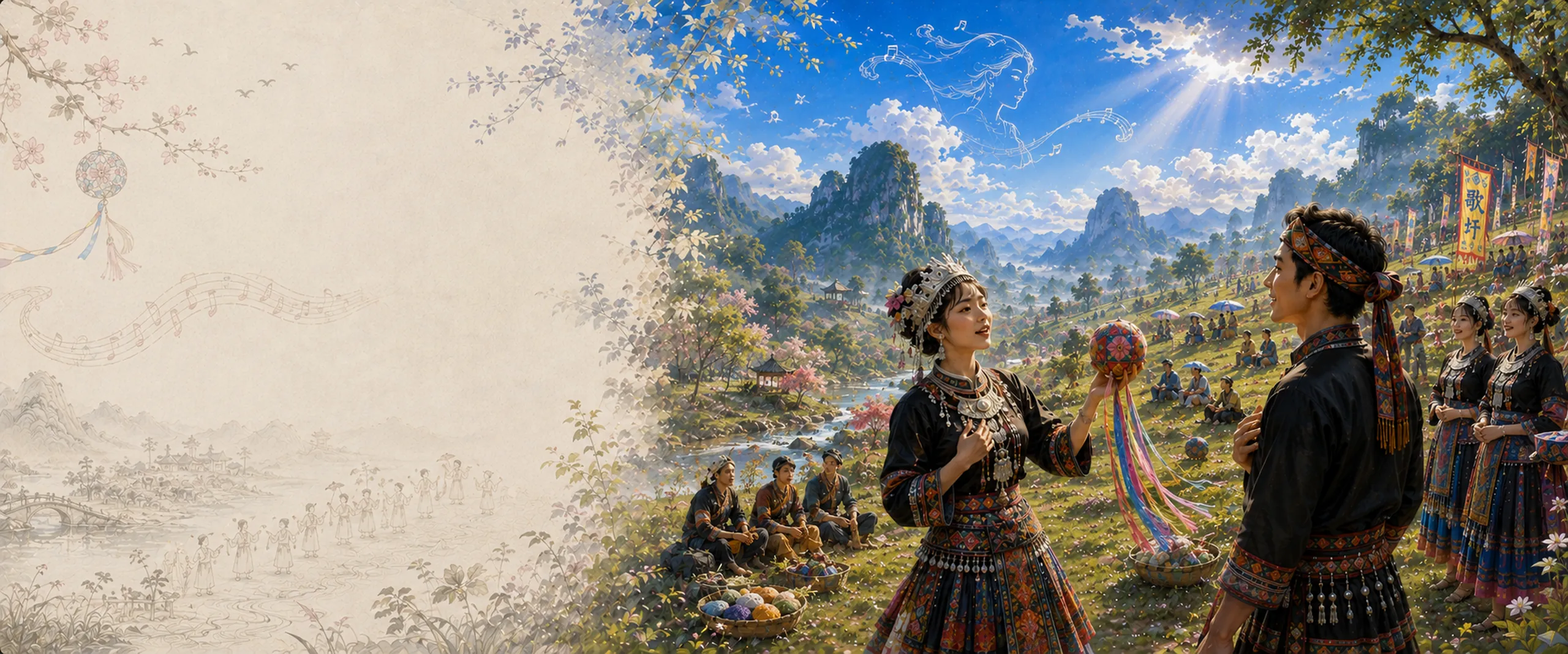
Every year on the third day of the third lunar month, the Li people dress in festive attire, carry Shanlan rice wine and fragrant bamboo-tube rice, and gather from all directions to worship their ancestors, sing antiphonally, and dance in celebration of the festival. On this day, young men and women rise early, put on their festive clothes, and head to forests or open fields, where they first engage in “collective conversation” before beginning antiphonal singing. The Li people, who uphold the virtue of respecting the elderly, bring home-pickled mountain vegetables, freshly brewed rice wine, and prepared cakes to visit respected elders in the village. Young men go out in groups to hunt and fish, while the young women grill fish and cook rice. When night falls, the young men perform traditional Li dances, while young men and women sing mountain songs antiphonally and confide their feelings to one another. The long-table banquet is also one of the most representative folk rituals of the Third Day of the Third Lunar Month Festival.
Main Customs
The Name of the Third Day of the Third Lunar Month Festival: A Thousand-Year Tradition from “Fu Nian Fu” to the “Festival of Love”
“Fu Nian Fu”: The Festival Code in the Li Language
The Li Third Day of the Third Lunar Month Festival is called “Fu Nian Fu” in the Li language. In Li, “Fu” carries the meaning of “day” or “season,” while “Nian” means “the third month”; “Fu Nian Fu” therefore means “the day of the third day of the third month.” This name precisely summarizes the festival’s two core elements—time, the third day of the third lunar month, and nature, a special day.
In the Chinese-language context, the Third Day of the Third Lunar Month Festival is also called the “Festival of Love” and the “Day for Talking of Love.” These two names highlight the festival’s core theme—love. The third day of the third lunar month is a day when young Li men and women express affection and seek the person they desire. It is a traditional festival through which the Li people “express their longing for happiness in love.” The Li people traditionally had no written script of their own, and all historical memory and cultural traditions were passed down from generation to generation through oral transmission. The name “Fu Nian Fu” is direct evidence of the way the Li people have transmitted festival culture through spoken language.
The Reputation as a “Festival of Love”
Because both its origin and its principal activities are connected with courtship and marriage, the Third Day of the Third Lunar Month Festival is also known as the “Festival of Love.” Its central activities—antiphonal singing, dancing, exchanging tokens of affection, and meeting under the moon—are all centered on interaction and romance between young men and women. For this reason, the Third Day of the Third Lunar Month Festival has also been praised as “the Valentine’s Day of the Li people” and is one of the most romantic traditional festivals on Hainan Island. Zhang Qingchang of the Qing dynasty recorded in Li Qi Jiwen: “Unmarried men and women gather in open fields at the turn of spring and summer. The men play mouth instruments (whistle), the women play the nose flute, and they sing Li songs to one another. When a man and a woman find themselves mutually suited, they gradually move closer together and thereby choose one another as spouses.” This record vividly reflects how, since ancient times, the Third Day of the Third Lunar Month Festival has been a grand occasion for young Li people to choose their partners freely.
The Third Day of the Third Lunar Month: A Date Shared by Many Ethnic Groups
The third day of the third lunar month is a festive date shared by many of China’s ethnic minorities. The Han have the Shangsi Festival, while the Zhuang, Dong, Bouyei, Miao, Yao, and many other ethnic groups also hold festive activities on this day. The Li Third Day of the Third Lunar Month Festival is an important member of this wider family of “Third Day of the Third Lunar Month” festivals. Combined with the Li people’s distinctive flood myths, founding-ancestor worship, and traditions of love, it has formed a festival culture with a unique identity.
The Flood Myth: The Ancient Origin of the Third Day of the Third Lunar Month Festival
The most ancient origins of the Li Third Day of the Third Lunar Month Festival can be traced to an ancient flood myth and the legend of a brother and sister marrying. This myth infused the festival with its deepest cultural meanings concerning ethnic rebirth, ancestor worship, and the origins of love.
Tianfei and Nanyin: Survivors after the Flood
Among the Li people, a legend about Tianfei and Nanyin is widely transmitted to explain the origin of the Third Day of the Third Lunar Month Festival. It is said that in ancient times, the Li people living along the Changhua River suffered a catastrophic flood. Large numbers of people and livestock died, and almost the entire Li settlement area was swallowed by the floodwaters. After the flood, humanity faced annihilation, and only one pair of siblings remained—the elder brother Nanyin and the younger sister Tianfei.
After the brother and sister reached adulthood, they faced the great responsibility of continuing the human lineage. Yet because they were siblings, they could not marry one another. The two therefore decided to search separately for partners, agreeing to return to meet beneath Yanwo Ridge every year on the third day of the third lunar month. From then on, every year on this day, Nanyin, Tianfei, and their descendants returned there to welcome spring. In order to prevent her brother from recognizing her, Tianfei endured the pain of using bamboo needles to tattoo patterns onto her face and then dyed them with plants. Through facial tattooing, she changed her appearance, and on one third day of the third lunar month she married Nanyin beneath Yanwo Ridge. On Yanwo Ridge, they spun thread and wove cloth, had children, reclaimed wasteland, cultivated fields, dug ponds, and raised fish, thereby producing descendants for the Li people.
Later, Nanyin and Tianfei fell into an eternal sleep inside a cave and turned into a pair of stones. To commemorate the contribution of this brother and sister to the continuation of the lineage, later generations of the Li people named the cave “Niangmu Cave.” Every year on the third day of the third lunar month, Li men and women, young and old, bring glutinous rice, cakes, zongzi, and Shanlan rice wine from all directions to Niangmu Cave to commemorate the ancestors and pray, through antiphonal singing and dancing, for the happiness and continued flourishing of their people. Each time the third day of the third lunar month arrives, Li working people commemorate this auspicious day in various ways, and the date naturally became a major Li festival.
Eniang and the Crow Demon: A Tragic Tale of Heroism and Love
In addition to the legend of Tianfei and Nanyin, the Li people also transmit the story of Eniang’s battle with the Crow Demon. Long ago, it is said, an evil crow demon lived in a cave and caused such harm that the local Li people could not live and work in peace. One day, the demon captured a beautiful Li girl named Eniang. On the third day of the third lunar month that year, Eniang’s beloved Agui climbed the mountain to rescue her but was killed while fighting the crow demon. Suppressing her grief, Eniang waited until the demon was asleep and killed it, avenging Agui. Eniang never married for the rest of her life. Every year on the third day of the third lunar month, she would go to Exian Cave and sing the love songs she and Agui had sung during their courtship. Later, to commemorate her, the Li people named the cave Eniang Cave, located in what is now Changjiang Li Autonomous County. Every year on the third day of the third lunar month, unmarried young Li men and women gathered at Exian Ridge, singing love songs while seeking their desired partners. This activity expanded year by year and spread throughout Li communities across Hainan, eventually forming a grand traditional festival. This legend endowed the Third Day of the Third Lunar Month Festival with a romantic dimension of heroism, love, and sacrifice.
Historical Changes in Gathering Places
The location of folk gatherings for the Third Day of the Third Lunar Month Festival has moved several times throughout history. The first site was Gaotan Slope beneath Mihou Ridge, where there was a spacious rock cave filled with stones of many forms and clear flowing water. After the cave collapsed and its entrance was blocked, the activities were moved to Changsha Beach, at the confluence of the Changhua River and Nanyao River. The third location was beneath Yanwo Ridge beside the Changhua River. When Japanese invaders occupied Hainan Island, the Third Day of the Third Lunar Month activities were again relocated, this time to Bodan Slope, four kilometers from Dongfang Township. Although the gathering sites changed repeatedly, the tradition of the festival was never interrupted.
In 1956, the renowned dancer Chen Qiao traveled to Xifang Village in Dongfang County, Hainan Li and Miao Autonomous Prefecture, Guangdong Province—today’s Dongfang City in Hainan Province—to collect folk dance material. By chance, she encountered local Meifu Li people celebrating the Third Day of the Third Lunar Month Festival. Inspired by what she witnessed, she created the Li dance The Third Day of the Third Lunar Month, thereby bringing the Li festival to wider public attention.
Preparations before the Festival: Devotion and Bustle in Welcoming the Celebration
Preparations for the Third Day of the Third Lunar Month Festival begin several days in advance, and entire Li villages become immersed in the bustle and joy of welcoming the festival.
Preparing Festival Foods
On the day of the festival, Li families rise before dawn. Women busy themselves pounding Shanlan glutinous rice and preparing festive foods. Every household slaughters chickens, buys meat, and prepares wine. Young women go into the mountains to gather leaves used for coloring rice. Shanlan glutinous rice is the most important food of the Third Day of the Third Lunar Month Festival. People dye and steam the glutinous rice to make colorful rice, which serves both as an offering to the ancestors and as a staple food at the festival banquet. Men go together into the mountains with dogs to hunt and enter the water to catch fish. Young men fish, while young women cook and grill the catch.
Preparing Festive Attire
Before the festival arrives, young women prepare their festive attire. Li women’s festival clothing is exceptionally exquisite, including black tube skirts, embroidered blouses, silver ornaments, shell decorations, and other accessories. Li girls wear long black tube skirts and black headscarves. Silver and shell ornaments shimmer in the firelight. Dressed in their finest attire and adorned with gold and silver, the young women sing and dance in celebration of the annual Third Day of the Third Lunar Month Festival. Festive clothing is not merely a display of beauty but also a symbol of family wealth and cultural identity.
Preparing Ritual Offerings
On the festival day, people prepare offerings for worshipping their ancestors. Li people in Sanya, Baoting, Lingshui, and other areas use pig heads, rice wine, and rice balls as sacrificial offerings. People also bring zongzi, cakes, and Shanlan rice wine. In the Tongshi region, Li people slaughter pigs and hold banquets at the Mutou household on the Ox Day of the third lunar month. Preparing ritual offerings expresses the Li people’s devotion to and gratitude toward their ancestors.
Ancestor Worship and Blessings: The Solemn Core of the Festival
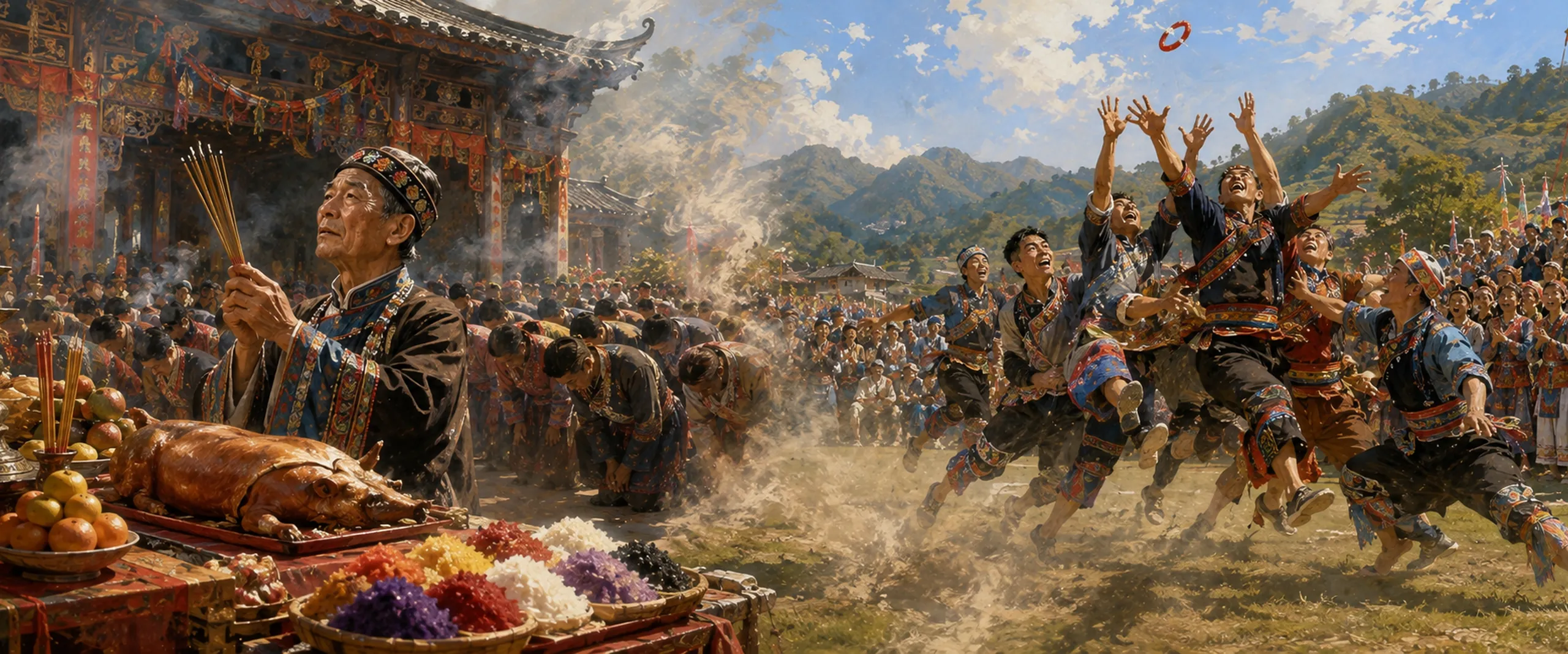
Worshipping the ancestors is the most central and solemn activity of the Third Day of the Third Lunar Month Festival. Ancestor worship is both a remembrance of founding ancestors such as Tianfei and Nanyin and a prayer for the flourishing of the people and the safety of families.
Worship at Niangmu Cave
Niangmu Cave is the most sacred place of ancestor worship for the Li people. Every year on the third day of the third lunar month, Li men and women, young and old, bring glutinous rice, cakes, zongzi, and Shanlan rice wine from all directions to Niangmu Cave to commemorate their ancestors. People place offerings at the entrance of the rock cave containing the stone forms of Tianfei and Nanyin. During the worship, people light incense and candles, arrange the offerings, bow before the founding ancestors, express gratitude to Nanyin and Tianfei, and pray for the continued flourishing and happiness of their people. Young men and women also use the festival as an occasion for celebration, making friends through song and expressing affection through dance.
Rituals at Luobi Cave and Ganshiling
During the Third Day of the Third Lunar Month Festival, Li people in Sanya, Baoting, Lingshui, and other areas take pig heads, rice wine, and rice balls as offerings to Luobi Cave in Sanya, Ganshiling Cave, and other places to pray for ancestral protection and peace. People believe that worshipping the ancestors in these sacred caves can bring their blessing and protection.
The Ritual for Summoning the Soul of Blessing
In the Tongshi region, on the Ox Day of the third lunar month, Li people slaughter pigs and arrange a banquet at the Mutou household. Crowds gather to beat gongs and drums and joyfully perform dances of ancestor worship, celebrating the blessings brought by spring. At the same time, they perform a ritual for summoning the “soul of blessing” for women who have not yet become pregnant, wishing that they will bear sons and daughters in the future. Summoning the soul of blessing is an ancient Li religious ritual. Through gongs, drums, and sacrificial dances, people call for the woman’s “soul of blessing” to return, praying for fertility and the prosperity of the family. This ritual reflects the Li people’s emphasis on the continuation of life and their hopes for the flourishing of the family line.
Contemporary Revival of the Worship of the Li Ancestor Paolongkou
In 2014, during the Third Day of the Third Lunar Month celebrations held by Wuzhishan City, a large-scale ceremony worshipping the Li ancestor was organized for the first time, elevating the festival’s meaning of ancestor worship and recognition of shared origins. Today, every year on the third day of the third lunar month at the Li-Miao Cultural Park in Shuiman Township, Wuzhishan City, several thousand Li people together with members of other ethnic groups take part in the grand ceremony worshipping the Li ancestor Paolongkou. The occasion is magnificent in scale. The ceremony mainly includes welcoming guests with horns, beating drums to announce the sacrifice, solemnly reading the sacrificial text, performing ritual music and dance, and paying homage to the Li ancestor. The entire ceremony is solemn and dignified. From ancient worship at Niangmu Cave to contemporary mass ancestor-worship ceremonies involving thousands of participants, the ritual tradition of the Third Day of the Third Lunar Month Festival has endured for thousands of years and has always remained a central way for the Li people to express gratitude toward their ancestors and affirm their ethnic identity.
Antiphonal Singing and Choosing a Partner: The Romantic Core of the Festival
Choosing a partner through antiphonal singing is the most romantic activity of the Third Day of the Third Lunar Month Festival and the principal means by which young Li men and women meet and fall in love. The festival’s reputation as a “Festival of Love” comes precisely from this tradition.
The Ancient Tradition of Antiphonal Singing
Antiphonal singing is one of the most精彩 aspects of the Third Day of the Third Lunar Month Festival. Zhang Qingchang of the Qing dynasty recorded in Li Qi Jiwen: “Unmarried men and women gather in open fields at the turn of spring and summer. The men play mouth instruments (whistle), the women play the nose flute, and they sing Li songs to one another. When a man and a woman find themselves mutually suited, they gradually move closer together and thereby choose one another as spouses.” This record shows that as early as the Qing dynasty, the custom of choosing a partner through antiphonal singing during the Third Day of the Third Lunar Month Festival was already highly developed. The forms of antiphonal singing are varied and flexible: it may be performed by two people or by larger groups. The songs may be original folk songs passed down among the people. During the singing, young men and women take turns singing and responding, asking and answering one another. They move from exchanging greetings to confiding feelings of affection, while songs echo across the open countryside and emotions flow through the melodies.
The Process of Antiphonal Singing
In areas speaking the Meifu dialect, young men and women rise early on the day of the Third Day of the Third Lunar Month, put on festival clothing, carry baskets, food, umbrellas, and other items, and travel to a previously agreed forest or open field, called “Bodang” in the Meifu dialect. There, they first engage in “collective conversation,” asking about one another’s villages and names, before beginning antiphonal singing. Through the singing, men and women learn more about one another, and those whose feelings are mutually suited become partners.
The young women hold “Buren,” a kind of fragrant tree branch and leaves, in front of their faces and hide among green trees, while groups of young men actively invite them to sing antiphonally. When night falls, the older generation gathers to drink and reminisce, while young men and women meet in groups. People sing throughout the night, using their songs to express their feelings. The young men and women especially revel in the festival, making friends through song and expressing affection through dance, immersing themselves in the happiness of love. Only as dawn approaches do they reluctantly part, promising to meet again on the third day of the third lunar month the following year.
Nose Flute and Whistling: Distinctive Li Musical Expression
The nose flute is a unique Li musical instrument made from bamboo and played by blowing through the nostrils. Its tone is soft and distant. During the Third Day of the Third Lunar Month Festival, Li girls play love songs on the nose flute, while young men answer with whistles and singing. Zhang Qingchang’s Qing-dynasty Li Qi Jiwen records that “the men play mouth instruments (whistle), while the women play the nose flute,” vividly portraying precisely such a scene. The musical expressions of the nose flute and whistling perfectly present the restrained yet passionate way love is expressed in Li culture.
Exchanging Tokens of Affection: Symbols of Betrothal
After the antiphonal singing, young men and women who share mutual affection exchange tokens as symbols of love. A young man hangs ear bells on the young woman’s ears and inserts a hairpin made from deer bone into her hair bun. The young woman ties around her beloved’s waist a multicolored belt she has carefully woven by hand. They pledge themselves solemnly to one another and promise to meet again on the third day of the third lunar month the following year. These tokens are not only expressions of love but also displays of traditional Li handicrafts—the silverwork of the ear bells, the carving skills embodied in the deer-bone hairpin, and the weaving techniques of the multicolored belt are all part of the essence of Li culture.
Traditional Sports Competitions: Displays of Strength and Skill
Traditional sports competitions are an important part of the Third Day of the Third Lunar Month Festival and a stage for the Li people to demonstrate strength, skill, and courage.
Coconut-Tree Climbing Race
Coconut-tree climbing is one of the traditional sports of the Third Day of the Third Lunar Month Festival that most distinctly reflects Hainan’s regional character. It originated in the folk practice of climbing trees to pick coconuts in Hainan and combines amusement, entertainment, and competition, with a pronounced local character. Competitors may choose their own climbing technique. They climb to the top of the coconut tree and touch the timing bell, and the competitor with the shortest time wins.
Beginning in 2008, coconut-tree climbing was listed as a sports competition in the Hainan Li and Miao traditional festival celebrations for the Third Day of the Third Lunar Month, marking its transition from a folk activity to a formal competitive event. In 2010, it was listed as an official event at the Hainan Provincial Traditional Sports Games of Ethnic Minorities. In 2024, coconut-tree climbing made its first appearance at the National Traditional Games of Ethnic Minorities. Competitive categories include the men’s individual nine-meter race, women’s individual seven-meter race, men’s team nine-meter race, and others.
Dagou Guipo (Driving the Dog Back to the Slope)
Dagou Guipo, also called “Gougan Guipo” or “Li hockey,” is a traditional Li competitive sport found in areas such as Luhuitou in Sanya City and Changjiang Li Autonomous County. Two teams with equal numbers of players compete using 1.5-meter sticks to strike a round ball woven from coconut leaves or rice straw. Points are scored by hitting the ball across the opponent’s end line or into the goal, and the team with the higher score within the specified time wins. Originally, the game had no goalposts; in modern times, goals were added by drawing on the model of football.
The losing side must carry members of the winning team from the field or imitate the way dogs walk, while the winners ride on their backs, wave their sticks, and shout commands, which gave rise to the game’s name. Because the sport is lively, humorous, simple to play, and combines competition with playfulness, it is popular among local Li youth. In Hainan Province, Dagou Guipo is one of the indispensable sporting events held whenever the Third Day of the Third Lunar Month arrives. The event has achieved living transmission through the Li Third Day of the Third Lunar Month Festival and the Hainan Provincial Ethnic Minority Games.
Traditional Archery
Archery is one of the oldest traditional sports of the Li Third Day of the Third Lunar Month Festival. Early Li bows and arrows were “wooden bows and bamboo arrows.” The wooden bow was generally between 1.2 and 1.5 meters long, with both ends bound tightly using white rattan. The arrow consisted of an arrowhead and shaft, and the arrowhead was generally carved from bamboo.
Archery competitions are often held during the traditional Li Third Day of the Third Lunar Month Festival. Before the competition, a cow leg or pig leg is hung from a large tree thirty or fifty meters away as the target. Whoever hits the target wins, and the cow leg or pig leg that is struck becomes the victor’s prize. This competitive practice of using game as the prize reflects traces of the hunting life of Li ancestors.
Tugging the “Turtle”
“Tugging the Turtle” is a Li sport combining entertainment and competition, created by imitating the way turtles move. During the contest, boundaries are marked on flat ground. The two ends of a hemp rope or mountain vine several meters long are tied around the waists of the two competitors. With their backs to each other, both place their hands on the ground and pull forward with force in a turtle-like crawling posture. Neither the hands nor feet may leave the ground. Whoever pulls the opponent across the prescribed boundary is the winner. “Tugging the Turtle” is often held during agricultural slack seasons or festive occasions, and village elders usually serve as judges.
Other Traditional Sports
A wide variety of traditional sports competitions are also held during the Third Day of the Third Lunar Month Festival. Traditional events include archery, pole climbing, wrestling, tug-of-war, and swinging. In modern celebrations, sports competitions have become even more diverse, with events such as coconut-tree climbing, stilt racing, plank-shoe racing, spinning tops, and Yajia. Yajia is divided into different weight classes, including 61 kilograms, 76 kilograms, and 85 kilograms. These sporting competitions are not merely contests of strength; they also display courage and skill and serve as an important way of strengthening cohesion within Li communities.
Song, Dance, and Artistic Performances: The Cultural Soul of the Festival
Song, dance, and artistic performances are among the most精彩 elements of the Third Day of the Third Lunar Month Festival and the most concentrated artistic expression of Li culture.
Firewood Dance
The Firewood Dance, also known as “Jumping over the Firewood,” is the most representative dance form of the Third Day of the Third Lunar Month Festival. It originated in traditional Li sacrificial rituals and was originally called “Jumping over the Firewood.” Performers bend green bamboo poles about five meters long into arches, insert the two ends into the ground to form a high-jump frame, and participants must cross the bamboo poles one after another. The Firewood Dance is not merely a dance but also a test of skill and courage. Dancers must jump accurately at the moment the bamboo poles open and close, reflecting the Li people’s admiration for skill, bravery, and coordination.
Rice-Pounding Dance
The Rice-Pounding Dance is one of the traditional Li dances. It imitates the movements of Li women pounding rice, elevating everyday labor into artistic performance. In ethnic areas such as Wuzhishan, Baoting, Qiongzhong, and Baisha, every Third Day of the Third Lunar Month, towns and townships hold cultural performances featuring not only folk instrumental music such as nose flute, Lilie, and Zhuoba, and folk singing, but also traditional dances such as the Li Firewood Dance and Rice-Pounding Dance.
Nose Flute and Folk Instrument Performances
The nose flute is one of the Li people’s most distinctive traditional musical instruments. Made from bamboo and played through the nostrils, it produces a soft, distant tone. Nose-flute performance is an indispensable element of artistic programs during the Third Day of the Third Lunar Month Festival. In addition to the nose flute, traditional Li instruments such as Lilie and Zhuoba are also performed.
Displays of Li Clothing and Silver Ornaments
The Third Day of the Third Lunar Month Festival is the most concentrated stage for displaying Li clothing and silver-ornament culture. Li girls wear long black tube skirts and embroidered blouses and adorn themselves with silver ornaments and shell decorations. Silver and shell ornaments shimmer in the firelight. Li brocade is the most famous traditional handicraft of the Li people and has a history of more than three thousand years. During the Third Day of the Third Lunar Month Festival, the display and transmission of Li brocade techniques form an important part of festival culture. Traditional handicrafts such as Miao embroidery and batik are also displayed and transmitted on the festival stage.
Seasonal Foods: Ethnic Memory on the Palate
The food of the Third Day of the Third Lunar Month Festival is the most concentrated presentation of Li culinary culture, carrying a thousand years of ethnic wisdom and cultural memory.
Shanlan Wine: Festival Wine
Shanlan wine is an indispensable drink at Third Day of the Third Lunar Month celebration banquets. It is the oldest type of wine among the Li people. Shanlan rice is used as the raw material, together with natural fermentation starters made from plants such as Bianyeci and mountain-orange leaves, and the wine is produced through distillation. During brewing, Li artisans first steam the Shanlan rice, mix it with the fermentation starter, place it in ceramic jars, and bury the jars underground or leave them in a cool place to ferment.
At long-table banquets, Shanlan wine is often divided into coconut shells or bamboo tubes and placed prominently among the dishes. Honored guests and clan elders are given priority in drinking the “first bowl of wine,” symbolizing the highest form of respect toward guests. While drinking, people also sit together and sing, with hosts and guests exchanging ancient ethnic melodies before using bamboo chopsticks to take the food by hand. For a time, drinking songs and laughter intermingle.
Bamboo-Tube Rice: A Gift from Nature
Li bamboo-tube rice is a traditional specialty food of the Hainan Li people. It originated during times of material scarcity and was initially used as portable food for labor in mountainous areas. In Li tradition, bamboo-tube rice is commonly prepared for long journeys, fieldwork, mountain hunting, or entertaining guests, and is also used during festivals, sacrificial activities, and family gatherings.
Bamboo-tube rice uses fresh bamboo as its container. Shanlan glutinous rice or high-quality rice serves as the main ingredient, combined with cured meat and seasonings, stuffed into the bamboo tube, and roasted over charcoal or an open flame. The finished dish combines the fresh fragrance of bamboo with the aromas of rice and meat. During Third Day of the Third Lunar Month celebrations, bamboo-tube rice is an indispensable food, used both for worshipping the ancestors and for sharing festive joy. Over the course of history, bamboo-tube rice has moved from rural fields into modern cities and hotel dining rooms, becoming a famous Hainan specialty.
Long-Table Banquet: The Highest Form of Hospitality
The long-table banquet is the highest form of banquet among the Li and Miao peoples and is said to have been transmitted for a thousand years. During the Third Day of the Third Lunar Month Festival, villagers arrange tables in long rows, cover them with banana leaves, and then fill them with a wide variety of foods, such as three-color rice, bamboo-tube rice, plain-cut chicken, wild vegetables, and braised pork.
At a traditional long-table banquet, the long tables, wine cups, chopsticks, and other utensils are generally handmade from bamboo. When the banquet begins, several rectangular bamboo tables are connected end to end in a row, their surfaces completely covered with fresh green banana leaves, which are both hygienic and rustic in character. The long tables are filled with an abundant array of foods, including fragrant Shanlan wine, aromatic bamboo-tube rice, fresh river fish and shrimp, mellow fish tea, as well as three-color rice, marinated chicken, Leigong bamboo shoots, and other natural local ingredients. This banquet form, using bamboo as utensils and leaves as the dining surface, is not only a continuation of a thousand-year-old culinary tradition but also a spiritual symbol of Li hospitality. The long-table banquet is more than a communal meal; it is also a medium for emotional exchange, as everyone sits together, samples different specialty foods, talks freely, and laughs.
Winnowing-Basket Rice: A Banquet of Nature
Li winnowing-basket rice is one of the most representative traditional foods of the Hainan Li people and carries a thousand years of ethnic wisdom and cultural memory. Its origins can be traced to the agricultural life of Li ancestors. In ancient times, when Li people went out to work, they often placed the rice, grilled fish, and other foods they carried with them on banana leaves and sat together to share them, gradually forming the custom of the “winnowing-basket meal.” Fresh green banana leaves are laid inside a winnowing basket and food is placed on top, forming the traditional “winnowing-basket rice.” This way of eating not only solved the problem of meals during breaks from labor but also became a symbol of unity and mutual assistance. Over time, winnowing-basket rice gradually developed into the highest etiquette of Li banquets. Especially during the Third Day of the Third Lunar Month Festival, weddings, or ancestor worship, Li people often fill winnowing baskets with abundant dishes to express respect and blessings toward their guests.
Three-Color Rice and Fish Tea
Three-color rice is a highly representative traditional food of the Hainan Miao people and is usually prepared and eaten during the Third Day of the Third Lunar Month Festival. On the morning of the festival, every Hainan Miao household steams red, yellow, and black glutinous rice. It is first offered to the ancestors, after which the whole family gathers together to eat the “three-color rice” as a sign of good fortune. Fish tea is a signature dish used by Li families to entertain guests. Pieces of fish are mixed with rice and fermented for a period of time, producing a distinctive flavor. When the fish tea is opened, the first aroma is the characteristic sour scent of fermentation, followed by a light salty fragrance reminiscent of wine.
Contemporary Transmission
### Recognition as National-Level Intangible Cultural Heritage
On May 20, 2006, the Li Third Day of the Third Lunar Month Festival was approved by the State Council for inclusion in the first batch of the National List of Intangible Cultural Heritage, under number X-12. The Wuzhishan City Cultural Center was designated as the safeguarding institution for the project.
The Third Day of the Third Lunar Month Festival is a traditional festival through which the Li people of Hainan commemorate their hardworking and courageous ancestors and express their longing for happiness in love. Its recognition marked the highest level of national cultural acknowledgement for this ancient festival. The Third Day of the Third Lunar Month Festival “is a traditional festival through which the Li people of Hainan commemorate their hardworking and courageous ancestors and express their longing for happiness in love.” This recognition not only affirmed the cultural value of the festival but also provided strong support for its transmission and development in contemporary society.
### Establishment as an Official Festival
In 1984, in accordance with the wishes and requests of the Li people and with the approval of the Standing Committee of the Guangdong Provincial People’s Congress and the Guangdong Provincial People’s Government, the government of the Hainan Li and Miao Autonomous Prefecture formally designated the third day of the third lunar month as a traditional Li festival. Celebration activities were held in Tongshi City, the capital of the autonomous prefecture, today’s Wuzhishan City.
After the autonomous prefecture was abolished in 1987, ethnic minority areas continued to preserve the festival. Hainan Province was established in 1988, after which the form of Third Day of the Third Lunar Month celebrations also changed. Each year, one county or city was selected as the host, while other counties and cities sent representatives to participate in the festivities. The main venue rotated from year to year, expanding the influence of the Third Day of the Third Lunar Month Festival to every corner of Hainan Island.
### The Scale of the Contemporary Third Day of the Third Lunar Month Festival
Far from declining in contemporary society, the Third Day of the Third Lunar Month Festival has continued to expand. Its activities have undergone enormous changes, developing from a festival focused primarily on ancestor worship and choosing partners through antiphonal singing into a comprehensive celebration integrating song-and-dance galas, public-square performances, Li and Miao costume shows, traditional ethnic sports competitions, traditional handicraft displays, exhibitions and sales of local specialties, investment promotion, tourism, and the study and experience of folk customs. The Third Day of the Third Lunar Month Festival has become an important platform for presenting Li and Miao culture, promoting ethnic unity, and advancing the integration of culture and tourism.
The festival’s activities have also become increasingly diverse. Since the 1980s, in addition to traditional activities such as Third Day of the Third Lunar Month antiphonal singing, traditional Li sports competitions—including archery, pole pushing, spinning tops, pole climbing, and Tugging the Turtle—various artistic performances, cattle racing, swinging, wrestling, and the Firewood Dance, new forms of cultural entertainment have also been added, including modern song and dance, garden fairs, calligraphy and painting, together with sports programs such as chess, ball games, and track and field. The scale of the festival has continued to grow, with participation ranging from several thousand people to more than ten thousand.
### Social Functions of the Third Day of the Third Lunar Month Festival
The Third Day of the Third Lunar Month Festival has become an important grand gathering for promoting the excellent traditional culture of the Chinese nation, strengthening interaction, exchange, and integration among different ethnic groups, and advancing economic development in ethnic minority regions. With the deepening of reform and opening up, the Li Third Day of the Third Lunar Month Festival has also taken on the function of introducing Li specialty products and promoting commercial exchange, thereby contributing to Li economic development. In the twenty-first century, amid Hainan’s drive to build an international tourism island, the Li Third Day of the Third Lunar Month Festival has played its proper role as a tourism and cultural brand. It has evolved into a festival integrating commerce, tourism, culture, and entertainment.
Closing Note
The folk activities of the Li Third Day of the Third Lunar Month Festival form a vast cultural scroll centered on “sacrifice” and “love.” From devout worship before Niangmu Cave to heroic legends on Exian Ridge, from the melodious songs of choosing partners through antiphonal singing to the deep affection expressed through exchanged tokens, from the thrilling excitement of coconut-tree climbing to the playful charm of Dagou Guipo, from thousands sharing a long-table banquet to the rich sweetness of Shanlan wine—the customs of the Third Day of the Third Lunar Month Festival bring together the Li people’s gratitude toward their ancestors, pursuit of love, love of life, and longing for a better future.
The Third Day of the Third Lunar Month Festival is a festival of “sacrifice.” Ancestor worship is an expression of gratitude toward the ancestors—gratitude to Tianfei and Nanyin for continuing the Li bloodline after the flood, and gratitude for the protection and guardianship of generations of ancestors. From worship at Niangmu Cave to prayers for blessings at Luobi Cave, from the ancient ritual of summoning the soul of blessing to the contemporary grand ceremony worshipping Paolongkou, the sacrificial activities of the festival have always been bound together by the principle of “carefully observing the rites for the departed and remembering distant ancestors.” Through ancestor worship, the Li people affirm their connection with their forebears and strengthen their historical memory and cultural identity as a people.
The Third Day of the Third Lunar Month Festival is also a festival of “love.” From the ancient practice in which “men played mouth instruments, women played the nose flute, Li songs were sung antiphonally, and those whose feelings matched chose one another as spouses,” to the romantic meetings of contemporary young men and women who make friends through song and express affection through dance, the festival has always been a stage on which young Li men and women seek love and express emotion. The lingering sound of the nose flute, the clear whistle, the graceful turns of the love songs, and the weaving of the multicolored belt—every song is a call of love, and every token is a witness to affection.
The customs of the Third Day of the Third Lunar Month Festival achieve a perfect integration of “sacrifice” and “love.” Ancestor worship is a tribute to the past, while love is an embrace of the future; ancestor worship brings the family together, while love ensures the continuation of life. From the perspective of its origins, the festival reflects how the ancient Li people reproduced and rebuilt their society after experiencing catastrophic floods, while expressing their reverence for their ancestors. This cultural spirit of “not forgetting where one came from, cherishing the present, and looking toward the future” is precisely the cultural code that has allowed the Third Day of the Third Lunar Month Festival to remain vibrant after a thousand years.
In 2006, the Li Third Day of the Third Lunar Month Festival was included in the first batch of the National List of Intangible Cultural Heritage. From the ancient flood myths to today’s national-level intangible cultural heritage, from worshipping the founding ancestors before Niangmu Cave to the mass celebrations of Wuzhishan City involving thousands of participants, the festival has crossed thousands of years and continues to flourish on this treasured island by the South China Sea through its distinctive cultural vitality. Its customs are both a concentrated expression of the Li tradition of “revering Heaven and following the ancestors” and a lived expression of the spirit of “freedom in love.” Between sacrifice and love, the Third Day of the Third Lunar Month Festival has carried out, again and again, profound dialogues about life, love, and culture. Just like the love songs that have echoed across Exian Ridge for a thousand years, they have passed through wind and rain and remain as deeply affectionate as ever.
—
Readers’ Comments
Calendar and traditional culture enthusiasts from around the world, sharing the same moon.
Sign in or register to join the conversation. Your comment account is created automatically the first time you use a connected account.
No comments yet
Share your thoughts with readers around the world.