March Third Festival

March Third FestivalCuisine of the March Third Festival

「 长桌宴上三色饭。 」

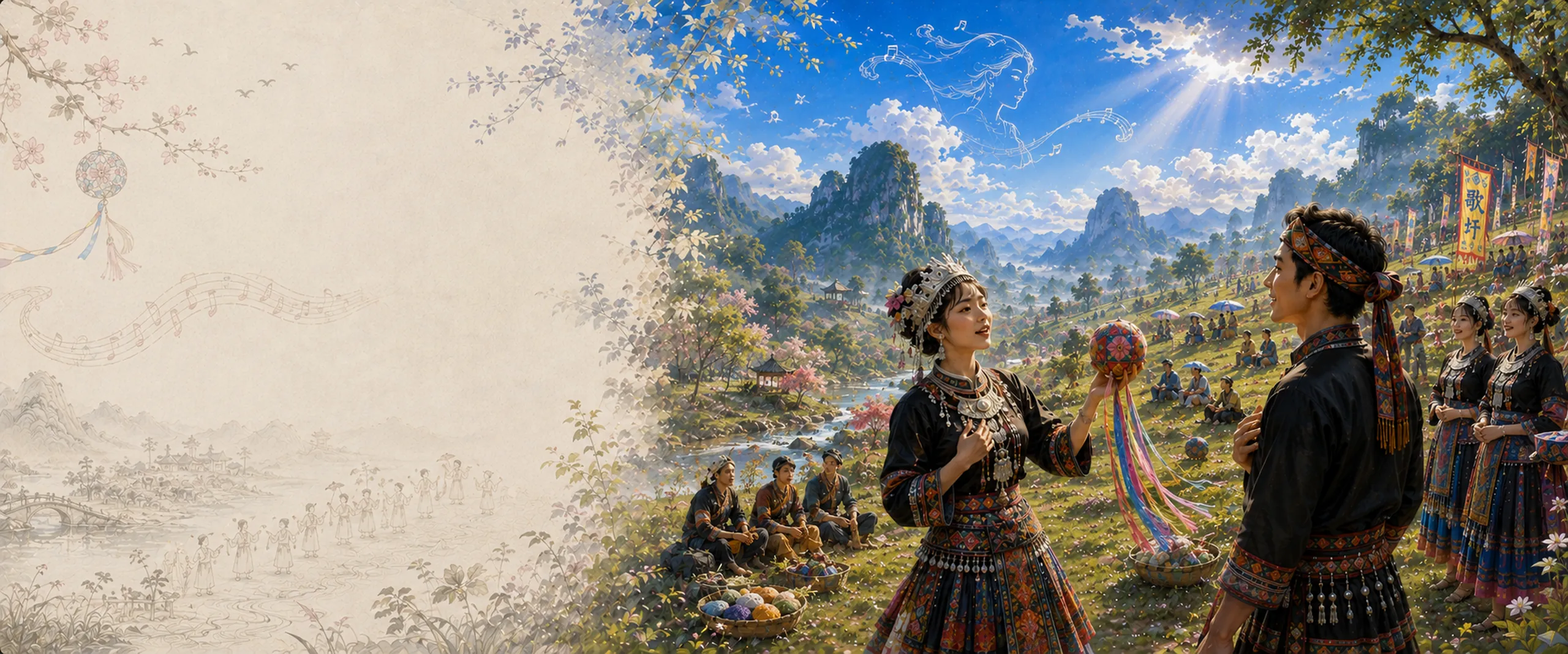
The Third of the Third Festival is a traditional festival of the Li people, celebrated in the Li‑populated areas of Hainan Island, held on the third day of the third lunar month. Various legends about its origin are passed down among the Li people…

The Third Day of the Third Lunar Month is the grandest traditional festival of the Li people, and food stands at the heart of its celebrations. The long-table banquet is its most representative form of communal dining. Villagers arrange tables in long rows, cover them with banana leaves, and fill them with Three-Colored Rice, Bamboo-Tube Rice, plain-cut chicken, wild greens, braised pork, and many other dishes.

Bamboo-Tube Rice is one of the Li people’s representative staple foods. Fresh bamboo tubes are cut and filled with Shanlan glutinous rice, often combined with meat and slowly roasted over charcoal until the clean fragrance of the bamboo has fully entered the rice.

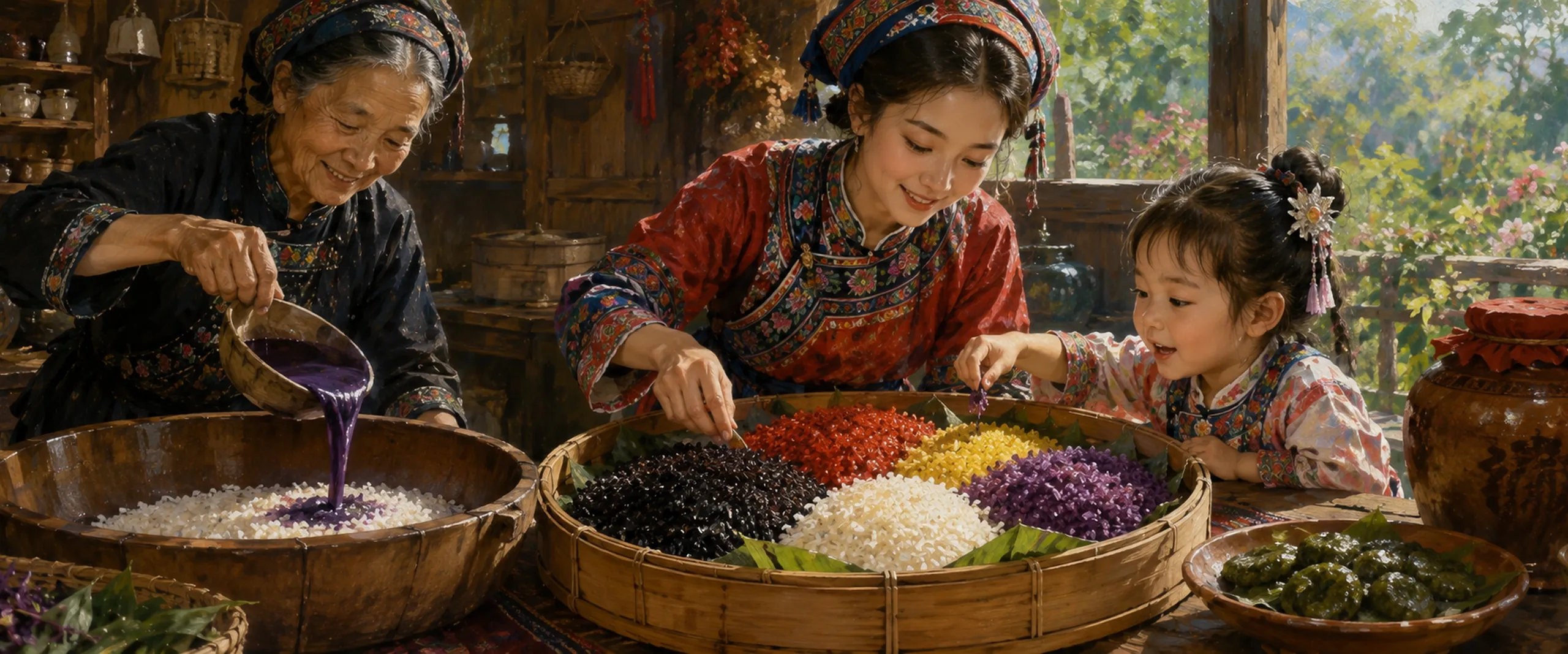
Three-Colored Rice is dyed with natural plants such as turmeric, red-vine grass, and maple leaves, producing yellow, black, and red grains. Shanlan Rice Wine is indispensable when the Li receive guests. At the long-table banquet, villagers dressed in festive attire drink together and celebrate the occasion as one.

With the colors of nature and deep, mellow flavors, the foods of the Third Day of the Third Lunar Month speak of the Li people’s reverence for their ancestors and their love of life.

March Third Festival / Cuisine of the March Third Festival

Festival Food Gallery

Seasonal Menu

Food in Detail

Seeking the True Flavor

Shanlan Wine

Drinks & Fine Wines

Basic Information

  • Category: Fermented / distilled alcoholic beverage
  • Popular Areas: Li communities across central and southern Hainan, especially Wuzhishan, Qiongzhong, Baisha, and Baoting
  • Main Ingredients: Shanlan rice (upland glutinous rice), natural fermentation starter made from wild orange leaves, mountain-ginger leaves, sugarcane leaves, rice flour, and other ingredients, plus mountain spring water
  • Also Known As: Shanlan Wine, biang wine—the transliteration of the Li word for “wine”—and Youbing Jiu

Historical Origins

Shanlan Wine is one of the oldest alcoholic drinks of the Li people and an indispensable “festival wine” at Third Day of the Third Lunar Month banquets.

Its brewing tradition has been passed down for generations. During the Northern Song dynasty, the great writer Su Shi left the line “小酒生黎法,干糟瓦盎中”, referring to the ancient winemaking methods of the Li people. In 2021, traditional Li winemaking techniques were included on Wuzhishan City’s municipal list of intangible cultural heritage.

The fundamental ingredient is Shanlan rice, a mountain-grown upland rice selected by the Li through long experience as a variety suited to dry-land cultivation. Shanlan rice is traditionally cultivated without chemical fertilizer or pesticides, using an ecological growing method, and is naturally fermented to produce Shanlan Wine with a rich range of flavors.

Shanlan Wine has been described as “the Maotai of the Li people.” In Li it is called “biang” with the fourth tone. In Wuzhishan there is a saying: “美不过黎族三月三,甜不过黎家山栏酒”—nothing is more beautiful than the Li Third Day of the Third Lunar Month, and nothing sweeter than Li Shanlan Wine.

Cultural Meaning

The key to good Shanlan Wine lies in the fermentation starter, the agent that drives the brewing process. Traditional starters are made by combining grains with microorganisms and allowing them to ferment.

Methods vary somewhat from place to place, but the basic process is similar. Ingredient selection is taken seriously. Li families in Sanya commonly use wild orange leaves, mountain-ginger leaves, and rice flour. Villagers in Shibao, Wuzhishan, generally use wild mountain-ginger rhizomes or fresh ginger leaves together with sugarcane leaves and Shanlan rice flour.

One maker explained: “生姜叶的辛香能唤醒酒魂,甘蔗叶的甘甜能驯服烈性”—the pungent fragrance of ginger leaves can awaken the soul of the wine, while the sweetness of sugarcane leaves can tame its fierceness.

In parts of Ledong, some brewers deliberately leave a portion of rice bran when making the starter from rice, believing that “糙米中的灵气更旺”—the vital spirit in unpolished rice is stronger.

The brewing process begins by husking, washing, and soaking dried Shanlan rice for three hours. It is then steamed for two to three hours. Once cooked, the rice is spread out to cool completely.

Fermentation starter is sprinkled over the surface, the rice is turned, and starter is added again. It is left to ferment for two days before being transferred to a jar. The mouth of the jar is sealed with banana leaves and the wine is stored for thirty days.

Another method steams Shanlan rice and separates it grain by grain, then mixes it with powdered “ball cakes” made from particular Li mountain plants and rice flour. The mixture is packed into a jar. After one day, a small amount of cool water is added, the jar is sealed, and it is buried beneath a banana tree to mature naturally into wine.

At long-table banquets, Shanlan Wine is often poured into coconut-shell cups or bamboo tubes and placed prominently along the table. Distinguished guests and clan elders are given the “first bowl of wine” before others, symbolizing the highest courtesy shown to a guest.

People sit together and sing as they drink. Hosts and guests answer one another in traditional melodies, while diners use bamboo chopsticks to take food from the table. Drinking songs and laughter soon intermingle, bringing the festive atmosphere to its height.

Shanlan Wine occupies an honored place in Li culture. First, “a brew for honoring the spirits.” During ancestral ceremonies on the Third Day of the Third Lunar Month, village elders dip bamboo tubes into Shanlan Wine and sprinkle it toward household shrines, mountains, and rivers while reciting blessings. Second, “the courtesy of hospitality.” When friends arrive from afar, they should be welcomed with good wine and invited to share the mellow fragrance of Shanlan Wine. Third, “the taste of time.” Shanlan Wine requires months of patient waiting and may even mature across an entire year, embodying the Li brewing wisdom of “exchanging time for flavor.”

Fish Tea

Meat & Seafood

Basic Information

  • Category: Fermented fish product
  • Popular Areas: Li communities across central and southern Hainan
  • Main Ingredients: Freshwater fish, preferably shiling fish, Shanlan rice, salt
  • Also Known As: Li Fish Tea, Wet Fish Tea, Dry Fish Tea, Meat Tea

Historical Origins

Fish Tea is one of the Li people’s most distinctive traditional fermented foods and a classic dish served to honored guests at Third Day of the Third Lunar Month long-table banquets.

Fish Tea is generally divided into “Wet Fish Tea” and “Dry Fish Tea.” For Wet Fish Tea, freshwater fish is cut into pieces, rubbed with salt, left for one or two hours, and then drained. Dry Fish Tea requires the fish to be dried first.

Li Fish Tea and Meat Tea, together with Miao Three-Colored Rice and Shanlan Rice Wine, are regarded as representative foods of Li and Miao cuisine. They occupy a distinctive place within Hainan’s food culture and are described as having broad prospects for development.

The origin of Fish Tea is closely linked to the food-preservation knowledge developed by Li ancestors in Hainan’s tropical, hot, and humid environment. Before refrigeration, fresh fish spoiled quickly. Li ancestors discovered that salting and natural fermentation could preserve fish for longer periods while also producing a distinctive flavor.

As the saying goes: “一次怯之,二次适之,三次瘾之”—the first taste makes one hesitate, the second feels familiar, and the third may become addictive.

This wisdom of “preserving through fermentation” forms one of the deepest foundations of Li food culture.

Cultural Meaning

Fish Tea may appear simple, but its preparation is highly exacting. The first requirement is freshness: fish that is not fresh cannot produce Fish Tea with a clean, delicious taste.

Hygiene is equally important. Bottles and jars used for fermentation must be thoroughly clean. Even a small trace of dirt, grease, or contamination can affect the quality of the finished Fish Tea.

To make Wet Fish Tea, a plump freshwater fish is thoroughly cleaned and cut into pieces. Salt is rubbed over the fish, which is left for one or two hours before the brine is drained away.

Cool cooked rice, fermented-rice lees, or toasted rice are then mixed in, and the mixture is packed into a clean jar and sealed. In hot weather, it can be opened and eaten after seven to ten days. In colder weather, it may require half a month or even a full month.

To make Dry Fish Tea, the fish is first dried, then mixed with cooked rice and salt before being sealed for fermentation. Some people also use pork or beef to make “Meat Tea.”

Fish Tea expresses a distinctive dimension of Li food culture. First, “a fermentation of time.” It requires days or weeks of patient waiting and natural fermentation, embodying the wisdom of “exchanging time for flavor.” Second, “food for the brave.” Its unusual flavor may cause first-time tasters to “hesitate,” then gradually “adapt,” and finally become “hooked.” Third, “a delicacy for honored guests.” Fish Tea is a dish used by the Li to receive distinguished visitors. Fourth, “the taste of mountain and water.” Shanlan rice comes from the mountains, while fresh fish comes from rivers and streams. Fish Tea unites “the rice of the mountains” with “the fish of the water” in a single expression of flavor.

Bamboo-Tube Rice

Grains & Staples

Basic Information

  • Category: Grain staple / roasted food
  • Popular Areas: Li communities across central and southern Hainan
  • Main Ingredients: Shanlan rice or fragrant glutinous rice, fresh green bamboo, pork or chicken, salt, five-spice powder
  • Also Known As: Li Bamboo-Tube Rice, Fragrant Bamboo Rice

Historical Origins

Li Bamboo-Tube Rice is a traditional food of the Li people of Hainan, made by cooking rice and seasonings inside a fresh bamboo tube.

Traditionally, Li families often prepared it outdoors in mountainous areas or roasted it over charcoal at home. In modern times, cooks have refined the traditional method and brought Bamboo-Tube Rice onto banquet tables, where it has earned a strong reputation and become one of Hainan’s best-known local foods.

Traditionally, Bamboo-Tube Rice was made when Li people traveled far from home, went hunting in the mountains, or received guests. It was therefore regarded as a valued food for hospitality.

Its origin is closely connected to the outdoor life of Li ancestors in mountain forests. Where no pots were available, bamboo was one of the easiest natural cooking vessels to obtain.

Li ancestors placed Shanlan rice inside fresh bamboo and roasted it over fire. The clean fragrance of the bamboo blended naturally with the sweetness of the rice, creating the distinctive food now known as Bamboo-Tube Rice.

A Li saying declares: “一家香饭熟,百户闻竹香”—when fragrant rice is cooked in one household, a hundred households can smell the bamboo.

Cultural Meaning

Traditional Bamboo-Tube Rice uses Shanlan rice, an upland variety, together with meat. The ingredients are placed inside sections of fresh fenzhu or mountain bamboo, a suitable amount of water is added, and the opening is tightly sealed with banana leaves before the tubes are roasted over charcoal.

A more detailed method begins by washing the Shanlan rice and soaking it for half an hour, then draining it and mixing it with refined salt and seasoning.

Lean pork is sliced and marinated with dark soy sauce, light soy sauce, and five-spice powder, then stir-fried in a hot wok.

Fresh green bamboo is cut section by section, opened at one end, washed, and dried. The inner wall is rubbed with refined lard. Seasoned Shanlan rice and pieces of lean pork are mixed evenly and packed inside, together with an appropriate amount of water.

The opening is tied and sealed with clean cloth strips, and the bamboo is roasted over charcoal until cooked. During roasting, the tubes must be turned continuously so that they heat evenly.

Once the fragrance of cooked rice begins to escape, the Bamboo-Tube Rice is ready. The green bamboo gradually blackens on the outside while fragrance spreads through the air. The charred outer layer of bamboo is peeled away before serving.

Bamboo-Tube Rice embodies the ecological wisdom of Li food culture. First, “taking from nature.” Bamboo serves as cooking vessel, tableware, and serving container, expressing the Li ecological principle of “取于自然、敬于自然”—taking from nature and respecting nature. Second, “the bamboo fragrance enters the soul.” The aroma of Bamboo-Tube Rice is not merely a sensory pleasure; it is also a taste-memory of Li life in the mountain forests. Third, “a treasured food for guests.” Bamboo-Tube Rice was traditionally prepared especially when Li families received visitors. Fourth, “the flavor of the festival.” It is an indispensable staple at Third Day of the Third Lunar Month long-table banquets.

Three-Colored Rice

Grains & Staples

Basic Information

  • Category: Grain staple
  • Popular Areas: Miao communities in Hainan; also made by the Li
  • Main Ingredients: Shanlan glutinous rice and natural plant dyes such as red-and-blue vine leaves, turmeric, and triangular maple
  • Also Known As: Five-Colored Rice, Miao Three-Colored Rice, Colored Glutinous Rice

Historical Origins

Three-Colored Rice is one of the most representative traditional foods of Hainan’s Miao communities. It is usually prepared and eaten during the Third Day of the Third Lunar Month and serves both as a dish for guests and as an important festival offering to ancestors.

On the morning of the festival, Miao households in Hainan steam glutinous rice in red, yellow, and black. The rice is first offered to the ancestors, after which the entire family gathers together to eat Three-Colored Rice as a sign of good fortune.

Three-Colored Rice is specifically associated with festival occasions and is rarely prepared during ordinary times. During the Third Day of the Third Lunar Month, however, it is commonly made throughout Miao villages.

Three-Colored Rice was originally Five-Colored Rice, with yellow, red, white, black, and blue grains. The traditional technique for making Miao Three-Colored Rice in Qiongzhong has been included on an intangible cultural heritage list.

Miao communities prepare the rice as a prayer for family health and safety in the coming year and for abundant harvests.

The Li also have a tradition of making Three-Colored Rice on the third day of the third lunar month. Shanlan rice is mixed with juices from three colors of wild ginger residue, wrapped in banana leaves, then boiled or steamed.

Cultural Meaning

Three-Colored Rice uses natural plants as dyes, and every shade comes directly from nature.

Red is obtained from red mallow or red-and-blue vine leaves, yellow from turmeric, and black from triangular maple or mulberry leaves.

The three types of plant material are soaked in water for two hours. Turmeric is preferably crushed before soaking. Once the water has taken on the required color, Shanlan rice is washed, drained, and divided into three equal portions.

Each portion is immersed in a different colored liquid and left for eight hours to absorb the dye. The rice is then removed, drained, placed in a wooden steamer, and steamed for a little over an hour.

Some versions wrap the rice in banana leaves before boiling or steaming.

Three-Colored Rice carries the color aesthetics of Li and Miao food culture. First, “the courtesy of honoring ancestors.” It is first offered to the ancestors and only afterward eaten by the family. Second, “abundant harvests.” The three—or originally five—colors symbolize plentiful grain and favorable weather. Third, “the colors of nature.” Red, yellow, black, white, and blue all come from wild plants, expressing the ecological principle of “taking from nature.” Fourth, “food of the festival.” Three-Colored Rice belongs specifically to the Third Day of the Third Lunar Month and is rarely seen at ordinary times.

Long-Table Banquet

Others

Basic Information

  • Category: Composite banquet
  • Popular Areas: Li and Miao communities across central and southern Hainan
  • Main Ingredients: Shanlan Wine, Bamboo-Tube Rice, Fish Tea, Three-Colored Rice, Five-Legged Pig, Leigong Bamboo Shoots, plain-cut chicken, river fish and shrimp, wild greens, and other foods
  • Also Known As: Li-Miao Long-Table Banquet, Thousand-Person Long-Table Banquet

Historical Origins

The long-table banquet is regarded as the highest form of Li and Miao feasting and is said to have been passed down for a thousand years.

During the Third Day of the Third Lunar Month, villagers arrange tables into long rows and cover them with banana leaves before setting out an abundance of dishes.

In traditional long-table banquets, the tables, wine cups, chopsticks, and other implements are generally handmade from bamboo. In recent years, the banquet has become one of the festival’s signature experiences and continues to leave a deep impression on visitors.

The long-table banquet is also described as having several thousand years of history and as the highest form of Li feasting and the most solemn etiquette for receiving guests.

Originally, long-table banquets were held for weddings, newborn celebrations, and social gatherings between villages. Today, Li-Miao long-table banquets are a regular feature of Hainan’s annual Third Day of the Third Lunar Month celebrations.

At the banquet, people take their seats in accordance with Li and Miao custom and raise cups of Shanlan Rice Wine together in celebration. Cups pass back and forth as songs fill the air, allowing participants to experience Li culinary traditions in an immersive setting.

Cultural Meaning

At the beginning of the feast, several rectangular bamboo tables are joined end to end in rows. Their surfaces are covered with lush green banana leaves, which are both practical and evocative of the natural environment.

The table is filled with a wide range of foods: mellow Shanlan Wine, fragrant Bamboo-Tube Rice, fresh river fish and shrimp, richly fermented Fish Tea, Three-Colored Rice, cured chicken, Leigong Bamboo Shoots, and other ingredients drawn from the local landscape.

This way of dining—using bamboo as the vessel and leaves as the table setting—is both a continuation of a thousand-year culinary tradition and a symbol of Li hospitality.

The banquet is more than a communal meal; it is also a medium for emotional exchange. At times it is combined with evening cultural performances, allowing song and dance to unfold alongside the feast.

The long-table banquet carries some of the highest ideals of Li food culture. First, “gathering and sharing.” It is the fullest expression of the Li ideal of “gathering all things and sharing food.” Second, “the highest hospitality.” The long-table banquet represents the highest etiquette for receiving guests. Third, “a thousand years of inheritance.” It is traditionally said to have been passed down for a millennium. Fourth, “using bamboo as vessel.” Tables, wine cups, and chopsticks are made from bamboo, reflecting the Li ecological principle of “taking from nature.”

Winnowing-Basket Rice

Others

Basic Information

  • Category: Composite banquet
  • Popular Areas: Li communities across central and southern Hainan
  • Main Ingredients: Three-Colored Rice, plain-cut chicken, pork belly, wild greens, pan-fried wild fish and shrimp, and other foods
  • Also Known As: Winnowing-Basket Meal, Woven-Bamboo Banquet

Historical Origins

Li Winnowing-Basket Rice is one of the most representative traditional foods of the Li people of Hainan, carrying a thousand years of ethnic wisdom and cultural memory.

It is not only an important part of everyday Li foodways, but also a symbol of etiquette at major occasions such as festivals, weddings, and ancestral ceremonies, expressing both reverence for nature and love of life.

Its origins can be traced to the agricultural lives of Li ancestors. In earlier times, when people went out to work, they often placed the rice, grilled fish, and other food they carried on banana leaves and sat together to share the meal. Over time, this developed into the custom of the “winnowing-basket meal.”

In the past, the woven bamboo winnowing basket was an agricultural tool found in almost every household. Fresh green banana leaves were laid inside the basket and food was arranged on top. This became the traditional form known as Winnowing-Basket Rice.

The practice not only solved the practical problem of eating during breaks from labor; it also became a symbol of unity and mutual assistance.

Over time, Winnowing-Basket Rice gradually developed into one of the highest forms of Li banquet etiquette. During the Third Day of the Third Lunar Month, weddings, or ancestral ceremonies, families often use winnowing baskets to present an abundance of dishes, expressing respect and blessings toward their guests.

Cultural Meaning

Winnowing-Basket Rice uses a woven bamboo basket as its serving vessel, lined with fresh green banana leaves and filled with Three-Colored Rice, plain-cut chicken, wild greens, braised pork, and other foods.

At traditional Li and Miao long-table banquets, distinctive Winnowing-Basket Rice gives diners a generous spread to enjoy. The basket may contain Three-Colored Rice, farmhouse chicken, pork belly, wild greens, and pan-fried wild fish and shrimp, all preserving the straightforward character of local ingredients.

Winnowing-Basket Rice is described in Li as “hou jia,” meaning “delicious.”

Winnowing-Basket Rice embodies the ecological wisdom of Li food culture. First, “taking from nature.” A woven bamboo basket becomes the plate and banana leaves its lining, reflecting the Li ecological principle of “taking from nature.” Second, “unity and mutual assistance.” The dish originated as food shared by people sitting together during outdoor labor and gradually became a symbol of cooperation and solidarity. Third, “a symbol of etiquette.” Winnowing-Basket Rice eventually developed into one of the highest forms of Li banquet etiquette.

Five-Legged Pig

Meat & Seafood

Basic Information

  • Category: Roasted / braised meat
  • Popular Areas: Mountainous regions of central and southern Hainan, especially Wuzhishan
  • Main Ingredient: Wuzhishan Five-Legged Pig
  • Also Known As: Wuzhishan Five-Legged Pig, Mountain Pig, Free-Range Pig

Historical Origins

The Five-Legged Pig is one of the most distinctive foods of the Wuzhishan region and one of the substantial centerpiece dishes of the Third Day of the Third Lunar Month long-table banquet.

It is a native free-range pig found in Li and Miao areas of Hainan. Because the pigs roam freely through the mountains and constantly keep their snouts close to the ground as they root for food, the snout appears like a fifth leg while they walk. This gave rise to the name “Five-Legged Pig.”

The animals forage freely in mountain forests, and their meat is firm, fresh, neither strongly gamey nor greasy.

Cultural Meaning

Five-Legged Pig can be prepared in several ways: plain-cut, red-braised, or roasted.

At long-table banquets, it is often one of the indispensable substantial meat dishes. Roast Five-Legged Pig develops a crisp golden skin while the meat remains tender and juicy. Plain-cut Five-Legged Pig preserves the natural flavor of the meat and is served with dipping sauces.

Five-Legged Pig carries the meaning of “the taste of the mountains and wilds.” Raised freely in mountain forests and feeding on wild fruits, grasses, and roots, it is a sensory expression of the Li culinary principle “靠山吃山”—living from what the mountains provide.

Leigong Bamboo Shoots

Seasonal Vegetables

Basic Information

  • Category: Vegetable / wild mountain green
  • Popular Areas: Li communities across central and southern Hainan
  • Main Ingredient: Leigong Bamboo Shoots, a type of wild mountain bamboo shoot
  • Also Known As: Mountain Bamboo Shoots, Wild Bamboo Shoots

Historical Origins

Leigong Bamboo Shoots are a type of wild mountain bamboo shoot distinctive to the mountainous regions of Hainan. Their name comes from the way they rapidly break through the soil after spring rains—after “Leigong,” the Thunder Lord, has sounded.

They are one of the indispensable mountain vegetables served at Third Day of the Third Lunar Month long-table banquets.

The mountains of Hainan are rich in wild greens. Leigong Bamboo Shoots, winged beans, shuzicai, lushiecai, and gemingcai are all regarded as “green foods” on Li tables.

Gathering Leigong Bamboo Shoots is closely tied to the forest life of Li ancestors. Each spring, after rainfall, the shoots grow rapidly. Li families gather them while tender, then stir-fry, dress them cold, or pickle them, bringing the freshness of the mountains directly onto the festival table.

Cultural Meaning

Leigong Bamboo Shoots carry the meaning of “freshness after the rain.” They are messengers of spring, emerging through the soil after rainfall and representing one of the tenderest gifts that the mountain forests offer the Li people.

During the Third Day of the Third Lunar Month, a festival filled with the atmosphere of spring, Leigong Bamboo Shoots are among the most seasonal flavors of the mountains.

Food Culture

Foodways

Viewed as a whole, the food traditions of the Li people’s Third Day of the Third Lunar Month reveal a cultural logic that runs consistently through the festival:

I. Fermentation as wisdom. Shanlan Wine is made from Shanlan upland rice and a natural fermentation starter prepared with ingredients such as wild orange leaves and mountain-ginger leaves. After fermentation, distillation, and cellar aging, the finished liquor takes on an amber hue, with a faint tartness on the palate followed by a gentle sweetness. Its making requires months of patient waiting and may even extend across an entire year.

Fish Tea is made by sealing fresh freshwater fish together with cooked rice and allowing the mixture to ferment naturally for seven to fifteen days. Its character is summed up in the saying “一次怯之,二次适之,三次瘾之”—the first taste may make one hesitate, the second brings familiarity, and by the third one may be hooked.

This wisdom of “exchanging time for flavor” is a distinctive culinary tradition created by Li ancestors through generations of production and everyday life.

II. The wild as its soul. The Li have long lived in the mountainous regions of central and southern Hainan Island, and many of their ingredients come directly from forests, hills, rivers, and streams. Shanlan rice is a form of upland “wild rice”; the Five-Legged Pig is a free-ranging “mountain pig”; Leigong Bamboo Shoots are “wild shoots” gathered after the rains; river fish and shrimp are the “wild freshness” of mountain streams.

Bamboo-Tube Rice uses fresh bamboo itself as the cooking vessel and is slowly roasted over charcoal. Three-Colored Rice relies on wild plants such as red-and-blue vine leaves, turmeric, and triangular maple as natural colorants.

Living by the principle of “靠山吃山”—living from what the mountains provide—Li ancestors gathered nature’s gifts in the most direct and unadorned way, transforming ingredients of the wild into the abundance of a festival feast.

III. Bamboo as vessel. Bamboo shapes the material language of the Third Day of the Third Lunar Month banquet. The tables, wine cups, and chopsticks used for long-table feasts are generally handmade from bamboo. Fresh green bamboo serves as both cooking vessel and tableware for Bamboo-Tube Rice. Three-Colored Rice is wrapped in banana leaves for steaming, while Winnowing-Basket Rice is served in woven bamboo trays.

This dining tradition of “using bamboo as vessel and leaves as the table setting” is both a continuation of a culinary culture passed down for a thousand years and a spiritual symbol of Li hospitality.

IV. Gathering as the core. The long-table banquet is the most representative form of dining during the Third Day of the Third Lunar Month. It is regarded as the highest form of Li and Miao feasting and is said to have been passed down for a thousand years.

At the banquet, rectangular bamboo tables are joined end to end in long rows. Their surfaces are covered in lush green banana leaves and filled with Shanlan Wine, Bamboo-Tube Rice, Fish Tea, Three-Colored Rice, Five-Legged Pig, Leigong Bamboo Shoots, and other foods drawn directly from the surrounding environment.

People sit together, taste the food, talk freely, and laugh as drinking songs mingle with the sounds of celebration. This way of dining—“using food as a medium and the banquet to gather affection”—is one of the most distinctive sensory expressions of cohesion within Li communities.

Regional Distribution

Foodways
Region Distinctive Foods of the Third Day of the Third Lunar Month
Wuzhishan City Three-Colored Rice, Bamboo-Tube Rice, plain-cut Maoyang goose, stir-fried chicken with laoye leaves, Five-Colored Rice, small river shrimp, pan-fried pork, distinctive wild greens; Li Bamboo-Tube Rice is one of the ten signature snacks served at the kilometer-long table banquet
Ledong Li Autonomous County Three-Colored Rice, roast suckling pig, Shanlan glutinous-rice wine, Huangliu kufen, Xinpo sweet potatoes, mangoes, dried seafood
Baisha Li Autonomous County Three-Colored Rice, Bamboo-Tube Rice, Shanlan Wine, Five-Legged Pig, Fucai sweet potatoes, fried fish, coconut-scented ciba, pandan mille-crêpe cake, stir-fried Yacha water bamboo, Tiger-Milk Lingzhi soup
Qiongzhong Li and Miao Autonomous County Li Winnowing-Basket Rice, Miao Three-Colored Rice, Shanlan Wine, farmhouse honey, Fish Tea
Baoting Li and Miao Autonomous County Five-Colored Rice, glutinous-rice cakes, Shanlan Wine, plain-cut Five-Legged Pig, roast “tree-climbing chicken,” plain-cut Liugong goose, “beef jerky that never makes it home,” stir-fried river shrimp with laoye leaves, Five Grains in Abundance, blanched okra, passion fruit
Changjiang Li Autonomous County Roast chicken, fried river shrimp, pig-blood sausage, stir-fried pork belly with melon peel, grilled fish, Bamboo-Tube Rice, Li distilled liquor, Wulie young goat, Bawangling small hens, Five-Legged Pig, eel braised with sour melon
Sanya City Three-Colored Rice, Bamboo-Tube Rice, Shanlan Wine; pig’s head, rice wine, and rice balls are offered to ancestors

Additional Notes:

  • Three-Colored Rice / Five-Colored Rice: One of the most iconic staple foods of the Li people’s Third Day of the Third Lunar Month. Shanlan glutinous rice is soaked in natural plant dyes made from maple leaves for black, turmeric for yellow, and red-blue grass for red, then steamed. Among Miao communities in Qiongzhong, Baoting, and other areas, Five-Colored Rice also appears in black, yellow, red, blue, and white. The Wuzhishan area also has “Li Black Glutinous Rice,” dyed with triangular maple leaves to achieve a glossy black finish.
  • Bamboo-Tube Rice: A representative Li staple. Shanlan glutinous rice is packed into fresh bamboo and roasted over charcoal until the bamboo fragrance permeates the rice. It is one of the signature dishes of the long-table banquet.
  • Fish Tea: One of the Li people’s most distinctive fermented foods. Fresh fish, cooked rice, and fermentation starter are combined and fermented until the finished product becomes sour with a slight saltiness. It is an indispensable traditional flavor of the Third Day of the Third Lunar Month.
  • Shanlan Wine: One of the oldest Li alcoholic drinks, made from Shanlan rice with natural fermentation starter. It is an essential wine for receiving guests at the long-table banquet.
  • Long-Table Banquet: The highest form of Li and Miao feasting, said to have been passed down for a thousand years. Banana leaves cover the long tables, which are laden with Three-Colored Rice, Bamboo-Tube Rice, Shanlan Wine, plain-cut chicken, river fish and shrimp, and other foods.
  • Winnowing-Basket Rice: One of the most representative traditional Li foods. Dishes are arranged over banana leaves in a woven bamboo winnowing basket, making it an important symbol of etiquette at festivals, sacrificial observances, and other major occasions.

Closing Reflections

Foodways

Morning light on the Third Day of the Third Lunar Month passes through the mist of Wuzhishan as cooking smoke begins to rise softly from the thatched roofs of Li villages. The festival, known among the Li as “孚仰孚”, is not only a day for honoring ancestors and celebrating love; it is also a feast of flavor in which Shanlan rice and the produce of the rainforest take center stage.

Three-Colored Rice provides the vivid foundation of the festival table. Its red, yellow, and black shades come from natural plant juices used separately to dye Shanlan glutinous rice before steaming. Unlike Han festivals that emphasize “abundance”, Li Three-Colored Rice steams the colors of the mountains, the fragrance of flowers, and the warmth of sunlight into the grains themselves—red symbolizing good fortune, yellow signifying harvest, and black representing the solidity of the earth. Li Black Glutinous Rice takes this aesthetic even further: triangular maple leaves are pounded for their juice, Shanlan glutinous rice is soaked in it, and the finished grains emerge glossy and dark like black jade. Li families do not seek ostentatious color; they prefer to bring the essence of the mountain forest into every meal in the most direct and natural way.

Bamboo-Tube Rice carries the clean fragrance of the mountains. Fresh bamboo is filled with Shanlan rice and slowly roasted over charcoal until the outer sheath blackens and the grains absorb the bamboo’s gentle sweetness. When the tube is split open, steam rises with a rush of bamboo fragrance—an ancient flavor from deep within the rainforest. Fish Tea, by contrast, is an adventure for the palate. Fresh fish, rice, and fermentation starter meet inside an earthenware jar and gradually develop a singular sour fragrance. First-time tasters may hesitate, but the Li have an old saying: “初尝怯之,二次适之,三次瘾之。” Shanlan Wine is the soul of the festival. Brewed from Shanlan rice, rich and sweet, it is poured into coconut shells or bamboo tubes, while honored guests and clan elders receive the “first bowl of wine” before anyone else.

Only when the long tables stretch through the village, banana leaves cover their surfaces, and Winnowing-Basket Rice is carried out does the true feast begin. The colors of Three-Colored Rice, the fragrance of Bamboo-Tube Rice, the bright sourness of Fish Tea, the mellow depth of Shanlan Wine, and the savory richness of Five-Legged Pig all converge from different directions. This banquet, with bamboo as vessel and leaves as the table setting, is both the continuation of a thousand-year culinary tradition and an ethnic memory passed from one generation to the next through taste.

—-

Continue exploring March Third Festival culture

Readers’ Comments

Calendar and traditional culture enthusiasts from around the world, sharing the same moon.

Sign in or register to join the conversation. Your comment account is created automatically the first time you use a connected account.