March Third Festival

March Third FestivalOrigins of the March Third Festival

「 <p>天妃南音,兄妹始祖,三月相会,黎家遗风。</p> 」

The Li March Third Festival (黎族三月三节) traces its origins to an ancient flood legend. According to tradition, after a catastrophic flood in remote antiquity, only the siblings Tianfei (天妃) and Nanyin (南音) survived along the banks of the…

There are several traditions concerning the origin of the Li March Third Festival (黎族三月三节). The most widely circulated is the ancient flood legend: a devastating deluge struck the Li communities living along the Changhua River, killing almost every person and animal and leaving only a brother and sister, Nanyin and Tianfei. When they grew up, they decided to separate in search of marriage partners, agreeing to return each year on the third day of the third lunar month to meet beneath Yanwoling (燕窝岭). They eventually became the progenitors of later generations of the Li people. Their descendants have therefore commemorated the siblings’ union and their role in preserving the Li lineage in many different ways every March Third. On the third day of the third lunar month, Li communities dress in festival clothing and gather from every direction carrying Shanlan rice wine (山兰米酒) and fragrant rice cooked in bamboo tubes, worshipping their ancestors, singing antiphonally, and dancing in celebration. Related customs are documented as early as the Song dynasty.

# Li March Third Festival

The Li March Third Festival is one of the oldest and grandest traditional festivals of the Li people, bringing together ancestral worship, song and dance, athletic competition, courtship, and social gathering. It is often described as the Li people’s “Festival of Love” and “Day for Speaking of Love.” This article begins with the festival’s name, examining the meaning of the Li expression “Funianfu” (孚念孚) and the cultural imagery surrounding the “Festival of Love.” It then traces three major legendary sources: the survival and renewal embodied in the flood story of the ancestral siblings; the love, heroism, and sacrifice found in the tale of Eniang’s struggle against the Crow Demon; and the themes of creation and salvation found in traditions concerning Limu and the lark. It next follows the festival’s historical development from the Song dynasty to the present, before turning to ancestral rites and core customs that reveal the festival’s unusual coexistence of solemnity and romance. Finally, it considers contemporary transmission and the continuing vitality of this centuries-old intangible cultural heritage in modern society.

March Third Festival / Origins of the March Third Festival

The Name “March Third”

Origins & Anecdotes · Tracing the Past

“Funianfu”

In the Li language, the March Third Festival is called “Funianfu” (孚念孚). In Li usage, *fu* (孚) carries the sense of a “day” or “season,” while *nian* (念) means the third lunar month. *Funianfu* may therefore be understood as “the day of the third day of the third month.” The name neatly captures the festival’s two defining features: its time—the third day of the third lunar month—and its character as a day set apart from ordinary time.

The Li people historically had no indigenous writing system of their own, and much of their historical memory and cultural tradition was therefore transmitted orally, from one generation to the next. The name *Funianfu* itself is direct evidence of this oral transmission of festival culture. Pronunciation varies among different Li branches and dialect groups, but the core meaning remains the same: the third day of the third lunar month is one of the most important days in the Li cultural calendar.

“Festival of Love” and “Day for Speaking of Love”

In Chinese-language contexts, Li March Third is also known as the “Festival of Love” (爱情节) and the “Day for Speaking of Love” (谈爱日). Both names emphasise one of the festival’s central themes: love. March Third is traditionally a day when young Li men and women express affection, meet potential partners, and seek the person with whom they hope to share their lives. It has therefore been described as a traditional festival through which the Li people “express their longing for happiness in love.”

The theme of love is so prominent that March Third is sometimes given a cultural position comparable to Valentine’s Day in the West. The names “Festival of Love” and “Day for Speaking of Love” capture a distinctive social function of the occasion: it creates a recognised space in which young men and women may meet freely, communicate feelings through song and express affection through dance.

From “March Third” to the “Li March Third Festival”

The third day of the third lunar month (三月三) is a festival date shared by numerous ethnic groups in China. Among the Han people it is associated with the ancient Shangsi Festival (上巳节), while the Zhuang, Dong, Bouyei, Miao, Yao, and many other ethnic groups also hold celebrations on or around this date. Li March Third is therefore one distinctive member of a much larger family of “March Third” traditions.

To distinguish it from the March Third celebrations of other ethnic groups and to emphasise its specifically Li cultural character, the festival is officially listed in the intangible cultural heritage system as the “Li March Third Festival” (黎族三月三节). This name both identifies the ethnic community to which the tradition belongs and affirms its distinctive value as an independent item of intangible cultural heritage.

Origins of the Festival

Origins & Anecdotes · Tracing the Past

The Flood Legend of the Brother and Sister

Among the many origin traditions surrounding Li March Third, the “Flood Legend of the Brother and Sister” is the most widely circulated and culturally influential. It gives the festival some of its deepest associations with the continuation of life, the rebirth of a people, and reverence for ancestral founders.

According to legend, in remote antiquity the Li communities living along the Changhua River (昌化江) were struck by an immense flood. Torrents overwhelmed villages, fields, and forests, killing great numbers of people and animals. Almost the entire Li-inhabited region disappeared beneath the waters, and humanity itself seemed to stand on the brink of extinction.

When the flood finally subsided, only two people remained: a brother named Nanyin (南音) and his younger sister Tianfei (天妃). The two depended upon one another and struggled to survive amid the devastation left behind by the flood. When they reached adulthood, however, they faced the immense responsibility of ensuring the continuation of human life. As brother and sister, they could not simply marry one another. They therefore decided to part and search separately for suitable partners, agreeing that every year on the third day of the third lunar month they would return to meet beneath Yanwoling (燕窝岭) and tell each other how their search had gone.

Year after year, the siblings returned on March Third and exchanged news of their search, yet after many years neither had found anyone else. The flood had destroyed everything; apart from the two of them, no possible marriage partners could be found. Faced with the imminent extinction of their people, Tianfei made a painful and momentous decision. She used bamboo needles to prick patterns into her own face and then coloured them with plant dyes. Through this facial tattooing, she deliberately changed her appearance so thoroughly that her brother would no longer recognise her as the sister he had always known.

On one March Third, Nanyin and Tianfei became husband and wife beneath Yanwoling. There they spun thread and wove cloth, bore and raised children, opened new fields for cultivation, dug ponds and raised fish, and thus gave rise to later generations of the Li people. Many years later, Tianfei and Nanyin entered a cave, where they fell into an eternal sleep and became a pair of stones. Their descendants named the cave “Niangmu Cave” (娘母洞) in memory of the siblings’ achievement in preserving the lineage. Every March Third, Li men and women, elders and children, came from every direction carrying glutinous rice, cakes, *zongzi*, and Shanlan rice wine to honour their ancestors before the cave, singing antiphonal songs and dancing as they prayed for the flourishing and happiness of their people.

The legend explains not only the origin of March Third but also the traditional Li custom of facial tattooing (纹面). In traditional Li society, facial tattooing was a marker of adult womanhood and was also regarded as a form of beauty. The story of Tianfei marking her face so that her brother would not recognise her tightly links the tattoo tradition with the Li people’s own origin mythology. Although facial tattooing has gradually disappeared from Li communities in modern times, the deeper theme embodied in the legend—self-sacrifice for the continuation of the people—continues to be carried forward through the March Third Festival.

Eniang and the Crow Demon

Among the many origin legends of Li March Third, the story of Eniang (俄娘) and the Crow Demon (乌鸦精) is also widely known. It gives the festival another layer of meaning, one filled with heroism, romantic love, courage, and sacrifice.

According to the legend, long ago a malevolent Crow Demon lived in a mountain cave. Possessing powerful supernatural abilities and a violent nature, it tormented the Li people and prevented them from living in peace. It repeatedly emerged from its lair to harm villagers, destroy crops, and seize property, leaving local communities in constant fear.

One day, the Crow Demon captured a beautiful Li girl named Eniang. She was said to be the loveliest young woman in her village and was deeply in love with a young man named Agui (阿贵). The Crow Demon abducted Eniang and imprisoned her inside its cave. When Agui learned that the woman he loved had been taken, he was overcome with grief and rage. On March Third of that year, he went into the mountains carrying a sharp knife and a bow and arrows to rescue her. Risking his life, he entered the Crow Demon’s lair and attempted to free Eniang, but during the struggle he was tragically killed.

Eniang watched helplessly as the man she loved died trying to save her and was devastated by grief. Yet she forced herself to endure her sorrow, and a desire for vengeance took root in her heart. She began secretly observing the Crow Demon’s habits, waiting for an opportunity. At last, while the creature was fast asleep, Eniang seized a knife and killed it. In doing so, she avenged Agui and freed the Li villagers from a terrible threat.

Eniang never married. Every year on the third day of the third lunar month, she returned to Exian Cave (俄贤洞) and sang the love songs that she and Agui had once sung together. Her songs carried her longing for Agui, her memories of their past, and her lifelong fidelity to their love. Later, the Li people named the cave Eniang Cave (俄娘洞) in her memory; it is located in what is now Changjiang Li Autonomous County. Every March Third, unmarried Li young men and women from surrounding communities gathered at Exianling (俄贤岭), singing love songs and searching for partners of their own. Over time, the gathering grew and spread to Li communities across Hainan, eventually developing into a major traditional festival.

Limu and the Lark

In addition to the flood legend and the story of Eniang’s struggle against the Crow Demon, Li oral tradition preserves other explanations for the origin of March Third. One tradition holds that the festival commemorates the birth of Limu (黎母), an ancient ancestral figure, and celebrates happiness, good fortune, and the flourishing of the Li people. In Li mythology, Limu is a creator goddess and common ancestral mother of the Li people, and her birth symbolically marks the beginning of the Li people themselves.

Another March Third legend is told in the Qizhiling (七指岭) region of Hainan. According to the story, the region once suffered an exceptional drought that made daily survival unbearable. A young man named Yayin (亚银) learned in a dream that a lark could help the people escape the disaster. He volunteered to climb Wuzhi Mountain (五指山) and played a nose flute (鼻箫), drawing a lark out from the valley. The bird transformed into a beautiful Li girl and followed Yayin back into the human world, where together they helped end the disaster. Their actions, however, angered a local dongzhu (峒主)—a powerful local lord—who ordered his retainers to set fire to the mountain. When the flames reached the cave in which Yayin and the girl were hiding, the rocks suddenly split and the mountain collapsed, crushing the cruel lord and his retainers beneath it. Yayin and the lark maiden then transformed into a pair of birds and flew away. When the villagers heard what had happened, they rushed to bid the couple farewell, dancing and singing in excitement to offer their blessings. The day was the third day of the third lunar month, and from then on it became a traditional festival of the Li people.

Some Li communities in Hainan also preserve a “Flood and Gourd” (洪水葫芦) legend. In this version, humanity is struck by a great flood in remote antiquity. A man and a woman take refuge inside a gourd and drift with the floodwaters until they reach the sparsely inhabited island of Hainan. In order to restore humankind, the two exchange antiphonal love songs on March Third, express their affection, become husband and wife, and give rise to later generations of the Li people. This tradition resembles the brother-and-sister flood legend but adds the gourd (葫芦) as a crucial symbol. Gourds appear in the flood myths of many peoples in China, functioning simultaneously as a vessel of refuge and a symbol of rebirth.

Historical Development

Origins & Anecdotes · Tracing the Past

From Remote Antiquity to Before the Song Dynasty

The origins of March Third can be traced back to remote antiquity. The Li are among the earliest inhabitants of Hainan Island, and their ancestors had already lived and multiplied on the island several thousand years ago. The flood legend, the story of Eniang and the Crow Demon, and the myth of Limu’s birth all point toward a distant mythic past. Transmitted orally from generation to generation, these stories became some of the deepest layers of collective memory within Li culture.

Over the long course of early society, March Third gradually evolved from a ritual occasion into a wider folk festival. In its earliest form, the celebration was primarily sacrificial: communities sought protection and blessings from ancestors and divine beings. As society developed, ritual observance gradually merged with recreation, and antiphonal singing, dancing, athletic contests, and other activities became incorporated into the occasion. Although there is little written evidence for March Third before the Song dynasty, Li oral tradition suggests that by this period the festival had already developed a recognisable form centred on ancestral worship and courtship through song.

The Song Dynasty

The Song dynasty marks the first period in which practices associated with March Third appear in historical documentation. The Southern Song writer and official Fan Chengda (范成大) recorded in *Guihai Yuheng Zhi* (《桂海虞衡志》, roughly *Records of Guihai and Its Natural and Cultural Conditions*):

> “春则秋千会,邻峒男女装束来游,携手并肩,互歌互答,名曰作剧。” > *“In spring there are swing gatherings. Men and women from neighbouring settlements come dressed for the occasion, walk hand in hand and shoulder to shoulder, and answer one another in song; this is called ‘making entertainment.’”*

This passage is extremely valuable. It describes a springtime social gathering in areas inhabited by Li communities during the Song dynasty, known as a “swing gathering” (秋千会). Men and women from neighbouring *dong*—local settlements or communities—came dressed in festival clothing, walked side by side, and exchanged songs in call-and-response form. Such activities were called zuoju (作剧), literally “making entertainment” or “performing festivity.” The description may preserve an early historical form of March Third. Both the swing as a recreational activity and antiphonal singing as a means of interaction between young men and women were already present in the social life of the period.

Fan Chengda (1126–1193) was a prominent Southern Song statesman and writer. He served as prefect of Jingjiang Prefecture—present-day Guilin—and as Pacification Commissioner of Guangnan West Circuit, and during his service in Guangxi he developed considerable familiarity with the customs of the peoples of Lingnan. *Guihai Yuheng Zhi* was written during this period and contains detailed descriptions of the natural environment, products, and ethnic customs of Guangxi, Hainan, and surrounding areas. It is regarded as one of the earliest historical sources associated with customs later identified with March Third.

The Yuan dynasty traveller Wang Dayuan (汪大渊) also recorded customs of the peoples of Hainan Island in *Daoyi Zhilüe* (《岛夷志略》, *A Brief Account of Island Peoples and Foreign Lands*). Although its references to March Third are less detailed than those in *Guihai Yuheng Zhi*, the work is likewise cited as evidence that related customs had already taken shape and were circulating within Li society by the Song-Yuan period.

The Ming and Qing Dynasties

By the Ming and Qing dynasties, descriptions of March Third had become more specific and detailed. The Qing writer Zhang Qingchang (张庆长) recorded in *Liqi Jiwen* (《黎岐纪闻》, roughly *Records of the Li and Qi Peoples*):

> “男女未婚者,每于春夏之交齐聚于旷野间,男弹嘴琴(口哨),女弄鼻宵,交唱黎歌,有情投意合者,男女各渐进凑一处,即定配偶。” > *“Unmarried men and women gather in the open country at the turn of spring and summer. The men play mouth instruments or whistle, while the women play nose flutes; they exchange Li songs, and those whose feelings are mutually harmonious gradually draw together and become partners.”*

The passage offers a vivid description of courtship among young Li men and women: “the men play mouth instruments, the women play nose flutes, and together they exchange Li songs.” Through antiphonal singing, young people expressed affection and came to know one another; those who discovered mutual attraction could form a partnership. This practice stands in direct continuity with the courtship-through-song that remains central to March Third today.

The nose flute (鼻箫) is a distinctive traditional Li instrument made from bamboo and played through the nostrils. Its tone is soft, gentle, and lingering. During March Third, Li girls traditionally used the nose flute to perform melodies associated with courtship, while young men responded through whistles or song. The account in *Liqi Jiwen* demonstrates that the nose flute was already widely used in romantic and social interaction during the Qing dynasty.

The gathering places associated with March Third also changed repeatedly during the Ming and Qing periods and thereafter. According to local accounts, an early gathering site lay on Gaotanpo (高滩坡) beneath Mihouling (猕猴岭), where there was a large and spacious cave. After lightning caused the cave to collapse, the gathering moved to Changshatan (长沙滩) at the confluence of the Changhua River and Nanyao River. When lightning later struck down a kapok tree there, the gathering moved again, this time beneath Yanwoling on the banks of the Changhua River. During the Japanese invasion of Hainan, March Third activities were relocated once more, to Bodanpo (波单坡) about four kilometres from Dongfang Township. These repeated changes of venue reflect the many disruptions the festival experienced over the course of history. Yet whatever the place, the tradition of March Third itself continued.

The Modern Period

During the Republican period, Hainan society underwent major transformation. The arrival of Western culture, the development of modern education, and improvements in transportation all exerted far-reaching influence upon traditional Li society. Although March Third retained its central traditional elements, it also began to encounter new cultural influences from outside the community.

Following the founding of the People’s Republic of China, Li society underwent fundamental institutional change. During the Cultural Revolution (文化大革命), however, March Third was disrupted and condemned as “feudal superstition” (封建迷信), and its public celebration was prohibited for a time. Festival transmission was temporarily interrupted. Nevertheless, the Li people’s cultural memory of March Third did not disappear; the tradition survived tenaciously within local communities.

The Contemporary Era

In 1984, in response to the wishes and requests of the Li people, the Guangdong Provincial People’s Congress and the Guangdong Provincial People’s Government formally designated March Third as a traditional festival of the Li people. This marked an important milestone in the history of the festival: an occasion previously maintained primarily through community transmission now received formal governmental recognition and support. From then onward, celebrations became increasingly organised and large in scale.

On 20 May 2006, the Li March Third Festival was approved by the State Council for inclusion in the first national list of intangible cultural heritage, under project number Ⅹ-12. The Wuzhishan Municipal Cultural Centre was designated as the safeguarding institution. Inclusion in the national intangible cultural heritage system marked the festival’s formal recognition at the national cultural level. Official descriptions characterise March Third as “a traditional festival through which the Li people commemorate their hardworking and courageous ancestors and express their longing for happiness in love.”

In the twenty-first century, March Third has undergone a transformation from a traditional folk celebration into a comprehensive cultural festival combining folk customs, culture, tourism, and commerce. Modern celebrations increasingly include ethnic song-and-dance performances, demonstrations of intangible cultural heritage skills, tourism programmes, and commercial activities. In recent years, organisers have also introduced younger and more immersive formats such as the “Guochao & Li-Chao” cultural creativity show (国潮&黎潮), the citywide interactive performance “March Third Adventure” (三月三奇遇记), the “Rainforest Starlight” music party (雨林星光), and intangible heritage tours featuring international online creators. These programmes allow March Third to retain its traditional cultural core while attracting younger generations.

In recent years, March Third celebrations have also been organised around the theme of “forging a strong sense of community for the Chinese nation” (铸牢中华民族共同体意识), with the principal venue rotating annually. In 2024, major events were held in Baoting Li and Miao Autonomous County and Shuiman Township in Wuzhishan; in 2025, the main venue was Wuzhishan; and in 2026, it moved to Dongfang City, where maritime opening and closing ceremonies were introduced for the first time. Additional sub-venues have been established in multiple cities and counties across Hainan. This rotation of the principal venue has helped extend the festival’s influence across the island.

Core Rituals

Origins & Anecdotes · Tracing the Past

Ancestral Worship

Ancestral worship is the most central and sacred ritual of March Third. Every year on the third day of the third lunar month, Li people dress in festival clothing and gather from every direction carrying Shanlan rice wine (山兰米酒) and fragrant rice cooked in bamboo tubes in order to worship their ancestral founders.

In traditional Li ritual aesthetics, black is associated with beauty and solemnity. On March Third, young women wear long black tube skirts and black headscarves, while young men carry black umbrellas and bring Shanlan wine, glutinous-rice wine, cured meat, and other offerings to an agreed mountain gathering place to worship the ancestors. After the rites are completed, participants share the offerings and celebrate together.

In Sanya, Baoting, Lingshui, and other areas, Li communities use pig heads, rice wine, and rice balls as ritual offerings and travel to places such as Luobi Cave (落笔洞) in Sanya and caves in Ganshiling (甘什岭) to pray for ancestral protection and peace. In the Tongshi region, on the “Ox Day” (牛日) of the third lunar month, Li communities slaughter pigs and prepare feasts at the *mutou* household, gather to beat gongs and drums, and perform ancestral dances to celebrate the blessings brought by spring. Rituals may also be performed to call in a blessing-soul for women who have not yet conceived, with prayers that they may later bear children.

#### The Paolongkou Ancestral Rite

In contemporary March Third celebrations, worship of the Li ancestral figure Paolongkou (袍隆扣) has become an especially important component. Paolongkou is remembered in Li tradition as one of the people’s supreme ancestral deities and a primordial forebear passed down through generations of myth and ritual.

According to Li mythology, Paolongkou held up the heavens to an immeasurable height and shot down six suns and six moons. He used the rainbow as a carrying pole and roads as ropes, gathered sand and stone to create mountains and rivers, kicked mountains upward and carved out valleys, turned his sweat into rivers, and his hair into forests, thereby creating a habitable world for the Li people and all living things. Before his death, fearing that the sky might collapse and injure humanity, Paolongkou stretched out his enormous hand and held up the firmament. Wuzhi Mountain (五指山), the “Five-Finger Mountain,” is said to be the gigantic hand of Paolongkou. It is therefore not only one of Hainan Island’s most recognisable geographical symbols but also a profound spiritual emblem for the Li people: the hand of their ancestral protector extended over his descendants.

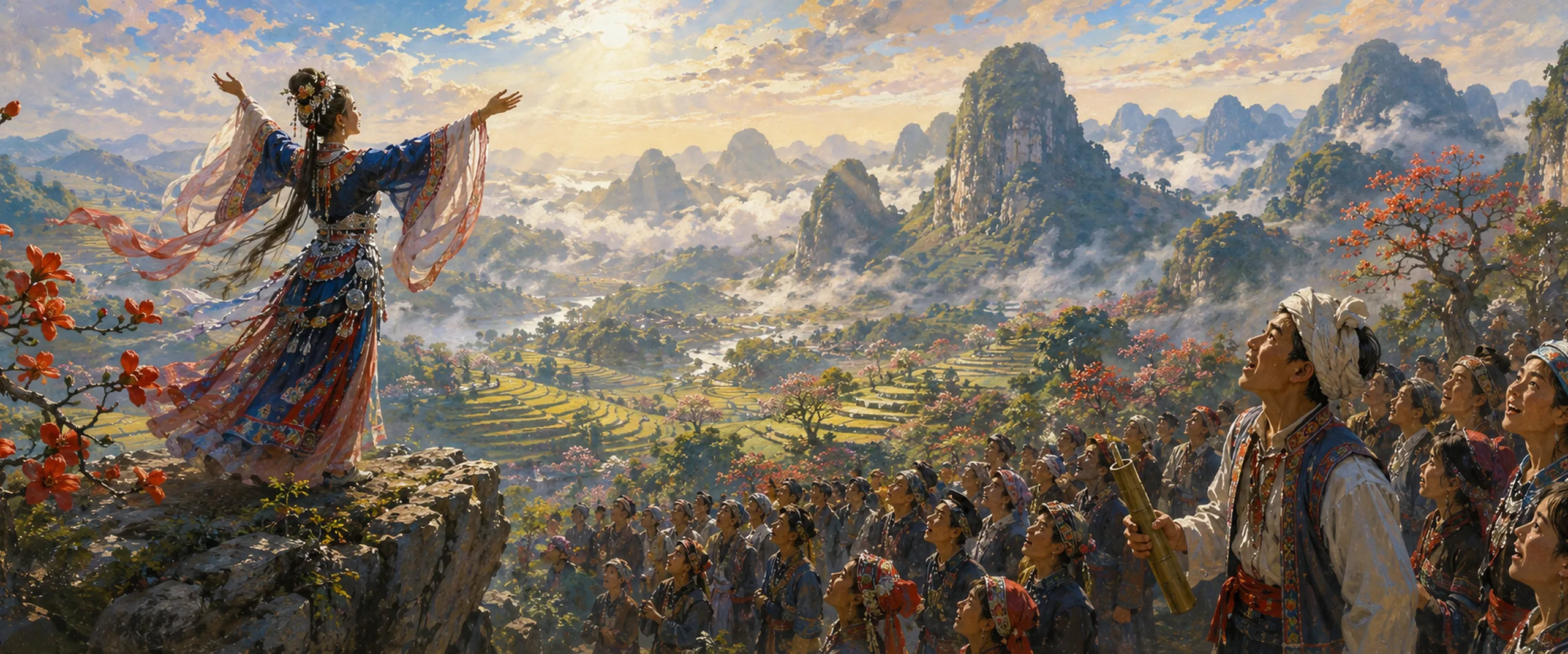
Today, in order to provide a unified place for large-scale ancestral worship, a Li-Miao Cultural Park has been established in Shuiman Township, Wuzhishan City. It includes a Li ceremonial hall and a March Third square capable of accommodating collective rites involving many thousands of participants, and has become an important sacred centre for Li ancestral worship. Every March Third, thousands of Li people and members of neighbouring ethnic communities gather there for the grand rite honouring Paolongkou. The ceremony includes horn calls welcoming guests, drums announcing the sacrifice, the formal reading of the ritual address, musical and dance offerings, and homage before the Li ancestor. The entire ritual is solemn, dignified, and highly ceremonial.

Courtship Through Antiphonal Singing

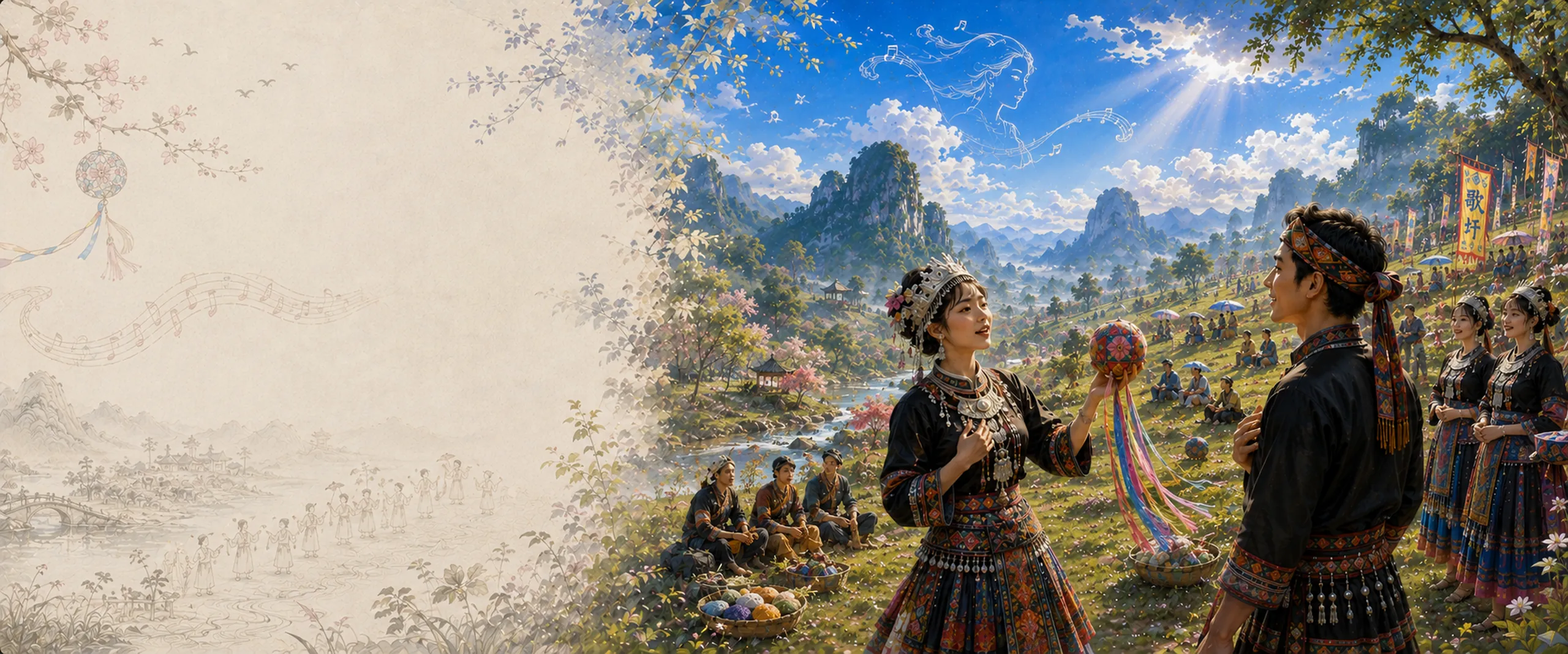
Choosing a partner through antiphonal singing is among the most romantic customs of March Third. Young women hold buren (布任)—the fragrant leaves and branches of a particular tree—in front of their faces and hide among the greenery, while groups of young men take the initiative in inviting them to exchange songs. One sings and the other replies; one asks and the other answers. What begins with greetings gradually develops into expressions of affection, and when two people choose one another, they exchange gifts and may become formally betrothed.

Among Li communities speaking the Meifu dialect (美孚方言), young men and women rise early on March Third, put on festival clothing, and carry baskets, food, umbrellas, and other necessities to a previously agreed forest or open field, called bodang (波当) in the Meifu dialect. They begin by “talking collectively,” asking one another about their villages and names, before turning to antiphonal song. Through these exchanges, the young men and women come to understand one another, and those who discover mutual affection may form a couple.

When night falls, older people gather to drink and reminisce, while groups of young men and women continue to meet. Antiphonal singing may last throughout the night, with emotion communicated through melody and verse. Young people use the festival as an occasion for exuberant celebration, making friends through song and expressing affection through dance, remaining immersed in the atmosphere of courtship until dawn approaches. Only then do they reluctantly part, often promising to meet again the following March Third.

The Bamboo-Pole Dance

The Dachai Dance (打柴舞) is one of the most common collective dances performed during March Third. Its performance structure is distinctive. Two thick round logs are first placed parallel to one another on the ground. Several pairs of slender poles or bamboo rods, each more than two metres long, are then laid crosswise over them with spaces between. Several pairs of young men and women squat beside the poles, facing one another and holding the rods, striking and opening or closing them according to a rhythmic pattern. The dancers, whose number is not fixed, jump and step between the moving poles as they repeatedly separate and come together.

The Dachai Dance is not merely a dance but also a test of skill, courage, timing, and coordination. Dancers must jump precisely at the moment the poles open; a slight mistake may cause their ankles or legs to be caught between the closing poles. The form therefore expresses the value traditionally placed by Li communities on agility, bravery, and bodily coordination.

Traditional Sports and Competitions

March Third also features a wide variety of traditional sporting competitions. Older events include archery, swinging, tree climbing, dagougun (打狗棍) stick contests, cattle riding, “turtle pulling” (拉乌龟), bamboo-raft racing or launching, vine climbing, and traditional gun shooting (粉枪射击). Ball games, board games, track-and-field events, and other modern competitions were later added.

Traditional Li sports display not only individual strength and skill but also the collective spirit of the community. Events such as cattle racing and wrestling recall techniques historically connected with production and everyday life while simultaneously strengthening communal participation and solidarity.

The Long-Table Banquet

The long-table banquet is one of the most representative forms of March Third food culture. Long tables are covered with Shanlan rice wine, fragrant bamboo-tube rice, *zongzi*, cakes, and other festival foods. The banquet is not simply about sharing food; it is also a space for exchanging emotions and strengthening relationships. Seated together along the long table, people drink Shanlan rice wine, taste bamboo-tube rice, and share the happiness of the festival.

Shanlan rice wine (山兰米酒) is a distinctive traditional Li alcoholic drink brewed from Shanlan upland rice. It is known for its mellow taste and characteristic aroma. Fragrant bamboo-tube rice (竹筒香饭) is prepared by placing rice inside sections of bamboo and roasting them, allowing the grain to absorb the fresh fragrance of the bamboo. These foods are not merely material components of the festival but important symbols of Li culinary culture.
Contemporary Transmission

Origins & Anecdotes · Tracing the Past

Official Recognition and Intangible Cultural Heritage Status

In 1984, in response to the wishes and requests of the Li people, the Guangdong Provincial People’s Congress and the Guangdong Provincial People’s Government formally designated March Third as a traditional festival of the Li people. On 20 May 2006, the Li March Third Festival was approved by the State Council for inclusion in the first national list of intangible cultural heritage, under project number Ⅹ-12. The Wuzhishan Municipal Cultural Centre was designated as the project’s safeguarding institution.

Participation of Hainan’s Miao Communities

March Third is not only a traditional Li festival but also an important festival among the Miao people of Hainan. Li and Miao communities have lived together on Hainan Island over a long historical period, and their cultures have influenced and interacted with one another. March Third has consequently become a festival celebrated by both peoples.

According to ancient Miao songs and oral traditions, in remote antiquity five Miao ancestors—bearing the surnames Deng, Pan, Li, Zhao, and Jiang—crossed the sea to Hainan Island. During their voyage they agreed that every year on the third day of the third lunar month they would gather together to commemorate their ancestors and celebrate reunion. This legend provides an origin narrative for the Miao observance of March Third. Although Li and Miao communities celebrate the same festival date, their specific customs and forms of expression remain distinct. It is precisely this cultural pattern of “difference within commonality and commonality within difference” that makes March Third a vivid example of intercultural exchange and interaction among the peoples of Hainan Island.

Contemporary Celebrations and the Integration of Culture and Tourism

In the twenty-first century, March Third has transformed from a traditional folk celebration into a large-scale cultural event bringing together folk custom, culture, tourism, and commerce. Contemporary programmes increasingly combine ethnic song-and-dance performances, demonstrations of intangible cultural heritage skills, tourism experiences, and commercial activities. They commonly include opening and closing performances, folk-song competitions, Li brocade and Miao embroidery contests, forums on Li and Miao culture in Hainan, exhibitions on ethnic unity and development, tourism and cultural experiences, and investment-promotion events.

The presentation of intangible cultural heritage (非遗) has become a particularly important dimension of contemporary March Third. Such presentations go beyond demonstrations of traditional techniques and increasingly promote “living transmission” through craft markets and cultural products. Li-brocade backpacks, Miao-embroidered headscarves, batik wall hangings, and other creative products are popular with visitors, who seek out forms of “intangible heritage that can be taken home.” Li brocade (黎锦) is among the best-known traditional crafts of the Li people. With a history said to extend for more than three thousand years, it is regarded as one of China’s earliest traditions of cotton textile production. Its intricate patterns and rich colours make it one of the most important visual carriers of Li culture.

In recent years, March Third has also introduced younger and more immersive programmes such as the “Guochao & Li-Chao” cultural creativity show, the citywide interactive performance “March Third Adventure,” the “Rainforest Starlight” music party, and intangible heritage journeys involving international online creators. The main venue rotates annually: in 2024 events were held in Baoting Li and Miao Autonomous County and Shuiman Township of Wuzhishan; in 2025 the main venue was Wuzhishan; and in 2026 it moved to Dongfang City, which introduced maritime opening and closing ceremonies for the first time. Multiple cities and counties across Hainan also host satellite events. March Third has therefore become an important platform for presenting Li and Miao culture, strengthening interethnic solidarity, and promoting the integration of culture and tourism.

Closing Reflections

Origins & Anecdotes · Tracing the Past

The formation of the Li March Third Festival is the result of thousands of years of accumulated Li cultural memory and the continuous addition of new meanings from successive historical eras. Its deepest roots lie in ancient memories of flood and the legend of the ancestral brother and sister—Nanyin and Tianfei preserve the Li lineage through self-sacrifice after the flood destroys the old world. In the heroic legend of Eniang and the Crow Demon, the festival acquires a romantic narrative of love and sacrifice; in the myth of Limu’s birth, it gains the solemnity of creation; in the story of Yayin and the lark, it acquires a spirit of resistance against oppression; in Fan Chengda’s Song-dynasty *Guihai Yuheng Zhi* (《桂海虞衡志》), it receives one of its earliest documentary reflections; in Zhang Qingchang’s Qing-dynasty *Liqi Jiwen* (《黎岐纪闻》), it receives one of its most vivid ethnographic descriptions; and through contemporary intangible cultural heritage protection, it has gained formal cultural recognition at the national level.

From the primordial flood along the Changhua River to the union of Nanyin and Tianfei beneath Yanwoling; from Eniang’s lifelong remembrance in Exian Cave to the great ancestral ceremonies drawing thousands to Shuiman Township in Wuzhishan; from village-organised sacrificial gatherings to a nationally recognised intangible cultural heritage celebration observed across Hainan—the history of March Third has been one of transformation from myth into history, from sacrifice into celebration, from village into island-wide festival, and from local tradition into national intangible cultural heritage. It preserves both the Li ancestors’ longing for the continuation of life and their responsibility toward the survival of the people, while also expressing the Li people’s gratitude toward their ancestors, their pursuit of love, and their hopes for a good and flourishing life.

In 2006, the Li March Third Festival was inscribed on China’s first national list of intangible cultural heritage under project number Ⅹ-12. From ancient flood legends to contemporary national heritage protection, March Third has travelled across millennia and continues to flourish on the island beside the South China Sea through its distinctive cultural vitality. It remains, in the words used to describe the tradition, a festival through which the Li people “commemorate their hardworking and courageous ancestors and express their longing for happiness in love.” Like the gentle sound of the nose flute (鼻箫) and the heartfelt voices of antiphonal love songs, its music is more than the sound of a festival: it is the cultural heartbeat of the Li people, still alive after centuries of wind and rain.

—-

Cultural Spirit

Cultural Core
March Third Festival carries the Chinese people’s longing for a better life and their devotion to family, embodying the cultural spirit of reunion, harmony, gratitude and blessing — it is one of the most enduring traditional festivals in Chinese culture.
The Continuation of Life
Freedom in Love
Ancestor Veneration
Community Cohesion

The Continuation of Life

The deepest cultural theme of March Third is its celebration of the continuation of life and the rebirth of the people. In the flood legend, Nanyin and Tianfei preserve the Li lineage through an act of profound self-sacrifice after the flood has destroyed everything around them. March Third is therefore a collective remembrance of this principle of life continuing even after catastrophe.

The Li people have endured many disasters and trials over the course of their history: floods, droughts, wars, and migrations. Yet after each ordeal, Li communities survived and rebuilt. March Third can therefore be understood as a celebration of that tenacious vitality—whatever the disaster, life can be renewed, homes rebuilt, and the lineage continued, just as in the story of Nanyin and Tianfei.

Freedom in Love

One of the most distinctive cultural values of March Third is its celebration of freedom in love and the right to choose one’s partner. From the tragic love of Eniang and Agui, to the romantic legend of Yayin and the lark maiden, to the annual antiphonal courtship songs exchanged by young people on March Third, love remains one of the festival’s central themes.

In traditional society, marriages were often arranged by parents or decided through family structures. March Third, by contrast, offered young people a socially recognised space for free interaction and personal choice. Within that space, men and women came to know one another through song and could choose to form a relationship based on mutual affection. Such a tradition of relatively free courtship was particularly meaningful within highly structured traditional societies. It is for this reason that March Third came to be called the “Festival of Love” and the “Day for Speaking of Love”: it is both a celebration of affection and a festival of chosen love.

Ancestor Veneration

March Third also embodies the Li people’s deep tradition of ancestor veneration. From ancient rites at Niangmu Cave to contemporary ceremonies involving thousands of worshippers in Shuiman Township, Wuzhishan, ancestral sacrifice has remained one of the festival’s central elements. Through March Third rituals, Li communities express gratitude toward their forebears, remember the history of their people, and affirm their commitment to inherited cultural traditions.

Ancestor veneration occupies a central place in traditional Li culture. The Li people traditionally believe that although ancestors have departed from the world of the living, their spirits continue to protect later generations. The ancestral rituals of March Third therefore create a spiritual dialogue between the living and the dead, between the present and the past. Through this dialogue, participants locate themselves within the genealogy of the people and strengthen collective memory and cultural identity.

Community Cohesion

March Third plays an important role in reinforcing community cohesion and ethnic identity. Every year on the third day of the third lunar month, Li people living throughout Hainan gather from many different places to participate in the celebrations together. Such collective and recurring gatherings strengthen emotional bonds and shared cultural identity within the community.

March Third has been described as “a cultural resource transmitted among the Li people for hundreds and thousands of years, and one of the most concrete and representative expressions of Li culture.” It is not only a manifestation of the Li people’s cultural creativity but also a vivid expression of human cultural diversity.

Continue exploring March Third Festival culture

Readers’ Comments

Calendar and traditional culture enthusiasts from around the world, sharing the same moon.

Sign in or register to join the conversation. Your comment account is created automatically the first time you use a connected account.