March Third Festival

March Third FestivalFolk Arts of the March Third Festival

「 三月三,黎家儿女情意长。 」

The Third of the Third Festival is a traditional festival of the Li people, celebrated in the Li‑populated areas of Hainan Island, held on the third day of the third lunar month. Various legends about its origin are passed down among the Li people…

Opening Verse:

三月三,黎家儿女情意长。

Introduction:

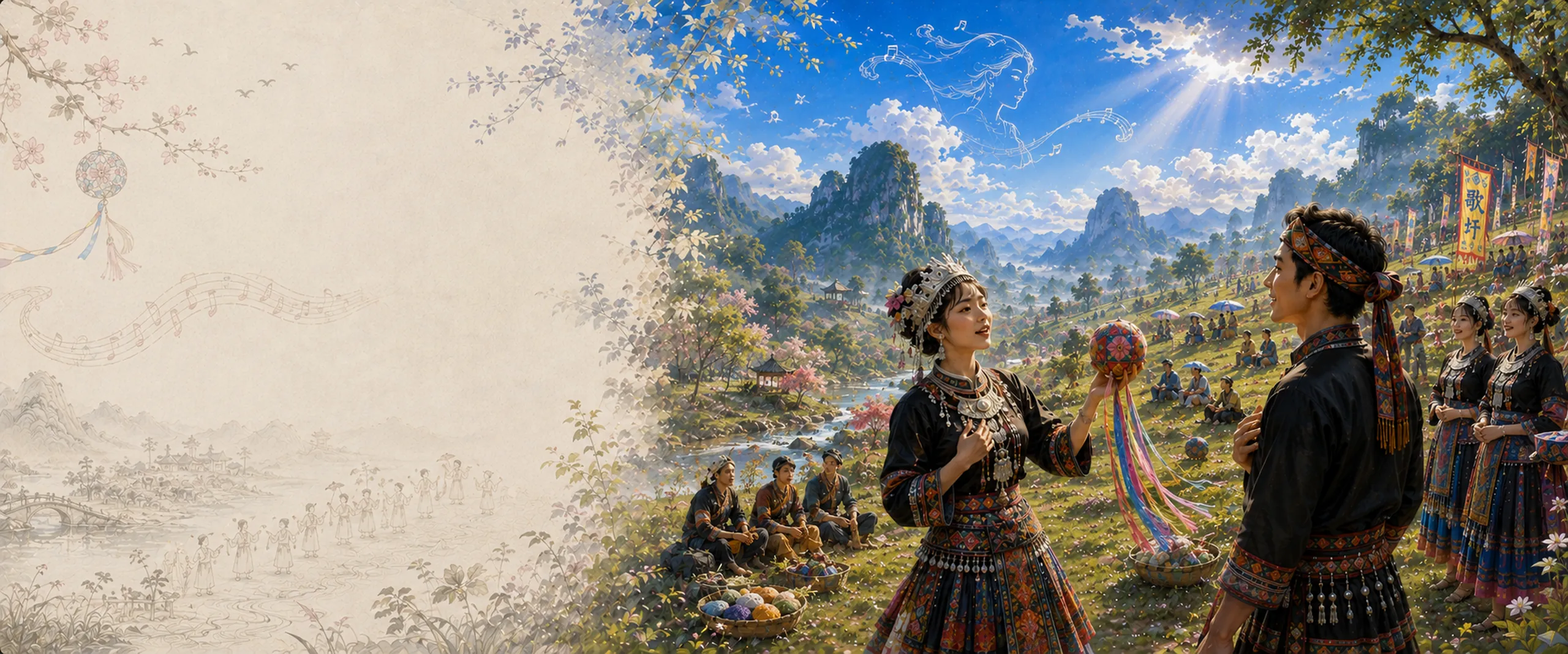
The poetry of the Third Day of the Third Lunar Month centers on honoring the ancestors and expressing affection through antiphonal singing. “黎家儿女情意长” evokes the deep emotions of young men and women who meet and fall in love during the festival. The poetry often records festive scenes in which the Li people worship their ancestors, sing and dance in antiphonal exchange, and celebrate together at long-table banquets.

The poetry of the Li Third Day of the Third Lunar Month festival centers on honoring the ancestors and expressing affection through antiphonal singing. The Li folk saying “三月三,黎家儿女情意长” captures the romantic character of the festival as an occasion for young men and women to meet and fall in love. During the festival, Li people dress in festive attire, carry Shanlan rice wine, bring fragrant rice cooked in bamboo tubes, and gather to worship their ancestors, sing in antiphonal exchange, and dance. The poetry and songs of the Third Day of the Third Lunar Month record the tradition through which young men and women convey their feelings through song—they go to the mountains and forests or open countryside, first converse in groups, and then begin to sing back and forth, gradually coming to know and understand one another through song. The festival’s poetry also records the grandeur of the long-table banquet—three-colored rice, bamboo-tube rice, and Shanlan rice wine fill the tables as people celebrate amid fine wine and song.

March Third Festival / Folk Arts of the March Third Festival

Art Forms

Forms of Expression

Li Folk Songs

Folk Song 黎族

A Long Tradition

Li folk songs are a form of oral literary art created by the Li people through their long history of production and everyday life, and they are one of the most important vehicles of Li culture. The Li people have no written script, and all culture has been transmitted from generation to generation through oral instruction and direct teaching. Folk songs therefore became their most important means of recording history, transmitting culture, and expressing emotion. Li folk songs possess a long historical tradition and distinctive ethnic characteristics. In terms of content, they include narrative songs, labor songs, love songs, drinking songs, wedding banquet songs, songs of daily life, and songs about current affairs and politics. In terms of singing style, they include pingdiao, gaodiao, changdiao, and other vocal forms, while Li folk songs from different regions and dialect groups each possess their own distinctive characteristics.

The Third Day of the Third Lunar Month is the most concentrated platform for the presentation of Li folk songs. Antiphonal singing for the purpose of choosing a partner is itself a core means through which Li folk songs are transmitted. During the festival, song continues from daytime until deep into the night, spreading from the ritual altar throughout the mountain villages.

Yazhou Folk Songs

Yazhou folk songs are a distinctive folk-song form native to Hainan Island. Although they belong ethnically to the Han folk-song tradition, their area of circulation overlaps extensively with that of the Li Third Day of the Third Lunar Month festival, making them an important part of the festival’s folk arts. Yazhou folk songs are traditional songs sung in Chinese dialects by Han communities in the Yazhou region of Hainan Island and have a history of transmission spanning a thousand years. In 2006, Yazhou folk songs were included in the first batch of China’s national intangible cultural heritage list.

The language of Yazhou folk songs is approachable and accessible, their melodies simple and graceful, and their subject matter encompasses labor and daily life, love and marriage, historical legends, and many other aspects of experience. During the Third Day of the Third Lunar Month, Yazhou folk songs and Li folk songs complement one another, together forming the festival’s rich soundscape. Over the course of their long development, Yazhou folk songs absorbed elements of Li folk songs and developed a distinctive artistic style, becoming testimony to the interaction and blending of multiple cultures on Hainan Island.

Antiphonal Love Singing

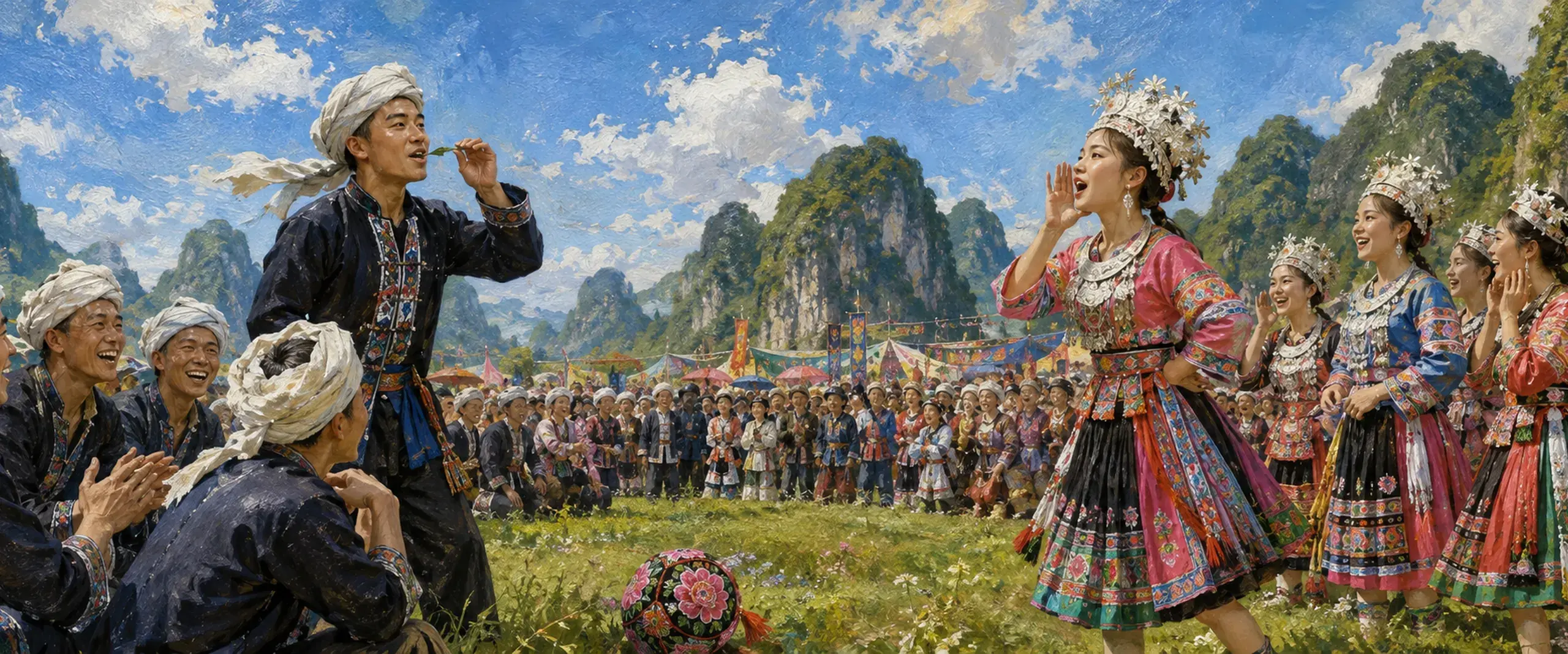
Antiphonal singing is the central activity of the Third Day of the Third Lunar Month and also one of the most vital forms of Li folk-song performance. At the festival, antiphonal singing is not merely an artistic presentation; it is also a way for young men and women to meet, fall in love, and choose a partner.

Its forms are varied and flexible. Two people may sing to one another, several people may sing in exchange, or participants may divide into male and female groups and sing antiphonally. The songs may be long-established traditional folk songs or may be improvised by the singers themselves. Improvised antiphonal singing best demonstrates a singer’s talent—responding emotionally to the scene, singing about the people one encounters, praising the things one sees, composing lyrics spontaneously and fitting them to the melody. The content of the exchange begins with mutual greetings and self-introduction, then gradually deepens into declarations of affection and expressions of longing. Antiphonal singing is the most romantic way for young Li men and women to meet—“以歌为媒,以歌传情”.

In areas speaking the Meifu dialect, young men and women rise early on the day of the Third Day of the Third Lunar Month, put on festive attire, take shoulder baskets, food, umbrellas, and other belongings, and go to a previously agreed mountain forest or open field. They first engage in “集体攀谈”, asking one another about their villages and names, and then begin singing in antiphonal exchange. Through this process, the two sides come to know one another, and those who find themselves mutually compatible become partners.

When night falls, older people gather to drink and reminisce, while young men and women meet in groups. People sing back and forth throughout the night, using song to convey affection. Young men and women in particular take advantage of the festival to revel together, making friends through song and expressing emotion through dance, immersing themselves in the happiness of love. Only as dawn approaches do they reluctantly part, promising to meet again at the next Third Day of the Third Lunar Month. This tradition of all-night antiphonal singing is the most moving soundscape of the Li festival—the songs continue from dusk until dawn, singing out every shade of longing and every joy of life.

Contemporary Transmission

Li folk songs are transmitted primarily through “口传心授”, with elders teaching younger generations vocal styles, lyrics, and performance techniques. On the festival stage, older singers perform ancient songs while younger singers continue the tradition in contemporary voices. Inheritors of Yazhou folk songs sustain the cultural vitality of this ancient song form through festival performances. Today, both Li folk songs and Yazhou folk songs have become important components of cultural presentations during the Third Day of the Third Lunar Month. Through antiphonal singing competitions, folk-song showcases, and other forms, these ancient voices continue to resonate in contemporary society.

Bamboo-Pole Dance

Other 黎族

Cultural Status

The bamboo-pole dance, also known as “跳柴”, is the most representative traditional dance of the Li people and one of the most visually striking forms of folk art during the Third Day of the Third Lunar Month. In 2006, the bamboo-pole dance was included in the first batch of China’s national intangible cultural heritage list.

The origins of the bamboo-pole dance are closely connected with the bamboo culture of Li ancestors. Hainan Island is rich in bamboo, and the Li people developed an inseparable relationship with bamboo in everyday life. Through long-term labor, they discovered that the sound of bamboo poles striking one another possessed a strong sense of rhythm and gradually developed the distinctive dance form known as the bamboo-pole dance. It is not merely a dance, but also an expression of the wisdom and courage of the Li people—accurately leaping in the instant when the bamboo poles open and close requires extraordinary nerve and agility.

Performance Form

The bamboo-pole dance is performed in a distinctive and thrilling manner. Two relatively thick logs are first placed parallel on the ground. Several pairs of slender wooden poles or bamboo poles more than two meters long are then laid crosswise over them, spaced several chi apart. Beside the poles squat several pairs of young men and women—the pole-beaters—who face one another while holding the slender poles and striking them according to the dance rhythm. The poles alternately separate and come together, while any number of dancers—the jumpers—perform between them. The dancers must leap with precision at the instant the bamboo poles open and close; the slightest mistake may cause their feet to be caught. This combination of danger and grace gives the bamboo-pole dance exceptional visual appeal.

The rhythm may be fast or slow. When slow, the steps are graceful and composed; when fast, they become urgent and exuberant. The rhythm created by the pole-beaters changes continuously, and the dancers must adjust the timing and posture of their jumps accordingly. The dance includes single-foot jumps, two-foot jumps, crossing jumps, turning jumps, and many other forms, each corresponding to a different rhythmic pattern. The dancers weave and leap among the bamboo poles like deer moving through a bamboo grove, light and agile.

Cultural Meaning

The bamboo-pole dance embodies the Li people’s ethnic character of “刚健质朴” and their ecological wisdom of “人与自然和谐相处”. Bamboo is one of the most common plants on Hainan Island, and Li ancestors turned bamboo itself into dance, incorporating their love of nature into the choreography. The bamboo-pole dance is not merely festival entertainment; it is also a display of the Li people’s vitality and courage. In performances during the Third Day of the Third Lunar Month, dancers conquer audiences through their superb technique and also conquer the rapidly moving bamboo poles—just as Li ancestors relied on wisdom and courage to master life in the primeval forests of Hainan Island.

Nose Flute

Other 黎族

Form and Timbre

The nose flute is one of the most distinctive traditional instruments of the Li people and represents an extremely rare mode of wind-instrument performance among Chinese ethnic musical traditions. Made from bamboo tubing and played through the nostrils, it produces a soft, distant tone, plaintive and lingering. The uniqueness of the nose flute lies not only in the way it is played, but also in its timbre—it is not as bright as a transverse flute and not as piercing as a suona, but possesses a hazy, dreamlike quality, as though its sound had traveled from remote antiquity.

The nose flute occupies a special position in Li culture. During the Third Day of the Third Lunar Month, Li young women play love-song melodies on the nose flute, while young men answer with whistles and song. Zhang Qingchang of the Qing dynasty recorded in 《黎岐纪闻》: “男女未婚者,每于春夏之交齐聚于旷野间,男弹嘴琴(口哨),女弄鼻宵,交唱黎歌”. The nose flute became one of the most romantic ways for young Li men and women to express affection—it requires no words, only a breath, yet can convey the deepest feeling to the one they love.

Legend

A moving legend about the origins of the nose flute circulates among the Li people. Long ago, it is said, a young Li man fell in love with a girl from a neighboring village, but because their families were hereditary enemies, the two could not marry. The young man made a nose flute from bamboo and played it each night near the girl’s village. Its plaintive, lingering sound expressed his endless longing. Moved by the music, the girl defied her family and eloped with him. From that time onward, the nose flute became a token through which young Li men and women expressed love. This legend closely links the instrument with romance, giving every performance of the nose flute a deeply romantic quality.

Musical Role

The nose flute is the most recognizable musical symbol of the Third Day of the Third Lunar Month. On festival nights, when bonfires are lit and singing begins, its melody flows through the night sky like moonlight. Young women play love-song melodies on nose flutes, while young men answer with whistles. Flute and whistle intertwine in the darkness, creating the festival’s most moving soundscape. This way of communicating emotion through the nose flute brings the restraint and romance of Li culture to an extreme—feeling lies hidden within the sound of the flute, with everything conveyed without words.

Traditional Instruments

Other 黎族

Single-Log Drum and Dingdong

Traditional Li percussion instruments play an important role during the Third Day of the Third Lunar Month. The single-log drum is one of the oldest Li instruments. Its body is made by hollowing out an entire section of nanmu wood, with cowhide stretched over both ends. Its timbre is rich, deep, and resonant, and during festival sacrificial rites and song-and-dance activities it serves to lead the rhythm. The deep sound of the single-log drum intertwines with the striking bamboo poles of the bamboo-pole dance and the lingering melody of the nose flute, together forming the distinctive soundscape of the festival.

Dingdong is a percussion instrument unique to the Li people. Two wooden sticks of different lengths strike a wooden resonating box, producing a clear “ding-dong, ding-dong” sound. Its rhythm is lively and its timbre crisp, helping to enliven the atmosphere of festival song and dance. When combined with the bamboo-pole dance, Dingdong enriches the rhythmic texture of the performance.

Lilie and Zhuoba

Lilie and Zhuoba are wind instruments unique to the Li people. Lilie is a Li double-reed aerophone with a bright tone resembling that of the suona. Zhuoba is a Li single-reed aerophone with a softer tone resembling that of the xiao. During the Third Day of the Third Lunar Month, performers of Lilie and Zhuoba join singers and dancers in creating the joyous atmosphere of the festival. These instruments have been passed down through generations of Li life and form an important part of Li folk music. In ethnic areas such as Wuzhishan, Baoting, Qiongzhong, and Baisha, towns and townships hold cultural performances during the festival that include not only nose flute, Lilie, Zhuoba, and other folk-instrument performances, but also folk singing and traditional dance.

Long-Table Banquet

Other 黎族

The long-table banquet is the form of dining with the greatest power to strengthen communal bonds during the Li Third Day of the Third Lunar Month, and it is also an important setting for folk-art performances. At the banquet, people do not merely eat together; they accompany wine with song and heighten the celebration with dance. Fragrant Shanlan wine, aromatic bamboo-tube rice, and mellow fish tea fill the long tables. People take their seats in an orderly manner according to Li and Miao customs and raise cups of Shanlan rice wine to celebrate the festival together.

Throughout the banquet, cups pass back and forth while songs linger in the air. Honored guests and clan elders are given priority in drinking the “头碗酒”, symbolizing the highest form of hospitality toward guests. As people drink, they sit together and sing. Hosts and guests answer one another in traditional ethnic melodies, using bamboo chopsticks to pick up food by hand; soon, drinking songs and laughter intertwine and the festive atmosphere reaches its height. The drinking songs of the long-table banquet are among the liveliest expressions of folk art during the festival—the melodies are simple yet passionate, the lyrics plain yet sincere, singing of the Li people’s welcome to guests, joy in a good harvest, and love of life.

Contemporary Transmission

Heritage & Transmission 黎族

Intangible Cultural Heritage Recognition

The Li Third Day of the Third Lunar Month was included in the first batch of China’s national intangible cultural heritage list on May 20, 2006, under number Ⅹ-12, with the Wuzhishan Municipal Cultural Center as its safeguarding unit. The festival is a traditional occasion on which the Li people of Hainan commemorate their hardworking and courageous ancestors and express their longing for happiness in love. In 1984, in accordance with the wishes and requests of the Li people and with approval from the Standing Committee of the Guangdong Provincial People’s Congress and the Guangdong Provincial People’s Government, the People’s Government of the Hainan Li and Miao Autonomous Prefecture formally designated the third day of the third lunar month as a traditional Li festival day. After Hainan became a province in 1988, ethnic regions continued to preserve the festival, whose scale of activities expanded year by year.

Inheritors

Li folk songs have several national-level representative inheritors of intangible cultural heritage. Wang Wuda was among the first group of national-level representative inheritors for the intangible cultural heritage project of Li folk songs. She loved singing Li folk songs from childhood and was skilled in many Li folk-song tunes, including “罗哩调”, “嘞嘞调”, and “嘿吓调”. She repeatedly participated in folk-song performances for the traditional Li festival of the Third Day of the Third Lunar Month and was awarded the title “黎族歌后” in 1979. Wang Wuda’s singing brought the traditions of Li folk song into the contemporary era and also gave the song tradition of the festival recognition and protection at the national level.

Contemporary Folk Celebration

Far from declining in contemporary society, the Third Day of the Third Lunar Month has instead taken on an increasingly expansive form. The content of the festival has undergone enormous change, developing from a celebration centered simply on ancestor worship and antiphonal singing for partner selection into a comprehensive festival that integrates song-and-dance evenings, public-square performances, Li and Miao costume presentations, traditional ethnic sports competitions, displays of traditional handicrafts, exhibitions and sales of local specialties, investment promotion, tourism, and folk-cultural field experiences.

Since the beginning of the twenty-first century, government organizations have participated in and taken a leading role in various activities held on the third day of the third lunar month, adding parades, cultural performances, film evenings, exhibitions, exchanges of goods, and other content. Today, the festival has developed into an occasion integrating trade, tourism, culture, and entertainment. In areas inhabited by Li and Miao communities, including Wuzhishan, Baoting, Baisha, Qiongzhong, and Changjiang, festival activities include folk-song antiphonal singing, bamboo-pole dance performances, nose-flute performances, ethnic costume presentations, and many other forms of folk art.

During the 2024 festival, Baoting and other principal venues held grand ethnic song-and-dance evenings, presenting traditional Li and Miao culture through song, dance, clothing, handicrafts, and other forms, and attracting visitors from across the country. The Third Day of the Third Lunar Month has become an important platform for presenting Li and Miao culture, promoting ethnic unity, and advancing the integration of culture and tourism.

Closing Reflections

Overview 黎族

The folk artistic expression of the Li Third Day of the Third Lunar Month differs fundamentally from the “literati poetry” associated with Han festivals. It is not “written” through words, but “sung,” “danced,” “played,” and “performed” at the festival itself. It does not arise from an external perspective of “watching” and “reflection,” but from an internal perspective of “speaking” and “revelry.”

From the thousand-year transmission of Yazhou folk songs to the graceful, lingering melodies of Li folk songs; from moonlit love songs sung in antiphonal courtship to solemn songs honoring the ancestors; from the thrilling leaps of the bamboo-pole dance to the labor rhythms of the rice-pounding dance; from the plaintive sound of the nose flute to the deep resonance of the single-log drum, from the brightness of Lilie to the softness of Zhuoba—the folk artistic expression of the Li Third Day of the Third Lunar Month takes “song” and “dance” as its core, with “instruments” and “ritual” as supporting wings, forming a complete, living, and continuously flourishing system of cultural expression.

Since ancient times, “三月三” has been an important space on Hainan Island for emotional expression, cultural identity, and communal cohesion among different ethnic groups—young men and women seek lifelong partners through antiphonal singing, elders transmit collective history through ritual memory, and group dances together with folk songs have built an aesthetic and spiritual world extending across a thousand years. From the ancient name “孚念孚” in the Li language to the grand contemporary celebrations of the Third Day of the Third Lunar Month, the folk arts of the Li festival have crossed thousands of years while continuing to carry, generation after generation, the Li people’s gratitude toward their ancestors, pursuit of love, passion for life, and longing for all that is good.

Like the love songs that have been sung on Exian Ridge for a thousand years, they have passed through wind and rain yet remain as deeply affectionate as ever. When the melody of the nose flute rises into the night sky of the Third Day of the Third Lunar Month, when the bamboo poles of the bamboo-pole dance whirl beneath the moonlight, when drinking songs rise one after another at the long-table banquet, and when the “罗哩调” of Wang Wuda, the “黎族歌后”, echoes across the stage—that is the Li people using their own voices, their own bodies, and their own dances to offer their deepest and most enduring declaration to “love” and “life.” The folk arts of the Third Day of the Third Lunar Month are an undying cultural flame beneath Wuzhishan and an ever-renewing song of a people on the shores of the South China Sea.

—

Continue exploring March Third Festival culture

Readers’ Comments

Calendar and traditional culture enthusiasts from around the world, sharing the same moon.

Sign in or register to join the conversation. Your comment account is created automatically the first time you use a connected account.