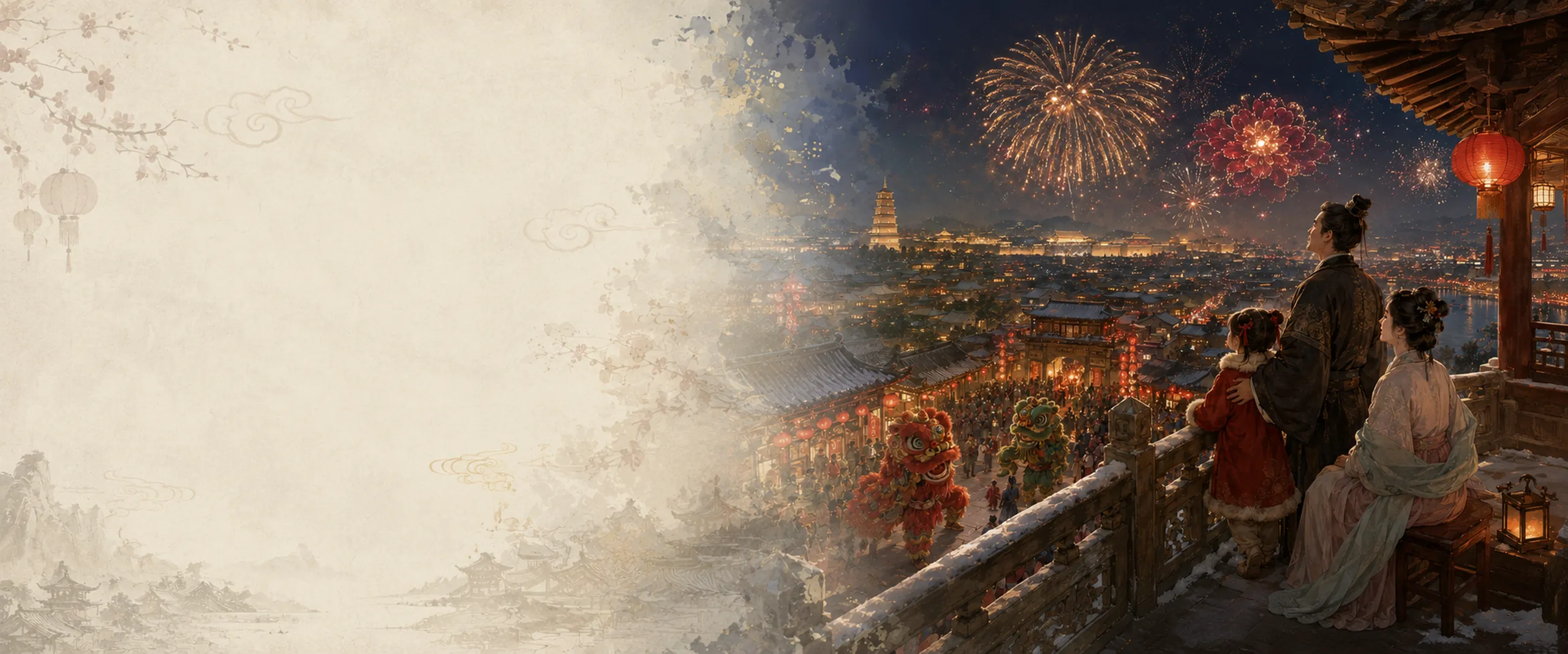
Spring Festival

Spring FestivalSpring Festival Origins

「 年头岁尾,祭神祭祖,驱邪纳福。 」

The Spring Festival is China’s most solemn and integrative traditional festival, originating from ancient year‑beginning harvest prayers and year‑end sacrificial rituals. As early as the Yao and Shun era, records of “year‑end sacrifices” (腊祭)…

The formation of the Spring Festival is the result of the gradual integration of multiple cultural sources over a long historical period. Its origins can be traced back to ancient year‑beginning harvest prayers, year‑end sacrificial offerings, and exorcism rituals. According to the “Book of Rites · Suburban Sacrifices” (《礼记·郊特牲》): “Lord Yīqí was the first to institute the wax sacrifice. Wax means ‘seeking’ — in the twelfth month of the year, he gathered all things and offered them in sacrifice.” The Yao and Shun era already had year‑end sacrifices to all deities and ancestors, known as “腊祭” (year‑end sacrifices). The “Shuowen Jiezi” (《说文解字》) defines “年” (year) as “grain ripening,” showing that the roots of the Spring Festival are deeply embedded in the soil of agrarian civilisation. Historically, the Spring Festival was not always called “Spring Festival.” In the pre‑Qin period it was called “Yuandan” (元日) or “Shangri” (上日); in the Han dynasty, “Zhengdan” (正旦) or “Suidan” (岁旦); from the Tang to the Qing dynasties, “Yuandan” (元旦) or “Yuanri” (元日); the name “Spring Festival” for the Lunar New Year was established in 1914. The festival’s system of customs evolved over thousands of years — taking shape in the Han dynasty, flourishing in the Tang and Song, and maturing in the Ming and Qing — forming a complete festival cycle of over a month from Laba to the Lantern Festival. The mainstream academic view holds that the Spring Festival is the result of the gradual fusion of ancient year‑beginning harvest prayers, year‑end sacrificial offerings, and exorcism rituals over a long historical evolution. Emperor Wu of Han’s “Taichu Calendar,” which established the first month of the Xia calendar as the beginning of the year, laid the decisive foundation for the festival’s formation; Cui Shi of the Eastern Han dynasty, in his “Monthly Instructions for the Four Classes of People” (《四民月令》), already recorded clear accounts of New Year’s Day sacrifices and New Year greetings, marking the initial formation of the Spring Festival’s ritual framework. Although later customs continued to enrich, “family reunion,” “bidding farewell to the old and welcoming the new,” and “gratitude and prayer” have always remained the core cultural spirit of the Spring Festival, endowing this thousand‑year‑old festival with enduring vitality.

Spring Festival / Spring Festival Origins
106 days until Spring Festival February 6, 2027 · Lunar 正月初一

The Name "Spring Festival"

Origins & Anecdotes · Tracing the Past

The Etymology of the Character “年” (Year)

In its original sense, “年” was not a temporal concept but referred to the growth cycle of crops. The “Shuowen Jiezi · Grain Section” (《说文解字·禾部》) records: “年, grain ripening. From the grain radical, with the phonetic ‘千’.” The oracle‑bone script for “年” has “禾” (grain) on top and “人” (person) below, resembling a person holding a sheaf of grain and dancing — expressing the joy of a bountiful harvest. Since grain in the Central Plains ripened once a year, “年” was extended to become a unit of time. The “Erya · Explanations of Heaven” (《尔雅·释天》) also states: “年 is the name for grain ripening; it ripens once each year, hence the year is named after it.” From “grain ripening” to “temporal cycle,” the evolution of the character “年” fully reflects the agrarian concept of time — time is not abstract passage but a rhythm of life closely tied to the growth and harvest of crops.

In ancient times, people called a year “腊” (twelfth month), during the Yao and Shun era it was called “载” (to record), in the Xia dynasty it was called “岁” (year/star cycle), in the Shang dynasty it was changed to “祀” (sacrificial cycle), and only in the Zhou dynasty was it called “年.” These different terms reflect different understandings of time across eras — from sacrifice (腊, 祀) to harvest (年), from the movement of stars (岁) to the ripening of grain (年) — each shift marked a change in cultural focus.

From “Year’s Beginning” to “Yuandan”

The Spring Festival was not always called “Spring Festival” in ancient times; it had various names throughout history. In the pre‑Qin period, it was called “Shangri” (上日), “Yuandan” (元日), “Gaisui” (改岁), and “Xiansui” (献岁). In the Han dynasty, it was called “Sanchao” (三朝), “Suidan” (岁旦), “Zhengdan” (正旦), and “Zhengri” (正日). In the Wei‑Jin and Southern‑Northern dynasties, it was called “Yuanchen” (元辰), “Yuanri” (元日), “Yuanshou” (元首), and “Suichao” (岁朝). In the Tang, Song, Yuan, and Ming dynasties, it was called “Yuandan” (元旦), “Yuan” (元), “Suiri” (岁日), “Xinzheng” (新正), and “Xinyuan” (新元). In the Qing dynasty, it was consistently called “Yuandan” (元旦) or “Yuanri” (元日). Though the names varied, all centred on the core character “元” (yuan), meaning “beginning” or “first.” “Yuandan” means “the beginning of the year.” The “Records of the Grand Historian” (《史记》) and the “Book of Han” (《汉书》) refer to the first day of the first month as the “Four Beginnings” (四始 — beginning of the year, season, day, and month) and the “Three Mornings” (三朝 — morning of the year, month, and day).

The Modern Establishment of the Name “Spring Festival”

It is important to note that before the Republic of China era, the term “Spring Festival” (春节) had no connection to the Lunar New Year. In ancient times, “Spring Festival” referred to “Lichun” (立春 — the Beginning of Spring), one of the 24 solar terms. The “Book of the Later Han · Biography of Yang Zhen” (《后汉书·杨震传》) contains a record of “Spring Festival,” but it refers to the Lichun solar term. During the Southern‑Northern dynasties, “Spring Festival” generally referred to the entire spring season. Since the New Year festival and the Beginning of Spring fell around the same time, the folk increasingly emphasised the New Year festival, and the themes of welcoming spring and receiving blessings naturally merged into it, causing the “Beginning of Spring festival” to gradually disappear — Lichun remained only as a solar term. However, “Spring Festival” as the name of a festival had no connection to the first day of the first month.

In 1912, the Republic of China adopted the Gregorian calendar, with 1 January called “Yuandan” (元旦). The traditional lunar “Yuandan” then faced renaming. In 1914, President Yuan Shikai of the Beiyang government accepted a proposal from the Ministry of Internal Affairs and officially renamed the first day of the first lunar month as “Spring Festival” (春节). From then on, the name that originally belonged to Lichun was given to the Lunar New Year. On 27 September 1949, the First Plenary Session of the Chinese People’s Political Consultative Conference stipulated that “the People’s Republic of China adopts the Common Era for its calendar,” with 1 January as “Yuandan” (元旦) and the first day of the first lunar month as “Spring Festival” (春节). In 2006, the Spring Festival was inscribed on China’s first list of National Intangible Cultural Heritage. On 4 December 2024, “Spring Festival — the social practice of the Chinese people celebrating the traditional New Year” was successfully inscribed on the UNESCO Representative List of the Intangible Cultural Heritage of Humanity.

Origins of the Festival

Origins & Anecdotes · Tracing the Past

The formation of the Spring Festival did not originate from a single event or tradition but from the gradual fusion of multiple cultural sources over a long historical period. These sources include the ancient year‑end sacrificial rituals (腊祭 and 蜡祭), exorcism rituals (傩祭), and year‑beginning harvest prayers. They converged from different directions to form the foundation of the Spring Festival.

Year‑End Sacrifices (腊祭 and 蜡祭)

The oldest origins of the Spring Festival can be traced back to the ancient year‑end sacrificial rituals of 腊祭 and 蜡祭. These represent the deepest and most essential cultural genes of the festival.

In agrarian societies, people regulated their lives according to the rhythms of crop production, forming the concept of “year” (年). At the end of the year, people held grand sacrificial ceremonies to pray for abundant harvests and the safety of people and livestock in the coming year. Such rituals existed as early as the Yao and Shun era, called “腊祭.” The “Fengsu Tongyi” (《风俗通义》) records: “腊 means hunting — speaking of hunting wild animals to sacrifice to one’s ancestors.” In an era dependent on nature, after the year’s agricultural work was completed, people held grand sacrifices in the twelfth month at the turn of the old and new years, offering hunted animals to ancestors and all deities to express gratitude for the blessings of heaven and earth.

The year‑end sacrifice had two ancient sources: one was the “蜡祭” (wax sacrifice) held in the suburbs to offer sacrifices to all deities in celebration of the harvest; the other was the “腊祭” held in the ancestral temple to thank ancestors for their protection. “蜡” and “腊” were later collectively referred to as “腊” (the twelfth month) after the Qin and Han dynasties. The month of the year‑end sacrifice was the twelfth month (腊月), and the day was the “腊日” (wax day). In the Han dynasty, the wax day was the third xu day after the winter solstice. Around the Southern dynasties, the Jiangnan region was the first to set the wax day on the eighth day of the twelfth month. From the very beginning, the wax day was an auspicious festival, including both sacrificial ceremonies celebrating the harvest and expressing gratitude, as well as exorcism activities for warding off disasters and praying for blessings.

The “Book of Rites · Suburban Sacrifices” (《礼记·郊特牲》) records: “Lord Yīqí was the first to institute the wax sacrifice. Wax means ‘seeking’ — in the twelfth month of the year, he gathered all things and offered them in sacrifice.” Lord Yīqí is Yao, indicating that the origins of the wax sacrifice can be traced back to the Yao and Shun era. The core spirit of this year‑end sacrifice is “gratitude” — gratitude to heaven and earth for the harvest, and gratitude to ancestors for their blessings. As the “Dictionary of Chinese Folk Beliefs and Customs” (《中国民间信仰风俗辞典》) explains the term “Spring Festival”: “It is said to originate from the year‑end sacrifices of ancient society, where 腊 was the name for the year‑end sacrifice to all deities; thus the Spring Festival came from the expression of gratitude for divine blessings after the completion of the year’s agricultural work.”

Exorcism Rituals (傩祭)

Exorcism rituals were called “傩” (nuo) in the pre‑Qin period. The most important nuo ritual of the year was the year‑end grand exorcism held in the twelfth month. The “Book of the Later Han · Treatises on Rites” (《后汉书·礼仪志》) and “Rhapsody on the Eastern Capital” (《东京赋》) record that the grand nuo ritual at the Eastern Han imperial palace was held on the night before the wax day, on a grand scale involving the emperor and all civil and military officials. After the palace ceremony, torches symbolising plague demons were escorted by over a thousand knights from the Five Camps and cast into the Luo River, symbolising the final suppression of pestilence. By the Southern dynasties, the exorcism ritual was already held on the wax day itself and was influenced by Buddhism. The “Jingchu Suishiji” (《荆楚岁时记》) records: The eighth day of the twelfth month is the wax day, and people of the time had a saying: “When the wax drums sound, spring grass grows.” Villagers beat slim‑waisted drums, wore Hugongtou masks, or dressed as Vajra warriors to drive away pestilence. These rituals were the prototypes of later nuo opera.

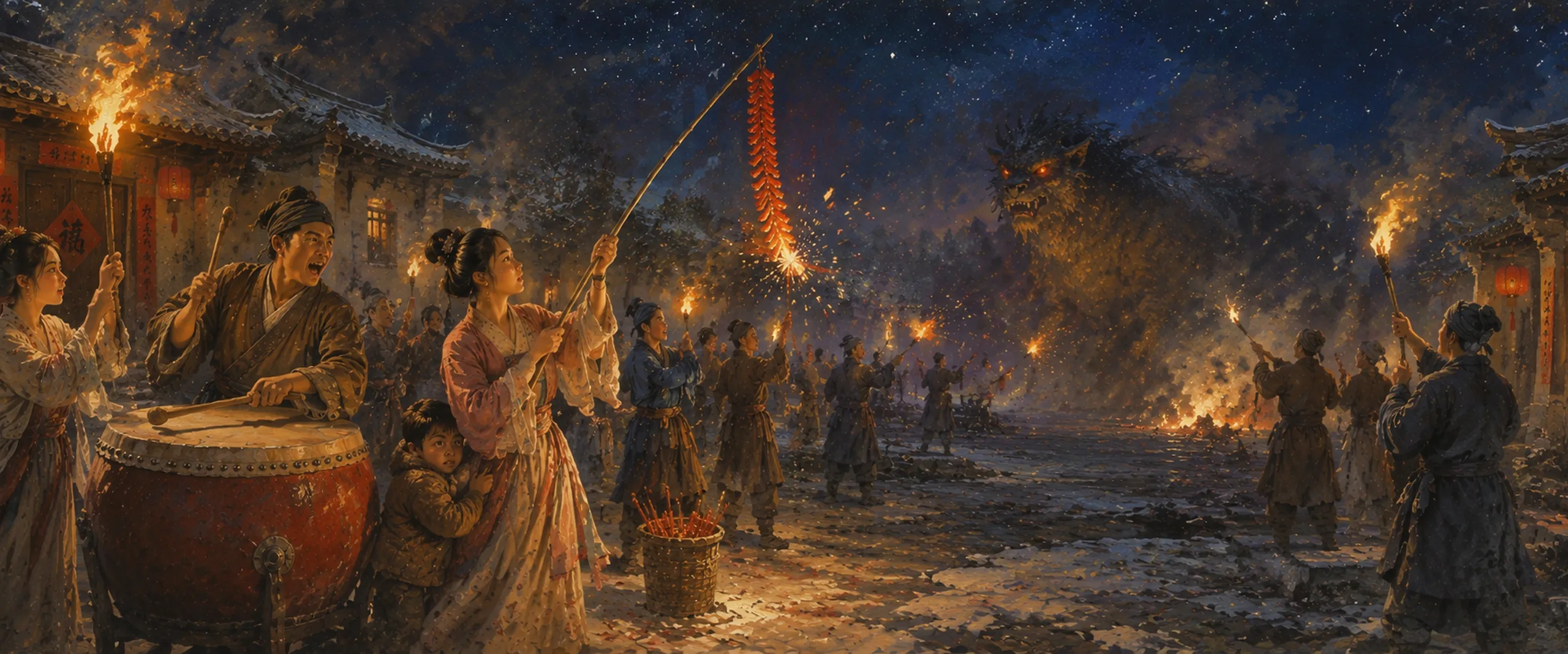
The core function of the nuo ritual was to exorcise demons and dispel pestilence. The ancients believed that the year‑end was a time when yin and yang alternated and evil energies were at their peak, requiring grand rituals to drive out plague demons to ensure peace in the coming year. This theme of exorcism later evolved into Spring Festival customs such as New Year’s Eve cleaning, firecracker‑setting, and pasting door gods.

Year‑Beginning Harvest Prayers

Another important source of the Spring Festival is the ancient year‑beginning harvest prayer rituals. According to historical records, the Spring Festival arose from the deity‑and‑ancestor worship activities of the Shun era. Oracle‑bone inscriptions from the Shang dynasty already contain the pictograph for “旦” (dawn/New Year’s Day). The Spring Festival evolved from ancient year‑beginning harvest prayers, becoming a comprehensive folk festival integrating renewal, deity and ancestor worship, prayer and exorcism, family reunions, celebration, and feasting.

In ancient times, primitive beliefs were an important factor in the formation of the festival. People believed that deities governed all things, that the gods of the sun, moon, heaven, earth, plants, animals, and ancestral spirits determined people’s lives and destinies. Thus, on important occasions such as seasonal changes and agricultural activities, people held various sacrificial rituals to express worship, respect, and reverence for the deities. Particularly at the year‑end, they held harvest‑celebrating rituals. On the wax day, offerings were presented to ancestors and all deities, accompanied by music, drumming, and recitations of prayers to thank the deities for the harvest and pray for favourable weather in the coming year. Then the entire family gathered to drink and celebrate joyfully.

It is precisely this gratitude to the deities of heaven and earth and this hope for the coming year’s harvest that constitute the most ancient cultural genes of the Spring Festival.

Core Customs

Origins & Anecdotes · Tracing the Past

Sweeping the Dust

Sweeping the dust is one of the most important preparatory activities before the Spring Festival. A folk saying goes: “腊月二十四,掸尘扫房子” (*On the 24th of the twelfth month, dust and sweep the house*). This custom originated from ancient rituals to drive away plague demons, later evolving into a year‑end thorough cleaning, symbolising “removing the old and bringing in the new” — sweeping away the bad luck and dust of the old year to welcome the cleanliness and good fortune of the new. The sweeping is generally done after the Kitchen God worship on the 23rd of the twelfth month and before New Year’s Eve — every household cleans rooms, washes utensils, and airs bedding, greeting the New Year with a fresh appearance.

Pasting Spring Festival Couplets and Door Gods

Spring Festival couplets originated from rectangular peach‑wood boards hung on both sides of doors in the Zhou dynasty, called “taofu” (桃符). Peach wood was believed to have the supernatural power to suppress evil and control demons, thus known as “immortal wood.” Peach wood could be carved into figures as protective deities, or painted and inscribed on peach boards as talismans to protect the household. The earliest personified door gods were two “peach figures” carved from peach wood, said to be incarnations of Shentu and Yulei. Later, the images of door gods multiplied; the most widely known and influential include Zhong Kui, Qin Qiong, and Yuchi Gong.

The custom of pasting Spring Festival couplets began in the Song dynasty and flourished in the Ming dynasty. By the Qing dynasty, the intellectual and artistic quality of couplets had greatly improved. Wang Anshi’s poem “New Year’s Day” (《元日》) reads: “爆竹声中一岁除,春风送暖入屠苏。千门万户曈曈日,总把新桃换旧符。” (*Amidst the sound of firecrackers, the old year passes; the spring breeze brings warmth as we drink Tusu wine. Ten thousand households bask in the bright sunlight, all replacing old peach charms with new ones.*) This is a vivid portrayal of the custom.

Setting Off Firecrackers

The custom of setting off firecrackers has a long history. The Liang‑dynasty “Jingchu Suishiji” (《荆楚岁时记》) records that “shansao” (山臊) is a malevolent demon that causes fevers and chills; therefore, on New Year’s Day, people set off firecrackers in their courtyards to scare it away. The Han‑dynasty “Shenyi Jing” (《神异经》) contains similar accounts. In the Song dynasty, the folk began to set off “string firecrackers” widely; the custom became increasingly prevalent. Firecrackers were originally made by burning bamboo to create cracking sounds to drive away ghosts and plague; only later did they evolve into gunpowder‑based firecrackers.

Staying Up on New Year’s Eve (Shousui)

Staying up on New Year’s Eve is one of the most important Spring Festival customs. During the Wei‑Jin period, some places began to have the custom of staying up on New Year’s Eve after ancestral worship and the reunion dinner. By the Tang dynasty, staying up on New Year’s Eve had become universal. The practice has two meanings: for the elderly, staying up is “bidding farewell to the old year,” showing appreciation for time; for the young, it is to extend their parents’ lifespan. The whole family sits together, sharing the reunion dinner, chatting, watching the Spring Festival Gala (in modern times), and waiting for the new year — reflecting the Chinese people’s deep appreciation for family togetherness.

New Year Greetings (Bainian)

The custom of New Year greetings began to flourish in the Han dynasty. On New Year’s Day, people visit relatives and friends to exchange New Year wishes. In the Tang dynasty, people invented “New Year greeting notes” — the earliest New Year cards. The proper order of greetings is: first to heaven and earth, second to ancestors, third to elders, then to peers. The core spirit of New Year greetings is “gratitude” and “blessings” — gratitude for the help received in the past year, and blessings for a safe and smooth new year.

Historical Evolution

Historical Development
Pre‑Qin Period
The seeds of the Spring Festival can be traced back to the pre‑Qin period. The Xia, Shang, and Zhou dynasties used different “year beginnings”: the Xia dynasty used the yin month (the first lunar month), the Shang used the chou month (the twelfth lunar month), and the Zhou used the zi month (the eleventh lunar month). After unifying the six states, Qin Shi Huang designated the hai month (the tenth lunar month) as the year’s beginning. Without a fixed year‑beginning, it was difficult to fix New Year customs.
Han Dynasty
The Han dynasty was the crucial period when the Spring Festival truly took shape. In the first year of the Taichu era of Emperor Wu of Han (104 BCE), astronomers Luoxia Hong, Deng Ping, and others revised the “Taichu Calendar” (《太初历》), officially establishing the first day of the first lunar month as the year’s beginning. The Taichu Calendar was a lunisolar calendar that designated the first month as the beginning of the year, aligning the start of the year with the beginning of the 24 solar terms. This calendar system lasted for over two thousand years, laying a solid foundation for the Spring Festival. From then on, the Chinese people’s temporal anchor finally had a unified reference point.
Wei‑Jin and Southern‑Northern Dynasties
During the Wei‑Jin period, Spring Festival customs became richer. Some places began to have the custom of staying up all night on New Year’s Eve after ancestral worship. The “Jingchu Suishiji” (《荆楚岁时记》) records: “The first day of the first month is the day of the Three Beginnings.” This day was regarded as “the beginning of the year, the beginning of the month, and the beginning of the season.” People drank pepper and cypress wine and ate five‑spice plates to ward off evil and welcome the new spring. At this time, the “year” had already evolved from a purely ritual activity into a comprehensive festival integrating food, entertainment, and social interaction.
Sui and Tang Dynasties
By the Tang and Song dynasties, the Spring Festival entered its “Golden Age,” much like today’s “Golden Week.” The Tang court designated the New Year as a statutory holiday. Emperor Xuanzong issued the “Jiaring Decree” (《假宁令》), stipulating: “New Year’s Day and the Winter Solstice are each given seven days of leave.” A total of seven days — three days before New Year’s Eve and New Year’s Eve itself, plus the first, second, and third days of the new year. Staying up on New Year’s Eve became a universal custom; people of Chang’an set off firecrackers on New Year’s Eve, enjoyed spring outings and plum blossoms on Renri (the seventh day), and hung lanterns during the Lantern Festival — a magnificent sight. On Tang New Year’s Day, high officials in the capital and prefectural governors were required to attend the grand court assembly to pay New Year’s respects to the emperor.
Song, Yuan, Ming, and Qing Dynasties
The Spring Festival in the Song dynasty was even more lively. In addition to continuing Tang customs, new rituals such as “offering farewell to the year,” “bidding farewell to the year,” and “staying up” appeared. Su Shi wrote in his poem “Staying Up on New Year’s Eve” (《守岁》): “明年岂无年,心事恐蹉跎。
Modern and Contemporary Period
After the 1911 Revolution, 1 January in the Gregorian calendar was designated as Yuandan (元旦), and the first day of the first lunar month was officially called Spring Festival (春节). In 1914, President Yuan Shikai of the Beiyang government officially approved the first day of the first month as “Spring Festival” and agreed to a regular holiday for it. After the founding of the People’s Republic of China in 1949, the Spring Festival was designated as a statutory holiday, retaining rich folk customs.

Pre‑Qin Period

The seeds of the Spring Festival can be traced back to the pre‑Qin period. The Xia, Shang, and Zhou dynasties used different “year beginnings”: the Xia dynasty used the yin month (the first lunar month), the Shang used the chou month (the twelfth lunar month), and the Zhou used the zi month (the eleventh lunar month). After unifying the six states, Qin Shi Huang designated the hai month (the tenth lunar month) as the year’s beginning. Without a fixed year‑beginning, it was difficult to fix New Year customs.

In the pre‑Qin period, “year” was not yet a national carnival but more like a ritual uniting the clan. During this period, the festival had different names: in the pre‑Qin era it was called “Shangri” (上日), “Yuandan” (元日), “Gaisui” (改岁), and “Xiansui” (献岁).

Han Dynasty

The Han dynasty was the crucial period when the Spring Festival truly took shape. In the first year of the Taichu era of Emperor Wu of Han (104 BCE), astronomers Luoxia Hong, Deng Ping, and others revised the “Taichu Calendar” (《太初历》), officially establishing the first day of the first lunar month as the year’s beginning. The Taichu Calendar was a lunisolar calendar that designated the first month as the beginning of the year, aligning the start of the year with the beginning of the 24 solar terms. This calendar system lasted for over two thousand years, laying a solid foundation for the Spring Festival. From then on, the Chinese people’s temporal anchor finally had a unified reference point.

In the Han dynasty, the “year‑end sacrifice” (腊祭) and “Zhengdan” (正旦 — the first day of the first month) gradually merged, forming a complete sequence of “first the wax sacrifice, then the New Year.” The “Monthly Instructions for the Four Classes of People” (《四民月令》) records that in the Han dynasty, people sacrificed to ancestors and held banquets on the wax day, and on Zhengdan they held grand “morning audience” ceremonies, with officials exchanging greetings and common people visiting relatives and friends — the custom of New Year greetings began to flourish. In the Han dynasty, people painted chickens or hung reeds on doors, or painted images of the deities Shentu and Yulei on peach boards placed between doors to ward off plague and evil spirits — these later evolved into door gods and New Year pictures.

In the Han dynasty, “Spring Festival” did not refer to the New Year festival but to the first of the 24 solar terms — “Lichun” (Beginning of Spring). “Lichun” was once an important folk festival, called the Beginning of Spring Festival or Spring Festival. During the Southern‑Northern dynasties, “Spring Festival” generally referred to the entire spring season. Since the New Year festival and the Beginning of Spring fell around the same time, the folk increasingly emphasised the New Year festival, and the themes of welcoming spring and receiving blessings naturally merged into it, causing the Beginning of Spring festival to gradually disappear.

Wei‑Jin and Southern‑Northern Dynasties

During the Wei‑Jin period, Spring Festival customs became richer. Some places began to have the custom of staying up all night on New Year’s Eve after ancestral worship. The “Jingchu Suishiji” (《荆楚岁时记》) records: “The first day of the first month is the day of the Three Beginnings.” This day was regarded as “the beginning of the year, the beginning of the month, and the beginning of the season.” People drank pepper and cypress wine and ate five‑spice plates to ward off evil and welcome the new spring. At this time, the “year” had already evolved from a purely ritual activity into a comprehensive festival integrating food, entertainment, and social interaction.

During the Wei‑Jin and Southern‑Northern dynasties, the festival was called “Yuanchen” (元辰), “Yuanri” (元日), “Yuanshou” (元首), and “Suichao” (岁朝).

Sui and Tang Dynasties

By the Tang and Song dynasties, the Spring Festival entered its “Golden Age,” much like today’s “Golden Week.” The Tang court designated the New Year as a statutory holiday. Emperor Xuanzong issued the “Jiaring Decree” (《假宁令》), stipulating: “New Year’s Day and the Winter Solstice are each given seven days of leave.” A total of seven days — three days before New Year’s Eve and New Year’s Eve itself, plus the first, second, and third days of the new year. Staying up on New Year’s Eve became a universal custom; people of Chang’an set off firecrackers on New Year’s Eve, enjoyed spring outings and plum blossoms on Renri (the seventh day), and hung lanterns during the Lantern Festival — a magnificent sight. On Tang New Year’s Day, high officials in the capital and prefectural governors were required to attend the grand court assembly to pay New Year’s respects to the emperor.

In the Tang dynasty, the Spring Festival was called “Yuanri” (元日), “Suiri” (岁日), “Xinzheng” (新正), and “Xinyuan” (新元). During the Five Dynasties and Ten Kingdoms period, the earliest Spring Festival couplet appeared: “新年纳余庆,嘉节号长春” (*The New Year brings continued blessings; the joyous festival is named Everlasting Spring*). Thereafter, the custom of pasting Spring Festival couplets became widespread.

Song, Yuan, Ming, and Qing Dynasties

The Spring Festival in the Song dynasty was even more lively. In addition to continuing Tang customs, new rituals such as “offering farewell to the year,” “bidding farewell to the year,” and “staying up” appeared. Su Shi wrote in his poem “Staying Up on New Year’s Eve” (《守岁》): “明年岂无年,心事恐蹉跎。努力尽今夕,少年犹可夸。” (*Will there be no next year? I fear my aspirations may falter. Let us make the most of this night — our youth is still worthy of praise.*) This vividly captures the complex emotions of Song people staying up on New Year’s Eve. By this time, the festival had completely shed the solemnity of sacrifice and become a carnival celebration for all. In the Song dynasty, the folk began to set off “string firecrackers” (编炮) widely; the custom of setting off firecrackers on New Year’s Eve and New Year’s Day gradually became prevalent.

During the Ming and Qing dynasties, customs such as whipping spring oxen, worshipping the Kitchen God, pasting New Year pictures, eating spring pancakes, enjoying lantern displays, and solving lantern riddles became popular, while eating dumplings, setting off firecrackers, exchanging New Year greetings, visiting temple fairs, eating tangyuan, lion dancing, dragon dancing, and theatrical processions flourished. In the Qing dynasty, some places began to call the Lunar New Year “Spring Festival.” Throughout the Song, Yuan, Ming, and Qing dynasties, the festival was called Yuanri (元日) or Yuandan (元旦), or New Year (新年).

Modern and Contemporary Period

After the 1911 Revolution, 1 January in the Gregorian calendar was designated as Yuandan (元旦), and the first day of the first lunar month was officially called Spring Festival (春节). In 1914, President Yuan Shikai of the Beiyang government officially approved the first day of the first month as “Spring Festival” and agreed to a regular holiday for it. After the founding of the People’s Republic of China in 1949, the Spring Festival was designated as a statutory holiday, retaining rich folk customs.

In 2006, the Spring Festival was inscribed on China’s first list of National Intangible Cultural Heritage. On 4 December 2024, “Spring Festival — the social practice of the Chinese people celebrating the traditional New Year” was successfully inscribed on the UNESCO Representative List of the Intangible Cultural Heritage of Humanity.

Cultural Spirit

Cultural Core
Spring Festival carries the Chinese people’s longing for a better life and their devotion to family, embodying the cultural spirit of reunion, harmony, gratitude and blessing — it is one of the most enduring traditional festivals in Chinese culture.
Reunion
Gratitude
Welcoming the New
Carnival

Reunion

The most central cultural spirit of the Spring Festival is “reunion.” No matter where they are, Chinese people rush home before New Year’s Eve to reunite with their families. The reunion dinner is the core ritual of reunion — the whole family sits together, sharing food and conversation. This devotion to family reunion reflects the Chinese people’s deep identification with kinship and bloodlines. As folk scholars have observed, the Spring Festival “embodies the Chinese people’s pursuit of life and emotional attachment, and passes down Chinese family ethics and social ethics.”

Gratitude

The Spring Festival also carries a profound culture of gratitude. From the ancient year‑end sacrifices, to later ancestral worship, to the modern reunion dinner, what runs through all is people’s gratitude to the deities of heaven and earth, to ancestors, and to parents — gratitude for the harvest bestowed by heaven and earth, for the protection of ancestors, and for the nurturing care of parents. Ancestral worship on New Year’s Eve is one of the most important rituals of the festival, through which people express their remembrance and reverence for their forebears.

Welcoming the New

The Spring Festival is a festival of bidding farewell to the old and welcoming the new. Sweeping the dust means sweeping away the bad luck of the old year; pasting Spring Festival couplets means welcoming the good fortune of the new year; setting off firecrackers means driving away the evil of the past year. All Spring Festival customs revolve around the theme of “removing the old and bringing in the new” — leaving behind the misfortunes of the past year and welcoming the hope and beauty of the new. This spirit of “welcoming the new” makes the Spring Festival a festival full of hope and vitality — no matter what happened in the past year, the Spring Festival signifies a new beginning.

Carnival

The Spring Festival is also China’s grandest “carnival.” From Laba to the Lantern Festival, over a month of festivities, people sweep dust, worship the Kitchen God, prepare New Year goods, paste couplets, share the reunion dinner, stay up, exchange greetings, visit temple fairs, and enjoy lantern displays — the Spring Festival is a grand carnival participated in by all. As some scholars have said, the festival “originated from the deity‑worshipping activities at the turn of the year during the Yin‑Shang period,” but after thousands of years of evolution, it has transformed from solemn sacrificial rituals into a nation‑wide festival of celebration and entertainment.

Conclusion

Afterglow

The formation of the Spring Festival is the crystallisation of thousands of years of Chinese civilisation. It emerged from the ancient year‑end sacrifices of 腊祭 and 蜡祭, acquired its ritual exorcism dimension from the nuo rituals, established its temporal coordinates from year‑beginning harvest prayers, fixed its date with Emperor Wu’s Taichu Calendar, flourished in the national carnival of the Tang and Song, fully matured in the folk integration of the Ming and Qing, and completed its final naming from “Yuandan” to “Spring Festival” in the modern era.

The year‑end sacrifice contributed gratitude and worship; the nuo ritual contributed exorcism and pestilence‑dispelling; the year‑beginning harvest prayer contributed renewal and blessing — these three sources gradually converged and merged over the course of history, ultimately forming the Spring Festival as a composite festival combining solemnity and celebration, remembrance and hope, family ethics and social carnival.

Today, the Spring Festival has long become the most important traditional festival of the Chinese nation. In 2006, it was inscribed on China’s first list of National Intangible Cultural Heritage; in 2024, it was successfully inscribed on the UNESCO Representative List of the Intangible Cultural Heritage of Humanity. In contemporary society, the Spring Festival has not been forgotten; on the contrary, it has taken on new vitality due to its unique humanistic connotations and emotional value. The Spring Festival is “not just a festival, but a cultural relay spanning three thousand years.” No matter how times change, the cultural spirit of reunion, gratitude, renewal, and carnival embodied in the Spring Festival will always remain the deepest emotional resonance and cultural identity of the Chinese people.

—-

Continue exploring Spring Festival culture

Readers’ Comments

Calendar and traditional culture enthusiasts from around the world, sharing the same moon.

Sign in or register to join the conversation. Your comment account is created automatically the first time you use a connected account.