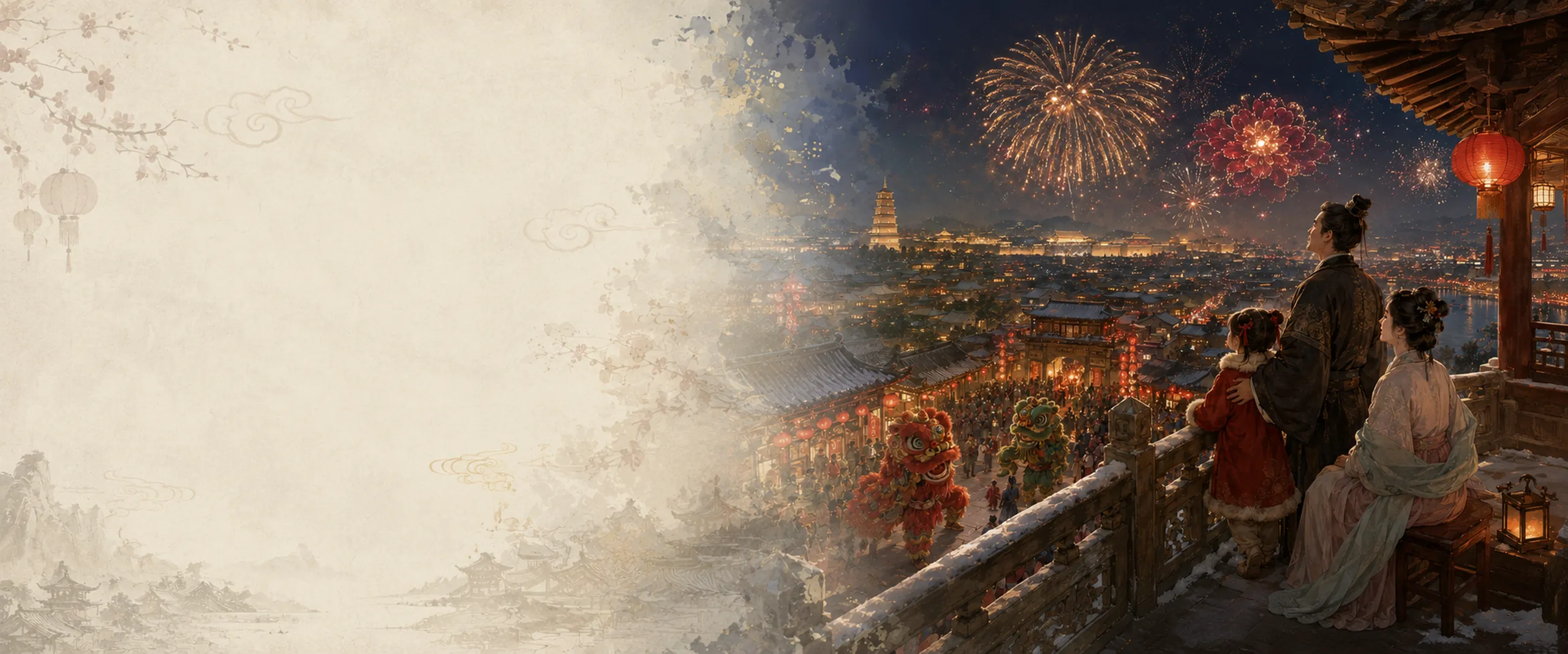
Spring Festival

Spring FestivalGlobal Spread

「 中国年,世界节。 」

Spring Festival customs are rich and varied: on the twenty-third day of the twelfth lunar month, people worship the Kitchen God; before New Year’s Eve, they sweep away dust, and because “dust” (尘, chén) and “old” (陈, chén) are homophones in…

In December 2024, China’s nomination, “Spring Festival — Social Practices of the Chinese People in Celebration of the Traditional New Year,” was reviewed by UNESCO’s Intergovernmental Committee for the Safeguarding of the Intangible Cultural Heritage and inscribed on UNESCO’s Representative List of the Intangible Cultural Heritage of Humanity. The accompanying nomination dossier and video were likewise recognized as exemplary models. The nomination defines the Spring Festival not as a single day, but as a ritual process: a complete ceremonial cycle marked by the first day of the Lunar New Year and extending from the twenty-third day of the twelfth lunar month through the fifteenth day of the first lunar month. The success of the nomination goes beyond the conventional aim of safeguarding individual forms of intangible cultural heritage in order to preserve human cultural diversity. It also brings into sharper relief the deeper role intangible heritage can play in advancing sustainable social development, encouraging mutual learning among civilizations, and fostering harmonious coexistence.

The Lunar New Year of 2025 was the first Spring Festival following the successful UNESCO inscription, and celebrations around the world were especially extensive. That year, the “Happy Chinese New Year” program presented nearly 500 events across more than 100 countries and regions, ranging from New Year concerts and public-square festivities to Spring Festival temple fairs, global lantern-lighting ceremonies, and “traveling New Year’s Eve dinners.” During the 2026 Bingwu Year of the Horse, “Chinese red” once again illuminated such global landmarks as the London Eye, Dubai’s Burj Khalifa, and the Sydney Opera House. From the bustling Chinatowns of New York and London to the vibrant cultural centers of Sydney, Toronto, and Kuala Lumpur, wherever Chinese communities have taken root, the Spring Festival is celebrated with warmth and enthusiasm.

Spring Festival / Global Spread
106 days until Spring Festival February 6, 2027 · Lunar 正月初一

Celebrated Worldwide

Regional Highlights
01

The Americas

United States

The United States is one of the countries where Spring Festival celebrations are most active and visible. During the 2026 Year of the Horse, festivities unfolded on a broad scale from the East Coast to the West Coast.

New York: From the Firecracker Cultural Fair to the Lunar New Year Parade. On February 17, Chinatown hosted a “Lunar New Year Firecracker Cultural Fair.” Dragon and lion dances, firecrackers, and a wide range of live activities drew thousands of visitors into the distinctive atmosphere of the Chinese New Year. On February 21, Flushing held the “2026 Lunar New Year Parade.” Elaborately decorated floats rolled through the streets to the thunder of gongs and drums as golden dragons twisted overhead and lions danced through the crowds, opening a wider series of Lunar New Year celebrations across the greater New York area. Over time, the parade has become part of the United States’ multicultural immigrant landscape, with growing participation from organizations and groups representing different ethnic communities. On March 1, the 28th New York Lunar New Year Charity Parade was held in Chinatown. New York Governor Kathy Hochul, New York City Mayor Zohran Mamdani, and representatives from different sectors attended. Dozens of floats and more than one hundred marching contingents moved through Chinatown, accompanied by dragon and lion dances, Chinese song and dance performances, and other festive displays that drew large crowds along the streets.

Los Angeles: A Century-Old Golden Dragon Parade. On February 21, Los Angeles staged the 127th Golden Dragon Parade, watched by large crowds lining the route. With more than a century of history, it is one of the city’s longest-running festival traditions, and more than one hundred groups registered to participate that year. Alongside Chinese community organizations, local political and business representatives, civic groups, and cultural organizations joined the procession. Groups from South Korea, Thailand, Japan, South America, and different communities within the United States were also specially invited. Zhuang Peiyuan, president of the Chinese Chamber of Commerce of Los Angeles, remarked: “The Spring Festival is not only a traditional festival of the Chinese community; it is also an annual celebration for the local community.”

Landmark Illuminations and the Arrival of New Technology. On the evening of February 16, the Empire State Building was illuminated with Spring Festival-themed lights. Chinese-made intelligent robots also made their first appearance in New York’s Lunar New Year festivities, turning, waving, and interacting with spectators during the parade, drawing crowds of residents and tourists who stopped to watch and take photographs.

Washington and California: Spring Festival in Multicultural Communities. Washington, D.C.’s largest Lunar New Year celebration has a history of more than sixty years. Dragon and lion dancers, middle-school marching bands, Scouts, and other parade groups fill the streets and lanes of Chinatown. Across California, Chinese communities organize activities such as zongzi-making, calligraphy, and paper-cutting workshops, inviting people of different generations and ethnic backgrounds to experience the beauty of Chinese culture together.

Canada

Spring Festival celebrations in Canada are equally vibrant. In Vancouver, the Chinese community prepared a full program of events for the 2026 Year of the Horse. The Chinatown Storytelling Centre hosted special Lunar New Year painting sessions, introductions to the art of Spring Festival couplets, red-envelope making, candy tasting, and other cultural experiences. On February 19, the third day of the Lunar New Year, the Joint Council of Chinese Associations in Canada held the 2026 Bingwu Year of the Horse Spring Festival Temple Fair at the Greater Vancouver Chinese Cultural Centre. The annual Lunar New Year parade was staged in grand fashion at the iconic Millennium Gate, drawing tens of thousands of local residents and visitors. The 52nd Vancouver Chinatown Spring Festival Parade followed on February 22.

In Toronto, the landmark CN Tower was illuminated in red to welcome the Lunar Year of the Horse. During the festival period, Chinatowns in Toronto and other cities were dressed in lanterns and festive decorations, while dragon and lion dances drew residents and tourists alike to stop and watch.

Brazil

During the 2026 Year of the Horse, Brazil’s Carnival and the Chinese Spring Festival happened to coincide. At a grand Carnival parade staged in the historic old quarter of Recife, capital of Pernambuco in northeastern Brazil, performers dressed in brilliant gold as a “golden dragon” surged and twisted above the crowd, weaving unmistakable Chinese imagery into the spectacle.

Spectator Maria Oliveira said: “The Chinese New Year and Carnival work beautifully together. I believe this kind of interaction is deeply meaningful for cultural exchange and connection between the two countries.” Lu Gongrong, president of the Recife Association of Overseas Chinese and Chinese Residents, noted that the year marked the “China-Brazil Year of Culture,” and that the encounter between the Chinese Spring Festival and Brazilian Carnival gave more Brazilians an opportunity to experience the appeal of Chinese culture.

On February 28, the Chinese Association of Brazil and 16 Zhejiang-origin Chinese associations jointly organized a Lantern Festival garden gathering in São Paulo, attracting tens of thousands of people to taste food and watch performances. Yu Peng, Consul General of China in São Paulo, said in his opening remarks: “This year, the Chinese Spring Festival and Brazilian Carnival happened to coincide. The most important festivals in the two cultures met in the same time and space.”

Argentina

In Buenos Aires, the landmark Women’s Bridge was illuminated in “Chinese red” to celebrate the Year of the Horse.

Venezuela

In 2025, the “Happy Chinese New Year · Spring Flower Market Carnival” opened in grand style at Youth Square in Caracas. Dragon and lion dances appeared on the same stage as Venezuela’s traditional folk “Devils Dance,” creating a vivid moment of cultural encounter.

Peru

During the 2026 Spring Festival, Peruvian students presented Chinese kung fu while wearing mamianqun.

02

Europe

United Kingdom

The United Kingdom hosts the largest Spring Festival celebration in Europe, and indeed one of the largest outside Asia. On February 22, 2026, the Chinese New Year celebration organized by the London Chinatown Chinese Association took place in Trafalgar Square, drawing nearly one million participants. The event also marked its 25th anniversary. British Prime Minister Starmer and Foreign Secretary Cooper sent congratulatory messages. In his remarks, Chinese Ambassador to the United Kingdom Zheng Zeguang described the annual Trafalgar Square celebration as the largest Spring Festival event outside Asia.

The program opened in spectacular fashion with lion dancing on plum blossom poles. Dragon dancers from Zhejiang and the powerful Ansai waist drums of Shaanxi were joined by the “Affection for China · Spring Festival Across the Seas” art troupe, the “Happy Chinese New Year” art troupe, the Zhejiang Wuju Opera Troupe, and local London artists in performances lasting more than five hours. A street procession through the neighborhoods around Trafalgar Square drew large crowds, filling central London with an unmistakable Chinese New Year atmosphere.

The celebration also featured float parades, stage performances, folk-culture activities, and culinary experiences. Earlier, on the evening of February 16, the London Eye had been illuminated in red, while performers presented a lion dance in front of the landmark.

France

On February 2, 2025—the fifth day of the Lunar New Year—the third “Happy Chinese New Year Across Paris, Dragons and Lions Celebrate on the Champs-Élysées” parade was held in grand style on the Champs-Élysées. Dragon and lion dance teams, Yingge troupes, Chinese-French children’s choirs, dance groups, and other contingents moved along the avenue, drawing more than 200,000 people into the Spring Festival celebration.

The Ximen Yingge Troupe from Chaoyang, Shantou, Guangdong, became an immediate focal point of the parade. In 2026, overseas Chinese communities in Lyon, in addition to celebrations organized by local associations, also welcomed the “Affection for China · Spring Festival Across the Seas” performance.

In Paris, Chinese-made intelligent robots appeared in the Spring Festival parade for the first time. They not only kept pace with the procession, but also turned, waved, and interacted with spectators. La Poste of France issued Spring Festival zodiac stamps for the 22nd consecutive year.

Germany

On the evening of February 5, 2026, the China Cultural Center in Berlin, together with the Berlin municipal government and the Hubei Provincial Department of Culture and Tourism, held the 2026 Year of the Horse “Happy Chinese New Year” gala and Spring Festival reception at Berlin’s Red City Hall. More than 300 guests gathered to welcome the Chinese Year of the Horse.

It was the 12th time the “Happy Chinese New Year” cultural program had appeared at Berlin City Hall. Traditional lion dancing, Chinese opera, and other performances were presented during the evening.

Italy

From February 21 to 22, overseas Chinese communities in Rome organized the 2026 Lunar New Year Garden Fair. Chinese associations staged dragon and lion dance processions, ethnic song and dance performances, traditional food tastings, and humanoid robot demonstrations—activities rich in festive atmosphere and contemporary technological flair. The events drew tens of thousands of local participants.

On February 21, the “Same Roots, Same Dream” Rome event, jointly organized by several overseas Chinese associations, was successfully held at Victoria Park. On February 22, Prato staged a citywide dragon-dance parade that has become a recognized cultural calling card of Tuscany. In Florence, the “Blessings Fill the New Spring” event at Dante Square in Campi introduced fish lanterns from She County, Anhui, together with a hands-on “fish-lantern coloring” workshop.

Chen Zhengxi, founding president of the Italy-China General Chamber of Commerce, observed that Spring Festival celebrations in Italian cities that year placed greater emphasis on “citywide coordination and immersive experiences,” evolving from celebrations “organized by overseas Chinese communities” into festivities involving “the entire city.”

Hungary

The eighth “Chinese Spring” Cultural Festival held three events in succession in Cegléd, Jászfényszaru, and Kozármisleny. The programs brought Chinese tradition into dialogue with local culture: the pipa sounded alongside the Hungarian citera, while Ansai waist drums met Hungarian rural dance.

Organizers noted that most of the crowds filling the streets of Budapest were local residents. The first event included a special “Talking About the Spring Festival” presentation in which Hungarian speakers introduced the origins and customs of the festival to the audience. Along the Danube, Sichuan Opera face-changing and “fire-spitting” techniques left Hungarian spectators astonished.

Netherlands

In The Hague, the Utrecht Zuylen Orchestra performed 《良宵》 and 《花样年华》 through violin-concerto arrangements, allowing Eastern melodies to flow naturally within a Western artistic context.

Belgium

In February 2026, the 2026 “Chinese Music Spring” Spring Festival traditional-music concert was held in Brussels. Cai Run, head of the Chinese Mission to the European Union, attended the event.

Spain

Fuenlabrada in the Madrid region hosted a “Happy Chinese New Year” Year of the Snake road race, joined by more than one thousand Spanish participants and members of the Chinese community in Spain. Chinese community organizations also held a large Spring Festival gala in which Chinese classical dance and Spanish castanet dance shared the stage.

Finland

At Kulosaari Secondary School in Helsinki, students experienced shadow-puppet theatre under professional guidance.

Croatia

The Croatia-China Friendship Association held a Spring Festival reception attended by more than one hundred Chinese and Croatian guests. Croatian artists performed Chinese songs including 《茉莉花》 in Chinese.

Russia

During the 2026 Spring Festival, the Palace Bridge over the Neva River in St. Petersburg changed into “red attire.” In 2025, the “Chinese New Year in Moscow” cultural program opened at Manezh Square in central Moscow and continued through February 9.

Russian Foreign Ministry spokesperson Zakharova extended Lunar New Year greetings to Chinese friends in Chinese. The Confucius Institute at Far Eastern Federal University also organized Spring Festival cultural activities, where local participants wrote the character “福,” practiced Chinese painting techniques, made Chinese knots, and painted Peking Opera facial designs.

03

Asia

Asia is the region where Spring Festival culture has spread most deeply and extensively. In many countries, celebrations extend well beyond Chinese communities: the festival has either been incorporated into national public-holiday systems or developed into distinctive local traditions of its own.

Malaysia

On January 25, 2025, the global launch ceremony of the 2025 “Happy Chinese New Year” program, together with the “Happy Chinese New Year · Celebration Across Five Continents” performance, was held in Kuala Lumpur. Malaysian Prime Minister Anwar attended.

Before the ceremony, 1,200 drones illuminated the Kuala Lumpur night sky, forming Year of the Snake-themed imagery and the words celebrating everlasting friendship between China and Malaysia.

During the 2026 Year of the Horse, the Lunar New Year atmosphere in Malaysia was described as “so strong it could hardly be dissolved.” Zhang Cong, chairman of World Chinese Media Group, noted that overseas Chinese families continued to preserve traditions such as putting up Spring Festival couplets, hanging lanterns, sharing reunion dinners, and setting off fireworks. The festival has moved beyond the Chinese community, with people of other ethnic groups actively joining New Year greetings and festive activities.

Jonker Walk in Malacca hung 2,026 red lanterns in conjunction with the 2026 Visit Malaysia and Visit Melaka Year.

Thailand

During the 2026 Year of the Horse, Thailand’s “Light Up Yaowarat” Spring Festival lantern display opened in Bangkok’s Chinatown. In 2025, Princess Sirindhorn attended the opening ceremony of Thailand’s “Happy Chinese New Year.” Thai King Vajiralongkorn, Prime Minister Paetongtarn, and other political leaders took part in a series of China-Thailand New Year greeting activities.

Singapore

During the Spring Festival, Singapore’s Chinatown is decorated with lanterns and festive ornaments, while dragon and lion dances attract local residents and tourists.

Indonesia

During the 2026 Spring Festival, the “Galloping Horse Welcomes Spring, Blessings Fill ASEAN” — 2026 Happy Chinese New Year Carnival at ASEAN Headquarters was held in Jakarta. Indonesian young people performed 《茉莉花》 on traditional instruments.

Also in Jakarta, the Chinese ethnic instrument maguhu met Indonesia’s distinctive gamelan, as Chinese and Indonesian musicians jointly performed 《山歌好比春江水》.

Japan

Yokohama Chinatown is the most concentrated center of Spring Festival celebration in Japan. The 2025 “Yokohama Spring Festival” expanded to more than 50 venues, far exceeding previous years in scale. Large traditional Chinese lanterns were installed at more than fifty locations, while lion dancing, Peking Opera, face-changing, festival processions, fireworks events, and other activities were staged in succession.

In November 2025, the “Spring Festival Lantern Flowers” event opened in Yokohama Chinatown, featuring lanterns dominated by auspicious shades of red and gold and continuing through March of the following year.

South Korea

On February 8, 2025, a Spring Festival temple fair was held at Seoul Overseas Chinese Primary School, where Miao dance, Sichuan Opera face-changing, martial arts demonstrations, traditional instrumental music, and other performances appeared in succession.

Seoul’s Namsangol Hanok Village launched the “2025 Namsangol Spring Festival Celebration — New Year Lanterns,” including traditional performances, games, rice-cake making, and handicraft experiences. Unhyeongung Palace held the “2025 Unhyeongung Good Fortune Spring Festival” program, featuring rice-cake sharing, New Year fortune predictions, and the traditional blessing activity “地神踩踏”.

Laos

Vientiane, the capital of Laos, hosted a wide range of Spring Festival celebrations.

Nepal

During the 2026 Year of the Horse, a China-Nepal cross-border Lunar New Year gala was held in the tourist city of Pokhara.

Sri Lanka

During the 2025 Spring Festival, Sri Lanka held a Chinese Culture Week and other activities, including a “Chinese Food Festival” and “Port City Chinese Culture Night.”

Bangladesh

On January 10, 2025, a “Happy Chinese New Year” temple fair was held in Dhaka, attracting thousands of Bangladeshi residents to experience Chinese Spring Festival culture.

Pakistan

The Chinese Embassy in Pakistan organized the “Open the Door to Celebrate the New Year · We Are Together” Spring Festival event in Islamabad.

Afghanistan

The Confucius Institute at Kabul University held a cultural event celebrating the Chinese Spring Festival, attended by more than one hundred representatives of Kabul University faculty and students as well as Chinese enterprises in Afghanistan.

04

Oceania

Australia

Australia’s Spring Festival celebrations rank among the largest outside Asia.

Sydney Opera House Illuminated in “Chinese Red.” From February 12 through February 27, the Sydney Opera House was illuminated in “Chinese red” every evening in celebration of the Chinese Lunar New Year—the Spring Festival.

Lunar New Year Concert. On the evening of February 21, the 2026 “Happy Chinese New Year · Lunar New Year Concert” was held at the Sydney Opera House Concert Hall and incorporated into China’s 2026 global “Happy Chinese New Year” cultural-brand program.

Celebrating the New Year at the Museum. On February 22, the “Happy Chinese New Year — Celebrating the New Year at the Museum” event took place at the Australian National Maritime Museum in Sydney’s Darling Harbour. The exhibition halls offered a broad range of Chinese cultural experiences and attracted more than 2,000 local residents and visitors.

Sydney Lunar New Year Dragon Boat Races. From February 28 to March 1, the 2026 Sydney Lunar New Year Dragon Boat Races were held at Darling Harbour. With a history of more than 40 years, the event is the finale of Sydney’s Lunar New Year celebrations and the largest dragon boat race in the Southern Hemisphere.

Across the two days, more than 100 professional clubs and more than 60 corporate and community teams took part, with thousands of competitors paddling in the races. Organized by Dragon Boats NSW, the event is one of the major highlights in the City of Sydney’s Lunar New Year celebration program.

Spring Festival Carnival Arts Festival. Dunhuang dance, Sichuan Opera face-changing, dragon and lion dancing, and other performances rich in ethnic character appeared on Sydney’s streets and theatre stages. Members of the Sydney Huaxing Arts Troupe presented ethnic song and dance performances in an outdoor square in the city center.

Organized by municipal governments across greater Sydney, the celebrations continued for two weeks. Alongside overseas Chinese associations, ethnic community groups from Thailand, Laos, Ireland, and elsewhere also took part.

Yu Junwu, head of the Sydney Huaxing Arts Troupe, remarked: “Now that the Spring Festival has been inscribed on the world intangible cultural heritage list and is widely known in mainstream local society, Spring Festival activities have also moved beyond Chinatown and become a cultural microcosm of the local multicultural community.”

Melbourne and Australia-Wide Participation. On February 21, Melbourne’s Box Hill hosted the “2026 Whitehorse Lunar New Year Carnival.” A national Chinese community Spring Festival gala was successfully held in Canberra, the capital. Australian Prime Minister Albanese wrote on social media that the Spring Festival has become an important date on Australia’s cultural calendar.

New Zealand

During the 2025 Year of the Snake, the “Lunar New Year Flower Market Fun Day” was held in Auckland. On February 1, the Museum of New Zealand hosted Spring Festival celebrations in its Māori meeting hall.

05

Africa

South Africa

South Africa is one of the African countries where the Spring Festival has taken deepest root.

On February 1, 2026, the fourth “Cape Town Chinese New Year” celebration was held at the renowned Victoria & Alfred Waterfront in Cape Town, South Africa’s legislative capital. The event was jointly organized by the Cape Town Huaxing Arts Troupe and several local Chinese associations.

Under the intense Southern Hemisphere sun, Victoria Harbour was dressed in “Chinese red,” set against the blue sky and sea. Visitors could explore festival markets, taste Chinese food, experience traditional Chinese culture, and watch stage performances. The event attracted tens of thousands of local residents and international visitors.

The Confucius Institute at Stellenbosch University offered a hanfu experience. Among the crowds were overseas Chinese dressed in festive attire as well as South African families, bringing together people of different skin colors and languages in the same celebration.

On February 13, the Chinese Embassy in South Africa held the “Happy Chinese New Year · Celebrating the Chinese New Year Together” event. Chinese Ambassador to South Africa Wu Peng, guests from different sectors of South African society, representatives of Chinese-funded institutions, and members of overseas Chinese communities—nearly one thousand people in all—gathered for the occasion.

Kenya

On February 8, 2026, the third Nairobi Chinese Spring Festival Temple Fair opened at the Two Rivers Mall plaza in Nairobi. The Spring Festival market and food street brought the atmosphere of Chinese New Year to the African highlands, with red lanterns and festive door decorations filling the venue. Zimbabwean artists and Chinese performance groups appeared together on stage.

On February 12, the 2026 Happy Chinese New Year celebration, “Galloping Steeds Celebrate the Chinese New Year,” together with the opening of the 2026 “China-Africa Year of People-to-People Exchanges,” was held in Nairobi. More than 1,000 people, including Tang Jianjun, counselor of the Chinese Embassy in Kenya; Leonida Kerubo, vice chancellor of the University of Nairobi; overseas Chinese residents; and representatives of Chinese-funded enterprises, gathered for the event.

At Milimani Primary School in Nairobi, the eighth Kenya Overseas Chinese Spring Festival Gala opened on the school grounds.

Uganda

On February 8, the “Warm Welcome to Spring · Celebrating the Chinese New Year Together” Spring Festival temple fair organized by overseas Chinese communities in Uganda, together with the launch ceremony of the China-Uganda Year of People-to-People Exchanges, was successfully held.

Egypt

At Cairo’s “Spring Festival Market,” paper-cutting and calligraphy works combining Chinese and Arab elements drew the attention of local visitors.

Botswana

The Confucius Institute at the University of Botswana held Spring Festival celebrations in Gaborone, the capital. Confucius Institute teachers and primary-school students jointly presented martial arts, Chinese and international songs and dances, and other performances.

Morocco

The Chinese Embassy in Morocco held a Lunar New Year reception for overseas Chinese communities.

“Happy Chinese New Year” and the Globalization of the Brand

In-Depth Feature

The Global “Happy Chinese New Year” Brand. Organized by China’s Ministry of Culture and Tourism, the “Happy Chinese New Year” program has been held for 25 consecutive years since 2001. In 2025, nearly 500 events were staged across more than 100 countries and regions, encompassing Lunar New Year concerts, public-square celebrations, Spring Festival temple fairs, global lantern-lighting events, traveling New Year’s Eve dinners, and other programs. For the first time, the global launch ceremony was held in Kuala Lumpur, where 1,200 drones illuminated the night sky.

Landmarks in “Chinese Red.” As “Chinese red” illuminates landmarks such as the London Eye, Dubai’s Burj Khalifa, and the Sydney Opera House, the Spring Festival is increasingly becoming a festival shared by the world. The Empire State Building in New York, the Palace Bridge in St. Petersburg, the London Eye, the Sydney Opera House, Women’s Bridge in Buenos Aires, and other global landmarks have all changed into “red attire.” The Eiffel Tower in Paris, Milan’s Chinatown, and other locations have likewise been illuminated in Chinese red.

Spring Festival in the Digital Age. Social media has become an important platform for the global circulation of Spring Festival culture. Short videos recording Yingge performances on the Champs-Élysées in Paris spread widely online. After China introduced visa-free entry for holders of ordinary passports from Canada and the United Kingdom, and with the continued expansion of visa-free access, improved departure tax-refund policies, and enthusiastic promotion across social media, “going to China for the Spring Festival” has emerged as a new trend among many overseas internet users.

The Globalization of the Spring Festival Economy. Businesses around the world have recognized the Spring Festival as a major commercial opportunity. International brands have developed special marketing campaigns, including limited-edition products linked to the Spring Festival and advertising created specifically around the holiday.

Mutual Learning Among Civilizations

In-Depth Feature

From a traditional festival of the Chinese nation, the Spring Festival has gradually moved onto the world stage. With “reunion” as its emotional core, “Chinese red” as its visual symbol, and “family reunion” as its spiritual essence, its global spread is turning the festival into a cultural celebration increasingly shared across societies.

The Spring Festival as a Global Cultural Symbol. Around one-fifth of the world’s population celebrates the Spring Festival, while nearly 20 countries have designated it as an official public holiday. Its globalization reflects the broad appeal of Chinese culture, from cuisine and traditional dress to art and custom. Foreign media commentary has observed that the increasingly global character of the Spring Festival reflects China’s growing soft power. One article wrote: “The Spring Festival has transcended national borders and become a truly global celebration.”

The Global Significance of UNESCO Recognition. The successful inscription of the Spring Festival stands as an example of the systematic and holistic approach long pursued in the safeguarding of intangible cultural heritage. The festival does more than provide Chinese people with a sense of identity and continuity. The ideas it embodies—harmonious coexistence between humanity and nature, and harmonious relations among people—can, through sustained cultural dialogue and mutual learning among civilizations, provide enduring momentum toward the ultimate well-being of humanity.

The local reflection and cultural dialogue encouraged by the UNESCO nomination are therefore not an endpoint. Rather, they mark a new beginning: one that takes culture as a bond and universality as a foundation, and that seeks through dialogue and mutual learning among civilizations to move toward the building of a community with a shared future for humanity.

The Spring Festival as a Bridge Between Civilizations. Joyful, peaceful, and auspicious, the Spring Festival carries the blessings and warmth of spring. It also embodies the Chinese cultural ideals of concord, harmony, and peace, and expresses universal human values such as family harmony, social inclusion, and harmonious coexistence between humanity and nature.

Bangura, Director-General of the United Nations Office at Nairobi, has said that Spring Festival culture profoundly embodies the value of harmonious coexistence between humanity and nature. It is an important expression of Chinese culture and, at the same time, a bond and bridge connecting China with other civilizations of the world. Khamis Omar, Tanzania’s ambassador to China, expressed the hope that, following the Spring Festival’s successful UNESCO inscription, people around the world would gain a deeper understanding of both the Chinese Spring Festival and Chinese culture.

From “Each Appreciating Its Own Beauty” to “Beauty Shared by All.” The experience of the Spring Festival’s UNESCO inscription shows that, on the basis of the universal characteristics shared by humanity and culture, deep reflection on local tradition and effective cultural translation can create a platform for dialogue and provide people of different countries with cultural codes that can be understood and appreciated across boundaries.

It means moving beyond the self-contained realm of “各美其美”, toward “美人之美” and ultimately “美美与共”—from appreciating one’s own beauty, to appreciating the beauty of others, and finally to a world in which different forms of beauty flourish together. Spring Festival couplets, New Year prints, dumplings, tangyuan, dragon dances, lion dances, red envelopes, temple fairs—each cultural symbol of the Spring Festival is now being understood, appreciated, and shared in different corners of the world.

Closing Note

Lingering Notes

The global spread of the Spring Festival has followed a long road from China to the world’s five continents. Its inscription in 2024 on UNESCO’s Representative List of the Intangible Cultural Heritage of Humanity marked the Spring Festival’s rise from a traditional festival of the Chinese nation to a cultural heritage shared by all humanity. Unlike the dragon boat races of the Dragon Boat Festival or the full-moon longing of the Mid-Autumn Festival, the Spring Festival has traveled abroad with “reunion” as its boat, “Chinese red” as its sail, and “family reunion” as its oar, carrying the spirit of the New Year to every corner of the world.

Across the Americas, from the “Chinese red” of the Empire State Building in New York to Vancouver Chinatown’s Lunar New Year parade of 90 contingents, from the golden dragon soaring through Brazil’s Carnival to Venezuela’s “Spring Flower Market,” the joy of the Spring Festival echoes through the cities and streets of the New World.

Across Europe, from the nearly 800,000 people gathered for the Lunar New Year celebration in London’s Trafalgar Square to the spectacle of 200,000 people along the Champs-Élysées in Paris, from the “Happy Chinese New Year” gala at Berlin City Hall to the eye-dotting of dragon and lion dances in Rotterdam, Spring Festival blessings move through Europe’s ancient cities.

Across Asia, from 1,200 drones illuminating Kuala Lumpur’s night sky to the lantern displays of Bangkok’s Chinatown, from the “Spring Festival” celebrations spread across more than 50 venues in Yokohama Chinatown to the temple fair at Seoul Overseas Chinese Primary School, Spring Festival traditions continue to take root in neighboring countries.

Across Africa, from dragon and lion dances at Nairobi’s Spring Festival temple fair to dragon boat racing on the Nile in Cairo, the footsteps of the Spring Festival have reached the African continent.

Across Oceania, from the dragon boat race of 3,000 competitors at Sydney’s Darling Harbour to Auckland’s “Lunar New Year Flower Market Fun Day,” the joy of the Spring Festival drifts beneath the warm sun of the Southern Hemisphere.

The global spread of the Spring Festival is not merely a cultural feast; it is also a dialogue among civilizations. As the successful UNESCO inscription makes clear, the ideas carried by the festival—harmonious coexistence between humanity and nature, and harmonious relations among people—can, through sustained cultural dialogue and mutual learning among civilizations, provide enduring momentum toward the ultimate well-being of humanity.

When people of different skin colors and languages celebrate the Chinese New Year together; when families from different cultural backgrounds put up Spring Festival couplets, make dumplings, and exchange the greeting “恭喜发财”—that is the Chinese nation, in its own way, offering its most heartfelt declaration of “reunion” and “harmony,” “inheritance” and “sharing.”

The red lanterns of the Spring Festival are illuminating every corner of the world.

—-

[Language: es]

Continue exploring Spring Festival culture

Readers’ Comments

Calendar and traditional culture enthusiasts from around the world, sharing the same moon.

Sign in or register to join the conversation. Your comment account is created automatically the first time you use a connected account.