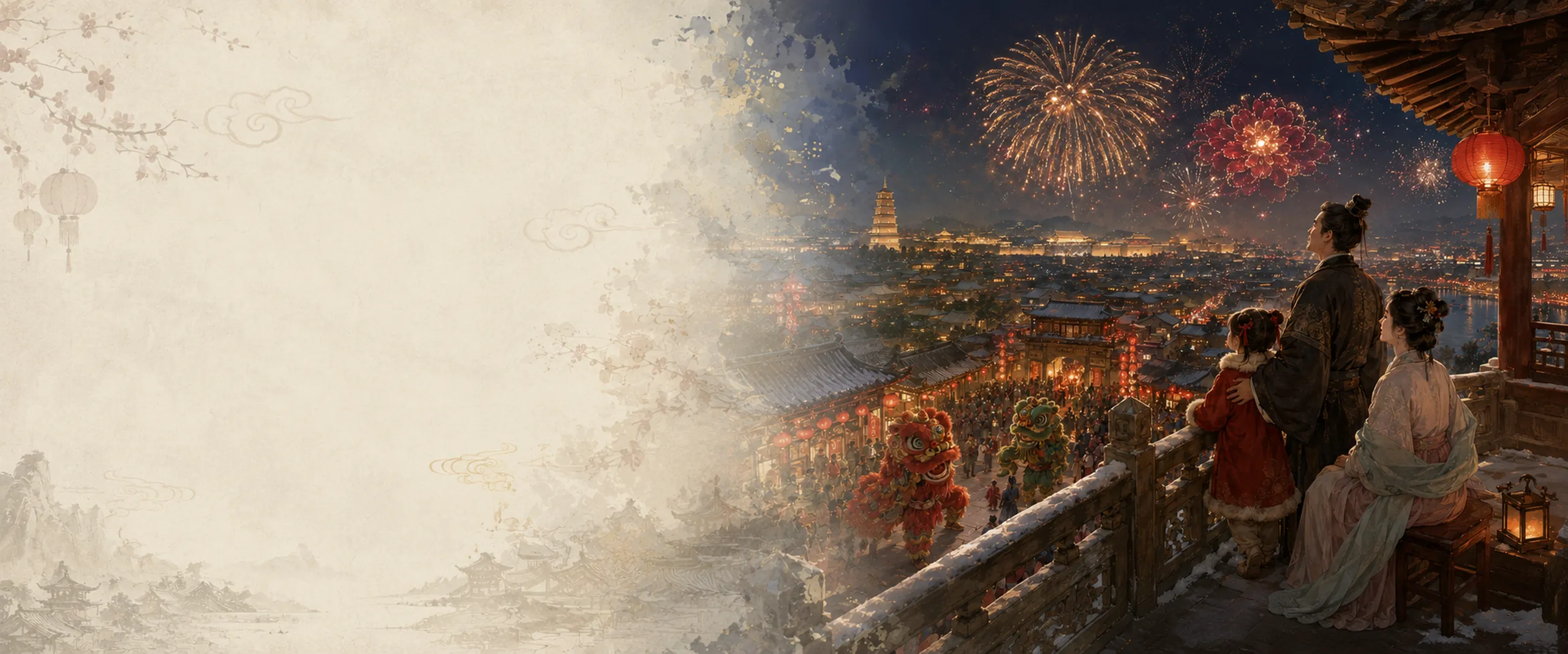
The Spring Festival is a comprehensive body of folk culture encompassing sacrifices, rituals, festive decorations, food traditions, entertainment, and social customs. Major activities include drinking Laba porridge (腊八粥) on the eighth day of the twelfth lunar month; worshipping the Kitchen God (祭灶) around the twenty-third day; making dumplings, tangyuan and rice cakes, sharing the family reunion dinner, staying awake on New Year’s Eve, hanging Spring Festival couplets, New Year pictures and paper cuttings, and setting off firecrackers; welcoming deities and exchanging New Year greetings on the first day of the first lunar month; and visiting lantern fairs and solving lantern riddles during the Lantern Festival on the fifteenth day. More than a seasonal celebration, the Spring Festival provides an important cultural setting in which family affection, harmonious relationships, and social bonds are renewed and strengthened. Over thousands of years, it has continually reinforced emotional ties among individuals, families, communities, and the nation, playing an important role in the continuity of Chinese civilisation.
Main Customs
Sweeping Away the Dust
Historical Origins
The custom of sweeping away the dust (扫尘) developed very early. The Lüshi Chunqiu (《吕氏春秋》, The Annals of Lü Buwei) already contains traditions associating house cleaning before the New Year with the legendary ages of Yao and Shun. During the Song dynasty, Wu Zimu (吴自牧) wrote in Mengliang Lu: New Year’s Eve (《梦粱录·除夜》):
“Whether noble or common, large household or small, every family sweeps away dust from gates and doorways, removes dirt, cleans courtyards, replaces the Door Gods, hangs images of Zhong Kui, fixes peachwood charms and pastes spring placards.”
The passage shows that by the Song period, New Year cleaning had already become closely integrated with the wider system of household renewal and protective decoration.
What People Do
A traditional saying goes: “On the twenty-fourth day of the twelfth lunar month, brush away the dust and sweep the house.” (腊月二十四,掸尘扫房子。) Cleaning the home before the Spring Festival has long been a widespread Chinese custom. In northern China it is commonly called “sweeping the house” (扫房), while in the south it is often known as “dusting” (掸尘).
As the festival approaches, households thoroughly clean their surroundings, wash utensils, remove and launder bedding and curtains, sweep courtyards, clear dust and cobwebs, and clean open and covered drains. In folk interpretation, the Chinese words for “dust” (尘, chén) and “old” (陈, chén) are homophones. Sweeping away dust therefore symbolically means “removing the old and establishing the new” (除陈布新)—sweeping poverty, bad luck, and the misfortunes of the previous year out of the home.
Cultural Meaning
The custom expresses the desire to discard the old, renew life, and welcome the coming year. Cleaning is therefore more than a physical act. It also represents spiritual purification: the dust, frustration, and misfortune of the old year are swept away so that the New Year may enter a clean and orderly household bearing fortune and happiness. In traditional Chinese thought, the cleanliness of the home and the auspicious wellbeing of the family are closely linked.
How to Take Part
Before the Spring Festival, families can carry out a thorough household cleaning together. Traditionally, some northern regions begin around the twenty-third day of the twelfth lunar month, while southern traditions often favour the twenty-fourth. Family members can divide the work, clean neglected corners, wash bedding and curtains, and prepare the home to welcome the New Year in a fresh and renewed state.
Worshipping the Kitchen God
Historical Origins
The custom of worshipping the Kitchen God (祭灶) is extremely old and reflects ancestral gratitude and reverence toward fire and the household stove. The Kitchen God was already regarded as an important deity in early Chinese tradition, and by the pre-Qin period, sacrifice to the stove was counted among the traditional “Five Sacrifices” (五祀).
From the Sui and Tang dynasties onward, worship of the Kitchen God gradually separated from the broader year-end sacrificial system and developed into a dedicated ritual associated with the Little New Year (小年).
What People Do
Kitchen God worship traditionally marks the beginning of preparations for the Spring Festival. A folk saying runs: “officials on the twenty-third, commoners on the twenty-fourth, boat people on the twenty-fifth” (官三民四船家五), referring to differing traditional dates for the ritual.
Today, the Little New Year is commonly associated with the twenty-third day of the twelfth lunar month in northern China and the twenty-fourth in the south. Families place fruits, wine, dishes, sweets, and other offerings before the Kitchen God, hoping that he will speak favourably of the household when reporting to Heaven and thereby help secure good weather and good fortune.
Sticky sweets such as maltose were traditionally offered so as to “sweeten” or symbolically seal the Kitchen God’s mouth, encouraging him to report only good things. In Qing-dynasty Beijing, offerings included nantang sweets, Guandong malt candy and sugar cakes, while water and beans were also prepared for the divine horse said to carry the Kitchen God to Heaven.
Cultural Meaning
Kitchen God worship expresses reverence and gratitude toward the hearth as the centre of household life. The Kitchen God was traditionally understood to oversee a family’s food, fortune, and misfortune. The ritual is therefore both an act of devotion and a wish for abundant food, domestic peace, and prosperity in the coming year.
How to Take Part
On the twenty-third or twenty-fourth day of the twelfth lunar month, simple offerings such as traditional sweets or pastries can be placed in the kitchen. In northern China, foods such as Guandong candy or other traditional Kitchen God sweets may be used. Even though modern urban homes no longer have the traditional earthen stove, people can still mark the custom symbolically in the kitchen and learn about its cultural meaning.
Hanging Spring Festival Couplets and New Year Pictures
Historical Origins
Spring Festival couplets (春联) developed from ancient peachwood charms (桃符) associated with warding off harmful spirits. The Book of the Later Han: Treatise on Rituals (《后汉书·礼仪志》) records the use of rectangular peachwood boards hung on either side of gateways, a practice traditionally traced to the Zhou period.
During the Five Dynasties era, Meng Chang (孟昶), ruler of Later Shu, is said to have written on peachwood boards:
“新年纳余庆;佳节号长春。” “May the New Year receive accumulated blessings; may this festive season be called Everlasting Spring.”
It is commonly regarded as one of the earliest surviving examples of a Spring Festival couplet. The custom became established during the Song dynasty and especially widespread in the Ming. The founding Ming emperor Zhu Yuanzhang (朱元璋) strongly encouraged the practice and, after establishing his capital at Nanjing, is said to have ordered that before New Year’s Eve, “every household, from officials to commoners, must add a pair of Spring Festival couplets to its doorway.”
New Year pictures (年画) can be traced to Han-dynasty images of Door Gods (门神), originally placed on doors to ward off evil and misfortune. With the development of printing during the Tang and Song periods, their subjects diversified, while their function gradually expanded from protection against evil toward inviting auspicious fortune and blessings.
What People Do
Spring Festival couplets use balanced, parallel, concise, and carefully crafted language to express hopes for the coming year and to reflect the spirit of the age. They are a distinctive form of Chinese festive literature. During the Spring Festival, households in both cities and villages traditionally choose bright red couplets and paste them on their doors, adding colour to the festival while bidding farewell to the old year and welcoming the new.
The character 福 (fú, “good fortune” or “blessing”) is also widely displayed. It represents people’s desire for happiness and a good future. The character is sometimes hung upside down because “福倒了” (“fu is upside down”) sounds like “福到了” (“fortune has arrived”) in Chinese, creating an auspicious play on words.
New Year pictures are another traditional form of visual celebration. Historically, families hung newly printed images in main halls, bedrooms, beside windows, on doors, by stoves, and around household shrines. They helped create a festive atmosphere while symbolically inviting divine blessings and driving away calamity.
Cultural Meaning
Spring Festival couplets express auspicious wishes through words, while New Year pictures communicate them through images. Together, they create the festival’s most immediately recognisable visual language: red.
In Chinese culture, red symbolises good fortune, celebration, warmth, vitality, and life. When doorways across entire communities are covered with red couplets and red fu characters, the shared visual environment strengthens both the collective atmosphere of the festival and a sense of cultural belonging.
How to Take Part
Before New Year’s Eve, people can buy Spring Festival couplets and New Year pictures or write their own calligraphy. In traditional vertical formatting, the first line is placed on the right and the second on the left. The character fu may be displayed upright or, where custom permits, upside down on doors, windows, or cabinets. New Year pictures can be hung indoors or on doors, preferably using auspicious themes such as “abundance year after year” (连年有余) or “abundant harvest of the five grains” (五谷丰登).
The New Year’s Eve Reunion Dinner
Historical Origins
The history of the New Year’s Eve dinner (年夜饭) can be traced at least to the Jin dynasty. Zhou Chu (周处) wrote in the Fengtu Ji (《风土记》, Records of Local Customs) of people inviting one another to food and drink in order to “bid farewell to the year”, while staying awake through New Year’s Eve.
The Jingchu Suishiji (《荆楚岁时记》, Records of the Seasonal Customs of Jing and Chu) later recorded:
“At the year’s end, every household prepares dishes and vegetables and goes to the place of keeping the old year, there to welcome the New Year.”
The specific expression “New Year’s Eve dinner” became established relatively late. It appears in the Qing-period work Qing Jia Lu (《清嘉录》) by the Suzhou scholar Gu Lu (顾禄).
At a deeper level, the custom derives from Chinese ideas of family and cyclical time. At the threshold between the old year and the new, time itself is understood as being in transition. A family sitting together to share food therefore represents not only reunion but also a collective ritual of accompanying the passage from one year into the next.
What People Do
The New Year’s Eve dinner, also known as the reunion dinner (团圆饭) or family feast, is the evening meal eaten on the final day of the lunar year. It is one of the most important meals of the entire year for Chinese families.
On New Year’s Eve, households prepare abundant banquets and family members of every generation gather together, speaking auspicious words and sharing the meal. Traditionally, offerings to ancestors may be made before the family begins eating, asking ancestral spirits to protect the household.
In northern China, dumplings are especially important. Their shape resembles traditional silver ingots and therefore symbolises wealth in the coming year. Southern traditions often feature tangyuan and niangao. Tangyuan symbolises reunion, while niangao is associated with the homophonous expression “higher year after year” (年年高).
Fish is common throughout China because 鱼 (yú, “fish”) sounds like 余 (yú, “surplus”), producing the blessing “surplus year after year” (年年有余). The number of dishes is often even, symbolising “good things coming in pairs.” Regional specialities include Sichuan cured meats, Cantonese poon choi, and Hunan steamed combinations of cured meats.
Cultural Meaning
The New Year’s Eve dinner is often regarded as the most important meal of the year in Chinese culture. It is far more than a feast: it embodies the reunion of the family.
No matter how far people live from home, many make great efforts to return before New Year’s Eve so that they can sit at the same table with their relatives. Every dish carries an auspicious meaning, and every toast expresses hope for the year ahead.
How to Take Part
On New Year’s Eve, prepare the meal together with family. Northern-style celebrations may include making dumplings, sometimes with symbolic items such as coins, dates, or peanuts hidden inside. Southern-style meals may include tangyuan or rice cakes.
Sit together, exchange blessings, and enjoy the meal as a family. If reunion with relatives is impossible, friends or colleagues can organise a shared “reunion-table dinner” to preserve the spirit of welcoming the New Year together. Those who wish may place food before ancestral tablets or photographs before eating as a gesture of remembrance and respect.
Staying Up to Welcome the New Year
Historical Origins
The custom of shousui (守岁)—staying awake through New Year’s Eve—has a long history. An early account traditionally attributed to the Western Jin writer Zhou Chu states:
“On New Year’s Eve, people exchange gifts, calling it ‘presenting the year’; invite one another to food and drink, calling it ‘bidding farewell to the year’; and remain awake until dawn, calling it ‘guarding the year.’”
The custom became increasingly prominent during the Southern and Northern Dynasties, when many literary works were written about keeping vigil on New Year’s Eve. In the early Tang dynasty, Emperor Taizong, Li Shimin (李世民) wrote in his poem Keeping the Year:
“寒辞去冬雪,暖带入春风。” “Cold departs with the winter snow; warmth arrives upon the spring wind.”
What People Do
Shousui means remaining awake on the final night of the old year and staying up to greet the arrival of the new. It is also colloquially called “enduring the year” (熬年).
A traditional saying declares:
“One night joins two years; at the fifth watch, the two years divide.”
People traditionally lit candles or oil lamps and stayed awake through the night, symbolically illuminating the darkness and driving away disease and evil while waiting for the auspicious arrival of the new year.
Shousui begins with the reunion dinner, which is traditionally eaten slowly. Families may sit down around nightfall and continue eating, talking, and celebrating until late into the night.
Cultural Meaning
Shousui expresses reverence for time and appreciation for life. At the threshold where one year becomes another, people stay awake to accompany and guard the transition, greeting the first light of the New Year in a conscious and wakeful state.
The custom also strengthens family bonds. During the long night, relatives sit together, talk about the year that has passed, and share their hopes for the year ahead.
How to Take Part
On New Year’s Eve, families can sit together, talk, watch the Spring Festival Gala (春晚) or other festive programmes, share snacks, and remain awake through midnight. Keeping household lights on can symbolise illumination and the expulsion of misfortune.
There is no need for elderly or tired family members to remain awake until dawn; participating through midnight and sharing the family gathering is fully in keeping with the spirit of the custom.
Lucky Money
Historical Origins
Lucky money (压岁钱) is believed to have ancient roots, although the custom became especially widespread during the Ming and Qing dynasties. Historically, there were both specially made protective coins and ordinary circulating currency used as New Year gifts.
The specially produced forms were often imitation coins made of copper or iron, square or rectangular in form, and inscribed with auspicious expressions such as “good fortune and fulfilment” (吉祥如意), “fortune, status, longevity and happiness” (福禄寿喜), or “may you live a hundred years” (长命百岁).
During the Ming and Qing periods, ordinary silver and copper coins increasingly came to be given as lucky money. This marked a gradual shift from a primarily protective or religious function toward the economic gift-giving role familiar today.
What People Do
After the New Year’s Eve dinner, elders traditionally give lucky money to younger family members as a blessing for their safe passage through the year.
A Qing-era poem describing the excitement of children in Hangzhou reads approximately:
“A hundred coins strung long on coloured thread, divided and hidden by the pillow’s edge; debating the price of firecrackers and sweet whistles, the delighted child is busy all night.”
After the Republican period began, it became common to wrap one hundred copper coins in red paper, evoking the blessing “a hundred years of life.” For older descendants, a silver dollar might be placed inside the red wrapping to symbolise flourishing wealth and profitable enterprise.
With modern banknotes, families often favour crisp new notes or consecutive serial numbers, symbolically suggesting continuous prosperity and advancement.
Cultural Meaning
The expression 压岁 (yāsuì) itself carries the idea of suppressing harmful spirits and protecting the recipient through the year. Lucky money is therefore more than a financial gift. It represents an elder’s blessing, protection, affection, and hope for the younger generation.
In contemporary China, it may also express hopes for academic success, professional achievement, health, and a bright future.
How to Take Part
On New Year’s Eve or the first day of the New Year, elders may place money in a red envelope (红包) and give it to younger relatives. Auspicious numbers such as 6, 8, or 9 are often preferred.
Young adults who have begun working may also give red envelopes to parents or grandparents as an expression of gratitude and filial affection. New banknotes are traditionally favoured because they symbolise “a new atmosphere for the new year.”
Setting Off Firecrackers
Historical Origins
The custom of using firecrackers (爆竹) to celebrate the Spring Festival had developed in China by the Han dynasty at the latest and therefore has a history of more than two thousand years.
Its distant origins are sometimes associated with the ancient “courtyard torch” (庭燎) tradition. The Book of Songs: Lesser Odes contains the line “庭燎晰晰”, describing brilliant courtyard fires.
The sixth-century Jingchu Suishiji already records that on the first day of the first lunar month people “rise at cockcrow and first explode bamboo before the courtyard” in order to drive away mountain spirits and evil beings.
During the Tang dynasty, exploding bamboo was known as baogan (爆竿). The Nanchang poet Lai Hu (来鹄) wrote in his poem Early Spring:
“新历才将半纸开,小亭犹聚爆竿灰。” “The new calendar is scarcely half unfolded; by the little pavilion still lie the ashes of exploding bamboo.”
With the invention of gunpowder and the spread of paper, the Northern Song period saw the appearance of paper-wrapped gunpowder devices. These gradually developed into the firecrackers familiar today.
What People Do
Setting off firecrackers is a traditional act of bidding farewell to the old and welcoming the new. On New Year’s Eve, households traditionally ignite them to drive away evil and pray for good fortune.
On the morning of the first day, people may set off firecrackers immediately after opening the front door. This is called the “opening-door firecracker” (开门炮仗). After the explosions, red paper fragments cover the ground, producing what is traditionally called “a hall full of red” (满堂红)—a highly auspicious image.
Cultural Meaning
The loud sound of firecrackers has long been believed to possess the power to frighten away harmful forces and avert calamity.
The popular legend of the Nian monster (年兽) provides a vivid narrative explanation: loud explosions could terrify the creature and protect households from harm. At the same time, the sound of firecrackers announces the arrival of the New Year and communicates human joy and hope to Heaven and Earth.
How to Take Part
Where legally permitted, firecrackers and fireworks may be set off in courtyards or designated areas on New Year’s Eve. Safety precautions and local regulations should always be observed.
Many cities now restrict or prohibit private fireworks for environmental and safety reasons. In such places, official firework shows, light displays, or electronic firecrackers provide safer alternatives.
Paying New Year Calls
Historical Origins
The custom of paying New Year calls (拜年) is sometimes linked to formal New Year court audiences held in imperial times. Ministers first paid respects to the emperor on New Year’s Day, and the wider practice of exchanging ritual congratulations gradually became popular among the general population.
Forms of New Year greeting existed by the Han dynasty. During the Song period, sending name cards or congratulatory visiting slips became fashionable, much like New Year cards today. By the Qing dynasty, collective forms of greeting known as “group New Year calls” (团拜) had also developed.
What People Do
Paying New Year calls is one of the most important social customs of the Spring Festival. Historically, the term primarily referred to formally congratulating elders on the New Year, usually beginning within one’s own household.
On the first morning of the year, people rise early, put on their best clothes, visit relatives and friends, and exchange auspicious wishes.
In earlier society, the process strongly reinforced family hierarchy and kinship relationships. The Qing writer Gu Tieqing (顾铁卿) described in Qing Jia Lu:
“After men and women have paid respects to the head of the household in order, the host leads younger and junior members out to visit neighbours, clan relatives and friends; or sends younger family members in their place. This is called ‘paying New Year calls.’”
Cultural Meaning
New Year calls are among the most important social-interaction rituals of the Spring Festival. They do more than convey blessings: they reaffirm and strengthen social relationships.
Through face-to-face greetings, ties between relatives, neighbours, friends, and communities are renewed. Although modern technology has diversified the ways people exchange New Year greetings, the underlying function—maintaining emotional connections and expressing good wishes—remains unchanged.
How to Take Part
On the first day of the New Year, greet elders respectfully and offer auspicious phrases. Then visit relatives and friends, or contact them by telephone, video call, or messaging applications.
Common greetings include “Happy New Year” (新年快乐), “May everything go as you wish” (万事如意), “Wishing you prosperity” (恭喜发财), and “Wishing you good health” (身体健康). Electronic red envelopes may also be sent when an in-person visit is impossible.
Dragon and Lion Dancing
Historical Origins
The origins of dragon dancing (舞龙) can be traced to the pre-Qin period, when dragons were understood as divine beings capable of connecting Heaven and Earth. During the Han dynasty, dragon dances were performed in rituals praying for rain and functioned as both ceremonial acts and entertainment.
Lion dancing (舞狮) developed during the Southern and Northern Dynasties, initially as a ritual performance associated with warding off evil and averting disaster. By the Tang dynasty, lion dances had also become court entertainment. After the Five Dynasties and Ten Kingdoms period, migration from the Central Plains helped spread lion-dance traditions into Lingnan and southern China.
What People Do
Dragon and lion dancing are among the most recognisable Spring Festival performances.
Dragon dancing, traditionally also called “dancing the dragon lantern” (舞龙灯), developed from ancient dragon worship. In Chinese culture, the dragon symbolises auspiciousness, dignity, courage, power, rain, and abundance. Dragon dances are therefore performed to drive away harmful forces and invite blessings and good fortune.
Lion dancing was historically known in some contexts as “Music of Great Peace” (太平乐) and developed into one of China’s most celebrated folk performance traditions. The lion, regarded as a powerful and protective animal, is believed to repel evil. During the Spring Festival, the lively movement of the lion brings an atmosphere of celebration and blessing.
Today, dragon and lion dances continue to embody hopes for protection from evil, peace, prosperity, and auspicious fortune, while serving as important vehicles of Chinese cultural identity.
Cultural Meaning
Both the dragon and the lion possess sacred symbolic power in Chinese culture. The dragon is closely linked to rain, fertility and abundance, while the lion symbolises courage and the ability to ward off evil.
Dragon and lion dancing is therefore more than folk entertainment. It is also a collective ritual of blessing. Amid the pounding of drums and gongs, people project their hopes for the coming year onto the leaping lion and undulating dragon.
How to Take Part
During the Spring Festival, dragon and lion dances can be watched at temple fairs, public squares, cultural centres, and community celebrations. Some locations also offer participatory experiences.
Spectators should remain outside the performance area and maintain a safe distance. Where permitted, touching the dragon or lion during interactive segments may be regarded as “sharing in the blessing.”
Visiting Temple Fairs
Historical Origins
Temple fairs (庙会) originated in religious sacrifice and can be traced to very ancient times. Early fairs were held on temple festival days or other significant dates, usually within temple precincts or immediately nearby.
During the Southern and Northern Dynasties, Buddhism flourished and large numbers of temples were constructed. Merchants gathered around temple celebrations to serve pilgrims and visitors, gradually turning these gatherings into lively temple markets.
By the Northern Song dynasty, the temple fair at Daxiangguo Temple in Kaifeng had become especially famous. In Beijing, traditional temple fairs can be traced to the Liao dynasty, developed further in the late Yuan and early Ming, and reached great prosperity during the Ming and Qing periods.
What People Do
Temple fairs are major traditional folk-cultural events and an important part of Spring Festival celebrations. They bring together food, shopping, entertainment, religious observance, craft traditions, and performance.
Visitors may encounter local snacks, dragon and lion dances, martial arts, acrobatics, diabolo performances, pinwheels, kites, paper cutting, comic dialogue, magic tricks, banner balancing, stilt walking, revolving lanterns and sugar figurine making.
At Beijing’s Baiyun Temple Fair, visitors traditionally queue to touch a stone monkey, believed to help avert illness and misfortune and promote longevity.
The temple fair therefore functions both as a New Year custom and as a lively seasonal marketplace.
Cultural Meaning
Temple fairs integrate belief, entertainment, commerce, and social life. They are places where people honour deities, but also where communities gather, socialise and celebrate.
Their noise and vitality embody the Spring Festival ideal of “universal celebration”: young and old, rich and poor, men and women can all find something to enjoy.
How to Take Part
During the Spring Festival, visit a local temple fair to sample regional foods, watch performances, explore folk crafts, and participate in games.
Large northern cities often host famous traditional fairs, including Beijing’s Changdian and Baiyun Temple fairs. Check opening dates and locations in advance and, where possible, avoid the busiest hours.
Walking the Flower Street
Historical Origins
The Guangzhou flower-market tradition can be traced to the Ming dynasty, when Huadi (花地) in the Fangcun area had already become an important centre of flower cultivation.
By the 1860s, previously scattered flower markets gradually became concentrated in the days immediately before the Spring Festival and developed into organised New Year flower markets (年宵花市). By the 1920s, the custom of “walking the flower street” (行花街) commonly took place from the twenty-fourth day of the twelfth lunar month until New Year’s Eve.
In 2021, the Spring Festival custom of Walking the Flower Street was included in China’s fifth national list of representative intangible cultural heritage projects.
What People Do
Walking the flower street is a distinctive Spring Festival tradition of the Lingnan region. From around the twenty-eighth day of the twelfth lunar month until New Year’s Eve, people gather at designated flower markets where flowers provide the central setting for a combination of New Year customs, horticultural culture, commerce, blessing rituals, and seasonal celebration.
For many Cantonese people, there is a popular saying: “It is not truly New Year until you have walked the flower street.”
Families buy flowering plants and festive greenery to decorate their homes and welcome the coming year.
Cultural Meaning
Flowers symbolise auspiciousness, beauty, renewal, and prosperity in Lingnan culture. Different plants carry specific meanings:
- New Year kumquats symbolise great good fortune.
- Peach blossoms suggest expanding prospects and success.
- Narcissus represents good luck and fulfilment.
- Phalaenopsis orchids symbolise happiness and harmony.
Walking the flower street is therefore more than shopping. It is a form of seasonal blessing: people walk among blossoms and fragrance, then bring those auspicious symbols home with them.
How to Take Part
Between the twenty-eighth day of the twelfth lunar month and New Year’s Eve, visit a local flower market and choose festive plants such as kumquats, peach blossoms, narcissus or orchids.
Evening is often the most atmospheric time to go, when the markets are brightly illuminated and filled with New Year crowds.
Regional Variations
North China
Beijing:Visiting temple fairs such as the Changdian Temple Fair (厂甸庙会), touching the stone monkey at Baiyun Temple (白云观) for good fortune, and attending the Dream of the Red Chamber–themed fair at the Grand View Garden; eating dumplings, hanging Spring Festival couplets, and staying awake on New Year’s Eve. Old Beijing also had the custom of “treading the year” (踩岁): sesame stalks were scattered in the courtyard on New Year’s Eve and deliberately crushed underfoot, symbolising “peace year after year” (岁岁平安) through a play on words. The God of Wealth is traditionally worshipped on the second day of the first lunar month.
Tianjin:Hanging diaoqian (吊钱), decorative paper cuttings placed on windows; steaming “hedgehog buns” (刺猬馒头) and placing them on windowsills or gate stones to symbolise carrying ingots into the household; visiting the Tianhou Palace temple fair and displaying Yangliuqing New Year pictures (杨柳青年画); eating vegetarian dumplings and rice cakes.
Hebei:In Yuxian, Zhangjiakou, the spectacular Dashuhua (打树花) tradition throws molten iron against a wall to create showers of sparks. Around Baoding and Cangzhou, people traditionally make “scattered flower lamps” (散灯花) from twisted paper soaked in oil. Manchu communities around Chengde preserve ancestor worship and forms of shamanic dance.
Shanxi:Steaming elaborate decorative breads known as huamo (花馍), including shapes such as date mountains, sheep and fish; drum-cart racing (跑鼓车) in southern Shanxi; building and lighting wanghuo (旺火) coal fires in northern Shanxi, around which families pray for blessings; and performing traditional shehuo (社火) spectacles in Pingyao, including stilt walking, raised platforms and acrobatic processions.
Inner Mongolia:Lighting a wanghuo bonfire at midnight on New Year’s Eve and circling it with the family to pray for blessings; eating hand-held mutton, lamb ribs, shaomai and fried pastries; conducting fire-deity rituals in pastoral areas; and, among Mongolian families, younger people presenting khata ceremonial scarves to elders during New Year greetings.
Northeast China
Heilongjiang / Jilin / Liaoning:Eating frozen pears, frozen persimmons and frozen tofu; serving suan cai pork stew and blood sausage, often regarded as indispensable dishes at the New Year’s Eve meal; hiding coins or sweets inside dumplings; enjoying ice lanterns, snow sculptures, yangge dancing and stilt walking. Some Manchu households preserve ancestral rites and the worship of Fotuo Mama (佛托妈妈).
Northwest China
Shaanxi:In Guanzhong, families steam New Year breads (年馍) shaped like tigers, rabbits and other figures. Northern Shaanxi preserves the custom of “walking the Nine-Bend Maze” (转九曲) through a lamp formation symbolising the bends of the Yellow River, undertaken to seek blessings and avert misfortune. Xi’an hosts major city-wall lantern festivals, while southern Shaanxi is known for festive “Eight Great Bowls” (八大碗) banquets.
Gansu:Lanzhou New Year’s Eve meals may include saozi noodles, sweet fermented grains and niangpi; eastern Gansu is known for window paper-cutting; Tianshui holds the “Ninth-Day” temple fair (上九) on the Jade Emperor’s birthday; and parts of the Hexi Corridor preserve liao tianpeng (燎天蓬), in which straw piles are burned on the twenty-third day of the first lunar month and people leap over the fire.
Ningxia:Hui families prepare fried youxiang, sanzi and mahua; local shehuo performances include stilts, land-boats and dragon dances. The custom of liaogan (燎疳) involves jumping over fires on the twenty-third day of the first lunar month to drive away misfortune.
Qinghai:Frying sanzi and huahua pastries; performing Guozhuang (锅庄) dances in Tibetan areas; staging the traditional “Old Sheep Song” in shehuo celebrations; and visiting the famous butter sculpture exhibition at Kumbum Monastery (塔尔寺) on the fifteenth day of the first lunar month.
Xinjiang:Han families make dumplings and hang Spring Festival couplets; Uyghur and Kazakh friends may exchange foods such as sanzi and almonds as New Year gifts; Urumqi also hosts large-scale ice-sculpture displays.
East China
Shanghai:Eating tangyuan and rice cakes; visiting the lantern fair at the Old City God Temple and Yuyuan Garden Lantern Festival; welcoming the Kitchen God on New Year’s Eve; “welcoming the God of Wealth” on the fifth day, when shops traditionally reopen amid firecrackers; eating eight-treasure rice and spring rolls.
Jiangsu:In Suzhou, “tying the stove” (扎灶) may involve arranging pine and cypress branches into a symbolic “money tree” at the door. Nanjing is famous for the Qinhuai Lantern Festival; Yangzhou’s morning tea houses become especially lively during the festival; Wuxi preserves the custom of visiting Huishan; and northern Jiangsu households may hang colourful doorway papers known as gualang (挂浪).
Zhejiang:In Hangzhou, worshippers traditionally seek to burn the “first incense” (头香) at Lingyin Temple on New Year’s Eve. Ningbo is known for hand-pounded rice cakes; Wenzhou’s Fensui banquet (分岁酒) traditionally includes ten cold dishes served in tall-footed bowls, symbolising “complete perfection” (十全十美); Shaoxing has traditional opera, Wuzhen water-lantern celebrations, and Jinhua is associated with ham banquets.
Anhui:Southern Anhui’s Huizhou region performs straw-dragon dances, with straw dragons covered in burning incense. Yixian in Huangshan makes carved rice cakes known as dashi tao (打食桃); northern Anhui holds New Year markets and opera performances; and Hefei’s four classic pastries—baked cake, sesame cake, cunjin and white slices—are traditional foods for entertaining guests.
Fujian:Fuzhou observes Aojiu Festival (拗九节) on the ninth day of the first lunar month, preparing porridge and honouring ancestors. Southern Fujian communities celebrate “Worshipping the Heavenly Lord” (拜天公) on the Jade Emperor’s birthday. Quanzhou features chest-beating dances and dragon and lion dances; Zhangzhou preserves fire-walking (踏火); Putian makes red glutinous-rice cakes known as hongtuan (红团); coastal areas preserve Sending the Royal Barge (送王船) traditions; Hakka communities eat “longevity greens” (长命菜).
Jiangxi:Nanchang has the saying “the seventh day is as important as New Year”, reflecting the significance of Renri (人日), the traditional “birthday of humankind.” Hakka communities around Ganzhou brew rice wine and prepare cured meats; Wuyuan features raised-platform processions (抬阁) with costumed children; Jiujiang has land-boat performances; and Jingdezhen produces distinctive porcelain lanterns.
Shandong:Jinan’s Baotu Spring lantern festival; sea worship along the Jiaodong coast; Confucius-family traditions in Qufu, including rites to Confucius and the reading of family instructions; ram-fighting in southwestern Shandong; courtyard bonfires called zhaoting (照庭) on New Year’s Eve; large decorated steamed buns known as dabobo (大饽饽); and the fifth-day custom of “breaking the fifth” (破五) and symbolically sending poverty away.
Central China
Henan:Temple fairs at Wansui Mountain in Kaifeng and Guanlin in Luoyang; the clay “Ninigou” (泥泥狗) tradition around Huaiyang; western Henan’s unusual “cursing shehuo” (骂社火), in which playful verbal abuse is considered auspicious; sweeping rubbish out of the house on the fifth day to “send away poverty”; and double-lion dances around Luohe.
Hubei:Seeking the first incense at Guiyuan Temple in Wuhan; dragon-lantern performances in Jingzhou from the first through the fifteenth day; Baishou dance (摆手舞) among the Tujia of Enshi; cured-pork hotpot in Yichang; and local “welcoming spring” (接春) rituals in Huangshi.
Hunan:Changsha’s Fire Palace temple fair, famous for foods such as stinky tofu and sugar-oil rice cakes; Miao New Year market gatherings in western Hunan, with antiphonal singing and lusheng dancing; Dong Yueye (月也) collective visiting traditions; Yueyang reunion dinners featuring cured fish that must not be completely eaten, symbolising “surplus year after year”; and shrimp-lantern dances in Xiangtan.
South China
Guangdong:Guangzhou’s famous “walking the flower street” (行花街) through New Year flower markets, reaching its peak on New Year’s Eve; Foshan’s Southern Lion dance and woodblock New Year prints; Chaoshan’s ying laoye (营老爷) deity processions and traditional rice cakes such as red-peach and shuqu cakes; Shenzhen’s multi-layered poon choi banquets; western Guangdong’s village nianli (年例) feast cycles; and the Cantonese custom of giving lai see (利是) red envelopes, traditionally from married to unmarried people.
Guangxi:Firecracker-dragon dancing in places such as Binyang; Zhuang Frog Goddess Festival (蛙婆节) traditions praying for harvest; Miao Manghao Festival (芒蒿节) in Liuzhou featuring masked dances to ward off evil; salty-water songs among the Tanka communities of Beihai; and the widespread custom of making large New Year rice dumplings, including enormous Hengxian-style zongzi.
Hainan:Haikou’s Flower-Exchange Festival (换花节) on the fifteenth day, when young people exchange flowers and socialise; Wenchang’s Gongqi (公期) ancestor and deity processions with communal feasts; Qionghai’s vegetarian casseroles on the first day; Danzhou diaosheng (调声) antiphonal singing; and bell-ringing prayers at Nanshan in Sanya.
Hong Kong and Macao:Seeking the first incense at Wong Tai Sin Temple, Victoria Harbour fireworks and float parades in Hong Kong; New Year markets at Senado Square, performances near the Ruins of St Paul’s and first-incense worship at A-Ma Temple in Macao. Local customs combine Chinese New Year traditions with distinctive Portuguese influences in Macao.
Southwest China
Sichuan:Chengdu’s major temple fair at Wuhou Shrine and lantern celebrations at Qingyang Palace; the internationally famous Zigong Lantern Festival; Langzhong’s distinctive Spring Festival traditions, including fetching Yin-hour water (抢寅水), displaying embroidered shoes, Spring Herald storytelling (春倌说春) and the “walking away a hundred illnesses” (游百病) custom; ox-lantern dancing in western Sichuan; cured pork, sausages and tangyuan; and Yibin’s custom of burning paper dragons on the fifteenth day.
Chongqing:Fengdu Ghost City temple fairs; Tongliang dragon dances, including spectacular fire-dragon performances amid molten-iron sparks; Ciqikou temple fairs; decorating homes with wintersweet blossoms; hotpot on New Year’s Eve to symbolise a flourishing life; and the kilometre-long banquet in Zhongshan Ancient Town.
Guizhou:In southeastern Guizhou, Miao New Year customs blend with the Han Spring Festival, including lusheng dancing, bullfighting and drum dancing. Dong communities perform Sa worship (祭萨) for the ancestral mother deity; Tunpu communities hold Wanggong processions (抬汪公); sour-fish soup is a festive dish; and Guiyang and Zunyi feature dragon-lantern dances and “exploding the dragon”, where firecrackers are set off around performers.
Yunnan:Kunming’s Golden Temple fair; Bai Raosanling (绕三灵) traditions around Dali; elephant-foot-drum dancing in some Dai areas during the Spring Festival period; Naxi Heaven worship (祭天) in Lijiang; festive ham, erkuai and rice noodles; Yi solar-calendar traditions around Shilin; and dabaojing (打保境) customs in Tengchong.
Tibet:Tibetan New Year may fall close to or overlap with the lunar Spring Festival. Traditions include Guthuk Night, when symbolic dough-ball soup is eaten to expel misfortune; sang-burning (煨桑) with fragrant juniper smoke; Guozhuang dances; hanging prayer flags; eating chema (切玛) grain boxes and khapse/kasai (卡赛) fried pastries.
Taiwan:Seeking first incense at Longshan Temple in Taipei; the Spring Festival Peace Lantern Festival at Fo Guang Shan in Kaohsiung; releasing sky lanterns at Pingxi during the Lantern Festival; the Bombing of Lord Handan (炸寒单爷) in Taitung; and New Year dishes such as radish cake, whose Taiwanese name caitou kueh evokes “a good beginning”, and mustard greens symbolising longevity.
Northern China — Temple Fairs and Dumplings
The Spring Festival in northern China is often characterised by a lively, hearty, and ceremonial atmosphere. Dumplings are central to the New Year meal. Their ingot-like shape symbolises wealth, and eating them on the first day is sometimes associated with the phrase “changing years at the moment of jiaozi” (更岁交子), a traditional wordplay linking the transition between years with jiaozi, the Chinese word for dumplings.
The northern Little New Year commonly falls on the twenty-third day of the twelfth lunar month. Visiting temple fairs is a classic family activity during the festival. Staying awake on New Year’s Eve is also widespread.
Northeastern China adds its own distinctive winter culture, particularly ice lanterns and snow sculpture. Harbin Ice and Snow World attracts large numbers of visitors during the Spring Festival period.
How to take part: Major northern cities host large temple fairs. In Beijing, the Changdian, Longtan, and Baiyun Temple fairs are among the best known. Visitors can sample northern snacks such as candied hawthorn, lüdagunr glutinous-rice rolls and Beijing-style sausage. In the northeast, ice lanterns and snow sculpture offer an especially distinctive winter New Year experience.
Southern China — Flower Markets and Tangyuan
Southern Chinese New Year celebrations are equally lively but are often associated with a warmer, softer seasonal atmosphere. Tangyuan and rice cakes are common festive foods: tangyuan symbolises reunion, while niangao suggests rising higher year after year.
The southern Little New Year is often observed on the twenty-fourth day of the twelfth lunar month. In Lingnan, visiting flower markets is among the most distinctive customs.
Many southern communities also perform household or temple worship for divine blessing. Cured meats are important components of the New Year’s Eve meal in many regions. Distinctive regional performances include Yingge dancing (英歌舞) in Chaoshan, Guangdong, and chest-beating dance (拍胸舞) in southern Fujian.
How to take part: Guangzhou’s Yuexiu Xihu Flower Market and Tianhe Flower Market are representative destinations during the New Year flower-market season. Shenzhen, Foshan, Zhongshan and other cities also organise markets of varying scale. As southern winters are comparatively mild, visitors can often walk the flower streets comfortably in lighter clothing, with evening usually providing the liveliest atmosphere.
Langzhong, Sichuan
Langzhong in Sichuan, recognised as an important centre of Spring Festival culture, preserves a number of highly distinctive traditions, including fetching Yin-hour water (抢寅水), displaying embroidered shoes (亮花鞋), Spring Herald storytelling (春倌说春), and “walking away a hundred illnesses” (游百病).
Fetching Yin-hour water takes place early on the morning of the first day, when people draw water from wells during the traditional yin hour, believing it to be especially pure and capable of dispelling illness and misfortune.
Displaying embroidered shoes is a characteristic local folk performance during the festival.
Spring Herald storytelling involves performers known as chunguan walking through streets and lanes before the New Year, carrying images of the Spring Ox and reciting auspicious verses.
Walking away a hundred illnesses takes place on the sixteenth day of the first lunar month, when people go outdoors and climb hills, symbolically “walking a hundred steps to drive away a hundred illnesses.”
How to take part: Visit Langzhong Ancient City during the Spring Festival to experience these traditions in their local setting. Cultural programmes often include demonstrations and performances. Those wishing to participate in fetching Yin-hour water should check the exact time and designated wells in advance.
Other Regional Traditions
Inner Mongolian Spring Festival traditions combine northeastern characteristics with those of pastoral culture. Families may steam rice cakes and bean buns and eat frozen tofu or vegetarian dumplings, while some Mongolian households preserve fire worship and oboo worship.
In Lanzhou, Gansu, New Year’s Eve meals may include saozi noodles and sweet fermented grains. Shanxi households are known for decorative huamo breads and knife-cut noodles. During the festival, elaborate steamed breads are both food and folk art.
How to take part: Before travelling, check local schedules because festival customs vary by county and village. In Inner Mongolia, visitors may encounter fire rituals in pastoral areas; in Lanzhou, traditional foods include beef noodles and sweet fermented grains; in Shanxi, workshops and village demonstrations sometimes offer opportunities to learn decorative bread making.
Closing Note
The customs of the Spring Festival form an immense cultural panorama centred on two ideas: “bidding farewell to the old” and “welcoming the new.” From sweeping the house and worshipping the Kitchen God to clear away the past, to the reunion dinner and New Year’s Eve vigil that bring the family together; from Spring Festival couplets and firecrackers that repel misfortune and invite blessings, to New Year visits and lucky money that renew human relationships; from the exuberance of dragon and lion dances to the bustle of temple fairs and flower markets—the festival’s traditions preserve both the ancient Chinese people’s reverence and gratitude toward Heaven, Earth and nature and the enduring value placed on family affection and the hope for a better life.
The Spring Festival is first a festival of “bidding farewell to the old.” Beginning with Kitchen God worship around the twenty-third day of the twelfth lunar month, people sweep away the dust and misfortune of the departing year and decorate doors with Spring Festival couplets and New Year pictures in preparation for what is to come. On New Year’s Eve, the family gathers and keeps vigil through the final hours of the old year. These customs may appear simple, but they express a deep Chinese philosophy of “discarding the old and establishing the new” (除旧布新): renewal becomes possible only after what is worn out has been cleared away.
The Spring Festival is equally a festival of “welcoming the new.” On the first morning of the year, people put on new clothes, open the door to the sound of firecrackers, and visit relatives and friends to exchange greetings. Elders give lucky money to younger generations, wishing them peace and safety. Dragon and lion dances, temple fairs and flower streets transform communities into spaces of collective celebration. Finally, the lanterns of the Lantern Festival bring the long New Year season to a luminous conclusion. Every custom becomes, in its own way, a blessing for the life people hope to live in the coming year.
The customs of the Spring Festival therefore unite farewell and renewal into a single ritual cycle. Bidding farewell to the old is a way of releasing the past; welcoming the new is an act of hope for the future. One expresses reverence for the passage of time, the other celebrates the continuation of life.
Like the firecrackers of New Year’s Eve, which both drive away the misfortunes of the old year and announce the auspicious arrival of spring; like the dumpling held in the hand, which tastes simultaneously of family reunion and hope for the future—the Spring Festival embodies a cultural principle of carrying the past forward while continually renewing life (继往开来、生生不息). This capacity to preserve continuity while embracing renewal is one of the deepest reasons the festival has remained extraordinarily vibrant across more than two thousand years.
On 4 December 2024, the Spring Festival was inscribed by UNESCO on the Representative List of the Intangible Cultural Heritage of Humanity, becoming China’s 44th element to enter UNESCO’s intangible cultural heritage lists at that time.
The customs of the Spring Festival are both a vivid expression of the Chinese idea of “the unity of Heaven and humanity” (天人合一) and one of the most powerful everyday expressions of “devotion to family and country” (家国情怀). Between bidding farewell and welcoming renewal, the Spring Festival repeatedly creates a profound dialogue between time and life, memory and hope, family and civilisation.
—
Readers’ Comments
Calendar and traditional culture enthusiasts from around the world, sharing the same moon.
Sign in or register to join the conversation. Your comment account is created automatically the first time you use a connected account.
No comments yet
Share your thoughts with readers around the world.