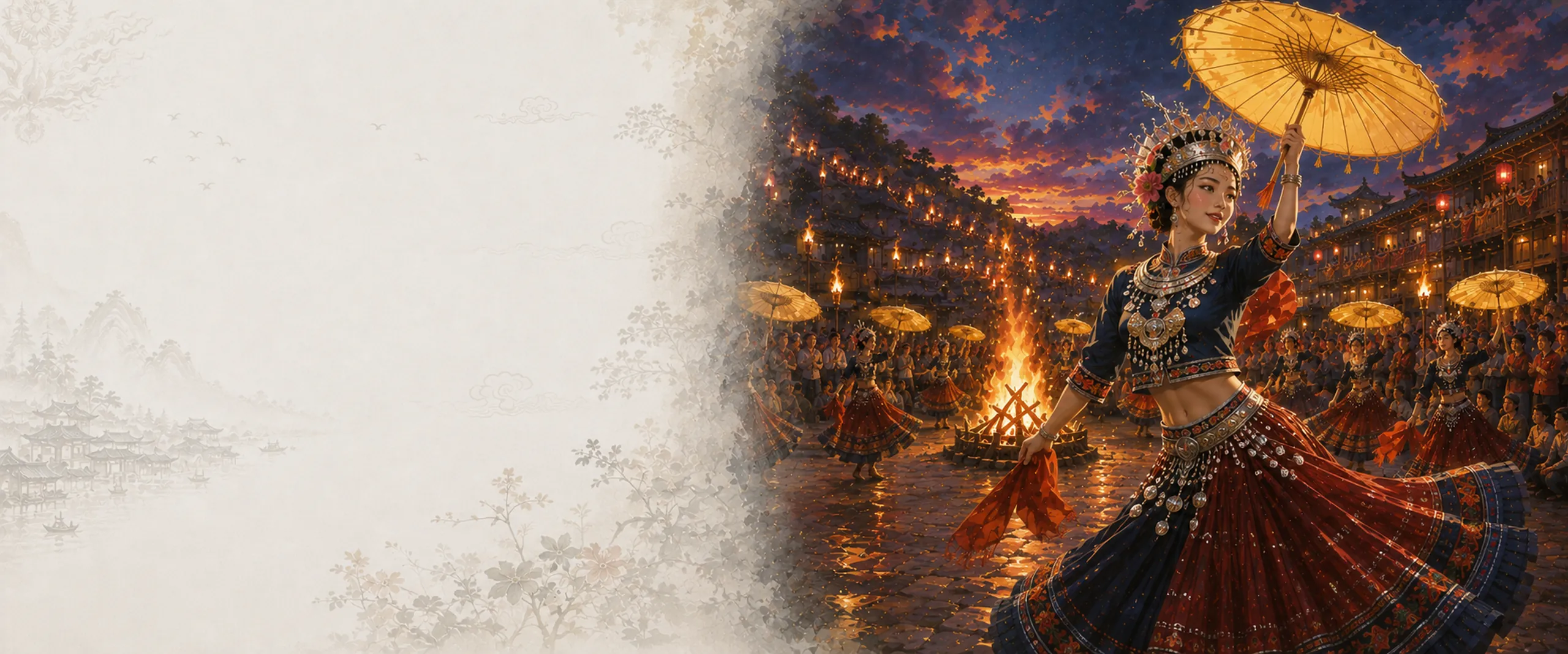
The Torch Festival is gradually moving from a traditional festival of the ethnic minorities of southwest China onto the world stage. Its path differs from those of the Spring Festival, Mid-Autumn Festival, and Dragon Boat Festival—if the Spring Festival takes “reunion” as its emotional core, the Mid-Autumn Festival the “bright moon” as its cultural symbol, and the Dragon Boat Festival “dragon boat racing” as its cultural emblem, then the Torch Festival takes “fire” as its most primal cultural totem and “light and carnival” as its most universal emotional connection.
Fire: a cultural language across civilizations. Fire was one of the earliest forces of nature mastered by humankind, and it is also a sacred symbol shared by civilizations everywhere. The Yi ancestors regarded fire as a totem: “Fire is the totem of the Yi ancestors; it is the life and soul of this people.”
In Europe, Scotland’s Celts welcome summer with flames; in Spain and France, summer solstice fire festivals have been inscribed as intangible cultural heritage of humanity; in Japan, fire festivals have been passed down for a thousand years.
Fire needs no translation. Wherever people may live, firelight can illuminate darkness; whatever the culture, reverence for and worship of fire are shared human impulses. As one observer remarked, Spain’s fire festival is “very much like the Yi Torch Festival in Sichuan, China”—this is not coincidence, but a common human feeling toward fire.
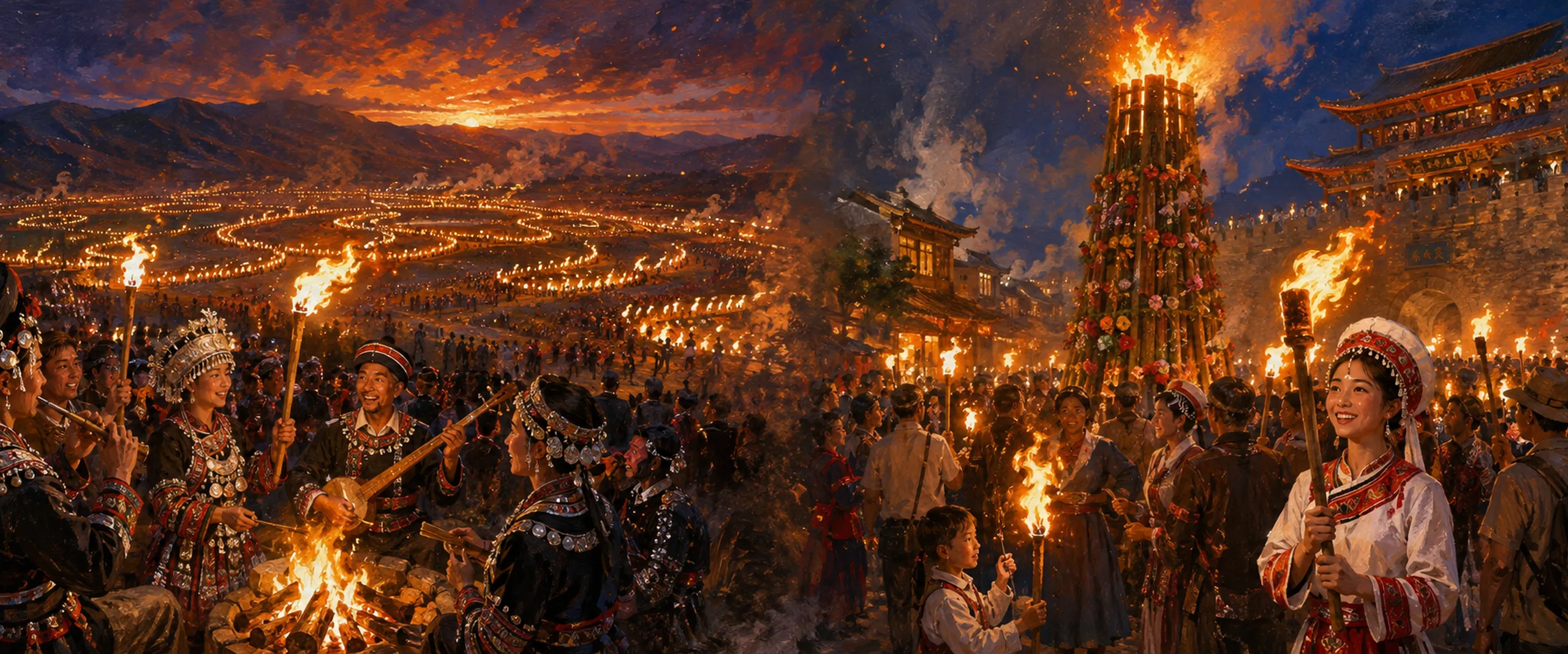
The Yi Torch Festival’s three days and three nights: worshipping the fire, passing on the fire, and sending off the fire. The Yi Torch Festival strictly follows three stages: “worshipping the fire,” “passing on the fire,” and “sending off the fire.” This sequence fully embodies the Yi ancestors’ understanding of fire—fire is sacred and therefore worshipped; fire can be transmitted and therefore passed on; fire must be respectfully sent away and therefore ceremonially farewelled.
When the first overseas Torch Festival in Los Angeles strictly followed this sequence, the festival’s core spirit was fully transmitted in a foreign land—not merely through the replication of outward form, but through the steadfast preservation of its cultural essence.
“Inviting people in” and “going out”: the Torch Festival’s two-way transmission. The international spread of the Torch Festival reveals a clear two-way path.
On one side, overseas Chinese communities actively “go out”—the first Torch Festival in Los Angeles in 2005, the first Yunnan Torch Festival in Melbourne in 2023, and the Yunnan Culture Festival in London in 2024 were all examples of overseas Chinese consciously promoting ethnic festivals abroad through cultural initiative.
On the other side, foreign visitors “come in” to experience the festival themselves—German youths travel to Chuxiong, Yunnan, to join the torch carnival; Lao and Thai bloggers dance the Left-Foot Dance in Yunnan; a Bangladeshi participant livestreams the grandeur of the Torch Festival.
This two-way interaction of “inviting people in” and “going out” means that the transmission of the Torch Festival is no longer a one-directional form of “cultural export,” but a two-way “cultural dialogue.”
Torch Festival narratives in overseas Chinese-language media. During the 2025 Torch Festival, representatives from 20 overseas Chinese-language media organizations from 17 countries traveled to Chuxiong, Yunnan. They joined the sea of people to experience the torch carnival and explored the “secret of fiery prosperity” in the Yi homeland.
As bridges connecting China and the world, overseas Chinese-language media are bringing the story of the Torch Festival to readers across the globe.
Civilizational dialogue between the Torch Festival and the world’s “fire festivals.” The most striking cultural phenomenon in the Torch Festival’s overseas spread is its dialogue and resonance with fire festivals around the world.
Scotland’s Viking Fire Festival and Celtic Fire Festival, the summer solstice fire festivals of Spain and France, Japan’s many fire festivals, and South Korea’s Fire Festival all have different origins and cultural backgrounds, yet they share a deeper logic: using fire to dispel evil, using fire to pray for blessings, and using fire to welcome renewal.
In 2015, the Summer Solstice Fire Festivals in the Pyrenees, jointly nominated by Spain and France, were inscribed on UNESCO’s Representative List of the Intangible Cultural Heritage of Humanity. The Yi Torch Festival itself was also submitted for UNESCO intangible cultural heritage recognition in 2014. Although it was not selected at that time, its cultural value had already attracted attention and recognition at the international level.
As one scholar has pointed out, the Torch Festival “not only plays an important social role, but also serves as an important bridge for social interaction and cultural accommodation between Yi and non-Yi residents.”
As the Torch Festival moves from the mountains of southwest China into the wider world, the spirit it carries—unity, carnival, and blessing—is becoming a warm flame of dialogue between different civilizations.
Readers’ Comments
Calendar and traditional culture enthusiasts from around the world, sharing the same moon.
Sign in or register to join the conversation. Your comment account is created automatically the first time you use a connected account.
No comments yet
Share your thoughts with readers around the world.