Torch Festival

Torch FestivalFolk Arts

「 谁把太空敲粉碎,满天星斗落人间。 」

The Torch Festival is held around the 24th day of the sixth lunar month each year, celebrated in Yi areas of Yunnan, Guizhou, and Sichuan. It was known in ancient times as the “Star‑Returning Festival.” The Ming‑dynasty scholar Yang Shen, while…

Opening Verse:

谁把太空敲粉碎,满天星斗落人间。

Introduction:

Torch Festival poetry often centers on blazing torches that light the sky and on exuberant communal singing and dancing. Yang Shen’s “满天星斗落人间” compares the torches to a shower of stars descending into the human world; Wen Zhangfu’s “万朵莲花开海市” likens them to countless lotus blossoms opening in a radiant mirage; and “蹋歌起舞月明中” evokes the all-night revelry of song and dance beneath the moon.

The Ming writer Yang Shen wrote in Reflections While Watching the Torches on Mount Lu (《泸山观火炬咏怀》): “老夫今夜宿泸山,惊破天门夜未关。谁把太空敲粉碎,满天星斗落人间”, using the magnificent image of “满天星斗落人间” to portray the spectacle of countless torches blazing through the night and sparks scattering into the darkness.

The Yuan poet Wen Zhangfu likewise wrote in Festival of Fire (《火节》), “万朵莲花开海市,一天星斗下人间”, once again drawing on the image of stars descending from the heavens to capture the brilliance of the Torch Festival.

Another verse records the joyous atmosphere of the celebration: “连乡火把照天红,六月为期问土风。一匝芦笙吹未断,蹋歌起舞月明中”, describing people playing the lusheng and dancing in rhythm beneath the moonlight throughout the festival night.

In Torch Festival poetry, fire is the soul of the celebration, fusing light, passion, and ethnic spirit into verse.

Torch Festival / Folk Arts

Art Forms

Forms of Expression

Creation Epic

Epic 傣族

The Yi creation epic 《勒俄特依》 forms one of the great cultural and historical lineages of the Yi people and is also among their oldest and most sacred oral traditions. Within this epic are accounts of the origin of fire and of the Torch Festival itself, narratives that constitute the deepest cultural foundation of the festival’s folk arts.

On the origin of fire, 《勒俄特依》 recounts:

“天上坠下一个火球,落在恩接间列山,燃起熊熊大火。九天烧到晚,九夜烧到亮。白天黑烟滚滚,夜晚火光闪闪。就这样天也烧地也烧,是为了诞生祖先的烧,也是为了创造人类的烧。”

After the fire was extinguished, three banks of mist rose and three snowfalls came. Weathered by wind and rain, the snow eventually gave rise to different plants, animals, and human beings. In the Yi understanding, fire is the source of all things—a primordial creative flame that descended from the heavens.

The epic also contains an account of the origin of the Torch Festival:

“天上坠下一个火球,掉在恩安吉列山,变成烈火而燃。九天烧到晚,九夜烧到亮,白天燃烧浓烟弥漫,夜晚燃烧闪烁光芒。”

It was from this sacred fire descending from the heavens that the Yi ancestors gradually developed an ancient worship of fire, eventually giving rise to the long-established tradition of the Torch Festival.

Among the Yi creation epics and Yi-script texts circulated in Liangshan are many mythic records concerning “fire.” In its most original form, the Torch Festival can be understood simply as an ancient form of fire worship.

Ritual songs such as 《祭火神》 and 《祭锅庄石》 recount the sacred deeds of the fire deity Ayi Diegu. These orally transmitted epics and ritual songs represent the oldest sources of Torch Festival folk culture, carrying the earliest awe and gratitude of the Yi ancestors toward fire.

Duoluohe”

Other 傣族

What Is “Duoluohe”?

“Duoluohe” is the most representative collective women’s song-and-dance form performed during the Torch Festival among the Yi people of Liangshan, and one of the brightest jewels of Torch Festival folk culture.

In the Yi language, it is also called “Duolehe” or “Duhuo,” meaning “a song in praise of fire.” “Duo” means fire and “he” means praise, so “Duoluohe” may be understood as a song-and-dance performance celebrating fire or the torch.

It is found primarily in Butuo County, Puge County, Ningnan County, and other parts of the Liangshan Yi Autonomous Prefecture in Sichuan Province. In 2007, “Duoluohe” was included in Sichuan Province’s provincial-level intangible cultural heritage list.

The origins of “Duoluohe” can be traced back to the hunting era. It was originally a dance performed by women to welcome men returning from the hunt. After society entered the agricultural age, it became integrated with the Torch Festival and continued to be passed down.

From mixed-gender festive singing to a women’s collective song-and-dance tradition, “Duoluohe” has survived the passage of centuries. Its original cultural meanings and distinctive artistic forms remain deeply worthy of study.

Butuo County, celebrated as the “Home of the Torch Festival,” offers one of the clearest demonstrations of the extraordinary wisdom of the Yi people in preserving and transmitting the Duoluohe tradition.

Performance Form

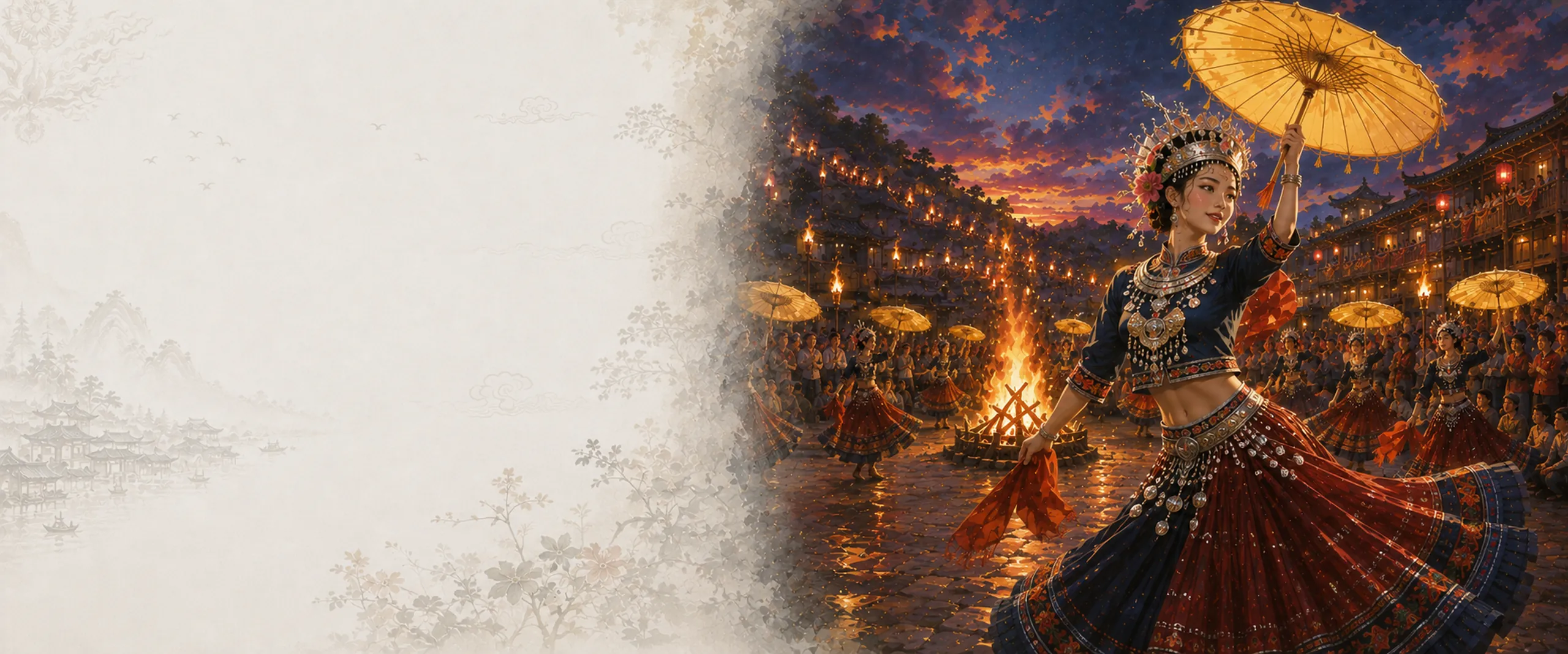
The second day of the Torch Festival marks the climax of the celebration. Yi women dress in full festive costume, hold yellow umbrellas, and form a circle. Led by a lead singer known as the “Hemo,” the women improvise verses in a call-and-response style.

Participants form a circle, holding hands or linking themselves with headscarves or triangular bags. Carrying yellow oilcloth umbrellas, they take delicate, closely spaced dance steps while singing the traditional “Duoluohe” repertoire.

During the performance, dancers lower their heads slightly, move with light steps, and hum the moving songs of the local Yi people while singing and dancing at the same time.

Dozens of women in Yi dress appear slowly beneath yellow oilcloth umbrellas, singing graceful melodies. The umbrellas turn gently, silver ornaments shimmer, and the spectacle is extraordinarily striking.

Large-scale Duolehe performances involving thousands of participants have been staged repeatedly in places such as Puge and Butuo. At the opening ceremony of the 2026 Liangshan Yi Torch Festival, 600 Yi women performed the intangible cultural heritage program 《朵乐荷》, presenting this ancient art form before a vast audience.

The vocal style of “Duoluohe” preserves the archaic unity of poetry, song, and dance, with a rich variety of melodies. The Puge Duolehe troupe once took part in an international intangible cultural heritage festival and won a gold award.

Classic Lyrics

The lyrics of “Duoluohe” frequently employ analogical and evocative imagery, and their themes include Yi history, mythology, customs, and everyday life. More than ten melodic forms are still preserved today.

Among the classic verses that continue to be sung are the following:

《七月的祈祷》

“朵洛荷,点起火把来哟,朵洛荷!

草生原野中啊,荞叶绿青青,朵洛荷!

害虫要远离啊,荞花花金灿灿,朵洛荷。

看那滩头石头亮光光啊,洪水走河道,朵洛荷!

朵洛荷!朵洛荷!年年都丰收啊,朵洛荷!”

“朵洛荷,点起火把来啊,灾荒要远去,朵洛荷!

朵洛荷!举起火把来啊,饥饿要远离,朵洛荷!

朵洛荷!舞起火把来啊,瘟疫不要作,朵洛荷!

朵洛荷,岁岁都平安啊,朵洛荷!”

“朵洛荷,不灭的火把举起来,朵洛荷。

朵洛荷,欢乐的火把舞起来,朵洛荷!

朵洛荷,熊熊的火把燃夜空,朵洛荷!”

《火把欢歌》

“(合)朵洛荷,朵洛荷……

(女)太阳点燃天上的火把,

(男)彝家点燃人间的火把。

(女)星星点燃夜空的火把,

(男)我们点燃心中的火把。”

“火把照亮百褶裙,火把照亮察尔瓦!

火把是天边最美的云霞,火把是世上最美的鲜花!

火把是彝人心中的灯塔,火把是生命灿烂的光华!”

A Duoluohe performance is generally divided into seven or eight sections and uses evocative comparison and imagery to sing of buckwheat, crops, pests, harvests, peace, and other themes.

Expressions such as “荞叶绿青青” and “荞花花金灿灿” convey prayers for abundant harvests. “害虫要远离”, “灾荒要远去”, “饥饿要远离”, and “瘟疫不要作” call for the expulsion of disaster.

These are precisely poetic expressions of the Torch Festival’s core functions: illuminating the year and praying for prosperity, driving away insects, and protecting the crops.

Lines such as “不灭的火把举起来”, “欢乐的火把舞起来”, and “熊熊的火把燃夜空” are among the most passionate celebrations of the festival’s spirit of communal revelry.
Dati Dance

Other 傣族

“Dati Dance” is one of the most representative collective dances of the Yi people and one of the Torch Festival activities with the broadest participation and most exuberant atmosphere.

Because Liangshan in Sichuan is shaped by a high-mountain environment, many local dances use large, forceful movements and place particular emphasis on strength in the legs. Dati Dance is a typical example.

Created in the 1980s, modern Dati Dance combines traditional elements with features of its own era and developed into a collective dance form.

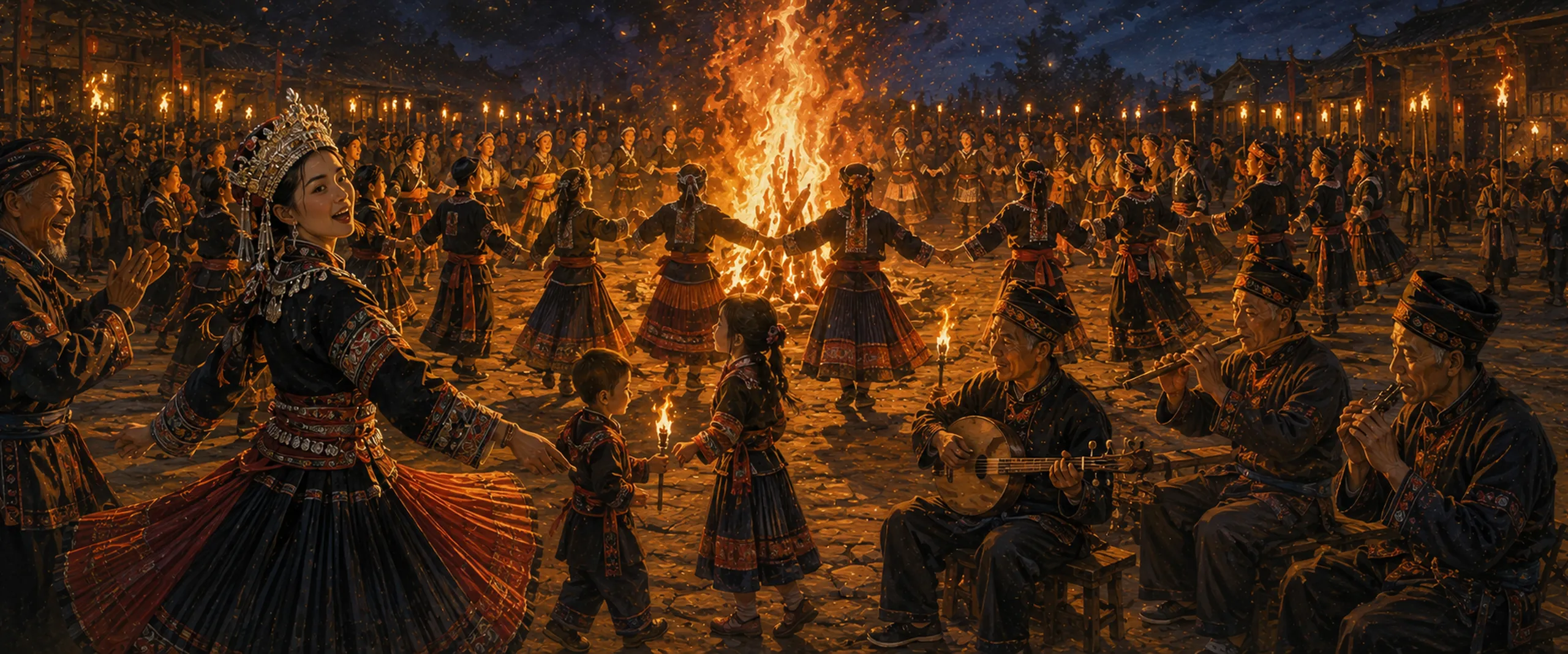
Its movements are simple and easy to learn, while the rhythm is brisk and energetic, allowing men and women, young and old, to participate together. People join hands and dance in a shared rhythm, creating an atmosphere of collective excitement.

The name “Dati” means “treading the earth” in the Yi language. Its core movement consists precisely of rhythmically stamping the feet, accompanied by swinging the arms and turning the body, creating a sense of strength radiating outward from within.

When tens of thousands of people dance Dati together around dozens of bonfires, the scale of the spectacle and the intensity of the atmosphere are breathtaking.

Dati Dance embodies qualities often associated with the Yi people: unity, warmth, and uninhibited vitality.

On the night of the Torch Festival, the southwestern sky sparkles with stars as Yi families gather in their homeland and dance through the night.

“情歌酒歌唱到天亮,达体舞越跳越想跳” — this is perhaps the most vivid portrait of Dati Dance during the Torch Festival.

Axi Tiaoyue”

Other 傣族

Origins and Characteristics of “Axi Tiaoyue”

“Axi Tiaoyue” is the best-known traditional dance of the Axi and Sani branches of the Yi people in Yunnan and is also an indispensable dance form during the Torch Festival.

The dance is accompanied by large, medium, and small three-stringed lutes, as well as bamboo flutes in high, middle, and low registers.

When performing the dance, men form a line, playing the three-stringed lute or blowing flutes as they move. Following the rhythm, they raise and kick their legs, step forward and backward, and shift their movements from left to right.

Men and women dance opposite one another to the accompaniment of the large three-stringed lute, while the vigorous five-beat rhythm creates a bold and joyful atmosphere.

Within Yi culture, the dance symbolizes reunion and harmony.

The Place of “Axi Tiaoyue” in the Torch Festival

Axi Tiaoyue includes dances for older people and dances for the young.

The former are accompanied by the small three-stringed lute and feature steadier steps. The latter use the large three-stringed lute and suona, with more energetic rhythms, and also incorporate traditional forms such as antiphonal singing from the epic 《阿细先基》.

On the day of the Torch Festival in Mile, crowds often form processions in the streets, gathering around the torches and dancing joyfully beneath the moonlight.

“Axi Tiaoyue” is one of the grandest activities of the Torch Festival and has been recognized as an intangible cultural heritage dance.

Warm and hospitable Axi villagers dress in festive attire and perform the traditional “Axi Tiaoyue,” welcoming visitors from afar with its lively rhythm.

Folk Music

Other 傣族

Jew’s Harp

The Jew’s harp is one of the most representative folk instruments of the Yi people and also an important means through which young men and women express emotion.

Butuo has long been celebrated as the “Home of the Yi Jew’s Harp.”

During the Torch Festival, the instrument’s lingering melodies mingle with firelight and moonlight, creating an atmosphere that is both romantic and mysterious.

Its tone is ethereal and distant, as though capable of crossing time itself and carrying the ancient emotions of the Yi ancestors into the ears of the present.

On Torch Festival nights, young men and women play the Jew’s harp and moon lute beside mountain paths and streams, expressing longing and affection to one another.

The sounds of the Jew’s harp, the moon lute, and love songs intertwine in the darkness, forming one of the festival’s most moving soundscapes.

Moon Lute

The moon lute is an instrument commonly played by Yi men. Its round body resembles the moon, and its sound is soft and melodious.

During the Torch Festival, it becomes an important medium through which young men express affection.

Young people at the festival play the moon lute and sing love songs, searching in the firelight for the one they love.

“那天的短笛吹得亮哟亮,那天的三弦弹得响又响” — this is one of the most vivid portrayals of Torch Festival folk music.

Mabu and Bimo Chanting

The mabu is a distinctive Yi wind instrument with a long, resonant tone.

The ritual instruments used by Bimo priests and the sound of their scripture chanting also form an important part of the Torch Festival’s musical world.

Bimo chanting is low, solemn, and powerful. Together with the firelight, it creates an atmosphere of ritual gravity and religious solemnity.

Yi High-Pitched Singing

Butuo is also celebrated as the “Home of Adu High-Pitched Singing.”

Adu high-pitched singing is a distinctive folk vocal tradition of the Adu region of Liangshan. It has a broad vocal range and a soaring melodic style and is an important form of vocal art during the Torch Festival.

Such singing is often performed in open mountain country, where the voice can travel across great distances.

It is a unique musical expression developed by the Yi people within their mountainous environment.

Folk Songs and Love Songs

Folk Song 傣族

Torch Festival Love Song

The Torch Festival is an important season for young Yi men and women to meet and fall in love.

Every year, thousands upon thousands of young people gather on the torch grounds, expressing affection through song and emotion through dance.

The following is a widely circulated Torch Festival love song:

《火把节情歌》

“火把节上的小阿妹,你彩裙飘飘人儿美。

去年阿妹一首动情的歌,唱醉阿哥半年多。

跨上那骏马,快快飞呀把你追,阿哥要悄悄地告诉你,早把阿妹藏心窝。”

“阿妹,阿妹,轻轻地摘下你的耳环,今晚村口来归还。

但愿呀阿妹如约而来,不为耳环为阿哥。

阿妹像一朵索玛花,你美得阿哥心儿醉。

阿哥摘下的是你的耳环,你却带走阿哥的心。”

“天上的月亮,快快照进阿妹的窗前,阿哥在村口痴痴地等,等待阿妹到身旁。

阿妹,阿妹,轻轻地拉住你的小手,今晚过后不再分开。

阿哥要一生守护着你,一起走到地久天长。”

“熊熊的火把已经点燃,跳起锅庄把歌儿唱。

你是我心中最美的歌,一生一世唱不完。”

The song begins with “火把节上的小阿妹” and closes with “熊熊的火把已经点燃”, weaving together the Torch Festival setting with the meeting, courtship, and commitment of young lovers.

Images such as “彩裙飘飘”, “索玛花”, “耳环”, “村口”, and “月光” create one of the most romantic visions of a Torch Festival night.

Torch Festival Folk Songs

Torch Festival folk songs also celebrate the festival itself and express love for life:

“七月的彝家火把节,是把青春点燃的七月。

美丽的彝家姑娘,爱情火花永不灭。

欢乐的彝家火把节,是用火把照亮了黑夜。

优美的歌声传四方。”

“一束束火把火光摇曳映天红,彝家姑娘手牵手歌颂幸福安康。”

“火把节里情更浓,彝家儿女永不忘。

火把虽要熄灭情不灭,彝族文化永流传。”

Melodies and Legends

Other 傣族

Heroic Legends and Ritual Songs

The Torch Festival originated in the ancient Yi worship of fire, with the aim of using flames to drive away pests and protect the growth of crops.

Many legends concerning the festival’s origins circulate throughout Yi regions, among which the story of the hero Heitilaba—also rendered as Hetielaba or Atilaba—defeating a heavenly deity is the most widespread.

According to legend, in ancient times the Yi hero Heitilaba became dissatisfied with the actions of a heavenly deity and killed the deity’s son.

The deity retaliated by unleashing an insect plague upon the human world. Heitibala’s wife transformed herself into fire and destroyed the infestation, and from that time onward the Torch Festival came into being.

There are many variants of this legend. Although their specific origins differ, their overall narrative structures are broadly similar: humans struggle against the gods — humans defeat the gods — the gods retaliate — humans defeat them once again — victory and a successful harvest are celebrated.

Ritual songs such as 《祭火神》 and 《祭锅庄石》 also recount the sacred deeds of the fire deity Ayi Diegu.

These heroic legends and ritual songs have been transmitted from generation to generation through the oral recitations of Bimo, the ritual specialists of the Yi people, and form an important part of the Torch Festival’s oral tradition.

“Duohong” Narrative Songs

“Duohong” is a collective name for several forms of song and dance performed during the Torch Festival in Butuo County, Liangshan.

Deeply rooted in Yi folk culture, “Duohong” possesses strong local and ethnic characteristics and has had a major influence on the formation and development of Yi narrative poetry.

《彝族火把节多哄之歌》 has been formally published, collecting and organizing melodies such as 《格啦多格啦,朵乐荷》.

Contemporary Transmission

Heritage & Transmission 傣族

Intangible Cultural Heritage Recognition

On May 20, 2006, the “Yi Torch Festival” of Liangshan in Sichuan and Chuxiong in Yunnan was approved by the State Council for inclusion in the first national list of representative intangible cultural heritage items.

The Torch Festival is one of the grandest traditional festivals of the Yi people. It lasts for three days and unfolds through the sequence of “worshipping fire — celebrating fire — sending off fire.”

Its folk activities include worship of the fire deity and ancestors; carrying torches through fields to drive away pests; beauty contests and costume competitions; wrestling, horse racing, bullfighting, ram fighting, cockfighting, and other traditional contests; as well as folk arts such as Duolehe, Dati Dance, the Jew’s harp, and the moon lute.

The Yi Torch Festival also has several nationally recognized representative inheritors of intangible cultural heritage.

Pu Shunfa is a representative inheritor of the fourth group of national intangible cultural heritage projects for the Torch Festival (Yi Torch Festival).

He Yinggui is likewise a representative inheritor of the national intangible cultural heritage project of the Yi Torch Festival. During the festival, he wears a ritual hat and traditional clothing, carries ritual implements, and joins other Bimo in chanting scriptures, worshipping fire, and striking stones to kindle flames. They pray for favorable weather in the coming year and pass the “sacred fire,” symbolizing happiness and hope, to a towering torch platform.

Contemporary Festive Splendor

Far from declining in contemporary society, the Torch Festival has instead taken on an increasingly rich and varied form.

The 2026 Liangshan Yi Torch Festival opened on July 19. At the opening ceremony, 600 Yi women performed the intangible cultural heritage program 《朵乐荷》, while traditional competitions including horse racing, bullfighting, ram fighting, and folk wrestling were also held.

That evening, a Duolehe intangible cultural heritage parade rich in Yi ethnic character was staged. Twenty-three Yi women, dressed in festive costumes and adorned with exquisite silver ornaments, carried yellow umbrellas as they departed from Datong Gate and processed through the streets.

During the Torch Festival, visitors can enjoy original folk Duoluohe performances, folk beauty contests, spectacular bullfighting, ram fighting, cockfighting, wrestling, pole climbing, and other contests, as well as traditional Yi folk songs and love songs, the lingering melodies of the Jew’s harp and moon lute, and other forms of folk performance.

Butuo and Puge counties in Liangshan are the places where the ancient customs of the Torch Festival have been preserved most completely, distinctively, and ceremonially, earning them the reputation of the “Homeland of Torches.”

Butuo is known as the “Home of the Chinese Yi Torch Festival,” the “Sacred Land of Torches,” the “Home of Adu High-Pitched Singing,” the “Home of the Yi Jew’s Harp,” and the “Home of Yi Silverwork.”

The four major categories of activities held during the festival—ritual worship, arts and sports, social interaction, and the exchange of goods—offer a concentrated expression of the rigor and completeness of the Yi cultural system.

Closing Reflections

Overview 傣族

The folk-artistic expression of the Yi Torch Festival is fundamentally different from the tradition of “literati poetry” associated with Han Chinese festivals. It is not primarily written in words; it is sung, danced, and performed in the living space of the festival itself. It is not an external act of “watching” and “reflecting,” but an internal act of “speaking” and “celebrating.”

From the ancient creation-epic narrative in 《勒俄特依》 of “天上坠下一个火球”, to the sacred deeds of the fire deity Ayi Diegu recounted in the ritual song 《祭火神》; from the heartfelt Duoluohe refrain “不灭的火把举起来”, to the celebration of life in “火把照亮百褶裙,火把照亮察尔瓦”; from the lingering melodies of the Jew’s harp and moon lute to the passionate declarations of antiphonal love songs; from the revelry of tens of thousands dancing Dati to the exuberant freedom of “Axi Tiaoyue”; from the solemn chanting of Bimo priests to the soaring resonance of Adu high-pitched singing—the folk arts of the Yi Torch Festival take fire as their soul, song as their voice, and dance as their form, creating a complete, living, and continuously renewing system of cultural expression.

On the night of the Torch Festival, the southwestern sky glitters with stars as Yi people gather in their homeland and dance together. “一束束火把火光摇曳映天红,彝家姑娘手牵手歌颂幸福安康。” “火把虽要熄灭情不灭,彝族文化永流传” — this is the deepest spiritual core of Torch Festival folk culture: torches may burn out, but the songs do not cease; firelight may fade, but the dance does not end. Through songs and steps handed down from generation to generation, the Yi people continue to transmit their reverence for fire, remembrance of their ancestors, hopes for abundant harvests, and longing for love.

In this festival whose very soul is fire, folk art is the flame that never dies. When the drums sound across the torch grounds, when the yellow umbrellas of Duoluohe turn beneath the moonlight, and when the melodies of the Jew’s harp flow through the night, it is the Yi people, through their own voices, their own bodies, and their own dances, making their deepest and most enduring declaration of devotion to fire and life.

—-

Continue exploring Torch Festival culture

Readers’ Comments

Calendar and traditional culture enthusiasts from around the world, sharing the same moon.

Sign in or register to join the conversation. Your comment account is created automatically the first time you use a connected account.