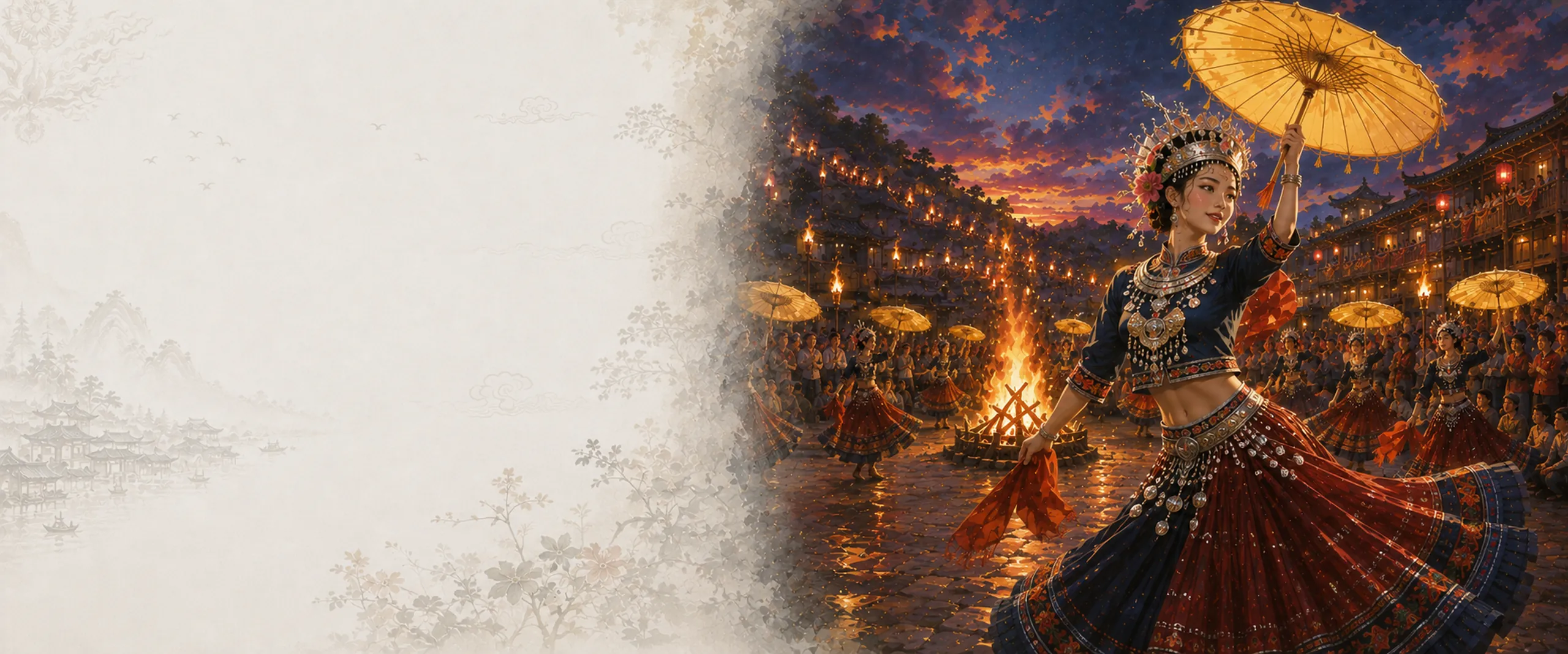
The Torch Festival is the grandest and most solemn traditional festival of the Yi people and one of the most influential ethnic-minority festivals in southwestern China. Every year, from the twenty-fourth to the twenty-seventh day of the sixth lunar month, millions of Yi people and members of neighboring ethnic communities gather across a vast region stretching from the Greater Liangshan Mountains of Sichuan to Chuxiong in Yunnan, from the Wumeng Mountains of Guizhou to Longlin in Guangxi, lighting torches, singing, and dancing together during this major festival, widely known as an “Oriental Carnival.” The customs of the Torch Festival revolve around “fire” and “life”: fire is the light that dispels darkness, the force that burns away pests, a sacred medium connecting Heaven and Earth, and a symbol of warmth that binds the community together. The Yi believe that torches can drive away calamity and evil, and they regard fire as a miraculous force capable of bringing abundant harvests, flourishing livestock, and protection from poverty and disease. The Torch Festival is therefore a sacrificial festival centered on praying for a good harvest and driving away disaster and evil, with folk traditions that include reverence for Heaven, ancestor worship, burning away pests and disease, and rituals for agricultural abundance.
Main Customs
Preparations Before the Festival
Preparations for the Torch Festival begin several days in advance. In Yi villages, every household cleans the home, purchases festival supplies, and prepares to welcome the most important celebration of the year.
Making the Torches
The torch is the central ritual object of the Torch Festival, and making torches is the most important preparation before the celebration. Villages bind large torches from dry pinewood and resinous pine splints and erect them in the village, while smaller torches are placed in front of individual homes. People cut down a local tree known as the “torch tree,” split one end into several sections with a knife, and pour melted pine resin over it to prepare the torch. Traditionally, torches are also made from bundled mugwort, while dry bamboo, other wood, or resinous pine splints may be used as well.
Torch sizes are strictly differentiated. A large torch several zhang high is erected in the center of the village, medium-sized torches stand in front of households, and small torches are carried by individuals. After the torches are made, they are dried in a cool place to ensure that they burn with strong flames. Torch-making is not merely a technical task but a collective activity involving the entire family and village: elders provide guidance, young people do the work, and children gather around to watch, so that anticipation for the festival gradually grows during the process. An open area near the village is selected as the main activity ground, where a green pine tree approximately 10 to 20 meters tall is erected in the center. A wooden pole decorated with red paper flowers is placed horizontally across the top, and flammable brushwood is stacked around the pine in the shape of a pagoda to create a giant ceremonial torch.
Sacrificing Livestock, Honoring Ancestors, and Preparing Food and Drink
Before the festival, Yi households traditionally slaughter cattle and sheep. The slaughter is not merely a way of preparing festival food but also a sacrificial act through which respect is shown to ancestors and the Fire Deity. Families prepare wine and meat for ancestor worship and make festival foods such as tuotuo meat (坨坨肉) and buckwheat bread.
On the day of the festival, each household erects several torches in front of the home for use in the celebrations. Young women prepare their finest festival clothing in advance and are sometimes so excited that they barely sleep, helping one another dress and arrange their appearance for the following day while also preparing dry provisions, meat, fruit, and other food for the journey to the communal festival grounds. A local saying describes the Torch Festival as a festival for enjoying oneself, with “three days of celebration and no fault in having fun.” Even newly married women celebrating their first Torch Festival in their husband’s family may shyly half-cover their faces with woolen capes and watch the festivities from behind their mothers-in-law and sisters-in-law.
Day One: Worshipping Fire — Honoring the Fire Deity, Worshipping Ancestors, and Driving Away Pests
The first day of the Torch Festival is called Duzai (都载), meaning “welcoming the fire.” The day is dominated by solemn sacrificial rites and is the most religiously charged part of the festival.
Striking Stone to Make Fire: The Birth of the Sacred Flame
As night falls, people from neighboring villages build a ritual altar at a site selected by elders. The altar is usually constructed with stones on an open plot of land or a hill near the village, symbolizing the sacred hearth.
The most sacred moment is the “taking of fire.” People ignite the sacred flame in the traditional way by striking flint against stone, then use the spark to light torches made from bundled mugwort stalks. This method symbolically recreates the moment when ancient ancestors first discovered and preserved fire: every strike pays tribute to ancestral wisdom, and every spark calls upon the Fire Deity. In places such as Shilin in Yunnan, Bimo (毕摩, Yi ritual specialists and priests) conduct solemn and mysterious ceremonies of obtaining and worshipping fire on majestic Laoguishan Mountain, striking a fire steel against flint to ignite tinder and then using the first sparks to light the torches.
Bimo Scripture Chanting: Dialogue Between Humans and the Divine
After the sacred fire has been lit, the Bimo chant ritual scriptures and conduct the fire sacrifice. The Bimo are among the most authoritative cultural figures and custodians of knowledge in Yi society, believed to mediate between the worlds of the living and the dead and to communicate directly with spiritual beings. They serve simultaneously as priests, healers, ritual specialists, and keepers of history, and are among the most important inheritors and guardians of Yi culture.
As the Bimo chant ancient scriptures in deep and powerful voices, villagers offer wine, meat, and newly harvested grain to the Fire Deity and their ancestors, praying for the safety of people and livestock, abundant harvests, and ancestral blessings upon future generations. During the fire ritual, the Bimo recite sacrificial texts whose contents commonly ask the Fire Deity for protection, the destruction of pests, and plentiful grain. Their voices mingle with the flickering flames and echo through the night sky, carrying human prayers toward the divine. The Bimo also preside over rites honoring Heaven and Earth, worshipping fire and ancestors, and driving away evil and misfortune.
Torch Processions: A Ritual Reenactment of Driving Away Pests
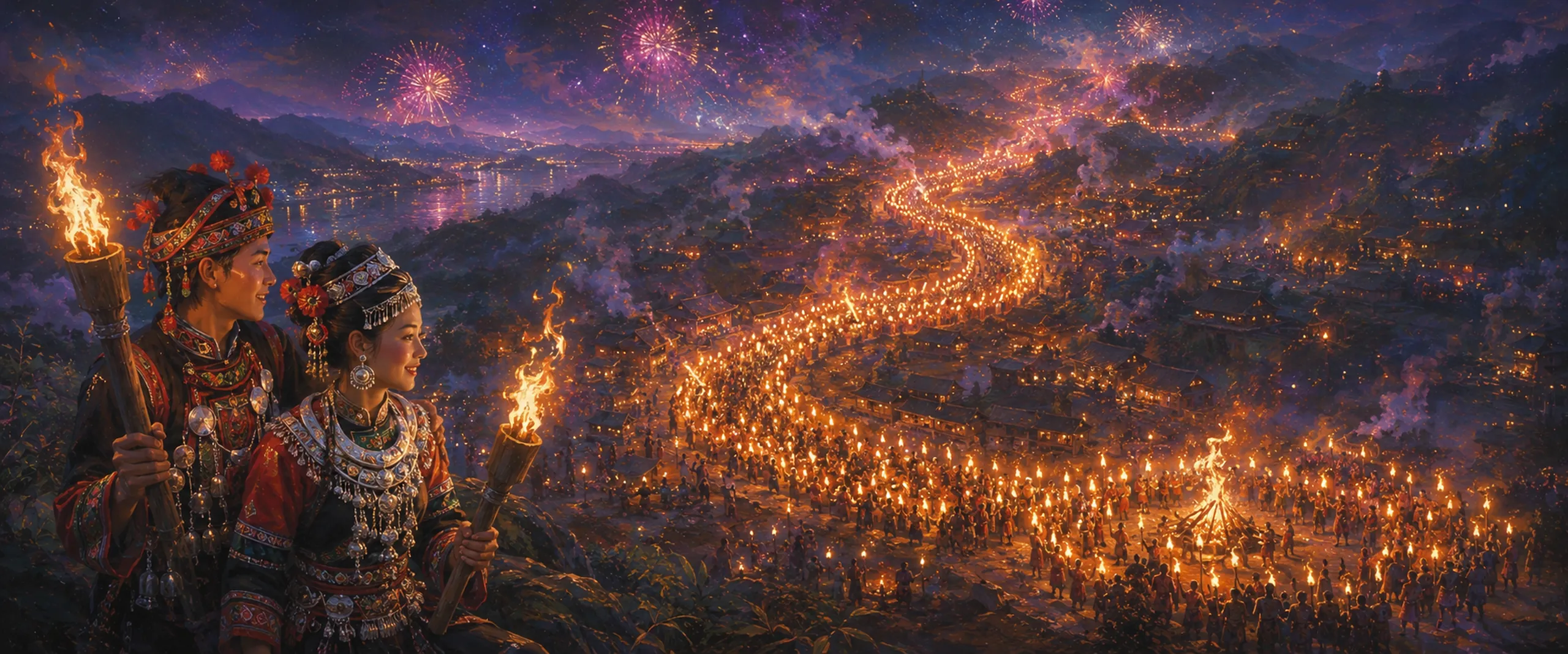
After the fire-sacrifice ceremony, adults and children from every household receive torches made from mugwort from the Bimo and walk through the edges and corners of the fields, reenacting the legend of Ashimo (阿什嫫) driving away pests with fire. People carry torches around fields and houses, forming a winding “fire dragon” along the ridges as the flames illuminate the entire countryside.
As they move, people loudly recite sacrificial verses, most of which concern destroying pests and securing a plentiful harvest, for example: “Let no sparrow come to the head of the field; if a sparrow comes, twist and break its beak. Let no rat come to the end of the field; if a rat comes, smash its teeth. Let no insects burrow into the grain; if they burrow in, raise the torch—when insects meet the flame they die, and the grain will be clean, full, and abundant…” The torch procession is therefore not only a visual spectacle but also an intense soundscape in which the crackling of fire, the shouts of the crowd, and the chanting of ritual texts combine to create a powerful ceremonial atmosphere.
The routes of the torch procession are carefully prescribed. Each household carries torches to its own fields, with families dispersing to walk around every edge and corner of their land in order to express the wish that pests be eliminated, weather remain favorable, and the harvest be abundant. The torches illuminate not only the fields but also the community’s hopes for agricultural prosperity. Seen from a distance, the entire village glows with light. Groups carrying small torches move through the edges of the village, mountain paths, and field ridges, inserting torches and resinous pine splints into corners of the farmland.
Finally, the participants gather on the hillsides, where they play with torches, sing, dance, and take part in various games. Although the first day is centered on “worshipping fire” and is primarily solemn and sacrificial, entertainment begins after the ceremonies, as people sing and dance in the firelight in preparation for the greater celebrations of the following day.
Day Two: Passing and Playing with Fire — The Height of the Celebration
The second day of the Torch Festival is called Duge (都格), meaning “praising fire” or “singing the praises of fire.” It is the climax of the festival and the liveliest and most varied day of the entire celebration.
Gathering in Festival Dress: A Celebration That Empties the Streets
At daybreak, men and women, young and old, dress in their finest festival clothing and bring cooked tuotuo meat and buckwheat cakes to the festival grounds. Thousands upon thousands of people gather from every direction to take part in the large-scale celebrations.
Yi clothing commonly uses red, yellow, and black, complemented by silver ornaments. Young women wear elaborate dresses and carry yellow oil-paper umbrellas, while young men put on the traditional chalva (查尔瓦, woolen felt cape), displaying Yi textile craftsmanship and aesthetic traditions. The Torch Festival is one of the most important occasions for the concentrated public display of Yi clothing culture.
Folk Competitions: Contests of Strength and Courage
Horse racing, wrestling, bullfighting, ram fighting, and cockfighting are among the most important activities of the second day. These forms of competition have symbolic connections with festival legends involving heroes wrestling or contending with divine beings and have become important cultural symbols within the celebration.
Wrestling is the most representative competitive sport of the Torch Festival. Yi wrestling has a long history and has traditionally been an important way of testing a man’s courage and strength. Wrestling competitions during the festival attract large crowds of spectators who cheer enthusiastically, while young men imitate the legendary hero Atilaba (阿体拉巴) by displaying strength and skill in the wrestling arena.
Horse racing is another indispensable competition. Young Yi riders leap onto their horses, raise their whips, and race around the track while spectators fill every available place around the course. The event is a dramatic display of speed and excitement.
Bullfighting, ram fighting, and cockfighting are also traditional festival competitions. These contests between animals express the Yi admiration for strength and form an important part of festival entertainment. In the bullfighting arena, two powerful bulls lock horns as dust rises around them, while ram fighting provides another intense and highly popular contest.
Pole climbing, especially climbing a greased pole, is another important event. A smooth bamboo pole is coated with oil, and participants attempt to climb it using only their hands and bodies. Whoever reaches the top is declared the winner. The contest tests not only strength but also technique and perseverance.
Yi Beauty Contests: Celebrating Beauty and Character
Beauty contests are among the most important events of the second day. The Yi have long valued and pursued beauty, and beauty selection has traditionally been one of the most distinctive activities of the Torch Festival.
Senior elders select an annual young man and young woman according to the legendary ideals represented by Atilaba, who is described as hardworking, courageous, heroic, and handsome, and Ashimo, who is regarded as kind, intelligent, beautiful, and generous. The female winner is called “Jinsoma” (金索玛), while the male winner is called “Golden Eagle” (金鹰). These titles represent not merely physical beauty and handsome appearance but also the Yi cultural ideal of noble personal qualities.
The contests therefore judge more than outward appearance. Hard work, courage, kindness, and intelligence—qualities highly valued in traditional Yi ethics—form the core criteria. Young women wear their finest clothing and most elaborate silver ornaments, presenting both beauty and character before the assembled community.
Duoluohe and Dati Dance: A Sea of Song and Dance
Duoluohe (朵洛荷) is a distinctive Liangshan Yi performance combining song and dance and traditionally performed collectively by women only during the Torch Festival. In Yi, duo means “fire,” while he carries the sense of “praise” or “song.” Duoluohe is one of the most characteristic artistic forms of the Yi.
Young women dressed in brilliant ethnic clothing carry yellow umbrellas and perform Duoluohe with light, coordinated steps. At major performances, hundreds of Yi women may hold yellow umbrellas and dance while singing, presenting the classic intangible-cultural-heritage performance Duoluohe. Its graceful, animated movements vividly display the beauty of Yi clothing and the rich atmosphere of Yi folk tradition. When as many as a thousand women in vivid ethnic dress move in orderly formations beneath yellow umbrellas, they resemble a sea of Soma flowers blooming across the mountains.
The Dati Dance (达体舞) is the collective dance with the broadest public participation and the liveliest atmosphere during the festival. The pattern is one of competitions by day and song and dance by night. As evening approaches, thousands upon thousands of torches form long fire dragons moving from every direction toward the same gathering place, where they eventually become countless bonfires that illuminate the sky. People sing and dance around the fires deep into the night.
An “Eastern Valentine’s Day”: Romance Under the Moon
When night falls, young couples gather in the mountains, beside streams, and beneath yellow oil-paper umbrellas, playing the yueqin (月琴, moon lute) and the mouth harp (口弦) while expressing affection and longing. For this reason, the Liangshan Yi International Torch Festival is sometimes called an “Eastern Valentine’s Day.”
As the bonfires begin to die down, young men and women quietly move toward hillsides and wooded areas, where they sit beneath yellow umbrellas, play the moon lute and mouth harp, and speak of their feelings. The Torch Festival provides young people with an opportunity for relatively free social interaction and emotional expression. The sounds of the moon lute, mouth harp, and love songs intermingle in the night while torchlight illuminates youthful faces, creating an atmosphere in which romance and festival life become closely intertwined.
Day Three: Sending Away the Fire — The Departure of the Sacred Flame and Hopes for the Coming Year
The third day is called Dusha (都煞), meaning “sending away the fire.” It marks the conclusion of the Torch Festival and is also its most sacred and solemn day.
The Fire-Sending Ceremony: Sending Away Calamity and Welcoming Auspiciousness
As night falls, everyone carries a torch to an agreed gathering place, where a fire altar is erected and the ceremony of sending away the fire is performed. People chant ritual texts and pray to the Fire Deity, asking both ancestors and the Fire Deity to grant health and happiness to future generations and abundance and joy to the human world.
The central idea of the ceremony is “sending away.” The Fire Deity is respectfully sent away, and all inauspicious things are symbolically sent away with it. Participants bring their torches together to form enormous bonfires, and the celebrating crowd gathers around the flames to sing and dance. Firelight illuminates every face while song and laughter echo through the night sky.
According to tradition, only after this ceremony is complete does the Torch Festival formally end. People believe that after three days of ritual and celebration, the Fire Deity has accepted their reverence and will bless the village with favorable weather, abundant crops, healthy livestock, and peace in the coming year. Although the sacred fire is sent away, reverence and gratitude toward fire remain in the hearts of the people.
The Complete Three-Day Ritual Structure
The three days of the Torch Festival—worshipping fire, playing with fire, and sending away fire—form a complete ritual cycle. The cycle is both a tribute to fire and an expression of the Yi understanding of time: through the lighting, burning, and extinguishing of fire at a moment of transition between old and new, the community completes a process of collective spiritual purification and temporal renewal.
The first day, “worshipping fire,” is about reverence—reverence for the Fire Deity, ancestors, Heaven, and Earth. The second day, “playing with fire,” is about celebration—song, dance, competition, and social interaction in the light of the flames. The third day, “sending away fire,” is about departure—sending away calamity, illness, and all the misfortunes of the old cycle. Each of the three days and nights has its own distinctive character. After dinner each evening, one household begins by lighting its torch, after which others quickly follow and walk out of the village with their torches. People sing Torch Festival songs, and their voices echo through the valleys as the flames spread. Following customary directions, the torches form a long fire dragon moving toward the public gathering grounds, where they are brought together into a large blaze around which the entire village dances and plays.
Food Traditions
During the Torch Festival, Yi communities prepare a wide variety of traditional foods, and communal eating is an indispensable part of the celebration.
Tuotuo Meat: The Festival’s Main Dish
Tuotuo meat (坨坨肉) is one of the most representative foods of the Torch Festival. Beef, mutton, or pork is cut into large pieces and boiled with minimal seasoning, usually only salt and Sichuan pepper, so that the natural flavor of the meat is preserved. Rich yet not greasy, tuotuo meat is regarded as one of the highest forms of hospitality in Yi culture. During the festival, people bring cooked tuotuo meat to the activity grounds and share it with relatives and friends.
Buckwheat Bread and Cakes: The Fragrance of the Staple Grain
Buckwheat is one of the most important traditional crops in Yi regions. During the Torch Festival, people make buckwheat bread, buckwheat cakes, and related foods. Buckwheat flour is mixed with water, kneaded into dough, shaped into cakes, and either roasted over fire or steamed, producing a distinctive aroma. Buckwheat bread is not only festival food but also a sacrificial offering: freshly harvested buckwheat is used to make bread for presentation to the Fire Deity and ancestors.
Tasting Newly Harvested Buckwheat and Grain
The Torch Festival coincides with the season when new buckwheat is harvested. People use freshly harvested grain to prepare different foods, both to taste the new harvest and to celebrate agricultural abundance. The fragrance of fresh buckwheat and the flavor of newly slaughtered cattle and sheep combine to create a rich festival feast. During the Bimo’s fire-sacrifice ceremony, villagers also offer newly harvested grains to the Fire Deity and ancestors as an expression of gratitude for the harvest.
Song, Dance, and Art: The Cultural Soul of the Torch Festival
The Torch Festival is one of the most concentrated public platforms for the display of Yi music, dance, clothing, handicrafts, and other artistic traditions.
Duoluohe: The Height of Women’s Collective Song and Dance
Duoluohe is a Liangshan Yi performance combining singing and dancing and traditionally performed only by groups of women during the Torch Festival. In Yi, duo means “fire”, while he conveys the meaning of “praising” or “singing.”
During the performance, Yi women wear distinctive festival dress whose brilliant colors shimmer in the sunlight. Holding golden-yellow oil-paper umbrellas, they form orderly lines and sing while dancing with light, coordinated movements. Their voices are melodious, their steps synchronized, and their silver ornaments glitter in the sun, creating a striking spectacle. Duoluohe is therefore not merely a dance but also a concentrated public expression of Yi ideals of feminine beauty.
Dati Dance: A Collective Celebration for Everyone
The Dati Dance has the broadest public participation and the most energetic atmosphere of all the dances performed during the Torch Festival. Its movements are relatively simple to learn, its rhythms lively and strong, and people of all ages can take part. Participants join hands around bonfires and dance in unified rhythm.
Training for Dati Dance can be highly systematic, with clear requirements for basic steps, hand gestures, and formation changes in order to produce rhythmic unity and coordinated group movement. When tens of thousands of people dance together around dozens of bonfires, the scale and energy of the scene are extraordinary. The Dati Dance expresses cultural values often associated with the Yi people: unity, warmth, enthusiasm, and openness.
Mouth Harp, Yueqin, and Mabu: The Sound of Traditional Instruments
During the Torch Festival, many traditional Yi instruments are played. The mouth harp (口弦) is especially favored by Yi women. Usually made from bamboo, it is held against the lips and plucked to produce a clear, delicate sound, and it is often used to express emotion. The yueqin (月琴, moon lute) is commonly played by Yi men; its round body resembles the moon, and its tone is soft and mellow. Kaxijuer (卡西举尔) is a Yi-style vertical flute, while the mabu (马布) is a distinctive Yi wind instrument known for its resonant and far-reaching tone.
At night, young men and women play the moon lute and mouth harp in the mountains and beside streams as they express affection to one another. These instruments are therefore not simply musical devices but important vehicles of emotional communication. The sounds of the moon lute, mouth harp, and love songs mingle in the darkness, creating one of the most evocative soundscapes of the Torch Festival.
Display of Traditional Handicrafts
The Torch Festival is also an important occasion for the concentrated display of Yi handicrafts. Yi silversmithing is highly developed, and silver crowns, necklaces, bracelets, and belts create a continuous shimmer from head to waist. Yi embroidery is known for vivid colors and intricate patterns and forms one of the most important decorative elements of traditional clothing. The Torch Festival is therefore one of the most important occasions for presenting the tangible cultural heritage of Yi dress, silverwork, embroidery, and related crafts.
Ritual and Belief: The Spiritual Core of the Torch Festival
The Torch Festival is fundamentally a sacrificial festival. Worshipping the Fire Deity, honoring Heaven and Earth, worshipping ancestors, and driving away evil and misfortune form the central spiritual content of the celebration.
Fire Worship: From Awe of Nature to Cultural Symbol
In its most basic form, the original foundation of the Torch Festival is ancient fire worship. The Yi ancestors’ early reverence for fire transformed it from a natural phenomenon into a cultural symbol representing light, strength, purification, and hope.
In the Yi worldview, fire is not only a source of light that disperses darkness and brings warmth but also a sacred medium connecting Heaven, Earth, human beings, and divine forces. The Torch Festival is a sacrificial celebration devoted to praying for a good harvest and driving away calamity and evil. Because the Yi believe torches can ward off disaster and harmful forces, fire is regarded as a miraculous power capable of bringing plentiful crops, flourishing livestock, and protection from poverty and disease. The festival is thus a collective and cyclical tribute to fire: by lighting torches and singing and dancing around bonfires, people establish a ritual connection with fire and reaffirm their relationship with nature, ancestors, and the community. Some scholars have further suggested that Yi fire worship may also be historically related to sun worship.
Ancestor Worship: Family Ethics of Honoring the Dead and Remembering One’s Origins
During the Torch Festival, villages prepare wine and meat to honor their ancestors. Ancestor worship is one of the most important religious practices in Yi culture. Within the Yi system of belief, ancestors are understood to continue protecting their descendants even after death. The festival’s ancestral rites therefore form a spiritual dialogue between the living and the dead and between the present and the past.
Through ancestor worship, Yi people affirm their position within the family lineage and strengthen their memory of and identification with ethnic history. During the festival, solemn rites are held to honor Heaven and Earth, worship fire and ancestors, and drive away evil, while prayers are offered for thriving livestock, abundant grain, and household peace. The Torch Festival therefore expresses the Yi aspiration to live in accordance with natural rhythms and to pursue a secure and prosperous life.
Driving Away Pests and Praying for Abundance: A Festival Expression of Agricultural Civilization
The Torch Festival is closely connected with agricultural civilization. The sixth lunar month is the season when rice begins heading and maize is flowering, and torches are prepared in advance for this agricultural moment. One of the festival’s most important functions is traditionally expressed as “illuminating the year and praying for abundance”—lighting the fields with torches, driving away pests, and praying for a good harvest.
During the festival, people carry torches through the fields and use flame and smoke to drive away insects. This action has both practical and ritual significance. The sight of torchlight illuminating the fields is understood not only as driving away pests but also as dispelling anxiety over the possibility of crop failure. The Torch Festival is therefore a sacrificial festival centered on praying for agricultural abundance and eliminating disaster and evil, and its folk characteristics include honoring Heaven and ancestors, burning away pests and disease, and performing rituals for a plentiful harvest.
Regional Variations
Liangshan, Sichuan
Three days and three nights; Duoluohe performances; beauty contests; wrestling; horse racing; large-scale Dati dancing
Chuxiong, Yunnan
Large bonfire processions; horse racing; folk song-and-dance competitions; flower markets; region-wide festival atmosphere
Shilin, Yunnan
Bimo striking stone to obtain fire; ceremonial worship of fire
Shuangbai, Yunnan
Bimo chanting migration texts; straw-costumed performer singing the Lament for the Mother
Guizhou
Traditional Torch Festival customs; recognized as a national intangible-cultural-heritage extension project
Bai communities of Dali
Villages erect large torches; people compete to seize the falling shengdou as a symbol of good fortune
Liangshan, Sichuan
Liangshan is one of the core regions of the Torch Festival and one of the places most strongly associated with the celebration. Liangshan Prefecture covers a vast area and has a large Yi population, and the annual festival is held on an exceptionally large scale. The Liangshan Yi Torch Festival generally lasts three days and three nights and is divided into the stages of worshipping fire, playing with fire, and sending away fire. Its principal activities include worshipping the Fire Deity and ancestors, carrying torches through fields to drive away pests, beauty contests and clothing displays, wrestling, horse racing, bullfighting, ram fighting, cockfighting, and other folk competitions.
Chuxiong, Yunnan
Chuxiong is another core region of the Torch Festival. In May 2006, the Chuxiong Yi Torch Festival was included by the State Council in the first batch of China’s National Intangible Cultural Heritage. During the festival, enormous crowds gather at Torch Square to dance together, the streets empty as residents join the festivities, and torchlight fills the night. Chuxiong hosts large-scale bonfire processions, horse racing, folk song-and-dance competitions, flower markets, and other activities across more than ten townships, creating a festival atmosphere throughout the wider region.
Shilin, Yunnan
Shilin Yi Autonomous County is another important area of Torch Festival culture. Bimo conduct solemn and mysterious ceremonies of obtaining and worshipping fire on the imposing Laoguishan Mountain, using traditional fire-making methods.
Zhekemang Village, Shuangbai County, Yunnan
The Yi Torch Festival customs of Zhekemang Village in Shuangbai County have distinctive local characteristics. The Bimo first chant the migration narratives of the Yi ancestors. Afterward, a “straw man”—a person dressed in a straw costume—raises a model symbolizing the male sexual organ, enters the gathering crowd, and sings the “Lament for the Mother” (《哭母调》).
Guizhou
Yi communities in Guizhou also preserve rich Torch Festival traditions. The Yi Torch Festival submitted by Hezhang County, Guizhou, was included in 2011 in the third batch of national intangible-cultural-heritage extension projects.
The Bai Torch Festival differs from the Yi Torch Festival. Among the Bai of Dali, villagers in each settlement voluntarily erect a large torch. A shengdou (升斗, a traditional measure-shaped object) is placed at the top. When it falls after the torch has burned, people rush to seize it because obtaining it is believed to bring good fortune.
Contemporary Transmission
### Recognition as National Intangible Cultural Heritage
On May 20, 2006, the Yi Torch Festival of Liangshan in Sichuan and Chuxiong in Yunnan was approved by the State Council for inclusion in the first batch of China’s National Intangible Cultural Heritage. In 2011, the Yi Torch Festival submitted by Hezhang County in Guizhou was included in the third batch of national intangible-cultural-heritage extension projects. The Liangshan Yi Torch Festival is listed under project number Ⅸ—10, and its safeguarding organization is the Liangshan Prefecture Intangible Cultural Heritage Protection Center of Sichuan Province.
The Yi Torch Festival also has a number of nationally recognized representative bearers of intangible cultural heritage. Pu Shunfa (普顺发) is a nationally recognized representative inheritor of the Yi Torch Festival. He is highly skilled in the ritual procedures of the Broadsword Dance, the making of Nuo deity masks, the painting of ceremonial flags in different colors, and the sculpting of local tutelary deity figures in clay. Through direct instruction and demonstration, he has transmitted Bimo knowledge and Broadsword Dance techniques to local Yi youth and trained a large number of young performers. He has personally taken part in many Torch Festival custom performances at prefectural, county, and township levels and has received wide recognition.
### The Contemporary Scale of the Torch Festival
Far from declining in modern society, the Torch Festival has continued to expand. During the 2024 Liangshan Yi Torch Festival, the prefecture received more than ten million visitor trips. The festival has become Liangshan’s largest traditional celebration, with the richest range of activities, the most spectacular scenes, the greatest number of participants, and one of the strongest concentrations of Yi cultural characteristics.
Torch Festival events in different regions continue to introduce new forms while preserving traditional content. Huidong County has brought parts of its festival program to high-altitude “cloud-top” venues, with wrestling, ram fighting, horse racing, bullfighting, mountain running, the “Cloud Soma” beauty contest, hundred-person Duoluohe performances, the “Apu Yahong” meadow concert, and mass Dati dancing. In Ningnan County, torches are lit simultaneously at three locations, combining intangible-cultural-heritage performances, traditional competitions, and folk ceremonies into a large ethnic cultural celebration for residents and visitors. At the opening ceremony of the 2026 Liangshan Yi Torch Festival, 600 Yi women carrying yellow umbrellas sang and danced in a major performance of the classic intangible-cultural-heritage work Duoluohe.
The Torch Festival has also become an important cultural bond encouraging interaction, exchange, and integration among different ethnic groups. It is no longer only a traditional Yi festival. As a regional cultural tradition of southwestern China, similar Torch Festival traditions have a long history among other peoples of the Yi language branch and neighboring ethnic communities, including the Naxi, Hani, Lisu, Lahu, and Jino.
Closing Note
The folk traditions of the Torch Festival form a long cultural narrative about “fire” and “life.” From the solemnity of worshipping fire to the exhilaration of playing with fire, from the immense crowds of the fire processions to the lingering emotions of sending the sacred flame away, from the intensity of wrestling and horse racing to the elegance of beauty contests and Duoluohe, and from the flavors of tuotuo meat and buckwheat bread to all-night Dati dancing around bonfires, the customs of the Torch Festival bring together the Yi ancestors’ reverence and worship of fire, gratitude toward and remembrance of ancestors, hopes for and celebration of agricultural abundance, and love and affirmation of life.
The core of the Torch Festival is fire. Fire is one of the most important symbols in Yi culture. In the Yi worldview, fire is not only the source of light that dispels darkness and brings warmth but also a sacred medium connecting Heaven, Earth, humans, and spiritual beings. The Yi believe that torches can drive away calamity and evil and therefore regard fire as a mysterious power capable of ensuring abundant crops, thriving livestock, and protection from poverty and disease. The Torch Festival is accordingly a sacrificial festival centered on praying for a good harvest and driving away disaster and harmful forces. All of its principal customs—worshipping fire, playing with fire, and sending away fire—are organized around reverence, gratitude, and celebration directed toward fire. Worshipping fire uses the sacred flame to honor divine forces while symbolically illuminating the human heart; playing with fire uses flame to disperse darkness while igniting collective enthusiasm; and sending away fire ritually removes calamity while welcoming hope.
The Torch Festival is also described among the Yi as a form of “celebrating the great New Year.” Its origins have been linked to the Xinghui Festival (星回节) and to the Yi ten-month solar calendar, which is traditionally associated with ancestral observation of celestial phenomena and the direction of the handle of the Big Dipper. The festival’s three days—worshipping fire, playing with fire, and sending away fire—form a complete ritual cycle. At a symbolic transition between old and new, the lighting, burning, and extinguishing of fire completes a collective process of spiritual purification and temporal transition.
In 2006, the Yi Torch Festival was included in the first batch of China’s National Intangible Cultural Heritage. From ancient fire worship to contemporary national heritage protection, and from spontaneous sacrificial rites in Yi villages to an internationally recognized “Oriental Carnival,” the Torch Festival has crossed centuries while continuing to flourish in the Greater Liangshan Mountains and across the red-soil plateaus of southwestern China. Like the torches blazing into the night, every flame carries a prayer, and every movement of fire suggests renewal. The customs of the Torch Festival are both a concentrated expression of the Yi cultural tradition of revering and honoring fire and a vivid example of the broader Chinese pattern of unity within cultural diversity. Through the ritual power of fire, the festival continues to renew a profound cultural dialogue about light, life, and hope.
—
Readers’ Comments
Calendar and traditional culture enthusiasts from around the world, sharing the same moon.
Sign in or register to join the conversation. Your comment account is created automatically the first time you use a connected account.
No comments yet
Share your thoughts with readers around the world.