Miao New Year

Miao New YearFolk Arts

「 笙吹奏丰收曲,银饰闪亮贺苗年。 」

The Miao New Year is the most solemn festival of the year for the Miao people. The dates vary across regions, but it is generally held after the autumn harvest, around the tenth month of the lunar calendar. During the festival, Miao people dress in…

Opening Verse:

笙吹奏丰收曲,银饰闪亮贺苗年。

Introduction:

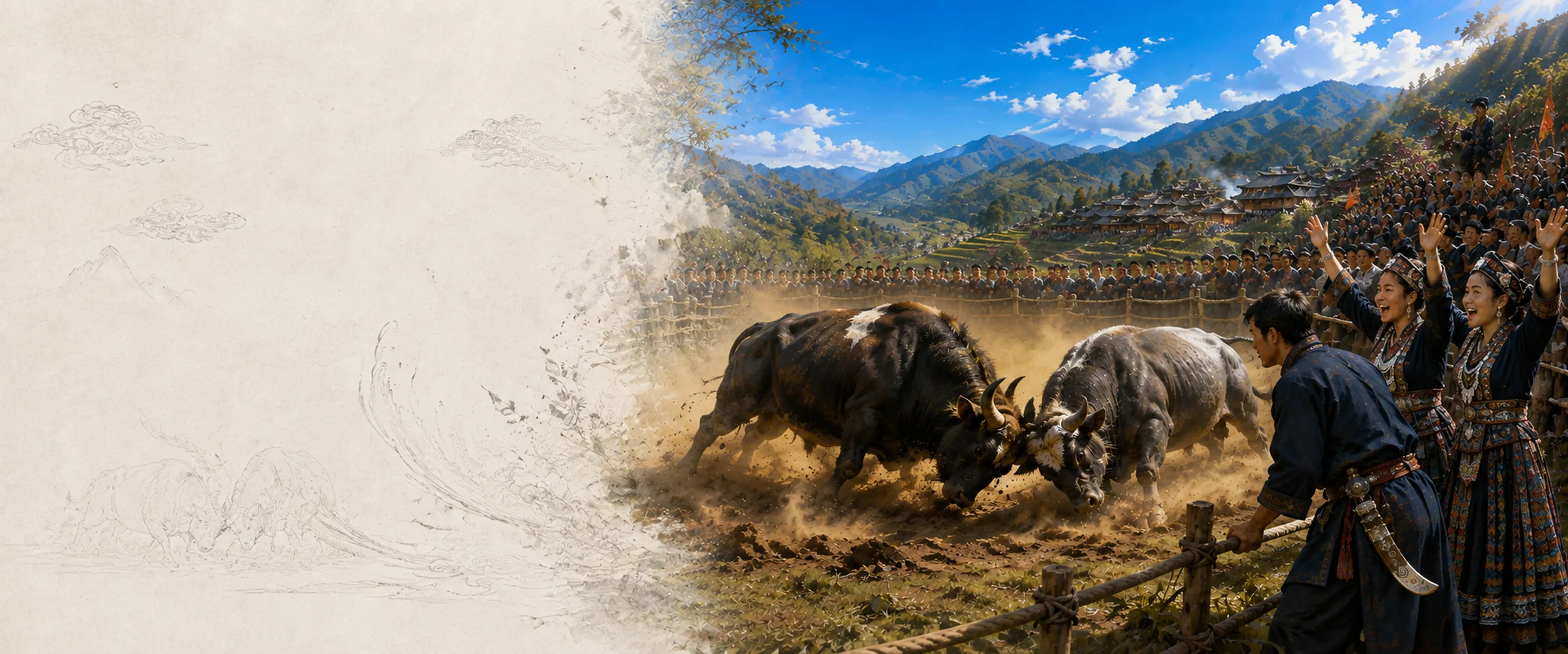
Poetry associated with the Miao New Year often centers on lusheng music and dance, together with the brilliance of ceremonial silver ornaments. During the festival, “芦笙吹奏” and “银饰闪亮” are among its most characteristic images. Such poems frequently portray the festive scenes of Miao communities slaughtering pigs and sheep, honoring their ancestors, dancing to the lusheng, and holding bullfighting and bird-fighting contests.

The Miao New Year is the grandest traditional festival of the Miao people, and poetry about the celebration often depicts lusheng music and dance alongside elaborate silver adornment. During the festival, men play the lusheng while women, wearing complete sets of silver ornaments, dance gracefully. The crisp chime of silver pendants mingles with lusheng melodies and song, creating the festival’s moving musical texture. Ancient Miao songs record both the origins of the Miao New Year and its traditional ways of celebration—slaughtering pigs and sheep, making glutinous-rice cakes, worshipping ancestors, sharing the year-end reunion meal, and drinking wine from village to village. Although Miao New Year poetry has not produced as many celebrated works handed down through the centuries as the festival poetry of the Han tradition, it finds rich expression in Miao folk literature, where plain and direct language records the joy with which this ancient people bids farewell to the old year and welcomes the new.

Miao New Year / Folk Arts

Art Forms

Forms of Expression

Ancient Miao Songs

Other 苗族

Oral Literature

The Miao people possess an exceptionally rich tradition of oral folk literature, including a large body of legends, stories, and songs concerning the origins of the “Miao New Year.” In southeastern Guizhou, traditions concerning the festival’s origin can broadly be divided into three categories: 《苗族古歌》, the Miao 《季节歌》, and Miao legends and folk tales. In the cycle 《打杀蜈蚣》 from 《苗族古歌》, the Miao ancestral figure Jiang Yang fights countless battles against the centipede, a representative of evil forces. Finally, with the help of his mother “妹榜妹留(蝴蝶妈妈)” and other deities, he defeats the vicious centipede in the tenth month, when cold and warmth alternate. Through this form of oral literary transmission, memories of the festival’s origins have continued across generations in the songs of the Miao people.

Ancient Miao songs encompass the history of migration and labor among Miao ancestors, and their melodies are solemn, distant, and lingering. In Baibei Miao Village in Rongjiang, Guizhou, there is a saying about the local ancient songs: “千年唱一曲、一曲唱千年”. These songs are repeatedly sung during the Miao New Year, merging the historical memory of the Miao people with the joy of festival celebration.

Folk Legends

A widely circulated legend in Miao areas of southeastern Guizhou explains the origin of the Miao New Year as follows. It is said that there once lived a Miao girl named Wodudui, who was beautiful, intelligent, and capable. Both Heaven and Earth wished to marry her, but Wodudui had made up her mind to become the wife of Earth. When the god in Heaven learned of this, he abducted her. Wodudui refused to submit even at the cost of her life and hanged herself in the celestial palace in the eleventh lunar month. Admiring her steadfastness, people prepared fine food every year on the first Tiger Market Day of the eleventh lunar month and invited her spirit to return for reunion. Young men and women dressed in ceremonial finery, traveled from village to village, played the lusheng, and danced beneath the moon. Repeated year after year and passed down from generation to generation, this custom gradually became the grand traditional Miao festival known as the Miao New Year.

Another widely circulated legend tells of “the struggle between Heaven and the human world for the New Year festival.” According to the story, the Miao New Year was originally celebrated only by those in Heaven, while the human world remained cold and desolate. When the people below asked Heaven to grant them the festival and were refused, they declared war upon the celestial realm. After a fierce struggle, the people of Heaven yielded, allowing the New Year festival to descend to the human world once its celebration in Heaven had ended. Through simple oral narratives, such legends closely connect the origins of the Miao New Year with the Miao people’s longing for a better life.

The Miao people also maintain a custom of transmitting songs from generation to generation. Around the twelfth lunar month each year, young women and men in Miao villages collectively invite elderly singers in the village to teach them songs. The learning sequence begins with youfang songs, followed by other forms such as ancient songs, drinking songs, and narrative songs. Learning to sing is also regarded as a way to dispel sorrow and relieve boredom. This custom of “transmitting songs” enables the oral literary tradition of the Miao New Year to continue from one generation to the next.

Lusheng

Other 苗族

Central Role

“到了苗年,芦笙和鼓就可以搬出来尽情欢跳。” This sentence captures the central place of the lusheng in the folk arts of the Miao New Year. During the festival, the instrument is awakened from the silence that follows the autumn harvest and becomes the most resonant sonic symbol of the celebration.

The lusheng is the most representative traditional musical instrument of the Miao people. It is made from bamboo pipes of different lengths inserted into a wooden wind chest, producing a melodious and far-reaching sound when played. Lusheng tunes have been transmitted from generation to generation, and each melody carries a particular cultural meaning—some are used in ancestor worship, some express love, some celebrate the harvest, and some welcome or bid farewell to guests. The Miao people have a deep love of music. Almost everyone can sing some traditional folk songs and play one or two ethnic instruments, and grand song-and-dance gatherings are held during the Miao New Year as well as on occasions of weddings, funerals, and other major celebrations.

“苗岭笙韵·笙声不息” is an especially apt summary of Miao New Year lusheng culture. At the opening ceremony of the 2025 Leishan Miao New Year, more than ten thousand lusheng players and dancers gathered together. Lusheng music and song rose into the sky, while dancing feet resounded across the earth, fully revealing the Miao cultural inheritance of “taking the lusheng as the soul and dance as the spirit.” The performance was both a tribute to tradition and a vivid expression of the cohesive power of Miao culture.

Making and Transmission

Making a lusheng is itself a refined form of folk craftsmanship. The instrument consists of bamboo pipes, reeds, and a wooden wind chest. Bamboo pipes of different lengths are inserted into the chest; when the instrument is played, the fingers cover and uncover the sound holes while air passes through the reeds and causes them to vibrate. Pipes of different lengths produce different pitches, allowing the lusheng to create a rich range of melodies.

During the Miao New Year, lusheng players perform ancient tunes while dancers move with powerful steps, bringing renewed vitality to traditional skills in contemporary life. Leishan County has fifteen items of national-level intangible cultural heritage, including Miao lusheng dance, the Miao New Year, and Miao embroidery. As the central instrumental symbol of Miao culture, the lusheng occupies an important place among these intangible cultural heritage traditions.

The Tenth National Miao Lusheng Dance and Music Competition held in Leishan County created a platform for practitioners and inheritors of lusheng culture to exchange knowledge and experience, greatly advancing the protection, transmission, innovation, and development of this national-level intangible cultural heritage. Such competitions preserve the cultural roots of Miao lusheng dance through authentic performance, thereby safeguarding the cultural heritage of the ethnic group, while also encouraging contemporary forms of expression and giving traditional art new vitality through adapted works.

Lusheng Caidang and Lusheng Dance

Other 苗族

Lusheng Caidang

Lusheng Caidang is the most emblematic form of folk dance during the Miao New Year and the most concentrated embodiment of the Miao cultural principle of “taking the lusheng as the soul and dance as the spirit.” It is performed in the village lusheng ground, with men playing and women stepping to the rhythm, while both men and women participate. Miao New Year folk activities are highly varied, with ancestor worship and lusheng Caidang among the principal traditions.

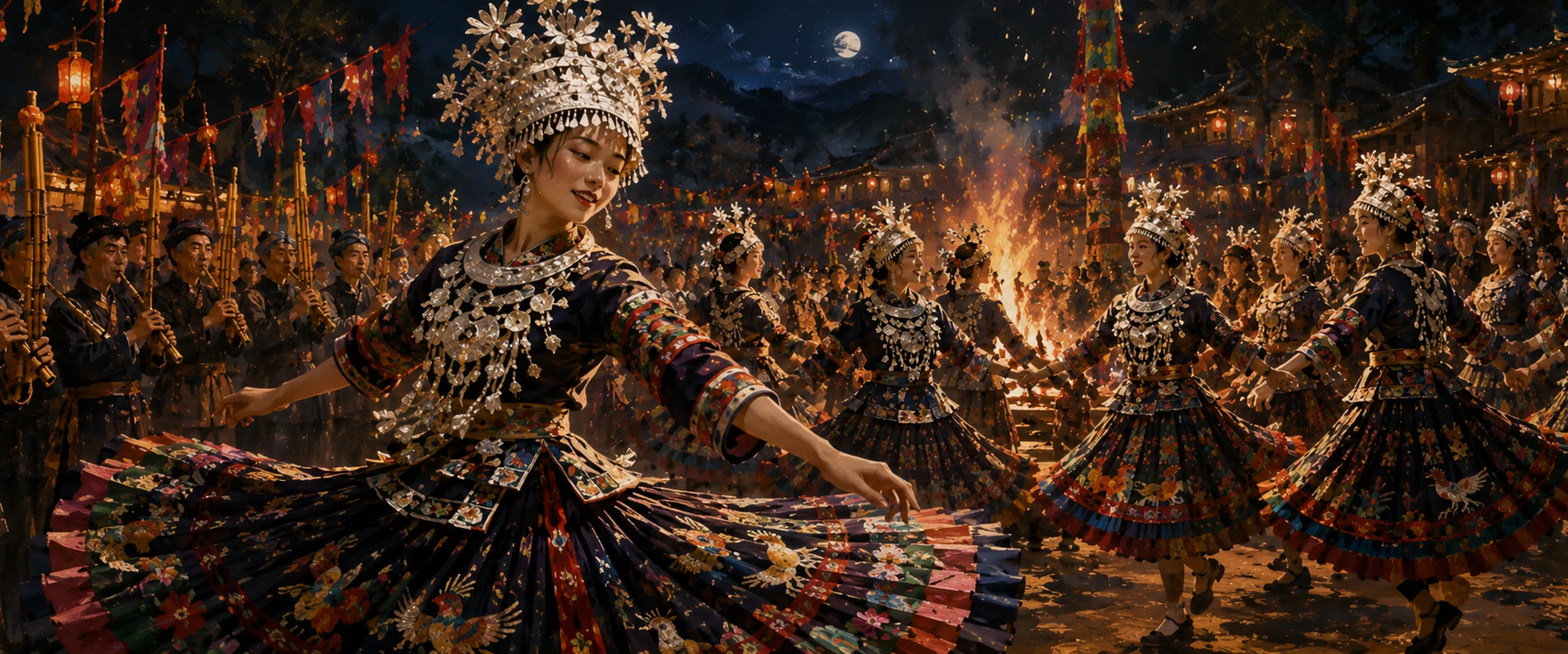
The performance form of lusheng Caidang is highly distinctive. First, the player of a small lusheng performs a brief phrase. Then players of both large and small lusheng join together, while young women wearing bird-patterned garments, silver ornaments, and silver floral crowns begin to dance gracefully. The crisp chime of silver pendants blends with lusheng music and song, forming a moving festival melody. Among young Miao men and women, the most common and beloved collective dance is known as 《踩堂》. Whenever it is performed during a festival, a lusheng ensemble of handsome young men approaches the dancing ground in a circle, each holding and playing a lusheng while swaying his body. The bright and ringing lusheng melody becomes fuller and more harmonious against the deep tone of the mangtong sounding from beneath the central male lusheng pillar and the resonant clang of the bronze drum.

In the Miao Caidang dance, a male lusheng ensemble begins by circling the ground while playing, creating a deep and resonant musical texture in combination with the mangtong and bronze drum. Women in ceremonial dress then enter wearing silver ornaments that may weigh more than ten jin, their ornaments producing clear metallic sounds with every step. In lusheng Caidang, visual and auditory effects merge perfectly—the melodious lusheng, the deep mangtong, the ringing bronze drum, and the crisp silver ornaments—each sound speaking of the Miao people’s love for the festival.

Village-to-Village Lusheng Visits and Lusheng Competitions

Village-to-village lusheng visits are an important form of cultural exchange among communities during the Miao New Year. When the festival arrives, neighboring villages become hosts and guests to one another and establish reciprocal annual bonds. Groups of dozens or even more than a hundred men and women from an entire village take their lusheng, dress in festival attire, beat gongs and drums, and travel to their partner village for joint celebration. Before entering the village, they perform three lusheng tunes to notify their hosts. The hosts then lead the men and women of the entire village out to welcome them. Once inside, the visiting group again performs lusheng music and Caidang in the lusheng ground as an entrance ceremony, while the hosts return the courtesy with their own lusheng playing and Caidang.

After the formal greetings, the guests are invited into individual homes for hospitality and usually remain for three days. During the day, they play the lusheng, perform Caidang, and take part in lusheng competitions; at night, Miao opera is performed. One village after another continues these lusheng gatherings in celebration until the “Drum-Turning Festival” in the second lunar month of spring. Through this custom, Miao villages scattered throughout the Miaoling Mountains are linked by the lusheng, and the joy of the Miao New Year passes from one community to the next. A total of 56 groups, involving more than 5,200 participants, took part in one parade. In addition to local residents, there were five groups from Hunan, Zhejiang, and other places, as well as seven lusheng teams from neighboring counties such as Congjiang, Rongjiang, and Liping.

During the Leishan Miao New Year, nearly ten thousand Miao participants formed more than fifty intangible cultural heritage parade contingents, including a large lusheng formation, a Yang’ousang formation, a high-pitched lusheng formation, a long-skirt and large-silver-horn lusheng formation, a long-skirt and medium-silver-horn lusheng formation, and a Nanmeng lusheng formation. As they advanced through the parade, these groups displayed the diverse song-and-dance traditions, agricultural culture, and other aspects of Miao life. After entering the main venue, the parade contingents performed five major chapters in succession: 《喜庆丰收》, 《多彩交织》, 《欢度苗年》, 《天籁之音》, and 《团结奋进》. Near the conclusion, all participants walked and danced together in the “Lusheng Unity Dance,” the circle growing larger and larger as a symbol of jointly drawing the “concentric circle” of ethnic unity and common endeavor.

Folk Dance

Other 苗族

Bronze Drum Dance and Drum-Stepping Dance

The bronze drum is one of the oldest musical instruments of the Miao people and is regarded as a ritual object capable of communicating with the divine. On the “Shen” day or a nearby zodiac day during the Miao New Year, the village solemnly “raises the drum,” and men and women in ceremonial dress dance joyfully around it in an activity known as “drum stepping.” Traditional entertainment during the Miao New Year includes lusheng dancing and drum stepping. The Miao people have preserved a large-scale dance originating in ancient sacrificial rites known as 《芦笙堂》. During the performance, men play the lusheng while a designated performer strikes the bronze drum. Young women in ceremonial dress and silver crowns extend their arms slightly like birds and dance with measured grace. Drum-stepping dance is also one of the Miao people’s sacrificial rituals. Miao ancestors beat wooden drums and danced forms such as the “Four-Direction Dance,” “Six-Direction Dance,” and “Eight-Direction Dance” to please their ancestors and thereby seek protection for future generations.

Bronze drum dance and lusheng dance are often combined. Among young Miao men and women, the most common and beloved collective dance is 《踩堂》. Accompanied by the mangtong and bronze drum, the music becomes fuller and more harmonious. During the Miao New Year, a small lusheng player first performs a brief phrase, after which players of both large and small lusheng join in. Young women wearing bird-patterned garments, silver ornaments, and silver floral crowns dance gracefully, while the crisp chime of their silver pendants blends with the lusheng music into line after line of harmony.

Carrying-Pole Dance

At the 2025 Leishan Miao New Year parade, the agricultural carrying-pole dance from Zhangpi Village in Datang Town, Leishan County, drew considerable attention. Its props are not refined musical instruments but the most common tools found in everyday households—carrying poles and sickles. Men and women, young and old, dance to the sounds produced by striking the two together. Bai Jinsong, secretary of the village Party branch and director of the village committee, explained that the dance imitates agricultural movements such as harrowing fields, transplanting rice seedlings, and harvesting. It transforms the agricultural memories transmitted through generations of Miao people into rhythm and movement, becoming a distinctive cultural symbol that records both Miao migration history and the civilization of mountain agriculture.

The appearance of the carrying-pole dance reveals another important dimension of Miao New Year folk arts: the festival is not only about ritual and revelry, but also about reviewing and celebrating a year of agricultural labor. The Miao New Year falls after the autumn harvest, when the year’s farm work is largely complete. The carrying-pole dance transforms that labor into dance and the joy of harvest into rhythm. Miao residents of Leishan County regard the tenth month each year as the end of the year; once the grain has been gathered into the household, the year is considered complete. It is precisely at this moment that the carrying-pole dance uses the striking sounds of sickles and poles to bring the agricultural year to a full and satisfying close.

Other Miao Dances

Miao folk dance includes a great variety of forms. During the Miao New Year, alongside lusheng dance, bronze drum dance, wooden drum dance, golden pheasant dance, and bench dance, there are also flying songs, toasting songs, ancient songs, youfang songs, and other forms of performance that exist side by side. Xijiang Thousand-Household Miao Village is known as an “ocean of song and dance.” There, performances of traditional song and dance allow visitors to experience the richness and diversity of Miao performing arts. Xijiang is a living stage for the display of Miao culture and one of the places where Miao song and dance are most intensively presented.

The Miao golden pheasant dance is one of the most distinctive forms of traditional Miao dance. Dancers wear bird-patterned garments and silver floral crowns, imitating the movements of the golden pheasant with grace and agility. The bench dance uses benches as props and is characterized by lively rhythm and humorous expression. Xiaoyao Huagu Dance, also known as Lusheng Drum Dance, is a traditional technical dance popular in Wudang District of Guiyang.

Miao Folk Songs

Folk Song 苗族

Miao Flying Songs

Miao flying songs, known in the Miao language as “Hxak Yeet,” are a form of Miao song popular in Taijiang, Leishan, Danzhai, Jianhe, Kaili, and surrounding areas of Guizhou. As their name suggests, they are high-pitched, resonant, soaring, and unrestrained, as if flying through the air. Their lyrics chiefly express praise, gratitude, and encouragement, and flying songs are generally performed during festive occasions such as the Miao New Year and dragon-boat celebrations.

Flying songs are known as the “gem” of Miao song. They are invariably sung during festivals and celebrations to express emotion and heighten the festive mood. True to their name, they are lofty, open, resonant, and soaring, while the freedom with which singers improvise upon whatever they see and feel is itself equally “flying.” They are usually sung by Miao women. A flying song generally contains around thirty lines, often combining lines of three, five, seven, or eight characters, though five-character lines are most common. The melodic framework is relatively fixed.

《歌唱美丽的家乡》 is a Miao “flying song,” known in the Miao language as “夏样.” It belongs to a four-tone zhi-mode folk-song system and features the distinctive lowered-third tonal note. The song is often used in improvised performances of praise and gratitude during celebrations such as the Miao New Year and Dragon Boat Festival.

《站在高高的苗岭》 is a flying song widely sung during the Miao New Year and performed by Miao singer Li Huihui. Its lyrics include: “登上高高的山岭,条条河水都清秀,村村寨寨都美丽,处处都是好风光。” The melody of the flying song is as free and expansive as the mountain wind, and its spontaneous ability to turn whatever is seen into feeling and song reflects the Miao people’s natural instinct to sing freely in the mountains and fields.

Miao Drinking Songs

Drinking songs are indispensable at the long-table banquets of the Miao New Year. During the festival, singing rises continuously along the tables as Miao women perform beautiful toasting songs and offer wine to guests in horn cups. The Miao horn cup is raised, and the Miao drinking song begins—“双手端起敬贵客,一二三四你干一杯”—one of the warmest invitations heard at a Miao New Year long-table banquet.

Miao drinking songs have a long history and are generally sung at formal wedding banquets or at feasts held for guests during the New Year. There are two forms of drinking song. In one, the singer carries a wine marker to the seat of the person being toasted and sings beside them, with each section generally consisting of around ten lines. The lyrics are direct and exuberant: “金打酒壶银打杯,打对凤凰壶上飞。金壶银杯装满酒,敬奉姑妈不用推”. The image “饮酒面带桃花色” vividly conveys the boldness and warmth of Miao people drinking and singing at a long-table banquet.

During the Miao New Year, people eat together, exchange songs, and drink at long-table banquets. The melodies of drinking songs mingle with the clinking of wine cups to form one of the liveliest soundscapes of the festival. During a Miao New Year cultural activity at the Leishan County Demonstration Kindergarten, children welcomed their young guests by singing toasting songs—the warmth of the drinking-song tradition finding its most innocent expression in childhood.

Miao Love Songs and Youfang Songs

Youfang—also known in different areas by names such as “摇马郎,” “坐妹,” “走寨,” “会姑娘,” “玩表,” and “踩月亮”—is one of the principal ways in which young Miao men and women form marriages through free courtship. It generally takes place during major festivals such as the Miao New Year, the New Rice Festival, and the Climbing Festival, or during agricultural slack seasons, and usually occurs at relatively fixed gathering places. Miao youfang songs are called “霞哟” or “霞游方” in the Miao language. Between the tenth lunar month and the second lunar month of the following year, young Miao people gather on youfang hillsides to exchange songs, including forms of group singing.

In places such as Fanpai Village in Taijiang County, ancient songs, love songs, flying songs, and drinking songs echo through the villages during the Miao New Year. Young people gather around bonfires and use song to express affection for those they love. The polyphonic love songs of Fanpai are classics of Miao love-song tradition. Singers sit together on the ground and engage in lively exchanges, while performers who have returned from other places for the festival encounter master singers and compare their skills. The singing seems to linger in the air for days, continuing from daylight until deep into the night.

Miao youfang songs are an important means of communication. From first acquaintance to falling in love, young Miao men and women are closely connected with the practice of “youfang.” During the Miao New Year, young men and women sit together and exchange songs through the night as they search for a desired partner. Through this custom of conveying affection and choosing a mate through song, the Miao New Year becomes not only a festival celebrating the harvest but also a season of love.

《游方趁年青》 is a widely circulated Miao love song: “游方趁年青,不玩久了就疏远。等到来年当了娘,把崽背着在背上,尿气铺满了全身。那时来玩不值得”. In simple and direct language, the song urges young people to cherish their youth and seek love through youfang while they are still young. “假如你是一朵花,不论开在那山峰,哥哥百计千方把你摘” — during the Miao New Year, love songs flow beneath the moonlight, and generation after generation of young Miao people meet, fall in love, and remain together through these songs.

Miao Opera

Other 苗族

Miao opera is an important form of folk art during the Miao New Year. During reciprocal village visits and annual alliance celebrations, guests generally remain in the host village for three days. During the day, they play lusheng, perform Caidang, and hold lusheng competitions; at night, Miao opera is performed. Miao opera is performed in the Miao language, and its stories are largely drawn from Miao historical legends, heroic tales, and folk life, bringing the oral literary tradition of the Miao people onto the stage.

Miao opera has no fixed theatre. Performances are often held in open spaces within the village or on the lusheng ground. Actors wear Miao ceremonial dress and tell stories through Miao-language dialogue and singing. Its vocal style is closely related to Miao folk song, combining the soaring quality of flying songs, the boldness of drinking songs, and the lyrical turns of love songs. On Miao New Year nights, the voices of Miao opera echo above the villages, forming an important part of the festival’s folk artistic life.

Contemporary Transmission

Heritage & Transmission 苗族

Intangible Cultural Heritage Recognition

In June 2008, with the approval of the State Council, the Miao New Year was included in the second batch of the National List of Representative Intangible Cultural Heritage Items. Leishan County, rich in ecological, ethnic-cultural, and tourism resources, has fifteen national-level representative intangible cultural heritage items, including Miao lusheng dance, the Miao New Year, and Miao embroidery (Leishan Miao embroidery), as well as 68 traditional Chinese villages. The appearance of Guiding lusheng long-drum dance at the Leishan Miao New Year not only added a strong atmosphere of ethnic culture to the China·Leishan Miao New Year, but also created a bridge for exchange among intangible cultural heritage traditions.

Contemporary Folk Celebrations

The 2025 Leishan Miao New Year ran from November 4 to December 20, with twenty large-scale activities scheduled. Bai Zhien, president of the Leishan County Miao Studies Association, explained that every activity represented an in-depth exploration of Miao culture, while every performance was a vivid interpretation of the ethnic spirit. In recent years, the Leishan Miao New Year has displayed four major highlights: the “grandeur of scale” demonstrates cultural confidence; “new forms of ritual” revitalize traditional meanings; the “power of the market” brings intangible cultural heritage to the forefront; and the “convenience of technology” allows traditional festivals to connect seamlessly with modern life.

On the opening day of the 2025 Leishan Miao New Year, the county received a total of 51,526 visitors, an increase of 19.46 percent year on year, and generated comprehensive tourism revenue of RMB 54.4929 million. The Miao New Year has become not only an important cultural symbol through which Leishan presents its image, but also an important engine for stimulating cultural, sports, and tourism consumption and promoting high-quality economic development.

Living Transmission

In the “Ten-Thousand-Person Intangible Cultural Heritage Parade” of the Leishan Miao New Year, more than ten thousand Miao participants dressed in traditional ceremonial attire gather from every direction. Silver ornaments chime as they move, while embroidered garments shimmer with color and light. In the parade, elderly people over seventy walk alongside young children, together carrying forward a thousand years of Miao cultural memory. “今天不仅是过节,更是对民族文化血脉的传承。” said one elderly Miao participant dressed in traditional ceremonial attire. Every embroidered pattern on the costume carries a particular cultural symbol, and such clothing is worn only on solemn occasions like the Miao New Year.

The Leishan Miao New Year has developed from an “ethnic symbol” into a “formula for breaking beyond the local circle,” and then into a contemporary “hotspot for driving sales.” By developing an immersive cultural-tourism experience economy and building a comprehensive festival IP-based commercial chain, the Miao New Year has become not only an important cultural symbol for presenting the image of Leishan, but also an important engine for stimulating cultural, sports, and tourism consumption and promoting high-quality economic development. As a county rich in ecological resources, ethnic culture, and tourism resources, Leishan possesses fifteen national-level intangible cultural heritage items, including Miao lusheng dance, the Miao New Year, and Miao embroidery. The county has consistently followed the principle of shaping tourism through culture and highlighting culture through tourism, promoting the integration of the protection and transmission of traditional Miao culture with the development of the cultural and tourism industries. In 2024, the county received more than 10.83 million visitors and generated comprehensive tourism revenue of RMB 11.862 billion. Inheritors of lusheng intangible cultural heritage enter schools and communities to teach their skills, allowing the cultural heritage of the Miao New Year to take root and grow among younger generations. From an “ethnic symbol” to a “formula for breaking beyond the local circle,” the influence of Miao New Year folk arts is expanding from Miao villages to the country as a whole.

In Baibei Miao Village in Rongjiang County, Miao New Year activities have a history of more than six hundred years. The ancient Miao saying “千年唱一曲、一曲唱千年” remains widely circulated there. The craftsmanship of making bird-patterned garments has been included in the second batch of Guizhou Province’s intangible cultural heritage list and has become an iconic symbol of Miao New Year culture. When young Miao people play the lusheng, dance Caidang, and sing ancient songs during the Miao New Year, they are not merely celebrating a festival; through their own voices and bodies, they are continuing the cultural lineage of their ancestors.

Closing Reflections

Overview 苗族

The folk artistic expression of the Miao New Year differs fundamentally from the “literati poetry” associated with Han festivals. It is not something “written” in words, but something “played,” “sung,” and “danced” into being at the festival itself. It is not an external act of “watching” and “reflection,” but an internal act of “speaking” and “celebration.”

From the creation narrative in 《苗族古歌》 of “在冷热交替的十月战胜了蜈蚣” to the legend of Wodudui’s unwavering fidelity; from the overwhelming spectacle of a ten-thousand-person lusheng performance in which “笙歌响彻云霄、舞步踏响大地” to the thousand-year-old lusheng Caidang tradition of “男吹女踩、银佩脆响”; from the mountain voice of flying songs, “高亢嘹亮、见物即情即兴编唱”, to the long-table revelry of drinking songs in which “金壶银杯装满酒”; from the heartfelt declaration “游方趁年青” in youfang songs to folk performance on Miao opera stages within the villages; from the agricultural memory of carrying-pole dance, “模拟耙田、插秧、收割”, to the diverse movements of golden pheasant dance and bench dance—the folk arts of the Miao New Year take the lusheng and song as their two wings, and ritual and celebration as their core, forming a complete, living, and continuously renewing system of cultural expression.

The Miao New Year is the most concentrated expression of the Miao cultural inheritance of “taking the lusheng as the soul and dance as the spirit.” Leishan County possesses fifteen national-level intangible cultural heritage items, including Miao lusheng dance, the Miao New Year, and Miao embroidery. “到了苗年,芦笙和鼓就可以搬出来尽情欢跳。” This is precisely the most essential character of Miao New Year folk arts: they are not exhibits in a museum, but the breath of everyday life; they are not performances merely to be watched, but celebrations to be entered and shared; they are not words written on paper, but melodies blown through the lusheng, emotions carried in song, and life itself danced through the body. When the lusheng sounds through Leishan County, when ten thousand people move forward singing and dancing in the parade, and when ancient songs continue to be passed from generation to generation deep within Miao villages, the Miao people are using their own voices, their own bodies, and their own dances to offer their deepest and most enduring declaration of affection for “the New Year” and “home.” The Miao New Year is not only a festival in which the Miao people celebrate the harvest and honor their ancestors, but also a grand stage for the living transmission of Miao folk arts. 银饰流光映星河,芦笙振谷醉苗乡——this is the most moving portrait of the folk arts of the Miao New Year.

—-

Continue exploring Miao New Year culture

Readers’ Comments

Calendar and traditional culture enthusiasts from around the world, sharing the same moon.

Sign in or register to join the conversation. Your comment account is created automatically the first time you use a connected account.