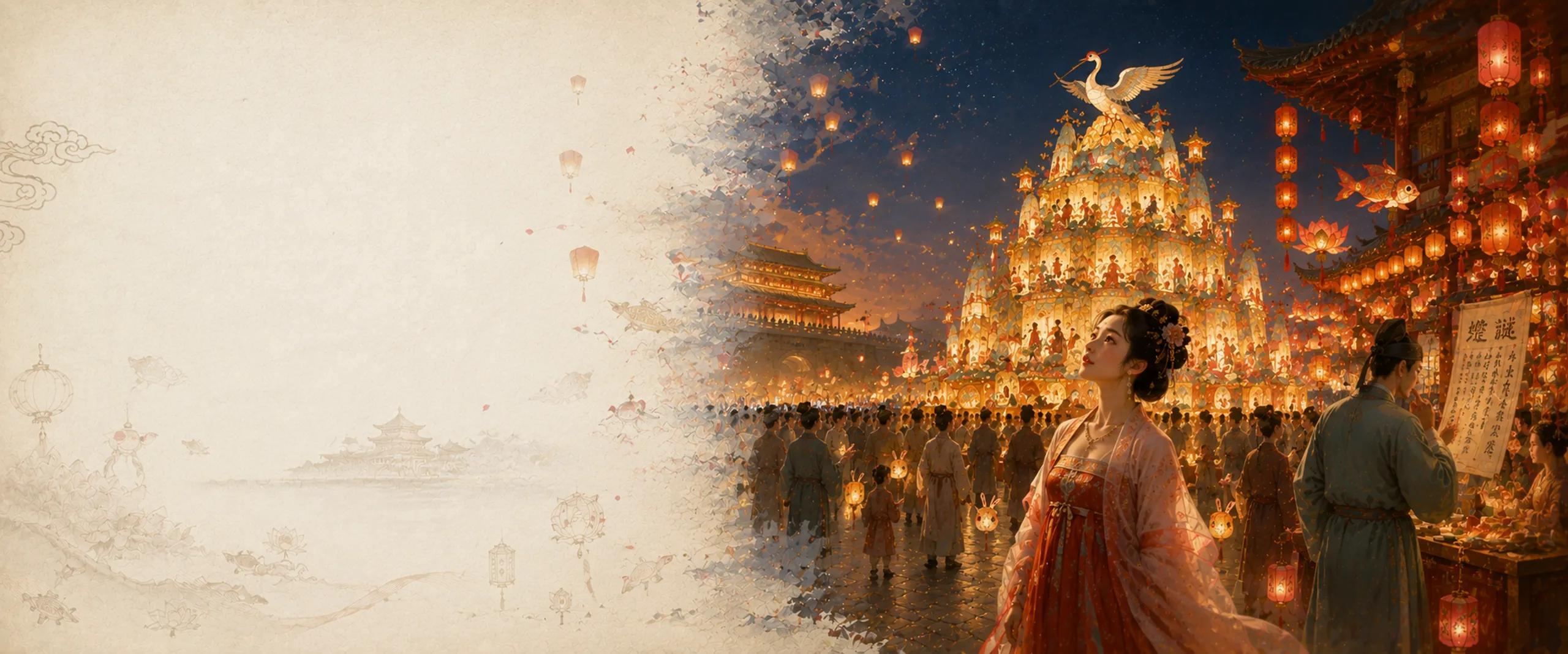
Lantern Festival

Lantern FestivalPoetry

「 火树银花合,星桥铁锁开。 」

The Lantern Festival originated in the Han dynasty and had become a grand carnival for all by the Tang dynasty. Su Weidao, in his poem “The Night of the 15th of the First Month” (《正月十五夜》), wrote: “火树银花合,星桥铁锁开。” (*The fiery trees…

The Lantern Festival is one of the most visually evocative festivals in classical Chinese poetry. In his Tang-dynasty poem The Night of the Fifteenth Day of the First Lunar Month (《正月十五夜》), Su Weidao wrote, “火树银花合,星桥铁锁开。暗尘随马去,明月逐人来,” depicting the magnificent spectacle of the capital on the night of Shangyuan, when lanterns blazed throughout the city and the gates remained unlocked. Xin Qiji’s The Green Jade Table · Lantern Festival (《青玉案·元夕》), with “东风夜放花千树,更吹落、星如雨。宝马雕车香满路。凤箫声动,玉壶光转,一夜鱼龙舞,” renders the lantern-lit city, music, and dancing with tremendous sweep. Ouyang Xiu’s Shengchazi · Lantern Festival (《生查子·元夕》) takes a strikingly different path: “去年元夜时,花市灯如昼。月到柳梢头,人约黄昏后,” recounting a Lantern Festival romance in the voice of a young woman. Tang Yin’s Lantern Festival (《元宵》), with its line “春宵一刻值千金,” speaks to the preciousness of a night when lanterns and moonlight illuminate one another and human joy fills the world.

Lantern Festival / Poetry
120 days until Lantern Festival February 20, 2027 · Lunar 正月十五

Historical Development

Seasonal Poetry

From the Han Dynasty to the Sui and Tang

The origins of the Lantern Festival can be traced back to the Han dynasty. Emperor Wen of Han designated the fifteenth day of the first lunar month as the Lantern Festival, while under Emperor Wu the worship of the deity “Taiyi” was likewise conducted on this date. By the Sui and Tang dynasties, the Lantern Festival had developed into a grand cultural celebration. Its duration expanded from a single day in the Han period to three days, while its scale grew and its forms and activities became increasingly varied. Liu Su’s Tang-dynasty collection of anecdotal writings, New Tales of the Great Tang (《大唐新语》), records: “京城正月望日盛饰灯影之会,金吾弛禁,特许夜行。贵族戚属及下隶工贾,无不夜游。车马喧阗,人不得顾”, offering a vivid glimpse of the extraordinary bustle.

The Tang dynasty marked the first great flowering of Lantern Festival poetry. The magnificence of the lantern fairs provided Tang poets with exceptional material. Through images such as “火树银花” and “星桥铁锁,” poets transformed the brilliance of Chang’an’s Lantern Festival night and the famed “端门灯火” into enduring verse. Su Weidao’s The Night of the Fifteenth Day of the First Lunar Month became a representative work of the period. It won distinction in a “poetry competition on the night of the fifteenth day of the first lunar month” and has been praised as one of the most beautiful poetic pictures of the Tang Lantern Festival. Cui Ye’s six poems titled Shangyuan Night (《上元夜》), Lu Zhaolin’s Watching Lanterns on the Fifteenth Night (《十五夜观灯》), and Zhang Hu’s Lanterns on the Night of the Fifteenth Day of the First Lunar Month (《正月十五夜灯》) are among the other celebrated Lantern Festival poems of the Tang.

The Two Song Dynasties

By the Song dynasty, the scale and momentum of the Lantern Festival had grown greater still, to the point that “游人已集御街,两廊下奇术异能,歌舞百戏,鳞鳞相切,乐声喧杂十余里” (The Eastern Capital: A Dream of Splendor 《东京梦华录》, by Meng Yuanlao of the Song dynasty). The rise of the ci lyric introduced a new artistic form for the subject, and Lantern Festival lyrics reached their height during the Song.

Xin Qiji’s The Green Jade Table · Lantern Festival (《青玉案·元夕》) has been acclaimed as the “finest Lantern Festival lyric through the ages.” With a vigorous hand, it writes in the refined mode of wanyue, finding the deepest solitude within the height of prosperity. Ouyang Xiu’s Shengchazi · Lantern Festival (《生查子·元夕》) unites the festival with the theme of love, and “月上柳梢头,人约黄昏后” became an immortal line. Li Qingzhao’s Yongyule · The Setting Sun Melts Like Gold (《永遇乐·落日熔金》), set against the Lantern Festival, expresses profound reflections on flourishing and decline, together with sorrow over the poet’s own fate. Su Shi’s Butterflies in Love with Flowers · Shangyuan in Mizhou (《蝶恋花·密州上元》) contrasts the Shangyuan scenes of Hangzhou and Mizhou, revealing nostalgia for the past and loneliness in the present.

Yuan, Ming, and Qing

Lantern Festival poetry of the Yuan, Ming, and Qing both inherited earlier traditions and opened new paths. During the Ming dynasty, the Lantern Festival brought a ten-day holiday, with officials and commoners celebrating together throughout the realm. Tang Yin’s Lantern Festival (《元宵》), written in an accessible and lucid style, depicts the joy of the festival. “有灯无月不娱人,有月无灯不算春” expresses the essential importance of lantern light and moonlight shining together on this night. Qing-dynasty works such as Fu Zeng’s Shangyuan Bamboo-Branch Song (《上元竹枝词》) continued the creative tradition of Lantern Festival poetry.

Core Imagery

Seasonal Poetry

Images that recur throughout Lantern Festival poetry form a distinctive “Lantern Festival image system.” They are both literary expressions of Yuanxiao customs and vessels for the poets’ emotions.

Lantern Light

Lantern light is the most central image in Lantern Festival poetry. “火树银花,” “星如雨,” “万灯明” — the lights of Yuanxiao are not merely sources of illumination, but a visual wonder that seems to surpass nature itself. Su Weidao’s “火树银花合” uses the four characters “火树银花” to define the aesthetic ideal of Lantern Festival brilliance. Xin Qiji’s “东风夜放花千树,更吹落、星如雨” imagines the spring wind opening flowers on a thousand trees in order to describe the abundance of light. Zhang Hu’s “千门开锁万灯明” depicts universal participation through the vast spectacle of thousands of households lighting lamps at once. Lantern light is the soul of Lantern Festival poetry—the “火树银花不夜天” of later imagination is precisely the festival’s unique carnival of light.

The Bright Moon

The Lantern Festival is the first full-moon night of the new year, making the moon indispensable to its poetry. Su Weidao’s “明月逐人来” describes moonlight following the crowd; Ouyang Xiu’s “月上柳梢头” combines the rising moon with the emotion of a lovers’ meeting; Cui Ye’s “谁家见月能闲坐” writes the moon as a summons no one can resist; Tang Yin’s “有月无灯不算春” emphasizes the complementarity of lantern and moon. The Lantern Festival moon has been a focal point for generations of writers. The round moon in the sky and the round yuanxiao or tangyuan on earth together form a cultural image of roundness—reunion, completeness, perfection.

Fish-and-Dragon Dances

“一夜鱼龙舞” is Xin Qiji’s classic image for the variety performances of Lantern Festival night. Fish-and-dragon dances involve lanterns shaped as fish and dragons moving as though the creatures were stirring the sea. The “百戏” performances of the Tang Lantern Festival were an important part of the collective revelry. Zhang Hu’s “三百内人连袖舞” and Xin Qiji’s “一夜鱼龙舞” together reveal an evening of music, dancing, and flourishing celebration.

Willow Branches and Dusk

“月上柳梢头,人约黄昏后” forms perhaps the most romantic combination of images in Lantern Festival poetry. The willow branch defines space: the willow is a messenger of spring, and its first green tips announce the season’s arrival. Dusk defines time: the sky is neither fully bright nor fully dark, everything softened and indistinct, the perfect hour for lovers to meet. This combination of images was repeatedly quoted in later generations and helped shape the Lantern Festival’s cultural identity as a “Chinese Valentine’s Day.”

Thematic Categories

Seasonal Poetry

Songs of a Flourishing Age

The Lantern Festival was one of the rare occasions in ancient China for true collective revelry, and the largest body of Lantern Festival poetry directly depicts the grandeur of the celebration. Su Weidao’s The Night of the Fifteenth Day of the First Lunar Month presents head-on the brilliant lights and shared joy of Chang’an; Cui Ye’s Shangyuan Night conveys universal participation through “谁家见月能闲坐,何处闻灯不看来”; Zhang Hu’s Lanterns on the Night of the Fifteenth Day of the First Lunar Month uses “千门开锁万灯明” to show thousands of households pouring into the streets; Lu Zhaolin’s Watching Lanterns on the Fifteenth Night describes the spectacular reach of illumination through “缛彩遥分地,繁光远缀天.” Set against the Lantern Festival, these poems reveal both the imposing grandeur of flourishing Tang civilization and the prosperity of Song urban life.

Love and Longing

Ouyang Xiu’s Shengchazi · Lantern Festival unites the Lantern Festival and romantic love with remarkable completeness, helping establish the festival as a cultural source for the idea of a “Chinese Valentine’s Day.” On the fifteenth day of the first lunar month, young men and women were able to go out together more freely to view lanterns, creating the possibility of “人约黄昏后.” Against the festival background, the lyric contrasts last year and this year, writing the sorrow of “不见去年人” while moon and lanterns remain unchanged. From that point onward, Lantern Festival light and moonlight became witnesses to love stories. Xin Qiji’s The Green Jade Table · Lantern Festival similarly uses the festival as its setting, finding amid the bustle of “众里寻他千百度” the sudden joy of “蓦然回首,那人却在灯火阑珊处.”

Reflections on Life, Rise, and Decline

Li Qingzhao’s Yongyule · The Setting Sun Melts Like Gold uses the Lantern Festival as a setting for profound reflections on flourishing and decline and the sorrow of her own life. The splendor of Bianjing and the desolation of Lin’an, the radiance of the young woman and the weariness of the older self—“中州盛日” and “如今憔悴” create an immense emotional distance. Su Shi’s Butterflies in Love with Flowers · Shangyuan in Mizhou similarly relies on contrast, setting Hangzhou’s prosperity against Mizhou’s loneliness. Bai Juyi’s The Fifteenth Day of the First Lunar Month in Chang’an (《长安正月十五日》) writes “明月春风三五夜,万人行乐一人愁,” finding individual sorrow amid universal celebration. Li Shangyin’s Hearing That There Are Lanterns in the Capital on the Fifteenth Day of the First Lunar Month and Regretting That I Cannot Go See Them (《正月十五闻京师有灯恨不得观》) expresses regret at being unable, because of illness—or another circumstance—to travel to the capital to view the lanterns. Against the bright backdrop of the Lantern Festival, these works write deeper reflections on human life.

Literary Gatherings and Chan Reflection

Su Shi’s Visiting the Monk Kejiu’s Room at Xiangfu on Shangyuan Night, Quietly Without Lanterns (《上元过祥符僧可久房萧然无灯火》) is an unusual Lantern Festival poem. It depicts the cold and quiet atmosphere of a monk’s room on Lantern Festival night, contrasting the singing and dancing outside with the stillness and absence of light within in order to express Chan reflection. “门前歌舞斗分朋” describes the lively lantern celebrations beyond the door; “一室清风冷欲冰” evokes the austere quiet of the monk’s room. “不把琉璃闲照佛,始知无尽本无灯” adapts the allusion of the “inexhaustible lamp” from the Vimalakirti Sutra (《维摩诘经》). Beginning with Su Shi’s experience of visiting a monk on Shangyuan night, the poem uses spatial contrast and Buddhist allusion to transform noisy festival experience into contemplation of Chan principles. At a festival given over to collective celebration, Su Shi enters a monk’s room without lanterns and writes a poem still as unmoving water—the revelry belongs to others; the serenity belongs to oneself.

Lantern Festival Folk Songs

Seasonal Poetry

The Lantern Festival is not only a Han Chinese festival but also an important celebration among many ethnic minority communities. In regions of Yunnan, Guizhou, and elsewhere where minority peoples live in concentrated communities, the festival has also absorbed distinctive local traditions. Miao, Dong, and other peoples perform activities such as lusheng dances and antiphonal singing during the Lantern Festival. The songs associated with these customs have been transmitted orally for centuries and, together with the written poetry of Han literati, form a fuller picture of Lantern Festival culture within the Chinese nation. Although many of these orally transmitted songs were never recorded in writing, they have passed from generation to generation in minority festival life, carrying forms of emotional expression and aesthetic sensibility distinct from those of Han classical poetry.

Closing Reflections

Seasonal Poetry

Lantern Festival poetry is a singular and brilliant landscape within the treasury of Chinese verse. From Su Weidao’s “火树银花合” and the grandeur of the flourishing Tang, to Xin Qiji’s “东风夜放花千树” and the subtle depths of Song ci; from Ouyang Xiu’s “月上柳梢头” and the romance of an unexpected encounter, to Li Qingzhao’s “落日熔金” and the sorrow of personal fate amid the rise and fall of dynasties—Lantern Festival poetry has recorded, across a thousand years, the Chinese longing for light, reunion, and a beautiful life.

Within these poems is the bustle of collective revelry—“千门开锁万灯明,正月中旬动帝京”; the romance of moonlight above willow branches—“月上柳梢头,人约黄昏后”; the devotion of searching through the crowd—“蓦然回首,那人却在,灯火阑珊处”; reflections on flourishing and decline—“中州盛日,闺门多暇,记得偏重三五”; and the completeness of lanterns and moonlight shining together—“有灯无月不娱人,有月无灯不算春”. The meaning of Lantern Festival poetry lies precisely in its ability to carry the lantern light and moonlight of a thousand years ago into every succeeding age of Chinese life.

Lanterns at the Lantern Festival are themselves poetic. In the lights of these poems, we see the grandeur of the Tang, the refinement of the Song, the urban vitality of the Ming, and the continuity of the Qing. Lantern Festival poetry is among the deepest and most enduring declarations Chinese people have made to light—a vast scroll of lanterns and moonlight written in ink by generation after generation. Within that scroll, light is more than light: it is the Chinese people’s undying longing for brightness itself.

—

[Language: es]

Continue exploring Lantern Festival culture

Readers’ Comments

Calendar and traditional culture enthusiasts from around the world, sharing the same moon.

Sign in or register to join the conversation. Your comment account is created automatically the first time you use a connected account.