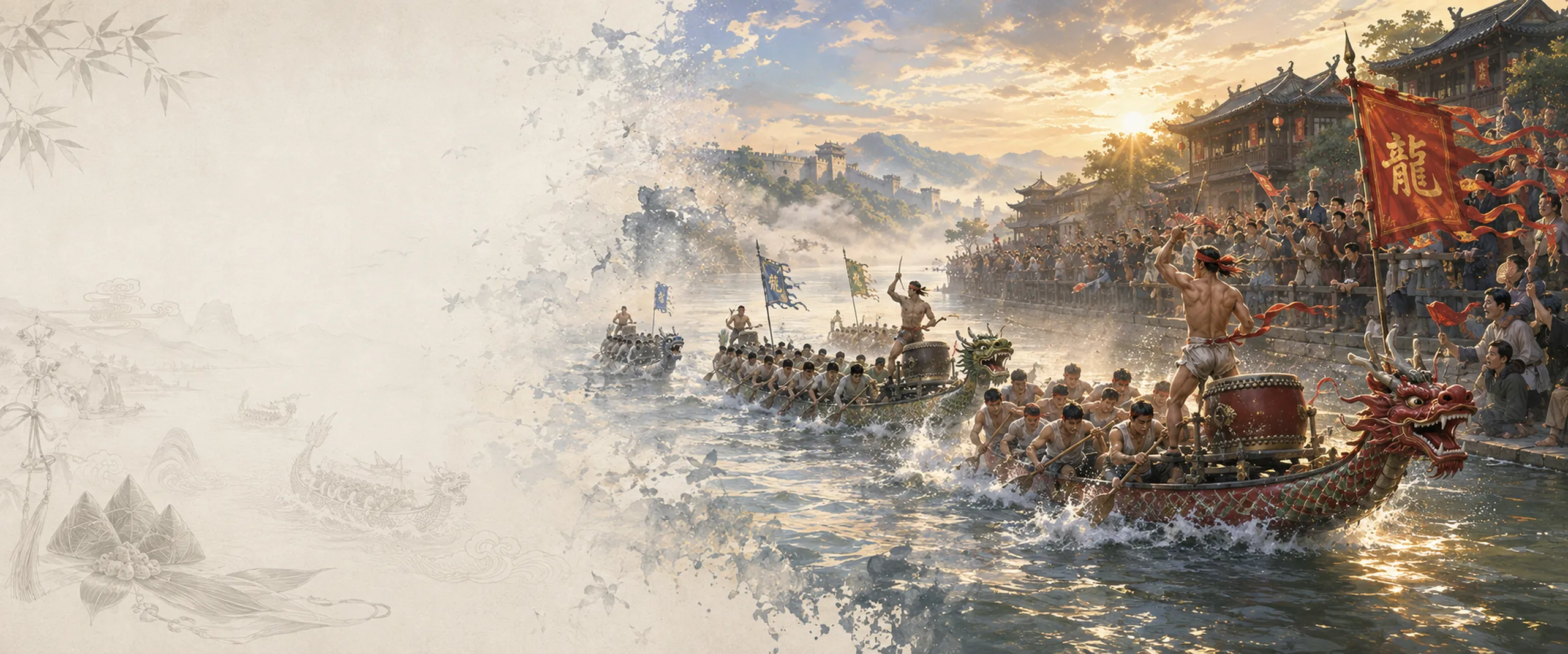

The Dragon Boat Festival originated from dragon totem sacrifices in the pre‑Qin period. Later, because Qu Yuan drowned himself in the Miluo River on the fifth day of the fifth lunar month, the day became a festival commemorating this patriotic poet. The Tang‑dynasty poet Wen Xiu, in his poem “Duanwu” (《端午》), writes: “节分端午自谁言,万古传闻为屈原。” (*The Dragon Boat Festival—who first gave it that name? Through the ages, the tale has been told of Qu Yuan.*) This verse clearly links the festival to Qu Yuan. The customs are rich and varied: dragon boat racing derives from the legend that local people rowed out to search for Qu Yuan; eating zongzi commemorates the poet—people wrapped sticky rice in reed leaves and threw them into the river to keep fish and shrimp from consuming his body; hanging mugwort and drinking realgar wine were meant to expel the “five poisons” (五毒: scorpions, centipedes, snakes, toads, and geckos) and drive away pestilence. As Mei Yaochen of the Song dynasty wrote in his poem “The Fifth Day of the Fifth Month” (《五月五日》): “屈氏已沉死,楚人哀不容。” (*Qu Yuan had sunk to his death; the people of Chu grieved for his unjust fate.*) After a thousand years, the fragrance of zongzi and the drumbeats of dragon boats remain the deepest tribute to this great poet.
Festival Journey
Origins & Legends
History · Evolution · Legend

Tracing the Source · Historical Evolution
- Han Dynasty The Dragon Boat Festival sprouted in the pre‑Qin period and was formally established as a festival during the Han dynasty
- Wei‑Jin and Northern and Southern Dynasties During the Wei‑Jin and Northern and Southern Dynasties period, the customs of the Dragon Boat Festival became more diverse and displayed distinctive regional characteristics
- Sui and Tang Dynasties During the Sui and Tang dynasties, the Dragon Boat Festival inherited the customs of the previous dynasties in form
- Song Dynasty and Later By the Song dynasty, the court posthumously honoured Qu Yuan as Duke Loyal and Martyr, and issued an edict designating the fifth day of the fifth month as “Duanwu Festival,” ordering local governments to organise activities such as dragon boat races to commemorate Qu Yuan
Festival Customs
Customs · Local Traditions · Everyday Life
Festival Foods
Food Traditions · Local Flavors · Taste
Seasonal Flavours · Seasonal Menu
Poetry & Verse
Classics · Imagery · Legacy

Representative Poems · Classic Selections
「Dragon Boat Festival」
节分端午自谁言,万古传闻为屈原。
堪笑楚江空渺渺,不能洗得直臣冤。
Global Features
Overseas · Chinese Communities · Celebrations

Overseas Celebrations · Lights of Chinese Communities
The United States is one of the countries where dragon boat sport is most active worldwide. Dragon Boat Festival celebrations extend from the East Coast to the West Coast, shaped both by the spontaneous initiatives of Chinese communities and by deep participation from mainstream society. Washington, D.C.: Dragon boat clubs train through the night. In the U.S. capital, dragon boat clubs practice through the night in preparation for Dragon Boat Festival races. Francis Lira, who began dragon boating in 2006, said: “It takes 20 people to move a dragon boat. You cannot do it alone. There is no individual in this sport; everyone has to work together.” Local media commented that “this growing sport is paying tribute to Chinese history.” Washington’s dragon boat races have become one of the city’s most influential multicultural events. California: A Dragon Boat Festival celebration for a multicultural community. In California, the 2025 Annual Dragon Boat Festival, organized by the Asian American Community Involvement Association, was held on May 31 at West Valley College in Saratoga, attracting hundreds of enthusiastic participants. The event not only showcased the appeal of diverse Asian cultures, but also demonstrated strong community cohesion and a spirit of exchange across ethnic groups. On the day of the Dragon Boat Festival, the third Dragon Boat Folk Culture Festival was held at Qiyang Cultural Center. Activities included hands-on zongzi making; tasting mugwort cakes, foods made with ai (艾), or Chinese mugwort, a plant closely associated with traditional Dragon Boat Festival customs; weaving five-colored cords (五彩绳), colored threads traditionally worn during the festival; calligraphy; papercutting; and “shooting the five poisons” (射五毒), an interactive folk game associated with the traditional wudu (五毒), or “five poisons.” The program also included traditional Chinese face painting and assessments of individual traditional Chinese medicine body constitutions (体质). Gao Huiling of Los Angeles said that the Dragon Boat Festival is an important traditional festival for Chinese people, carrying profound cultural and historical significance; through storytelling, music and dance, food stalls, and other activities, people of different generations and ethnic backgrounds are invited to experience the beauty of Chinese culture together. Seattle: A Chinese school’s cultural return. Located south of Seattle, Nanpu Xiaxida Chinese School returned after a six-year absence to participate in the 17th Kent International Festival, organized by the Kent Chamber of Commerce on May 31, 2025, presenting Dragon Boat Festival culture to local residents. Michigan: A Dragon Boat Festival celebration in the library. On April 26, the Michigan Lion Dance Team held a “Taiwanese American Dragon Boat Festival” cultural event in Adam Strohm Hall at the Detroit Public Library. Holding the event in this historic hall—renowned for its soaring vaulted ceiling, ornate decoration, and murals by American artist Gari Melchers—gave the occasion particular significance; within a space where knowledge and history intertwine, the Dragon Boat Festival celebration took on an added depth while opening a new chapter for different communities. Corporate cultural transmission. Huamao Logistics also organized Dragon Boat Festival celebrations across several of its U.S. offices. The Miami and Los Angeles offices strengthened awareness of tradition through dragon boat race videos and cultural introductions; the Chicago office created a rich festive atmosphere with themed backdrops, while its e-commerce team brought colleagues closer through food, games, and cultural learning, with touhu (投壶), the traditional Chinese game of tossing arrows into a narrow vessel, generating particularly lively interaction; the New York office introduced employees to traditional Chinese culture, and everyone tasted traditional zongzi.
Dragon Boat Festival celebrations are equally vibrant in Canada. Even before the festival arrives, many supermarkets and stores begin offering an array of zongzi; the fragrance of zongzi leaves spreads through the early-summer air, while dragon boat racing has become one of the favorite sports of people in Canada’s mainstream communities. During the festival period, Vancouver and other places in Canada hold dragon boat races and related activities, drawing large crowds of spectators and creating a lively atmosphere. Huamao Logistics Canada organized employees in Toronto to taste traditional zongzi and exchange cultural stories, strengthening employees’ sense of belonging through the principle of “people first, cultural integration.” Weng Guoning, chairman of the Federation of Chinese Associations in Toronto, said that the Dragon Boat Festival has long since become more than merely a traditional Chinese festival; it has become a vibrant calling card for Chinese culture as it reaches the world.
The 2025 Argentina Dragon Boat Competition was held on May 24 at the dragon boat base in Escobar, Buenos Aires Province, attracting more than 100 competitors. The scale of the event reached a new record, and a 2,000-meter long-distance race was introduced for the first time. Liu Jingang, chairman of the Argentine Dragon Boat Association, said that dragon boat sport not only embodies the spirit of unity, cooperation, and striving forward, but has also become an important bond connecting the peoples of China and Argentina. Nicolás Ceruya, director of Escobar’s municipal sports bureau, said that dragon boat sport has become an effective platform connecting different cultural groups: “This is a sport worth promoting, not only because it is highly competitive and exciting to watch, but also because it is a symbol of tradition and unity.” Since its establishment in 2019, the Argentine Dragon Boat Association has actively promoted the sport and gradually built a training and competition system covering several provinces across Argentina.
On May 10, 2025, Consul General Gao Zhenting in Guayaquil attended a Dragon Boat Festival celebration jointly organized by Guayaquil’s Chinese community and the municipal government. Consul General Gao said that the traditional Chinese Dragon Boat Festival had been inscribed by UNESCO on the Representative List of the Intangible Cultural Heritage of Humanity; the joint organization of Dragon Boat Festival activities by the Chinese community of Guayaquil and the municipal government had created a platform for exchange and mutual learning between Chinese and Ecuadorian civilizations.
Visitor Guide
Preparation · Etiquette · Take Part with Confidence
Readers’ Comments
Calendar and traditional culture enthusiasts from around the world, sharing the same moon.
Sign in or register to join the conversation. Your comment account is created automatically the first time you use a connected account.
No comments yet
Share your thoughts with readers around the world.