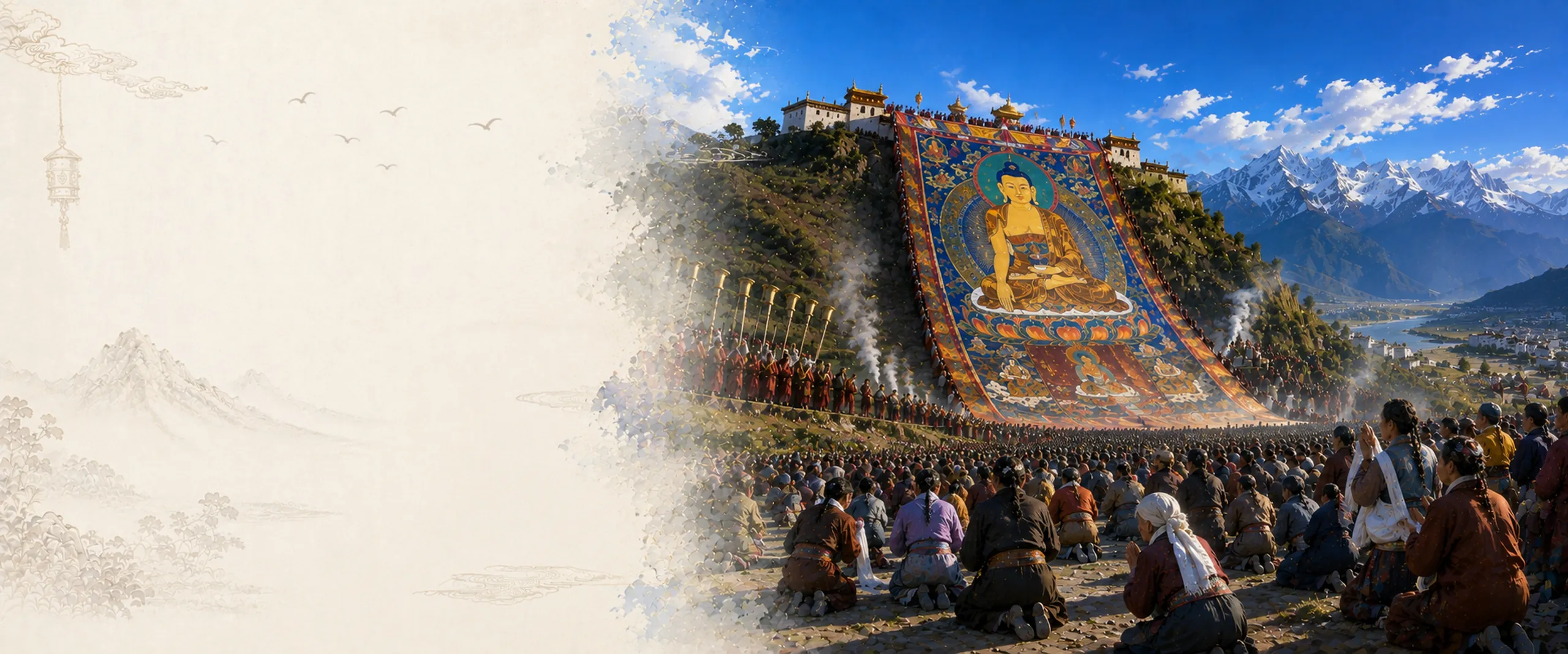

The Shoton Festival is held in the sixth month of the Tibetan calendar and is one of the grandest traditional festivals in Tibet. “Sho” means “yogurt” and “ton” means “banquet,” hence the name “Yogurt Festival.” It originates from the Gelug school of Tibetan Buddhism’s “summer retreat” tradition — monks would remain in seclusion during the summer months to avoid stepping on insects. On the day the retreat ended, laypeople offered yogurt to the monks and entertained them with Tibetan opera, thus giving rise to this grand festival.
The most spectacular event of the festival is the Buddha‑unfolding (Thangka display) — at temples such as Drepung Monastery, enormous Thangka paintings are unfurled, attracting worshippers from far and wide. Tibetan opera is another highlight, with performers wearing colourful masks and enacting ancient legends. “Lingka” means outdoor picnicking — people set up colourful tents, enjoy yogurt and butter tea, and sing and dance together. The Shoton Festival is where religion and secular life meet, where solemnity and joy blend, celebrating the joy of life and the power of faith in the most unique way on the snowy plateau.
Festival Journey
Origins & Legends
History · Evolution · Legend

Tracing the Source · Historical Development
- Early Form (before the 17th Century) Before the 17th century, the Shoton Festival was a purely religious activity
- Mid‑17th Century The year 1642 was a critical turning point in the history of the Shoton Festival
- Early 18th Century After the construction of the Norbulingka (罗布林卡) in the early 18th century, the Shoton Festival activities moved again from the Potala Palace to Norbulingka, and ordinary citizens were allowed to enter the park to watch Tibetan opera
Festival Customs
Customs · Local Traditions · Everyday Life
Festival Foods
Food Traditions · Local Flavors · Taste
Seasonal Flavours · Seasonal Menu
Folk Arts
Song & Dance · Living Tradition · Heritage

Living Folk Arts · Of Song and Dance
Through Song and Dance · A Living Tradition
Opening Verse: 雪顿节日喜欣天,圣地山河歌舞翩。 Introduction: Shoton Festival poetry centers on the unveiling of giant Buddha images, Tibetan opera, song, and dance. “雪顿节日喜欣天” captures the festive joy of the occasion; “雄鹰展翅传佳韵” evokes the grandeur of the high plateau; and “圣地山河歌舞翩” portrays the magnificent spectacle of people celebrating through music and dance. Although poetry associated with the Shoton Festival is not as abundant as that of traditional Han Chinese festivals, there are still fine works depicting its distinctive festive scenes. 《鹧鸪天·雪顿情》 reads: “云朵飘飘覆草原,雪顿节日喜欣天。雄鹰展翅传佳韵,圣地山河歌舞翩。风轻抚,月儿圆,格桑花笑映眉前”. In the poem, “雪顿节日喜欣天” conveys the joyful atmosphere of the festival; “圣地山河歌舞翩” depicts the grand scene of singing and dancing across the plateau; while “格桑花笑映眉前” takes the Gesang flower as its central image, bringing together the distinctive landscape of the snowy plateau and the happiness of the celebration. Shoton Festival poetry carries both the Tibetan people’s devotion to faith and their love of life.
Global Features
Overseas · Chinese Communities · Celebrations

Overseas Celebrations · Lights of Chinese Communities
As the birthplace and principal venue of the Shoton Festival, Lhasa and the grandeur of its celebrations form the foundation of the festival’s international reach. Buddha unveiling: the solemn prelude to Shoton. The Shoton Festival begins with the unveiling of the Buddha image at Drepung Monastery. Every year on the thirtieth day of the sixth month of the Tibetan calendar, around August in the Gregorian calendar, people begin gathering before dawn from every direction at the foot of Mount Genpei Utsé, where Drepung Monastery stands. At 6 a.m., monks of Drepung Monastery proceed one after another to the Tsokchen Assembly Hall to prepare for the Buddha-unveiling ceremony. At around 7 a.m., beneath the first rays of dawn, long blasts of ritual horns and the sound of ceremonial gongs fill the air. About one hundred monks shoulder the enormous rolled thangka and wind their way up the mountain path toward the unveiling platform on Mount Genpei Utsé. As the appointed moment approaches, and ritual horns resound through the valley, nearly one hundred monks slowly carry the immense silk thangka, resembling a long dragon, out from the Tsokchen Assembly Hall of Drepung Monastery. When the gigantic thangka image of Shakyamuni Buddha gradually unfolds, worshippers throw khatas (哈达), ceremonial scarves symbolizing auspiciousness, toward the enormous image, press their palms together, and gaze upon it with awe and devotion. For a time, khatas flutter before the Buddha image, creating an extraordinarily magnificent scene. Every year, the unveiling ceremony draws tens of thousands of visitors from China and abroad, together with local Tibetans, to view the sacred image. In addition to Drepung Monastery, Sera Monastery also holds a Buddha-unveiling ceremony on the thirtieth day of the sixth Tibetan month. Tibetan opera: the cultural essence of Shoton. After the unveiling ceremony, Tibetan opera is the most important cultural activity of the festival period. Tibetan opera uses drums and cymbals as its principal instruments, while performers sing in high, resonant voices marked by distinctive ethnic characteristics. Tibetan opera performance is the cultural essence of the Shoton Festival. After more than six centuries of transmission and development, the art displays its unique appeal through distinctive dance rhythms, ringing vocal styles, magnificent costumes, ancient and simple masks, and colorful dramatic narratives. During the Shoton Festival each year, Tibetan opera troupes take turns presenting classic works such as 《白玛文巴》, 《朗萨雯蚌》, and 《苏吉尼玛》 in Norbulingka Park and Zongjiao Lukang Park. Norbulingka, a World Cultural Heritage site, becomes exceptionally lively during the festival, with spectators crowding around the performance stages. Since 2012, the Tibetan opera showcase has been held continuously for 13 years and has become an enduring cultural program benefiting the public. Horse-racing gathering: a Shoton feast on horseback. During the Shoton Festival, the northern suburban racecourse hosts traditional ethnic equestrian performances. On August 24, 2025, the Lhasa Shoton Horse-Racing Gathering and Equestrian Performance ran from 10 a.m. until 4:20 p.m. Riders presented local residents and tourists with a visual “Shoton” feast on horseback. The program included traditional ethnic equestrian events, speed racing, gaited horse competitions, and difficult movements including dances performed on horseback. Lingka outings: a popular festival carnival. During the Shoton Festival, residents pitch tents in places such as Norbulingka for guo lingka (过林卡), traditional outings in parks and open green spaces involving picnics, singing, dancing, and communal celebration. Groups of friends or entire families bring rope or lime and mark out a circle on a patch of grass, indicating that the space has been claimed. On the day of the Shoton Festival, people arrive early, erect brightly colored tents, spread cushions and carpets on the ground, and lay out various wines, beverages, dishes, and other festive foods. The creativity of the Shoton Festival lies in combining solemn religious ceremony with lively popular entertainment. The Buddha-unveiling ritual carries the power of faith, Tibetan opera reveals the charm of art, and guo lingka embodies enthusiasm for life—interwoven together, these three elements form the distinctive and complete cultural landscape of the Shoton Festival.
The international spread of the Shoton Festival in Asia has primarily taken place through the participation of foreign businesspeople, regional cultural exchange, and cultural resonance with neighboring countries. More than 600 foreign businesspeople “seek opportunities” at Shoton. On August 4, 2024, the first day of Lhasa’s traditional Shoton Festival, the 2024 Lhasa Imported Commodities Expo opened at the Tibet Convention and Exhibition Center. A total of 246 companies and more than 600 foreign businesspeople from 31 countries and regions traveled to Tibet to “seek opportunities.” The exhibition featured five themed pavilions representing Nepal, Serbia, Malaysia, Thailand, and Mongolia. During the Shoton Festival, these foreign businesspeople not only took part in trade negotiations but also personally experienced festival traditions such as the Buddha unveiling and Tibetan opera. Nawaraj Dhakal, Consul General of Nepal in Lhasa, said he was very pleased to see large numbers of Nepali merchants as well as business representatives from other countries and regions participating in the exhibition, and expressed the hope that Kathmandu and Lhasa could work together in the future to hold similar exhibitions in both cities and promote exchanges and tourism development. Aminzai Muhammad Jia, a merchant from Kabul, Afghanistan, came to Tibet for the second time to exhibit and sell goods. Faisal Rashid of Pakistan is a regular participant in imported-product exhibitions in Tibet and had also joined an exhibition that May, achieving sales of RMB 300,000. The Shoton Festival is “gradually becoming a bridge and bond connecting China with the world, and a brilliant calling card through which the world comes to understand China.” “Experience Tibet” activities. Since 2009, Tibet has held annual “Experience Tibet” activities, inviting overseas media professionals from India, Nepal, and other countries to visit Tibet. They take part in the principal activities of the Shoton Festival, visit cultural sites, and engage in face-to-face exchanges with farmers and herders. Through their own reporting, these overseas media professionals bring the grandeur of the Shoton Festival to readers in their respective countries. Religious resonance with Nepal and South Asia. Every year during the Shoton Festival, tourists and believers from India, Nepal, and other South Asian countries make special journeys to Lhasa to attend the Buddha-unveiling ceremony. For followers of Tibetan Buddhism, the unveiling at Drepung Monastery is one of the most solemn religious moments of the year, and this attraction transcends national borders. The broad spread of Shoton among Tibetan communities. The Shoton Festival is not only a festival of the Tibet Autonomous Region, but also a traditional religious festival for Tibetan communities in Qinghai, Gansu, Sichuan, Yunnan, and other provinces. Across the wider Tibetan region there are eight major traditions of Tibetan opera, and performances are held at Norbulingka during the Shoton Festival. This cultural resonance across provincial and regional boundaries has given the festival a deep cultural foundation throughout the Qinghai-Tibet Plateau.
The Shoton Festival has spread in Europe mainly through two channels—the overseas cultural tours of Tibetan artistic ensembles and festival activities organized by Tibetan communities. European tour of Heavenly Tibet (《天上西藏》). In 2007, the Tibet Song and Dance Ensemble took its large-scale song-and-dance production Heavenly Tibet on a cultural tour of Eastern Europe. The tour lasted 16 days, included five performances, and drew nearly 10,000 audience members. The production was divided into five sections, including 《雪顿节》, 《赛马节》, 《望果节》, 《斯姆钦布》, and 《藏历年》. Through classic dances, the program presented audiences with Tibet’s captivating customs, beautiful legends, moving stories, harmonious and happy life, and splendidly diverse religious art. On June 12, 2007, Heavenly Tibet premiered at the Stefanía Cultural Center in Budapest, Hungary. Its soaring, resonant singing and passionate, distinctive Tibetan songs and dances deeply affected the audience. Georgi Peichinov, Bulgaria’s ambassador to China, commented that the production “embodies the imprint of cultural interaction among multiple ethnic groups.” Director Danzeng Gongbu stated that the work was intended to “present the preservation of plateau culture and the changes of the times through the mirror of festivals.” The Chinese Tibet Arts Ensemble also visited Romania, where its performances were similarly successful. Heavenly Tibet became a representative production of international cultural exchange, bringing Tibetan festival cultures such as the Shoton Festival before European audiences. Immersive experiences for foreign envoys in China. Heavenly Tibet was also performed at the China Theatre in Beijing, where 62 diplomatic envoys from 30 countries and international organizations, together with 27 journalists from 14 foreign media organizations, attended the performance. The moving stories, magnificent costumes, and passionate songs and dances left the diplomats and journalists “immersed in a longing for a splendid and colorful life.” Shoton in overseas Tibetan communities. In Tibetan communities overseas, the Shoton Festival is likewise celebrated as an important cultural festival. In Belgium, for example, on July 26 and 27, 2025, the Belgian Regional Ü-Tsang Association successfully held a two-day Shoton Festival in the coastal city of Ostend. The event opened with the traditional Tibetan dance “Tashi Shupa”, followed by a display of traditional clothing from the Ü-Tsang region. The association also presented a range of cultural performances highlighting Tibet’s rich cultural heritage. Association president Angwang Zongji briefly introduced the profound cultural significance of the Shoton Festival within Tibetan tradition. Chief guest Dundup Gyapo praised the association’s efforts in organizing this important cultural event and commended the unity of Belgium’s Tibetan community in celebrating Shoton despite being geographically dispersed. The Shoton Festival in Ostend demonstrated that the cultural symbols of Shoton—Tibetan opera, traditional dance, and festival celebration—can be reproduced and sustained beyond the plateau.
The influence of the Shoton Festival in the Americas has primarily been realized through recognition by international festival awards and connections with global festival networks. “World Festival and Event City Award”: the highest international recognition. In 2012, the Lhasa Shoton Festival, submitted by the Ethnic Festival Committee of the Chinese Association for Anthropology and Ethnology, captured the attention of judges for international festival awards with its distinctive appeal, enabling Lhasa to stand out in the annual IFEA awards and receive the highest honor—the “International Festival and Event City Award.” Lhasa thus received the top honor in the 2012 IFEA awards, the “World Festival and Event City Award.” As one of China’s first nationally recognized intangible cultural heritage items and a traditional ethnic festival of Tibet, the Shoton Festival has in recent years generated a “Shoton effect,” attracting increasing numbers of people to Lhasa for tourism, sightseeing, investment, and business development. It has produced substantial social and economic benefits and has exerted a broad and far-reaching influence across China. “Most Internationally Influential Festival” award. On June 18, 2017, at the Sixth China Ethnic Festival Summit and the 2017 China Outstanding Ethnic Festival Awards Ceremony held in Oroqen Autonomous Banner, Inner Mongolia, the “2016 China Lhasa Shoton Festival” received the “Most Internationally Influential Festival” award. As a calling card of the city of Lhasa, the China Lhasa Shoton Festival has been included on the national intangible cultural heritage list and has successively received honors including “China’s Top Ten Festivals,” “Top Ten Festival China Award,” and “China’s Top Ten Branded Festivals.” These international honors have given the Shoton Festival broad visibility and recognition within the festival industry in the Americas. Invited to attend the World Festival Association annual meeting. In 2012, the Lhasa Shoton Festival Organizing Committee was invited to travel to the United States in September to attend the annual meeting of the World Festival Association. The opportunity to participate in a top-level meeting of the international festival industry provided the Shoton Festival with a direct channel of communication with festival cities and festival events around the world. By maintaining a continuing presence in the global festival field, the Shoton Festival has not only displayed the distinctive charm of Tibet’s traditional culture, but also earned an international reputation for Lhasa’s city branding. The spread of the Shoton Festival in the Americas has not occurred through large-scale community celebrations, but through recognition within international festival systems and connections through professional networks—a distinctive path in which professional influence substitutes for grassroots dissemination.
Visitor Guide
Preparation · Etiquette · Take Part with Confidence
Readers’ Comments
Calendar and traditional culture enthusiasts from around the world, sharing the same moon.
Sign in or register to join the conversation. Your comment account is created automatically the first time you use a connected account.
No comments yet
Share your thoughts with readers around the world.