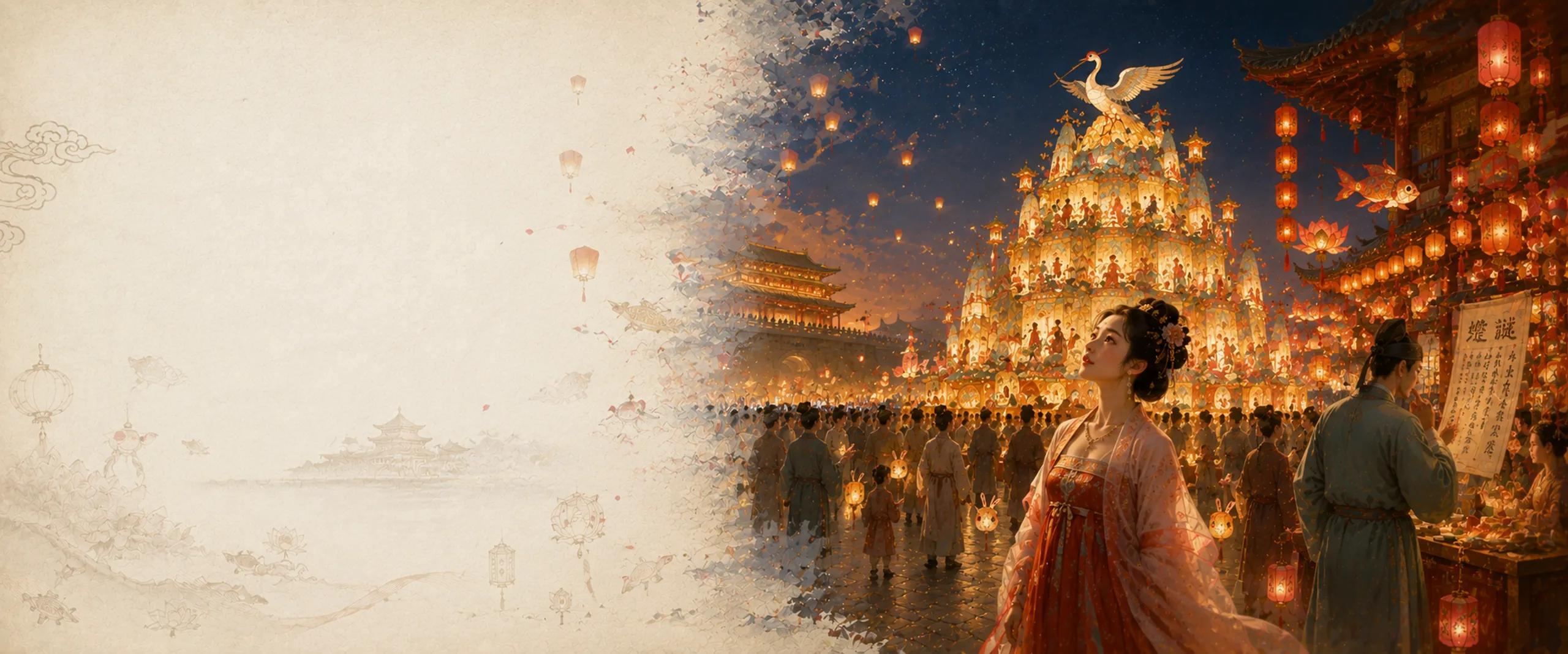
On the night of the Lantern Festival, streets and alleys are illuminated with colorful lanterns as people go out to admire the displays, solve riddles, and eat yuanxiao. Lantern riddles (灯谜), also called “guessing lantern riddles” (打灯谜), became established during the Song dynasty, when riddles were written on slips of paper and attached to lanterns for visitors to solve. Folk entertainments such as dragon and lion dances, land-boat performances, and stilt walking are also widely staged. Eating yuanxiao—known in many southern regions as tangyuan (汤圆) or yuanzi (圆子)—symbolizes reunion, completeness, and good fortune. As the “final revelry” of the Spring Festival season, the Lantern Festival brings the festive atmosphere that began on New Year’s Eve to one last brilliant climax.
Main Customs
Viewing Lanterns
Historical Origins
There are several explanations for the origin of Lantern Festival lantern-viewing. One theory traces it to the pre-Qin Chu tradition of worshipping Taiyi (太一神), a supreme deity believed to govern the universe. According to this interpretation, the people of Chu worshipped Taiyi on the fifteenth day of the first lunar month. During the reign of Emperor Wu of Han, the state ritual to Taiyi was fixed on this date, and by the time Sima Qian helped establish the Taichu calendar (太初历), the fifteenth day of the first lunar month had already acquired the status of an important festival.
Another widely circulated explanation connects the practice with Buddhism. Emperor Ming of the Eastern Han promoted Buddhism and, according to later tradition, learned that Buddhist monks observed the fifteenth day of the first lunar month by viewing Buddhist relics and lighting lamps in honor of the Buddha. He therefore ordered lamps to be lit in the imperial palace and Buddhist temples that evening and encouraged both elites and ordinary people to hang lanterns. Over time, this Buddhist ritual celebration is said to have developed into a major folk festival.
A third explanation associates the festival with the Daoist concept of the Three Yuan (三元). In this system, the fifteenth day of the first lunar month is the Shangyuan Festival (上元节), the day on which the Heavenly Official bestows blessings (天官赐福). Because the Heavenly Official was associated with joy and blessing, lamps were lit in celebration.
After the Sui and Tang dynasties, public lantern festivities became increasingly popular. Although the Tang capital normally enforced a night curfew, the emperor suspended it for three nights during the Shangyuan Festival, a special dispensation known as “releasing the night” (放夜). By the reign of Emperor Xuanzong, the festival had grown into a citywide carnival. In the Song dynasty, lantern displays were extended from three nights to five, accompanied by fireworks and various entertainments. During the Ming dynasty, Zhu Yuanzhang ordered lanterns to be raised on the eighth day and taken down on the seventeenth, creating a ten-night celebration. After the Qing dynasty, the imperial court ceased organizing large lantern fairs, but popular lantern celebrations remained spectacular.
Activities
Viewing lanterns is one of the oldest and most central customs of the Lantern Festival. Indeed, because of the tradition of displaying and viewing lamps, the festival is also known as the “Lantern Festival” (灯节) or “Lantern Evening” (灯夕). Lanterns come in countless forms, including palace lanterns, animal-head lanterns, revolving lanterns, floral lanterns, and bird-shaped lanterns. Their surfaces may depict ancient legends, the traditional “Four Gentlemen” of plum blossom, orchid, bamboo, and chrysanthemum, or symbolic creatures such as dragons, phoenixes, luan birds, and tigers.
On Lantern Festival night, streets are filled with hanging lanterns, colored decorations, and shifting light. People leave their homes to wander through lantern markets and celebrations, often continuing late into the night. The Tang poet Su Weidao (苏味道) captured the brilliance of Chang’an’s Lantern Festival in On the Night of the Fifteenth Day of the First Month (《正月十五夜》):
火树银花合,星桥铁锁开。 Trees of fire and flowers of silver merge in brilliance; the locks of the star-lit bridge are opened.
Cultural Meaning
In Chinese culture, lantern light symbolizes brightness, hope, and auspiciousness. Viewing lanterns expresses hope for a bright future in the new year while also symbolically dispelling darkness and welcoming spring. Because the fifteenth day is the first full-moon night of the new year, the moon in the sky and the lanterns on earth illuminate one another, creating the celebrated image of a city so radiant that night itself seems to disappear.
How to Participate
On the evening of the fifteenth day of the first lunar month, visitors can attend lantern fairs and lantern markets across China. Major displays are held in places such as Qianmen in Beijing, Yuyuan in Shanghai, the Confucius Temple area in Nanjing, the Grand Tang Mall in Xi’an, and the Zigong Lantern Festival in Sichuan. Displays usually begin around dusk and continue late into the night. It is advisable to check dates and locations in advance, dress warmly where necessary, and avoid peak crowds. Some events also offer lantern-making workshops where visitors can create a small lantern of their own.
Solving Lantern Riddles
Historical Origins
Lantern riddles developed from China’s much older tradition of riddles and word puzzles, which can be traced to the Spring and Autumn and Warring States periods. Riddles remained a popular form of intellectual entertainment throughout Chinese history. Records indicate that by the Song dynasty, literary riddles were being written on silk lanterns.
The Southern Song scholar Zhou Mi (周密) wrote in Old Affairs of Wulin: Lantern Varieties (《武林旧事·灯品》):
“There were also silk lanterns on which poems and verses were cut and written, sometimes containing satire and humor, together with painted figures, hidden-head riddles, coded sayings, and jokes from the old capital, all intended to amuse passersby.”
In the Southern Song capital of Lin’an, present-day Hangzhou, composing and solving riddles became especially popular during the Lantern Festival. By the Ming and Qing dynasties, lantern riddles had matured into one of the festival’s standard customs.
Activities
Solving lantern riddles (猜灯谜), also called “striking lantern riddles” (打灯谜), is one of the festival’s most intellectually engaging activities. On the fifteenth day, colorful lanterns are hung in public spaces and fireworks may be set off. Riddles are written on paper slips and attached beneath or beside the lanterns for visitors to solve. Because riddles stimulate the mind while fitting naturally into the festive atmosphere, the custom became increasingly popular and eventually became an indispensable part of the celebration. Lantern riddles draw on literature, history, geography, folk customs, language, and everyday knowledge, making them both learned and entertaining.
Cultural Meaning
Lantern riddles reflect the high value Chinese culture traditionally places on intelligence, learning, and literary skill. In the midst of a festive atmosphere, participants display knowledge and sharpen their thinking, giving the Lantern Festival not only visual spectacle but also intellectual pleasure. Many riddles also contain historical allusions or moral lessons, giving the custom an educational function through entertainment.
How to Participate
At Lantern Festival events, riddles are often written on red slips of paper and hung beneath lanterns. Visitors may attempt to solve them and, depending on the event, take the slip to a designated desk to check the answer. Correct answers may earn small prizes. Participants should avoid damaging lanterns or removing riddle slips without permission. Community centers and shopping districts also frequently organize lantern-riddle activities during the festival.
Eating Yuanxiao
Historical Origins
The earliest surviving records of eating foods resembling modern yuanxiao (元宵) during the festival date to the Song dynasty. The Song scholar Zhou Bida (周必大) wrote in Continued Drafts from Pingyuan (《平园续稿》) that people cooked fuyuanzi (浮元子) during the Lantern Festival, remarking that earlier writers seemed not to have composed poetry about it.
The Song text Shanfu Lu (《膳夫录》) by Zheng Wangzhi records: “Among festival foods in Bianjing, Shangyuan oil hammers are eaten.” Lü Yuanming’s Miscellaneous Notes on Seasonal Customs (《岁时杂记》) states that people in the capital made tadpole-shaped soup from mung-bean flour, rolled glutinous rice into balls, and served them with sweet syrup, calling the rice balls yuanzi (圆子). Yuanxiao were also known as fuyuanzi, yuanzi, or tuanzi (团子). Because these names evoke the sound and idea of tuanyuan (团圆)—family reunion and completeness—the food gradually became a symbol of household harmony and happiness.
According to a widely circulated later anecdote, after the 1911 Revolution, Yuan Shikai disliked the name yuanxiao because it sounded like “Yuan disappears” (袁消) and in 1913 ordered that it be called tangyuan (汤圆) instead.
Activities
Eating yuanxiao is the most representative food tradition of the festival. Made from glutinous-rice flour, yuanxiao may be plain or filled. Common fillings include sweet red-bean paste, sugar, hawthorn, sesame, jujube paste, rose, walnuts, mixed nuts, and osmanthus. They may be boiled, pan-fried, steamed, or deep-fried, producing very different textures and flavors.
A well-known distinction is that northern yuanxiao are “rolled,” while southern tangyuan are “wrapped.” Northern-style yuanxiao are made by cutting the filling into small pieces and repeatedly rolling them in a basket or tray of dry glutinous-rice flour so that layer after layer adheres to the surface. Southern tangyuan are made by mixing glutinous-rice flour with water into a dough, wrapping the filling inside, and rolling it into a smooth ball. Despite their different preparation methods and textures, both foods symbolize reunion and completeness. Their round shape evokes both the full moon and the hope that “the moon is full and the family is whole.”
Cultural Meaning
The round shape of yuanxiao echoes the full moon of the fifteenth night and symbolizes reunion, completeness, and harmony. Eating yuanxiao is therefore more than a culinary pleasure: it expresses hopes for family unity and a happy life. In Chinese festival culture, eating yuanxiao at the Lantern Festival carries a ritual importance comparable to eating mooncakes at the Mid-Autumn Festival.
How to Participate
Yuanxiao or tangyuan can be bought or made at home. In northern China, some supermarkets and pastry shops sell freshly rolled yuanxiao, while in the south handmade tangyuan are widely available. Visitors can also try making them themselves—rolling yuanxiao in the northern style or wrapping tangyuan in the southern style. When boiling them, use plenty of water, add them after the water reaches a boil, and cook until they float. Because glutinous rice is dense and sticky, yuanxiao are best eaten hot, slowly, and in moderation.
Dragon-Lantern Dancing
Historical Origins
The earliest written descriptions of dragon dancing are often associated with Zhang Heng’s (张衡) Han-dynasty Rhapsody on the Western Capital (《西京赋》), which vividly describes dragon performances among the baixì, or “hundred entertainments.” The Book of Sui: Treatise on Music (《隋书·音乐志》) also records a spectacular dragon performance known as “Transformation of the Yellow Dragon” (黄龙变) during the reign of Emperor Yang of Sui.
Dragon dancing developed from ancient Chinese dragon worship. Because dragons were associated with rain and the regulation of weather, people performed dragon dances to seek divine protection and pray for favorable weather and abundant harvests. By the Ming and Qing dynasties, dragon dancing had spread widely across the country.
Activities
Dragon-lantern dancing (耍龙灯), also called “dancing the dragon lantern” (舞龙灯) or simply dragon dance (龙舞), is one of the Lantern Festival’s most visually impressive folk performances. In traditional Chinese culture, the dragon is regarded as an auspicious being. A dragon lantern may extend twenty meters or more, with the head and body illuminated from within and mounted on poles carried by a team of performers. As the dragon follows a “pearl,” the performers make it coil, leap, twist, rise, and dive. The long illuminated body undulates through the darkness, producing a brilliant and dramatic spectacle.
The Southern Song poet Xin Qiji (辛弃疾) famously described the splendor of the Lantern Festival in The Green Jade Table: Lantern Festival (《青玉案·元夕》):
东风夜放花千树,更吹落,星如雨。宝马雕车香满路。凤箫声动,玉壶光转,一夜鱼龙舞。 The east wind blooms a thousand trees with light at night, then scatters stars like rain. Fragrant carriages fill the road; phoenix flutes sound, the luminous moon turns, and fish and dragons dance through the night.
Cultural Meaning
In Chinese culture, the dragon symbolizes auspiciousness, nobility, courage, power, and abundance. The dragon dance is therefore not merely a folk performance but also a ritualized expression of hopes for favorable weather, plentiful harvests, and communal prosperity.
How to Participate
During the Lantern Festival, dragon-lantern processions can be seen in streets, plazas, temple fairs, and village celebrations. Performers often travel through entire neighborhoods, creating a highly animated atmosphere. Spectators should remain outside the performance route and keep a safe distance. In some areas, visitors may be allowed to try carrying a section of the dragon under supervision.
Lion Dancing
Historical Origins
Records of lion dancing can be found as early as the Wei, Jin, and Northern and Southern Dynasties period, including descriptions associated with the Record of Buddhist Monasteries in Luoyang (《洛阳伽蓝记》). Traditional accounts often trace its early development to the Three Kingdoms period, after which it gradually became a standardized festival performance.
According to Buddhist tradition, the lion was associated with Manjushri Bodhisattva (文殊菩萨), and the spread of Buddhism into China is sometimes linked in popular explanations to the arrival of lion-dance traditions. By the Tang dynasty, lion dancing had become widely popular and later spread deeply into folk culture.
Activities
Lion dancing is one of China’s best-known folk performing arts and is widely staged during the Lantern Festival and other major celebrations. It is also known as “lion dance” (狮子舞) or, in older contexts, “Music of Great Peace” (太平乐). A basic lion team generally consists of three performers: one controls the lion’s head, one controls the body and hind legs, and a third acts as the lion’s guide.
Two broad styles are traditionally distinguished: “civil lion” (文狮) and “martial lion” (武狮). The civil lion emphasizes gentle, playful behavior such as shaking its fur and rolling on the ground. The martial lion emphasizes power and agility, performing leaps, climbs, and ball-play. The guide, often holding an embroidered ball, leads the lion through increasingly difficult movements. Folk belief traditionally attributes to the lion the power to repel evil spirits.
Cultural Meaning
The lion is regarded as the king of beasts and as a powerful protector against evil. Lion dancing therefore expresses wishes to ward off disaster, repel harmful forces, and welcome blessings. The custom also traveled overseas with Chinese migration and became especially prominent in places such as Malaysia and Singapore.
How to Participate
During the Lantern Festival, lion dances can be seen on streets, at temple fairs, in scenic districts, and in commercial areas. Performances are usually accompanied by drums, gongs, and cymbals, creating an energetic rhythm. Spectators should keep a safe distance. Some venues offer interactive moments in which visitors may touch the lion’s head to symbolically “share in its good fortune.”
Walking Away the Hundred Illnesses
Historical Origins
The custom known as “Walking Away the Hundred Illnesses” (走百病) can be traced directly to an older observance called Haomo Day (耗磨日) during the Northern and Southern Dynasties. The Guangxu-era Dongguang County Gazetteer states that the sixteenth day of the first lunar month was formerly called Haomo Day and identifies this practice as an origin of the later custom.
By around the Tang dynasty, Walking Away the Hundred Illnesses gradually merged with rituals for dispelling disease and epidemic misfortune and with Lantern Festival customs. From the Ming and Qing periods onward, it became an important element of the festival. The Ming writer Zhou Yong (周用) described women preparing themselves to go out together and “walk away the hundred illnesses.”
Activities
The custom is also known as “dispersing the hundred illnesses” (散百病), “strolling away the hundred illnesses” (遛百病), “roasting away the hundred illnesses” (烤百病), or “walking bridges” (走桥). Participants were traditionally mostly women, who went out in groups on Lantern Festival night, walking along walls, crossing bridges, or heading into the countryside in the belief that such movement could ward off disease and disaster.
The Ming authors Liu Tong (刘侗) and Yu Yizheng (于奕正) recorded in Scenes and Objects of the Imperial Capital (《帝京景物略·春场》) that from the eighth to the eighteenth day, women dressed in white silk garments walked together at night, believing this would protect them from ailments of the back and legs; the practice was called “walking bridges.” The Qing writer Pan Rongbi (潘荣陛) likewise noted that women went out in groups on Lantern Festival night to pray for protection from misfortune, often crossing bridges in small groups in a rite called “passing beyond calamity” (度厄).
Cultural Meaning
Walking Away the Hundred Illnesses reflects traditional Chinese concern with health, well-being, and the avoidance of disease. Because the fifteenth night is the first full moon of the new year, going outdoors and crossing bridges was understood symbolically as crossing beyond misfortune and entering a year of health. Historically, it also provided women with a relatively rare opportunity for public movement and social interaction.
How to Participate
On Lantern Festival evening, friends or family can go for a walk together and cross a bridge. Urban participants can choose a park, riverside path, or pedestrian bridge, enjoying fresh air and gentle exercise. It is one of the easiest traditional customs to reinterpret in modern life. Comfortable shoes and warm clothing are recommended.
Sending Children’s Lanterns
Historical Origins
The custom of “sending children’s lanterns” (送孩儿灯) has a long history. Because the Chinese words “lamp” (灯, dēng) and “male heir” (丁, dīng) sound similar, giving a lantern became associated with the auspicious wish of “adding a son” (添丁). In traditional society, fertility and the continuation of the family line were major concerns, so sending lanterns became one of the most earnest blessings a natal family could give to a married daughter. The Ming text Wuzazu (《五杂俎》) already records the custom in Fuzhou.
Activities
Sending children’s lanterns, usually shortened to “sending lanterns” (送灯) and also called “sending flower lanterns” (送花灯), traditionally meant that before the Lantern Festival a bride’s natal family would send lanterns to her new household, or that relatives and friends would send them to a newly married couple without children. Because of the sound association between “lamp” and “heir,” the gift expressed the wish that the bride would soon bear children and that the family line would flourish.
Practices vary by region. Around Xi’an in Shaanxi, lanterns are traditionally sent between the eighth and fifteenth days. In the first year, a pair of large palace lanterns and a pair of painted glass lanterns may be given. If the daughter is pregnant, one or two pairs of smaller lanterns may be added. In Fuzhou, during the first Lantern Festival after marriage, the natal family traditionally sends a lotus lantern. If there is still no child in the second year, a Guanyin-Bringing-Children lantern may be sent; after a third year, an orange lantern may be chosen because the Fuzhou words for “orange” and “urgent” sound alike. After a child is born, lanterns portraying “the top scholar riding a horse” or “Heaven grants a qilin child” may be given.
A folk rhyme says:
正月元宵灯,外婆爱外甥,送来红红桔子灯,吉利又添丁。 Lanterns glow at the first-month festival; grandmother loves her grandchild. She brings a bright red orange lantern—auspicious, and wishing the family another child.
Cultural Meaning
Sending children’s lanterns combines the Lantern Festival’s culture of light with traditional Chinese ideas about fertility and family continuity. Through the wordplay between 灯 and 丁, a small lantern came to carry the much weightier wish for new descendants and a flourishing lineage.
How to Participate
For newly married friends or relatives, a pair of festive lanterns can be given before the Lantern Festival together with wishes for family happiness. Red and gold designs are especially common. Because this custom historically carries a fertility message, however, it is best understood in its cultural context and used with sensitivity in modern personal relationships.
Welcoming Zigu
Historical Origins
The worship of Zigu (紫姑) existed by at least the Northern and Southern Dynasties. Zong Lin (宗懔) of the Liang dynasty recorded the custom of welcoming Zigu on the fifteenth day in the Jingchu Suishiji (《荆楚岁时记》). Stories about Zigu’s identity differ from region to region, but the basic image of a woman who died unjustly, became divine, and was associated with the protection of sericulture remained relatively stable.
Activities
Welcoming Zigu (迎紫姑) was a traditional Lantern Festival folk ritual. Zigu was also called Qigu (戚姑) and, in northern China, names such as Toilet Maiden or Third Pit Maiden. According to one legend, she had originally been a concubine who was envied by the principal wife and killed in a toilet on the fifteenth day of the first month, after which she became a deity associated with that space.
On the evening of the festival, people made a life-sized figure of Zigu from straw, scraps of cloth, and other materials and welcomed her into the household near the toilet or pigsty, where offerings were made. Worship of Zigu was especially connected with divining the success of silkworm raising, though she could also be consulted about other matters.
Cultural Meaning
In traditional agricultural society, sericulture was an important source of household income, and Zigu came to be regarded as a deity capable of influencing the success of silkworm raising. The custom therefore reflects both agricultural concerns and the way women in traditional society expressed anxiety and curiosity about their own lives and futures.
How to Participate
Some rural areas retain memories or vestiges of Zigu worship. Visitors may learn about the tradition from local elders, folk museums, or heritage exhibitions. For most modern urban participants, it is better approached as a historical window into the Lantern Festival’s diverse ritual culture rather than as a practice that must be reenacted.
Regional Variations
North China
Beijing:In old Beijing, the Lantern Festival was traditionally even more exuberant than the Spring Festival itself. From the thirteenth to the seventeenth day of the first lunar month, people celebrated for five days and nights. During the Ming dynasty, the main lantern market stood at Dengshikou in the eastern city, where shops displayed lanterns made of silk gauze, beads, translucent horn, wheat straw, pith, and other materials. By the Qing dynasty, lantern markets had spread throughout the city. The Zhuanghu Banner Fair of Qianjuntai and Zhuanghu villages in Mentougou (千军台庄户幡会) originated in the Ming dynasty, flourished in the Qing, and was inscribed on China’s national intangible cultural heritage list in 2014. Lion dances, dragon dances, yangge, land boats, and stilt performances filled the streets, while drum-and-wind ensembles played traditional pieces such as Shifan and Haiqing.
Tianjin:People admire lanterns, eat yuanxiao, and solve riddles. Yangliuqing New Year prints (杨柳青年画) add to the festive atmosphere, while Tianhou Temple and Ancient Culture Street host lantern fairs and folk performances.
Hebei:In the former Yongping Prefecture, around present-day Lulong, traditions included Taojiu (陶灸), in which ill women gathered near kiln sites; Dubaie (度百厄), in which children crossed bridges in intersecting lines to symbolically pass beyond misfortune; and Jie Yangchang (结羊肠), in which knotted paper cords were used for divination. Jinghai County traditionally ate oversized steamed buns as festival food. In Qingyun County, men invited the “Five Ancestors” to teach martial arts while women invoked Zigu (紫姑) to divine fortune. Jingxing is known for the Lahua dance (拉花), Zanhuang for the “pulling the stone roller” dance (拉碌碡), and Changjia Hutong in Funing District, Qinhuangdao, has preserved a lantern-hanging custom dating to the Qianlong reign of the Qing dynasty.
Shanxi:Families hang lanterns of many shapes and styles, lighting them each evening from the fourteenth through the sixteenth day. Fireworks are among the festival’s most popular attractions, while hanging decorative lanterns is considered an essential part of celebrating the occasion.
Inner Mongolia:In Tongliao and other eastern areas, dairy products may be incorporated into yuanxiao because of the region’s strong pastoral traditions. Eastern Inner Mongolia also preserves the mass folk activity known as “Turning the Yellow River” (转黄河), a winding lantern formation modeled on the Nine-Bends Yellow River. In pastoral areas, fire worship and bonfire gatherings also remain part of the holiday season.
Northeast China
Liaoning:Zhuanghe has the distinctive custom of lighting zodiac lanterns to pray for peace and good fortune in the new year. An older practice known as “Lantern Festival well-viewing” (元宵照井) held that looking into a well on this night could make a person appear more beautiful. In some Manchu communities, maternal uncles traditionally made lanterns for their nephews.
Jilin / Heilongjiang:In cities such as Harbin, people eat yuanxiao, perform dragon dances, walk on stilts, dance yangge, admire colorful lanterns, and enjoy ice-lantern displays. In Aihui, older Shangyuan customs included appointing a “lantern official” (立灯官), performing yangge, playing riddle games, arranging formations, and “rolling on the ice to sell illness” (滚冰卖病)—a custom in which people rode sledges down the riverbank onto the frozen Heilongjiang River, symbolically leaving sickness behind in the old year. Manchu traditions include making ice lanterns, arranging yangge formations, and performing the Zhaoli Gugu dance (笊篱姑姑舞). Among Korean Chinese communities, the festival is called Shangyuan (上元节) and includes customs such as fetching “fortune water,” eating five-grain rice, eating tooth-strengthening sweets, drinking “ear-clearing wine,” performing folk dances, and walking across bridges.
East China
Shanghai:The Yuyuan Lantern Festival is the city’s most representative Lantern Festival event. People eat tangyuan, admire lanterns, and solve riddles, while older customs also included rituals such as welcoming the Kitchen God.
Jiangsu:Nanjing’s Qinhuai Lantern Festival is celebrated with the saying that “Qinhuai lantern boats are unrivaled under heaven.” Nanjing traditions include “walking away the hundred illnesses” (走百病) and climbing the city wall. Suzhou has the custom of “walking the three bridges” (走三桥). Taizhou traditionally observes five major customs: eating yuanxiao, celebrating the festival in the streets, solving lantern riddles, setting off fireworks, and “sending auspicious blessings” (送吉祥). In some towns, relatives and friends present newlyweds with bridge-post symbols or images of Guanyin bringing children in hopes of fertility. In Wujin, bundles of reeds were tied into torches and placed in fields in a practice called “illuminating field wealth” (照田财) to divine future drought or flooding. Children in Yixing once wore ghost masks in a custom called “jumping ghosts” (跳鬼). Huashan Village in Zhenjiang holds a “Opening-the-Gates Fair” (开门集), where parents buy clay whistles called “Taiping clay whistles” (太平泥叫叫) for children to blow away bad luck. In Liuhe District, Nanjing, “Fangxiang people walk north” (方巷人走北) is a Lantern Festival custom with more than five centuries of history.
Zhejiang:In Hangzhou, the fifteenth day is traditionally regarded as the time when the Heavenly Official bestows blessings (天官赐福), and many people observe vegetarian practices, recite scriptures, and worship at Wushan. Haining is famous for refined chrysanthemum lanterns. In Shangyu, martial arts contests were traditionally held at night. Newly married households in Jiande offered wine in a ritual to the marriage bed. The Qiantong Lantern Festival procession in Ninghai is known for drum pavilions, elevated platforms, and swing-like parade structures. In Jinhua, welcoming dragon lanterns is the central event from around the tenth to the fifteenth day. Shaoxing has the custom of “lighting wine lamps” (点酒灯), Hangzhou holds a special Qian Kings Sacrifice (元宵钱王祭), Deqing has the Northern Zhejiang Qianlong Lantern Festival, and Yiwu’s dragon lanterns are performed to repel evil, dispel epidemics, and pray for peace.
Anhui:In Shangyao, Huainan, folk performances follow one after another, including Flower Drum Lantern dancing, dragon lanterns, lions rolling embroidered balls, stilt walking, elevated platforms, flower sticks, decorative lanterns, umbrella lanterns, land boats, and single-pole bridge acts. Along the Huai River there was once a saying that “the fifteenth day of the first month is as important as New Year itself.” Fuyang’s lantern fair dates to the Sui and Tang periods and flourished in the Ming dynasty. Fengyang preserves three major customs: swinging, carrying lanterns, and throwing torches. A local saying holds that “if you swing on the Lantern Festival, your back will not ache all year.”
Fujian:The Lantern Festival is also widely called the “Festival of Lanterns” (灯节). Quanzhou is known for distinctive lantern forms including incense lanterns, folded-paper lotus lanterns, silk palace lanterns, and eight-knot lanterns. In Shaowu, temple processions carrying incense around the local area on Lantern Festival night are called “purifying the streets” (净街). In parts of southern Fujian, children from neighboring villages traditionally threw stones at one another in play; folk belief held that if this did not occur, an epidemic might strike. Bench-dragon processions, commonly called “welcoming the dragon” (迎龙), are widespread. Jiangdong Village in Huangshi, Putian, builds towers of red mandarin oranges, a tradition said to have continued for more than 1,200 years and listed as Fujian provincial intangible cultural heritage in 2022. The bench-dragon lantern tradition of Zhangjiao in Quangang is said to date to the late Yuan or early Ming. The “Two Ma Regions Celebrate the Lantern Festival Together” (两马同春闹元宵) lantern festival was the first national-level intangible cultural heritage project jointly nominated from both sides of the Taiwan Strait.
Jiangxi:In Xinjian County, people traditionally visited graves and inserted bamboo stems as lanterns. In Wan’an, communities worshipped the Shangyuan Divine Boat (上元神舟). From the first through the fifteenth evening of the lunar month, villagers gathered after dinner in ancestral halls or temples holding Lantern Festival songbooks.
Shandong:In Linshui communities of Zichuan, Zibo, people often release river lanterns. In Ningyang, Tai’an, lanterns are brought to ancestral graves. Boxing County in Binzhou preserves a lantern-illumination custom in which boys carry lamps around jujube trees six times while chanting for the trees to flower and bear fruit. In Juxian, Rizhao, people of all ages go outdoors on the sixteenth day for an excursion called “walking the old appearance away” (走老貌), believed to preserve youthfulness. Villages around Qufu perform dragon-lantern dances, and each village’s dragon traditionally appears at the Confucius Mansion. In Laiyang, Yantai, people make lamp bowls from bean flour, fill them with oil, and light them in the custom known as “lighting lamp bowls” (点灯碗).
Central China
Henan:In Xiangcheng County, people eat wonton soup called “reunion tea” (团圆茶), and married daughters are invited back to their natal homes for the festival. Where there are bridges, people cross them together; where there are none, wooden boards may be laid as a symbolic “heavenly bridge”, part of the custom of walking away illness. In some localities, stone turtles were heated with fire during lantern celebrations. In Guangshan and Xinxian in southern Henan, the “sending lanterns” (送灯) custom has been practiced for more than six centuries. Liguan寨 Village in Neihuang County, Anyang, holds a Lantern Festival Fair, with a decorated steamed-cake competition as a major event. Lankao County is known for the national intangible cultural heritage Qilin dance, while dragon teams in Baiqueyuan move through lanes and homes, with the dragon’s head entering and withdrawing three times to symbolize receiving good fortune.
Hubei:In Yunmeng, older farmers traditionally carried torches through the fields at night in a custom called “illuminating and exterminating field silkworms” (照绝地蚕). Children used field drums to welcome deities and divine the year ahead. In Wuchang, “playing the dragon” (弄龙) could continue for three days, with villagers following the dragon lantern to neighboring villages for banquets in a practice known as “dragon exchanged for wine” (龙换酒).
Hunan:In Changde, families prepared a pepper soup with chives and fruit for guests, known as “seasonal soup” (时汤). In Xintian County, dragon lanterns were burned after the performance in a ritual called “sending away disaster” (送灾). Zhengyuan Village in Suxian District, Chenzhou, preserves the Lantern Festival custom of the “Fire Immortal Ox” (火仙牛).
South China
Guangdong:In the Cantonese-speaking region, people eat tangyuan, visit temple fairs, admire lanterns, solve riddles, and watch dragon and lion dances. The Guangfu Temple Fair incorporates cultural performances, contemporary “China-chic” presentations of intangible heritage, food fairs, and other themed sections. Foshan: “Walking Tongji” (行通济) has a history of more than 400 years. Residents carry pinwheels and lettuce across Tongji Bridge to pray for favorable weather and good fortune. Tradition requires walking from north to south without retracing one’s steps, symbolizing an uninterrupted path of good luck. Chaoshan: lantern riddles are especially popular. In the Chaoshan dialect, “lamp” and “male heir” are homophones, so lighting lamps symbolizes adding sons to the family. Families that had a boy during the previous year traditionally hang lanterns in the ancestral hall in a rite called “raising the lantern” (起灯) and bring the child to light the lamp each evening until the eighteenth day. “Parading the lantern” (营灯) likewise symbolizes flourishing descendants, while families with newborn sons may host an ancestral-hall banquet called “making the son’s table” (做丁桌). Jieyang has the custom of crossing bridges, and touching the stone lion at a bridgehead is considered lucky. Hakka regions: Meizhou and Heyuan retain the Shangdeng (上灯) custom celebrating a new male child in the lineage. Elsewhere, traditions include obtaining threads from dragon whiskers for children’s health, “stealing greens,” eating basin feasts in Xiasha Village, Shenzhen, the “viewing the bride” marriage custom in Pinqing Village, Shanwei, and Wuchuan’s celebrated flower bridges, clay sculpture, and piaose processions.
Guangxi:Nanning, Guilin, and other cities hold lantern displays and dragon and lion dances. In Shanglin and Jingxi, people eat fried glutinous-rice balls known as youtuan or jiandui. Hezhou has a firecracker-grabbing custom in which the first prize is called the “wealth firecracker” and the second the “fertility firecracker.” Mashan preserves a more than 500-year-old Lingxian Temple sacrifice and worship of the Yang family generals. Yangshuo features straw-dragon processions and “big-headed dog” performances. Shankou Town in Hepu holds nianli-style Lantern Festival celebrations, while windmill-stepping is a central activity in Longlin.
Hainan:Haikou’s Flower-Exchange Festival (换花节) in Fucheng is the island’s most distinctive Lantern Festival event. Elsewhere, people admire lanterns, solve riddles, and eat tangyuan.
Hong Kong and Macao:Hong Kong holds lantern carnivals and illuminated displays around Victoria Harbour. In Macao, festival lighting appears around Senado Square, while worshippers visit A-Ma Temple to pray for blessings.
Southwest China
Sichuan:Zigong has a long lantern-making tradition, with records of New Year illumination going back to the Tang and Song periods; its Lantern Festival displays are especially renowned. The Southern Song poet Lu You (陆游) described a Sichuan lantern celebration with the line “a mountain of lanterns, ten thousand torches stirring the dusk” (灯山万炬动黄昏). Sichuan also preserves the so-called “Four Stealings” (四偷): “first steal tangyuan, second steal greens, third steal eave lamps, fourth steal red objects.” Stealing greens was associated with health, while the others were connected with fertility wishes. Kaixian traditionally had a ritualized quarrelling custom in which people carried benches outdoors and publicly voiced accumulated grievances, while those being scolded were not supposed to respond.
Chongqing:Tongliang’s fire-dragon performance, in which molten iron produces showers of sparks around the dancing dragon, is one of the most distinctive events. Lantern fairs, temple fairs, and dragon dances are held throughout the municipality.
Guizhou:The “Dragon Dance amid Huahua Sparks” (舞龙嘘花) of Taijiang’s Miao communities has been passed down for centuries and was listed in China’s fifth group of national intangible cultural heritage projects in 2021. Spectators ignite handmade tubes and spray sparks toward the dragon, with more sparks considered more auspicious. Shibing’s “blasting the dragon” (炸龙) has likewise continued for centuries, with crowds lighting strings of firecrackers around the dancing dragon. In parts of southeastern Guizhou, the Lantern Festival is also called the “Vegetable-Stealing Festival” (偷菜节). The Maonan people of Pingtang preserve a fire-dragon procession.
Yunnan:The Mizhi Lantern Festival in Midu County is listed as provincial intangible cultural heritage and has maintained its tradition for more than a century. Midu lantern culture includes decorative lantern displays, public singing and dancing such as “street-crossing lanterns” (过街灯) and “courtyard lanterns” (团场灯), as well as “door-to-door lanterns” (门户灯) that visit homes to offer New Year blessings and repel evil. In Yunlong County, the Three Chong Deities are welcomed before the Lantern Festival and worshipped at temporary street altars. In some areas around Mile, people burn incense on bridges the day after the festival, throw stones into water, and wash their eyes with collected water in hopes of curing illness. In Luliang County, the true revelry occurs on the sixteenth day. Wenshan holds lantern-lit lake walks, Chinese-style garden events, and bonfire gatherings, while the Ailao Mountains preserve the thousand-year-old Ailao Plough Fair (哀牢犁耙会).
Tibet:The Tibetan New Year falls near the Lantern Festival in some years, and festive traditions may include burning incense offerings, dancing Guozhuang, and hanging prayer flags.
Northwest China
Shaanxi:Around Tongchuan, people observe the custom of “lamp-accompanying steamed buns” (伴灯馍): lamps are lit throughout the home, with decorative steamed breads placed beside them. In Fengxiang County, daughters and sons-in-law are invited to a feast called “eating the fifteenth” (吃十五), while lamps and oil are given in a custom whose name evokes “adding oil,” or encouraging advancement. Sky lanterns also have a long history here and were already used in the Tang dynasty.
Gansu:In Huating, eastern Gansu, families grind mixed grains into flour to make small lamp bowls; steaming and lighting these lamps is among the region’s most ritualized customs. Gaotai County’s Nine-Bends Yellow River Lantern Formation (九曲黄河灯阵) is provincial intangible cultural heritage and can trace its early form to the Ming dynasty. Its 365 lamps symbolize light accompanying every day of the year. Among the Baima Tibetans of Wen County, Longnan, people light torches and perform the Chigezhou mask dance (池哥昼) and fire-circle dances.
Ningxia:Hui families fry traditional foods such as youxiang and sanzi, while communities hold shehuo, dragon dances, and lion dances. Some areas preserve the liaogan (燎疳) custom of jumping over fires to dispel bad luck.
Qinghai:Tibetan areas hold Guozhuang dances and shehuo performances, while Kumbum Monastery presents its famous butter-sculpture exhibition on the fifteenth day.
Xinjiang:Han families make yuanxiao and admire lanterns, while people of different ethnic groups exchange festival greetings. Uyghur, Kazakh, and other families may prepare foods such as sanzi for guests.
Taiwan:An old belief holds that unmarried women who secretly pick scallions or vegetables on Lantern Festival night may find a good husband, expressed in sayings such as “steal a scallion and marry a good man” and “steal vegetables and marry a good husband.” Releasing sky lanterns in Pingxi is one of the island’s best-known Lantern Festival traditions. Taitung holds the Bombing of Lord Handan (炸寒单爷), in which firecrackers are thrown toward the embodied God of Wealth. Elsewhere people admire lanterns, solve riddles, and eat yuanxiao.
North China — Temple Fairs and Shehuo
In northern China, the Lantern Festival is especially associated with large lantern fairs and temple fairs. Old Beijing’s lantern markets once spread across the city, with particularly prosperous sites around Dongsi, Xisi, Di’anmen, the Drum Tower, Zhengyangmen, and Changdian. Shops hung lanterns in every imaginable size and shape—large and small, tall and short, square and round.
Northern celebrations generally emphasize noise, energy, spectacle, and communal excitement. In addition to lantern viewing, performances such as stilt walking, yangge, land boats, and other forms of shehuo (社火) are common. Temple fairs combine folk performances with food stalls and festive markets, encouraging visitors to stroll slowly, snack, and watch performances along the way. In the Northeast, ice-lantern exhibitions add a distinctive winter character to the festival.
How to participate: Major northern cities host large temple fairs, including Beijing’s Changdian and Longtan fairs. Visitors can try northern festival snacks such as candied hawthorn and lüdagunr. In the Northeast, ice lanterns and snow sculptures offer a particularly distinctive interpretation of the Lantern Festival.
South China — Lantern Art and Waterside Towns
Southern Lantern Festival celebrations are especially known for refined decorative lanterns and lively lantern markets. Among the four major lantern traditions of the Song period, Suzhou lanterns (苏灯) were celebrated for their variety, meticulous painting, brilliant color, and intricate structure. Lantern craftsmanship in Quanzhou and Fuzhou in Fujian and in Chaozhou and Foshan in Guangdong likewise developed distinctive regional styles.
Lantern riddles were particularly popular in the south. In the Southern Song capital of Lin’an, present-day Hangzhou, large numbers of people composed and solved riddles during the festival. Southern celebrations often favor a more delicate and visually refined atmosphere: lantern reflections shimmer across Jiangnan waterways, Guangdong and Fujian stage fire-dragon dances and Shangyuan blessing rituals, Sichuan and Chongqing enjoy fermented-rice tangyuan, while Lingnan culture emphasizes the connection between lighting lamps and adding descendants. Southern tangyuan may be sweet or savory, including versions filled with meat.
How to participate: Representative southern lantern destinations include Shanghai’s Yuyuan Garden, Nanjing’s Confucius Temple, and lantern displays around Hangzhou’s West Lake. Because winter weather is milder in many southern regions, lighter clothing may be sufficient. Visitors can also try regional foods such as savory tangyuan and tangyuan served with fermented rice wine.
Contemporary Transmission
### Intangible Cultural Heritage Recognition
In June 2008, Lantern Festival folk customs were included in China’s second national list of representative intangible cultural heritage. As one of the most important traditional festivals of the Chinese cultural world, the Lantern Festival is the final major observance in the Spring Festival cycle and carries more than two millennia of cultural memory and emotional meaning. Its central ideal of reunion has endured from antiquity to the present. According to the source material, more than twenty regions have national-level intangible cultural heritage projects connected with Lantern Festival customs.
### The Festival Today
Today, urban Lantern Festival customs are often concentrated around two activities: visiting lantern fairs and eating yuanxiao. Cities also organize televised and online Lantern Festival galas, cultural evenings, and entertainment programs. People can choose between going out to admire lanterns and festivities or staying home to eat yuanxiao while watching holiday performances.
Contemporary celebrations can be extremely large and diverse. Zigong in Sichuan transforms subjects such as dinosaurs into animated illuminated installations; Xi’an’s Grand Tang Mall uses lanterns and performances to evoke the atmosphere of historical Chang’an; Harbin turns ice and snow into monumental illuminated landscapes. In 2026, Changzhou Ancient City in Dazu District, Chongqing, displayed more than sixty large lantern installations and over 3,000 distinctive lanterns. Ziyang in Sichuan organized a folk parade involving 458 performers, with dragon and lion teams, yangge, bridal sedan chairs, and land boats. In Yugan County, Jiangxi, Lantern Festival events attracted more than 300,000 participants and viewers online and offline.
The Lantern Festival has been celebrated for more than two thousand years and remains important not only on both sides of the Taiwan Strait but also in overseas Chinese communities. Lion dancing, in particular, spread internationally with Chinese migration and is especially prominent in Malaysia and Singapore. Chinese communities in Europe and North America have likewise established numerous lion-dance associations, which perform during the Spring Festival and other major celebrations.
Closing Note
The folk traditions of the Lantern Festival form a brilliant cultural panorama. From “raising the lanterns” on the thirteenth day to “taking down the lanterns” on the seventeenth, from viewing lanterns and solving riddles to eating yuanxiao and watching dragon and lion dances, and from Walking Away the Hundred Illnesses and sending children’s lanterns to welcoming Zigu, the festival’s customs bring the long sequence of Spring Festival celebrations to a satisfying conclusion while illuminating the first full moon of the new year.
The Lantern Festival is above all a festival of “revelry” (闹). That single Chinese character captures the fundamental difference between the Lantern Festival and many earlier days of the Spring Festival season. The earlier New Year period emphasizes “keeping” and “gathering inward”: families keep vigil on New Year’s Eve, exchange New Year greetings on the first day, and place the household at the center of celebration. The Lantern Festival, by contrast, emphasizes “opening outward” and “joining the revelry.” People leave their homes, pour into the streets, and complete the transition from the old year into the new spring amid lantern light, music, crowds, and celebration. Its customs are therefore not merely ritual forms but expressions of emotion: viewing lanterns celebrates light; solving riddles honors intelligence; eating yuanxiao blesses reunion; dragon and lion dances display vitality and strength; Walking Away the Hundred Illnesses expresses the wish for health.
Like the lanterns that fill an entire city with light, the customs of the Lantern Festival have traveled through more than two millennia of history while continuing to illuminate the fifteenth night of the first lunar month for generations of Chinese people. In 2008, Lantern Festival folk customs were included in China’s second national list of intangible cultural heritage. Today, the festival remains vibrant across mainland China, Taiwan, Hong Kong and Macao, and in Chinese communities throughout the world, where each year lanterns are lit once again beneath the first full moon of the new year.
—
[Language: es]
Readers’ Comments
Calendar and traditional culture enthusiasts from around the world, sharing the same moon.
Sign in or register to join the conversation. Your comment account is created automatically the first time you use a connected account.
No comments yet
Share your thoughts with readers around the world.