Qixi Festival

Qixi FestivalPoetry

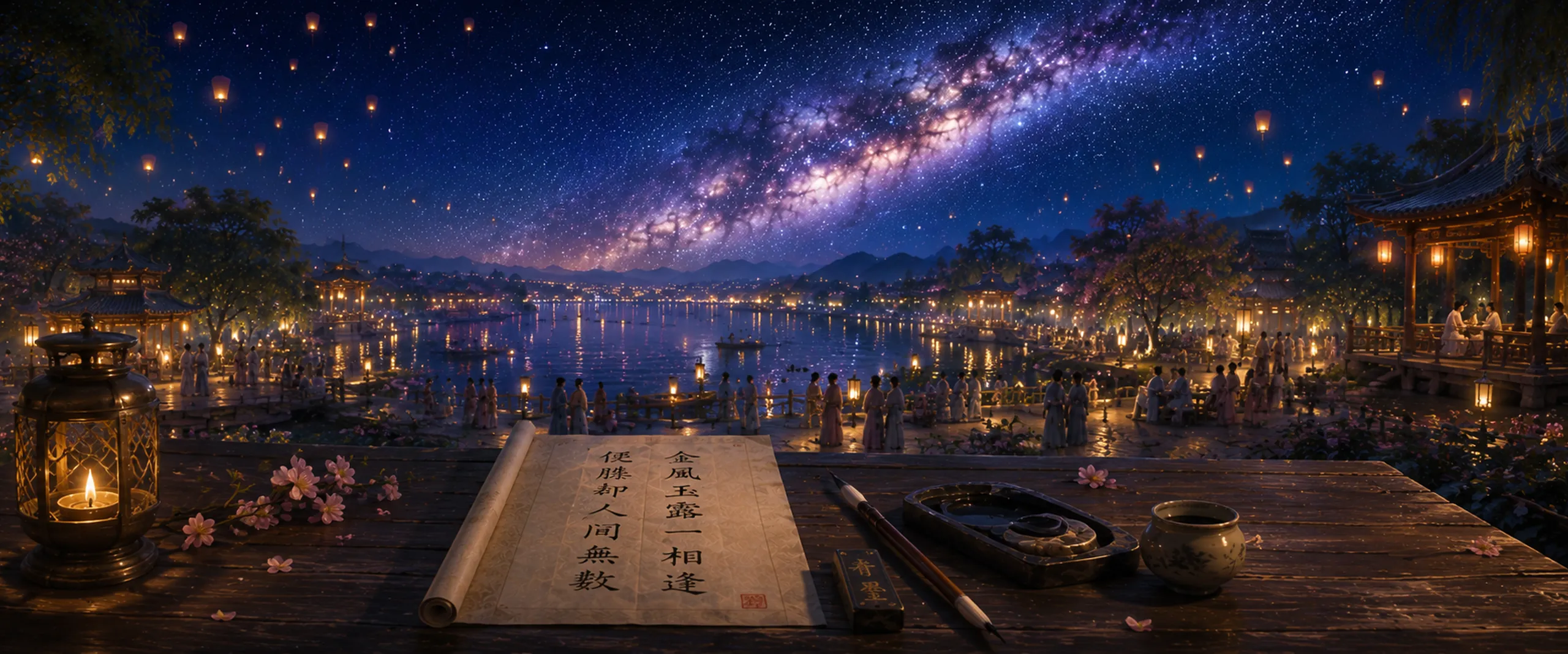
「 金风玉露一相逢,便胜却人间无数。 」

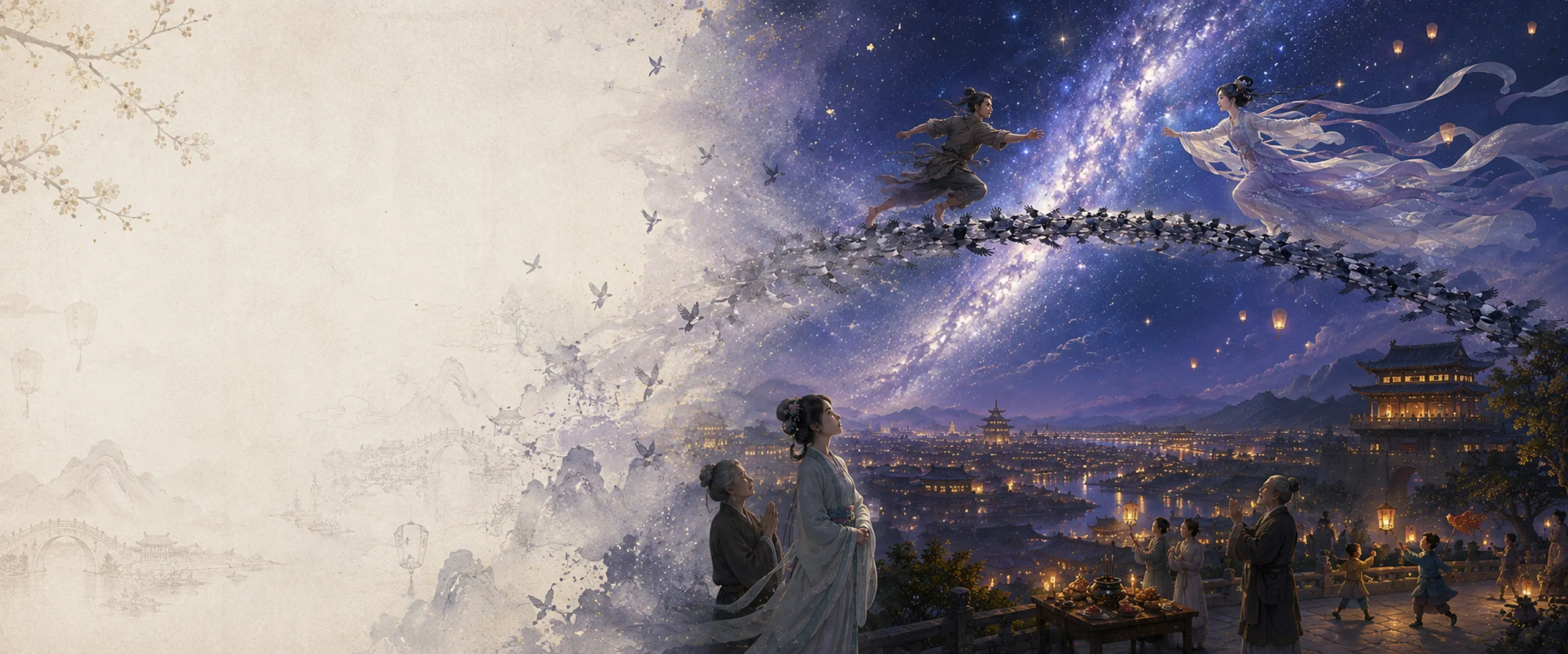
The Qixi Festival originated in the Han dynasty, rooted in ancient star worship — the Cowherd star and the Weaver Girl star face each other across the Milky Way, giving rise to the beautiful tale of their annual reunion on the Magpie Bridge on the…

Qin Guan’s Queqiao Xian (《鹊桥仙》) is the most celebrated work in the poetic tradition of Qixi:

“纤云弄巧,飞星传恨,银汉迢迢暗度。金风玉露一相逢,便胜却人间无数。柔情似水,佳期如梦,忍顾鹊桥归路。两情若是久长时,又岂在朝朝暮暮。”

Du Mu’s Qixi (《七夕》), “银烛秋光冷画屏,轻罗小扇扑流萤。天阶夜色凉如水,坐看牵牛织女星”, uses a cool, restrained tone to portray the loneliness of looking up at the Milky Way on a Qixi night. Bai Juyi’s Qixi (《七夕》), “烟霄微月澹长空,银汉秋期万古同。几许欢情与离恨,年年并在此宵中”, condenses into “年年并在此宵中” the temporal destiny of the Cowherd and the Weaver Girl, permitted to meet only once each year. “迢迢牵牛星,皎皎河汉女” from the Nineteen Old Poems (《古诗十九首》) is among the earliest poetic expressions of the Qixi legend. Qixi poetry fuses the stars of heaven with human love, creating some of the most romantic festival verse in the Chinese literary tradition.

Qixi Festival / Poetry
289 days until Qixi Festival August 8, 2027 · Lunar 七月初七

Historical Development

Seasonal Poetry

From the Pre-Qin Period to the Han Dynasty

The oldest origins of the Qixi Festival lie in the observation and imagination of the night sky by people in remote antiquity. The original forms of the stars known as the Cowherd and the Weaver Girl were celestial bodies, and the mythology surrounding them first emerged from star worship and imaginative interpretation.

As early as the Western Zhou, Shijing · Xiaoya · Dadong (《诗经·小雅·大东》) already contained references to the Weaver Girl and the Cowherd:

“维天有汉,监亦有光。跂彼织女,终日七襄。虽则七襄,不成报章。睆彼牵牛,不以服箱。”

Here, “汉” refers to the Milky Way, while “织女” and “牵牛” are the names of stars. The Weaver Girl crosses the sky seven times in a day, yet cannot weave cloth; the Cowherd shines brightly, yet cannot be harnessed to draw a cart. At this stage, there was still no narrative connection between the two stars. Yet people had already begun to personify them: the Weaver Girl was imagined as a woman spinning and weaving, while the Cowherd was imagined as a man leading an ox and drawing a cart.

By the Han dynasty, the appearance of Distant, Distant, the Cowherd Star (《古诗十九首·迢迢牵牛星》) marked the point at which the legend of the Cowherd and the Weaver Girl had largely taken shape. In the poem, “盈盈一水间,脉脉不得语” transforms the Milky Way between the two stars into a heavenly river separating lovers. The Cowherd and the Weaver Girl had ceased to be mere star names and had become a pair of lovers.

Ying Shao’s Han work Fengsu Tongyi (《风俗通义》) contains the earliest known reference to the seventh day of the seventh lunar month as “七夕”. In the Han dynasty, Qixi was still primarily a festival of women within the palace. According to Ge Hong’s Eastern Jin work Xijing Zaji (《西京杂记》): “汉彩女常以七月七日穿七孔针于开襟楼,人俱习之。” This is the earliest surviving written record of the custom of qiqiao (乞巧), in which women sought skill and dexterity.

Wei, Jin, Northern and Southern Dynasties

The Wei, Jin, Northern and Southern Dynasties were a crucial period in which the legend of the Cowherd and the Weaver Girl reached a more settled form, and Qixi poetry began to flourish as an independent poetic category. By this time, the characters and narrative structure of the legend were largely established: the Weaver Girl, daughter of the Heavenly Emperor, falls in love with the Cowherd; after marriage she neglects her weaving; the Heavenly Emperor becomes angry and separates them; thereafter they may meet only once a year.

The development of Qixi poetry also underwent several major changes during this period. Palace-style poetry and family literary traditions of the Six Dynasties helped transform Qixi into a distinct poetic subject. After Xiao Tong of the Liang dynasty improvised the lines “迢迢牵牛星,皎皎河汉女”, poets of the Tang dynasty would continue to write on Qixi in an unbroken succession.

The Tang Dynasty

By the Tang dynasty, Qixi had become thoroughly popular throughout the country, emerging as an important festival both at court and among ordinary people. Festive activities flourished not only in popular society but also within the imperial palace.

Tang Qixi poetry includes reflections on celestial mythology, descriptions of the folk custom of qiqiao, and expressions of personal sorrow, longing, and separation. Bai Juyi’s Qixi condenses the joy and sorrow of heaven and earth into four lines through “几许欢情与离恨,年年并在此宵中”. Du Mu’s Autumn Night (《秋夕》), beginning “银烛秋光冷画屏”, depicts the loneliness and upward gaze of a woman secluded deep within the palace. Luo Yin’s Qixi records the ancient custom of threading needles and praying for skill. In both quantity and quality, Qixi poetry reached an unprecedented height during the Tang.

The Two Song Dynasties

With the rise of ci poetry in the Song dynasty, Qixi gained a new artistic form. Qixi ci reached its peak during this period. Among surviving Song ci, works on Qixi form the third-largest category of festival ci, surpassed only by those on the Lantern Festival and Mid-Autumn Festival, with nearly 140 extant pieces.

Qin Guan’s Queqiao Xian · Xianyun Nongqiao (《鹊桥仙·纤云弄巧》) has been praised as the “千古七夕第一词”, the foremost Qixi ci through the ages. Its open-hearted vision in “两情若是久长时,又岂在朝朝暮暮” transcends the traditional lament over the brevity of reunion. Fan Chengda’s Queqiao Xian · Qixi (《鹊桥仙·七夕》) writes the extremity of parting sorrow through “相逢草草,争如休见”. Li Qingzhao’s Xingxiangzi · Qixi (《行香子·七夕》) expresses inexhaustible separation through “星桥鹊驾,经年才见”. Yan Jidao’s Zhegutian · Qixi (《鹧鸪天·七夕》) writes the contrast between a brief meeting and a year-long separation in “欢尽夜,别经年”.

In Song ci, Qixi moved from “writing scenery” toward “writing the heart,” and from “recording events” toward lyrical expression.

Yuan, Ming, Qing, and the Modern Era

By the Yuan, Ming, and Qing dynasties, the customs of Qixi had become firmly established, with qiqiao and romantic love developing side by side. Although Qixi poetry no longer reached the same dazzling heights as in the Tang and Song, the tradition continued without interruption. During the Ming and Qing, Qixi returned more strongly to the sphere of family ritual; in the modern era, it expanded again into a social festival combining traditional customs with contemporary culture.
Core Imagery

Seasonal Poetry

The images that recur throughout Qixi Festival poetry form a distinctive “Qixi image system.” These images are at once literary expressions of Qixi customs and vehicles for the emotions of poets.

The Cowherd and Weaver Girl Stars

The Cowherd and Weaver Girl stars are the most fundamental source of imagery in Qixi poetry. Shijing · Xiaoya · Dadong already contains references such as “维天有汉”, “跂彼织女”, and “睆彼牵牛”. By the Han dynasty, Distant, Distant, the Cowherd Star from the Nineteen Old Poems transformed the two stars from astronomical phenomena into literary images through “迢迢牵牛星,皎皎河汉女”.

In Qixi poetry, the Cowherd and the Weaver Girl are not merely stars in the sky; they become symbols of human separation. Du Mu’s “卧看牵牛织女星” in Autumn Night depicts the upward gaze of a woman secluded deep in the palace. Meng Haoran’s “迢迢问斗牛” gives voice to the questioning of a traveler far from home.

The Cowherd and Weaver Girl stars are the soul of Qixi poetry: without these two stars, there would be no Qixi poetic tradition.

The Magpie Bridge

The Magpie Bridge is one of the most imaginative images in Qixi poetry. According to legend, magpies form a bridge so that the Cowherd and the Weaver Girl may meet, and the image recurs throughout poetry and ci.

Qin Guan’s “忍顾鹊桥归路” writes the unbearable sorrow of leaving. Xu Ning’s “一道鹊桥横渺渺” depicts the bridge stretching across the vast Milky Way. Fan Chengda’s “星桥鹊驾,经年才见” writes the longing carried by the bridge.

The Magpie Bridge is both a bridge of reunion and a passage of departure—“忍顾” alone makes this clear. The legend of magpies building the bridge links animals with romantic love, lending Qixi poetry both greater warmth and deeper sadness.

Golden Wind and Jade Dew

“金风玉露” is the classic image created by Qin Guan in Queqiao Xian. “金风” means autumn wind, and “玉露” means white dew; both are markers of autumn.

In “金风玉露一相逢,便胜却人间无数”, Qin Guan condenses both the time of the Cowherd and Weaver Girl’s reunion—autumn—and the event itself into these four characters, transforming “金风玉露” into a symbol of faithful love. Li Shangyin also uses this image in Qixi in the Xinwei Year (《辛未七夕》): “由来碧落银河畔,可要金风玉露时”.

Threading Needles and Praying for Skill

Threading needles and praying for skill is another major Qixi image. Lin Jie’s Qiqiao (《乞巧》) writes:

“七夕今宵看碧霄,牵牛织女渡河桥。家家乞巧望秋月,穿尽红丝几万条”

The word “家家” evokes a lively scene in which households everywhere participate. Luo Yin’s Qixi writes “香帐簇成排窈窕,金针穿罢拜婵娟”, capturing the details of women threading needles to pray for dexterity.

The custom brings Qixi down from “heaven” to “the human world,” transforming myth into the texture of everyday life.

Thematic Categories

Seasonal Poetry

Love and Longing

Love and longing form the central theme of Qixi poetry. Qin Guan’s Queqiao Xian is the supreme achievement of this tradition. Through “两情若是久长时,又岂在朝朝暮暮”, steadfast love is elevated into an eternity that transcends time and space.

Bai Juyi’s Qixi, through “几许欢情与离恨,年年并在此宵中”, writes reunion and separation as two sides of the same emotional experience. Yan Jidao’s Zhegutian · Qixi uses “欢尽夜,别经年” to contrast the brevity of meeting with the length of separation. Fan Chengda’s Queqiao Xian writes the extremity of parting through “相逢草草,争如休见”—a brief reunion may only deepen the sorrow that follows.

Against the background of the Cowherd and Weaver Girl legend, these works express humanity’s universal longing for love and its profound pain in separation.

Qiqiao and Folk Customs

Qixi is not merely a festival of romantic love; it is also a festival in which women prayed for skill and dexterity. Lin Jie’s Qiqiao, with “家家乞巧望秋月,穿尽红丝几万条”, depicts the lively scene of widespread participation. Luo Yin’s Qixi uses “金针穿罢拜婵娟” to record the details of threading needles. Cui Hao’s Qixi portrays the custom in Chang’an, where “家家持针线”.

These poems bring Qixi back from mythic heaven into the 烟火气 of ordinary life, recording an ancient social custom through which women sought to enhance their own skills and value.

Travel and Homesickness

Meng Haoran’s Qixi in a Foreign Land is a representative work of this theme. Encountering Qixi while far from home, the poet cannot see his wife threading a needle beneath the moon and must endure intense homesickness and the sorrow of travel.

Du Mu’s Autumn Night writes the loneliness and upward gaze of a woman secluded in the palace. Against the background of a festival associated with reunion, such poems portray those unable to gather with their loved ones. The more romantic Qixi becomes, the deeper their solitude appears.

Reflection and the Rise and Fall of Dynasties

Li Shangyin’s Mawei · No. 2 (《马嵬·其二》) is a distinctive Qixi poem. In “此日六军同驻马,当时七夕笑牵牛”, the poet takes the Mawei mutiny during the An Lushan Rebellion as background and contrasts the love of Emperor Xuanzong of Tang and Yang Guifei with the legend of the Cowherd and the Weaver Girl.

Once, on Qixi, the lovers whispered together in the Palace of Eternal Life, “夜半无人私语时”; now there is only the tragedy of “六军同驻马”. Through this contrast, Qixi poetry moves beyond the theme of romantic love into a profound reflection on historical rise and decline.

Li Qingzhao’s Xingxiangzi · Qixi, meanwhile, writes the sorrow of the Cowherd and Weaver Girl in “星桥鹊驾,经年才见”, using it as an implicit reflection of her own pain in being separated from her husband.

Qixi Festival Folk Songs

Seasonal Poetry

Qixi is not only a festival of the Han Chinese but also an important celebration among many ethnic minority communities. Among the Bouyei people of Guizhou, couples meet on Qixi and compete in singing love songs, expressing affection for one another through antiphonal mountain songs.

The Zhuang people also possess a strong tradition of antiphonal singing, including both individual male-female exchanges and group singing between men and women. The lyrics are largely improvised, easy to sing, lively, humorous, and witty.

Dong communities also use Qixi as an occasion to recount the origins of the festival and share knowledge concerning ethnic unity. In Shilin, Yunnan, a major gathering of love songs is held every Qixi, bringing together folk singers from different regions to perform rich and distinctive traditional Chinese love songs.

These love-song traditions among ethnic minority communities have been passed orally from heart to heart for hundreds, even thousands, of years. Together with the literary poetry of Han writers, they form the broader cultural landscape of the Qixi Festival within the Chinese nation.

Closing Reflections

Seasonal Poetry

Qixi Festival poetry forms a distinctive and radiant landscape within the treasury of Chinese verse. From the first appearance of celestial imagery in Shijing · Dadong to the deeply emotional gaze of Distant, Distant, the Cowherd Star; from Bai Juyi’s “几许欢情与离恨” to Qin Guan’s “两情若是久长时”; from Du Mu’s “卧看牵牛织女星” to Meng Haoran’s “迢迢问斗牛”—Qixi poetry has recorded, across a thousand years, the Chinese gaze toward the stars, the pursuit of love, the sorrow of separation, and the longing for beauty.

Within these poems lies the pain of being close yet impossibly far in “盈盈一水间,脉脉不得语”; the celebration of steadfast love in “金风玉露一相逢,便胜却人间无数”; the open-hearted understanding of love in “两情若是久长时,又岂在朝朝暮暮”; the lonely resentment of “银烛秋光冷画屏,轻罗小扇扑流萤”; and the homesick sorrow of travel in “他乡逢七夕,旅馆益羁愁”. The meaning of Qixi poetry lies precisely in its ability to carry the starlight and emotions of a thousand years ago into every new age.

From Qin Guan’s “纤云弄巧” and the “千古七夕第一词”, to Li Qingzhao’s “星桥鹊驾” and the extremity of separation, from Yan Jidao’s “欢尽夜,别经年” to the tragic imbalance of “别多欢少”—Qixi poetry is one of the deepest and most enduring declarations Chinese people have made to “stars” and “feeling”, a “letter of love written across the Milky Way” composed in ink by generation after generation. Within these lines, Qixi is both the night of qiqiao in “纤云弄巧” and the moment of reunion in “银汉迢迢暗度”; both the tenderness of “柔情似水” and the reluctance to part in “忍顾鹊桥归路”; both the painful brevity of “欢尽夜,别经年” and the eternity of “两情若是久长时,又岂在朝朝暮暮”. Qixi poetry is the warmest imagination of Chinese people when they look toward the stars, the gentlest attachment when separated by thousands of miles, and some of the most romantic moonlight and starlight in Chinese culture. From Han needle-threading and qiqiao, to the poetry of Tang and Song writers, from the folk songs of Ming and Qing communities to new Qixi verse in the present day, Qixi poetry has crossed more than two thousand years while continuing to carry the simplest and most persistent hopes of generation after generation for beautiful and enduring love.

—-

[Language: es]

Continue exploring Qixi Festival culture

Readers’ Comments

Calendar and traditional culture enthusiasts from around the world, sharing the same moon.

Sign in or register to join the conversation. Your comment account is created automatically the first time you use a connected account.