The Name "Qixi"
The name “Qixi” itself contains rich astronomical and calendrical information. “Qi” is the number seven, “xi” means night, and “Qixi” is the night of the seventh day of the seventh month. This seemingly simple name embodies the ancients’ profound understanding of numerology worship, astronomical observation, and calendrical calculation.
The Cultural Significance of “Seven”
“Seven” is an extremely special number in traditional Chinese culture. The ancients believed that “seven” symbolised “recurrence” and “return.” In the hexagram and line statements of the Book of Changes, “returning on the seventh day” appears — “recurring in its course, returning on the seventh day is the movement of heaven.” Seven days constitute a complete cycle, the basic rhythm of the operation of heaven and earth. The Book of Changes · Return Hexagram has the saying “returning on the seventh day,” meaning that when things develop to a certain point, they return to their origin, completing a cycle. This concept of “returning on the seventh day” deeply influenced the Chinese understanding of time cycles.
In addition, “seven” is also related to the life rhythms of the human body — humans have seven orifices; at seven, a girl’s teeth change and hair grows; at fourteen (two times seven), she reaches puberty and menstruation begins; at forty‑nine (seven times seven), menstruation ceases and fertility ends. The Yellow Emperor’s Inner Canon uses “seven” as the base number for the female life cycle, establishing a natural connection between “seven” and women. This medical concept provided a physiological philosophical basis for Qixi as the “Daughters’ Festival” or “Girls’ Festival.”
On the level of numerology worship, “seven” was regarded as an auspicious number. On the seventh day of the seventh month, both the month and the day are “seven” — a double seven, carrying special auspicious meaning in ancient numerology. As scholars have noted: “‘Seven’ in the Book of Changes signifies ‘recurrence’ and ‘return,’ hence the legend of the Cowherd and Weaver Girl uses ‘the seventh day of the seventh month’ as their meeting day.” This meaning of “recurrence” and “return” precisely echoes the narrative theme of the annual reunion of the Cowherd and Weaver Girl on the Magpie Bridge — the return after separation is the projection of the cosmic rhythm of “returning on the seventh day” onto human emotions.
From “Seventh Day of the Seventh Month” to “Qixi”
Before the name “Qixi” appeared, this festival was commonly called “the seventh day of the seventh month.” Before the mid‑Eastern Han, this day was called “the seventh day of the seventh month.” Ying Shao’s Comprehensive Meanings of Customs first used the term “Qixi,” abbreviating it. The Wei texts of the Han period, Chunqiu Mingli Xu, also contain records of “Qixi.” By the Wei‑Jin and Northern and Southern Dynasties, “Qixi” had become established as the festival’s proper name.
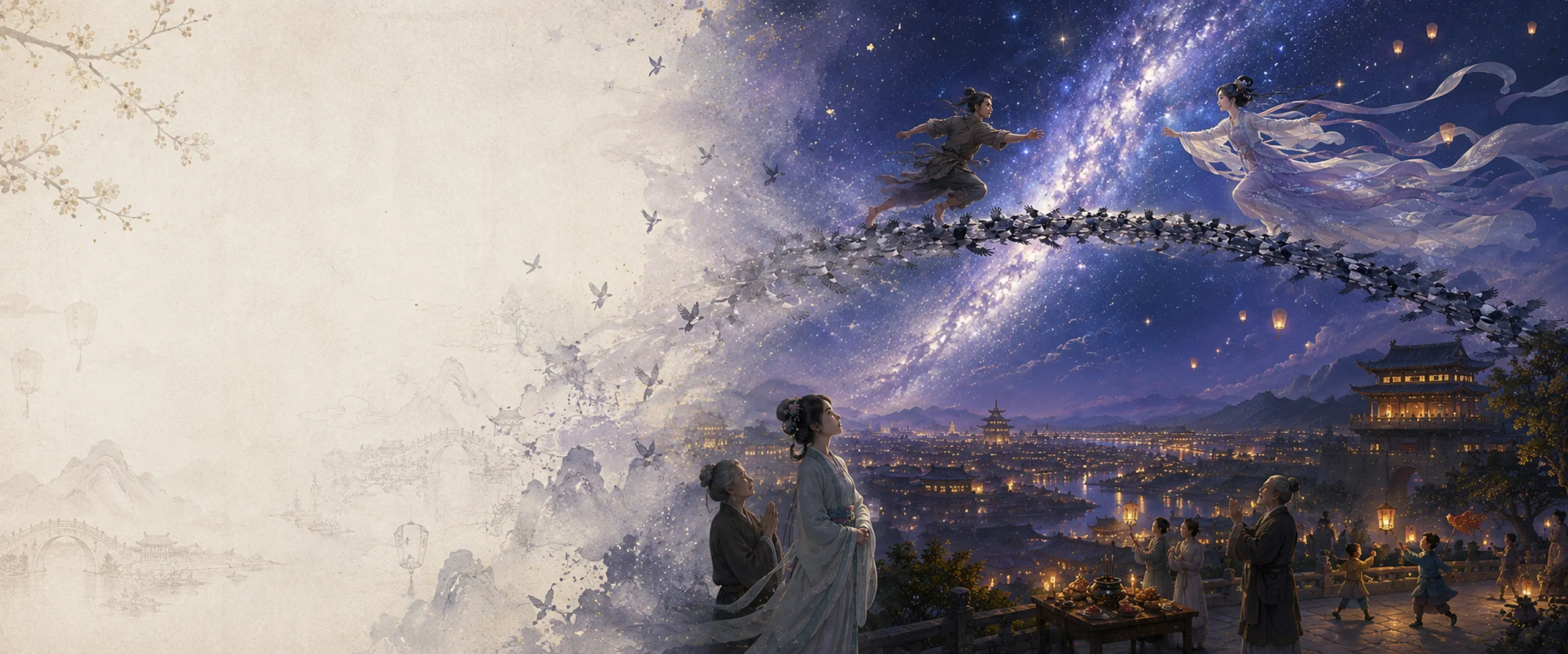
The evolution of “Qixi” from an abbreviation of “the seventh day of the seventh month” to the festival’s proper name marked the elevation of this day from an ordinary time point to a festival symbol with specific cultural meaning. “Xi” means night, emphasising the nocturnal character of the festival — the core activities of Qixi, whether worshipping stars, Qiqiao, or stargazing, all take place at night. On the night of the seventh day of the seventh month, Altair and Vega gaze at each other across the Milky Way, giving this night a unique ritual significance and romantic colour.
Various Names of the Qixi Festival
Qixi has had an extremely rich system of alternative names throughout history, precisely reflecting the diversity of its customs and the complexity of its cultural fusion. The festival was first called “Double Star Festival” or “Double Seven Festival”; from the Han dynasty it was called “Qixi Festival” or “Qiqiao Festival”; by the Tang and Song it was also called “Daughters’ Festival” or “Girls’ Festival.” “Double Star Festival” emphasises the two stars, Altair and Vega — the oldest astronomical source of the festival. “Double Seven Festival” emphasises the date — the seventh day of the seventh month, a double seven. “Qiqiao Festival” highlights the custom of praying to Vega for skills — the core folk activity of the festival. “Daughters’ Festival” or “Girls’ Festival” emphasises the festival’s close connection with women and girls — Qixi was a festival exclusively for young girls in ancient times. Each of these different names is a mark left on the festival by the long river of history, collectively forming the rich and diverse cultural face of Qixi.
Readers’ Comments
Calendar and traditional culture enthusiasts from around the world, sharing the same moon.
Sign in or register to join the conversation. Your comment account is created automatically the first time you use a connected account.
No comments yet
Share your thoughts with readers around the world.