Qixi Festival

Qixi FestivalQixi Festival Cuisine

「 巧果串成串,乞巧女儿心。 」

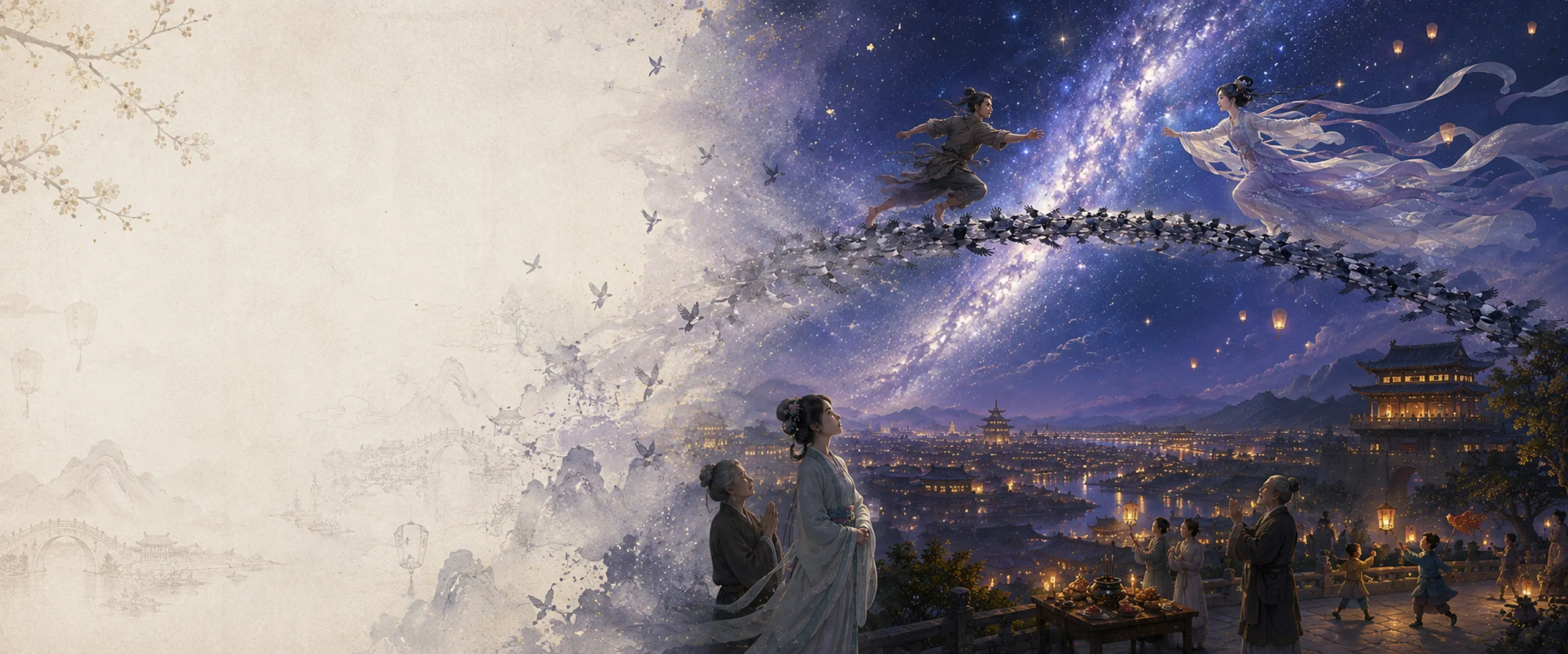
The Qixi Festival originated in the Han dynasty, rooted in ancient star worship — the Cowherd star and the Weaver Girl star face each other across the Milky Way, giving rise to the beautiful tale of their annual reunion on the Magpie Bridge on the…

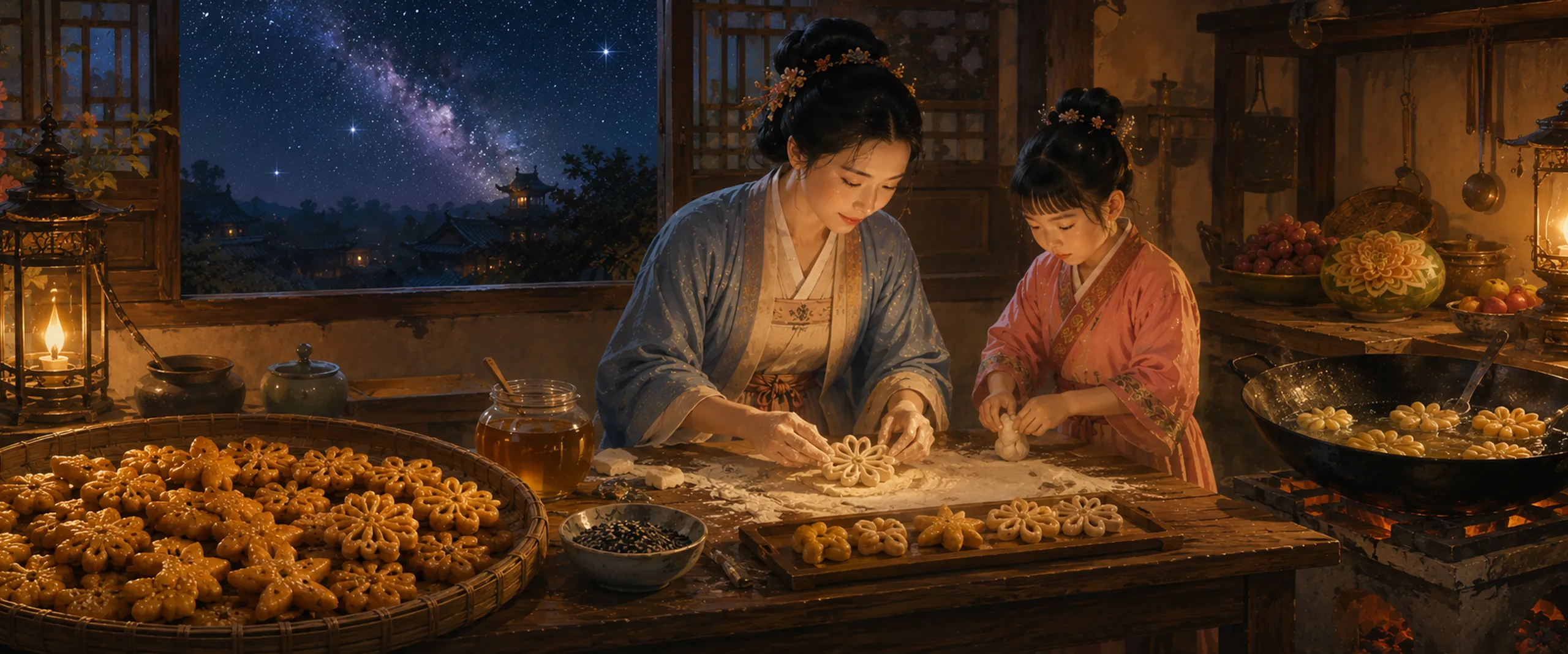
Qiaoguo is the most distinctive festive food associated with the Qixi Festival and is also known as “qiqiao guozi” (乞巧果子). Its principal ingredients are oil, flour, sugar, and honey, sometimes with sesame seeds added. The preparation involves several steps, including melting sugar, kneading the dough, rolling it thin, cutting and folding it, and finally deep-frying it. The finished pastries are golden, crisp, and fragrant. The origins of qiaoguo can be traced back to the Tang and Song dynasties, when people made pastries known as “guoshi” (果食) from ingredients such as oil, fermented grain starter, sugar, and honey, fashioning them into a wide variety of intricate forms. The Song-dynasty Dongjing Menghua Lu (《东京梦华录》) refers to them as “xiaoyaner” (笑靥儿). During the Qixi Festival, people displayed qiaoguo in their courtyards alongside seasonal produce such as lotus seedpods, white lotus roots, and red water caltrops. Qiaoguo is not merely a festive delicacy, but also an important vehicle for the Qixi tradition of qiqiao (乞巧), the ritual pursuit of skill and dexterity.

Qixi Festival / Qixi Festival Cuisine
289 days until Qixi Festival August 8, 2027 · Lunar 七月初七

Festival Food Gallery

Seasonal Menu

Food in Detail

Seeking the True Flavor

Qiaoguo (巧果)

Pastries & Snacks

Basic Information

  • Category: Fried pastry
  • Popular Regions: Nationwide, especially prevalent in the Jiangnan region
  • Main Ingredients: Flour, oil, sugar, honey, sesame seeds
  • Also Known As: Qiqiao guozi (乞巧果子), Qixi guo (七夕果), xiaoyaner (笑靥儿), guoshi huayang (果食花样), qiaoshi (巧食), zhujie (苎结)

Historical Origins

Qiaoguo is the most representative seasonal food of the Qixi Festival and also the most widely distributed Qixi delicacy. Its origins can be traced back to the Northern Song dynasty. According to tradition, it was a food made by women in hopes of asking the Weaver Girl to bestow upon them a pair of skillful hands.

The Song-dynasty writer Meng Yuanlao recorded in Dongjing Menghua Lu (《东京梦华录》): “又以油面糖蜜造成笑靥儿,谓之‘果食’,花样奇巧百端,如捺香方胜之类。若买一斤,数内有一对被介胄者如门神之像,盖自来风流,不知其从,谓之‘果食将军’。” During the Song dynasty, qiaoguo were already sold in street markets for Qixi. If one bought a jin, the assortment would include a pair of armored human figures resembling door gods, known as “guoshi jiangjun” (果食将军, “Generals of Guoshi”). According to Sui Shi Guang Ji (《岁时广记》), “guoshi jiangjun” were human-shaped foods made from sugar and flour during Qixi and could be exchanged as gifts among neighbors.

By the Ming dynasty, the making of qiaoguo had become even more widespread. The Qing-dynasty work Qing Jia Lu (《清嘉录》) by Gu Lu contains an entry titled “Qiaoguo,” describing its ingredients and preparation: “七夕前,市上已卖巧果,有以面白和糖,绾作苎结之形,油氽令脆者,俗呼为‘苎结’。” Pan Rongbi’s Qing-dynasty Dijing Suishi Jisheng (《帝京岁时纪胜》) records: “街市卖巧果,人家设宴,儿女对银河拜,咸为乞巧。”

Cultural Meaning

The principal ingredients of qiaoguo are oil, flour, sugar, and honey. Traditionally, white sugar is first heated in a pot until it melts into syrup. Flour and sesame seeds are then added and mixed well. The dough is spread on a work surface, rolled thin, allowed to cool, cut into pieces, and deep-fried until golden. Skillful women would also shape qiaoguo into various forms related to Qixi legends, bringing them out during qiqiao rituals to compare and share with their female companions.

Later, folk artisans carved special molds specifically for making qiaoguo. Common designs included lotus seedpods, peaches, tigers, and chirping cicadas, producing an exceptionally rich variety of forms. Qiaoguo could be made from wheat flour or rice flour, baked in an oven or deep-fried, shaped into round cakes or shuttles—the weaving shuttle of the Weaver Girl—and fashioned into birds, beasts, unusual flowers, and exotic plants.

The cultural symbolism of qiaoguo has several layers. First, “seeking skill and wisdom through qiqiao.” According to tradition, unmarried girls in the past hoped to become clever and dexterous, so they prayed in this way for the Weaver Girl to “send them skill,” hoping that she would bestow upon them a pair of deft hands. Eating qiaoguo thus embodies the wish that the person who eats it will become clever and skillful. Second, “auspicious blessings.” The “qiao” (巧, “skillful”) in qiaoguo is a homophone of “qiao” (俏, “pretty”), carrying connotations of beauty and loveliness. In some regions, people string “qiaoshi” (巧食) together with multicolored threads and toss them onto rooftops so that magpies may carry them away to build a bridge, allowing the Cowherd and Weaver Girl to cross the Milky Way at night and meet.

Regional Evolution

Qiaoguo takes on different forms and flavors across China:

  • Suzhou: Qiaoguo is an important Qixi custom in Suzhou. In Nanjing, Suzhou, Changzhou, and other places, people traditionally observed the custom of “eating qiaoguo” during Qixi. The folk expression “seven bends and eight turns” was often used to describe the shape of “qiqiao.” Eating qiaoguo was called “chi qiao” (吃巧, “eating skill”) and was believed to serve the purpose of qiqiao. Wujun Suihua Jili (《吴郡岁华纪丽》) records: “吴中旧俗,七夕,市上卖巧果,以面和糖,绾作苎结形,或剪作飞禽之式,油煮令脆,总名巧果。”
  • Zhejiang: In Zhejiang, qiaoguo are made by shaping flour dough into various small objects and deep-frying them. During the evening banquet, qiaoguo, lotus seedpods, white lotus roots, red water caltrops, and other foods are arranged in the courtyard. In Shaoxing, Zhejiang, qiaoguo somewhat resemble the northern fried pastry known as paicha (排叉).
  • Tianjin: Tianjin qiaoguo are mainly made from oil, flour, sugar, and honey. Mothers first place leavened dough into wooden molds carved in various floral shapes, then deep-fry or bake the molded dough. Qiaoguo come in a rich array of forms, including scissors, pears, eggplants, melons, pomegranates, apples, chicks, piglets, little lions, goldfish, frogs, crabs, and shrimp.
  • Northern China: In some northern areas, large quantities of qiaoguo are made before the Qixi Festival. They may be threaded together on strings and placed around babies as an auspicious symbol. Some northern qiaoguo are also tinted with color, strung together on long threads, and finished with crabapples or patterned cloth at the ends before being hung on walls as decorations.
  • Suburban Shanghai: When newly married women return to their natal homes on the seventh day of the seventh lunar month, they bring qiaoguo back from their parents’ homes as gifts for their husbands.

Simple Preparation

  • Ingredients: 250 g flour, 50 g white sugar, 20 g honey, sesame seeds as needed, cooking oil
  • Steps:
  1. Heat the white sugar with a small amount of water until dissolved, then add the honey and stir well.
  2. Sift the flour, add the syrup and sesame seeds, knead into a smooth dough, and let it rest for 20 minutes.
  3. Roll the dough into a thin sheet (about 3 mm thick), then cut into small squares or strips.
  4. Fold the pieces into shuttle shapes (or other forms) to make the qiaoguo blanks.
  5. When the oil reaches about 60% of full frying heat, add the pieces and fry slowly over low heat until golden and crisp.
  6. Remove, drain off the oil, and allow to cool before serving.

Tip: The thinner the dough is rolled, the crisper the fried qiaoguo will be. Qiaoguo can be made in many shapes—scissors, pomegranates, goldfish, and more—and the more intricate the form, the more fitting it is for the festival. Traditional qiaoguo is prized for four qualities: “flaky, crisp, fragrant, and sweet.”

Qiaosu (巧酥)

Pastries & Snacks

Basic Information

  • Category: Pastry
  • Popular Regions: Nationwide, especially in Jiangsu and Zhejiang
  • Main Ingredients: Flour, pastry dough, red bean paste (or mixed-nut filling, egg-yolk filling, fruit filling, etc.)
  • Also Known As: Qiaoren (巧人), qiaoren su (巧人酥), song qiaoren (送巧人)

Historical Origins

Qiaosu is a traditional pastry specially prepared by pastry shops during the Qixi Festival, named for being fashioned in the image of the Weaver Girl. In many traditional pastry shops, bakers make flaky pastries shaped like the Weaver Girl, commonly called qiaoren (巧人) or qiaosu (巧酥); when sold, this is referred to as “song qiaoren” (送巧人, “giving the skillful figure”). Folk belief holds that those who eat this “flaky sweet” will become clever and dexterous.

The history of qiaosu is almost as long as that of qiaoguo. According to Dongjing Menghua Lu (《东京梦华录》), by the Song dynasty there was already a Qixi custom of making human-shaped foods from sugar and flour; the “guoshi jiangjun” (果食将军) were precisely such human-shaped foods made during Qixi. By the Ming and Qing dynasties, qiaosu had become more refined, and flaky pastries shaped in the image of the Weaver Girl had become one of the most representative Qixi gifts.

Cultural Meaning

The central meaning of qiaosu is “seeking skill and praying for blessings.” Qiaosu is shaped in the image of the Weaver Girl, and those who eat it believe they can receive her protection and become clever and dexterous. When sold, it is also called “song qiaoren” (送巧人), treating “qiao” (巧, skill) as a gift that can be given to others and expressing good wishes for family and friends. The “su” (酥, “flaky/crisp”) in qiaosu echoes “shu” (舒, “ease/comfort”), also conveying the wish for a life of ease and fulfillment.

Regional Evolution

Qiaosu takes different forms in different places:

  • Yuhuan, Zhejiang: Qiaosu is made by wrapping flaky pastry dough around fillings such as red bean paste, mixed nuts, egg yolk, fruit, or sausage, then baking it in an oven.
  • Suzhou: Qixi “qiaosu” mostly consists of various decorative flaky pastries.
  • Northern China: Folk pastry shops make flaky pastries in the image of the Weaver Girl, commonly known as “qiaoren” (巧人).

Simple Preparation

  • Ingredients: 150 g flour (for the oil dough), 100 g flour (for the water-oil dough), 60 g oil, 200 g red bean paste
  • Steps:
  1. Oil dough: mix 150 g flour with 60 g oil and knead into a dough. Water-oil dough: mix 100 g flour with 20 g oil and an appropriate amount of water, kneading until smooth.
  2. Roll out the water-oil dough, wrap the oil dough inside, roll into a rectangle, fold into thirds, and repeat twice.
  3. Roll into a thin sheet and use a round mold to cut out pastry wrappers.
  4. Wrap each with red bean paste, seal, place seam-side down, and flatten.
  5. Bake at 180°C for 20 minutes, until the surface is golden.

Tip: Traditional qiaosu can be shaped into the figure of the Weaver Girl; for home preparation, a mooncake mold can be used to press decorative patterns. Good qiaosu should have clearly defined layers and a light, flaky texture.

Jiangmi Tiao (江米条)

Pastries & Snacks

Basic Information

  • Category: Fried pastry
  • Popular Regions: Nanjing, Jiangsu, and surrounding areas
  • Main Ingredients: Glutinous rice flour, bean flour, maltose, plum blossom, pine pollen, sesame seeds, and others
  • Also Known As: Jiangmi guo (江米果), jingguo (京果)

Historical Origins

Jiangmi tiao is a distinctive Qixi festival food among people of old Nanjing. It is a Han Chinese snack made by combining glutinous rice flour with bean flour to form a dough, steaming it in a covered pot, pounding it with a wooden pestle in a stone mortar, rolling it out into a round shape, drying it in the sun, frying it in oil, and finally coating or dipping it in plum blossom, pine pollen, sesame seeds, and other ingredients.

The precise origins of how jiangmi tiao became a Qixi festival food in Nanjing are now difficult to establish. Folk tradition associates it with the story of the Cowherd and the Weaver Girl, perhaps reflecting a wish that eating this elongated pastry during Qixi would symbolically “connect” their once-a-year meeting across the Magpie Bridge. A Nanjing folk saying goes, “七夕吃根江米条,甜甜蜜蜜度良宵”. On the special occasion of Qixi, eating jiangmi tiao is not merely a pleasure of taste, but also a way of carrying forward and honoring traditional food culture.

Cultural Meaning

Jiangmi tiao carries the auspicious meaning of “sweetness and happiness.” Its crisp texture and lingering sweetness perfectly represent the sweetness of Qixi. People therefore fry jiangmi tiao at home and exchange them as gifts, expressing their shared longing for a sweet and happy life. The long, slender shape of jiangmi tiao also symbolizes enduring, unbroken love. Couples eat jiangmi tiao together during Qixi, using its sweet, glutinous flavor to reinforce their hopes for a happy and harmonious marriage.

Simple Preparation

  • Ingredients: 200 g glutinous rice flour, 50 g bean flour, 50 g maltose, water as needed, sesame seeds, cooking oil
  • Steps:
  1. Mix the glutinous rice flour and bean flour; dissolve the maltose in water over heat.
  2. Add the maltose water to the flour mixture and knead into a smooth dough.
  3. Roll the dough into long strips, cut into short sections, and roll each into a rounded stick.
  4. Place them into cool oil and fry slowly over low heat until golden on the surface.
  5. Remove and coat with sesame seeds or dip in plum blossom or pine pollen.

Tip: Jiangmi tiao is prized for being “fragrant, flaky, crisp, and sweet.” The heat should be kept low during frying so that the pieces cook through and become crisp. Traditional jiangmi tiao goes through five processes—“steaming, pounding, rolling, drying, and frying”—though the method can be simplified for home preparation.

Qiaoqiao Fan (巧巧饭)

Grains & Staples

Basic Information

  • Category: Grain-based staple food
  • Popular Regions: Juancheng and Caoxian, Shandong
  • Main Ingredients: Flour, fillings (including a copper coin, needle, red date, etc.)
  • Also Known As: Qiqiao fan (乞巧饭)

Historical Origins

Qiaoqiao fan is a distinctive Qixi food custom in parts of Shandong. In the areas around Juancheng and Caoxian, qiaoqiao fan is eaten on Qixi. The qiqiao custom is as follows: seven close female friends gather grain and vegetables together to make dumplings, placing a copper coin, a needle, and a red date separately inside three of them. After the qiqiao activities, they gather to eat the dumplings. According to tradition, whoever finds the coin is blessed with good fortune, whoever finds the needle will be skillful with her hands, and whoever finds the date will marry early.

Cultural Meaning

The central meaning of qiaoqiao fan is “divining skill and seeking blessings.” Like rituals such as threading needles to seek skill and floating needles to test one’s dexterity, qiaoqiao fan is also a form of “divining qiao”—one’s fortune is foretold through what one finds in the food. Finding the copper coin foretells good fortune, finding the needle foretells dexterity, and finding the date foretells an early marriage. By combining food with divination, this custom transforms qiaoqiao fan from an ordinary meal into a ritual filled with suspense and anticipation.

Simple Preparation

  • Ingredients: 300 g flour, 200 g minced pork, 1 copper coin (cleaned), 1 needle (securely wrapped), 1 red date, minced scallion and ginger, light soy sauce, salt
  • Steps:
  1. Mix the minced pork with minced scallion and ginger, light soy sauce, and salt.
  2. Place the copper coin, needle, and red date separately into three portions of dumpling filling, mark them, and mix the dumplings in with the rest.
  3. Wrap the dumplings and boil until cooked.
  4. The young women gather to eat the dumplings and see who receives “fortune,” “skill,” or “marriage.”

Tip: When placing a needle inside, be sure to enclose it completely in the dumpling wrapper to ensure safety when eating. Traditionally, seven young women participate together, symbolizing the “seven skills” of qiqiao.

Qiaobing (巧饼)

Pastries & Snacks

Basic Information

  • Category: Grain-based pastry
  • Popular Regions: Jiaodong, Shandong; Shaowu, Fujian; and other areas
  • Main Ingredients: Flour, sugar, oil
  • Also Known As: Qiaobing (巧饼), mianbing (面饼)

Historical Origins

Qiaobing is an important type of flour-based food for the Qixi Festival. In the Jiaodong region of Shandong, young women make patterned cakes and steamed breads in the forms of peonies, lotuses, plum blossoms, orchids, chrysanthemums, and other flowers, calling them qiaobing. In Shaowu, Fujian, flour cakes are also made during Qixi and are likewise known as qiaobing.

The origins of qiaobing are closely connected with the qiqiao custom. Women shape dough into different kinds of flowers, both imitating the Weaver Girl’s “skillful hands” and praying for “qiao”—the very act of producing beautiful flour foods is itself a manifestation of skill. Qiaobing can be made not only from wheat flour but also from rice flour, and their varied forms display women’s ingenuity and craftsmanship.

Cultural Meaning

Qiaobing carries the meaning of “displaying skillful artistry.” Making qiaobing is itself a display of craftsmanship, as women compete to see whose creations are more beautiful and imaginative. The character “qiao” (巧) in qiaobing directly identifies its connection with the theme of qiqiao. Young women in Jiaodong create designs such as peonies, lotuses, plum blossoms, orchids, and chrysanthemums, each carrying its own auspicious symbolism—peonies symbolize wealth and honor, lotuses purity, plum blossoms resilience, and orchids elegance.

Simple Preparation

  • Ingredients: 200 g flour, 30 g white sugar, 1 egg, 20 g oil
  • Steps:
  1. Mix the flour with white sugar, egg, and oil, and knead into a smooth dough.
  2. Take small pieces of dough and shape them into peonies, lotuses, plum blossoms, orchids, chrysanthemums, and other flowers.
  3. Brush a frying pan with oil and cook over low heat until golden on both sides.
  4. Alternatively, steam for 10 minutes.

Tip: Scissors, combs, and other tools can be used to press textures into the dough when shaping the flowers. The more refined the qiaobing, the more fully it demonstrates the maker’s “qiao,” or skill.

Huagua (花瓜)

Others

Basic Information

  • Category: Fruit and vegetable carving
  • Popular Regions: Nationwide
  • Main Ingredients: Watermelon, Hami melon, winter melon, and other melons and fruits
  • Also Known As: Huagua (花瓜), diaohua gua (雕花瓜)

Historical Origins

Huagua is one of the traditional foods of the Qixi Festival and originated in the art of fruit and melon carving during the Tang and Song dynasties. During those periods, the fruits and melons used in qiqiao began to develop into distinct forms. Melons became “huagua”—that is, melons carved into decorative patterns, hence the name “huagua.”

Skillful women would carve melons and fruits into fantastical birds and unusual forms, or create relief designs on their surfaces, using them to worship the Weaver Girl or entertain guests. These were known as “huagua.” Huagua was both food and artwork—young women used it to display their carving skills. Later dishes such as winter-melon bowls and watermelon bowls largely trace their origins to this tradition.

Cultural Meaning

Huagua carries the dual meaning of “displaying skillful artistry.” Making huagua is itself a display of dexterity, for only women with skillful hands could transform ordinary melons and fruits into exquisite works of art. Huagua was also offered to the Weaver Girl during Qixi, displayed in the courtyard for her to “admire.” After incense had been burned and the ritual offerings made, these offerings became food for the festival’s late-night meal.

Simple Preparation

  • Ingredients: 1 watermelon (or Hami melon or winter melon)
  • Steps:
  1. Wash the melon and lightly sketch the outline of a design on its surface with a pencil.
  2. Use a carving knife to cut patterns along the outline (flowers, birds, butterflies, auspicious characters, and other motifs may be carved).
  3. Scoop out the flesh and use the carved melon shell as a container.
  4. Fill it with diced fruit or desserts and serve it as a Qixi offering or a dish for guests.

Tip: Before carving, spray a little water over the melon skin to make it crisper and easier to carve. Beginners can start with simple patterns such as flowers or stars.

Qiaoya Mian (巧芽面)

Grains & Staples

Basic Information

  • Category: Grain-based staple food
  • Popular Regions: Nationwide
  • Main Ingredients: Noodles, mung bean sprouts, shredded pork
  • Also Known As: Qiaoya mian (巧芽面), qiqiao mian (乞巧面)

Historical Origins

Qiaoya mian is an important flour-based food of the Qixi Festival. Eating qiaoya mian on the seventh day of the seventh lunar month may allow love itself to sprout—a custom filled with auspicious meaning. The origins of qiaoya mian are connected with the custom of “growing sprouts to pray for children.” According to tradition, on the Qiqiao Festival, people prepare a clean small wooden board, scatter seeds of mung beans, adzuki beans, millet, and other grains across it, spray them regularly with water, and wait several days for tender green shoots to emerge. These sprouts symbolize the joy of having a child and the healthy growth of the children in the family.

Cultural Meaning

Qiaoya mian carries the auspicious meaning of “love beginning to sprout.” Mung bean sprouts are called “qiaoya” (巧芽, “qiao sprouts”) during the Qixi Festival, symbolizing love taking root and sprouting. Mung bean sprouts, regarded as clearing heat and reducing internal heat, are stir-fried with shredded pork and made into a broth, which is poured over noodles that have been rinsed in cool water to create Qixi “qiaoya mian.” The “ya” (芽, “sprout”) in qiaoya mian is a homophone of “ya” (牙, “tooth”), also carrying the meaning of “biting onto happiness and holding it fast.” Eating qiaoya mian is both a way to enjoy a cool and refreshing summer dish and a prayer for a happy marriage.

Simple Preparation

  • Ingredients: 200 g noodles, 150 g mung bean sprouts, 100 g shredded pork, 1 tablespoon light soy sauce, salt as needed, chopped scallions
  • Steps:
  1. Wash the mung bean sprouts and marinate the shredded pork in light soy sauce for 10 minutes.
  2. Heat a wok and oil, stir-fry the pork until cooked, add the mung bean sprouts and stir-fry quickly, season with salt, then add a small amount of water and cook into a broth.
  3. In a separate pot, cook the noodles until done, remove them, and rinse in cool water to make cold noodles.
  4. Pour the mung bean sprout and pork broth over the noodles and sprinkle with chopped scallions.

Tip: Mung bean sprouts should be stir-fried quickly over high heat to preserve their crisp, tender texture. Qiaoya mian is best served as cold noodles, refreshing and appetizing, perfectly suited to the summer heat of the Qixi season.

Wuzi (五子)

Fruits & Nuts

Basic Information

  • Category: Dried fruits and nuts
  • Popular Regions: Nationwide
  • Main Ingredients: Longans, red dates, hazelnuts, peanuts, melon seeds
  • Also Known As: Wuzi (五子)

Historical Origins

Wuzi is an indispensable offering in worship of the Weaver Girl during the Qixi Festival. Wuzi refers to melon seeds, peanuts, red dates, longans, and hazelnuts. Among the ritual offerings presented during the Qixi custom of “worshipping the Weaver Girl,” wuzi is indispensable. After incense is burned and the ritual is completed, these offerings become food for the late-night meal.

In Fujian, during the Qixi Festival, fruits and melons are presented for the Weaver Girl to admire and taste, in hopes that she will bless the coming year with an abundant harvest of fruits and melons. The offerings include tea, wine, fresh fruit, wuzi—longans, red dates, hazelnuts, peanuts, and melon seeds—flowers, and face powder used by women as cosmetics.

Cultural Meaning

Each ingredient among the wuzi carries its own auspicious meaning. Longans symbolize “reunion” and “fulfillment”; red dates symbolize “prosperity” and “the early birth of noble children”; hazelnuts symbolize “many children and abundant blessings”; peanuts symbolize “longevity” and “unceasing vitality”; and melon seeds symbolize “many children” and “proliferation.” Together, the five express women’s cherished hopes for family happiness and flourishing descendants.

Simple Preparation

  • Ingredients: Longans, red dates, hazelnuts, peanuts, and melon seeds, as needed
  • Steps:
  1. Wash the five kinds of dried fruits and nuts separately and arrange them on a plate.
  2. On Qixi night, place them on an incense altar in the courtyard as offerings to the Weaver Girl.
  3. After the ritual, share them with the family.

Tip: The exact selection of wuzi varies slightly by region, but the core principle is “five kinds of dried fruits and nuts with auspicious meanings.” Raisins, walnuts, and other ingredients may also be substituted.

Yunmian (云面)

Grains & Staples

Basic Information

  • Category: Grain-based staple food
  • Popular Regions: Certain regions
  • Main Ingredients: Flour, dew
  • Also Known As: Yunmian (云面), qiqiao mian (乞巧面)

Historical Origins

Yunmian is a distinctive type of noodle eaten during the Qixi Festival. Its unique feature is that yunmian must be made with dew; only by eating noodles prepared in this way can one obtain the blessing of qiao. Dew on the night of Qixi is called “Tiansun Shui” (天孙水, “Water of the Celestial Granddaughter”) or “Sheng Shui” (圣水, “sacred water”). According to legend, eating noodles made by kneading dough with this dew allows one to receive the protection of the Weaver Girl. The “yun” (云, “cloud”) in yunmian refers both to clouds in the sky and, more subtly, to the romantic legend of the Cowherd and Weaver Girl meeting among the clouds.

Cultural Meaning

Yunmian carries the meaning of “seeking skill and receiving blessings.” Kneading dough with dew is a way of incorporating the “spiritual essence” of the heavens into food. Qixi dew is believed to be the tears shed when the Cowherd and Weaver Girl meet; by making noodles with this “sacred water,” those who eat them believe they can receive the Weaver Girl’s blessing. This culinary wisdom of “using dew as the medium” reflects the ancient people’s simple philosophy of “the unity of Heaven and humanity.”

Simple Preparation

  • Ingredients: 200 g flour, an appropriate amount of dew collected on the morning of Qixi, a little salt
  • Steps:
  1. Collect dew on the morning of Qixi, using a clean container to gather droplets from blades of grass.
  2. Add salt to the dew and use it to knead the flour into a smooth dough.
  3. Roll the dough into a thin sheet and cut it into noodles.
  4. Bring water to a boil, add the noodles, cook until done, remove, and serve with a clear broth or mixed sauce.

Tip: Dew should be collected before sunrise. Use clean gauze or a clean container to gently gather it from grass leaves. City residents may substitute purified water as a symbolic way of experiencing this tradition.

Food Culture

Foodways

Looking across the culinary traditions of the Qixi Festival as a whole, several cultural themes run consistently throughout:

I. “Qiao” (巧, skill and dexterity) at the core. The most representative Qixi foods include qiaoguo (巧果), qiaosu (巧酥), qiaoqiao fan (巧巧饭), and qiaoya mian (巧芽面)—all foods bearing the character “巧” serve as vehicles through which people seek ingenuity and dexterity from the Weaver Girl. “Qiao” is the central theme of Qixi cuisine. Whether in the pairing of “guo” (果) with “qiao” in qiaoguo or the blending of “su” (酥) with “qiao” in qiaosu, they all express the same wish: that women everywhere may be blessed with deft hands and clever minds. The Song-dynasty writer Meng Yuanlao recorded in Dongjing Menghua Lu (《东京梦华录》) that during Qixi, “又以油面糖蜜造为笑靥儿,谓之‘果食’,花样奇巧百端”. This way of “embodying meaning through form” is one of the most direct forms of cultural expression in Chinese seasonal cuisine.

II. Women at the center. Another striking characteristic of Qixi cuisine is its “female-centered nature.” The Qixi Festival is also known as the “Daughters’ Festival” and the “Qiqiao Festival,” and in ancient times it was a festival especially associated with unmarried girls and young married women. From preparation to consumption, Qixi foods largely centered on women. Qiaoguo were handmade by women, flaky sweets were selected by women, and qiaoqiao fan was prepared collectively by young women—every stage in the making of Qixi foods tells of ancient women’s pursuit of greater personal skill and worth. In some regions, young women would gather on Qixi night to eat “qiaoqiao fan,” placing a copper coin, a needle, and a red date separately inside three dumplings. Whoever found the coin was considered blessed with good fortune; whoever found the needle would be dexterous; and whoever found the date would marry early.

III. Freshness as beauty. Qixi falls at the transition between summer and autumn, when melons and fruits are fragrant and seasonal produce is at its most abundant. Lotus seedpods, white lotus roots, red water caltrops, melons, fruits, and other foods displayed at qiaoguo banquets are all among the freshest seasonal offerings around the time of Qixi. Huagua (花瓜), or carved melons, go even further by transforming seasonal fruits and melons into fantastical flowers and unusual birds, perfectly uniting food and art.

IV. Wordplay as delight. “Qiao” (巧, “skillful”) echoes “qiao” (俏, “pretty”); “guo” (果, “fruit”) echoes “guo” (裹, “to wrap”); and “su” (酥, “flaky/crisp”) echoes “shu” (舒, “ease/comfort”)—the names of Qixi foods are filled with the ingenuity of homophonic symbolism. In old Nanjing, people ate jiangmi tiao (江米条) during Qixi to express their longing for a “sweet and happy life”; in Fuzhou, people ate broad beans, with “can” (蚕, “silkworm”) echoing “chan” (缠, “to entwine”), symbolizing the wish to bind good things tightly and keep them close; while malao (麻粩) from Longyan, Fujian, is a pastry created specifically to commemorate the Cowherd and the Weaver Girl. Such cultural expressions built upon homophonic associations give Qixi cuisine its rich emotional layers.

Regional Distribution

Foodways
Region Distinctive Qixi Foods
Beijing Qiaoguo (seven shapes corresponding to the number “seven” in Qixi, with modern fillings such as cheese and hawthorn or condensed milk)
Shandong Jiaodong qiaoguo (hand-carved pastry molds recognized as an intangible cultural heritage craft, with traditional motifs such as magpies and lotus seedpods); Jiaodong qiaobing (decorative flour cakes shaped with peonies, lotuses, plum blossoms, orchids, chrysanthemums, and other designs); Qiaoqiao fan/dumplings from Juancheng and Caoxian (seven young women gather grain and make dumplings together, hiding a copper coin, a needle, and a red date inside; whoever finds the coin is blessed, whoever finds the needle is dexterous, and whoever finds the date will marry early); Qingdao qiaoguo (using trehalose in place of sucrose to suit older people)
Hebei Auspicious-symbol dumplings (containing copper coins, red dates, needles and thread, and other objects, each signifying a different kind of good fortune); slaughtering a rooster in Xiong County (legend holds that if no rooster crows at dawn on Qixi night, the Cowherd and Weaver Girl will never have to part)
Xinxiang, Henan Dumplings, griddle cakes, and noodle soup (all prepared in quantities of seven, in hopes that the Weaver Girl will bestow skill)
Nanjing, Jiangsu Jiangmi tiao (made from glutinous rice flour and bean flour, crisp outside and sweet within, symbolizing a sweet life)
Zhejiang Qiaoguo (flour shaped into various small objects and deep-fried; at the evening banquet, qiaoguo, lotus seedpods, white lotus roots, and red water caltrops are displayed); qiaosu/qiaoren (flaky pastries shaped in the image of the Weaver Girl, with fillings such as red bean paste, mixed nuts, egg yolk, and others); Ningbo “Qiaoxin Zhiguo” hands-on courses (using pumpkin purée and dragon-fruit powder to color dough before kneading and molding)
Fujian Shaowu qiaobing (flour cakes); qiaoya tang (巧芽汤, “qiao-sprout soup”: qiaocai is soaked and qiaogong activities begin on the first day of the seventh lunar month; beans and wheat are sprouted, then cooked into soup on the seventh day); broad beans (exchanged among relatives and friends, symbolizing the resolution of conflicts and harmonious relations); Longyan malao (麻粩, puffed-rice confection); Putian fried sugared beans; Fuzhou bean-sharing to form bonds, Minqing ciba (糍粑); Dongshan Island, Zhangzhou: Rangoon creeper fruit cooked with crab/squid/pork/eggs
Siyi, Guangdong Water caltrops (ling 菱 sounds like ling 灵, suggesting intelligence and cleverness; an essential offering)
Ezhou/Wuhan, Hubei Water caltrops (eating them is called “yaoqiao,” 咬巧), peanuts, dates
Jiangnan water towns Water caltrops, lotus roots, and fox nuts (芡实) and other aquatic crops (the horn-like shape of water caltrops is associated with “lingli,” 伶俐, meaning clever and quick-witted; fox nuts symbolize reunion and fulfillment)
Nationwide Qiaoguo/qiqiao guozi (the most widespread Qixi food, made with wheat flour or rice flour, baked or deep-fried, in round or shuttle-like forms, and decorated as birds, animals, unusual flowers, and exotic plants); huagua (melons and fruits carved with fantastical floral and bird motifs as offerings to the Weaver Girl); wuzi (五子, “five seeds/nuts”: longans, red dates, hazelnuts, peanuts, and melon seeds, offered to the Weaver Girl and symbolizing abundant descendants)

Closing Reflections

Foodways

With peach blossoms glowing red, willows flourishing green, and the river of stars brilliant overhead, the foods of Qixi arrive on the summer night breeze with the quiet elegance and ingenuity traditionally associated with young women—neither as exuberant and bustling as the foods of the Spring Festival nor as solemn and profound as those of the Dragon Boat Festival. Qixi is also known as the “Qiqiao Festival” and the “Daughters’ Festival,” and its culinary customs are collectively called “chi qiaoshi” (吃巧食, “eating qiao foods”). Each exquisitely fashioned pastry and every dish of fresh seasonal fruit speaks of women’s simple hopes for deft hands and a happy marriage. In northern households, qiaoguo are shaped from flour into seven different forms, fried until golden and crisp, and served with condensed milk or modern fillings, echoing the number “seven” in Qixi; in Jiaodong, qiaoguo are pressed in traditional handmade pastry molds using an intangible cultural heritage craft, imprinting auspicious motifs such as magpies and lotus seedpods. So exquisite that one can scarcely bear to eat them, these qiaoguo were once an annual stage upon which women displayed their craftsmanship, as well as promises of a beautiful life made at their fingertips.

Across north and south, the culinary landscape of Qixi unfolds like a scroll filled with women’s ingenuity. In Juancheng and Caoxian, Shandong, young women gather grain to prepare “qiaoqiao fan,” hiding a copper coin, a needle and thread, and a red date inside dumplings—the one who finds the needle is dexterous, the one who finds the coin is blessed, and the one who finds the date will marry early, turning a single dumpling into an act of divining one’s fate. In the Jiangnan water towns, qiaoya tang (巧芽汤) is made into a clear soup from tender bean and wheat sprouts soaked from the first day of the seventh lunar month; their green tips unfurl in the broth, symbolizing “the first emergence of qiao sprouts, intelligence and graceful cleverness.” In Fujian, broad beans serve as “beans of affinity” exchanged among relatives, friends, and neighbors to resolve old grievances; a single bean becomes a sincere gesture of reconciliation. In Guangdong, water caltrops are presented as offerings because “ling” (菱, “water caltrop”) is homophonically associated with “ling” (灵, “clever, quick-witted”), and women eat them as a symbol of intelligence and dexterity. Nanjing’s jiangmi tiao are crisp outside and sweet within; one bite produces a resounding crunch, the familiar sound of Qixi in the deep lanes of old Jinling.

Most poetic of all are the “wuzi” and “huagua.” Longans, red dates, hazelnuts, peanuts, and melon seeds fill the offering table as women burn incense beneath the moonlight and bow toward the star of the Weaver Girl, praying for skill with needle and thread and a happy marriage. Those with especially skillful hands carve melons and fruits into fantastical flowers and unusual birds, lifelike beneath the glow of candlelight. Qixi foods are not intended simply to fill the stomach, but to delight through ingenuity—every qiaoguo, every water caltrop, and every broad bean embodies women’s steadfast pursuit of “dexterity and skill,” as well as the measure of refinement and romance they have preserved for themselves through a thousand years. When the Milky Way stretches across the summer night sky, the delicate sweetness of a bite of qiaoguo still carries the unspoken thoughts once held beneath the star of the Weaver Girl.

—-

Continue exploring Qixi Festival culture

Readers’ Comments

Calendar and traditional culture enthusiasts from around the world, sharing the same moon.

Sign in or register to join the conversation. Your comment account is created automatically the first time you use a connected account.