Qixi Festival

Qixi FestivalGlobal Spread

「 金风玉露一相逢,便胜却人间无数。 」

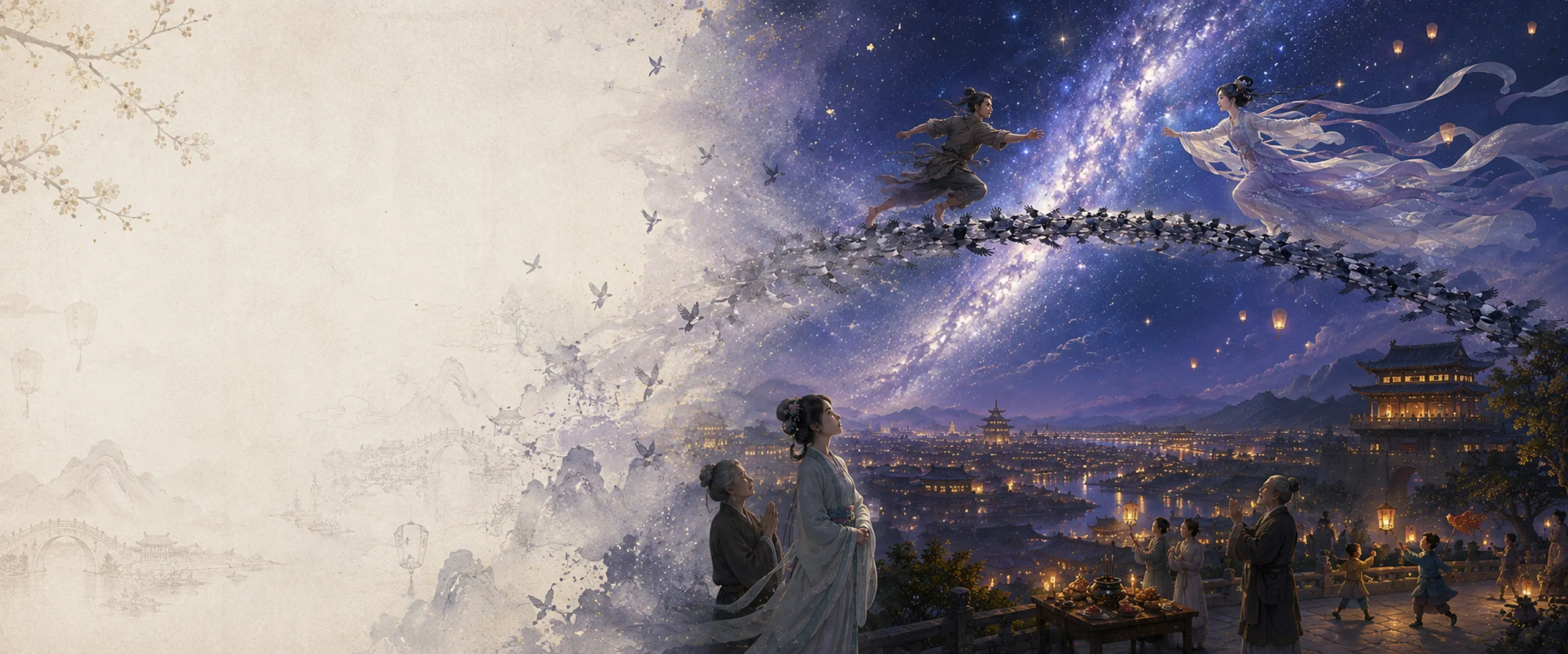
The Qixi Festival originated in the Han dynasty, rooted in ancient star worship — the Cowherd star and the Weaver Girl star face each other across the Milky Way, giving rise to the beautiful tale of their annual reunion on the Magpie Bridge on the…

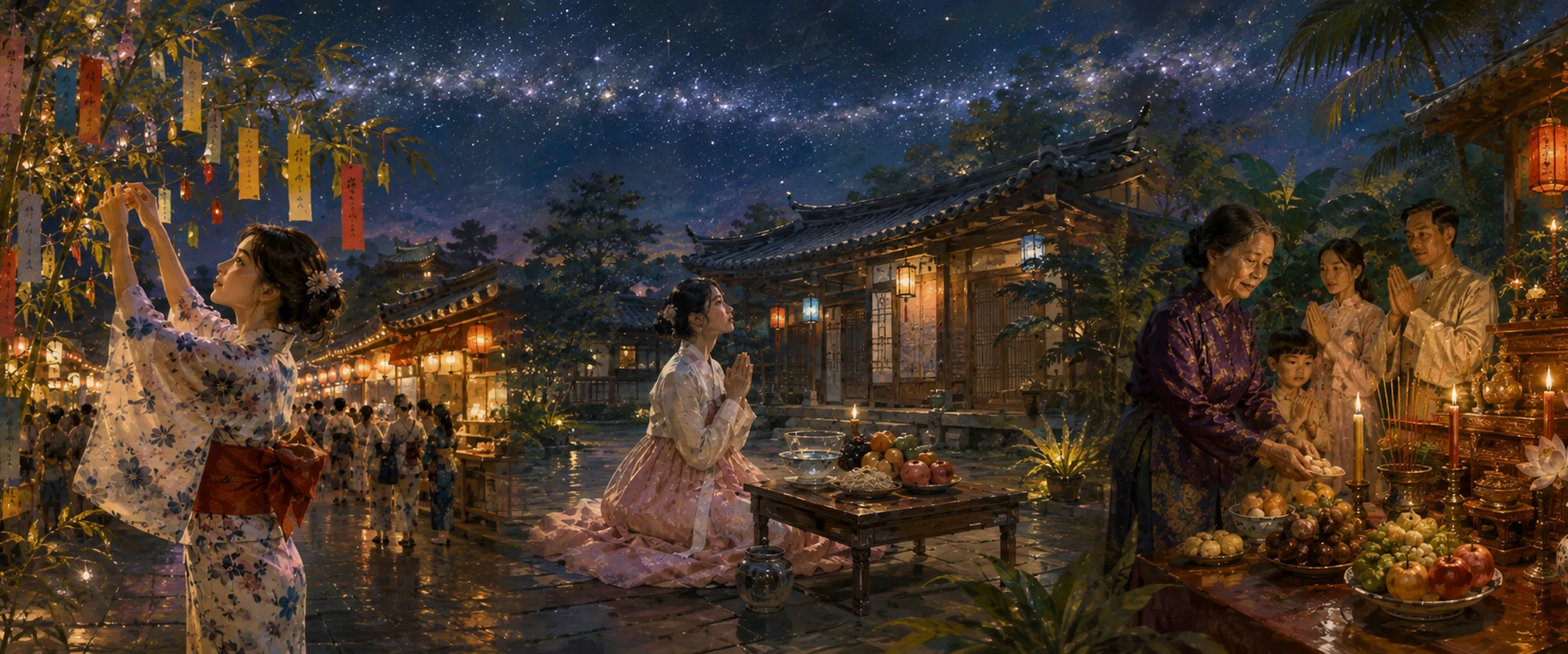
The Qixi Festival has not only circulated widely throughout the Chinese cultural sphere, but has also profoundly influenced the festival traditions of neighboring countries. In Japan, Tanabata (七夕 / たなばた) originated from the Chinese legend of the Cowherd and the Weaver Girl and is celebrated every year on July 7 of the Gregorian calendar, or on August 7 in some regions. People write their wishes on colorful strips of paper and hang them from bamboo branches, praying that those wishes will come true. In South Korea, Chilseok (칠석) likewise derives from the legend of the Cowherd and the Weaver Girl, and women pray to the Weaver Girl on this day for skillful hands and craftsmanship. In Vietnam, Qixi is known as the “Festival of the Cowherd and the Weaver Girl,” and people make offerings and wishes on this day.

As the influence of Chinese culture has grown, the concept of Qixi as “Chinese Valentine’s Day” has also gradually become known internationally. Centered on the theme of faithful love that crosses the Milky Way, Qixi has become a symbol of romantic love throughout the East Asian cultural sphere and even more broadly around the world.

Qixi Festival / Global Spread
289 days until Qixi Festival August 8, 2027 · Lunar 七月初七

Celebrated Worldwide

Regional Highlights
01

Asia

Asia is the region where Qixi culture has spread most deeply and extensively. Qixi is not only widely observed in China; distinctive traditions have also developed in Japan, South Korea, Vietnam, and other countries. Qixi can be regarded as a shared festival gene within the East Asian cultural sphere.

Japan

Japan is the country in which Qixi culture has undergone the most thorough transformation after spreading overseas. Qixi was introduced from China to Japan during the Nara period. After the Meiji Restoration, Japan abolished the lunar calendar, and Tanabata came to be celebrated on July 7 of the Gregorian calendar each year. Unlike China, where the love story occupies a central position, Japanese Tanabata places greater emphasis on praying for improvement in skills, particularly the hope that girls will acquire outstanding handicraft abilities. From the Nara period onward, the imperial court and aristocracy began imitating Tang-dynasty customs by holding Tanabata rituals, threading-needle competitions for skill, and elegant poetry gatherings.

Hanging bamboo and writing poetry slips: the central customs of Japanese Tanabata. Beginning in the Edo period, adults and children would write wishes and poems on colorful elongated paper slips on Tanabata, hanging them together with paper decorations from small bamboo branches before setting the bamboo upright in the courtyard. After Tanabata ended, the bamboo and offerings were placed in rivers, symbolizing the hope that one’s wishes would reach the River of Heaven. In Sendai, Kyoto, and many other places, paper garments associated with Tanabata were regarded as a means of dispelling misfortune—people used these paper garments to pray for favorable winds and timely rain.

Sendai Tanabata Festival: Japan’s largest Tanabata celebration. The Sendai Tanabata Festival is Japan’s largest and one of its most popular Tanabata celebrations. Every year from August 6 to 8, the shopping streets of central Sendai are filled with brightly colored paper and decorations, creating a spectacular sight. Tanabata events are also held throughout Japan, including portable-shrine processions, floats, drum-and-flute ensembles, and parades.

Oita Tanabata Festival: a summer celebration of traditional dance. The Oita Tanabata Festival is the largest summer event in Oita City and is generally held on the first Friday and Saturday of August. Its principal highlight on the first day is “府内戦紙”, in which dance teams and vividly colored floats made with washi paper, shaped as dancers and rising dragons, proceed magnificently along Chuo-dori.

On the second day, the “大分chikirin囃子市民総踊” is held. Dancers move to the cheerful rhythm of chikirin (钲), a traditional percussion instrument long used in Oita, striking bamboo sticks as they perform lively dances, while spectators are also welcome to join in. During the festival, downtown shopping streets are decorated with bamboo, paper cranes, paper wind streamers, and other traditional Japanese Tanabata ornaments.

Goryokaku Tower Tanabata Festival: Qixi culture in Hakodate. Hakodate’s Goryokaku Tower holds a Tanabata Festival each year from July 1 to July 7, introducing the story of the Weaver Girl and the Cowherd and inviting visitors to experience Hakodate’s distinctive Tanabata culture.

Tanabata blessings at the airport: a journey of wishes from Taoyuan to Sendai. Japan Airlines (JAL) once organized a Tanabata blessing activity at Taoyuan International Airport, placing a “Tanabata wishing bamboo” in front of the boarding gate for flights to Tokyo and inviting travelers to write down their wishes and hang them from the bamboo branches. All the wish slips were later flown to Japan and offered at Osaki Hachimangu Shrine in Sendai. By transforming an airport waiting area into a Tanabata prayer space, this creative initiative allowed Qixi culture to travel with people on their journeys.

South Korea

South Korea’s Chilseok also originated in ancient China and is celebrated each year on the seventh day of the seventh lunar month. One of the most representative traditions of Korean Chilseok is worshipping the Weaver Girl Star, through which people pray for improved handicraft skills, particularly in weaving. On the morning of Chilseok, women place melons, fruits, and other offerings before the Weaver Girl Star and pray devoutly.

Praying to the Weaver Girl Star: the Korean form of Qiqiao. Similar to China’s Qiqiao (乞巧), praying for dexterity, Korean women pray to the Weaver Girl during Chilseok for greater skill with their hands. That morning, women place melons, cucumbers, and other fruits on tables, bowing and praying that their weaving skills will become increasingly accomplished.

Airing books and clothing: putting things in order during a quieter season. The seventh lunar month is the period when the intense heat gradually begins to subside, and it also comes after the busiest agricultural work has ended, while farming households wait for the autumn harvest. After the rainy season, farming families traditionally take out clothing and books that have become damp during the summer and dry them in the sun.

Offerings and food: pumpkin pancakes and steamed cakes. Pumpkins, cucumbers, and melons begin to reach abundance during this period, and people often make offerings of fried pumpkin to the Big Dipper. Traditional Korean households prepare Chilseok pancakes and steamed cakes, while younger generations may go out to eat seafood pancakes or kimchi pancakes.

Vietnam

Qixi celebrations in Vietnam are concentrated primarily among Chinese communities. Qixi is also known in Vietnam as “the Day of the Cowherd Lord and Weaver Lady.” Vietnamese Qixi likewise involves prayers for beautiful love, but places greater emphasis on collective worship and blessings than on romantic dates between couples.

Among the Chinese community in Ho Chi Minh City, Qixi offerings are largely similar to those found in southern China, including water caltrops, 棋子饼, 金钱饼, peanuts, and two offerings closely associated with the legend of the Cowherd and Weaver Girl: “禾秧” and the “七姐盘”. Many young people also write their hopes for love and family on slips of paper, silently making wishes during worship and hoping for a happy and fulfilling future.

One intriguing cultural difference is that while Chinese people regard Qixi as a lovers’ festival, Vietnamese people instead avoid holding weddings during the seventh lunar month, fearing that the bride and groom may end up living apart like the Cowherd and the Weaver Girl. This taboo itself demonstrates the depth of the legend’s influence in Vietnamese culture: the story has not simply been “romanticized,” but has instead been treated with a serious sense of reverence and caution.

Southeast Asia

Chinese communities in Southeast Asia have mainly preserved two major Qixi traditions: Qiqiao, praying for skill, and “celebrating the sixteenth year,” a coming-of-age custom for children.

Singapore: from the “Seven Sisters Associations” to a Guinness World Record. From the 1930s through the 1970s, Cantonese women in Singapore spontaneously organized “Seven Sisters Associations” (七姐会) to celebrate Qixi. They handmade paper altars, displayed handicrafts, sang songs, and prayed for blessings, turning neighborhood streets and lanes into festive spaces.

Although this tradition faded for a time, it has been revived in recent years. Qixi Fest aims to revive this long-forgotten festival through a series of activities.

In 2025, Singapore’s Qixi Qiqiao Carnival attracted more than 180,000 participants, including Prime Minister Lawrence Wong. During the event, organizers undertook a Guinness World Records challenge for the “largest team embroidery.” From July 7 to August 7, more than 600 participants from across Singapore took part, including older people, young people, school groups, families, migrant workers, and disadvantaged groups.

From the handmade paper altars of the “Seven Sisters Associations” to an embroidery challenge involving 600 people, Singapore’s Qixi completed a striking transformation from tradition to modernity.

Malaysia: three native-place communities, each with its own traditions. Ethnic Chinese account for about 23% of Malaysia’s population, and Chinese culture has taken deep root there. Among Chinese communities of different native-place origins, Fujianese, Cantonese, and Teochew communities celebrate Qixi most ceremonially: Fujianese families “celebrate the sixteenth year” for children who reach the age of sixteen; Cantonese communities maintain active customs of worshipping the Seven Sisters; and Teochew families hold “Chut Huay Hng” (出花园), “leaving the garden,” for children.

The Fujianese and Teochew customs are relatively similar, being centered mainly on worshipping protective deities of children. Once children reach a certain age, a ritual is held to dissolve their “contract” with the protective deity.

The Penang Tong On Association holds a Qiqiao Festival every year, continuing a tradition more than a century old. Penang has many century-old associations, but only the Tong On Association has consistently maintained its Qiqiao celebration. The festival was originally worshipped by “ma jie” (妈姐) women and was gradually passed down thereafter.

Offerings include the handmade “Seven Sisters Basin” (七姐盆) prepared annually by members, as well as cosmetics, needles and thread, fans, seven-colored flowers, seven grains, seven cakes, and seven kinds of fruit. The Tong On Association is not only the only association in Penang to celebrate the Qiqiao Festival, but is even the only one in Malaysia, and many members from other states make special journeys to attend the ceremony.

In Johor and surrounding areas, Chinese associations frequently organize Qixi handicraft markets, paper-cutting competitions, and blessing ceremonies. The Chinese community in Johor Bahru once organized an “Love in the South” cultural evening that attracted more than one thousand participants from various ethnic groups, with local media devoting extensive coverage to the event.

After Cantonese Qixi customs spread to Malaysia, they underwent certain changes. Practices such as opera performances and singing, Taoist scripture recitation, and praying to the Weaver Girl for skill became relatively uncommon in Malaysia. Some offerings absorbed Fujianese customs. In regions where Fujian folk traditions predominate, communities of different native-place origins borrowed from one another and blended their cultures, forming a distinctive Nanyang form of Qixi.

Thailand: Qixi memories among Chinese communities. Chinese communities in Thailand likewise maintain traditions during Qixi. The festival carries meanings of longing and reunion. Thai friends experience Qixi romance through traditional Chinese gifts such as fragrance sachets, round fans, 罗帕, combs, and hairpins.

Cambodia and Indonesia

Chinese communities in Cambodia maintain traditions of worship during the Qixi Festival. Chinese communities in Indonesia likewise hold Qixi celebrations, where the festival is closely connected with the transmission of traditional Chinese festivals. Among participants in the intangible-cultural-heritage project “七娘妈生做十六岁” organized by Xiamen Chaozong Palace have also been Indonesian youths.

02

The Americas

United States

The United States is one of the countries with the largest populations of Chinese immigrants in the world. Although Qixi is not as widely known as the Spring Festival or Mid-Autumn Festival, celebrations are becoming increasingly lively in cities with large Chinese populations, including New York, San Francisco, Los Angeles, and Houston.

New York: a hometown-style Qixi among Fujianese immigrants. In New York’s four major Chinese residential areas—Chinatown, Brooklyn, Flushing in Queens, and Staten Island—many Chinese residents, particularly immigrants from Fujian, attach great importance to Qixi.

Young men and women, lovers, and couples exchange roses and visit specialty gold shops together to buy gold necklaces and bracelets as festival gifts. On days off during Qixi, young couples go in pairs for candlelit dinners, while middle-aged couples bring their parents and children to hotels to celebrate Qixi together.

Fujianese families also prepare their own guobianhu (锅边糊), a Fuzhou-style rice-batter soup served with oysters, dried shrimp, shredded pork, shiitake mushrooms, celery, garlic, and other ingredients—the unmistakable flavor of “Fuzhou and Fujian-style guobian.” New York’s “Fuzhou Street” becomes filled with the strong festive atmosphere of Qixi as it is celebrated back home.

An elderly couple who had lived in the United States for more than thirty years said: “Every year we celebrate both Chinese and Western Valentine’s Days—the Western Valentine’s Day in February and the traditional Chinese Valentine’s Day of lunar Qixi. The romance and passion leave endless memories!”

For the many Chinese and Fujianese immigrants living far from home in the Western world, cherishing their homeland and ancestors and upholding traditional virtues has become a valued custom.

Houston: a Qixi social gathering of nearly 200 people. The International Trade Center in Houston’s Chinatown, in the fourth-largest city in the United States, once held a Qixi social gathering that brought together nearly 200 Chinese and international participants. Through singing, dancing, games, and other interactive activities, people expressed affection toward those they loved, while single Chinese participants were given a platform to meet and socialize.

San Francisco and Los Angeles: Qixi lantern festivals in Chinatown. In San Francisco, Los Angeles, and other cities, Chinatowns organize dragon and lion dances, lantern festivals, and traditional handicraft markets, with the aim of promoting Chinese culture and helping local residents better understand traditional Chinese festivals.

Oakland: experiencing Qixi in a Chinese-style setting. Oakland Chinatown once organized a Qixi event featuring more than 20 food vendors and over 50 art, craft, and merchandise exhibits, allowing visitors to experience the festival in a setting rich in Chinese cultural character. The event also included a traditional-culture photography exhibition, special Qixi activities, and a wishing tree where visitors could take commemorative photographs and make wishes.

The American version of Qixi: from Qiqiao to Valentine’s Day. In the United States, Qixi is understood as “Chinese Valentine’s Day.” Although the country has no traditional festival corresponding exactly to Qixi, Chinese communities combine traditional practices such as Qiqiao competitions and needle-threading skills with modern customs such as roses and candlelit dinners, giving Qixi a distinctly Chinese-Western fusion.

Canada

Qixi celebrations among Chinese communities in Canada are equally varied, with a particular emphasis on the revival of traditional culture.

Vancouver: a grand Qixi celebration by the Hanfu Society. The Vancouver Hanfu Society and the Chinese Cultural Centre of Greater Vancouver jointly organized a Qixi event at the Cultural Centre’s museum. Activities included needle-threading competitions for dexterity, worshipping the Weaver Girl and Kui Xing, dyeing fingernails, tying red cords to pray for romantic destiny, and floating river lanterns, allowing participants to experience the romantic atmosphere of Qixi.

The event also included “eating qiaoguo and playing drinking games,” with snacks, tea, games, and other entertainment. Participants could try making small clay figurines to offer to Mohele (磨喝乐), recreating the playful appeal of traditional customs. The Hanfu Society encouraged attendees to wear hanfu, traditional Han Chinese clothing, and also provided hanfu rental services.

Toronto: the cultural return of Qixi. Toronto’s Chinese community likewise values the Qixi Festival. When Chinese communities organize the Huazhao Festival, Lantern Festival fairs, or Mid-Autumn celebrations, participants include not only Chinese residents but also many people of other ethnic backgrounds who come to watch and take part. Cultural exchange occurs naturally on precisely such occasions. The activities of the Vancouver Hanfu Society are a typical example of this form of cultural exchange.

Canadian Chinese Yellow Pages: Qixi listed as a commemorative day. Notably, the Canadian Chinese Yellow Pages has listed “Qixi Valentine’s Day” as a public commemorative day in August 2026. Although this is not a statutory holiday, it indicates that Qixi has gained a certain degree of cultural recognition within Canada’s Chinese communities.

03

Europe

Europe is the region where the overseas spread of Qixi displays the strongest sense of “cultural encounter.” The romantic core of the festival has produced a distinctive chemistry with European cultures of love.

France

During the 2025 Qixi Festival on August 29, China’s traditional lovers’ festival generated considerable enthusiasm in Paris. Large numbers of French couples dressed in hanfu and wore red cords around their wrists as they joined a “Qixi Red Cord” flash event, forming a queue said to stretch a kilometer in front of the DR diamond-ring flagship store near the Louvre. The event incorporated hanfu experiences and was enthusiastically welcomed by the French public.

Agence France-Presse commented that Chinese culture surrounding love was deeply appreciated by French people. The queue outside the Louvre even drew the attention of Louvre security personnel. AFP described the DR Paris Louvre store as having already become an unofficial “civil registry office” among French people. Many foreign visitors were drawn to the event and took roses to give to their partners. Among those waiting in line was also a French couple dressed in hanfu.

In the Montmartre arts district of Paris, Qixi activities organically combined traditional folk customs with modern technology, meeting the emotional needs of overseas Chinese communities while also attracting large numbers of local French participants.

The popularity of Qixi in France demonstrates the cross-cultural reach of the theme of love: when the legend of the Cowherd and the Weaver Girl is translated as “China’s Romeo and Juliet,” and wearing hanfu and tying red cords become fashionable experiences sought after by French couples, the romantic core of Qixi crosses barriers of language and culture.

United Kingdom

Although the Chinese community in the United Kingdom is smaller than those of Southeast Asia, it is equally active and cohesive. In major cities such as London, Manchester, and Birmingham, Chinese culture has in recent years shown a tendency to “move beyond Chinatown.”

London’s Canary Wharf financial district once hosted an “Eastern Romance” themed dinner, where many Chinese professionals and British friends wore hanfu, wrote qiao characters, and attended a translated storytelling session on the Cowherd and the Weaver Girl. The Evening Standard reported on the cultural phenomenon under the title “China’s Festival of Love,” demonstrating its gradually expanding influence.

Among Chinese communities in Europe and North America, Qixi is also a festival that intensifies feelings of homesickness. Living far from home makes the emotions of longing for family and romantic love even stronger. Whether married or dating, people often go to great lengths on this day to create romance for their partners.

Germany

Qixi likewise receives attention among Chinese communities in Germany. Wang Wenwen, an overseas cultural-promotion representative from Shan County and a graduate student at Friedrich-Alexander University Erlangen-Nürnberg, celebrates Qixi together with her husband Stefan—a reflection of the growing popularity of traditional Chinese festivals overseas.

Wang Wenwen carefully selected Chinese cultural gifts for her husband, including fragrance sachets, scented plaques, folding fans, and paper-cuttings. In Chinese tradition, the fragrance sachet itself can serve as a token of love.

In Germany, Qixi is called “Das Fest der Liebenden” or “Chinesischer Valentinstag.” For German couples, the standard Valentine’s Day combination is a candlelit dinner and flowers.

Italy

Zhang Wenxin, a Chinese-Italian young woman who has long enjoyed traditional Chinese clothing, said that increasing numbers of people in Europe are beginning to understand and appreciate traditional Chinese dress. Her mamianqun (马面裙), a traditional Chinese pleated skirt, bears patterns of flowers, birds, mountains, and rivers. She explained: “These are all common elements in Chinese landscape painting, while flying birds and cranes also symbolize soaring upward and praying for blessings.”

Qixi has become an important occasion for displaying the beauty of traditional Chinese clothing.

Overseas Chinese at Home and Abroad Celebrate Qixi Online

An online Qixi event organized by the Federation of Returned Overseas Chinese in Qingtian County, Zhejiang Province invited 15 overseas Chinese couples, both in China and abroad, together with community leaders, to celebrate the festival. This form of cloud-based gathering enabled Chinese communities scattered across the world to share Qixi’s romance at the same moment.

04

Oceania

Australia

Sydney Harbour Bridge: the ultimate romance of a “meeting on the Magpie Bridge.” On the day of China’s Qixi Festival, four Chinese couples once climbed to the top of the Sydney Harbour Bridge, staging a distinctive “meeting on the Magpie Bridge” above the harbor.

Climb leader Chen Qingfeng said that this was the second year in which Sydney Harbour Bridge had organized a couples’ climb during Qixi, with the aim of encouraging reserved Chinese couples to express their love more openly. Sydney Harbour Bridge would continue organizing such activities to promote further cultural exchange between China and the West.

Sydney’s 145 Chinatown: Qixi debut and Spring Festival Gala auditions. Eastwood once held the inaugural “145 Chinatown Neon Night—Qixi”, timed to coincide with the Chinese lovers’ festival and the first romantic seasonal occasion of Sydney’s early spring. The event also launched program auditions for the 2026 Sydney Alliance Spring Festival Gala.

Sydney Shuangxi Culture Studio: Chinese-style intangible-heritage handicrafts. Shuangxi Culture Studio was founded in Sydney in August 2024 and is dedicated to promoting traditional Chinese culture by organizing intangible-cultural-heritage handicraft activities, including lacquered fans, velvet flowers, mother-of-pearl inlay, bamboo weaving, fragrance sachets, and lantern making.

Melbourne: celebrating Qixi with singing, dancing, and a picnic. During the traditional Chinese Qixi Festival, Chinese residents of Casey in southeastern Melbourne held a social gathering featuring singing, dancing, a picnic, and birthday celebrations. Participants sang and danced, strengthened bonds of hometown friendship, remembered the past, and enjoyed the beauty of the present moment together.

Qixi consumption in Australia: sincerity matters more than money. One Chinese resident in Australia shared that Qixi expenses amounted to more than A$300, including flowers, gifts, and dinner. There were also ways to save money—celebrating at home, buying fewer flowers, and cooking dinner oneself. As the resident put it, “Celebrating Valentine’s Day is ultimately about the thought behind it.”

New Zealand

Chinese communities in New Zealand likewise organize related activities during the Qixi Festival. As Li Fen, president of the New Zealand Huaxia Multicultural Arts Exchange Center, has said, overseas Chinese are witnessing outstanding traditional Chinese culture taking root and flourishing on foreign soil【此前中秋内容】—and the same is true of Qixi.

05

Africa

The spread of Qixi in Africa remains at an early stage, with the seeds of Qixi culture being sown across the continent primarily through Confucius Institutes, Chinese-funded enterprises, and similar channels.

Democratic Republic of the Congo: a Qixi cultural lecture at a Confucius Institute. The Confucius Institute at the Diplomatic Academy of the Democratic Republic of the Congo held a Qixi cultural lecture at its teaching site in the National Institute of Arts. The activity combined popular education about traditional Chinese festivals with language instruction and incorporated musical elements according to local conditions, using a relaxed and enjoyable approach to deepen local understanding of Chinese traditional festivals and culture.

Qixi in the Cloud

In-Depth Feature

With the development of digital technology, Qixi has generated entirely new forms of celebration among overseas Chinese, turning the poetic idea of “sharing this moment though separated by the ends of the earth” into reality.

Overseas Chinese at home and abroad celebrate Qixi online. An online Qixi activity organized by the Federation of Returned Overseas Chinese in Qingtian County, Zhejiang Province invited 15 overseas Chinese couples, together with overseas Chinese community leaders, to celebrate Qixi. This cloud-based form of gathering allowed Chinese communities scattered across the world to share the romance of Qixi at the same moment.

Overseas dissemination of CCTV’s Qixi Gala. The 2021 China Media Group Qixi Gala successfully brought Qixi folk culture “beyond its original circle” through highly creative stage presentation and imaginative program design. Program information and related videos generated a strong response after being published by overseas media.

Global Qixi on social media. On WeChat, Xiaohongshu, and other social platforms, overseas Chinese share the ways they celebrate Qixi—from wearing hanfu to writing skillful characters, from candlelit dinners to handmade crafts. Chinese American students have created paintings praising CCTV’s Qixi Gala. In Cuba, media observers noted that “on WeChat, we can see many photographs of people taking walks and giving chocolates, roses, and other gifts.” Social media is becoming an important channel for the global dissemination of Qixi culture.

The deeper meaning of Qixi in the cloud: cloud-based Qixi allows relatives living far apart and overseas Chinese away from home to reunite online and express feelings of homesickness and love. Through the internet, Chinese communities around the world realize the emotional connection of “sharing this moment though separated by the ends of the earth.” Wherever people may be, love and longing are shared human emotions.

Mutual Learning Among Civilizations

In-Depth Feature

The Qixi Festival has gradually journeyed from a traditional festival of the Chinese nation toward the world. Its path differs from those of the Spring Festival, Lantern Festival, Qingming, Dragon Boat Festival, Mid-Autumn Festival, Double Ninth Festival, and Laba Festival: if the Spring Festival takes “reunion” as its emotional core, the Lantern Festival “lantern lights” as its visual symbol, Qingming “remembrance” as its spiritual core, the Dragon Boat Festival “dragon boat racing” as its cultural emblem, the Mid-Autumn Festival the “bright moon” as its greatest common denominator, the Double Ninth Festival “respect for the elderly” as its universal value, and the Laba Festival “a bowl of porridge” as its cultural vehicle, then Qixi takes “love” as its greatest cultural common denominator and “Qiqiao” as its cultural foundation.

Qixi’s dual cultural identity: the romance of a lovers’ festival and the ingenuity of the Qiqiao Festival. Qixi presents two faces in its overseas transmission. In Europe and North America, it is understood as “Chinese Valentine’s Day”—an “Asian version of Romeo and Juliet”—with romantic dates and gift exchanges as its principal forms. In East and Southeast Asia, it has retained more of the traditional core of Qiqiao: worshipping the Weaver Girl, threading needles to pray for skill, and asking for dexterity and a happy marriage.

This dual identity allows Qixi to enter mainstream European and North American awareness through the universal value of love, while continuing within East Asian traditional culture through the cultural depth of Qiqiao.

Qixi in East Asia: “shared origin, divergent development”—an exemplary case of cultural transmission. After Qixi spread to Japan, South Korea, and Vietnam, each country developed a completely different cultural form.

Japan transformed it into a wishing festival for children and young girls, emphasizing improvement in skills. South Korea integrated it with harvest rituals, emphasizing star worship, prayer, and abundant crops. Vietnam preserved it as a collective day of prayer among Chinese communities while developing a taboo against weddings during the seventh lunar month.

As some scholars have observed, although each country has selected different symbols and meanings—China emphasizes love, South Korea prayer, Vietnam continuity of tradition, and Japan a more childlike quality—whatever the form, the core remains humanity’s shared wishes: yearning for what is good and cherishing meaningful bonds.

The transformation of Qixi across East Asia is a typical example of the “localization” of cultural transmission.

Qixi’s “cultural encounter” in Europe and North America: from the kilometer-long queue outside the Louvre to a themed dinner in Canary Wharf. The spread of Qixi in Europe and North America displays a distinctive character of cultural encounter.

In Paris, large numbers of French couples dressed in hanfu and tied red cords around their wrists, forming a kilometer-long queue outside the Louvre. Agence France-Presse commented that “Chinese culture of love is deeply loved by the French people.” In London, the Evening Standard reported on Qixi under the title “China’s Festival of Love.” In Germany, transnational families celebrate Qixi with Chinese tokens of affection such as fragrance sachets and folding fans.

The romantic core of Qixi—the Cowherd and Weaver Girl’s “faithful love across the Milky Way”—can be understood without translation. This is precisely the deeper reason Qixi has been able to win admirers so rapidly in Europe and North America.

Qixi’s “century-long perseverance” in Southeast Asia: from the “Seven Sisters Associations” to a Guinness World Record. Southeast Asia is the region where traditional Qixi culture has been most completely preserved overseas.

Singapore’s “Seven Sisters Associations” from the 1930s to the 1970s, the century-old Qiqiao Festival preserved by Penang’s Tong On Association, and the distinctive Qixi customs of Fujianese, Cantonese, and Teochew communities all represent cultural traditions maintained overseas for generations.

At the same time, Singapore’s 2025 Qixi Qiqiao Carnival attracted 180,000 participants and set a Guinness World Record, demonstrating how tradition can undergo creative transformation in contemporary society.

From the handmade paper altars of the “Seven Sisters Associations” to a 600-person team embroidery challenge, Qixi in Southeast Asia has completed a transformation from “preservation” to “innovation.”

Closing Note

Lingering Notes

The global spread of the Qixi Festival traces a romantic journey from China’s ancient worship of the stars to the world’s five continents. Its inclusion in China’s national list of intangible cultural heritage in 2006 marked Qixi’s transition from a folk festival into the sphere of national protection; its widespread presence across dozens of countries around the world demonstrates that the theme of “love” can cross languages and national borders.

Unlike the Spring Festival with its reunion, the Lantern Festival with its lights, Qingming with its remembrance, the Dragon Boat Festival with its dragon boats, the Mid-Autumn Festival with its bright moon, the Double Ninth Festival with its respect for the elderly, or the Laba Festival with the fragrance of porridge, the overseas spread of Qixi takes “love” as its greatest cultural common denominator and “Qiqiao” as its distinctive cultural foundation—love is an emotion shared by all humanity, while Qiqiao embodies a form of ingenuity unique to Chinese culture.

Wherever people may be, the yearning for beautiful love is shared; whatever the culture, admiration for dexterity and skill is similar.

Across Asia, from Oita’s traditional dance festival to Sendai’s shopping streets filled with colorful poetry slips, from Korean women devoutly praying to the Weaver Girl Star to Vietnamese Chinese communities collectively worshipping on the “Day of the Cowherd Lord and Weaver Lady,” from Singapore’s 600-person embroidery Guinness challenge to the century-old Qiqiao Festival of Penang’s historic association, Qixi traditions take distinctive forms across neighboring countries, sharing a common origin while following different paths.

Across the Americas, from the Fujian-style guobianhu of New York’s “Fuzhou Street” to a Qixi social gathering of nearly 200 people in Houston, from lantern festivals in San Francisco’s Chinatown to needle-threading Qiqiao activities organized by Vancouver’s Hanfu Society, the romance of Qixi warms the North American continent.

Across Europe, from the kilometer-long queue of hanfu-clad couples outside the Louvre in Paris to the “Eastern Romance” themed dinner in London’s Canary Wharf, from fragrance sachets exchanged as tokens of affection in transnational families in Germany to the mamianqun worn by a Chinese-Italian young woman, Qixi’s “Chinese-style romance” has captured European hearts.

In Oceania, from the “meeting on the Magpie Bridge” atop Sydney Harbour Bridge to the singing-and-dancing picnic held by Chinese residents in Casey, Melbourne, the romance of Qixi warms the Southern Hemisphere.

In Africa, the seeds of Qixi are being sown across the vast continent through Confucius Institutes.

More moving still is the moment when French couples queue outside the Louvre to experience the “Qixi Red Cord,” when British media report on Qixi under the title “China’s Festival of Love,” and when Singapore revives the Qiqiao tradition through a Guinness World Record.

At such moments, Qixi is no longer merely “a festival of Chinese people”; it is becoming “a festival of the world.”

Just like the Magpie Bridge spanning the Milky Way—it has crossed a thousand years and remains as romantic as ever; it crosses mountains and seas and continues to move the human heart.

The starlight of Qixi is illuminating every corner of the world.

—-

Continue exploring Qixi Festival culture

Readers’ Comments

Calendar and traditional culture enthusiasts from around the world, sharing the same moon.

Sign in or register to join the conversation. Your comment account is created automatically the first time you use a connected account.