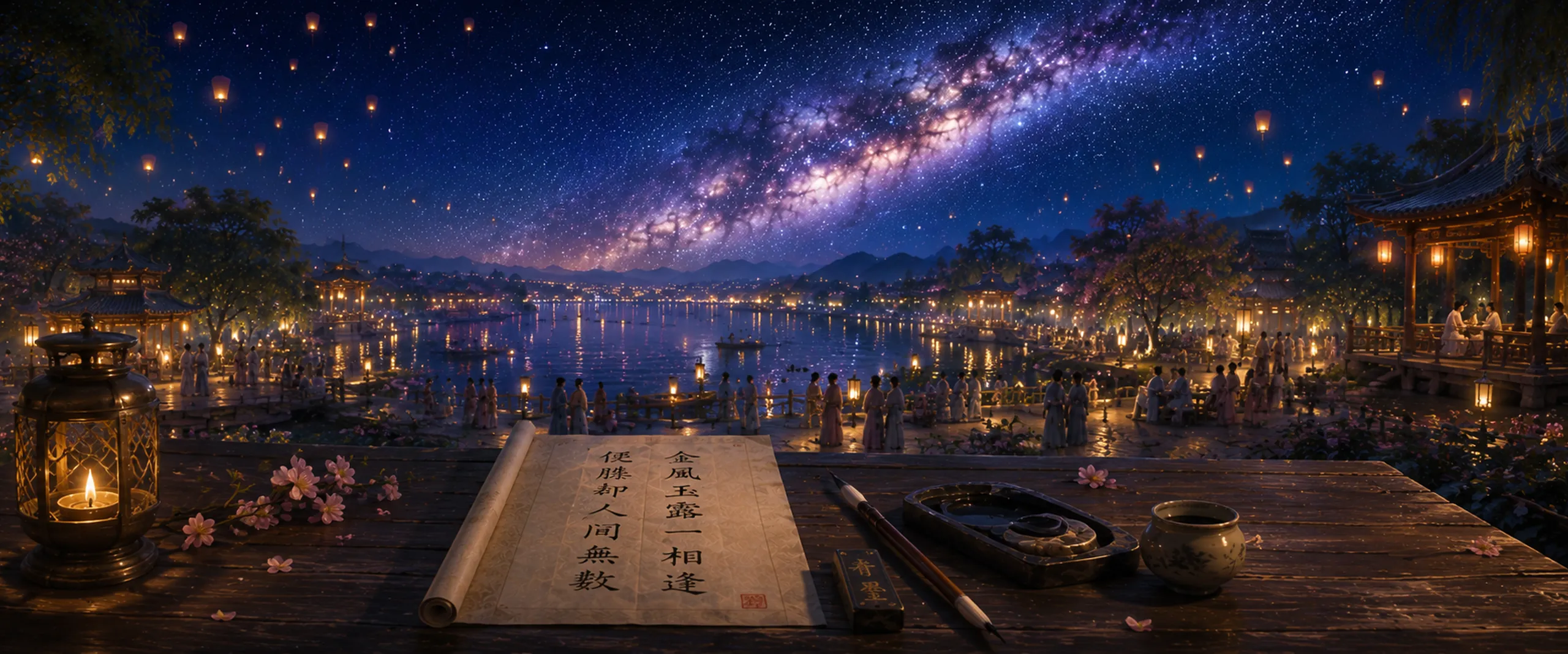
Fine clouds change into ingenious forms across the sky, as though shaped by the skillful hands of the Weaver Girl; shooting stars streak across the heavens, carrying the sorrow of longing; and the immense, distant Milky Way is quietly crossed tonight. “纤云弄巧” not only echoes the Qixi theme of qiqiao, but also alludes to the Weaver Girl’s skillful hands. “飞星传恨” personifies the shooting stars, turning them into messengers of longing. “银汉迢迢暗度” depicts the Cowherd and the Weaver Girl secretly crossing the Milky Way to meet. The word “暗” suggests both the secrecy of the meeting and the difficulty and preciousness that surround it.
Qin Guan’s Queqiao Xian (《鹊桥仙》) is the most celebrated work in the poetic tradition of Qixi:
“纤云弄巧,飞星传恨,银汉迢迢暗度。金风玉露一相逢,便胜却人间无数。柔情似水,佳期如梦,忍顾鹊桥归路。两情若是久长时,又岂在朝朝暮暮。”
Du Mu’s Qixi (《七夕》), “银烛秋光冷画屏,轻罗小扇扑流萤。天阶夜色凉如水,坐看牵牛织女星”, uses a cool, restrained tone to portray the loneliness of looking up at the Milky Way on a Qixi night. Bai Juyi’s Qixi (《七夕》), “烟霄微月澹长空,银汉秋期万古同。几许欢情与离恨,年年并在此宵中”, condenses into “年年并在此宵中” the temporal destiny of the Cowherd and the Weaver Girl, permitted to meet only once each year. “迢迢牵牛星,皎皎河汉女” from the Nineteen Old Poems (《古诗十九首》) is among the earliest poetic expressions of the Qixi legend. Qixi poetry fuses the stars of heaven with human love, creating some of the most romantic festival verse in the Chinese literary tradition.
Historical Development
From the Pre-Qin Period to the Han Dynasty
The oldest origins of the Qixi Festival lie in the observation and imagination of the night sky by people in remote antiquity. The original forms of the stars known as the Cowherd and the Weaver Girl were celestial bodies, and the mythology surrounding them first emerged from star worship and imaginative interpretation.
As early as the Western Zhou, Shijing · Xiaoya · Dadong (《诗经·小雅·大东》) already contained references to the Weaver Girl and the Cowherd:
“维天有汉,监亦有光。跂彼织女,终日七襄。虽则七襄,不成报章。睆彼牵牛,不以服箱。”
Here, “汉” refers to the Milky Way, while “织女” and “牵牛” are the names of stars. The Weaver Girl crosses the sky seven times in a day, yet cannot weave cloth; the Cowherd shines brightly, yet cannot be harnessed to draw a cart. At this stage, there was still no narrative connection between the two stars. Yet people had already begun to personify them: the Weaver Girl was imagined as a woman spinning and weaving, while the Cowherd was imagined as a man leading an ox and drawing a cart.
By the Han dynasty, the appearance of Distant, Distant, the Cowherd Star (《古诗十九首·迢迢牵牛星》) marked the point at which the legend of the Cowherd and the Weaver Girl had largely taken shape. In the poem, “盈盈一水间,脉脉不得语” transforms the Milky Way between the two stars into a heavenly river separating lovers. The Cowherd and the Weaver Girl had ceased to be mere star names and had become a pair of lovers.
Ying Shao’s Han work Fengsu Tongyi (《风俗通义》) contains the earliest known reference to the seventh day of the seventh lunar month as “七夕”. In the Han dynasty, Qixi was still primarily a festival of women within the palace. According to Ge Hong’s Eastern Jin work Xijing Zaji (《西京杂记》): “汉彩女常以七月七日穿七孔针于开襟楼,人俱习之。” This is the earliest surviving written record of the custom of qiqiao (乞巧), in which women sought skill and dexterity.
Wei, Jin, Northern and Southern Dynasties
The Wei, Jin, Northern and Southern Dynasties were a crucial period in which the legend of the Cowherd and the Weaver Girl reached a more settled form, and Qixi poetry began to flourish as an independent poetic category. By this time, the characters and narrative structure of the legend were largely established: the Weaver Girl, daughter of the Heavenly Emperor, falls in love with the Cowherd; after marriage she neglects her weaving; the Heavenly Emperor becomes angry and separates them; thereafter they may meet only once a year.
The development of Qixi poetry also underwent several major changes during this period. Palace-style poetry and family literary traditions of the Six Dynasties helped transform Qixi into a distinct poetic subject. After Xiao Tong of the Liang dynasty improvised the lines “迢迢牵牛星,皎皎河汉女”, poets of the Tang dynasty would continue to write on Qixi in an unbroken succession.
The Tang Dynasty
By the Tang dynasty, Qixi had become thoroughly popular throughout the country, emerging as an important festival both at court and among ordinary people. Festive activities flourished not only in popular society but also within the imperial palace.
Tang Qixi poetry includes reflections on celestial mythology, descriptions of the folk custom of qiqiao, and expressions of personal sorrow, longing, and separation. Bai Juyi’s Qixi condenses the joy and sorrow of heaven and earth into four lines through “几许欢情与离恨,年年并在此宵中”. Du Mu’s Autumn Night (《秋夕》), beginning “银烛秋光冷画屏”, depicts the loneliness and upward gaze of a woman secluded deep within the palace. Luo Yin’s Qixi records the ancient custom of threading needles and praying for skill. In both quantity and quality, Qixi poetry reached an unprecedented height during the Tang.
The Two Song Dynasties
With the rise of ci poetry in the Song dynasty, Qixi gained a new artistic form. Qixi ci reached its peak during this period. Among surviving Song ci, works on Qixi form the third-largest category of festival ci, surpassed only by those on the Lantern Festival and Mid-Autumn Festival, with nearly 140 extant pieces.
Qin Guan’s Queqiao Xian · Xianyun Nongqiao (《鹊桥仙·纤云弄巧》) has been praised as the “千古七夕第一词”, the foremost Qixi ci through the ages. Its open-hearted vision in “两情若是久长时,又岂在朝朝暮暮” transcends the traditional lament over the brevity of reunion. Fan Chengda’s Queqiao Xian · Qixi (《鹊桥仙·七夕》) writes the extremity of parting sorrow through “相逢草草,争如休见”. Li Qingzhao’s Xingxiangzi · Qixi (《行香子·七夕》) expresses inexhaustible separation through “星桥鹊驾,经年才见”. Yan Jidao’s Zhegutian · Qixi (《鹧鸪天·七夕》) writes the contrast between a brief meeting and a year-long separation in “欢尽夜,别经年”.
In Song ci, Qixi moved from “writing scenery” toward “writing the heart,” and from “recording events” toward lyrical expression.
Yuan, Ming, Qing, and the Modern Era
By the Yuan, Ming, and Qing dynasties, the customs of Qixi had become firmly established, with qiqiao and romantic love developing side by side. Although Qixi poetry no longer reached the same dazzling heights as in the Tang and Song, the tradition continued without interruption. During the Ming and Qing, Qixi returned more strongly to the sphere of family ritual; in the modern era, it expanded again into a social festival combining traditional customs with contemporary culture.
Core Imagery
The images that recur throughout Qixi Festival poetry form a distinctive “Qixi image system.” These images are at once literary expressions of Qixi customs and vehicles for the emotions of poets.
The Cowherd and Weaver Girl Stars
The Cowherd and Weaver Girl stars are the most fundamental source of imagery in Qixi poetry. Shijing · Xiaoya · Dadong already contains references such as “维天有汉”, “跂彼织女”, and “睆彼牵牛”. By the Han dynasty, Distant, Distant, the Cowherd Star from the Nineteen Old Poems transformed the two stars from astronomical phenomena into literary images through “迢迢牵牛星,皎皎河汉女”.
In Qixi poetry, the Cowherd and the Weaver Girl are not merely stars in the sky; they become symbols of human separation. Du Mu’s “卧看牵牛织女星” in Autumn Night depicts the upward gaze of a woman secluded deep in the palace. Meng Haoran’s “迢迢问斗牛” gives voice to the questioning of a traveler far from home.
The Cowherd and Weaver Girl stars are the soul of Qixi poetry: without these two stars, there would be no Qixi poetic tradition.
The Magpie Bridge
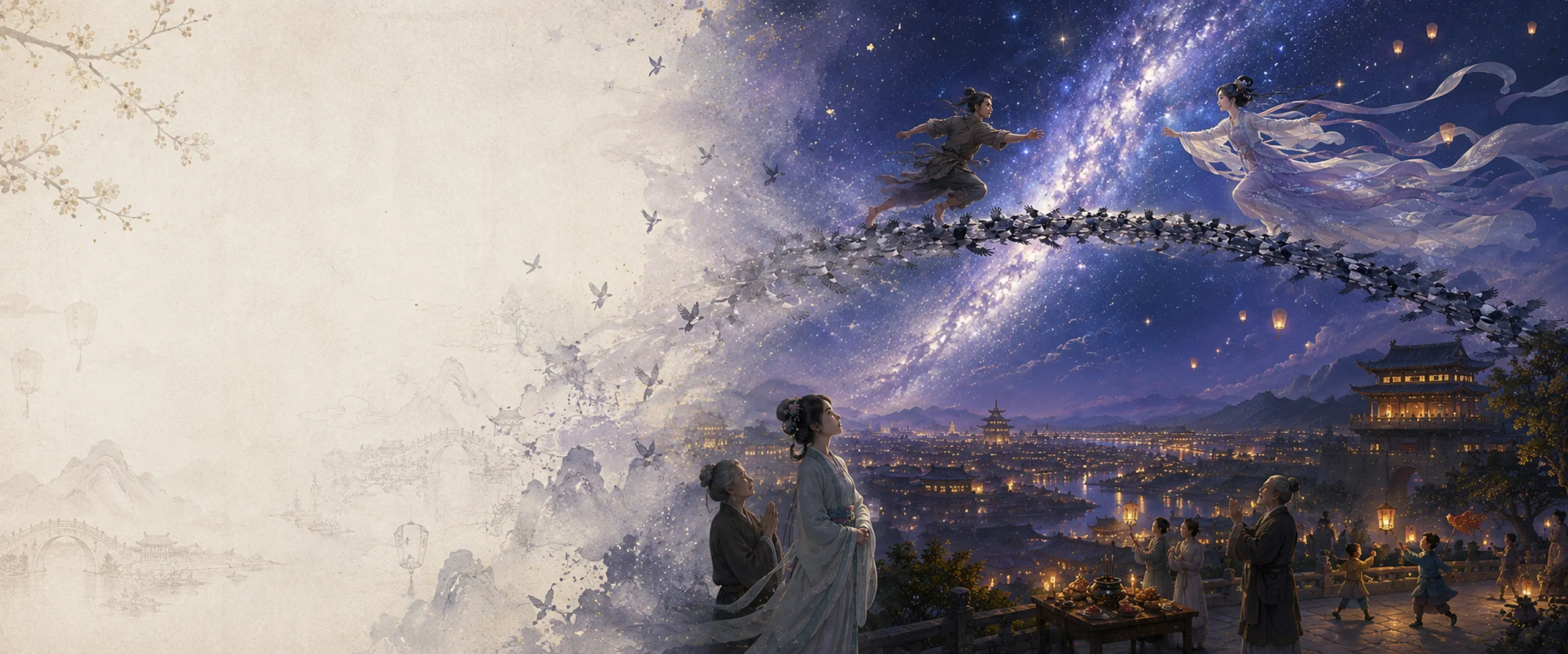
The Magpie Bridge is one of the most imaginative images in Qixi poetry. According to legend, magpies form a bridge so that the Cowherd and the Weaver Girl may meet, and the image recurs throughout poetry and ci.
Qin Guan’s “忍顾鹊桥归路” writes the unbearable sorrow of leaving. Xu Ning’s “一道鹊桥横渺渺” depicts the bridge stretching across the vast Milky Way. Fan Chengda’s “星桥鹊驾,经年才见” writes the longing carried by the bridge.
The Magpie Bridge is both a bridge of reunion and a passage of departure—“忍顾” alone makes this clear. The legend of magpies building the bridge links animals with romantic love, lending Qixi poetry both greater warmth and deeper sadness.
Golden Wind and Jade Dew
“金风玉露” is the classic image created by Qin Guan in Queqiao Xian. “金风” means autumn wind, and “玉露” means white dew; both are markers of autumn.
In “金风玉露一相逢,便胜却人间无数”, Qin Guan condenses both the time of the Cowherd and Weaver Girl’s reunion—autumn—and the event itself into these four characters, transforming “金风玉露” into a symbol of faithful love. Li Shangyin also uses this image in Qixi in the Xinwei Year (《辛未七夕》): “由来碧落银河畔,可要金风玉露时”.
Threading Needles and Praying for Skill
Threading needles and praying for skill is another major Qixi image. Lin Jie’s Qiqiao (《乞巧》) writes:
“七夕今宵看碧霄,牵牛织女渡河桥。家家乞巧望秋月,穿尽红丝几万条”
The word “家家” evokes a lively scene in which households everywhere participate. Luo Yin’s Qixi writes “香帐簇成排窈窕,金针穿罢拜婵娟”, capturing the details of women threading needles to pray for dexterity.
The custom brings Qixi down from “heaven” to “the human world,” transforming myth into the texture of everyday life.
Thematic Categories
Love and Longing
Love and longing form the central theme of Qixi poetry. Qin Guan’s Queqiao Xian is the supreme achievement of this tradition. Through “两情若是久长时,又岂在朝朝暮暮”, steadfast love is elevated into an eternity that transcends time and space.
Bai Juyi’s Qixi, through “几许欢情与离恨,年年并在此宵中”, writes reunion and separation as two sides of the same emotional experience. Yan Jidao’s Zhegutian · Qixi uses “欢尽夜,别经年” to contrast the brevity of meeting with the length of separation. Fan Chengda’s Queqiao Xian writes the extremity of parting through “相逢草草,争如休见”—a brief reunion may only deepen the sorrow that follows.
Against the background of the Cowherd and Weaver Girl legend, these works express humanity’s universal longing for love and its profound pain in separation.
Qiqiao and Folk Customs
Qixi is not merely a festival of romantic love; it is also a festival in which women prayed for skill and dexterity. Lin Jie’s Qiqiao, with “家家乞巧望秋月,穿尽红丝几万条”, depicts the lively scene of widespread participation. Luo Yin’s Qixi uses “金针穿罢拜婵娟” to record the details of threading needles. Cui Hao’s Qixi portrays the custom in Chang’an, where “家家持针线”.
These poems bring Qixi back from mythic heaven into the 烟火气 of ordinary life, recording an ancient social custom through which women sought to enhance their own skills and value.
Travel and Homesickness
Meng Haoran’s Qixi in a Foreign Land is a representative work of this theme. Encountering Qixi while far from home, the poet cannot see his wife threading a needle beneath the moon and must endure intense homesickness and the sorrow of travel.
Du Mu’s Autumn Night writes the loneliness and upward gaze of a woman secluded in the palace. Against the background of a festival associated with reunion, such poems portray those unable to gather with their loved ones. The more romantic Qixi becomes, the deeper their solitude appears.
Reflection and the Rise and Fall of Dynasties
Li Shangyin’s Mawei · No. 2 (《马嵬·其二》) is a distinctive Qixi poem. In “此日六军同驻马,当时七夕笑牵牛”, the poet takes the Mawei mutiny during the An Lushan Rebellion as background and contrasts the love of Emperor Xuanzong of Tang and Yang Guifei with the legend of the Cowherd and the Weaver Girl.
Once, on Qixi, the lovers whispered together in the Palace of Eternal Life, “夜半无人私语时”; now there is only the tragedy of “六军同驻马”. Through this contrast, Qixi poetry moves beyond the theme of romantic love into a profound reflection on historical rise and decline.
Li Qingzhao’s Xingxiangzi · Qixi, meanwhile, writes the sorrow of the Cowherd and Weaver Girl in “星桥鹊驾,经年才见”, using it as an implicit reflection of her own pain in being separated from her husband.
Qixi Festival Folk Songs
Qixi is not only a festival of the Han Chinese but also an important celebration among many ethnic minority communities. Among the Bouyei people of Guizhou, couples meet on Qixi and compete in singing love songs, expressing affection for one another through antiphonal mountain songs.
The Zhuang people also possess a strong tradition of antiphonal singing, including both individual male-female exchanges and group singing between men and women. The lyrics are largely improvised, easy to sing, lively, humorous, and witty.
Dong communities also use Qixi as an occasion to recount the origins of the festival and share knowledge concerning ethnic unity. In Shilin, Yunnan, a major gathering of love songs is held every Qixi, bringing together folk singers from different regions to perform rich and distinctive traditional Chinese love songs.
These love-song traditions among ethnic minority communities have been passed orally from heart to heart for hundreds, even thousands, of years. Together with the literary poetry of Han writers, they form the broader cultural landscape of the Qixi Festival within the Chinese nation.
Closing Reflections
Qixi Festival poetry forms a distinctive and radiant landscape within the treasury of Chinese verse. From the first appearance of celestial imagery in Shijing · Dadong to the deeply emotional gaze of Distant, Distant, the Cowherd Star; from Bai Juyi’s “几许欢情与离恨” to Qin Guan’s “两情若是久长时”; from Du Mu’s “卧看牵牛织女星” to Meng Haoran’s “迢迢问斗牛”—Qixi poetry has recorded, across a thousand years, the Chinese gaze toward the stars, the pursuit of love, the sorrow of separation, and the longing for beauty.
Within these poems lies the pain of being close yet impossibly far in “盈盈一水间,脉脉不得语”; the celebration of steadfast love in “金风玉露一相逢,便胜却人间无数”; the open-hearted understanding of love in “两情若是久长时,又岂在朝朝暮暮”; the lonely resentment of “银烛秋光冷画屏,轻罗小扇扑流萤”; and the homesick sorrow of travel in “他乡逢七夕,旅馆益羁愁”. The meaning of Qixi poetry lies precisely in its ability to carry the starlight and emotions of a thousand years ago into every new age.
From Qin Guan’s “纤云弄巧” and the “千古七夕第一词”, to Li Qingzhao’s “星桥鹊驾” and the extremity of separation, from Yan Jidao’s “欢尽夜,别经年” to the tragic imbalance of “别多欢少”—Qixi poetry is one of the deepest and most enduring declarations Chinese people have made to “stars” and “feeling”, a “letter of love written across the Milky Way” composed in ink by generation after generation. Within these lines, Qixi is both the night of qiqiao in “纤云弄巧” and the moment of reunion in “银汉迢迢暗度”; both the tenderness of “柔情似水” and the reluctance to part in “忍顾鹊桥归路”; both the painful brevity of “欢尽夜,别经年” and the eternity of “两情若是久长时,又岂在朝朝暮暮”. Qixi poetry is the warmest imagination of Chinese people when they look toward the stars, the gentlest attachment when separated by thousands of miles, and some of the most romantic moonlight and starlight in Chinese culture. From Han needle-threading and qiqiao, to the poetry of Tang and Song writers, from the folk songs of Ming and Qing communities to new Qixi verse in the present day, Qixi poetry has crossed more than two thousand years while continuing to carry the simplest and most persistent hopes of generation after generation for beautiful and enduring love.
—-
[Language: es]
Selected Poems
Selected Poems
鹊桥仙·纤云弄巧
Song Dynasty · Qin Guan
纤云弄巧,飞星传恨,银汉迢迢暗度。
金风玉露一相逢,便胜却人间无数。
柔情似水,佳期如梦,忍顾鹊桥归路。
两情若是久长时,又岂在朝朝暮暮。
Background
Among all poems and ci devoted to Qixi, Qin Guan’s Queqiao Xian is without question one of the most accomplished and influential. Whereas countless earlier Qixi poems follow the traditional theme of the painful brevity of a cherished meeting, Qin Guan’s seasonal ci is strikingly original in conception and elevated in vision.
The opening immediately establishes Qixi’s distinctive lyrical atmosphere. “巧” and “恨” point simultaneously to the earthly theme of qiqiao and to the tragic character of the Cowherd and Weaver Girl legend. The concluding line, “两情若是久长时,又岂在朝朝暮暮”, reaches the work’s highest realm: it both captures the distinctive form of love represented by the two celestial lovers and articulates the poet’s own understanding of love.
The ci blends landscape, emotion, and reflection into a single whole. It recounts the mythic love of the Cowherd and the Weaver Girl while giving these divine lovers a deeply human emotional life, celebrating a love that is sincere, delicate, pure, and steadfast. Qin Guan (1049–1100), courtesy name Shaoyou and literary name Huaihai Jushi, was an outstanding representative of the Northern Song wanyue tradition. Together with Huang Tingjian, Chao Buzhi, and Zhang Lei, he was known as one of the “苏门四学士”.
Queqiao Xian · Xianyun Nongqiao is one of his representative works and one of the crowning achievements of Song ci on Qixi. Against the background of the Cowherd and Weaver Girl legend, it moves from the passionate celebration of “金风玉露一相逢,便胜却人间无数” to the intellectual and emotional elevation of “两情若是久长时,又岂在朝朝暮暮”, breaking beyond the traditional Qixi pattern of lamenting that happiness is painfully short.
Line-by-Line Reading
A single meeting on a Qixi night of autumn wind and white dew surpasses countless unions in the human world. This is the highest praise of the Cowherd and Weaver Girl’s love. “金风” means autumn wind, while “玉露” refers to white dew; both are images of autumn. The poet argues that the value of love lies not in the length of time lovers remain physically together, but in the sincerity and constancy of their feeling. Though the Cowherd and the Weaver Girl may meet only once a year, their love surpasses countless human couples who remain together yet are inwardly estranged.
Their tender feeling is soft as flowing water, yet the beautiful meeting is as brief and unreal as a dream. How could they bear to look back toward the road of departure across the Magpie Bridge? “柔情似水” writes the tenderness and sweetness of reunion; “佳期如梦” writes its brevity and dreamlike unreality. “忍顾鹊桥归路” conveys the reluctance and pain of parting. The two characters “归路” already announce the coming separation: the Magpie Bridge is both the path of reunion and the passage of farewell.
The concluding line, “两情若是久长时,又岂在朝朝暮暮” — If two hearts remain constant and enduring, why must they cling to being together every morning and every evening? This is the decisive line of the entire ci and one of the most philosophically elevated lines in all Qixi poetry. Qin Guan releases the love of the Cowherd and the Weaver Girl from the sorrow of “meeting once a year” and transforms it into a spiritual love that transcends time and space.
If the essence of love lies in constancy and endurance, then physical distance and the brevity of reunion cannot diminish its worth. These lines both summarize the particular form of the Cowherd and Weaver Girl’s love and express the poet’s own philosophy of love.
Overall Appreciation
Artistically, this ci reaches an exceptional level. The first stanza writes reunion. Through the passionate praise of “金风玉露一相逢,便胜却人间无数”, the lovers’ single annual meeting is elevated beyond ordinary worldly love. The second stanza writes separation. Through the reflective transcendence of “两情若是久长时,又岂在朝朝暮暮”, the pain of parting is transformed into the eternity of love.
The work fuses lyricism, scenery, and reflection. Its conception is original, its imagination ingenious, and its path distinctively its own; yet the language remains natural and fluid, graceful and suggestive, leaving a long aftertaste. On the surface, it writes of two stars in heaven; beneath the surface, it writes of lovers in the human world. Emotionally, it uses joyful scenery to deepen sorrow and sorrowful scenery to intensify joy, allowing both feelings to resonate more powerfully.
In barely more than fifty Chinese characters, Qin Guan transcended the traditional Qixi theme of happiness made bitter by its brevity and introduced a new philosophical dimension into the subject. As contemporary scholars have observed, this is precisely why the work possesses an aesthetic and artistic value that crosses both eras and national boundaries.
迢迢牵牛星
Han Dynasty · Anonymous
迢迢牵牛星,皎皎河汉女。
纤纤擢素手,札札弄机杼。
终日不成章,泣涕零如雨。
河汉清且浅,相去复几许。
盈盈一水间,脉脉不得语。
Background
If one seeks the earliest major poetic treatment of Qixi, this Distant, Distant, the Cowherd Star from the Nineteen Old Poems deserves pride of place. The poem contains ten lines, six of which use reduplicative expressions—“迢迢”, “皎皎”, “纤纤”, “札札”, “盈盈”, and “脉脉”. These repeated sounds give the poem a quality that is simple, fresh, elegant, and rich in feeling.
The final two lines in particular, “盈盈一水间,脉脉不得语”, bring before the reader the image of a young woman burdened by separation. The emotional meaning is profound, while the style feels naturally complete. Distant, Distant, the Cowherd Star is one of the Nineteen Old Poems (《古诗十九首》), and its author is unknown. The collection is generally dated to the late Eastern Han and marks the maturity of five-character poetry written by literati. This poem takes the legend of the Cowherd and the Weaver Girl as its subject and writes the suffering of longing from the perspective of the Weaver Girl.
Line-by-Line Reading
Far away is the Cowherd Star; bright is the Maiden of the Milky Way. The poem opens with the reduplicative expressions “迢迢” and “皎皎”, which convey both the distance and brightness of the two stars while also suggesting the great distance between the lovers and the beauty of their figures.
She raises her slender, pale hands, while the loom sounds zhazha as she works. “纤纤” describes the delicacy of her hands, and “札札” recreates the sound of the loom. Sound is used to intensify stillness; movement deepens the sense of solitude.
She spends the entire day without completing a piece of cloth, while tears fall like rain. Longing prevents her from concentrating on weaving; her inability to weave deepens her longing. The rainlike tears convey the depth, intensity, and bitterness of her love.
The Milky Way appears clear and shallow; how far apart can they truly be? They seem almost within reach, yet are in reality separated as though by the ends of the earth. The apparent closeness implied by “清且浅” forms a profound emotional contrast with the reality of “不得语”.
The concluding line, “盈盈一水间,脉脉不得语” — Only a clear stream of water lies between them, yet they can do no more than gaze at one another with deep feeling, unable to exchange even a word. This is the most moving passage of the poem. A single river separates two lovers; one stretch of water becomes the distance of the whole world. Their silent, affectionate gaze arises from physical separation, but also from the depth of feeling itself—for at the deepest point of emotion, words may fall away.
Overall Appreciation
Written from the Weaver Girl’s perspective, this poem gives full expression to the pain of longing and separation. A sequence of reduplicative expressions creates a close unity of sound and emotion, producing a harmonious musical rhythm.
The poem never uses the character “思”, yet longing is everywhere. It never uses “怨”, yet every line carries sorrow. The closing “盈盈一水间,脉脉不得语” compresses a thousand words into a single silent moment, restrained and suggestive, with an aftertaste that does not fade. The poem marks the entry of the Cowherd and Weaver Girl legend from oral tradition into the literary world of educated poetry and established the fundamental Qixi emotional pattern of “咫尺天涯”—within arm’s reach, yet as distant as the ends of the earth.
秋夕
Tang Dynasty · Du Mu
银烛秋光冷画屏,轻罗小扇扑流萤。
天阶夜色凉如水,卧看牵牛织女星。
Background
Du Mu’s Autumn Night is among the most restrained and suggestive Qixi poems of the Tang dynasty. The entire work unfolds like a genre painting: it presents customs associated with Qixi while vividly conveying the loneliness, resentment, and sorrow of a person looking upward at the stars.
The Qing anthologist Hengtang Tuishi commented: “层层布景,是一幅着色人物画。只‘卧看’两字,逗出情思,便通身灵动”. Du Mu (803–852), courtesy name Muzhi and literary name Fanchuan Jushi, was one of the outstanding poets of the late Tang and, together with Li Shangyin, was known as one of the “小李杜”. Set against a Qixi night, this poem depicts the solitude and quiet resentment of a woman secluded within the inner palace and is one of Du Mu’s best-known seven-character quatrains.
Line-by-Line Reading
Silvery candlelight falls across a painted screen in autumn, giving off an atmosphere of chill. The single character “冷” establishes the tone of the entire poem: it is not merely the chill of the autumn night, but the coldness of the heart.
She holds a small fan of light silk and swats at drifting fireflies. The fan belongs to the turning of summer into autumn; fireflies belong to the autumn night. The gesture looks leisurely, yet in truth reveals the boredom of having nothing else to do. The old allusion “秋扇见捐”, the discarded autumn fan, also lends the fan a tragic implication of abandonment.
On the palace steps, the night is cool as water. By comparing coolness with water, the poem turns an abstract temperature into a tangible sensation and intensifies the coldness of the autumn night.
She looks up into the sky at the Cowherd and Weaver Girl stars. This is the poem’s decisive line. Deep within the palace, the woman gazes at the celestial lovers and thinks that they, at least, may meet once each year, while she herself is confined within palace walls without freedom. On one side lies a moving tale of love; on the other, her own lonely and unhappy fate. Her unspoken thoughts surge through the stillness of the night.
Overall Appreciation
Du Mu never writes the word “sorrow,” yet every word contains sorrow; he never writes “resentment,” yet every line carries it. There is a person in the poem, but no speech: no sighs, no tears, no direct statement of resentment, grief, or hatred. Read as a whole, the emotion seems like a pool of still water beneath which hidden currents continually move.
“冷画屏”, “扑流萤”, and “凉如水” prepare the atmosphere layer by layer, before “卧看牵牛织女星” brings the emotion gently into focus. The poem is restrained, suggestive, and endlessly resonant.
Qixi Festival
Tang Dynasty · Bai Juyi
烟霄微月澹长空,银汉秋期万古同。
几许欢情与离恨,年年并在此宵中。
Background
Among Tang poems on Qixi, Bai Juyi’s Qixi contains only four lines, yet encompasses heaven and earth, joy and separation, with remarkable economy. The entire poem remains closely centered on the Qixi myth. Scenery and emotion correspond perfectly, without digression, and the final phrase “此宵” returns directly to the title “七夕”. Bai Juyi (772–846), courtesy name Letian and literary name Xiangshan Jushi, was one of the greatest realist poets of the Tang dynasty. The poem takes as its background the folk legend of the Cowherd and the Weaver Girl meeting on Qixi and writes of the joys and sorrows of union and separation in love.
Line-by-Line Reading
In the mist-veiled heavens, a faint crescent moon hangs lightly in the vast sky. The poem begins with scenery. The thin moon suspended high in the night appears lonely and desolate. It provides the setting for the Qixi reunion while creating an atmosphere that corresponds to the emotional world of the lovers. From this opening description alone, even a reader unfamiliar with the legend can sense the melancholy undertone of Qixi.
The Milky Way on this autumn occasion of Qixi remains unchanged through the ages. “秋期” quietly echoes the title, while “万古同” expresses the enduring permanence of the celestial Milky Way. The Cowherd and the Weaver Girl live on opposite banks of the heavenly river, able throughout the year only to gaze across at one another, except on the night of Qixi, when they may cross and meet.
How much joy in reunion, and how much sorrow in parting, are gathered every year into this one night of the seventh day of the seventh month. The happiness of meeting and the pain of separation coexist within a single evening. The lovers at last reunite, with endless words of affection and longing still to share; yet the beautiful night is painfully short, and after their brief meeting what remains is still greater longing.
The greater the joy, the greater the sorrow of parting; the deeper the separation, the more precious the reunion becomes. Year after year the cycle repeats, giving rise to an unavoidable sense of tragic destiny.
Overall Appreciation
The poem is concise and restrained. By blending mythical figures with celestial phenomena, it achieves a complete unity of setting and emotion and exemplifies the Tang Qixi tradition of combining the imagined and the real.
Beginning with the natural scene of “微月澹长空”, it moves into the ancient story of “银汉秋期” and finally settles on the human emotions of “欢情与离恨”. Heaven and earth answer one another; nature and human experience merge. All of this is perfectly contained within four brief lines.
他乡七夕
Tang Dynasty · Meng Haoran
他乡逢七夕,旅馆益羁愁。
不见穿针妇,空怀故国楼。
绪风初减热,新月始临秋。
谁忍窥河汉,迢迢问斗牛。
Background
Meng Haoran’s Qixi in a Foreign Land is among the Tang poems that most deeply express homesickness and the sorrow of travel. Encountering Qixi while far from home, the poet cannot see his wife threading a needle beneath the moon to pray for skill and must endure an intensified sense of displacement. The poem also reflects Meng Haoran’s own frustration at failing to achieve his ambitions. By borrowing the story of the meeting on the Magpie Bridge to express homesickness, the poem allows personal destiny to enter more deeply into the Qixi theme. Meng Haoran (689–740), courtesy name Haoran and known as Meng Shanren, was a famous Tang poet of landscape and pastoral verse. The poem was written while he was traveling away from home and happened to encounter the Qixi Festival. Feelings of homesickness and longing for family arose naturally, giving birth to this regulated verse.
Line-by-Line Reading
To encounter Qixi in a foreign place only deepens the sorrow of staying at an inn as a traveler. The word “益” is the poem’s emotional pivot: being far from home is already a source of grief; encountering Qixi while far away adds sorrow upon sorrow.
He cannot see his wife threading a needle beneath the moon for qiqiao and can only think in vain of the towers and buildings of home. Qixi was the day when women prayed for skill, and the absence of the needle-threading woman implies that his wife is far away. “空怀故国楼” expresses his deep longing for home.
The first autumn breeze begins to reduce the heat; a new moon rises as autumn begins. The couplet captures Qixi’s position at the threshold between summer and autumn. “初减热” writes the waning heat of late summer, while “始临秋” announces the beginning of autumn.
Who could bear to gaze at the Milky Way and ask from afar about the Cowherd and the Weaver Girl? Both “窥河汉” and “问斗牛” point toward their legend. Looking up at the heavenly river would only deepen his longing for home and family. He cannot bear to look, yet cannot stop himself from asking. The line captures his contradictory emotions with remarkable clarity.
Overall Appreciation
Meng Haoran ingeniously combines Qixi’s theme of romantic love with the homesickness of the traveler. Even the Cowherd and the Weaver Girl may meet once a year, while the poet wanders far from home and remains separated from his wife.
The celestial lovers, though divided by the Milky Way, at least possess one night of reunion each year. The human traveler and his wife do not know when they will meet again. This contrast deepens the sorrow of wandering and gives Qixi in a Foreign Land a distinctive place within the Qixi poetic tradition.
行香子·七夕
Song Dynasty · Li Qingzhao
草际鸣蛩,惊落梧桐,正人间、天上愁浓。
云阶月地,关锁千重。
纵浮槎来,浮槎去,不相逢。
星桥鹊驾,经年才见,想离情、别恨难穷。
牵牛织女,莫是离中。
甚霎儿晴,霎儿雨,霎儿风。
Background
Li Qingzhao (1084–c.1155), literary name Yi’an Jushi, was the most outstanding woman ci poet of the Southern Song and has been celebrated as “千古第一才女”. Xingxiangzi · Qixi is one of her representative works. It takes the mythic reunion of the Cowherd and the Weaver Girl during Qixi as its subject and uses it to express the poet’s own sorrow of separation.
It is generally thought to have been written during a period when Li Qingzhao and her husband Zhao Mingcheng were apart, using the grief of the two celestial stars to reflect the separation of husband and wife in the human world.
Line-by-Line Reading
Crickets cry in the grass, startling leaves from the parasol tree; this is the moment when sorrow is deepest both on earth and in heaven. Images such as “鸣蛩” and “梧桐” create an autumnal atmosphere of desolation.
Clouds form the steps and moonlight the ground of the celestial palace, yet countless barriers lock the lovers apart.
Even if a floating raft could come and go between the heavens, they still could not meet. The line expresses the helplessness of the Cowherd and the Weaver Girl before the forces that divide them.
Only by the starry bridge borne by magpies can they meet after an entire year; the sorrow of separation and regret of parting must surely be without end. This is the emotional center of the ci: “经年才见” conveys how difficult reunion is, while “别恨难穷” gives full measure to the depth of separation.
Cowherd and Weaver Girl, are you perhaps already in the midst of parting? The poet addresses the celestial lovers, but the question is also a lament over her own fate.
The concluding “甚霎儿晴,霎儿雨,霎儿风” — Why is it clear one moment, raining the next, and windy the next? The instability of the weather becomes an implicit metaphor for the uncertainty of human joy and sorrow and the repeated reversals of fate.
Overall Appreciation
Against the background of Qixi’s celestial legend, Li Qingzhao uses the pain of separation between the two stars to express her own sorrow. “星桥鹊驾,经年才见,想离情、别恨难穷” gives full voice to the bitterness of longing: after waiting a year for one meeting, the old sorrow has not yet faded before new sorrow begins.
The ci opens with “正人间、天上愁浓” and closes with “霎儿晴,霎儿雨,霎儿风”, placing personal grief within the shifting movements of the heavens. The result is restrained yet profound, with an emotional resonance that continues long after the poem ends.
鹧鸪天·七夕
Song Dynasty · Yan Jidao
当日佳期鹊误传,至今犹作断肠仙。
桥成汉渚星波外,人在鸾歌凤舞前。
欢尽夜,别经年,别多欢少奈何天。
情知此会无长计,咫尺凉蟾亦未圆。
Background
Yan Jidao’s Zhegutian · Qixi is one of the Northern Song Qixi ci that most deeply explores the sorrow of separation. Beginning with a Song-dynasty account in which magpies mistakenly transmitted the message of the lovers’ meeting and thereby left the Cowherd and the Weaver Girl only a single day together, the poem first writes regret over the magpies’ error and then turns toward the pain of parting. Though the lovers are granted reunion, their fate remains ultimately tragic. Yan Jidao (c.1030–c.1106), courtesy name Shuyuan and literary name Xiaoshan, was a renowned Northern Song ci poet and the son of Yan Shu. His poetry is graceful and delicate and frequently concerns the separation of men and women. Zhegutian · Qixi is one of his representative works.
Line-by-Line Reading
Long ago, the magpies mistakenly carried the message of their cherished meeting, leaving the Cowherd and Weaver Girl as heartbroken immortals to this day. The line draws on a Song account in which the magpies’ mistaken transmission caused the lovers to have only one day together.
The Magpie Bridge forms beyond the starlit waves of the Milky Way, and the lovers meet amid the music of luan birds and the dance of phoenixes. “鸾歌凤舞” expresses the joy and beauty of their reunion.
Their happiness lasts only one night; their separation lasts an entire year. Parting is long and joy is brief—what can be done against such a fate? This is the emotional core of the ci.
They know full well that this meeting cannot last; even the cool moon nearby has not yet become full. “凉蟾未圆” implicitly suggests that true reunion remains incomplete, while “咫尺” evokes a distance that seems close enough to touch yet is in reality as remote as the ends of the earth.
Overall Appreciation
Yan Jidao first writes the regret caused by the magpies’ mistaken message, then the sorrow of the lovers’ inevitable separation. Their meeting exists, yet the result remains tragic.
“欢尽夜,别经年,别多欢少奈何天” pushes the tragedy of their fate to its extreme: a year of waiting earns only a single night of reunion, and the time spent apart is 365 times longer than the time together. This imbalance of “别多欢少”—much separation, little joy—is one of the deepest emotional structures running through centuries of Qixi poetry.
Readers’ Comments
Calendar and traditional culture enthusiasts from around the world, sharing the same moon.
Sign in or register to join the conversation. Your comment account is created automatically the first time you use a connected account.
No comments yet
Share your thoughts with readers around the world.