Laba Festival

Laba FestivalLaba Festival Origins

「 牧女献乳,菩提悟道,腊八成佛,粥以纪之。 」

The Laba Festival originated from the ancient year‑end sacrificial rituals of “La.” Before the Qin and Han dynasties, the date of the “La” sacrifice was not fixed. In the Han dynasty, the third xu day after the Winter Solstice was designated as the…

The predecessor of the Laba Festival was the ancient La Day, the most important year‑end sacrificial day in ancient times. People would hold winter sacrifices, offering harvested grains and hunted game to the gods and ancestors, praying for a bountiful harvest and family safety in the coming year — commonly known as the “La sacrifice.” Before the Qin and Han dynasties, the date of the La sacrifice was not fixed. In the Han dynasty, the third xu day after the Winter Solstice was designated as the “La Day.” During the Northern and Southern Dynasties, Buddhism, promoted by the court, grew increasingly influential. On the eighth day of the twelfth month — traditionally regarded as the day of the Buddha’s enlightenment — Buddhists held commemorative ceremonies: it is said that Sakyamuni, after six years of ascetic practice, attained enlightenment under the Bodhi tree on this day, having previously been offered milk‑rice by a milkmaid. The La Day — a royal sacrificial festival — merged with the Buddhist “Buddha’s Enlightenment Day,” and the Laba Festival thereby expanded its influence, becoming a folk festival. The original meaning of Laba was to sacrifice to ancestors and gods, praying for a bountiful harvest and good fortune.

Laba Festival / Laba Festival Origins
84 days until Laba Festival January 15, 2027 · Lunar 腊月初八

The Name "Laba"

Origins & Anecdotes · Tracing the Past

The character “腊” (la) in “Laba” is key to understanding the festival’s origin. In ancient Chinese, “腊” is not a single meaning but carries three distinct cultural connotations. The first is its original meaning of dried meat. The Shuowen Jiezi explains: “腊, dried meat.” In ancient times, people would air‑dry hunted game to make preserved meat for long‑term storage and sacrificial use. The second is as a name for sacrifice. Kong Yingda’s commentary on the Book of Rites · Monthly Ordinances states: “腊 means hunting. It refers to hunting animals to sacrifice to ancestors and the five household spirits.” The La sacrifice used hunted animals to honour ancestors and household deities. The third is as a name for the month — because the La sacrifice was held in the twelfth lunar month, that month came to be called the “La month” (腊月). These three meanings are interconnected: in the La month, people hunted animals, made dried meat, and held the La sacrifice — a single character “腊” links hunting, sacrifice, and the yearly cycle.

Before the name “Laba” appeared, the year‑end sacrificial festival had different names in different eras. In the pre‑Qin period, the Xia dynasty called it “Jiaping,” the Shang dynasty called it “Qingsi,” and the Zhou dynasty called it “Dala.” After the Han dynasty, it was uniformly renamed “La.” The fixing of the La Day on the eighth day of the twelfth month was completed during the Northern and Southern Dynasties. The Jingchu Suishiji by Zong Lin of the Southern Liang dynasty clearly records: “The eighth day of the twelfth month is the La Day.” From this point, the eighth day of the twelfth month was established as a fixed date, becoming a lasting custom. The name “Laba” as a festival name gradually evolved from “La Day” to “Laba Festival” after the date was fixed, with the cultural infusion of the Buddhist “Buddha’s Enlightenment Day” and the popularity of Laba porridge as a seasonal food.

Origins of the Festival

Origins & Anecdotes · Tracing the Past

The formation of the Laba Festival did not originate from a single tradition but from the gradual fusion of multiple cultural sources over a long historical period. These sources include the ancient imperial Great La sacrifice, the year‑end ancestral temple La sacrifice, the evolution and establishment of the La Day date from the pre‑Qin period through the Han to the Northern and Southern Dynasties, and the later influx of Buddhist “Buddha’s Enlightenment Day” and Daoist “Wanghou La” beliefs. Converging from different directions, they jointly formed the foundation of the Laba Festival.

The Zha Sacrifice and the La Sacrifice

In the pre‑Qin period, there were two important year‑end sacrifices — the “Zha sacrifice” (蜡祭) and the “La sacrifice” (腊祭). Although they sound similar (in ancient rhyme books, zha was pronounced zhà, and la was pronounced là), they were two different sacrifices with different origins and objects.

The Zha sacrifice (zhà jì) was a great year‑end thanksgiving offering to the agricultural deities. According to the Book of Rites · Suburban Sacrifices: “The Son of Heaven performs the Great Zha of Eight. Lord Yiqi was the first to institute the Zha. Zha means ‘seeking’ — in the twelfth month of the year, all things are gathered and offered in sacrifice.” The objects of the Zha sacrifice were the eight deities closely related to agricultural production — Xianse (Shennong), Sise (Houji), Nong (the field official), Youbiaozhuì (the field official’s office), cat and tiger (which protected crops by eating rats and wild boars), Fang (embankments), Shuiyong (ditches), and insects. The prayer of the Zha sacrifice is still preserved in the Book of Rites · Suburban Sacrifices: “Let the earth return to its abode, let the waters return to their channels, let the insects not arise, let the grasses and trees return to their marshes!” These four lines, in an imperative tone, express the hope that the land not be washed away, the waters not flood, insects not cause harm, and weeds not grow in the fields — the most simple and sincere prayer of ancient people for a bountiful harvest.

The Zha sacrifice was extremely lively, resembling a carnival. Zigong, after witnessing a Zha sacrifice, exclaimed, “The whole country is as if mad with joy.” Confucius explained: “The toil of a hundred days is rewarded with the joy of a single day — this is beyond your knowledge. To bend a bow without relaxing it is what even the wise kings could not do; to relax it without bending is what they would not do. Alternating tension and relaxation — that is the way of the wise kings.” The people toiled in the fields all year for this single day of enjoyment — this is the rhythm of “tension and relaxation” in agrarian civilisation.

The La sacrifice (là jì) was the year‑end sacrifice to ancestors and household deities. The Book of Rites · Monthly Ordinances records: “In the first month of winter… the Son of Heaven prays to the heavenly spirits for the coming year, makes great offerings at the communal altars and village gates, sacrifices to the ancestors and the five household spirits, and rewards the farmers with rest.” The objects of the La sacrifice included the heavenly spirits (sun, moon, stars), ancestors, and the five household spirits (gate, door, well, stove, and central hall). If the Zha sacrifice was “thanking the natural deities,” the La sacrifice was “worshipping the clan ancestors and household spirits” — the two, one external and one internal, formed a complete year‑end sacrificial system.

The Zha and La sacrifices were initially two distinct but related rites; later, they gradually merged. The Eastern Han scholar Zheng Xuan already interpreted them together, and Tang scholar Kong Yingda further noted: “This is what the Rites of Zhou calls the Zha sacrifice. The heavenly spirits refer to the sun, moon, and stars. The great offering refers to the slaughter of many animals.” After the Qin and Han dynasties, the Zha and La sacrifices gradually merged into a unified “La sacrifice.” This merger was not merely a consolidation of names but a deep integration of two sacrificial spirits — the agricultural deities and the ancestral deities were brought into the same year‑end ritual framework, and the La sacrifice henceforth carried the dual meaning of “repaying heaven and earth” and “repaying the ancestors.”

From La Day to Laba

Although the “La sacrifice” had a fixed month (the La month), its exact date remained unfixed for a long time. In the pre‑Qin period, the date of the La sacrifice was not uniform. The Rites of Zhou records that the Zhou dynasty held the La sacrifice in the first month of winter (the tenth lunar month). The Qin dynasty held it in the twelfth month. In the Han dynasty, the La Day received a unified date — the third xu day after the Winter Solstice. The Shuowen Jiezi clearly records: “腊, the third xu day after the Winter Solstice, when a sacrifice is offered to all deities.” This regulation linked the La Day to the important solar term of the Winter Solstice, placing it at a specific temporal node of yin‑yang transition. Ying Shao’s Fengsu Tongyi further explains: “腊 means junction — it is the junction of the old and new, hence a great sacrifice is held to report achievements.” The character “junction” (接) captures the essence of the La Day — positioned at the transition between the old year and the new, people held great sacrifices to report the year’s achievements and welcome the new year.

The Han dynasty regarded the La Day as an important festival. The emperor held banquets on the La Day, and officials drank together in celebration. The La Day, together with the New Year’s Day of the first month, was an important time marker for bidding farewell to the old and welcoming the new. The famous “La gifts” system of the Han dynasty was an institutional arrangement in which the emperor bestowed gifts on officials on the La Day.

The fixing of the La Day on the eighth day of the twelfth month was completed during the Northern and Southern Dynasties. The Jingchu Suishiji by Zong Lin of the Southern Liang dynasty clearly records: “The eighth day of the twelfth month is the La Day.” From this point, the eighth day of the twelfth month was established as a fixed date, becoming a lasting custom. This fixing was not accidental — binding the La Day to the eighth day of the twelfth month preserved the “La month” time frame while specifying the eighth day, making it easy for people to remember and pass on. At the same time, the coincidence of the eighth day of the twelfth month with the Buddhist “Buddha’s Enlightenment Day” infused the Laba Festival with new cultural meaning.

The evolution of the La Day date from the pre‑Qin period through the Han to the Northern and Southern Dynasties is a historical witness to the Laba Festival’s journey from antiquity to maturity. After the date was fixed, the festival also acquired various names in different eras. In the pre‑Qin period, the Xia dynasty called it “Jiaping,” the Shang called it “Qingsi,” and the Zhou called it “Dala.” After the Han dynasty, it was uniformly renamed “La.” These different names reflect the festival’s long evolution.

The Introduction of Buddhism

The formation of the Laba Festival cannot be separated from the profound influence of Buddhist culture. The introduction of Buddhism infused this ancient La Day sacrifice with entirely new cultural meaning.

According to Buddhist scriptures, before attaining enlightenment, Sakyamuni had practised asceticism for many years, his body emaciated. He realised that asceticism was not the path to ultimate liberation and decided to give it up. At this time, he met a shepherdess (or cowherd) who offered him milk‑rice (a porridge of milk and grains). After eating it, Sakyamuni regained his strength, sat down under a Bodhi tree, and vowed, “I will not rise from this seat until I have attained perfect enlightenment.” After seven days and nights of deep meditation, at dawn on the eighth day of the twelfth month, he attained supreme perfect enlightenment. This day is the Buddhist “Buddha’s Enlightenment Day.”

Later generations, in gratitude to the Buddha and to benefit all beings, emulated the milkmaid’s offering by cooking porridge on this day to offer to the Buddha and to give back to the faithful. The origin of Laba porridge is precisely the Buddhist milk‑rice offering. As the Yuan dynasty Chixiu Baizhang Qinggui records: “On the eighth day of the twelfth month, we respectfully encounter the anniversary of the enlightenment of our teacher, the Great Monk Sakyamuni Tathagata, and lead the assembly of monks to prepare incense, flowers, lamps, candles, tea, fruits, and delicacies as offerings.”

After Buddhism was introduced to China, the Buddha’s Enlightenment Day coincided temporally with the indigenous La Day sacrifice (both falling on the eighth day of the twelfth month) and shared a spiritual connection — both involved “gratitude” and “offering.” This dual coincidence of time and spirit provided an excellent opportunity for the fusion of Buddhist culture and indigenous culture.

According to the Dreams of the Eastern Capital, the Laba Festival in Kaifeng during the Northern Song dynasty already showed a deep fusion of Buddhism and folk customs: “On the eighth day, groups of monks and nuns in the streets chant the Buddha’s name in formation. Using silver, copper, or fine basins, they place a golden or wooden Buddha statue, sprinkle it with fragrant water, and go door to door teaching. The great temples hold Buddha‑bathing assemblies and present seven‑treasure five‑flavour porridge to their disciples, called Laba porridge. On this day, every household also cooks porridge with fruits and other ingredients.” This passage vividly shows the coexistence and interweaving of Buddhist and folk Laba customs — temples held Buddha‑bathing ceremonies and distributed porridge, while ordinary people also cooked porridge with various ingredients.

This coexistence and fusion elevated the Laba Festival from a purely indigenous sacrificial festival to a comprehensive festival combining Buddhist sacredness and secular life. As scholars have noted: “The Laba Festival and the Kitchen God Festival are festivals formed by the ancient Chinese people, not festivals that appeared only after Buddhism was introduced to China.” Buddhism did not “create” the Laba Festival but “enriched” it — a vivid example of indigenous culture absorbing and transforming foreign culture. As research on Dunhuang manuscripts has revealed, the “milk‑rice” in Buddhist scriptures converged with the “medicinal food” and “milk medicine” frequently mentioned in Dunhuang documents; the Laba diet of ancient Dunhuang monastic communities was directly inherited from the Buddhist “milk‑rice.”

Daoist “Wanghou La”

In addition to Buddhism, Daoism also provided another system of meaning for the Laba Festival. In traditional Chinese festivals, there is the concept of “Three Yuan and Five La,” all closely related to Daoism. The “Five La” respectively refer to: the first day of the first month (Spring Festival) as Tian La, the fifth day of the fifth month (Dragon Boat Festival) as Di La, the seventh day of the seventh month (Qixi Festival) as Daode La, the first day of the tenth month (Winter Clothing Festival) as Minsui La, and the eighth day of the twelfth month (Laba Festival) as Wanghou La.

According to the Daoist text Yunji Qiqian: “The eighth day of the twelfth month (Laba Festival) is Wanghou La, when the Five Emperors gather at the Upper Xuan Capital Jade Capital.” The Chisongzi Zhangli also records: “The eighth day of the twelfth month is Wanghou La. The Five Emperors examine the dwelling places of living beings and assign their ranks.” Daoism holds that the Five La days are suitable for cultivating the self and sacrificing to ancestors. Daoism inherited traditional Chinese ritual content; both the “Three Yuan” and “Five La” are important Daoist festivals, containing both the secular dimension of the La sacrifice and special religious meanings. The Daoist “Wanghou La” doctrine provided another faith foundation for the Laba Festival.

Multiple streams converged — Buddhism, Daoism, and the indigenous La Day tradition met and merged on the eighth day of the twelfth month, ultimately creating the rich and diverse cultural face of the Laba Festival.

Laba Porridge

Origins & Anecdotes · Tracing the Past

Laba porridge is the most iconic seasonal food of the Laba Festival, and its evolution itself is a condensed cultural history of the festival.

The Origin of Laba Porridge

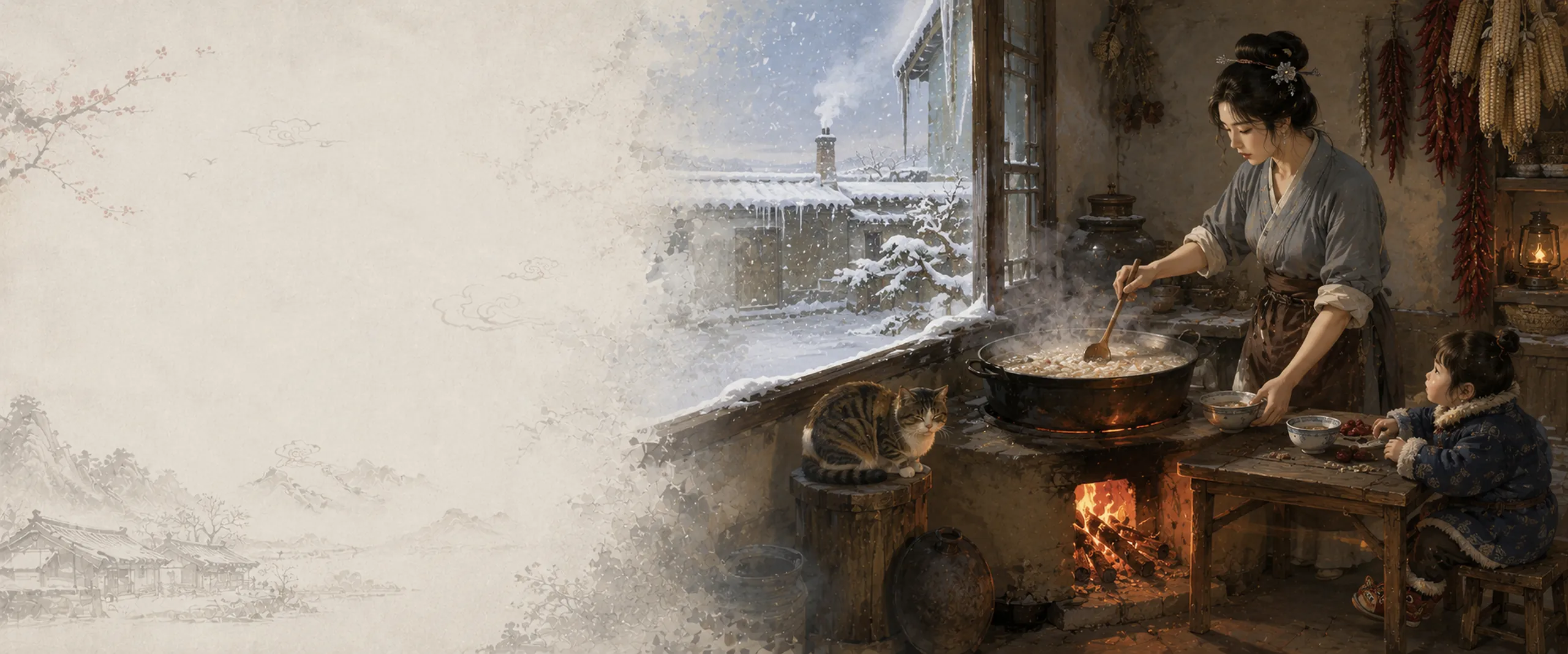
The origin of Laba porridge can be traced back to the milk‑rice offered by the milkmaid to Sakyamuni as recorded in Buddhist scriptures. After Buddhism was introduced to China, monasteries would cook porridge on the eighth day of the twelfth month, the Buddha’s Enlightenment Day, as an offering to the Buddha, called “Buddha porridge” or “Laba porridge.” Laba porridge was initially a religious food in Buddhist monasteries, used for offering to the Buddha and distributing to the faithful.

In the Song dynasty, Laba porridge was called “five‑flavour porridge” or “seven‑treasure five‑flavour porridge.” The “five flavours” referred to the addition of five different ingredients; the “seven treasures” referred to the use of seven precious fruits. Whether “five flavours” or “seven treasures,” both embody the essential characteristic of Laba porridge — “gathering diverse ingredients.” As the Book of Rites · Suburban Sacrifices says, the Zha sacrifice is “in the twelfth month of the year, gathering all things and offering them in sacrifice.” Laba porridge brings together ingredients from all directions, cooked together with rice — this is the meaning of “gathering all things and harmonising a thousand spirits.”

Ingredients and Cultural Symbolism

The traditional ingredients of Laba porridge are extremely rich, generally including rice, millet, corn, Job’s tears, red dates, lotus seeds, peanuts, longan, and various beans (such as red beans, mung beans, soybeans, black beans, kidney beans, etc.). So many ingredients are used because each has its own symbolic meaning — lotus seeds symbolise “successive children,” longan symbolises “reunion,” red dates symbolise “prosperity,” peanuts symbolise “long life,” and beans symbolise “abundance.” With so many fruits together, a bowl of Laba porridge also contains the meanings of harmony, inclusiveness, and completeness.

The preparation of Laba porridge is also very meticulous. Old Beijingers would begin washing rice, soaking fruits, and removing pits on the evening of the seventh day of the twelfth month, then simmer over low heat until the next morning, when the porridge would be ready. After the porridge was cooked, it had to be given to relatives and friends, and must be sent out before noon. Some Laba porridge should be left over, symbolising “surplus year after year.” These practices show that Laba porridge is not just food but a cultural symbol carrying interpersonal relationships, temporal concepts, and auspicious meanings.

Evolution from Buddha Offering to Shared Food

The evolution of Laba porridge from a temple offering to a shared food reflects the transition from religion to secular life. Initially, Laba porridge was a religious food used in monasteries for offering to the Buddha and distributing to the faithful. With the secularisation of Buddhism and socio‑economic development, Buddhist porridge and the folk Laba custom converged in the Song dynasty. In the Song, people began to imitate monasteries in cooking Laba porridge, transforming it from a religious food to a folk seasonal food. By the Ming and Qing dynasties, Laba porridge had become a holiday delicacy shared by all — whether court, government, monasteries, or ordinary households, everyone made Laba porridge. The evolution of Laba porridge from “Buddha porridge” to “home porridge” is a microcosm of the Laba Festival’s transformation from a religious festival to a folk festival.

Folk Legends

Origins & Anecdotes · Tracing the Past

During the long evolution of the Laba Festival, the infusion of folk legends enriched this originally sacrificial and Buddhist festival with more cultural layers and broader social recognition.

The Legend of Zhu Yuanzhang

A widely circulated legend is associated with Zhu Yuanzhang, the founding emperor of the Ming dynasty. It is said that as a child, Zhu Yuanzhang was poor and worked as a cowherd for a rich man. One year on the eighth day of the twelfth month, starving, he discovered a rat hole and reached inside, finding grains such as rice, peanuts, beans, and corn. He boiled them all in a clay pot, making a porridge that solved his hunger. Another version says that when Zhu Yuanzhang was in prison suffering in the cold, he found red beans, rice, red dates, and other grains from a rat hole and cooked them into porridge. Later, when he became emperor, he suddenly remembered that the day was the eighth day of the twelfth month and casually said, “This is Laba porridge.” Every year on that day, he would have the imperial kitchen cook “Laba porridge,” eating it himself and rewarding his ministers with it. The legend links the Laba Festival with a humble emperor, giving Laba porridge the symbolic meaning of “from hardship to prosperity,” resonating particularly with ordinary people.

The Legend of Yue Fei

Another widely told legend is associated with Yue Fei, the Jin‑resisting hero of the Southern Song dynasty. It is said that when Yue Fei led his troops against the Jin at Zhuxian Town, in the depths of winter, his army lacked food and clothing, suffering from cold and hunger. The people brought porridge, and after the Yue army had eaten their fill of “porridge from a thousand households,” they regained their strength and confidence and returned victorious. The day was the eighth day of the twelfth month. After Yue Fei’s death, to commemorate him, people cooked porridge with mixed grains and beans every Laba, eventually forming a lasting custom. In Henan and other places, Laba porridge is also called “everyone’s meal,” a food used by the people to commemorate Yue Fei. The legend infuses the Laba Festival with the spirit of “loyalty” and “patriotism,” making a bowl of Laba porridge not only a ritual for sacrifice and prayer but also a vessel for remembering and revering a national hero.

“Red Beans to Ward off Ghosts”

An even more ancient legend holds that the Laba Festival comes from the custom of “red beans to ward off ghosts.” It is said that Zhuanxu, one of the Five Emperors of antiquity, had three sons who became evil ghosts after death, specifically frightening children. In ancient times, people widely believed in superstition and feared ghosts and spirits, believing that illnesses and poor health were caused by evil spirits. These ghosts feared nothing but red beans, giving rise to the saying “red beans to ward off ghosts.” Thus, on the eighth day of the twelfth month, people cooked porridge with red beans to dispel pestilence and welcome good fortune. The legend of “red beans to ward off ghosts” links Laba porridge with the ancient belief in warding off evil, revealing the deep cultural meaning of red beans in Laba porridge — they are not just an ingredient but an object of apotropaic power with magical function.

Although these legends may not be historically accurate, they interpret the cultural meaning of the Laba Festival through vivid stories. From Zhu Yuanzhang’s “finding grain in a rat hole” to Yue Fei’s “porridge from a thousand households,” from “red beans to ward off ghosts” to the monastery’s “Buddha porridge” — each legend represents a different social stratum and cultural tradition’s understanding and re‑creation of the Laba Festival. These layered legends transformed the Laba Festival from a single sacrificial festival into a diverse celebration integrating imperial legend, hero worship, magical beliefs, and Buddhist culture.

Historical Evolution

Historical Development
Before the Northern and Southern Dynasties
Before the Northern and Southern Dynasties, the core of the La Day was still sacrifice — sacrificing to ancestors, to deities, and exorcising pestilence. As a continuation of the La Day, the Laba Festival preserved the ancient tradition of “repaying heaven and earth and repaying the ancestors.” Zong Lin’s Jingchu Suishiji not only recorded “the eighth day of the twelfth month is the La Day” but also recorded the custom of exorcism on Laba: “When the La drum sounds, spring grass grows. Villagers beat slim‑waisted drums, wear Hu head masks, and dress as Vajra warriors to drive away pestilence.” Drumming to hasten spring and drive away pestilence in the La month were important Laba customs. This exorcism ritual was directly continuous with the ancient Nuo ritual — using drums and masks to drive away pestilence and welcome the new spring.
Sui and Tang Dynasties
By the Tang dynasty, with the further spread and indigenisation of Buddhism, the Buddhist colour of the Laba Festival gradually increased. The Tang Laba Festival included both the continuation of indigenous La sacrifices and the rise of Buddhist Laba porridge customs. The Tang Laba Festival already showed a pattern of Buddhist‑folk integration. However, from documentary evidence, there is no clear record of Laba porridge in Sui and Tang texts. The widespread popularity of Laba porridge as a seasonal food had to wait for the Song dynasty.
Song Dynasty
The Song dynasty was the decisive period in the development of the Laba Festival. It was in the Song dynasty that Laba porridge became the emblematic seasonal food of the festival, and the Laba Festival evolved from a religious festival to a nationwide folk festival.
Yuan, Ming, and Qing Dynasties
Although the Yuan dynasty was ruled by the Mongols, they were deeply sinicised, and festival customs largely followed Han traditions. The Laba customs of the Yuan period basically continued Song traditions — monasteries distributed porridge, the people ate porridge, and the ingredients of Laba porridge grew increasingly rich. The Yuan dynasty Chixiu Baizhang Qinggui contains detailed records of the monastery’s Laba porridge‑distributing rituals, indicating that the Laba Festival had already become an institutionalised festival in Buddhist monasteries.
Contemporary Era
The Laba Festival continues to thrive in modern society. On every Laba Festival, monasteries across the country still hold porridge‑distributing events — famous temples such as Lingyin Temple in Hangzhou and Yonghegong in Beijing still draw huge crowds on Laba. Since Lingyin Temple restarted its Laba activities in 1978, by 2008 its porridge distribution had expanded beyond the temple to many distribution points and home deliveries. By 2021, Lingyin Temple had been carrying out Laba porridge distribution for 14 consecutive years, increasing the number of portions from 100,000 to over 300,000. A bowl of hot porridge conveys a social warmth and spirit of charity that transcends religion.

Before the Northern and Southern Dynasties

Before the Northern and Southern Dynasties, the core of the La Day was still sacrifice — sacrificing to ancestors, to deities, and exorcising pestilence. As a continuation of the La Day, the Laba Festival preserved the ancient tradition of “repaying heaven and earth and repaying the ancestors.” Zong Lin’s Jingchu Suishiji not only recorded “the eighth day of the twelfth month is the La Day” but also recorded the custom of exorcism on Laba: “When the La drum sounds, spring grass grows. Villagers beat slim‑waisted drums, wear Hu head masks, and dress as Vajra warriors to drive away pestilence.” Drumming to hasten spring and drive away pestilence in the La month were important Laba customs. This exorcism ritual was directly continuous with the ancient Nuo ritual — using drums and masks to drive away pestilence and welcome the new spring.

Wei Shou, a historian and writer of the Northern and Southern Dynasties, vividly depicted the Laba scene in his poem “La Day”: “The biting cold presses upon the clear sacrifice; wine is set out for the Jiaping feast. What can I say of my long‑held thoughts? Through this I console my inner feelings.” The poem captures the scene of people setting out wine and meat to sacrifice to all spirits, thanking them for their blessings, amid the cold depths of winter. The solemnity of the La sacrifice and the joy of feasting are united in the poem.

Sui and Tang Dynasties

By the Tang dynasty, with the further spread and indigenisation of Buddhism, the Buddhist colour of the Laba Festival gradually increased. The Tang Laba Festival included both the continuation of indigenous La sacrifices and the rise of Buddhist Laba porridge customs. The Tang Laba Festival already showed a pattern of Buddhist‑folk integration. However, from documentary evidence, there is no clear record of Laba porridge in Sui and Tang texts. The widespread popularity of Laba porridge as a seasonal food had to wait for the Song dynasty.

The evolution from La Day to Laba was not merely a change in name but a shift in the centre of festival customs. The core of the La Day was sacrifice — to all spirits, ancestors, and heaven and earth. The core of Laba was the distribution and consumption of porridge — whether the monastery’s “Buddha porridge” or the folk “Laba porridge,” food became the festival’s emblematic symbol. This shift reflects the general trend in traditional Chinese festivals from “sacrifice‑centred” to “food‑emblematic.” As folklorists have noted, Laba customs “developed from singularity to complexity, with folk characteristics becoming more pronounced.”

The Tang dynasty also saw the rise of Laba poetry. Tang poets composed verses on the Laba Day, infusing this ancient festival with literati aesthetic sensibilities. Although the record of Laba porridge in Tang texts is unclear, Laba as a festival had already received cultural confirmation and elevation in literati writings.

Song Dynasty

The Song dynasty was the decisive period in the development of the Laba Festival. It was in the Song dynasty that Laba porridge became the emblematic seasonal food of the festival, and the Laba Festival evolved from a religious festival to a nationwide folk festival.

The exact date of the first appearance of Laba porridge as a seasonal food is difficult to verify, but from documentary evidence, it appears frequently in historical records after the Song dynasty, indicating that Laba porridge was already very popular in the Song at least. The Dreams of the Eastern Capital by Meng Yuanlao of the Northern Song provides the most detailed account: “The great temples hold Buddha‑bathing assemblies and present seven‑treasure five‑flavour porridge to their disciples, called Laba porridge. On this day, every household in the capital also cooks porridge with fruits and other ingredients.” This passage clearly shows that Laba porridge originated in monasteries — temples cooked porridge on Laba to offer to the Buddha and present to disciples, and then the populace imitated them, cooking porridge with various ingredients. This was the complete path of Laba porridge from monasteries to the people.

Wu Zimu’s Dreams of the Painted Land of the Southern Song also records: “On the eighth day, monasteries call it ‘Laba.’ Great temples all prepare five‑flavour porridge, called ‘Laba porridge.'” Zhou Mi’s Old Affairs of Wulin of the Southern Song further records the recipe of the time: “Using walnuts, pine nuts, milk mushrooms, persimmons, and chestnuts to make porridge, called ‘Laba porridge.'” This shows that Southern Song Laba porridge was already quite elaborate, containing not only grains and beans but also nuts and dried fruits.

An important feature of the Song Laba Festival was the widespread participation of all sectors of society. Whether court, government, monasteries, or ordinary households, everyone made Laba porridge. Laba porridge was not only an offering to the Buddha but also a gift for relatives and friends. The tradition of monasteries distributing porridge to the faithful and the poor on Laba had already formed in the Song. Laba porridge as “Buddha porridge” was endowed with the religious meaning that “eating it brings the Buddha’s protection.” At the same time, the folk also cooked porridge for themselves and gave it to relatives and friends, reflecting the secularisation of the festival.

Song Laba porridge was called “five‑flavour porridge” or “seven‑treasure five‑flavour porridge.” It was typically made with walnuts, pine nuts, milk mushrooms, persimmons, and chestnuts as ingredients. Compared with later periods, Song Laba porridge used relatively simple ingredients, but already established the basic pattern of “mixed grains and fruits.”

The Song dynasty produced a large number of poems and prose about Laba. The Southern Song poet Lu You wrote in his poem “Walking to the Western Village on the Eighth Day of the Twelfth Month”: “The wind in the La month is mild, and spring already seems near; I pass by my neighbour’s house while out for a stroll. Misty smoke rises from the thatched gate; cattle tracks are heavy by the wild waters. Ill health requires only medicine; with no tax levies, I am a man at leisure. Today, Buddha porridge is exchanged all around, and I feel the village by the river already has a new springtime feel.” The poem says that after drinking the porridge distributed by the monastery in the morning, his hunger was relieved and his mood improved, and he felt that the riverside village was already showing signs of spring. This poem not only records the Song Laba custom of “exchanging Buddha porridge” but also links Laba porridge with the spiritual experience of “bidding farewell to the old and welcoming the new” — after one bowl of porridge, one feels the “newness of the season.”

Lu You’s poem also reveals an important cultural phenomenon: the Laba Festival in the Song dynasty was already closely connected with the consciousness of “spring.” Although the La month is the depths of winter, “the wind in the La month is mild, and spring already seems near” — the Laba Festival falls at the transition between winter and spring, and people sense the approach of spring by drinking Laba porridge. This is the Song version of the folk saying: “Children, don’t be greedy; after Laba, the New Year is within reach.”

Yuan, Ming, and Qing Dynasties

Although the Yuan dynasty was ruled by the Mongols, they were deeply sinicised, and festival customs largely followed Han traditions. The Laba customs of the Yuan period basically continued Song traditions — monasteries distributed porridge, the people ate porridge, and the ingredients of Laba porridge grew increasingly rich. The Yuan dynasty Chixiu Baizhang Qinggui contains detailed records of the monastery’s Laba porridge‑distributing rituals, indicating that the Laba Festival had already become an institutionalised festival in Buddhist monasteries.

The Ming dynasty was a period of further development for the Laba Festival. The Ming History · Treatises on Rites records that the Ming court valued Laba highly, placing it on the same footing as the Beginning of Spring, the Lantern Festival, the Buddha’s Birthday on the eighth of the fourth month, the Dragon Boat Festival, and the Double Ninth Festival. During the Yongle reign, these festivals were “all celebrated with banquets for officials at the Fengtian Gate, with music.” Wu Kuan of the Hongzhi reign wrote a poem “Banquet on Laba Day,” depicting the grand scene of Ming court Laba banquets.

The preparation of Laba porridge in the Ming dynasty was also more refined. According to the Yongle Encyclopedia, Ming Laba porridge was made by first soaking red dates in water, then adding japonica rice, ginkgo nuts, walnut kernels, chestnuts, water chestnuts, and other ingredients. The folk similarly “mixed five grains and various fruits, cooked them into porridge, and gave them as gifts.” In Ming Beijing, “households followed the monastery custom, mixing beans and fruits with rice to make porridge, offering it and eating it in the morning, called Laba porridge.” The process of Laba porridge moving from monasteries to the people had already been completed in the Ming dynasty.

The Ming dynasty also saw the custom of “storing ice on Laba Day” — people would cut ice on Laba to store in ice cellars for summer use, linking the festival with the ancient Zhou dynasty rite of “ice storage.”

The Qing dynasty Laba celebrations were even more magnificent. The Qing court consistently valued the Laba Festival. Qing Laba porridge used even richer ingredients — yellow rice, white rice, glutinous rice, millet, water chestnuts, chestnuts, red cowpeas, pitted dates, and other ingredients cooked together, then garnished with red‑dyed peach kernels, almonds, melon seeds, peanuts, hazelnuts, pine nuts, and white sugar, brown sugar, and raisins to enhance colour and flavour. Laba porridge developed from the simple “five‑flavour porridge” and “seven‑treasure porridge” into “hundred‑fruit porridge” with over ten ingredients, reflecting the richness of Qing material life and the refinement of its culinary culture.

The Qing poet Li Fu wrote: “The porridge of the eighth day of the twelfth month, transmitted from the kingdom of Brahma. Seven treasures harmoniously blended, five flavours mixed with fragrance…” This detailed description of the origin and preparation of Laba porridge testifies that Laba porridge was introduced to China with Buddhism from India, first flourishing in monasteries and then spreading to the common people. The Qing Laba Festival also included ancestral sacrifices, gift‑giving, and other rich folk activities.

Contemporary Era

The Laba Festival continues to thrive in modern society. On every Laba Festival, monasteries across the country still hold porridge‑distributing events — famous temples such as Lingyin Temple in Hangzhou and Yonghegong in Beijing still draw huge crowds on Laba. Since Lingyin Temple restarted its Laba activities in 1978, by 2008 its porridge distribution had expanded beyond the temple to many distribution points and home deliveries. By 2021, Lingyin Temple had been carrying out Laba porridge distribution for 14 consecutive years, increasing the number of portions from 100,000 to over 300,000. A bowl of hot porridge conveys a social warmth and spirit of charity that transcends religion.

On 24 May 2021, the “Customs of the Laba Festival” were approved by the State Council of the People’s Republic of China for inclusion in the fifth batch of National Intangible Cultural Heritage, item number X‑174. The Laba Festival customs are “rooted in cultural tradition, yet integrated with the spirit of the new era, placing greater emphasis on carrying forward the spirit of benevolence and gratitude to society.” This designation marks the Laba Festival’s elevation from a folk‑transmitted cultural phenomenon to a nationally recognised and protected cultural heritage.

Cultural Spirit

Cultural Core
Laba Festival carries the Chinese people’s longing for a better life and their devotion to family, embodying the cultural spirit of reunion, harmony, gratitude and blessing — it is one of the most enduring traditional festivals in Chinese culture.
Gratitude and Reciprocity
Warding off Evil and Praying for Blessings
Bidding Farewell to the Old and Welcoming the New
Charity and Benevolence

Gratitude and Reciprocity

The most central cultural spirit of the Laba Festival is “gratitude.” From the ancient Zha sacrifice (thanking the deities for the harvest) to the La sacrifice (thanking ancestors for protecting the family), from the Buddhist Buddha’s Enlightenment Day (thanking the milkmaid’s offering) to the monastery’s porridge distribution (repaying the faithful and society) — the spirit of gratitude runs through the entire history of the Laba Festival. Emerging from ancient harvest sacrifices, undergoing Buddhist transformation and folk reinvention, “gratitude” has always remained its deepest spiritual core. Monasteries set up porridge stalls on Laba to aid the poor, practising the belief of “great compassion without discrimination.” This tradition transforms ancient sacrificial gratitude into care for the vulnerable in society, giving the Laba Festival universal values that transcend religion.

Warding off Evil and Praying for Blessings

Another important cultural spirit of the Laba Festival is “warding off evil” and “praying for blessings.” From the pre‑Qin Nuo exorcism rituals to the Han La Day spirit‑driving, from the legend of “red beans to ward off ghosts” to the symbolic meaning of red beans in Laba porridge — warding off evil and praying for blessings have always been important themes. In ancient times, the La month was an “evil month” and the La Day an “evil day,” when pestilence spirits were rampant. People used sacrifices, drumming, masks, and red bean porridge to drive away pestilence and pray for safety. The red beans and adzuki beans in Laba porridge are the culinary expression of the ancient belief in “red beans to ward off ghosts.” The Laba Festival also carries the function of praying for blessings — through sacrifices to ancestors and spirits, people pray for favourable weather, abundant harvests, and family prosperity. The themes of warding off evil and praying for blessings reflect the ancient concern for life safety and the longing for a better life.

Bidding Farewell to the Old and Welcoming the New

The Laba Festival holds a special place in the culture of the New Year cycle. Laba is the “prelude” to the Spring Festival, the starting point of the New Year celebrations. The folk saying goes: “After Laba, the New Year is within reach.” After the Laba Festival, people enter the “busy New Year” mode — Kitchen God worship on the 23rd of the twelfth month, house cleaning on the 24th, tofu making on the 25th, meat stewing on the 26th, chicken slaughtering on the 27th, dough preparation on the 28th, bun steaming on the 29th, and staying up all night on New Year’s Eve — the preparations for the Spring Festival unfold one by one. Positioned at the transition between winter and spring, the old and the new, the Laba Festival serves both as a summary of the old year (the La sacrifice) and the opening of the new year (welcoming spring). This “linking the past and the future” temporal position gives the Laba Festival a unique cultural function — it is not only an independent festival but also the “starting line” of the entire New Year festival system.

Charity and Benevolence

The Laba Festival also carries the cultural spirit of charity and benevolence. The monastery’s porridge‑distribution tradition transforms religious compassion into social charitable action. The recipients of Laba porridge are not limited to the faithful but include the poor and vulnerable. This tradition of “great compassion without discrimination” gives the Laba Festival a social relief function. Laba porridge is not only an offering to the Buddha but also food for the poor — this is the cultural elevation of the Laba Festival “from the divine to the human.” The Laba Festival customs in the contemporary era “place greater emphasis on carrying forward the spirit of benevolence and gratitude to society.”

Conclusion

Afterglow

The formation of the Laba Festival is the result of thousands of years of cultural accumulation and the continuous infusion of the spirit of different eras. It originated from the ancient Zha and La sacrifices — the Zha sacrifice thanking the deities for the harvest, the La sacrifice thanking the ancestors for protecting the family — received a fixed temporal coordinate in the Han dynasty’s “La Day” system, gained the religious meaning of “Buddha’s Enlightenment Day” with the introduction of Buddhism in the Wei‑Jin and Northern and Southern Dynasties, acquired the seasonal emblem of “Laba porridge” in the Song dynasty’s popularisation, developed a rich festival system in the Ming and Qing dynasties’ nationwide participation, and received national‑level cultural recognition with contemporary intangible heritage status.

From the pre‑Qin “Son of Heaven’s Great Zha of Eight,” to the Han “third xu day after the Winter Solstice,” from the Northern and Southern Dynasties’ “eighth day of the twelfth month is the La Day,” to the Song’s “great temples hold Buddha‑bathing assemblies and present seven‑treasure five‑flavour porridge,” from the Ming and Qing’s “households follow the monastery custom, mixing beans and fruits with rice to make porridge,” to the contemporary inscription of “Customs of the Laba Festival” as a National Intangible Cultural Heritage — the Laba Festival has undergone a long evolution from sacrifice to Buddhism, from Buddhism to folk custom, from religion to secular life, from elite to popular. It carries both the ancient agrarian civilisation’s reverence and gratitude for the deities of heaven and earth, and the most simple longing for health and safety of generations past; it demonstrates both Chinese culture’s capacity to absorb and transform foreign influences and the vitality of folk culture’s constant self‑renewal through the long river of history.

On 24 May 2021, the “Customs of the Laba Festival” were approved by the State Council of the People’s Republic of China for inclusion in the fifth batch of National Intangible Cultural Heritage. This designation is the highest recognition of the Laba Festival’s millennia‑old cultural accumulation. As folklorists have noted, the Laba Festival “developed from its initial sacrificial and Buddhist festival into a series of customs closely related to people’s production and daily life; the content and function of the festival customs evolved from singularity to complexity, with folk characteristics becoming more pronounced.” From the pre‑Qin Zha sacrifice to contemporary intangible heritage, the Laba Festival has traversed over three thousand years, still warming every Chinese person’s winter with its unique cultural charm.

After Laba comes the New Year. A bowl of Laba porridge simmers not only grains but also the depth and warmth of a thousand years of culture.

—-

Continue exploring Laba Festival culture

Readers’ Comments

Calendar and traditional culture enthusiasts from around the world, sharing the same moon.

Sign in or register to join the conversation. Your comment account is created automatically the first time you use a connected account.