In previous years, the La day was still bitterly cold, and warmth seemed far away; this year, however, the weather is mild, and the frost has completely disappeared. The opening immediately establishes the difference between this year and former years: “遥” evokes the lingering cold of the past, while “消” conveys the warmth of the present. As the old saying goes, after the deepest cold comes spring; after great disorder comes great order. The poet uses warming weather as a metaphor for improving national fortune. This is more than a description of nature: it is also an expression of delight at the court’s recovery of the two capitals. The lines reveal his relaxed and joyful mood, as both the weather and the vegetation give him a sense of warmth and promise.
Du Fu writes in La Day (《腊日》), “腊日常年暖尚遥,今年腊日冻全消。侵凌雪色还萱草,漏泄春光有柳条”, using the warming weather of the La season to suggest that the breath of spring is beginning to stir. The Qing poet Li Fu writes in Laba Porridge (《腊八粥》), “腊月八日粥,传自梵王国。七宝美调和,五味香糁入”, explicitly pointing to the Buddhist origins of Laba porridge. Lu You’s Walking to West Village on the Eighth Day of the Twelfth Month (《十二月八日步至西村》), with “今朝佛粥更相馈,更觉江村节物新”, depicts the lively scene of people exchanging “Buddha porridge” during the Laba Festival. These poems show that Laba poetry records more than the custom of eating porridge: through the fragrance of porridge at year’s end, it also carries people’s hope for spring to return to the earth.
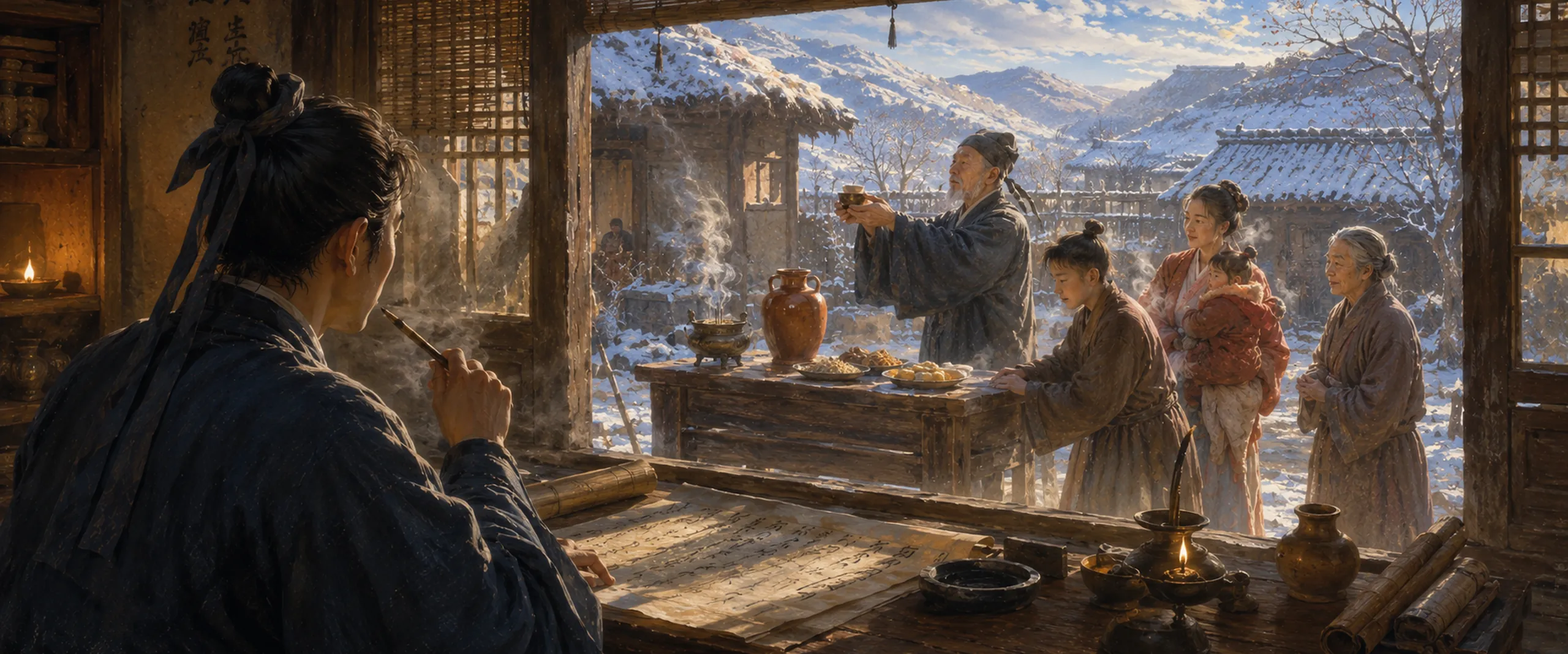
Historical Development
From the Pre-Qin Period to the Wei and Jin Dynasties
The original meaning of the character “腊” is closely connected with ancient year-end sacrificial rites. Liji · Jiaotesheng (《礼记·郊特牲》) records: “腊者,猎也,言田猎取禽兽,以祭祀其先祖也。” During the pre-Qin period, four major sacrifices were held each year using animals obtained through hunting. Among them, the winter sacrifice was the largest and most solemn, and was known as the “La sacrifice” (腊祭). It took place during the twelfth lunar month, although the precise date was not fixed. Only in the Han dynasty was the La day formally designated as the third xu day after the winter solstice.
By the Wei and Jin periods, the La day had already become an important festival. The La Festival (《腊节》) by the Northern Qi poet Wei Shou is one of the earliest surviving poems on the subject. “凝寒迫清祀,有酒宴嘉平” depicts the ritual offering to the many deities on the La day. The Eastern Jin poet Tao Yuanming also wrote a poem titled La Day (《腊日》): “风雪送馀运,无妨时已和。梅柳夹门植,一条有佳花”. At the year’s end, amid the La-day worship of the gods, the poet drinks wine and admires plum blossoms, absorbed in a state of tranquil ease and self-contentment.
The Tang Dynasty
During the Northern and Southern Dynasties, Buddhism flourished increasingly under official patronage. According to tradition, Buddhist communities held commemorative observances on the eighth day of the twelfth lunar month, regarded as the day on which the Buddha attained enlightenment. In this way, the La day, originally a festival of royal sacrifice, gradually merged with the Buddhist “Festival of the Buddha’s Enlightenment,” extending the influence of Laba and helping it develop into a folk festival. Yet from the Wei, Jin, Northern and Southern Dynasties through the Tang, the custom of eating Laba porridge does not appear in the official histories or the literary writings of the educated elite. Tang poems on the La day focus more often on seasonal weather, natural signs, court audiences, and imperial banquets.
Du Fu’s La Day is the best-known Tang poem on the festival. It was composed in the second year of Zhide (757), the year in which the Tang court recovered Chang’an and Luoyang from the rebel forces during the An Lushan Rebellion. The lines “腊日常年暖尚遥,今年腊日冻全消” use the warmth of winter to write of the fortunes of the state. Departing from Du Fu’s characteristic style of “沉郁顿挫”, the poem is filled throughout with springlike vitality and brightness. Meng Haoran’s Worship at Shicheng Temple in Shan County on the Eighth Day of the Twelfth Month (《腊月八日于剡县石城寺礼拜》), meanwhile, portrays Buddhist worship on Laba. “愿承功德水,从此濯尘机” expresses longing for the merit and spiritual purification associated with Buddhism.
The Two Song Dynasties
By the Song dynasty, the custom of eating Laba porridge formally entered the literary field of vision. Meng Yuanlao records in Dongjing Meng Hua Lu (《东京梦华录》): “初八日……诸大寺作浴佛会,并送七宝五味粥与门徒,谓之腊八粥。都人是日各家亦以果子杂料煮粥而食也。” Laba porridge was also known as “Buddha porridge” (佛粥).
Lu You’s Walking to West Village on the Eighth Day of the Twelfth Month is one of the most representative Song poems on Laba. Its line “今朝佛粥交相馈,更觉江村节物新” depicts the warmth of neighbors exchanging Laba porridge. Su Shi’s Nangezi · Drinking in Huai Min’s Small Pavilion in Huangzhou on Laba Day (《南歌子·黄州腊八日饮怀民小阁》), composed during his exile in Huangzhou, gives full expression to the frustration and self-mockery of a disappointed scholar during the festival. Zhao Wannian’s Reflections on Receiving Porridge from the Wei Household at Laba (《腊八危家饷粥有感》) records the Laba Festival as experienced by a Southern Song commander resisting the Jin amid warfare. Wang Yang’s Rising Early in My Study on Laba Day, as My Southern Neighbor Fang Zhishan Sends Porridge amid Falling Snow and Cold, Which I Happily Finish (《腊八日书斋早起南邻方智善送粥方雪寒欣然尽》) depicts the scene of receiving Laba porridge from a neighbor on a cold snowy morning.
Yuan, Ming, and Qing
By the Qing dynasty, Laba porridge had become a seasonal food enjoyed throughout society. The Qing imperial household maintained the custom of cooking and distributing porridge at Yonghe Temple during the Laba Festival. The Daoguang Emperor’s Laba Porridge (《腊八粥》) describes the grandeur of imperial porridge distribution. Xia Renhu’s Laba (《腊八》) records the palace custom of using four enormous cauldrons at Yonghe Temple to cook porridge for offerings to the Buddha and for distribution to princes and high officials. The Qing poet Li Fu’s Laba Porridge traces the origins and preparation of the dish while also reflecting periods of poor harvest, public hunger, and charitable porridge distribution by Buddhist temples.
Core Imagery
The recurring images in Laba Festival poetry form a distinctive “Laba image system.” They are both literary expressions of festival customs and vehicles for poetic emotion.
Laba Porridge
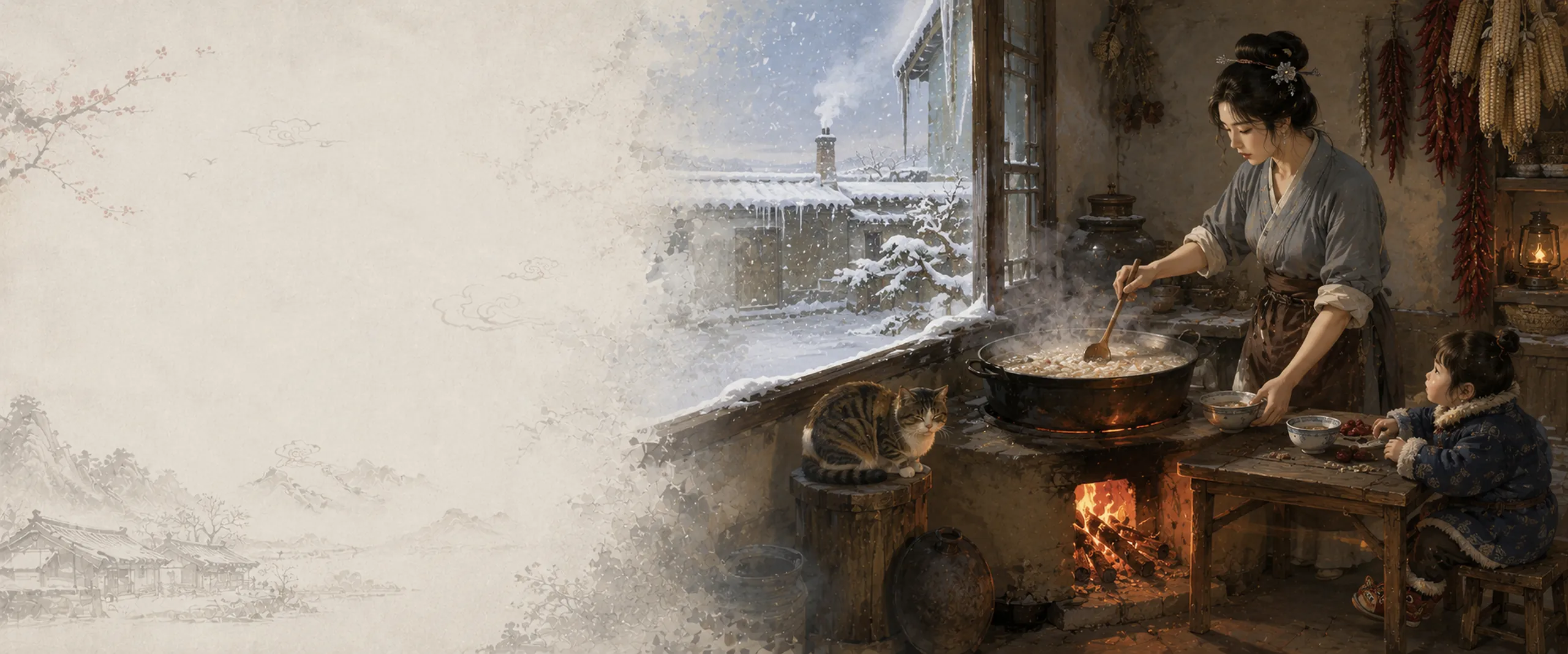
Laba porridge is the central image of Laba poetry. Lu You’s “今朝佛粥交相馈” writes the warmth of neighbors exchanging porridge; Wang Yang’s “栗桃枣柿杂甘香” writes the abundance of ingredients; the Daoguang Emperor’s “谷粟为粥和豆煮” describes the grandeur of imperial porridge distribution; Xia Renhu’s “腊八家家煮粥多” records how widely porridge was cooked among ordinary households. Laba porridge gathers foods from many directions into a single pot and cooks them together with rice, embodying the idea of “合聚万物、调和千灵”—bringing all things together and harmonizing myriad forms of vitality.
Laba porridge is not merely food; it is human warmth. “团坐朝阳同一啜,大家存有热心肠” evokes people sitting together in the morning sun and sharing the same warm porridge. A bowl of hot porridge warms the stomach, but even more deeply, it warms the heart.
The First Breath of Spring
Laba falls in the depths of winter, yet poets repeatedly discover signs of spring within the cold. Du Fu’s “侵陵雪色还萱草,漏泄春光有柳条” uses newly green daylilies and budding willows to reveal spring’s first appearance. Lu You’s “腊月风和意已春” finds spring in the softness of the wind. Wang Yang’s “坐变劲峭同春柔” writes of gentleness emerging within the severe cold.
The “spring” of Laba does not mean that spring has already arrived. It is the “news” that spring is on its way. This image of spring within Laba embodies the Chinese philosophical idea of “阴极阳生”: when yin reaches its extreme, yang begins to arise. The coldest moment is precisely the moment when spring is closest.
Sacrifice
Laba originated in the La sacrifice, making sacrificial ritual one of the oldest images in its poetic tradition. Wei Shou’s “凝寒迫清祀” writes the solemnity of worshipping the many deities in bitter winter. Du Fu’s “还家初散紫宸朝” writes the grandeur of the imperial court assembly. Li Fu’s “腊月八日粥,传自梵王国” recalls the Buddhist tradition of distributing porridge. Laba sacrifice is both an act of reverence toward the divine and an expression of gratitude—giving thanks to the many deities for their protection and for bringing affairs to successful completion.
La Drums and the Approach of the New Year
The Laba Festival is closely connected with the year’s end and the approach of the New Year. A folk saying declares, “腊鼓鸣,春草生”: when the La drums sound, spring grass begins to grow. The La drum is therefore a sound welcoming the coming year. Zhao Wannian’s “不为主人供粥饷,争知腊八是今辰” uses a bowl of porridge to remind the poet that the festival has arrived. Lu You’s “今朝佛粥交相馈,更觉江村节物新” senses the approaching New Year through Laba porridge.
Laba is the prelude to the Spring Festival. Once Laba has passed, the New Year is near. The feeling of “节物新” in Laba poetry is precisely an anticipation of the coming year.
Thematic Categories
La Sacrifice and Reverence for the Divine
The oldest source of the Laba Festival lies in the pre-Qin “腊祭”, the year-end sacrifice in which hunted animals were offered to ancestors and the many deities. Wei Shou’s The La Festival is representative of this theme. “凝寒迫清祀,有酒宴嘉平” writes the solemnity of La-day worship. Li Lianxiu’s La Day (《腊日》) also traces the origins of the festival: “饮烝大割孟冬腊,为报得禽自思猎”. Such poems connect Laba directly with the sacrificial traditions of high antiquity and constitute one of the most archaic strands within Laba poetry.
The Gift of Buddha Porridge
The fusion of Laba with Buddhism made “佛粥”, or Laba porridge, one of the warmest themes in the festival’s poetry. Lu You’s “今朝佛粥交相馈,更觉江村节物新” writes the warmth of neighbors giving porridge to one another. Wang Yang’s “腊月八日梁宋俗,家家相传侑僧粥” records the folk custom of distributing porridge on Laba. The Daoguang Emperor’s Laba Porridge depicts the magnificent scene of imperial porridge distribution. Xia Renhu’s “腊八家家煮粥多,大臣特派到雍和” records the Qing palace custom of porridge distribution at Yonghe Temple.
From Buddhist temples to ordinary households, from the imperial court to common people, a single bowl of Laba porridge carries human kindness and warmth.
The First Stirring of Spring
Another important theme in Laba poetry is the discovery of spring. Du Fu’s “侵陵雪色还萱草,漏泄春光有柳条” uses plants to announce spring. Lu You’s “腊月风和意已春” finds spring in the wind. Tao Yuanming’s “风雪送馀运,无妨时已和。梅柳夹门植,一条有佳花” finds it in plum and willow.
The “spring” of Laba poetry is not spring itself, but the promise that spring is approaching. “大寒之后,必有阳春”—after the deepest cold, spring must come. The hope for spring contained within Laba’s winter is one of the festival’s deepest reflections on life.
Reflections on the Passing Years
Because Laba falls near the end of the year, it readily awakens reflection on the passage of time. Zeng Guofan’s “腊月八日年年过,持节频看鬓有丝” observes the appearance of white hair during a Laba night watch. Yu Liangneng’s “冉冉头新白,匆匆岁又残” laments the swift passing of another year amid Laba snow. Su Shi’s “他时一醉画堂前,莫忘故人憔悴、老江边” reflects, in a Laba farewell, on the aging of an old friend.
Laba stands at the threshold of the year’s end. At the moment when the old year gives way to the new, poets cannot help but feel the quiet weight of “another year gone.”
Laba Festival Folk Songs
The Laba Festival is not only a festival of the Han Chinese but also an important celebration among many ethnic minority communities. The custom of eating Laba porridge has also influenced many minority regions. In Yunnan, Guizhou, and other areas with substantial minority populations, Laba has incorporated distinct local traditions. Some communities observe the festival by worshipping ancestors, sharing Laba porridge, and singing their own traditional songs. Although many of these orally transmitted songs were never recorded in writing, they have been passed from generation to generation through festival life and, together with the literary poetry of Han writers, form the broader cultural landscape of the Laba Festival within the Chinese nation.
Closing Reflections
Laba Festival poetry forms a distinctive and warmly luminous landscape within the treasury of Chinese verse. From Wei Shou’s “凝寒迫清祀” and the archaic solemnity of La sacrifice and reverence for the gods, to Tao Yuanming’s “梅柳夹门植” and the tranquil pleasure of admiring plum blossoms at year’s end; from Du Fu’s “侵陵雪色还萱草” and the joyful expectation of spring’s first light, to Lu You’s “今朝佛粥交相馈” and the human warmth of neighbors exchanging porridge; from Zhao Wannian’s “矢石丛中未死身” and the heroism of Laba on the battlefield, to Zeng Guofan’s “持节频看鬓有丝” and his deep reflection on passing years—Laba poetry has recorded for a thousand years Chinese gratitude for harvest, reverence toward the divine, hope for spring, and cherishing of human bonds.
Within these poems is the solemn dignity of La sacrifice—“凝寒迫清祀,有酒宴嘉平”; the warmth and sweetness of Laba porridge—“今朝佛粥交相馈,更觉江村节物新”; the vigorous life of spring just beginning to stir—“侵陵雪色还萱草,漏泄春光有柳条”; and the profound year-end reflection of “冉冉头新白,匆匆岁又残”. The meaning of Laba poetry lies precisely in its ability to carry forward, from a thousand years ago into every new age, the warmth of a bowl of porridge, a faint message of spring, and a sincere reverence toward the divine.
The poetic tradition of the Laba Festival traces a cultural history in which Chinese festival life moves from “敬神” toward “爱人”—from reverence for the divine toward care for human beings. From pre-Qin sacrifices to the many deities, to Wei and Jin La-day banquets; from Tang court assemblies on the La day to Song exchanges of Buddha porridge; from Qing imperial porridge distribution to ordinary households cooking porridge everywhere—Laba poetry bears witness to the thousand-year journey through which “腊” moved from sacrifice into everyday life. In these poems, Laba is both the solemnity of “凝寒迫清祀” and the warmth of “腊月风和意已春”; both the grandeur of imperial favor in “口脂面药随恩泽” and the ordinary 烟火气 of “团坐朝阳同一啜”. And in the line “今朝佛粥交相馈,更觉江村节物新”, a bowl of porridge, an act of affection, and a breath of approaching spring from a thousand years ago are gathered into Laba’s warmest cultural memory. Laba poetry is one of the deepest and most enduring declarations Chinese people have made to “porridge” and “spring,” a prelude to the flavor of the New Year written in ink by generation after generation. Once Laba has passed, the New Year is near—and every Laba poem becomes a literary signpost on the road toward 年.
—-
[Language: es]
Selected Poems
Selected Poems
腊日
Tang Dynasty · Du Fu
腊日常年暖尚遥,今年腊日冻全消。
侵陵雪色还萱草,漏泄春光有柳条。
纵酒欲谋良夜醉,还家初散紫宸朝。
口脂面药随恩泽,翠管银罂下九霄。
Background
Among all Tang poems depicting the La day, or Laba, Du Fu’s La Day is undoubtedly the most famous. Du Fu is usually celebrated for the “沉郁顿挫” quality of his poetry, yet this work is filled line after line with the freshness of spring and a sense of brightness. By writing of a warm winter, the poet writes of the fortunes of the state; by observing seasonal changes, he reveals his own emotional state. Personal joy and national revival are brought together, making this one of the relatively rare openly joyful works in Du Fu’s poetry. Du Fu (712–770), courtesy name Zimei and literary name Shaoling Yelao, was one of the greatest realist poets of the Tang dynasty and was later honored as the “Poet Sage.” This poem was written on the La day in the second year of Zhide (757). That year, Tang forces recovered the two capitals, Chang’an and Luoyang, which had been occupied by rebel armies during the An Lushan Rebellion. Du Fu was then serving in Chang’an as zuoshiyi. After years of displacement caused by war, he finally witnessed the revival of the court, and his joy is evident throughout the poem. The work was written in celebration of receiving imperial favor on the La day: the first four lines describe scenery, while the last four record events.
Line-by-Line Reading
The snow covering the hills has melted away, revealing tender green daylilies; slender willow branches, touched by the bright light, seem already to betray the coming spring. “侵陵” conveys the sense of snow pressing upon and covering the land, while its retreat reveals what lies beneath. “萱草” is also known as “忘忧草”, the “forget-sorrow herb”; the ancients believed it could dispel grief. Here it is both a real plant and an image suggesting the poet’s happiness at leaving sorrow behind. The phrase “漏泄春光” is especially vivid: spring has not formally arrived, yet the willow branches have already “leaked” its secret. The couplet is neatly balanced and visually striking, bringing the warmth of the La season and the first signs of spring vividly before the reader.
In his happiness, the poet wishes to return home after court, drink freely, and spend the fine evening in intoxication. Yet in this moment he is still conscious of the emperor’s favor and cannot simply leave. “纵酒” conveys both inner joy and a desire to abandon restraint, while “欲谋良夜醉” expresses anticipation of convivial pleasure. “还家初散紫宸朝” records that the court audience has only just ended. The Zichen audience was an imperial court assembly at which the Tang emperor received his officials. The poet has left court but has not yet reached home. The phrase “初散” captures this precise moment of transition.
Lip balm and facial ointment bestowed by the emperor arrive together with imperial favor, contained in green tubes and silver vessels, as though descending from the highest heavens. Such balms and ointments were court gifts presented to close officials during the La season in the Tang dynasty, while the green tubes and silver containers were their elegant packaging. “下九霄” magnifies the grandeur of imperial grace: the emperor’s favor seems to descend from heaven itself, filling the poet with a sense of extraordinary honor. The couplet writes both the imperial gift and the poet’s astonished gratitude at receiving it.
Overall Appreciation
This poem was composed in gratitude for imperial gifts on the La day, and the entire work is suffused with joy. The opening couplet writes of warmth: where former La days were cold, this year the frost has vanished. The second couplet writes of spring in seasonal signs: daylilies turn green, willows begin to bud. The third writes of personal delight: the poet wishes to drink deeply after the court audience. The final couplet writes of imperial favor: lip balm and facial ointment seem to descend from heaven. Beginning with “warmth” and ending with “grace,” the poem unfolds in a single continuous breath.
Du Fu’s poetry is generally associated with gravity and emotional tension, yet this work is filled throughout with springlike vitality. Through the unusual warmth of the La day, the poet expresses joy at national revival, gratitude for his own circumstances, and hope for the coming spring. The poem may be read as a perfect literary annotation to the idea that after the greatest cold comes spring, and after great disorder, great order may return.
十二月八日步至西村
Song Dynasty · Lu You
腊月风和意已春,时因散策过吾邻。
草烟漠漠柴门里,牛迹重重野水滨。
多病所须唯药物,差科未动是闲人。
今朝佛粥交相馈,更觉江村节物新。
Background
Among all Song poems on Laba, Lu You’s Walking to West Village on the Eighth Day of the Twelfth Month is undoubtedly one of the most widely loved. It depicts the rural scenery of the festival and the poet’s unhurried state of mind. Though it is still the depth of winter, the weather already carries the softness and brightness of spring. Walking with a staff toward West Village, the poet sees smoke drifting behind rustic gates and the overlapping tracks of cattle beside wild water; he also receives Laba porridge from his neighbors and feels the deep warmth of the festival. The poem begins with “spring” and closes with “new,” giving the entire work the freshness of a gentle spring breeze. Lu You (1125–1210), courtesy name Wuguan and literary name Fangweng, was one of the greatest patriotic poets of the Southern Song. This poem was written in the winter of the third year of Shaoxi (1192). The poet was then around forty years old and, after leaving office, had returned to his home in Shanyin, Yuezhou, present-day Shaoxing in Zhejiang, where he lived in West Village near Sanshan. His feelings toward retirement were conflicted. He remained angry and dissatisfied with political reality and had not yet become completely disillusioned; he still hoped for a chance to return to public life. The poem records what he saw and felt during an outing to West Village on Laba, describing both the pleasant weather and landscape and the relative leisure of his life.
Line-by-Line Reading
The breeze in the twelfth lunar month is already gentle enough to suggest spring, and the poet walks with his staff past a neighbor’s home. The opening establishes both season and mood. Although it is still midwinter, the poet senses mild weather and the first breath of spring. “风和” conveys the gentleness of the wind, while “意已春” reveals his acute sensitivity to spring’s approach. “散策” means to stroll with a walking staff; the single word “散” gives the movement a feeling of leisure and ease.
Smoke drifts behind the neighbor’s rustic gate, while the tracks of working cattle overlap thickly beside the water in the fields. The couplet paints a scene of ordinary village life: misty smoke within the gate, dense hoofprints by the wild water. “漠漠” evokes the thick, hazy spread of smoke, while “重重” conveys the abundance of cattle tracks. The two reduplicated expressions give the scene a tactile richness. Rustic gate, smoke, hoofprints, wild water—these simple images form a complete village picture of the La season.
The poet is frequently ill and needs little beyond medicine; the year’s corvée obligations and taxes have not yet begun, so for the moment he is a man at leisure. The couplet describes both his physical condition and his way of life. Lu You was living at home after leaving office and suffered from illness, yet he was not despondent. “差科未动” means that the new year’s labor levies and taxes had not yet been assigned, allowing him a rare interval of calm. Amid disappointment in official life, he finds consolation in the plain rhythms of village existence.
Today the neighbors exchange Laba porridge with one another, making the riverside village feel all the more renewed by the season. “佛粥”, Buddha porridge, is Laba porridge, so called because Buddhist temples cooked porridge as an offering to the Buddha during the festival. Laba porridge was also known as “七宝五味粥”. The exchange of food among neighbors and the first faint stirrings of vitality in nature allow the poet to rediscover the pleasures of ordinary life. “交相馈” conveys warmth and mutual care between neighbors, while “节物新” expresses anticipation of spring. The poem closes on “新”, referring both to the renewal of the seasonal world and to a renewed state of mind.
Overall Appreciation
Set against the Laba Festival, this poem presents a simple rural world through what the poet sees and feels while walking to West Village. Its structure is mature and tightly interwoven. The opening couplet writes the weather—“风和意已春”; the second writes the village landscape—“草烟” and “牛迹”; the third turns inward to the poet’s circumstances—“多病” and “闲人”; the final couplet writes the exchange between neighbors—“佛粥交相馈”. The four couplets proceed layer by layer, from outer landscape to inner feeling, and conclude with “节物新”.
The “柴门” and “牛迹” embody the simplicity of village life; “佛粥” and “节物新” embody the warmth of human relationships. On one of the coldest days of winter, Lu You walks with a staff through a village of curling smoke and layered cattle tracks, drinks Laba porridge, feels the soft arrival of spring, and perhaps also hopes that spring will return to his own life sooner rather than later. The poem has the warmth of a restorative spring breeze and is among the most comforting works in the Laba poetic tradition.
腊节
Northern & Southern Dynasties · Wei Shou
凝寒迫清祀,有酒宴嘉平。
宿心何所道,藉此慰中情。
Background
Among poems depicting the La day, Wei Shou’s The La Festival is one of the most archaic and concise. In only twenty Chinese characters, it records both the solemn scene of sacrificing to the many deities and the poet’s devout reverence. As one of the earliest surviving poems on the La day, the work also possesses considerable documentary value. Wei Shou (507–572), courtesy name Boqi, was a historian and writer of the Northern Qi. He served as zhongshuling and zhuzuo lang and was the principal compiler of the Book of Wei (《魏书》). This poem was composed during a La-day sacrifice. Amid the winter cold, the poet joined others in worshipping the various deities and, moved by the occasion, recorded the solemn ritual and his reverent feelings in spare language.
Line-by-Line Reading
Severe cold presses upon the solemn sacrifice. The twelfth lunar month is the coldest time of the year. “凝寒” intensifies the sense of bitter weather, while “迫” shows how forcefully the cold bears down upon the ritual. Yet the colder the season, the more necessary it becomes to express reverence and gratitude toward the divine through sacrifice. “清祀” conveys the solemnity and purity of the rite.
Wine and food are laid out for the La sacrificial feast. “嘉平” is another name for the La day. Before the Han dynasty, the precise date of the La sacrifice was not fixed; in the Han, it was established as the third xu day after the winter solstice. The two characters “有酒” suggest abundance and ceremonial dignity.
What need is there to speak of the reverence long held within the heart? “宿心” means an intention or feeling long cherished. The line expresses the poet’s devotion to the gods: reverence lies deeply within and requires no elaborate verbal declaration.
Through the La sacrifice, the emotions within the heart find consolation. This is the poem’s decisive line. The sacrifice is not only an offering to the many deities but also a source of inward reassurance. In the depths of winter, when cold grips the earth, people offer wine and meat to the gods, give thanks for divine protection, and release the reverence long stored within their hearts.
Overall Appreciation
This five-character quatrain contains only twenty Chinese characters, yet it evokes a solemn ritual scene in the deepest winter, when people sacrifice to the many deities on the La day. Its language is plain and unornamented, but possesses a naturally grave and dignified force. The first two lines depict the sacrificial setting—“凝寒迫清祀,有酒宴嘉平”; the final two turn toward the worshipper’s inner state—“宿心何所道,藉此慰中情”. Wei Shou’s The La Festival is an important source for understanding ancient La sacrificial customs and one of the poems that most clearly preserves the original meaning of the character “腊”.
腊八危家饷粥有感
Song Dynasty · Zhao Wannian
襄阳城外涨胡尘,矢石丛中未死身。
不为主人供粥饷,争知腊八是今辰。
Background
Among all Laba poems, Zhao Wannian’s Reflections on Receiving Porridge from the Wei Household at Laba is one of the most tragic and heroic. Smoke from battle fills the poem, along with the boldness of a warrior, turning a Laba Festival spent amid warfare into a scene of extraordinary intensity. Its atmosphere of “Laba on the battlefield” has a certain resonance with Mao Zedong’s “战地黄花分外香”. Zhao Wannian was a well-known Southern Song commander who fought against the Jin. The poem was written during the Laba Festival in the second year of Kaixi (1206). That winter, Jin forces crossed southward and besieged Xiangyang with an army of two hundred thousand. The defenders of Xiangyang numbered only a little over ten thousand. As a powerful enemy closed in and officials from the Xuanzhaosi fled one after another, Zhao Wannian repaired weapons, stockpiled provisions, and led the soldiers in the city in a determined defense.
From the eleventh lunar month of that year until the second month of the following year, Xiangyang remained under siege for more than ninety days. With just over ten thousand defenders, Zhao Wannian held out against two hundred thousand Jin troops, and the city was ultimately preserved. During that year’s Laba Festival, fierce fighting was still raging outside Xiangyang.
Line-by-Line Reading
Outside Xiangyang, clouds of dust raised by the Jin army billow upward. The verb “涨” is forceful: dust surges forward like a rising tide, conveying the strength and aggression of the advancing enemy. “胡尘” is at once the dust thrown up by Jin cavalry and a symbol of a land torn by war.
Amid a thicket of arrows and flying stones, I have somehow survived. The line writes the brutality of battle: missiles fall like rain, and the poet stands among them, repeatedly escaping death. “丛” conveys the density of arrows and stones, while “未死身” expresses the sheer contingency of survival. The poet has already set life and death aside, yet by fortune remains alive.
If the host had not brought him a bowl of Laba porridge… “主人” refers to the person hosting him. Even during the siege of Xiangyang, someone still remembered to bring him a bowl of festival porridge. “供粥饷” captures a moment of human warmth within a city in danger.
How else would I have known that today was Laba? Amid intense battle, the poet has lost track even of the date. This is the most moving line of the poem. Only when a bowl of Laba porridge is placed before him does he suddenly realize that the festival has arrived. War has made people forget even the calendar, yet one bowl of porridge reminds him that ordinary human life continues and that the year is still moving toward its festivals.
Overall Appreciation
The poem is filled with both tragic gravity and heroic spirit. More than eight hundred years ago, in the depths of winter, the defense of Xiangyang was raging even as the Laba Festival arrived. Zhao Wannian, absorbed in combat, would not even have known it was Laba had someone not brought him a bowl of porridge. In only four lines, the poem places the violence of battle beside the calm optimism of a defender. The single bowl of Laba porridge on the battlefield becomes all the more warming because of the danger surrounding it. Amid blood and fire, the poet retains a composure that places life and death beyond personal concern. This is the spirit of a hero and also a form of national fortitude.
腊八日夜直
Qing Dynasty · Zeng Guofan
仙掖深深昼掩扉,玉堂清切坐垂帷。
宫漏乍催朝罢晚,御炉初暖退朝迟。
诗成却恨无佳句,书就还疑有旧诗。
腊月八日年年过,持节频看鬓有丝。
Background
Zeng Guofan’s Night Duty on Laba Day is a distinctive Qing poem on the festival. It records his experience of spending the night on duty at the Hanlin Academy. Against the background of Laba, the solemnity of the palace and the poet’s personal reflections combine into a deep meditation on the passage of time and the ease with which human beings grow old. Images such as “仙掖深深”, “宫漏乍催”, and “御炉初暖” create an atmosphere at once austere and lonely. Zeng Guofan (1811–1872), courtesy name Bohan and literary name Disheng, was a statesman and writer of the late Qing and one of the representative figures of the Self-Strengthening Movement. The poem was composed between the twenty-fourth and twenty-fifth years of Daoguang (1844–1845), when Zeng was serving as an editor in the Hanlin Academy and undertaking night duty in the palace. Spending the Laba night at his post, he reflected on the passage of time and wrote this seven-character regulated verse.
Line-by-Line Reading
Deep within the Hanlin Academy, the doors remain closed even by day; in the chill of the Jade Hall, the poet sits behind lowered curtains. “仙掖” refers to the Hanlin Academy, while “玉堂” is another name for it. The two lines evoke both the solemnity and the cold stillness of the court. “昼掩扉” suggests the secluded depth of the academy, while “坐垂帷” brings out the poet’s solitude.
The palace water clock urges on the hours, and by the time court is dismissed it is already late; the imperial brazier has only just begun to warm, yet withdrawal from court is delayed. “宫漏” is the palace timekeeping device, and “乍催” creates a sense of time pressing forward. “御炉初暖” suggests warmth within the palace, while “退朝迟” records the long duration of duty. The contrast between “催” and “迟” gives the couplet its distinctive sense of time.
The poem is complete, yet he regrets that it contains no fine line; the writing is finished, yet he suspects he may merely have reproduced an old poem. These lines express the poet’s self-mockery and self-scrutiny. On such a particular night, he remains dissatisfied with what he has written. “恨无佳句” and “还疑有旧诗” both reveal the high standard he sets for his own literary work.
The eighth day of the twelfth month comes and goes every year; while serving at his post, he repeatedly notices that white hairs have appeared at his temples. This is the poem’s decisive stroke. A festival that should bring joy becomes, in the poet’s eyes, a witness to passing years. “鬓有丝” writes the gradual emergence of white hair, while “频看” reveals his growing attention to his own aging. Against the background of Laba, the poem expresses both the loneliness of palace duty and a deep sigh over the passing of time.
Readers’ Comments
Calendar and traditional culture enthusiasts from around the world, sharing the same moon.
Sign in or register to join the conversation. Your comment account is created automatically the first time you use a connected account.
No comments yet
Share your thoughts with readers around the world.