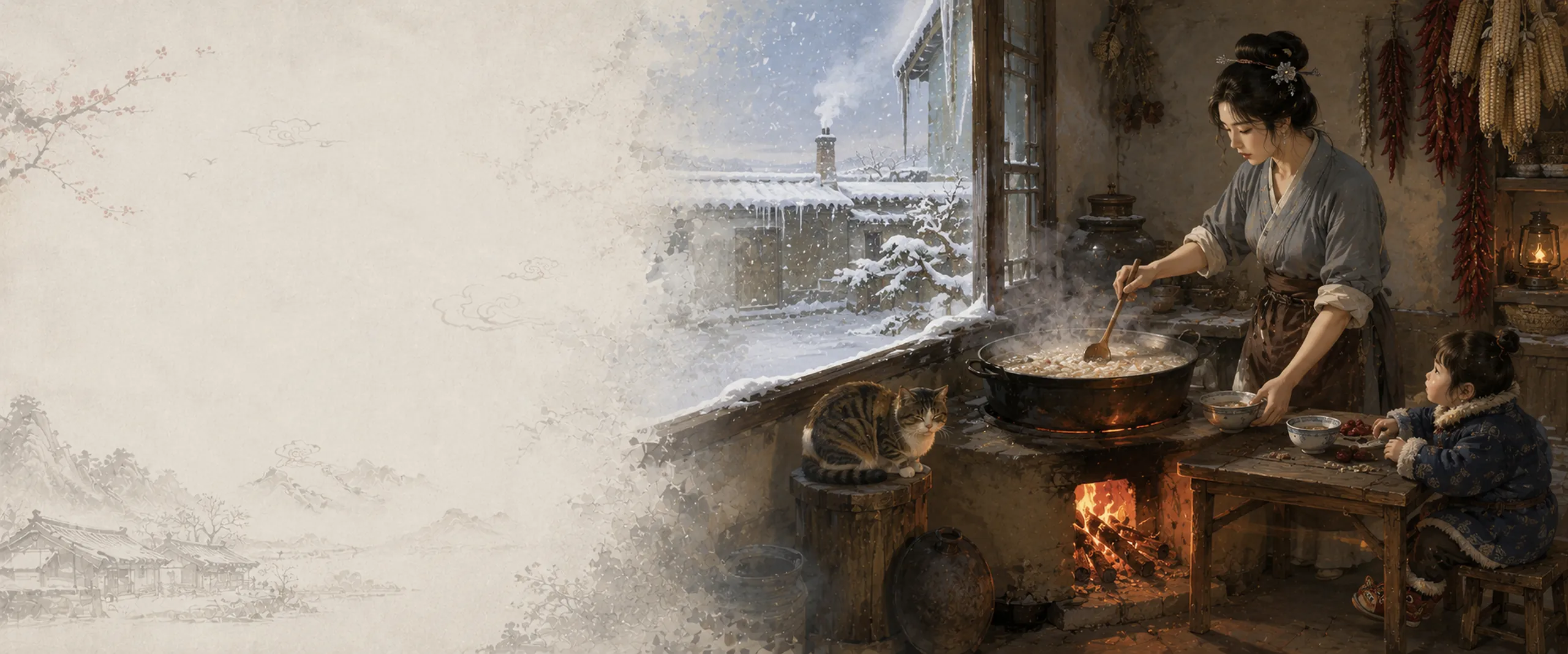
Eating Laba porridge is the central custom of the festival. Also known as “Seven-Treasure Five-Flavor Porridge” (七宝五味粥), it is cooked from a wide variety of ingredients such as glutinous rice, red beans, mung beans, peanuts, lotus seeds, red dates, and longan. Some versions use only seven or eight ingredients, while elaborate recipes may contain more than twenty. The mixture symbolizes abundant harvests and family completeness.
The custom of eating Laba porridge in China has a history of more than a thousand years and is generally traced in surviving records to the Song dynasty. Traditionally, once the porridge was ready, the first portion was offered to gods and ancestors, the next was given to relatives and friends, and only then did the family eat together. Having porridge left over after the meal was considered auspicious, expressing the wish for “surplus year after year” (年年有余). Different regions also developed their own distinctive Laba foods, especially Laba noodles and Laba garlic.
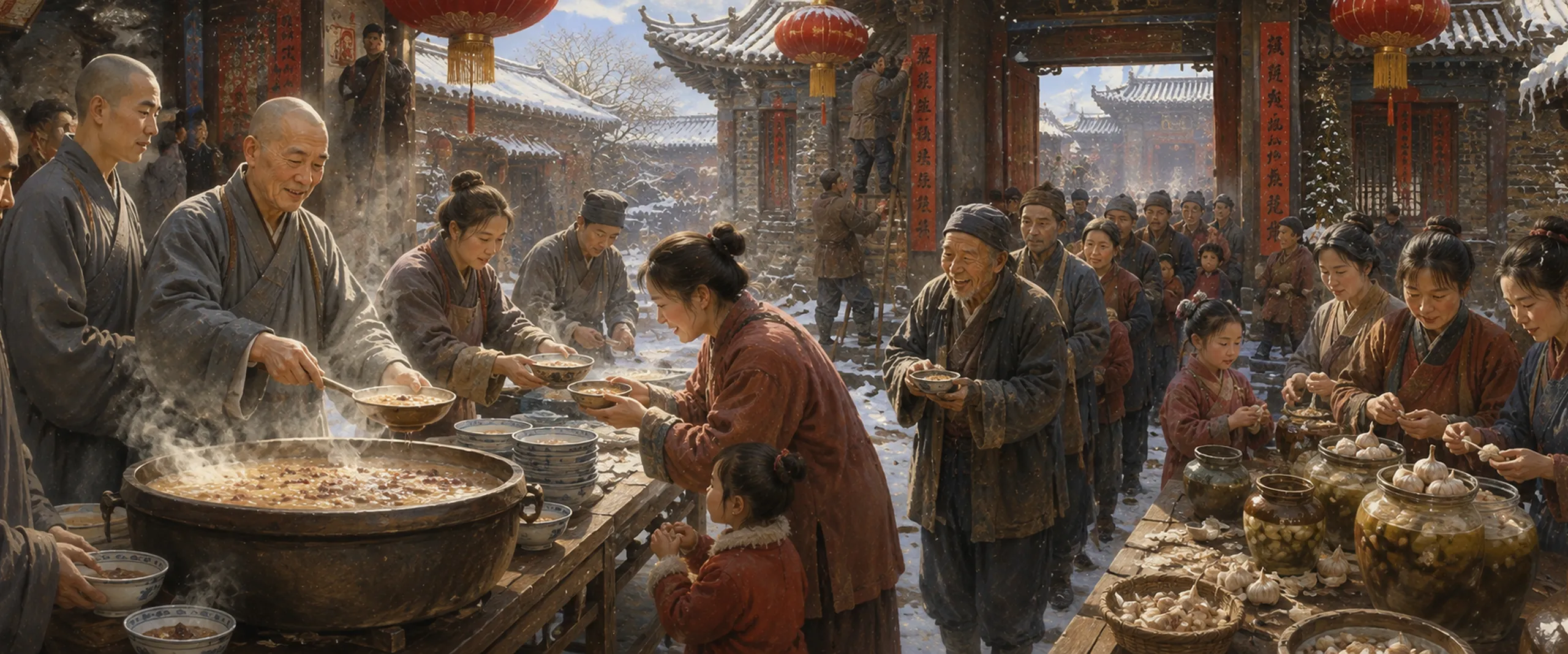
Main Customs
Worshipping Ancestors and Deities
Historical Origins
An old saying explains the festival’s sacrificial character:
“腊者,岁终大祭,纵吏民宴饮。” Là refers to the great sacrifice at the end of the year, when officials and common people were permitted to feast and drink.
The most ancient form of the Laba Festival was therefore a major year-end sacrificial observance, held to thank ancestors and deities for their protection and to pray for abundant harvests and good fortune in the coming year. By the Han dynasty, the la day (腊日) had come to mark the transition between one year and the next, in a way comparable to the function of New Year’s Eve today.
The objects of the old la sacrifice (腊祭) included ancestral spirits and the Five Household Gods—the spirits of the gate, household entrance, skylight, stove, and the ground inside the doorway. These sacrificial practices, inherited from remote antiquity, were intended to secure harvest, safety, and order.
The Ritual
In traditional society, worship of numerous deities accompanied the cycle of folk festivals. On Laba, people could conduct large-scale sacrificial rites for gods and ancestors as a ritual of recompense—thanking those supernatural powers and ancestral spirits believed to have protected the household over the previous year and asking them to continue their protection in the year ahead. Some regions preserve elements of this tradition today.
Ice-cutting divination was another important Laba activity. In many areas, ice was cut and examined to predict agricultural abundance or scarcity. An 1882 edition of the Shouyang County Gazetteer (《寿阳县志》) from Shanxi records:
“Ice is cut to sacrifice to the gods and placed upon manure heaps, in order to avert drought in the coming year.”
A related custom was called “freezing the ice” (冻冰冰). On the evening of the seventh day of the twelfth lunar month, a bowl of clear water was prepared, decorated with red and white radish carved into flowers and vegetable leaves arranged as greenery, then placed outdoors at a high spot. On Laba morning, if the surface of the ice had formed many raised bumps of different sizes, it was taken as a sign that the wheat crop in the coming year would be abundant.
Cultural Meaning
Laba ancestor and deity worship reflects the Chinese ethical ideal of “carefully attending to the end and remembering those who came before” (慎终追远), as well as the value of gratitude toward one’s origins (感恩报本). At the end of the year, people expressed thanks to ancestors and divine powers and prayed for continued protection in the coming year.
The ritual connected the household and lineage with the supernatural world, strengthening both family cohesion and shared cultural identity.
How to Participate
On Laba, a household altar may be prepared with offerings for ancestors. Families may also visit ancestral halls or temples and take part in communal rites.
For city residents who do not conduct formal sacrifices, a simpler form is possible: after the Laba porridge is cooked, one bowl can be placed before an ancestral tablet or memorial space before the family begins eating, as a gesture of respect.
Expelling Epidemics and Performing Nuo Rituals
Historical Origins
Laba traditions for expelling disease and harmful influences took many forms, the most important of which was the Great Nuo ritual (大傩). Its purpose was to drive away wandering ghosts, epidemics, and disaster. In the pre-Qin period, Great Nuo was a large-scale sacrificial ceremony and once enjoyed considerable prominence.
The custom of beating drums in the twelfth lunar month to expel disease, rooted in ancient ritual and shamanic practice, survives today only in a limited number of regions, including parts of Xinhua, Hunan.
The Ritual
The Book of the Later Han: Treatise on Ritual (《后汉书·礼仪志》) records:
“先腊一日大傩,谓之逐疫。” On the day before the la sacrifice, the Great Nuo is performed; this is called expelling epidemic disease.
Thus, Great Nuo was performed on the day before the la sacrifice in order to remove plague and calamity.
Bathing was another method of ritual purification. The Record of the Seasonal Customs of Jing and Chu (《荆楚岁时记》) states:
“沐浴,转除罪障。” By bathing, one turns away and removes sinful obstructions.
Here, “罪障” may be understood broadly as impurities, misfortune, and calamities comparable to epidemic affliction.
In earlier times, hunting was also conducted around Laba in order to obtain animals for offerings to ancestors and gods. The character 腊 itself is historically associated with meat and winter sacrifice.
Northern China also preserves traditions involving Laba ice. People rose early and broke off the first ice from springs or rivers and ate it, believing that it could eliminate illness and disaster. On the day before Laba, a basin of water might be left outdoors to freeze; on Laba itself, the ice was broken and eaten. Folk belief held that anyone who ate Laba ice would not suffer stomach pain during the coming year.
Cultural Meaning
These epidemic-expelling and Nuo traditions reveal how earlier societies understood and responded to disease and disaster. In periods when medical knowledge and treatment were limited, ritual provided psychological reassurance and gave the community a shared means of confronting danger.
Such customs express a persistent Chinese concern with health, safety, and freedom from calamity.
How to Participate
A symbolic version of the old ice custom can be experienced by freezing clean drinking water indoors and using the ice on Laba. Direct consumption of outdoor ice or river ice is not advisable in modern urban environments for hygiene reasons.
In areas such as Xinhua, Hunan, visitors may be able to observe drum-based epidemic-expelling rites or Nuo performances held around Laba. These ceremonies should be viewed respectfully from a safe distance and according to local rules.
Eating Laba Porridge
Historical Origins
The custom of eating Laba porridge has a history of more than a thousand years. It is generally traced in surviving written records to the Song dynasty, when the imperial court, government offices, Buddhist monasteries, and ordinary households all prepared porridge on Laba.
During the Northern Song, Su Shi (苏轼) spent Laba at Lingyin Temple and wrote Inscribed at the Abbot’s Quarters of Lingyin Temple (《留题灵隐寺方丈》). The lines
“高堂会食罗千夫,撞钟击鼓喧朝晡。” In the great hall, a thousand gather to eat; bells are struck and drums resound from morning to evening.
describe the extraordinary atmosphere of Lingyin Temple during the festival.
The Song writer Meng Yuanlao (孟元老) recorded in the Dongjing Meng Hua Lu (《东京梦华录》, Dreams of Splendor of the Eastern Capital):
“(十二月)初八日……诸大寺作浴佛会,并送七宝五味粥与门徒,谓之腊八粥。都人是日各家亦以果子杂料煮粥而食也。” On the eighth day of the twelfth month… the great monasteries hold bathing-the-Buddha assemblies and distribute Seven-Treasure Five-Flavor Porridge to their disciples, calling it Laba porridge. On that day, households throughout the capital also cook porridge with fruits and assorted ingredients and eat it.
By the Qing dynasty, the custom had become even more widespread. In the imperial palace, the emperor, empress, princes, ministers, attendants, and palace women could all receive Laba porridge, while rice and fruit were sent to temples for the use of monks. Laba porridge has also been called “Seven-Treasure Five-Flavor Porridge” (七宝五味粥), “Buddha Porridge” (佛粥), and “Everyone’s Rice” (大家饭).
The Activity
Laba porridge carries numerous auspicious wishes. Traditionally, it is simmered slowly over low heat until thick. Folk interpretation sometimes connects this thickness and stickiness with the idea of “staying connected”, and therefore with continuous harvests year after year.
Its ingredients may also carry symbolic meanings. Longan evokes wealth and family reunion, lily bulb suggests harmony in all affairs, walnut symbolizes domestic harmony, while red dates and peanuts may be interpreted through wordplay as a wish for children and descendants.
The order in which the porridge is eaten also traditionally mattered. Once the porridge was ready, the first portions were offered to gods and ancestors. It could then be sent to relatives and friends—ideally before noon—and only afterward eaten by the household.
Having porridge left over after several meals was considered especially fortunate because it represented “surplus year after year” (年年有余). Giving porridge to the poor was also understood as an act of accumulating merit.
Laba porridge varies enormously across China. Beijing was especially famous for elaborate versions containing more than twenty ingredients, including red dates, lotus seeds, walnuts, chestnuts, almonds, pine nuts, longan, hazelnuts, grapes, ginkgo, water chestnuts, candied green and red strips, rose, red beans, and peanuts. Northern versions are generally sweeter, while southern ones may be sweet or savory. In Jiangsu, vegetables and oil may be added; in Suzhou, arrowhead, water chestnut, walnut, pine nut, gorgon fruit, wood ear mushroom, greens, and enoki mushrooms may be included.
Cultural Meaning
Laba porridge is more than a festive food. It is a concentrated expression of the Chinese ideal of gratitude and cherishing blessings (感恩惜福). From offering it to gods and ancestors, to giving it to relatives and friends, to sharing it within the family and distributing it to the poor, every stage of its circulation establishes a relationship between people, family, community, and the sacred.
The porridge’s texture and ingredients are also interpreted symbolically, turning the act of eating into a ritual of blessing.
How to Participate
Laba porridge can be cooked at home, or visitors can attend temple porridge distributions. Many Buddhist monasteries across China organize free porridge events on the festival. Lingyin Temple in Hangzhou and major temples in Beijing are particularly well known for the tradition.
There is no strict formula for the ingredients. Rice, beans, nuts, dried fruit, lotus seeds, and other grains may be combined according to taste. The important point is not exact replication but the experience of slow cooking, sharing, and seasonal blessing.
Pickling Laba Garlic
Historical Origins
Laba garlic (腊八蒜) is a distinctive custom of North China. Across much of the region, people traditionally soak garlic in vinegar on the eighth day of the twelfth lunar month.
The custom is also associated in folk explanation with the old practice of settling accounts before the New Year. Because Laba falls close to year-end, merchants traditionally checked income and expenses and calculated gains and losses around this time, a process colloquially called “Laba calculation” (腊八算). An old commercial principle held that “accounts should not cross into the new year.” In old Beijing, shops began reconciling their books around Laba.
Since 蒜 (suàn, garlic) sounds like 算 (suàn, to calculate), Laba garlic came to carry the additional folk meaning of “calculating away one’s troubles.”
Traditional literary references are also associated with the custom. In later popular attribution, verses linked with Bai Juyi and Tang Xianzu praise the aroma of garlic in the Laba season, further strengthening the food’s literary aura.
The Activity
Laba garlic is made by soaking peeled garlic cloves in vinegar. Purple-skinned garlic and rice vinegar are commonly preferred. The outer skin is removed, the cloves are placed in a clean jar, completely covered with vinegar, sealed, and kept in a cool place until the garlic turns green.
After roughly ten days or more, by the time the Spring Festival arrives, the garlic may become a vivid emerald color, while the vinegar takes on a sharp garlic fragrance. Around New Year’s Eve and the Spring Festival, the garlic and vinegar are commonly eaten with dumplings or used to season cold dishes.
Cultural Meaning
Laba garlic creates a direct bridge between Laba and New Year’s Eve. It is prepared on Laba and eaten during the Spring Festival, so the gradual transformation of the garlic in the vinegar becomes a visible countdown to the New Year.
The homophony between 蒜 (garlic) and 算 (calculate) adds another layer: the custom symbolically expresses the wish to “settle everything from the old year” and enter the new one with a fresh beginning.
How to Participate
On Laba, peel and wash purple-skinned garlic cloves, place them in a clean glass jar, pour in enough rice vinegar to cover them completely, seal the jar, and store it in a cool place.
By New Year’s Eve, the garlic should ideally have turned green and can be served with dumplings. Purple-skinned garlic is traditionally preferred because it more readily develops the characteristic bright color.
Eating Laba Noodles
Historical Origins
In some parts of northern China where rice was historically unavailable or less common, people did not eat Laba porridge but instead prepared Laba noodles (腊八面). The custom is especially associated with Shaanxi, Shanxi, and other northwestern areas, reflecting the strong wheat-based food culture of northern China.
The Activity
The toppings are often prepared the day before using a variety of fruits, vegetables, beans, tofu, and meat. The noodles are rolled in advance, and before sunrise on the morning of Laba, the whole family gathers to eat a steaming bowl.
In traditional practice, eating Laba noodles also expressed respect for gods and remembrance of ancestors. Once the meal had been eaten, it symbolically meant that the New Year was approaching.
Some versions combine mixed-grain noodles with a rich saozi topping. The long shape of noodles is also associated with wishes for enduring longevity.
Cultural Meaning
Laba noodles demonstrate the regional adaptability of Chinese festival culture. In areas where rice was not the dominant staple, wheat noodles replaced porridge without changing the essential ritual meaning of the festival.
The length of the noodles naturally evokes ideas of long life and long-lasting blessing, allowing the same seasonal hopes to be expressed through a different local food tradition.
How to Participate
A bowl of Laba noodles can be prepared on the festival morning with a topping made from ingredients such as carrot, potato, tofu, mushrooms, beans, and diced meat.
Visitors to northwestern China can seek out local versions, particularly in Shaanxi, where Laba noodles remain one of the festival’s most distinctive food traditions.
Drying Laba Tofu
Historical Origins
Laba tofu (腊八豆腐) is a traditional specialty of Yixian County, Anhui. Around the eighth day of the twelfth lunar month, households historically prepared tofu and dried it naturally for use during the coming Spring Festival.
The custom reflects both the food culture and the winter climate of southern Anhui.
The Activity
Homemade tofu is tied with straw rope and hung in a cool, well-ventilated place to dry naturally. Properly dried tofu can be stored for two to three months.
It may be eaten on its own, combined with other ingredients, or served cold. Natural drying gives the tofu a firmer texture and distinctive flavor, making it an important food on Spring Festival tables in southern Anhui.
Cultural Meaning
Drying Laba tofu reflects the traditional Chinese ideals of making full use of available food and preparing in advance for major festivals. At year’s end, people preserved tofu for the Spring Festival, transforming practical food storage into a seasonal household ritual.
How to Participate
Visitors can taste traditional Laba tofu in Yixian County, Anhui. At home, tofu can be dried only under appropriately clean, cool, ventilated, and food-safe conditions.
For urban residents, commercially prepared dried tofu offers a safer and simpler way to experience the flavor tradition.
Family Reunion Meal
Historical Origins
Chinese culture has long emphasized family harmony and reunion. From the pre-Qin period through the Han dynasty and later eras, once the year-end sacrifices were complete, households gathered to share food and enjoy family companionship.
Laba therefore developed not only as a sacrificial festival but also as an important occasion for household reunion.
The Activity
A warm family meal is one of the important customs of Laba. As the first major festival of the twelfth lunar month, Laba also acts as the opening chapter of the Spring Festival season.
After Laba, New Year preparations intensify: Kitchen God worship, house cleaning, frying rice cakes, preparing pork and mutton, writing Spring Festival couplets, washing bedding, steaming buns, frying meatballs, buying New Year prints, hanging lanterns, and numerous other preparations follow one after another until New Year’s Eve.
In this sense, a bowl of Laba porridge does more than mark a single day—it begins the gradual transformation of the household into a New Year environment.
Cultural Meaning
The Laba family meal has the special function of warming up the emotional atmosphere for the Spring Festival. During this transitional period between the old year and the new, the family gathers over porridge to look back on the year just ending and anticipate the year to come.
The reunion of Laba therefore establishes the emotional tone of the approaching Spring Festival.
How to Participate
Families can gather on Laba to share Laba porridge, Laba garlic, and other seasonal foods. Those living away from home can call or video-chat with relatives as a way of beginning the New Year reunion season.
Friends and colleagues may also cook porridge together, turning the festival into an occasion for shared warmth and community.
Regional Variations
North China
Beijing:Beijing Laba porridge is traditionally one of the most elaborate, often containing no fewer than twenty ingredients mixed with white rice. Preparation may begin on the evening of the seventh day of the twelfth lunar month: rice is washed, dried fruits are soaked, skins and pits removed, and the porridge is simmered over low heat from around midnight until dawn. Pickling Laba garlic is considered essential: peeled garlic cloves are soaked in vinegar until, by the Spring Festival, they turn a vivid jade green and the vinegar becomes infused with the garlic’s pungency. Temples also have a long tradition of distributing porridge; historic monasteries such as Guangji Temple may offer free “blessing porridge” (福粥) to residents in the early morning. Old Beijing also had a custom of cutting and storing ice on Laba. Laba ice was regarded as auspicious, reflected in the saying “Laba ice, you can eat it without harm” (腊八冰,吃不坏).
Tianjin:Laba porridge is similar to Beijing’s but often includes lotus seeds, lily bulb, pearl rice, coix seed, barley, sticky sorghum, glutinous millet, kidney beans, mung beans, longan, ginkgo nuts, red dates, and sweet osmanthus syrup.
Hebei:Customs are broadly similar to those of Beijing and Tianjin, centering on Laba porridge and Laba garlic.
Shanxi:Laba porridge is also called Eight-Treasure Porridge (八宝粥). Millet forms the base, with cowpeas, red beans, mung beans, small red dates, sticky yellow millet, rice, and glutinous rice added. In southeastern Shanxi, people may begin on the fifth day of the twelfth lunar month, cooking red beans, cowpeas, sweet potato, peanuts, glutinous rice, and dried persimmon together in a dish called “sweet rice” (甜饭).
Inner Mongolia:Laba customs resemble those of the northwest in some respects, while certain areas retain pastoral traditions.
Northeast China
Heilongjiang / Jilin / Liaoning:In cities such as Harbin, Laba porridge is accompanied by the custom of eating Laba garlic. Manchu families may also preserve ancestral rites and other traditional observances.
East China
Shanghai:Laba porridge often uses glutinous rice and ordinary rice as a base, with red beans, lotus seeds, lily bulb, and other ingredients. Chongming also preserves a tradition of savory Laba porridge.
Jiangsu:Laba porridge may be sweet or savory. The savory version traditionally contains vegetables and avoids meat, often using arrowhead, water chestnut, gorgon fruit, and walnut. In Suzhou, ingredients may include arrowhead, water chestnut, walnut, pine nut, gorgon fruit, red date, chestnut, wood ear mushroom, leafy greens, and enoki mushrooms. Nanjing has a custom called “cooking five beans” (煮五豆)—red beans, mung beans, soybeans, black beans, and peas are cooked and shared by the family, symbolizing abundant grain harvests. In Yangzhou, besides sweet porridge, a savory version is made with shredded greens, carrot, tofu, pickled mustard greens, daylily, and wood ear mushroom cooked together with white rice porridge.
Zhejiang:Laba porridge commonly includes walnuts, pine nuts, lotus seeds, red dates, longan, and dried lychee, producing a fragrant and sweet flavor. One tradition holds that this cooking method spread from Nanjing.
Anhui:Yixian County is known for Laba tofu (腊八豆腐), made by cutting tofu into blocks and naturally drying them in the sun, producing a distinctive flavor.
Fujian:In some parts of Fujian, ancestral worship is the main Laba custom, with offerings prepared for ancestors and deities.
Jiangxi:Laba is regarded as the prelude to the New Year, and households begin preparing festive goods such as peanuts, melon seeds, and cured meat from this day onward.
Shandong:In the food traditions of the Kong Family Mansion (孔府), two kinds of Laba porridge were prepared. One, made with coix seed, longan, lotus seeds, lily bulb, chestnuts, red dates, and japonica rice, was garnished with carved “porridge fruits” (粥果) in decorative shapes and served to the household’s masters. The other, made with rice, sliced meat, cabbage, tofu, and other ingredients, was served to workers and attendants.
Central China
Henan:Laba rice may be made with eight ingredients such as millet, mung beans, cowpeas, wheat kernels, peanuts, red dates, and corn, then sweetened with brown sugar and walnuts, symbolizing an abundant harvest in the coming year. In Linzhou, porridge is cooked with millet and pieces of persimmon and is colloquially called “persimmon-lump white soup” (柿疙瘩白汤); traditionally, rural women had to finish it before sunrise. In Tanghe, Nanyang, Laba porridge may be prepared as savory Laba rice. Shaolin Temple on Mount Song has a tradition of distributing porridge; its version, sometimes called “Shaolin Five-Element Eight-Treasure Porridge” (少林五行八宝粥), uses five “Five-Element beans”—soybeans, red beans, black beans, mung beans, and kidney beans—together with glutinous rice, purple rice, coix seed, longan, and more than twenty ingredients, plus a secret herbal liquid.
Hubei:The main custom is drinking Laba porridge, while some areas also preserve ancestral rites.
Hunan:Customs resemble those of Hubei; some areas retain traditions of Kitchen God worship and giving food to neighbors.
South China
Guangdong:Laba is observed mainly in the Pearl River Delta and is often described as a custom brought south by Hakka communities from northern China. Laba porridge differs from northern versions and often uses glutinous rice, lily bulb, lotus seeds, and similar ingredients. In Chaoshan, Laba is called the “Birthday of the Arhats” (罗汉生日). Cantonese communities traditionally place greater emphasis on “thanking the Kitchen God” (谢灶) on the twenty-third day of the twelfth lunar month, so the atmosphere of Laba itself is relatively subdued.
Guangxi:Laba porridge often uses glutinous rice and ordinary rice with red beans, lotus seeds, lily bulb, and other light ingredients. Some shops add aged tangerine peel for fragrance, adapting the porridge to the humid southern climate and local ideas of seasonal nourishment.
Hainan:Customs resemble those of other southern regions, with Laba porridge as the principal practice.
Hong Kong and Macao:Customs are similar to those of Guangdong, with Laba porridge at the center.
Southwest China
Sichuan:Laba porridge appears in many forms—sweet, savory, and even spicy. In rural areas, savory versions are common, made with soybeans, peanuts, diced meat, white radish, and carrot. Cured pork and carrot are frequent ingredients.
Chongqing:Customs resemble those of Sichuan, with Laba porridge as the principal food.
Guizhou:Customs are similar to those of other southwestern regions, while some areas preserve ethnic-minority traditions.
Yunnan:Laba porridge is the main custom.
Tibet:Customs resemble those of the northwest in some respects; in areas influenced by Tibetan Buddhism, porridge distribution traditions may also appear.
Northwest China
Shaanxi:In Guanzhong, people in some areas do not eat Laba porridge but instead eat Laba noodles (腊八面), particularly in Huayin, Huaxian, Tongguan, Fengxiang, Chengcheng, and surrounding areas. Broad noodles are served with a topping made from eight ingredients such as pork, dried tofu, radish, mushrooms, wood ear fungus, daylily, and soybeans. The long noodles symbolize longevity, reflected in the folk line “Laba noodles, thin as needle and thread” (腊八面,似针线). In the Fengxiang area, eating may begin on the seventh day of the twelfth month and continue until Kitchen God worship on the twenty-third. Southern Shaanxi eats mixed porridge in “five-flavor” and “eight-flavor” versions. The former uses rice, glutinous rice, peanuts, ginkgo nuts, and beans; the latter adds diced meat, tofu, and radish. After cooking, the porridge is first offered to ancestors, then shared with relatives and friends, and finally “fed” to fruit trees in the courtyard as a prayer for abundance. In northern Shaanxi, Laba porridge is called “braised rice” (焖饭), mainly made with soft millet, assorted beans, and red dates, cooked before dawn and eaten at daybreak. Wuqi County preserves a ritual called “smearing rice” (抹饭): cooked Laba rice paste is smeared on doors, the stove, and trees outside to ward off evil and disaster. Eating vegetables on Laba is traditionally avoided in some places because it is said to cause excessive weeds in the fields.
Gansu:Traditional porridge is cooked from grains and vegetables, eaten by the family, shared with neighbors, and sometimes fed to livestock. In Lanzhou and Baiyin, elaborate Laba porridge may contain rice, beans, red dates, ginkgo, lotus seeds, raisins, dried apricots, dried melon, walnuts, colored candied strips, sugar, and diced meat. Once cooked, it is first offered to the Door God, Kitchen God, Earth God, and God of Wealth before being shared with relatives and neighbors. Wuwei emphasizes a “vegetarian Laba” (素腊八), eating thick rice porridge or lentil rice with fried sanzi and twisted dough pastries, popularly called “lentil porridge soaked with sanzi” (扁豆粥泡散).
Ningxia:Laba rice may be made from lentils, soybeans, red beans, broad beans, black beans, rice, and potatoes, together with diamond-shaped wheat or buckwheat pieces called “wheat ears” (麦穗子) or small round pieces called “sparrow heads” (雀儿头). Scallion oil is added before serving. Traditionally, the family eats only Laba rice that day and no separate vegetable dishes.
Qinghai:In the Xining area, people traditionally do not eat porridge but wheat-kernel rice (麦仁饭). On the evening of the seventh day, freshly ground wheat kernels are simmered overnight with beef or mutton, together with green salt, ginger peel, Sichuan pepper, tsaoko, fennel, and other seasonings, until the mixture becomes thick and creamy and gives off a rich aroma.
Xinjiang:Customs resemble those of other northwestern regions, and people of different ethnic backgrounds may celebrate together.
Taiwan:Traditions resemble those of Fujian, especially eating Laba porridge and honoring ancestors.
Closing Note
The folk traditions of the Laba Festival form a long cultural narrative about gratitude and welcoming the new year. From the solemn devotion of ancestral and divine worship to the ancient echoes of Nuo rituals for expelling epidemics, from the fragrance of Laba porridge rising from countless households to the bright green crispness of Laba garlic, from the northwestern character of Laba noodles to the distinctive dried Laba tofu of southern Anhui, the festival brings together reverence for Heaven and the sacred, gratitude toward ancestors, celebration of harvest, and anticipation of the coming Spring Festival.
Laba is, first of all, a festival of gratitude. From the pre-Qin la sacrifices to the many gods and ancestors, to later traditions of cooking newly harvested grains into porridge for Buddhist offerings and ancestral rites, a continuous thread of gratitude runs through the festival: gratitude to Heaven and Earth for harvest, gratitude to ancestors for protecting the family line, and gratitude to deities for safeguarding peace and well-being.
Laba is also a festival of welcoming the new. An old explanation states:
“腊者,接也,新故交接。” Là means connection—the meeting point of the new and the old.
Laba stands precisely at the transition between the outgoing year and the coming one. Eating Laba porridge opens the Spring Festival season, while pickling Laba garlic begins a visible countdown to New Year. The familiar children’s rhyme—
“小孩小孩你别馋,过了腊八就是年。” Child, child, don’t be impatient for treats; once Laba has passed, the New Year is here.
—captures this atmosphere of eager anticipation.
The customs of Laba therefore achieve a particularly complete union of gratitude and renewal. Gratitude looks backward and honors what has been received; welcoming the new looks forward and embraces possibility. Gratitude provides the cultural roots, while renewal gives life its momentum.
A steaming bowl of Laba porridge embodies both dimensions. It contains the taste of harvest gathered from many grains, but it also expresses a philosophy of time through slow simmering over a gentle flame. The festival thus turns food into a meditation on continuity, patience, and hope.
From ancient year-end sacrifices to modern heritage protection, from early ritual observances to a festival shared by households and communities, Laba has passed through thousands of years while retaining its distinctive cultural vitality. Its customs are both a concentrated expression of the Chinese tradition of “revering Heaven and following the ancestors” (敬天法祖) and an everyday expression of the spirit of “bidding farewell to the old and welcoming the new” (辞旧迎新).
Between gratitude and renewal, the Laba Festival continues to open a profound cultural conversation about time, life, memory, continuity, and hope.
—
Readers’ Comments
Calendar and traditional culture enthusiasts from around the world, sharing the same moon.
Sign in or register to join the conversation. Your comment account is created automatically the first time you use a connected account.
No comments yet
Share your thoughts with readers around the world.