
Laba Porridge
Soups, Broths & CongeeBasic Information
- Category: Porridge and soup
- Popular Regions: Nationwide
- Main Ingredients: Glutinous rice, red beans, mung beans, peanuts, lotus seeds, longan, red dates, walnuts, and others
- Alternative Names: Seven-Treasure Five-Flavor Porridge, Buddha Porridge, Dajia Fan (大家饭), Fangfeng Zhou (防风洲)
Historical Origins
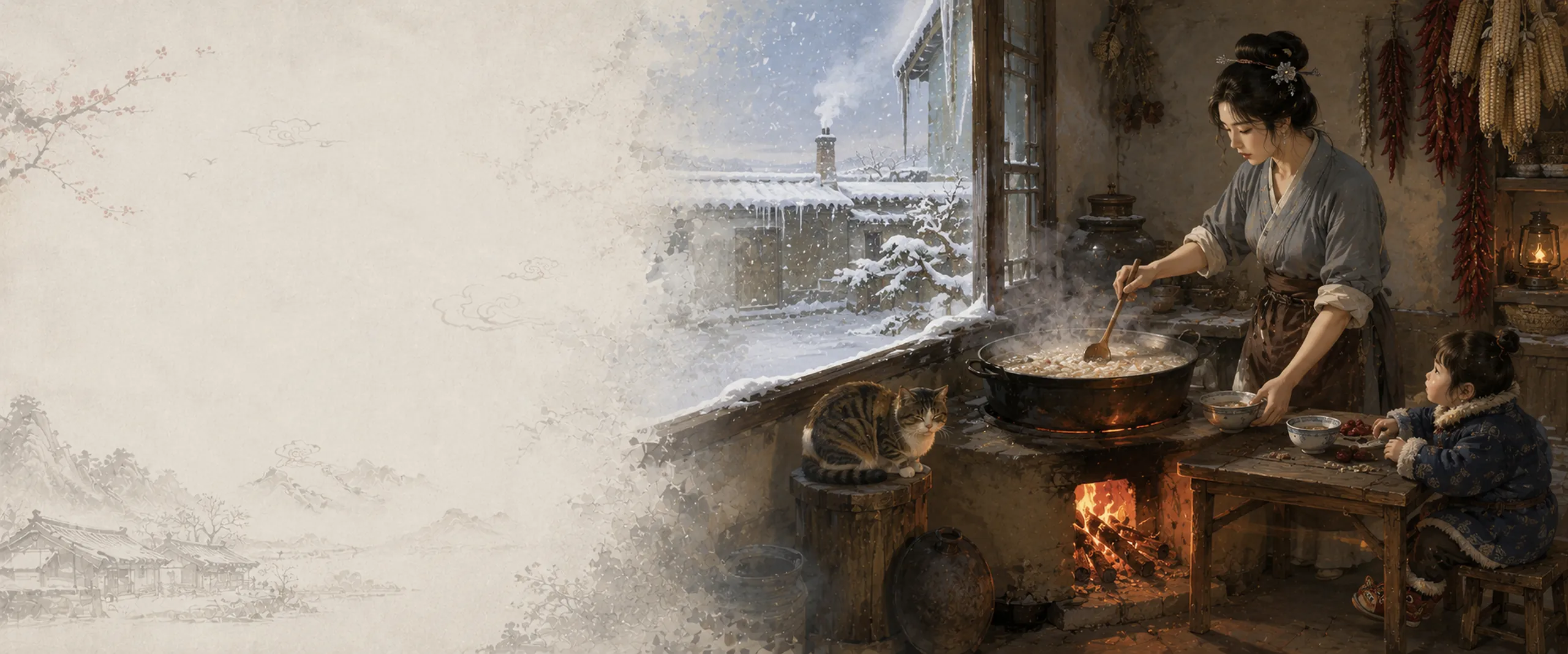
Laba porridge is the most representative seasonal food of the Laba Festival, and its history can be traced back more than a thousand years to the Song dynasty. According to Wu Zimu’s Southern Song Mengliang Lu (《梦粱录》): “八日,寺院谓之‘腊八’。大刹寺等俱设五味粥,名曰‘腊八粥’。” By this time, cooking porridge on Laba had already become a popular food custom.
The origin of Laba porridge is closely connected with Buddhism. According to tradition, Shakyamuni Buddha, seeking to save people from suffering and find a way to relieve the pains of life, gave up the comforts of palace life and undertook ascetic practices. One day, exhausted from long travel, he fainted. A herdswoman offered him milk porridge—porridge cooked from milk and grain. After eating it, Shakyamuni recovered his strength, sat beneath the Bodhi tree in meditation, and finally, on the eighth day of the twelfth lunar month, suddenly attained supreme perfect enlightenment. Later Buddhists, in remembrance of the hardships the Buddha endured before enlightenment, cooked mixed-grain porridge and ate it on this day.
After Laba porridge entered China, it blended with indigenous La sacrifice traditions. According to written records, Laba porridge was originally a sacrificial offering used by the Son of Heaven to worship deities and pray for favorable winds, timely rains, and a good harvest in the coming year. It was also once used as an offering to bodhisattvas, with eighteen kinds of dried fruit added to symbolize the Eighteen Arhats. Later, some temples prepared Laba porridge themselves and distributed it to the poor, calling it “Buddha Porridge.” In 2021, with approval from the State Council, Laba Festival customs were included in the national list of representative intangible cultural heritage projects. What simmers in this bowl is not merely food, but a cultural root worthy of preservation.
Cultural Meaning
A folk legend about the origin of Laba porridge is also widely circulated. It is said that before Zhu Yuanzhang, founding emperor of the Ming dynasty, became emperor, he once suffered imprisonment during a bitter winter. Cold and starving, he managed to dig seven or eight kinds of grain—including red beans, rice, and red dates—out of a rat hole in the prison. Zhu Yuanzhang cooked them into porridge. Folk tradition holds that eating such porridge could bring good fortune. After he later became emperor, he remembered the incident and ordered the imperial kitchen to prepare this porridge on the eighth day of the twelfth lunar month so that he could eat it together with civil and military officials. Laba porridge was thus said to have spread among the people.
Laba porridge is commonly made from ingredients such as glutinous rice, red beans, sesame, walnuts, longan, red dates, and lily bulbs. Some ingredients are also used to convey auspicious meanings—for example, longan represents “reunion,” walnuts symbolize “harmony and beauty,” and lily bulbs signify “harmony in all things.” The Qing-dynasty Yanjing Suishi Ji · Laba Zhou (《燕京岁时记·腊八粥》) records: “腊八粥者,用黄米、白米、江米、小米、菱角米、栗子、红江豆、去皮枣泥等,开水煮熟,外用染红桃仁、杏仁、瓜子、花生、榛穰、松子及白糖、红糖、琐琐葡萄,以作点染。” This is a classic recipe for Laba porridge in Qing-dynasty Beijing.
Laba porridge brings foods from all directions together in one pot and cooks them with rice, carrying the meaning of gathering all things together and harmonizing a thousand spirits. People believe that eating Laba porridge during the festival can bring divine protection and ensure that everything goes smoothly. Since Laba falls during the coldest part of winter, drinking the porridge is also said to dispel cold, warm the body, and nourish the spleen and stomach.
Once Laba porridge has been eaten, preparations for the New Year begin, opening the prelude to Spring Festival.
Regional Evolution
Laba porridge takes on different flavors around China and broadly follows a pattern of “sweet in the north, savory in the south”:
- Beijing: Laba porridge is especially elaborate. Yellow millet, white rice, glutinous rice, millet, water-caltrop kernels, chestnuts, red cowpeas, peeled date paste, and other ingredients are cooked together in water, while red-dyed peach kernels, almonds, melon seeds, peanuts, hazelnuts, pine nuts, white sugar, brown sugar, raisins, and others are used as decoration. The varieties are numerous and the colors rich.
- Henan: Mainly uses millet, mung beans, cowpeas, wheat kernels, peanuts, red dates, corn, and other ingredients. Brown sugar and walnut kernels are added before serving, producing a thick, sweet porridge that symbolizes abundant grain in the coming year.
- Northern Shaanxi: In addition to various kinds of rice and beans, dried fruits, tofu, and meat must also be added, giving the porridge a savory fragrance and rich nutrition.
- Sichuan and Chongqing: Sweet, savory, and spicy versions are all found. Savory Laba porridge is mainly made with soybeans, peanuts, diced meat, radish, and other ingredients. Spicy versions add chili or chili paste to these ingredients.
- Jiangsu and Zhejiang: Water chestnuts are a local specialty; in some areas, greens and oil are added to the porridge.
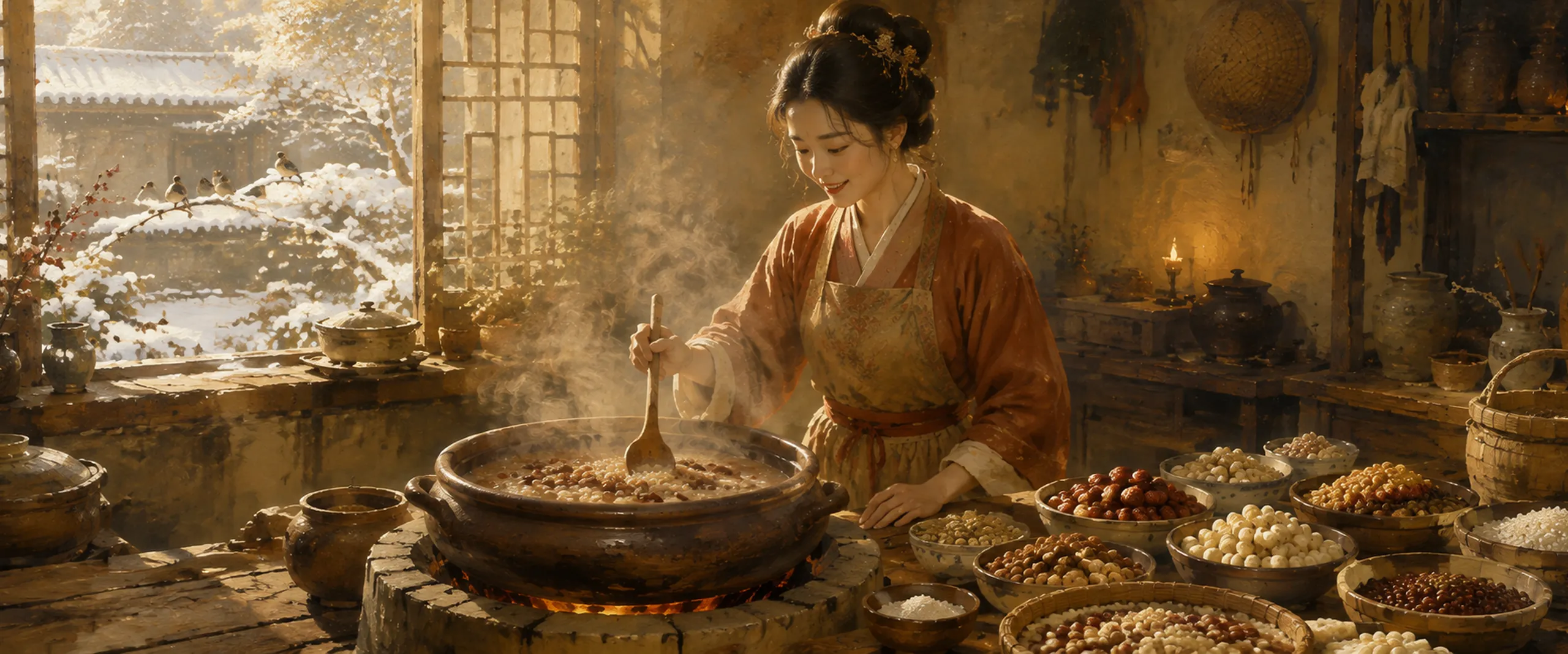
- Suzhou: Laba porridge is authentically rich and sweet. Carefully selected glutinous rice, red dates, lotus seeds, longan, ginkgo nuts, peanuts, pine nuts, and other ingredients are slowly simmered over low heat until thick, smooth, and glutinous.
- Fuzhou: Laba porridge has an interesting feature—a small lion made from several kinds of fruit is placed on top to symbolize warding off evil. In the past, Fuzhou households generally began preparing Laba porridge on the evening of the seventh day of the twelfth lunar month, simmering it carefully through the night so that it was ready the next morning.
- Gansu and Ningxia: Laba porridge is savory, fragrant, and warming, reflecting the wisdom of resisting the severe cold of the northwest.
- Parts of Shaanxi: Laba porridge must contain “Laba beans”—fermented beans prepared several months in advance. Added to the porridge, they create a distinctive mellow flavor.
Simple Preparation
- Ingredients: 50 g glutinous rice, 50 g rice, 30 g millet, 30 g red beans, 30 g mung beans, 30 g peanuts, 20 g lotus seeds, 10 red dates, 10 longans, 20 g walnut kernels, rock sugar as needed
- Steps:
- Soak the beans—red beans, mung beans, and peanuts—for 4–6 hours in advance. Wash the glutinous rice, rice, and millet. Remove the bitter cores from lotus seeds and pit the red dates.
- Bring water to a boil in a pot, adding enough from the start so that additional water is ideally unnecessary. Add the soaked beans first; bring to a boil over high heat, then cook over medium-low heat for 20 minutes.
- Add the glutinous rice, rice, millet, lotus seeds, and peanuts, and continue cooking for 20 minutes.
- Add red dates, longan, and walnuts and cook for another 20 minutes, stirring during cooking to prevent sticking.
- When the porridge becomes thick, add rock sugar to taste. Turn off the heat and let it rest, covered, for 10 minutes for a better texture.
Tip: Add enough water at the beginning. Rice and glutinous rice are rich in starch and are key to giving Laba porridge its thickness. Soaking beans and similar ingredients for 3–4 hours in advance can greatly shorten the cooking time. The ingredients do not have to be limited to exactly eight kinds: “once eight kinds are gathered, it counts as authentic flavor.”
Readers’ Comments
Calendar and traditional culture enthusiasts from around the world, sharing the same moon.
Sign in or register to join the conversation. Your comment account is created automatically the first time you use a connected account.
No comments yet
Share your thoughts with readers around the world.