Before the Northern and Southern Dynasties
Before the Northern and Southern Dynasties, the core of the La Day was still sacrifice — sacrificing to ancestors, to deities, and exorcising pestilence. As a continuation of the La Day, the Laba Festival preserved the ancient tradition of “repaying heaven and earth and repaying the ancestors.” Zong Lin’s Jingchu Suishiji not only recorded “the eighth day of the twelfth month is the La Day” but also recorded the custom of exorcism on Laba: “When the La drum sounds, spring grass grows. Villagers beat slim‑waisted drums, wear Hu head masks, and dress as Vajra warriors to drive away pestilence.” Drumming to hasten spring and drive away pestilence in the La month were important Laba customs. This exorcism ritual was directly continuous with the ancient Nuo ritual — using drums and masks to drive away pestilence and welcome the new spring.
Wei Shou, a historian and writer of the Northern and Southern Dynasties, vividly depicted the Laba scene in his poem “La Day”: “The biting cold presses upon the clear sacrifice; wine is set out for the Jiaping feast. What can I say of my long‑held thoughts? Through this I console my inner feelings.” The poem captures the scene of people setting out wine and meat to sacrifice to all spirits, thanking them for their blessings, amid the cold depths of winter. The solemnity of the La sacrifice and the joy of feasting are united in the poem.
Sui and Tang Dynasties
By the Tang dynasty, with the further spread and indigenisation of Buddhism, the Buddhist colour of the Laba Festival gradually increased. The Tang Laba Festival included both the continuation of indigenous La sacrifices and the rise of Buddhist Laba porridge customs. The Tang Laba Festival already showed a pattern of Buddhist‑folk integration. However, from documentary evidence, there is no clear record of Laba porridge in Sui and Tang texts. The widespread popularity of Laba porridge as a seasonal food had to wait for the Song dynasty.
The evolution from La Day to Laba was not merely a change in name but a shift in the centre of festival customs. The core of the La Day was sacrifice — to all spirits, ancestors, and heaven and earth. The core of Laba was the distribution and consumption of porridge — whether the monastery’s “Buddha porridge” or the folk “Laba porridge,” food became the festival’s emblematic symbol. This shift reflects the general trend in traditional Chinese festivals from “sacrifice‑centred” to “food‑emblematic.” As folklorists have noted, Laba customs “developed from singularity to complexity, with folk characteristics becoming more pronounced.”
The Tang dynasty also saw the rise of Laba poetry. Tang poets composed verses on the Laba Day, infusing this ancient festival with literati aesthetic sensibilities. Although the record of Laba porridge in Tang texts is unclear, Laba as a festival had already received cultural confirmation and elevation in literati writings.
Song Dynasty
The Song dynasty was the decisive period in the development of the Laba Festival. It was in the Song dynasty that Laba porridge became the emblematic seasonal food of the festival, and the Laba Festival evolved from a religious festival to a nationwide folk festival.
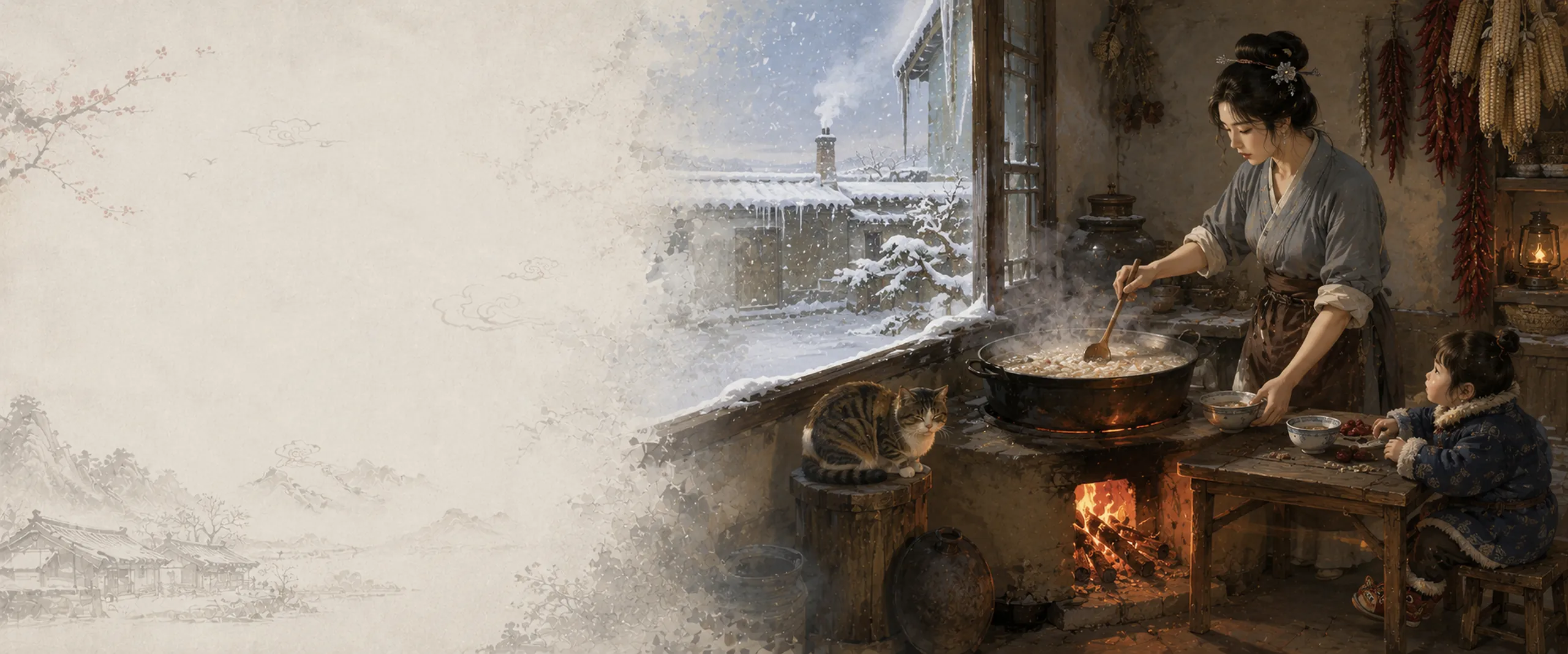
The exact date of the first appearance of Laba porridge as a seasonal food is difficult to verify, but from documentary evidence, it appears frequently in historical records after the Song dynasty, indicating that Laba porridge was already very popular in the Song at least. The Dreams of the Eastern Capital by Meng Yuanlao of the Northern Song provides the most detailed account: “The great temples hold Buddha‑bathing assemblies and present seven‑treasure five‑flavour porridge to their disciples, called Laba porridge. On this day, every household in the capital also cooks porridge with fruits and other ingredients.” This passage clearly shows that Laba porridge originated in monasteries — temples cooked porridge on Laba to offer to the Buddha and present to disciples, and then the populace imitated them, cooking porridge with various ingredients. This was the complete path of Laba porridge from monasteries to the people.
Wu Zimu’s Dreams of the Painted Land of the Southern Song also records: “On the eighth day, monasteries call it ‘Laba.’ Great temples all prepare five‑flavour porridge, called ‘Laba porridge.'” Zhou Mi’s Old Affairs of Wulin of the Southern Song further records the recipe of the time: “Using walnuts, pine nuts, milk mushrooms, persimmons, and chestnuts to make porridge, called ‘Laba porridge.'” This shows that Southern Song Laba porridge was already quite elaborate, containing not only grains and beans but also nuts and dried fruits.
An important feature of the Song Laba Festival was the widespread participation of all sectors of society. Whether court, government, monasteries, or ordinary households, everyone made Laba porridge. Laba porridge was not only an offering to the Buddha but also a gift for relatives and friends. The tradition of monasteries distributing porridge to the faithful and the poor on Laba had already formed in the Song. Laba porridge as “Buddha porridge” was endowed with the religious meaning that “eating it brings the Buddha’s protection.” At the same time, the folk also cooked porridge for themselves and gave it to relatives and friends, reflecting the secularisation of the festival.
Song Laba porridge was called “five‑flavour porridge” or “seven‑treasure five‑flavour porridge.” It was typically made with walnuts, pine nuts, milk mushrooms, persimmons, and chestnuts as ingredients. Compared with later periods, Song Laba porridge used relatively simple ingredients, but already established the basic pattern of “mixed grains and fruits.”
The Song dynasty produced a large number of poems and prose about Laba. The Southern Song poet Lu You wrote in his poem “Walking to the Western Village on the Eighth Day of the Twelfth Month”: “The wind in the La month is mild, and spring already seems near; I pass by my neighbour’s house while out for a stroll. Misty smoke rises from the thatched gate; cattle tracks are heavy by the wild waters. Ill health requires only medicine; with no tax levies, I am a man at leisure. Today, Buddha porridge is exchanged all around, and I feel the village by the river already has a new springtime feel.” The poem says that after drinking the porridge distributed by the monastery in the morning, his hunger was relieved and his mood improved, and he felt that the riverside village was already showing signs of spring. This poem not only records the Song Laba custom of “exchanging Buddha porridge” but also links Laba porridge with the spiritual experience of “bidding farewell to the old and welcoming the new” — after one bowl of porridge, one feels the “newness of the season.”
Lu You’s poem also reveals an important cultural phenomenon: the Laba Festival in the Song dynasty was already closely connected with the consciousness of “spring.” Although the La month is the depths of winter, “the wind in the La month is mild, and spring already seems near” — the Laba Festival falls at the transition between winter and spring, and people sense the approach of spring by drinking Laba porridge. This is the Song version of the folk saying: “Children, don’t be greedy; after Laba, the New Year is within reach.”
Yuan, Ming, and Qing Dynasties
Although the Yuan dynasty was ruled by the Mongols, they were deeply sinicised, and festival customs largely followed Han traditions. The Laba customs of the Yuan period basically continued Song traditions — monasteries distributed porridge, the people ate porridge, and the ingredients of Laba porridge grew increasingly rich. The Yuan dynasty Chixiu Baizhang Qinggui contains detailed records of the monastery’s Laba porridge‑distributing rituals, indicating that the Laba Festival had already become an institutionalised festival in Buddhist monasteries.
The Ming dynasty was a period of further development for the Laba Festival. The Ming History · Treatises on Rites records that the Ming court valued Laba highly, placing it on the same footing as the Beginning of Spring, the Lantern Festival, the Buddha’s Birthday on the eighth of the fourth month, the Dragon Boat Festival, and the Double Ninth Festival. During the Yongle reign, these festivals were “all celebrated with banquets for officials at the Fengtian Gate, with music.” Wu Kuan of the Hongzhi reign wrote a poem “Banquet on Laba Day,” depicting the grand scene of Ming court Laba banquets.
The preparation of Laba porridge in the Ming dynasty was also more refined. According to the Yongle Encyclopedia, Ming Laba porridge was made by first soaking red dates in water, then adding japonica rice, ginkgo nuts, walnut kernels, chestnuts, water chestnuts, and other ingredients. The folk similarly “mixed five grains and various fruits, cooked them into porridge, and gave them as gifts.” In Ming Beijing, “households followed the monastery custom, mixing beans and fruits with rice to make porridge, offering it and eating it in the morning, called Laba porridge.” The process of Laba porridge moving from monasteries to the people had already been completed in the Ming dynasty.
The Ming dynasty also saw the custom of “storing ice on Laba Day” — people would cut ice on Laba to store in ice cellars for summer use, linking the festival with the ancient Zhou dynasty rite of “ice storage.”
The Qing dynasty Laba celebrations were even more magnificent. The Qing court consistently valued the Laba Festival. Qing Laba porridge used even richer ingredients — yellow rice, white rice, glutinous rice, millet, water chestnuts, chestnuts, red cowpeas, pitted dates, and other ingredients cooked together, then garnished with red‑dyed peach kernels, almonds, melon seeds, peanuts, hazelnuts, pine nuts, and white sugar, brown sugar, and raisins to enhance colour and flavour. Laba porridge developed from the simple “five‑flavour porridge” and “seven‑treasure porridge” into “hundred‑fruit porridge” with over ten ingredients, reflecting the richness of Qing material life and the refinement of its culinary culture.
The Qing poet Li Fu wrote: “The porridge of the eighth day of the twelfth month, transmitted from the kingdom of Brahma. Seven treasures harmoniously blended, five flavours mixed with fragrance…” This detailed description of the origin and preparation of Laba porridge testifies that Laba porridge was introduced to China with Buddhism from India, first flourishing in monasteries and then spreading to the common people. The Qing Laba Festival also included ancestral sacrifices, gift‑giving, and other rich folk activities.
Contemporary Era
The Laba Festival continues to thrive in modern society. On every Laba Festival, monasteries across the country still hold porridge‑distributing events — famous temples such as Lingyin Temple in Hangzhou and Yonghegong in Beijing still draw huge crowds on Laba. Since Lingyin Temple restarted its Laba activities in 1978, by 2008 its porridge distribution had expanded beyond the temple to many distribution points and home deliveries. By 2021, Lingyin Temple had been carrying out Laba porridge distribution for 14 consecutive years, increasing the number of portions from 100,000 to over 300,000. A bowl of hot porridge conveys a social warmth and spirit of charity that transcends religion.
On 24 May 2021, the “Customs of the Laba Festival” were approved by the State Council of the People’s Republic of China for inclusion in the fifth batch of National Intangible Cultural Heritage, item number X‑174. The Laba Festival customs are “rooted in cultural tradition, yet integrated with the spirit of the new era, placing greater emphasis on carrying forward the spirit of benevolence and gratitude to society.” This designation marks the Laba Festival’s elevation from a folk‑transmitted cultural phenomenon to a nationally recognised and protected cultural heritage.

Readers’ Comments
Calendar and traditional culture enthusiasts from around the world, sharing the same moon.
Sign in or register to join the conversation. Your comment account is created automatically the first time you use a connected account.
No comments yet
Share your thoughts with readers around the world.