Water-Splashing Festival

Water-Splashing FestivalFolk Arts

「 欢快时节圣水扬,污秽随清泼洒净。 」

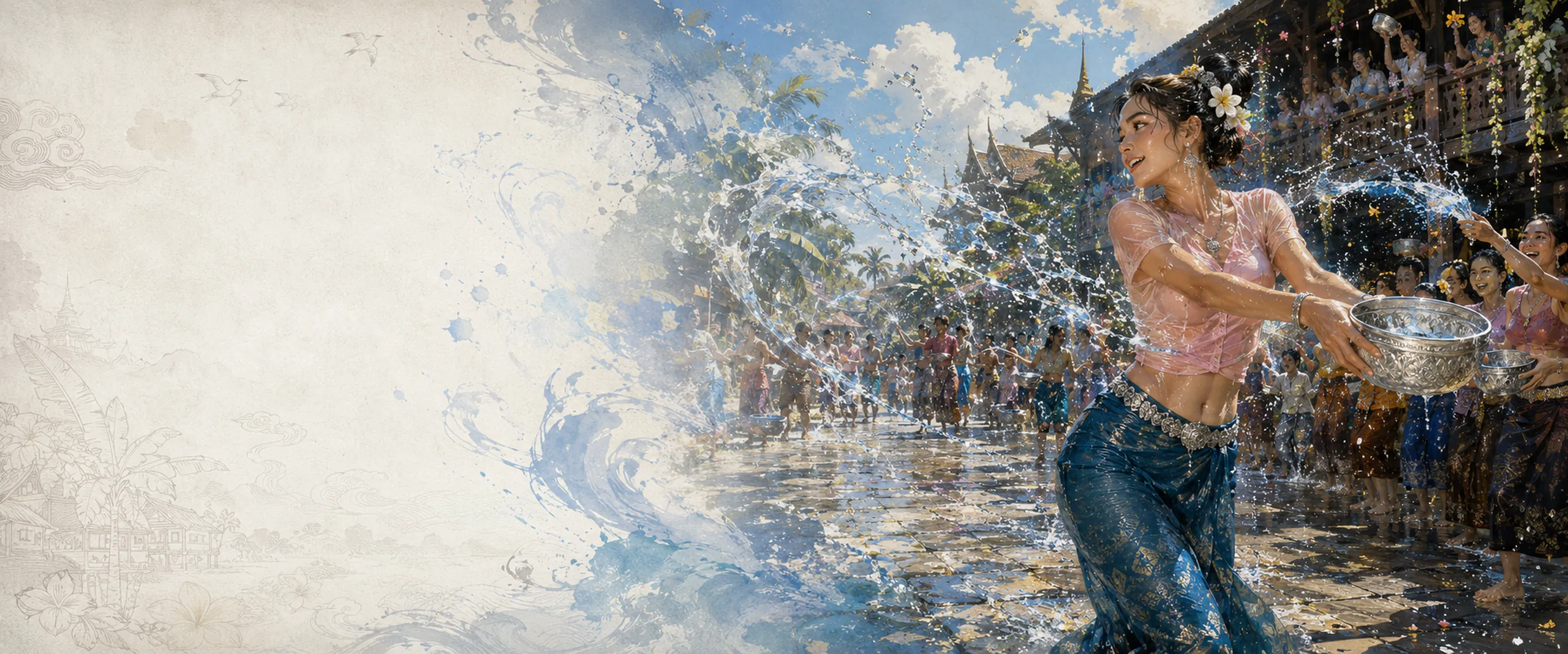
The Water‑Splashing Festival is held in mid‑April (the first month of the Dai calendar) each year and is the grandest traditional festival of the Dai ethnic group. During the festival, people splash pure water on one another, symbolising the…

Opening Verse:

欢快时节圣水扬,污秽随清泼洒净。

Introduction:

Water-Splashing Festival poetry centers on blessings conveyed through splashing water and the excitement of dragon-boat racing. “欢快时节圣水扬” evokes the cleansing of dust and the offering of blessings through water; “龙舟竞渡,人山人海,万面鼓声喧” captures the fervor of dragon-boat competition; and “清水瓢瓢泼喜悦,深情洒向心中逑” presents water-splashing as an expression of affection.

Poetry associated with the Water-Splashing Festival often takes the cleansing of dust with water and the welcoming of the new year as its central themes. One poem reads: “欢快时节圣水扬,污秽随清泼洒净,祈福永续万年长”, bringing together the ideas of purification through water, the removal of impurity, and the wish that blessings endure for generations.

Another lyric describes the festive spectacle of the Water-Splashing Festival: “彩色长裙短雪衫……龙舟竞渡,人山人海,万面鼓声喧。无忧花放浴新欢。相泼水,笑连天”, vividly recording Dai people dressed in festive finery, racing dragon boats, and joyfully splashing water upon one another.

Another poem writes, “清水瓢瓢泼喜悦,深情洒向心中逑”, elevating the act of splashing water into an expression of emotion. In Water-Splashing Festival poetry, water becomes the medium through which blessings, joy, and deep affection are conveyed.

Water-Splashing Festival / Folk Arts

Art Forms

Forms of Expression

Zhangha

Shuochang (Storytelling & Singing) 傣族

Status and Significance of Zhangha

Zhangha is the most representative traditional narrative singing art of the Dai people. The term refers both to the genre itself and to the singers who perform it.

Dai people compare Zhangha to “the indispensable salt of everyday life” and to “flowers overflowing with fragrance.” A Water-Splashing Festival without Zhangha, they say, would be as bland as a meal without salt.

Zhangha originated in Dai folk labor songs and, as social divisions of labor developed, gradually gave rise to groups of professional performers. Its lyrics include improvised compositions, formulaic blessing and prayer songs, as well as long narrative songs preserved in fixed texts.

In 2006, Dai Zhangha was included in the first group of China’s national-level intangible cultural heritage listings.

Artistic Characteristics of Zhangha

A Zhangha performance generally involves one singer and one accompanist. The singer holds a small fan, partly covering the face, and chants or sings softly, preserving a distinctly ancient manner.

Its melodies are steady and gentle, closely following the tonal contours of the Dai language. The singing is graceful, flowing, and unmistakably Dai in character.

Zhangha lyrics are rhymed and possess a rhythmic beauty specific to Dai-language verse. Their full musical flavor cannot be reproduced in another language.

The art is traditionally passed down primarily through oral teaching and direct personal transmission. Senior performers teach younger generations the lyrics, melodies, and techniques of performance.

Classic Zhangha Passages for the Water-Splashing Festival

《澜沧江水唱起歌》

“澜沧江水唱起歌,各族同胞和谐共庆泼水节,相互传递祝福与吉祥。”

《凤尾竹跳起了舞》

“凤尾竹跳起了舞,我们用最清甜的泉水泼向长辈,祝福他们健康长寿;我们用最真诚的笑脸迎接客人,祝福大家吉祥如意。”

《新农村》

“听吧!如今的农村新貌不同往日,农民金银满袋稻谷满仓,盖起一座座新楼,家家户户住进了新楼房。听吧!乡村公路通天下,柏油马路通到家,村民致富游四海,幸福花儿落傣乡。”

《快乐的泼水节》

“泼水节来了,乡亲们换上节日的盛装,敲起象脚鼓、跳起依拉贺,迎接新年的到来。清澈的水啊,带来了佛祖的祝福,洗去旧年的尘埃,迎接吉祥的新岁。”

During the Water-Splashing Festival, Zhangha performances also include works specially created for the occasion, such as 《欢歌泼水黎明时》, 《泼水欢歌》, and 《欣欣向荣的傣乡》.

Yilahe”

Song & Dance 傣族

Cultural Meaning

“Yilahe” is one of the most distinctive Dai forms of singing while dancing during the Water-Splashing Festival.

During the festival, Dai people enjoy forming processional groups, striking mang gongs and beating elephant-foot drums as they dance the “Yilahe,” moving from household to household to offer New Year greetings and wishes for happiness and success.

“Yilahe” consists of sung verses performed while dancing. It is deeply rooted in Dai everyday life and rich in emotion, and is performed during New Year greetings, water-splashing, dragon-boat racing, and the launching of gaosheng rockets.

The verses are often improvised by a lead singer, while the entire group responds in chorus with “依拉贺,依拉贺,水水水!” This structure allows everyone present to participate.

Classic Lyrics

New Year Greeting — Red Kapok Blossoms

“攀枝花,红艳艳,桑开傣(新年贺新),已来到。帕萨傣(傣族),尽开颜,糯米酒,蜜样甜,共举杯,贺新年,依拉贺,依拉贺,水水水!”

Water-Splashing Song — Silver Water Blossoms

“澜沧江,黎明城,各族人,似穿梭。深情人,心中出,似洁泉,如甘露。银水花,在飞舞,一个个,湿漉漉。透进心,是祝福,笑脸盘,是花朵。依拉贺,依拉贺,水水水!”

Dragon-Boat Song — Like a Flood Dragon

“铜芒响,齐举桨,团结紧,有力量。象蛟龙,劈波浪,昂起首,使劲划,帕萨傣,赛龙船,依传统,争上游。依拉贺,依拉贺,水水水!”

Launching the Gaosheng — Like an Arrow

“做高升,放高升。学科学,练本领。火一点,黑烟喷,似利箭,冲入云。祝来年,好光景,愿五谷,又丰登。依拉贺,依拉贺,水水水。”

Invitation Song — Sisters, Come Along

“妹妹们来吧来吧来吧,我们一起去赶摆。哥哥们来吧来吧来吧,我们一起去泼水。我们一起约着来泼水啰。高升大高升长,长长的高升扛上架,点燃它冲向广阔无边的苍穹,带着我们美好的祝福。”

“滚滚澜沧江,万万纳卡河,水流千转过连过,鲜花开放水花飞,朵朵浪花一首歌,清清泉水遍地洒,傣家生活红似火,跳起依拉贺,水水水水水。”

Yi Lahui

Song & Dance 傣族

《依腊灰》 is a folk song-and-dance tradition found in Dai villages of Xishuangbanna. It retains an archaic unity of poetry, song, and dance, and is performed only during the Dai New Year, that is, the Water-Splashing Festival.

《依腊灰》 is largely improvised and takes its name from the fact that the performers sing 《依腊灰》 at the end of the performance.

The Water-Splashing Festival is a season of poetry and music. When the festival arrives, young Dai men and women put on their festive clothing and dance gracefully to the rhythms of elephant-foot drums and mang gongs. Their songs rise one after another and resound through the sky.

Because this form appears only during the Water-Splashing Festival, 《依腊灰》 possesses an especially strong sense of belonging exclusively to the festival itself.

Ancient songs about the Water-Splashing Festival are still sung among Dai communities today:

“当和煦的春风吹拂大地,芬芳的莫过帅开满漫山遍野,欢乐的楞货桑勘比迈就要来到了……”

When April arrives and mountain after mountain is clothed in green, the footsteps of the Water-Splashing Festival draw near.

Water-Splashing Festival Folk Songs

Folk Song 傣族

《傣家哥妹》

Female voice:

“月光照在窗外,竹楼飘进歌来,傣家阿妹手拿针线,坐在灯下思绪敞开,绣一个鸳鸯荷包,悄悄把哥等待,针针线线寄情怀,阿哥哟你何时来。”

Male voice:

“月亮花儿盛开,巴乌声声传来,傣家阿哥在竹楼外,摘一朵花等妹来戴,唱一曲山歌哟传递心中的爱,真真切切寄情怀,阿妹哟阿哥在等待。”

Chorus:

“泼水节来——等哥表白。孔雀屏开——妹妹的心等哥来爱。春风暖暖吹来,缅桂花儿盛开,春雨滋润香蕉叶摆,阿哥阿妹敞开情怀。”

Moonlight, bamboo houses, embroidered pouches, the bawu, and fragrant miangui blossoms—every image is steeped in the texture of life in the Dai homeland.

The repeated motif of “waiting” in the song expresses the expectation of love felt by young Dai men and women during the special season of the Water-Splashing Festival.

《泼水歌》

“啊,傣家的泼水节,到处洋溢着喜庆的雨,把友情泼向我,把爱心洒向你,把问候泼向我,把祝福洒向你。泼水节泼出的水,比酒更加醉人,比蜜还要甜蜜。”

《恭祝泼水节》

“又是一年赏建花开,充满了吉祥和纯净的花香拂过傣族家家户户,把我们的爱唤醒,让我们手牵手,一起来吧,傣家人,让我们结伴同行,释放激情。”

《吉祥的泼水》

“走进我们傣家的竹楼,泼水是我们对你的祝福,是对你的问候。祝福你如履金旺,祝福你生活幸福,让我们用圣洁的水……”

During the Water-Splashing Festival, Dai people also sing an old folk song:

“姑娘们穿上漂亮的衣服,小伙子敲响金灿灿的铓锣,人们聚集在一起,共同欢度傣历新年。不是水贵如油,是我们的祝福比水长;不是酒贵如金,是我们的情义比酒浓。”

Creation Epic

Epic 傣族

The Dai creation epic 《巴塔麻嘎捧尚罗》 extends to more than ten thousand lines. It is celebrated as one of the Five Great Poetic Kings of the Dai people, a grand synthesis of Dai mythology, and a complete expression of the Dai understanding of the cosmos.

The epic describes the central place of water within the Dai worldview:

“在傣族人的心目中,水是孕育万物的乳汁,是生命的源泉,是幸福吉祥的载体。傣族创世史诗《巴塔麻嘎捧尚罗》在描述开天辟地时说,是水形成了地,是水创造了世,水是万物之源。”

Within the epic, the creator deity Yingba forms the earth by mixing water with other substances.

In Dai creation narratives, water is not merely the source of life; it is the primordial source of the cosmos itself. This cultural understanding of water as the origin of life is precisely what gives water its sacred status during the Water-Splashing Festival.

Splashing water is therefore not simply an act of celebration. It is also an expression of reverence and gratitude toward the source of life.

Music and Dance

Ritual Music & Dance 傣族

Elephant-Foot Drum Dance

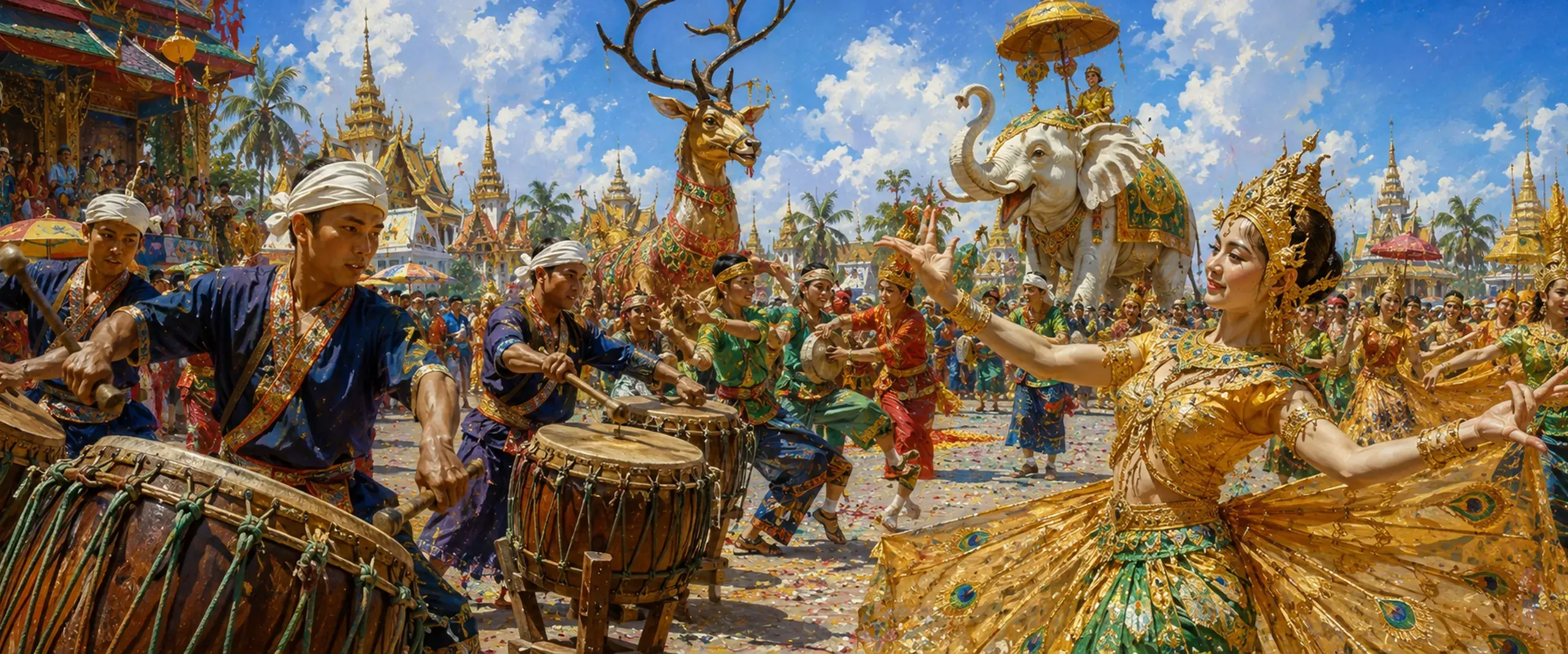
The elephant-foot drum is the most emblematic musical instrument of the Water-Splashing Festival. Its long, slender body resembles an elephant’s leg, while its sound is deep and resonant.

The moment the drum begins to sound, the Water-Splashing Festival has truly begun.

The making of an elephant-foot drum is itself a highly refined craft. The body is usually fashioned from high-quality woods such as Chinese toon or mango wood, while the drumhead is covered with cowhide and tightened with ox-sinew cords for tuning.

During the festival, the rhythm of the elephant-foot drum drives the tempo of the entire town. Wherever the drum is heard, there is the exuberance of water-splashing.

Peacock Dance

The peacock is an auspicious bird in Dai culture, and the Peacock Dance is one of the most representative dances performed during the Water-Splashing Festival.

Its movements imitate the gestures of the peacock—spreading its wings, shaking its feathers, drinking water, and strolling. Graceful and elegant, the dance expresses the Dai people’s affection for the peacock and their admiration for the beauty of nature.

During the Water-Splashing Festival, the Peacock Dance is not merely an artistic performance, but also a prayer for auspiciousness and beauty.

White Elephant Dance

The White Elephant Dance is another important traditional dance performed during the Water-Splashing Festival.

Elephants occupy a sacred place in Dai culture and are regarded as symbols of auspiciousness and strength. The White Elephant Dance is solemn and steady, imitating the movements of a white elephant and carrying a pronounced sense of ritual.

During the Water-Splashing Festival, the White Elephant Dance and Peacock Dance—one strong and dignified, the other soft and graceful—together form two complementary jewels of Dai dance culture.

Mang Gongs and Hulusi

The mang gong is a large bronze gong distinctive to Dai culture. Its sound is deep, rich, and lingering, and together with the elephant-foot drum it creates one of the most distinctive soundscapes of the Water-Splashing Festival.

When the mang gong sounds during the festival, the entire village knows.

The hulusi is one of the most representative Dai wind instruments. Its tone is soft, lyrical, and flowing. On Water-Splashing Festival nights, the melody of the hulusi, moonlight, and flying water droplets weave together one of the most romantic nocturnal scenes of the Dai homeland.

Contemporary Transmission

Heritage & Transmission 傣族

In 2006, Dai Zhangha was included in the first group of China’s national-level intangible cultural heritage listings.

As the most important setting for Zhangha performance, the Water-Splashing Festival provides a living cultural space in which this ancient narrative singing tradition can continue to be passed down. Zhangha artists enter schools and communities to teach their skills, allowing the cultural heritage of the Water-Splashing Festival to take root among younger generations.

In April 2026, China Media Group’s television program China in Intangible Cultural Heritage (《非遗里的中国》) broadcast a special feature on the Water-Splashing Festival. Its narration introduced the Dai expression “桑勘比迈”, meaning “Dai New Year,” presenting the festival’s original name and meaning to a nationwide audience.

When young Dai people beat elephant-foot drums and dance the Yilahe during the Water-Splashing Festival, they are doing more than celebrating. Through their own bodies and voices, they are carrying forward the cultural lineage of their ancestors.

Closing Reflections

Overview 傣族

The indigenous folk-artistic expression of the Dai Water-Splashing Festival is fundamentally different from the tradition of “literati poetry” associated with Han Chinese festivals. It is not something primarily written down in words; it is sung, danced, and performed in the living space of the festival itself. It is not an external act of “observing” and “reflecting,” but an internal act of “speaking” and “celebrating.”

From the improvised chanting of Zhangha performers to the songs of Yilahe processions moving from village to village; from the interwoven rhythms of elephant-foot drums and mang gongs to the flowing movements of Peacock and White Elephant dances; from the ancient creation-epic narrative that “water is the source of all things” to the contemporary folk-song refrain that festival water is “比酒更加醉人,比蜜还要甜蜜”—the folk arts of the Dai Water-Splashing Festival take water as their soul, blessing as their core, and the festival as their living stage, forming a complete, dynamic, and continuously renewing system of cultural expression.

As a saying passed down for generations through Dai Zhangha declares: “水花放,傣家旺;泼湿一身,幸福终身。” Within a single drop of water are the ancient echoes of Dai creation mythology, the thousand-year influence of the compassion and wisdom of Theravada Buddhism, the collective exhilaration of Yilahe dance steps, and the heartfelt blessings carried in Zhangha lyrics. When elephant-foot drums sound beside the Lancang River, and when cries of “水水水” echo through Dai villages, it is the Dai people, through their own voices, their own bodies, and their own dances, making their deepest and most enduring declaration of devotion to water and blessing.

—

Continue exploring Water-Splashing Festival culture

Readers’ Comments

Calendar and traditional culture enthusiasts from around the world, sharing the same moon.

Sign in or register to join the conversation. Your comment account is created automatically the first time you use a connected account.