The origins of the Water-Splashing Festival cannot be reduced to a single historical event.
A useful way of understanding its formation is to distinguish three cultural layers:
1. a distant tradition of ceremonial water splashing associated in some Chinese historical interpretations with Pohan Huxi and the cultures of Persia and Central Asia; 2. the more direct influence of South Asian Brahmanical and Buddhist traditions of ritual purification and Buddha bathing; 3. the indigenous Dai traditions of water reverence, rainmaking, and wet-rice agriculture.
Rather than representing three completely separate origins, these traditions appear in later cultural interpretation as overlapping layers that helped shape the festival into the form known today.
A Distant Persian and Central Asian Connection
Some Chinese reference works and scholarly interpretations trace a distant precursor of the Water-Splashing Festival to a practice known as Pohan Huxi (泼寒胡戏), sometimes rendered as “cold-splashing Hu entertainment.”
Historical descriptions associate this performance with peoples of the Western Regions and with customs involving water, winter, collective celebration, and prayers for favourable weather.
The Chinese term itself contains several elements. *Po* means “to splash”; *han* refers to cold; and *Hu* was a broad historical Chinese designation for various peoples to the west and northwest of China. The term therefore describes a water-splashing performance of foreign or Central Asian origin.
Accounts of such customs contrast strikingly with the modern Water-Splashing Festival. Whereas the contemporary Dai celebration takes place in the warmth of April, Pohan Huxi was associated with colder conditions. This contrast illustrates an important feature of cultural transmission: traditions frequently change their season, meaning, and social function as they move into new environments.
According to one line of interpretation, water-splashing customs travelled eastward through the networks of exchange linking Persia, Central Asia, South Asia, and China.
In this reconstruction, the custom did not remain unchanged. As it encountered Indian religious culture, water acquired increasingly explicit associations with purification, ritual bathing, and renewal. From South Asia, related practices continued into mainland Southeast Asia, where they interacted with Theravada Buddhist New Year traditions.
The Thai term Songkran, for example, ultimately derives from the Indic concept of *saṃkrānti*, meaning a calendrical transition. Related terminology also appears in Dai-speaking communities.
The linguistic relationship does not by itself prove a single uninterrupted line of transmission from ancient Persia to the modern Dai festival. It does, however, illustrate the deep historical connections linking South Asian calendrical culture, Theravada Buddhist societies, and New Year traditions across mainland Southeast Asia and southwestern China.
Traditional accounts generally describe two broad routes through which water-related customs entered China: one through Central Asia into the Chinese heartland, and another through South and Southeast Asia into Yunnan.
The modern Dai Water-Splashing Festival belongs primarily to the latter cultural sphere.
The South Asian Religious Source
If the Persian and Central Asian connection is regarded as a distant historical layer, South Asian religious traditions provide a more direct framework for understanding the ritual use of water in the festival.
Ancient Indian religious traditions placed great importance on water as a medium of purification. In Brahmanical practice, ritual bathing and the use of sacred water were closely associated with cleansing, renewal, merit, and religious observance.
Calendrical traditions of South Asia also attached significance to the movement of the sun through the zodiac. The transition associated with the sun’s movement into a new zodiacal position, particularly around the beginning of a new annual cycle in some regional calendrical traditions, came to be expressed through terms derived from saṃkrānti.
This same linguistic family underlies the names of several New Year festivals in South and Southeast Asia.
As Buddhism developed in India and later spread across Asia, ritual bathing acquired Buddhist interpretations as well.
In East Asian Buddhist tradition, the Bathing of the Buddha commemorates the birth of Śākyamuni Buddha. One widely known legendary account tells of dragons or celestial beings pouring fragrant or pure water over the newborn Buddha. The ritual therefore became an act of reverence, purification, and commemoration.
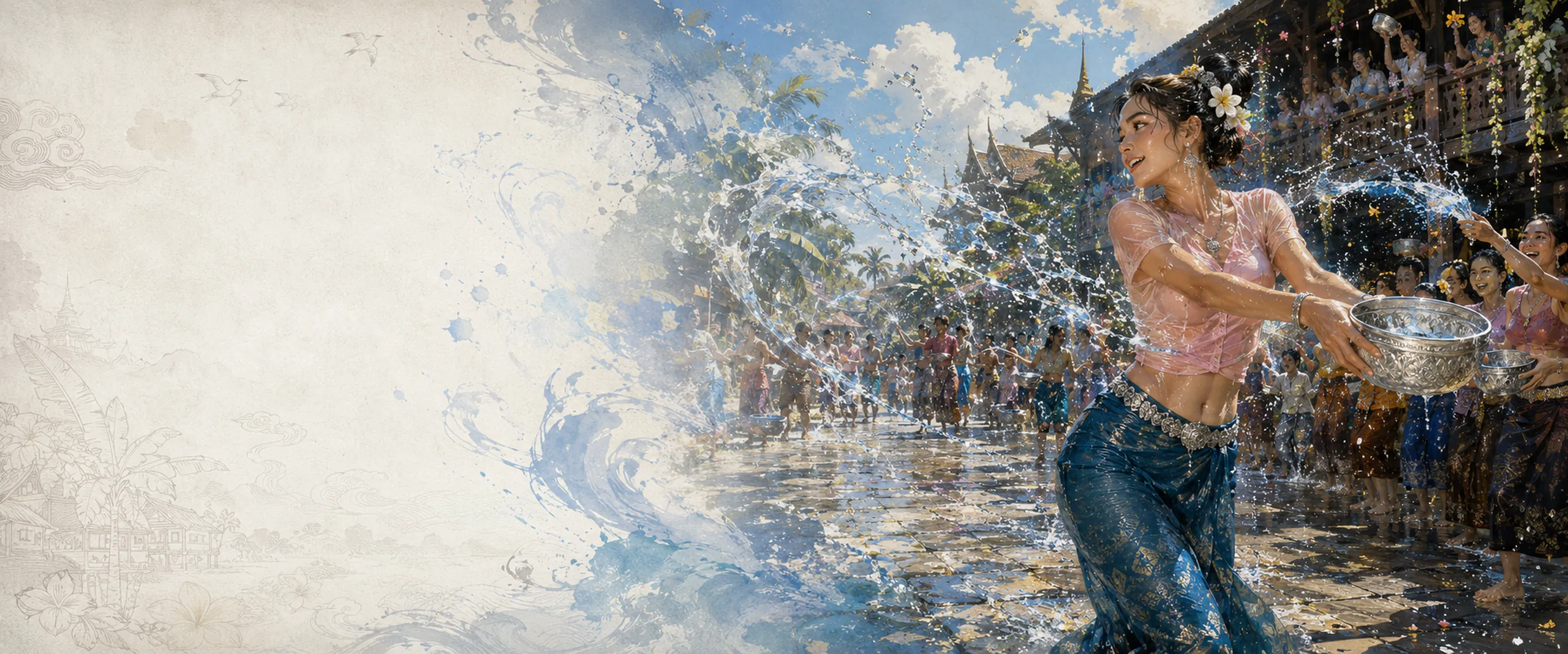
When Theravada Buddhism became established among Dai communities, ritual bathing of Buddha images became an important part of the New Year observance. Festival participants visit monasteries, pour pure water over Buddha images, make offerings, listen to chanting, and seek religious merit and blessings.
The festival’s relationship with Theravada Buddhism is therefore fundamental, although the festival as practised by the Dai cannot be explained by Buddhism alone.
Its development reflects a combination of Buddhist ritual and local social custom.
One important transformation was the expansion from bathing the Buddha to blessing other people with water.
Within the monastery, water expressed reverence toward the Buddha. Within the community, the same symbolic language of purification and blessing gradually came to structure interpersonal exchange. Sprinkling or splashing water on another person became a way of wishing them good fortune and cleansing away the misfortunes of the previous year.
The religious rite and the popular celebration therefore belong to the same symbolic world, even though their atmosphere and social function differ considerably.
The Indigenous Dai Foundation
The Water-Splashing Festival could not have taken such deep root in Dai society without the cultural importance of water already present in the Dai homeland.
The Dai are a people whose historical way of life has been closely connected with rivers, irrigation, monsoon rainfall, and wet-rice agriculture.
A well-known Dai saying is often translated along the lines of:
“Elephants follow the forest, bamboo follows the climate, and the Dai follow the water.”
The saying captures the close relationship between Dai settlement and waterways.
In Xishuangbanna and Dehong, major river systems—including the Lancang, Nujiang, and Ruili rivers and their tributaries—have shaped agriculture, settlement, transportation, and everyday life for generations.
Rice cultivation has traditionally been one of the foundations of Dai society. Water is therefore not simply a natural resource: it is closely associated with life, fertility, prosperity, and continuity.
This relationship also acquired strong aesthetic and emotional meanings.
Water appears throughout the everyday cultural landscape of Dai communities: people carrying water at dawn, children fishing along riverbanks, fields fed by irrigation channels, villages built close to rivers, and social life organised around the rhythm of the monsoon.
Such images are not merely picturesque. They reflect an ecological reality in which the agricultural year depends on the movement between dry and rainy seasons.
Before the establishment of Theravada Buddhism, Dai ancestors are believed to have maintained indigenous rituals connected with natural forces, water, rain, and agricultural fertility.
Prayers for rain were particularly meaningful in a tropical monsoon environment. Around April, the dry season approaches its end and communities begin to anticipate the arrival of the rains.
A water-centred New Year celebration at this moment therefore possesses a strong agricultural logic.
The water symbolically poured during the festival may be understood not only as a means of purification but also as an expression of hope for the rains that will sustain the next agricultural cycle.
When Buddhist water rituals entered this cultural environment, they encountered a society in which water already carried profound spiritual and practical significance.
The Buddhist act of bathing the Buddha and indigenous practices of praying for rain therefore found a natural point of convergence.
One used water to express reverence and purification; the other associated water with rainfall, fertility, and agricultural renewal.
Over time, these meanings became difficult to separate.
Scholarly interpretations of the festival frequently describe it as a product of precisely this cultural synthesis: Theravada Buddhist New Year rites interacting with the rice-farming traditions and customary practices of Dai communities between roughly the eleventh and thirteenth centuries and thereafter.
Dai Origin Legends
Dai communities also preserve a number of popular legends explaining why people splash water during the New Year.
These stories should not be treated as literal historical accounts. Their importance lies instead in the cultural meanings they attach to water, morality, renewal, and collective memory.
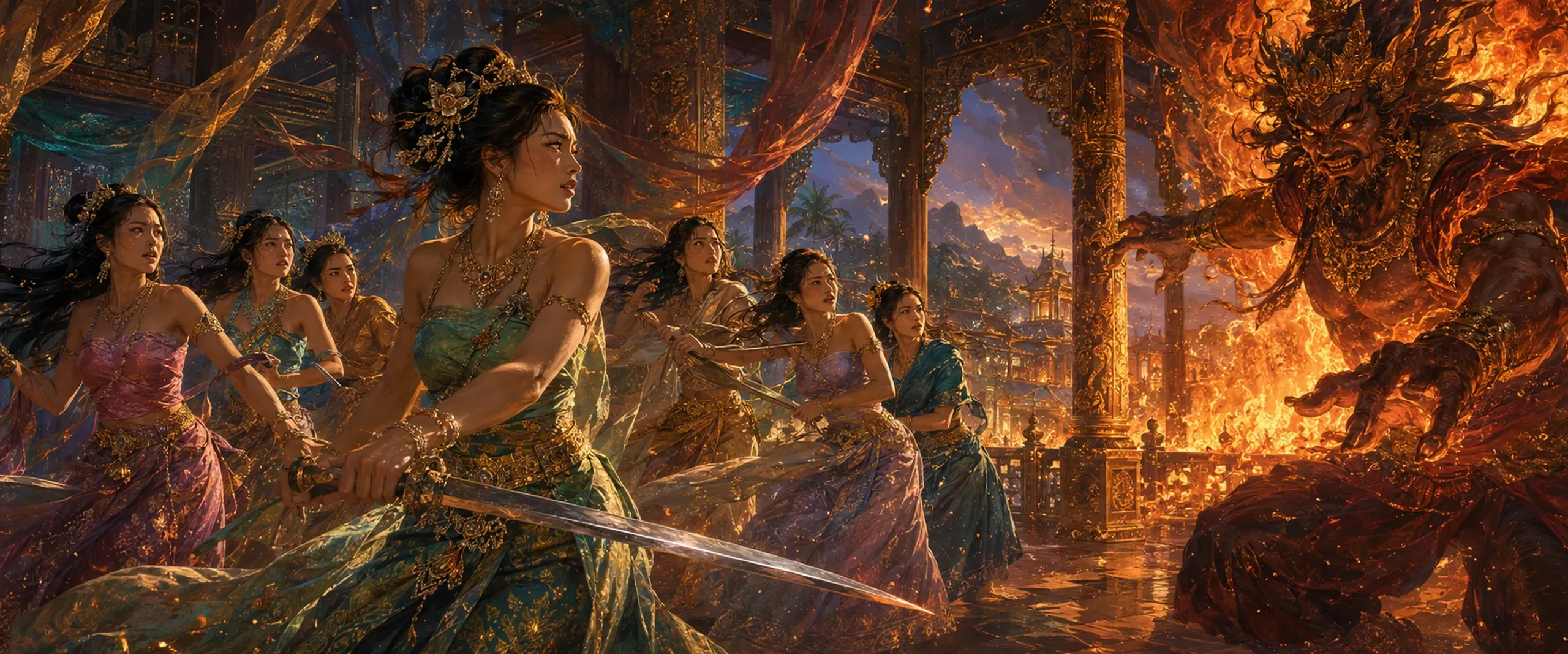
One of the best-known stories concerns seven young women who defeat an evil ruler or demon.
According to one version, a cruel supernatural being known as Pengma Diandalazha seized seven beautiful women and forced them to become his wives. The women hated his cruelty.
The seventh eventually discovered his hidden weakness. Taking advantage of the moment, the women used hair to sever his head.
But the demon’s death created a new danger.
When his severed head touched the ground, flames erupted. When it was thrown into water, floods threatened the land. The seven women therefore had to take turns holding the head.
Whenever one woman passed it to the next, water was used to wash away the pollution associated with it.
In later popular interpretation, the annual custom of splashing water commemorated the courage and sacrifice of these women while transforming cleansing into an act of blessing.
Versions told in Dehong sometimes describe the seven women taking turns over a period of seven days, linking the legend with the duration of traditional New Year observances.
Another legend centres on a heroic Dai man sometimes named Liliang.
In this story, the land is struck by calamity: rain disappears, the seasons lose their proper order, and destructive fire threatens the community. Liliang risks his life to fetch water from the Jinsha River and repeatedly throws it over the flames until the fire is finally extinguished.
The villagers survive and later commemorate him through water-splashing rituals.
These legends differ considerably in plot and character, but their symbolic structure is similar.
Water defeats destruction. It removes pollution. It saves life. It marks gratitude and renewal.
The stories therefore reveal how Dai communities have culturally interpreted the festival even when they do not provide evidence for its historical origins.
Readers’ Comments
Calendar and traditional culture enthusiasts from around the world, sharing the same moon.
Sign in or register to join the conversation. Your comment account is created automatically the first time you use a connected account.
No comments yet
Share your thoughts with readers around the world.