
Water-Splashing Festival

Water-Splashing FestivalCuisine of the Water-Splashing Festival

「 泼水粑粑香,糯米寄吉祥。 」

The Water‑Splashing Festival is held in mid‑April (the first month of the Dai calendar) each year and is the grandest traditional festival of the Dai ethnic group. During the festival, people splash pure water on one another, symbolising the…

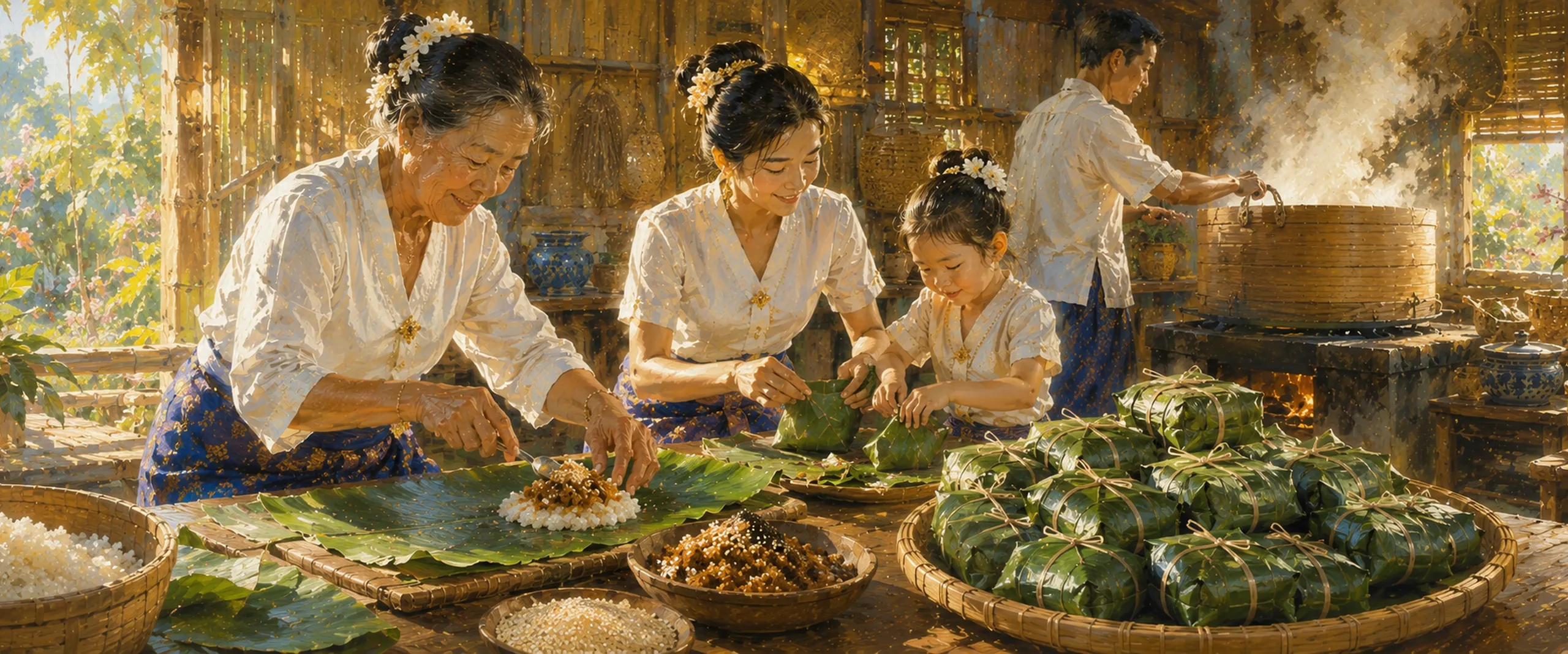
Water-Splashing Baba is an indispensable traditional snack of the Water-Splashing Festival. Its ingredients may seem simple, yet together they create a distinctive flavor—glutinous rice flour, edible vegetable oil, fresh banana leaves, brown-sugar syrup, and perilla seeds are transformed by skilled Dai hands into a delicacy. In the Dai language, it is called “hao nuo suo.” In the past, it could be eaten only during the Water-Splashing Festival; today, it has become an everyday sweet snack among Dai communities. During the festival, Dai women gather fresh banana leaves and use them to wrap sweet baba for festive banquets. Bamboo-tube rice is another beloved festival specialty: the fresh fragrance of bamboo mingles with the sweetness of glutinous rice, leaving a lingering impression. Yellow rice, meanwhile, symbolizes auspiciousness and prosperity. Through their natural flavors, these foods carry the Dai people’s hopes for a beautiful life.

Water-Splashing Festival / Cuisine of the Water-Splashing Festival

Festival Food Gallery

Seasonal Menu

Food in Detail

Seeking the True Flavor

Water-Splashing Baba (毫闷)

Pastries & Snacks

Basic Information

  • Category: Rice-based snack
  • Popular regions: Dai-inhabited areas, especially Xishuangbanna, Dehong, and Changning in Baoshan
  • Main ingredients: Glutinous rice flour, brown sugar, perilla seeds, fresh banana leaves, cooking oil
  • Other names: Haomen, haoluosuo, hao luosuo

Historical Origins

Water-Splashing Baba is the most iconic seasonal food of the Water-Splashing Festival, and its very name comes from the festival itself. In the past, Dai women would gather fresh banana leaves during the festival, wrap sweet baba inside them, and use the food for Buddhist offerings and festive banquets, entrusting auspicious wishes to these delicacies. Passed down from generation to generation, this custom became an important part of Dai culture.

The Dai-language name for Water-Splashing Baba varies by region. In Menglian, Pu’er, and other areas, Dai baba is known as “hao luosuo.” For Dai people, it has a significance similar to zongzi during the Dragon Boat Festival or mooncakes on the fifteenth day of the eighth lunar month. It is an indispensable Water-Splashing Festival delicacy and carries the meaning that “one’s career will prosper higher year after year, and life will grow richer step by step.” In Lujiangba, Longyang District, Water-Splashing Baba could originally be eaten only during the festival, but as times changed it gradually became an everyday Dai specialty.

Cultural Meaning

The making of Water-Splashing Baba looks simple, yet it embodies the careful craftsmanship of the Dai people. First, fresh banana leaves are gathered, washed, and cut into neat squares. Fine glutinous rice flour is mixed with an appropriate amount of brown sugar and kneaded repeatedly until the dough reaches a balanced softness and firmness. A thin layer of oil is spread evenly over each banana leaf to prevent sticking and to allow the leaf’s natural fragrance to seep into the food during steaming. A piece of dough about one-third the size of a fist is placed in the center of the leaf; in some versions, the dough is filled with toasted perilla-seed paste. The leaf is gently folded around the dough and sealed securely, then placed in a traditional steamer for about half an hour.

During preparation, powdered brown sugar is first kneaded into the glutinous-rice flour, then cooked brown-sugar syrup is poured in, and the mixture is kneaded repeatedly until the dough becomes springy and resilient. Once steamed, Water-Splashing Baba is soft and elastic. The mellow sweetness of glutinous rice mingles with the fresh fragrance of banana leaves, creating rich layers of flavor. When freshly lifted from the steamer, it releases clouds of steam carrying the mingled scents of banana leaf and brown sugar.

Water-Splashing Baba carries several layers of auspicious meaning. First, “offering to the Buddha and honoring the sacred.” It was originally a Buddhist offering, expressing reverence through food. Second, “sweet reunion.” The sweetness of brown sugar, the stickiness of glutinous rice, and the wrapping of banana leaves together create an image of “sweetness and reunion.” Third, “rising higher step by step.” Hao luosuo symbolizes a career that becomes more successful year after year and a life that improves steadily. Fourth, “energy replenishment.” Small in size yet energy-dense, Water-Splashing Baba can quickly restore strength after the exertion of exuberant water-splashing celebrations.

Simple Preparation

  • Ingredients: 300 g glutinous rice flour, 100 g brown sugar cooked into syrup, 50 g toasted perilla seeds, several fresh banana leaves, cooking oil as needed
  • Steps:
  1. Wash the banana leaves and cut them into squares of about 20 × 20 cm. Blanch briefly in hot water to soften. Toast the perilla seeds and pound them together with brown sugar to make the filling.
  2. Cook brown sugar with water into a syrup and allow it to cool. Add it to the glutinous rice flour and knead repeatedly until the dough becomes resilient.
  3. Brush the surface of each banana leaf evenly with oil to prevent sticking. Take a small piece of glutinous-rice dough, flatten it, place the perilla-brown-sugar filling inside, then pinch closed and roll into a ball.
  4. Place the dough in the center of the banana leaf, fold the leaf around it securely, and press into a rectangular shape.
  5. Place in a steamer and steam for 25–30 minutes.

Tip: Fresh banana leaves should be used, as older leaves crack easily. The dough is best when kneaded until “springy and resilient.” Use sufficient heat while steaming to ensure the filling is fully cooked. The finished baba may be eaten either hot or cooled.

Lemongrass-Grilled Fish

Meat & Seafood

Basic Information

  • Category: Grilled meat dish
  • Popular regions: Xishuangbanna, Dehong, Jinping, and surrounding areas
  • Main ingredients: Tilapia or crucian carp, lemongrass, bird’s-eye chili, ginger, garlic, culantro
  • Other names: Lemongrass grilled fish, Dai-style grilled fish

Historical Origins

Lemongrass-grilled fish is one of the most representative grilled dishes of the Dai people and a centerpiece of the Water-Splashing Festival table. As a traditional Dai dish for entertaining guests, it holds a special place in festive occasions. During the Water-Splashing Festival in Jinping, Yunnan, lemongrass-grilled fish has been promoted as a distinctive Dai specialty. Reports related to Jinping’s 2025 Water-Splashing Festival indicated that fish weighing 500–1,000 grams, including tilapia and crucian carp, were used as principal ingredients.

The Dai live in hot, humid tropical regions where lemongrass is one of the most common aromatic plants. Dai ancestors discovered that lemongrass could remove fishy odors and add fragrance, combining it with charcoal-grilled fish to create this classic dish with crisp skin, tender flesh, and abundant aroma. The use of lemongrass also reflects the Dai culinary wisdom of viewing food and medicinal properties as originating from the same source.

Cultural Meaning

Lemongrass-grilled fish uses a two-stage marinating method. During the first stage, cooking wine, sliced ginger, and culantro are spread evenly over the fish, which is left for 15 minutes to remove unwanted odors. In the second stage, oyster sauce, light soy sauce, and salt are mixed into a marinade and applied for another 30 minutes so the flavors fully penetrate the fish.

The fish cavity is stuffed with finely chopped ginger and garlic, fresh culantro, and bird’s-eye chili, with the proportions adjusted according to the size of the fish. Lemongrass is rubbed to release its fragrance and tied around the body of the fish so that its aroma can penetrate the flesh. Another method finely chops scallion, ginger, garlic, green chili, and coriander, stuffs them into the fish cavity, binds the fish with two or three lemongrass leaves, clamps it between bamboo strips, and grills it over charcoal.

For roasting, the prepared fish is clamped securely between bamboo strips to prevent deformation. It may be placed in an oven preheated to 180°C and roasted with heat from above and below for 40 minutes. After 40 minutes, it is removed, brushed with vegetable oil, supplemented with fresh lemongrass, and roasted for another 20 minutes until the skin becomes crisp.

The finished dish has three layers of flavor: a smoky outer layer produced by even grilling between bamboo strips; a tender middle layer preserved through careful temperature control; and an inner layer infused with spices, where lemongrass and bird’s-eye chili fully mingle inside the fish.

Lemongrass-grilled fish carries the meaning of “honoring and welcoming guests.” As a traditional Dai banquet dish, it is indispensable when entertaining important guests during the Water-Splashing Festival. Lemongrass symbolizes “warding off evil and disaster,” so eating lemongrass-grilled fish at this moment of bidding farewell to the old year and welcoming the new expresses hopes for peace and smooth fortune in the year ahead.

Simple Preparation

  • Ingredients: 1 tilapia, about 500–800 g; 3–4 stalks lemongrass; 3–5 bird’s-eye chilies; sliced ginger; minced garlic; culantro; cooking wine; oyster sauce; light soy sauce; salt
  • Steps:
  1. Scale, gut, and clean the fish. Make diagonal cuts on both sides to help the seasoning penetrate.
  2. First marinade: rub the fish evenly with cooking wine, ginger, and culantro. Rest for 15 minutes.
  3. Second marinade: mix oyster sauce, light soy sauce, and salt; spread inside and outside the fish and marinate for 30 minutes.
  4. Fill the cavity with minced ginger and garlic, bird’s-eye chili, and chopped culantro. Rub the lemongrass and tie it around the fish.
  5. Clamp the fish between bamboo strips and grill slowly over charcoal, or roast in an oven preheated to 180°C for 40–60 minutes, until the skin is crisp and the flesh fully cooked.
  6. Serve with lemon dipping sauce or a dry spice dip.

Tip: Rub the lemongrass before use to release its fragrance. Keep the heat even while grilling. Clamping the fish firmly with bamboo helps maintain its shape. The finished dish combines crisp skin and tender flesh with both smoky charcoal aroma and fresh herbal fragrance.

Sapie (撒撇)

Others

Basic Information

  • Category: Cold mixed dish / dipping sauce
  • Popular regions: Dehong, Tengchong, Xishuangbanna, and surrounding areas
  • Main ingredients: Beef—or fish or pork—bitter intestinal broth or lemon water, chives, fragrant willow herb, culantro, bird’s-eye chili
  • Other names: Sapie, beef sapie, lemon sapie

Historical Origins

Sapie can be regarded as one of the defining dishes of Dai cuisine and is an indispensable delicacy during the Water-Splashing Festival. It has an exceptionally long history and developed through generations of Dai production and everyday life. The Dai traditionally relied on agriculture and hunting, and beef was an important source of meat. People pounded raw meat into a paste and combined it with aromatic herbs and bitter intestinal broth, creating this distinctive cold-mixed dish.

By flavor, sapie is divided into bitter sapie and lemon sapie; by ingredient, there are pork, beef, fish, kuzi, and other variations. In Wuhe, Tengchong, and other areas, sapie is considered essential during the Water-Splashing Festival. Over time, it has moved beyond festival occasions into everyday dining and become one of the most representative Dai foods of Dehong, Tengchong, and neighboring areas.

Cultural Meaning

The preparation of sapie requires considerable care. For beef sapie, fragrant willow herb, coriander, and chives are first finely chopped in a special wooden utensil. Beef is sliced and pounded into a paste, then mixed thoroughly with the chopped herbs, salt, and chili powder. The dipping sauce is the soul of sapie: finely pounded beef is mixed with additional herbs, sesame, chili powder, bird’s-eye chili, and either bitter broth or lemon water to create the dish’s “soul dipping sauce.”

In the traditional Dehong method, raw meat is pounded into a paste and combined with chives, fragrant willow, Burmese coriander, bird’s-eye chili, extremely hot chilies, and other seasonings. Bitter broth made from an animal’s “bitter intestine” is then added. The mixture is eaten as a dip with rice noodles, vegetables, grilled liver, and other foods.

Finally, sapie rice noodles may be served with shredded beef, fried dried fish, fried pork skin, cabbage, and garnished with crown daisy, creating a dish rich in color, fragrance, and flavor.

Sapie carries the philosophical meaning of “sweetness after bitterness.” The bitterness of bitter sapie comes from the bitter intestinal broth of cattle. It tastes slightly bitter at first, but leaves a sweet aftertaste, reflecting the Dai life wisdom of “bitterness first, sweetness later.” The word “sa” in the Dai language carries the meaning of “cold mixing,” making sapie especially refreshing during the hot Water-Splashing Festival season. The bright acidity of lemon sapie stimulates the appetite and also evokes the wish that life may be “sweet and sour, yet fulfilling.”

Simple Preparation

  • Ingredients: 200 g beef, chives, fragrant willow herb, culantro, bird’s-eye chili, lemon, rice noodles
  • Steps:
  1. Slice the beef and pound into a paste. Finely chop the chives, fragrant willow herb, and culantro.
  2. Mix the beef paste with the chopped herbs, salt, and chili powder.
  3. Squeeze the lemon and combine the juice with finely pounded beef, sesame, chili powder, and bird’s-eye chili to make the “soul dipping sauce.”
  4. Cook the rice noodles and rinse in cold water. Serve with shredded beef, fried pork skin, cabbage, and other accompaniments.
  5. Dip and eat.

Tip: The “bitter broth” in bitter sapie comes from boiled cattle bitter intestine, while lemon sapie replaces it with lemon water. The dipping sauce is the essence of the dish, and the proportions of the different herbs determine its final character.

Pineapple Rice (毫糯索)

Grains & Staples

Basic Information

  • Category: Grain-based staple
  • Popular regions: Xishuangbanna, Dehong, and surrounding areas
  • Main ingredients: Pineapple, glutinous rice or purple rice, white sugar, raisins, goji berries
  • Other names: Hao nuo suo, hao luosuo, pineapple glutinous rice

Historical Origins

Pineapple rice is one of the most representative staple foods of the Dai people in Xishuangbanna. In the Dai language it is called “hao nuo suo” or “hao luosuo,” meaning “pineapple glutinous rice.” The Qing-dynasty Dianhai Yuheng Zhi (《滇海虞衡志》) records: “滇南热带,有果名菠萝,形如凤尾,肉甜多汁,土人以糯米实其中蒸食,味香美绝。” During the Water-Splashing Festival and other celebratory occasions, pineapple rice is an indispensable dish.

The birth of pineapple rice reflects the wisdom of Dai ancestors living in symbiosis with nature. According to legend, hunters traveling into the mountains or Dai people working outdoors once saved cooking utensils by stuffing glutinous rice and pineapple flesh into a hollowed pineapple shell and steaming it. They unexpectedly discovered a fragrant sweet-and-sour flavor, and the dish became an “emergency meal.” From this early practical food for outdoor life, it gradually evolved into an indispensable staple of festival celebrations.

Cultural Meaning

Pineapples used for this dish are often local Xishuangbanna varieties such as fragrant pineapple or large Jinghong pineapple. The ideal fruit is about seventy percent ripe, with golden skin, plump flesh, and a rich aroma. High-quality glutinous rice or purple rice is soaked in water for at least four hours beforehand. Some versions soak the rice in pineapple juice to intensify the fruit fragrance.

The pineapple is cut horizontally about one-third of the way down from the top. The top is retained as a “lid,” while the lower portion is hollowed out and kept intact as the serving container. The removed flesh is diced and reserved. Traditionally, the glutinous rice is steamed in a wooden steamer, and a spoonful of coconut milk and half a spoonful of salt may be added to the steaming water for extra flavor.

A traditional sweet Dai-style version mainly uses four additions: diced pineapple, shredded coconut, crushed peanuts, and raisins. A distinctive technique is to “stir-fry first, then steam”: steamed glutinous rice is lightly dry-fried in an unoiled iron wok over low heat for about two minutes, then diced pineapple and its juice are added and stir-fried together. Finally, the rice mixture is packed back into the pineapple shell, covered with the pineapple lid, and steamed again for about 15–20 minutes.

Pineapple rice is an important carrier of Dai food culture and symbolizes harvest, auspiciousness, sweetness, and reunion. It is indispensable at the Water-Splashing Festival, weddings, and other celebratory occasions. At Dai weddings, pineapple rice also carries the meaning of “many children and many blessings.”

Simple Preparation

  • Ingredients: 1 pineapple, 200 g glutinous rice or purple rice, 50 g white sugar, raisins, goji berries, shredded coconut as needed
  • Steps:
  1. Soak the glutinous rice for at least 4 hours, then steam until half-cooked.
  2. Cut off the top third of the pineapple, remove the flesh while preserving the shell intact, and dice the flesh.
  3. Mix the half-cooked glutinous rice with pineapple cubes, sugar, raisins, goji berries, and shredded coconut.
  4. Fill the pineapple shell with the mixture and cover with the pineapple lid.
  5. Once the steamer is producing steam, place the pineapple inside and steam over high heat for 15–20 minutes.

Tip: Choose a pineapple that is about seventy percent ripe so that its sweetness and acidity are balanced. The glutinous rice must be soaked long enough or it will be difficult to cook through. Traditionally, steaming the rice in a wooden steamer gives the best flavor.

Sour Meat

Meat & Seafood

Basic Information

  • Category: Fermented meat product
  • Popular regions: Xishuangbanna, Dehong, Mengding, Mengnuo, and surrounding areas
  • Main ingredients: Pork, beef, pork skin, glutinous rice, salt, wild chili
  • Other names: Nesong, leaf-wrapped sour meat

Historical Origins

Sour meat is an indispensable traditional delicacy during the Dai Water-Splashing Festival. Dai elders say that five sour foods must be eaten during the festival—sour chicken-feet greens, sour ants, sour cattle hide, sour meat, and sour fish: without sourness, there is no banquet. Sour meat is called “nesong” in the Dai language, and the Dai communities of Mengding are especially renowned for making it.

The emergence of sour meat is closely connected with the survival wisdom of Dai ancestors. In a hot and humid tropical climate, meat is difficult to preserve. Dai ancestors discovered that lactic fermentation could extend the storage life of meat while giving it a distinctive flavor. This wisdom of “using sourness for preservation” became an important part of Dai food culture.

Cultural Meaning

One traditional method uses equal portions of fine fresh pork and beef, chopped into small pieces, combined with cooked pork skin sliced thinly and a little salt. Some versions also add a small amount of cooked glutinous rice. The mixture is wrapped tightly in wild “dongjin” leaves and stored. After several days it develops into sour meat and may be preserved for around half a year.

More specifically, the pork and beef are chopped but not reduced to a paste. Pork skin is boiled, sliced thinly, and mixed with the chopped meat. Minced ginger, garlic, Sichuan pepper, salt, and other seasonings are added, along with a spoonful of cooked glutinous rice. The meat is then tightly wrapped in wild dongjin leaves and refrigerated to ferment for about a week. In Mengnuo and other areas, selected pork, beef, or cattle hide undergoes special fermentation for 3–5 days, during which the meat is transformed by the souring process.

Sour meat embodies the wisdom of “eating sour foods for well-being.” The Dai believe that “eating sour foods has become a form of inheritance and belief among the Dai people.” Its acidity comes from natural fermentation and is said to aid digestion, stimulate the appetite, and relieve summer heat. During the hot and humid Water-Splashing Festival season, sour meat is regarded as especially suitable for regulating the body and increasing appetite.

Simple Preparation

  • Ingredients: 300 g pork, 200 g beef, 100 g pork skin, 50 g cooked glutinous rice, salt, minced ginger, minced garlic, Sichuan pepper, dongjin leaves or banana leaves
  • Steps:
  1. Chop the pork and beef finely, but do not turn them into a paste. Boil the pork skin and slice thinly.
  2. Mix the chopped meat with pork skin, cooked glutinous rice, ginger, garlic, Sichuan pepper, and salt.
  3. Wrap the mixture tightly in dongjin leaves or banana leaves and tie securely.
  4. Leave in a cool place to ferment for 3–7 days, until the meat develops a sour flavor.
  5. It may be steamed and sliced before eating, or traditionally eaten raw.

Tip: The longer the fermentation, the stronger the sour flavor. Dongjin leaves are the traditional wrapping material, but banana leaves may be substituted. Sour meat can be preserved for around half a year.

Pounded Chicken Feet

Pastries & Snacks

Basic Information

  • Category: Cold mixed snack
  • Popular regions: Xishuangbanna, Dehong, and surrounding areas
  • Main ingredients: Chicken feet, lemon, bird’s-eye chili, garlic, peanuts, culantro
  • Other names: Pounded chicken claws, Dai-style pounded chicken feet

Historical Origins

Pounded chicken feet are a classic expression of the Dai flavor profile—sour, spicy, fresh, and aromatic. “Pounding” is a traditional Dai cooking method in which ingredients and seasonings are repeatedly crushed together in a stone mortar with a pestle so their flavors fully combine. This technique is an important carrier of Dai cultural heritage. During the Water-Splashing Festival, pounded chicken feet are indispensable at both family meals and festive gatherings.

The pounding method originated in the everyday life of Dai ancestors. Before modern kitchen equipment existed, stone mortars were essential household utensils. Crushing ingredients inside them not only released their flavors more fully but also allowed different tastes to merge together. Pounded chicken feet are a representative dish created from this traditional technique.

Cultural Meaning

First, the claws are trimmed and each chicken foot is chopped into two or three pieces so it can absorb seasoning more easily. Water is brought to a boil with sliced ginger and cooking wine, then the chicken feet are added and boiled for about ten minutes. They are immediately transferred into ice water—an important step that tightens the skin and gives the chicken feet a crisp, chewy texture.

Next, bird’s-eye chili, garlic, yardlong beans, lemon juice, peanuts, coriander, and other ingredients are placed in a mortar and pounded vigorously together with the chicken feet until the flavors are well absorbed. A Dai saying goes, “three parts pounding, seven parts mixing”—only thirty percent depends on pounding, while seventy percent depends on the seasoning mixture. The finished chicken feet are sour, spicy, crisp, and refreshing, with the freshness of lemon contrasting strongly with the heat of chili.

Pounded chicken feet embody the culinary philosophy of “pounding flavor into the food.” The Dai believe that ingredients reveal their full character only after being pounded in the mortar—fragrant willow, culantro, bird’s-eye chili, and lime juice burst and release their aromas beneath the repeated strikes of the pestle. The sour and spicy taste is both appetizing and invigorating, making pounded chicken feet one of the most popular snacks during the Water-Splashing Festival.

Simple Preparation

  • Ingredients: 500 g chicken feet, 2 lemons, 5–8 bird’s-eye chilies, 5 cloves garlic, crushed peanuts, culantro, salt, sugar
  • Steps:
  1. Trim the claws and chop each chicken foot into two or three pieces. Add water, ginger, and cooking wine to a pot; once boiling, cook the chicken feet for 10 minutes.
  2. Immediately transfer them to ice water and soak until completely cool. This gives them a springier texture.
  3. Place bird’s-eye chili, garlic, and salt in a stone mortar and pound.
  4. Add the chicken feet, lemon juice, culantro, and crushed peanuts, then continue pounding until well seasoned.
  5. Transfer to a plate and serve.

Tip: Cooling the chicken feet in ice water after boiling is essential for their springy texture. Use moderate force when pounding: the spices should release their flavor without breaking the chicken feet apart too much. “Three parts pounding, seven parts mixing” is the Dai secret to pounded dishes.

Bamboo-Tube Rice

Grains & Staples

Basic Information

  • Category: Grain-based staple
  • Popular regions: Xishuangbanna, Dehong, Changning in Baoshan, and surrounding areas
  • Main ingredients: Glutinous rice, fresh bamboo tubes
  • Other names: Fragrant bamboo rice, bamboo-tube glutinous rice

Historical Origins

Bamboo-tube rice originated from the outdoor cooking methods of ancient Dai people working or hunting in the mountains. Written records from the Song dynasty already mention “cutting bamboo to cook rice.” The Dai live in tropical areas rich in bamboo and timber, and bamboo has long been one of the most commonly used materials in daily life. While working outdoors, Dai ancestors placed glutinous rice inside fresh bamboo tubes and roasted them over fire. They discovered that the fresh scent of bamboo blended perfectly with the sweetness of glutinous rice, giving birth to bamboo-tube rice.

Bamboo-tube rice is a festive staple for the Water-Splashing Festival and the Dai New Year. It symbolizes abundant harvests, reunion, and harmony, and is also a high form of hospitality when welcoming guests. Today, it has long moved beyond its original festival setting and become an indispensable part of everyday Dai cuisine.

Cultural Meaning

The method has a distinctly outdoor character. A section of bamboo is cut and hollowed, filled with rice, and sealed with bamboo leaves. The opening must be tight enough to keep the rice inside while leaving some space, after which the tube is roasted in a fire. Another method uses freshly cut bamboo sections filled with glutinous rice and water and soaked for several hours; the opening is sealed with banana leaves or clean sugarcane leaves before the tube is roasted over fire. Once cooked, the bamboo is placed on a flat wooden board and tapped gently. The thin outer bamboo layer is peeled away, revealing a cylindrical column of rice.

When fully cooked, the fragrance of bamboo combines with the sweetness of glutinous rice. The bamboo must be young and fresh so that it releases the richest possible bamboo aroma during roasting.

Bamboo-tube rice embodies the ecological wisdom of “nature’s gift.” The Dai “take from nature and respect nature,” and bamboo-tube rice is a concentrated expression of this worldview. Bamboo is both container and ingredient, cooking vessel and tableware. During the Water-Splashing Festival, eating bamboo-tube rice symbolizes abundant harvests, reunion, and harmony.

Simple Preparation

  • Ingredients: 300 g glutinous rice, 2–3 fresh bamboo sections about 5–8 cm in diameter, banana leaves or sugarcane leaves
  • Steps:
  1. Wash the glutinous rice and soak for at least 4 hours.
  2. Cut fresh bamboo into sections about 20–30 cm long, leaving one natural joint intact as the bottom.
  3. Fill the bamboo with the soaked glutinous rice and add water until about eighty percent full.
  4. Seal the opening tightly with banana leaves or sugarcane leaves.
  5. Slowly roast the bamboo beside a fire, or steam it in a steamer, until the rice is fully cooked.
  6. Peel away the outer bamboo layer before eating to reveal the cylindrical bamboo-tube rice inside.

Tip: Fresh fragrant bamboo is best, as it provides a stronger aroma. Do not use excessively high heat or the bamboo may burn. Fill only to about eighty percent to leave room for the rice to expand.

Hao Beng and Kao Beng (Dai Puffed-Rice Candy)

Pastries & Snacks

Basic Information

  • Category: Fried snack
  • Popular regions: Lincang, Gengma, Shuangjiang, and surrounding areas
  • Main ingredients: Glutinous rice, brown or white sugar, sesame, cooking oil
  • Other names: Dai puffed rice, haobeng

Historical Origins

Hao beng is a traditional Dai fried puffed-rice candy, prepared and eaten mainly during the Water-Splashing Festival. It has a long history dating back more than six centuries to the early Ming dynasty and carries strong characteristics of Dai food culture. Hao beng is a specialty snack of Yongde County, Lincang, and an indispensable festival food every year. Kao beng is another fried puffed-rice candy made by the Dai. Fragrant, crisp, sweet, and golden in color, it is not only essential during the Water-Splashing Festival but also serves as an offering when Dai families worship their ancestors or make Buddhist donations.

The Dai people of Shuangjiang begin preparing “kao beng” two months before the annual Water-Splashing Festival, showing how much advance preparation the food requires.

Cultural Meaning

To make hao beng, glutinous rice is soaked in water for one day, washed, drained, and steamed in a wooden steamer. Once slightly cooled, the cooked rice is pressed into round cakes with molds. When the cakes have dried to about thirty or forty percent, they are soaked in brown-sugar or white-sugar syrup according to taste, then dried again until about ninety percent dry.

For kao beng, high-quality glutinous rice is soaked overnight in cold water, washed, steamed, shaped into cakes, and dried until about thirty percent dry. The cakes are then dipped in brown-sugar syrup and dried again. This is repeated two or three times. Finally, the sugar-soaked dry glutinous-rice cakes are fried until crisp in fragrant oil. Dai kao beng is aromatic, crisp, sweet, golden, and rich without being greasy.

Hao beng and kao beng carry the meaning of “sweetness and auspiciousness.” Golden or white in color, they are crisp, fragrant, sweet, and not overly greasy. As indispensable Water-Splashing Festival foods, they are often served to guests or eaten as everyday snacks. Kao beng is also used as an offering when Dai families worship ancestors and make Buddhist donations, reflecting a festival worldview that places equal importance on reverence for the sacred and hospitality toward guests.

Simple Preparation

  • Ingredients: 500 g high-quality glutinous rice, 200 g brown sugar, sesame as needed, cooking oil
  • Steps:
  1. Soak the glutinous rice overnight in cold water. Wash thoroughly and steam until cooked.
  2. Once slightly cooled, use a round mold to shape the rice into cakes. Dry until about thirty percent dry.
  3. Cook the brown sugar with water into syrup. Dip the rice cakes in the syrup, remove and dry again. Repeat two or three times.
  4. Heat oil and fry the dried sugar-soaked rice cakes until crisp.
  5. Remove, drain, and serve.

Tip: Do not dry the cakes under excessively strong sun. Dipping in syrup should be repeated two or three times so the sweetness penetrates fully. The frying oil should not be too hot, or the cakes may scorch.

Cold Sour-Ant Salad

Meat & Seafood

Basic Information

  • Category: Cold insect dish
  • Popular regions: Menglian and Jinggu in Pu’er, and surrounding areas
  • Main ingredients: Sour ants, also known as yellow jiaoyi ants, garlic, coriander, lemongrass, chili
  • Other names: Golden ant, yellow jiaoyi ant

Historical Origins

Every April, around the time of the Water-Splashing Festival, Dai communities living in Menglian, Jinggu, and other parts of Pu’er serve honored guests a special dish—cold sour-ant salad. Sour ants, also known as golden ants and scientifically called yellow jiaoyi ants, live mainly in Pu’er, Xishuangbanna, Lincang, and other regions of China. Because their bodies contain an acidic liquid, they are commonly called “sour ants.” As a traditional food resource associated with well-being, these ants have a long history of consumption among the Dai.

The use of sour ants as food stretches back far into the past. Dai ancestors discovered them as a natural source of acidity during long periods of daily life. The acidic liquid inside the ants not only seasons food but is also said to stimulate the appetite and aid digestion. Eating sour ants during the Water-Splashing Festival both continues an old tradition and represents one of the highest forms of hospitality toward guests.

Cultural Meaning

Not just any ant can be used. The dish requires a type of yellow ant that builds nests high in large tropical trees. Around the Water-Splashing Festival, Dai men gather companions and enter the mountains to search for these ants. Once a nest is found, a strong young man skilled at climbing trees ascends and cuts down the branch containing the nest, after which the ants are collected into bags and brought home.

Afterward, they are rinsed with warm water at 60–80°C. The first rinse removes surface impurities, the second cleans them further, and after the third stage they are ready to mix and eat. The seasonings are crucial: garlic, coriander, lemongrass, and chili are indispensable. The chilies are first roasted in hot ash until softened and fragrant, then pounded with garlic, ginger, and other seasonings in a mortar. The mixture is poured into the container of ants and stirred evenly before serving.

Cold sour-ant salad is an extreme expression of the Dai culture of “eating sour foods” and reflects the ecological wisdom of “taking from nature while respecting nature.” Its acidity comes from the ants’ natural acidic liquid—a gift from the natural world. During the Water-Splashing Festival, sour-ant salad is served to relatives, friends, and honored guests and represents one of the highest forms of Dai hospitality.

Simple Preparation

  • Ingredients: Sour ants, also known as yellow jiaoyi ants, as needed; garlic; coriander; lemongrass; chili; salt
  • Steps:
  1. Gather sour ants around the Water-Splashing Festival from nests built by yellow ants in large tropical trees.
  2. Rinse twice in warm water at 60–80°C to remove impurities.
  3. Roast the chili in hot ash until softened and aromatic.
  4. Pound garlic, coriander, lemongrass, roasted chili, ginger, and other ingredients together in a stone mortar.
  5. Add the sour ants and mix evenly before eating.
  6. Eat directly, or prepare as a dipping mixture for lettuce.

Tip: Sour ants are available only from March to May each year. Roasting chilies in hot ash before use is a distinctive Dai seasoning technique. The finished salad combines intense sourness and heat for a vivid, stimulating flavor.

Food Culture

Foodways

Looking across the culinary traditions of the Dai Water-Splashing Festival, several cultural themes run consistently throughout:

I. Sourness as the soul. Sour flavors lie at the heart of Dai cuisine, and during the Water-Splashing Festival, “no banquet is complete without sourness.” Dai elders say that five sour foods must be eaten during the festival—sour chicken-feet greens, sour ants, sour cattle hide, sour meat, and sour fish. Sour flavors stimulate the appetite, relieve summer heat, and help preserve food in a humid tropical climate, reflecting the survival wisdom developed by Dai ancestors in adapting to their environment. Dai sourness comes from an extraordinarily diverse range of sources—the fruit acid of lemons, the fermented acidity of sour bamboo shoots, the natural formic acid of sour ants, and the lactic acidity of fermented meat—each contributing its own layers of flavor and cultural meaning.

II. Glutinous rice as the foundation. The Dai are a rice-growing people, and glutinous rice holds an irreplaceable place in Water-Splashing Festival cuisine. Water-Splashing Baba is made from glutinous rice flour; pineapple rice uses glutinous rice as its staple; bamboo-tube rice is centered on glutinous rice; and hao beng and kao beng are also made from glutinous rice. “Stickiness” forms the underlying flavor of festival cuisine and serves as a culinary expression of Dai rice-growing civilization. Glutinous rice symbolizes reunion and fulfillment. At this moment of bidding farewell to the old year and welcoming the new, glutinous-rice foods carry heartfelt hopes for abundant harvests in the year ahead.

III. Greenery as the vessel. Banana leaves are among the most distinctive “tableware” used in Dai Water-Splashing Festival cuisine. Water-Splashing Baba is steamed inside banana leaves; pineapple rice uses the pineapple shell itself as a natural container; bamboo-tube rice uses fresh bamboo as its cooking vessel. In Dai cuisine, the container itself becomes part of the food. This approach of “taking from nature while respecting nature” reflects the ecological wisdom of living in harmony with the natural world.

IV. The festival as the boundary. Many Water-Splashing Festival foods were originally “festival-only” specialties. Water-Splashing Baba, for example, was once prepared only during the festival for Buddhist offerings and banquets, with auspicious wishes entrusted to the food itself. Over time, these foods gradually moved beyond the limits of the festival and became indispensable parts of everyday Dai life. From “offering to the Buddha” to “welcoming guests,” and from “festival” to “daily life,” Water-Splashing Festival foods have completed a cultural transition from the sacred to the secular.

Regional Distribution

Foodways
Region Distinctive Water-Splashing Festival Foods
Xishuangbanna Lemongrass-grilled fish, lemongrass-grilled chicken; tomato nammi platter (nammi is a distinctive Dai dipping sauce served with fruits and vegetables); fish wrapped in lettuce with rice noodles, coriander, and special sauce; pounded chicken feet; fried green algae (crisp and flavorful, often eaten with glutinous rice); lemon liangfen (rice jelly mixed with banana-starch noodles, served with water-spinach stems, bird’s-eye chili, and local lemon); pineapple rice, bamboo-tube rice; chicken cooked with sour bamboo shoots, bitter greens with egg crisps; beef sapie; stir-fried rice sheets; crispy bee pupae
Dehong Fire-roasted pork (a centerpiece dish of the Water-Splashing Festival, with crisp-skin and Yingjiang styles, served with bird’s-eye chili dipping sauce); qianbao rice (called “hao yin he” in Dai, with rice, spicy pickled vegetables, fried pork, and other foods wrapped in banana leaves—a “Dai-style packed lunch” carried during flower gathering); Water-Splashing Baba; bamboo-tube rice, pineapple rice, pea jelly, boiled snails; lemon chicken, sour vegetables, sapie; niu bahu (beef stewed until tender in a mint-and-chili broth); spicy curry crab
Baoshan Water-Splashing Baba (a traditional specialty of Dai communities in Changning, named after the festival itself); bamboo-tube rice
Pu’er Hao luosuo (Dai baba, called “hao luosuo” in the Dai language; for Dai people, it holds a significance comparable to zongzi at the Dragon Boat Festival or mooncakes at the Mid-Autumn Festival and is indispensable during the Water-Splashing Festival); ethnic-unity long-table banquet (including Lahu stir-fries, beef sapie, Wa rice porridge, glutinous-rice platters, and more)
Tengchong Dai-style sapie (one of the defining dishes of Dai cuisine, divided into bitter sapie and lemon sapie, with beef, pork, and other variations); Dai hand-grabbed rice (served in a bamboo-woven tray with golden dyed glutinous rice, lemongrass-grilled fish, pounded chicken feet, pineapple purple-rice, cold “ghost chicken,” and more); fire-roasted pork; lemon-flavored specialties such as lemon chicken feet, lemon chicken, lemon fish, and shredded lemon dried beef

Additional Notes:

  • Characteristics of Dai cuisine: Dai food centers on sour, spicy, and sweet flavors. Dai people believe that eating sour and spicy foods helps the body generate warmth, while chili can stimulate the appetite and help ward off colds. Lemongrass is one of the most commonly used aromatics in Dai cooking.
  • Regional distribution: Water-Splashing Festival foods are concentrated mainly in Dai-inhabited areas of Yunnan, especially Xishuangbanna, Dehong, Baoshan, Pu’er, and Tengchong.
  • The prevalence of glutinous-rice foods: Water-Splashing Baba, bamboo-tube rice, pineapple rice, qianbao rice, and many other festival foods use glutinous rice as a principal ingredient, reflecting its central role in Dai cuisine.

Closing Reflections

Foodways

Glutinous rice and brown sugar are folded inside banana leaves in the hands of Dai women, forming neat little square parcels—Water-Splashing Baba is perhaps the festival’s gentlest imprint of sweetness and fragrance. Sometimes described as a “Dai rice cake,” it is a culinary symbol of the celebration. Glutinous rice flour is kneaded with brown-sugar syrup, filled with toasted perilla-seed paste, wrapped in oiled banana leaves, and steamed thoroughly. Half an hour later, when the parcels emerge from the steamer, the fresh scent of banana leaves mingles with the sweetness of brown sugar. One bite reveals a soft, dense, sticky texture that slowly melts across the tongue. In Dai understanding, Water-Splashing Baba carries the auspicious wish that “one’s career will prosper higher year after year.” It is an offering made to the Buddha for blessings during the festival, a heartfelt gift shared with relatives and friends, and a festival memory deeply embedded in collective life.

Once the splashing water settles, the feast in the village is only just beginning. Dai hand-grabbed rice is one of the most ceremonial ways of receiving guests during the festival. On a bamboo-woven tray, golden flower-dyed glutinous rice rises in a small mound; lemongrass-grilled fish has crisp, charred skin and snowy-white flesh; pineapple purple-rice carries the fragrance of tropical fruit; and sour-spicy pounded chicken feet awaken the palate with lemon and bird’s-eye chili. There is no need for bowls or chopsticks. A handful of warm glutinous rice is picked up with bare hands, wrapped around grilled foods or side dishes, and brought directly to the mouth. The fragrance clinging to the fingertips mingles with the explosion of flavor on the tongue, evoking the feeling of standing among Dai bamboo houses. If hand-grabbed rice is an expression of reunion, then sapie represents the height of Dai culinary aesthetics—fragrant willow, coriander, and chives are chopped fine, beef is pounded into a paste and mixed with spices, and bitter broth or lemon juice creates a bowl of “soul dipping sauce” in which sourness, heat, bitterness, and fragrance unfold layer by layer. Fire-roasted pork, meanwhile, is the undisputed centerpiece of the Water-Splashing Festival feast. Local small-eared pigs are used, their cavities filled with Burmese peach leaves, lemongrass, and other natural aromatics, before being coated in stove ash and clay and slowly roasted over a gentle fire. When finished, the skin is golden and crisp; as the knife cuts through it, a sharp crack accompanies the release of meat juices. The craft of preparing this dish has been included in Yunnan Province’s intangible cultural heritage.

When the splashes have faded and the water guns are put away, the flavors passed between banana leaves and bamboo-woven trays still linger on the lips and palate. The Dai believe that water can wash away the dust of the old year, while food firmly places the blessings of the new year into the body. This is the Water-Splashing Festival’s double gift—the water cleanses the body, while food brings warmth to the heart.

—

Continue exploring Water-Splashing Festival culture

Readers’ Comments

Calendar and traditional culture enthusiasts from around the world, sharing the same moon.

Sign in or register to join the conversation. Your comment account is created automatically the first time you use a connected account.