Torch Festival

Torch FestivalOrigins of the Torch Festival

「 <p>火把映天照岁稔,笙歌动地庆丰年。</p> 」

The Torch Festival is held around the 24th day of the sixth lunar month each year, celebrated in Yi areas of Yunnan, Guizhou, and Sichuan. It was known in ancient times as the “Star‑Returning Festival.” The Ming‑dynasty scholar Yang Shen, while…

The Torch Festival is one of the most visually striking and spiritually compelling ethnic festivals in Southwest China. It originated from the Yi people’s ancient worship of fire—the deepest spiritual root of the festival; was given precise temporal coordinates by the Yi’s unique ten‑month solar calendar; and was continually enriched with cultural connotations through heroic legends and historical events passed down orally over generations. The festival has evolved into a comprehensive celebration with fire at its core, structured around a three‑stage ritual sequence—worshipping fire, celebrating fire, and seeing off fire—and bearing the dual faces of exorcism and blessing on the one hand, and communal revelry on the other. This article will comprehensively trace the origin and evolution of the Torch Festival from five dimensions: first, the origin of its name—from the Yi language “Dutzie” (都则) to the ancient title “Xinghui Jie” (星回节, Star‑Return Festival)—decoding the cultural codes embedded in its appellations; second, the multiple sources of the festival, sorting out how the three streams—fire worship, the ten‑month solar calendar, and heroic legends—jointly constitute its foundation; third, historical records, examining how the festival first appeared in Yuan‑dynasty documents and became increasingly detailed in Ming‑Qing local gazetteers; fourth, cultural spirit, understanding the philosophy of life and sense of community behind the three‑fold ritual structure of “worshipping fire – celebrating fire – sending off fire”; and finally, contemporary transmission, observing how this ancient festival continues to burn brightly amid the tide of modernisation.

Torch Festival / Origins of the Torch Festival

The Name of the Torch Festival

Origins & Anecdotes · Tracing the Past

The Torch Festival has different names in different regions and among different Yi subgroups, and each name carries specific cultural connotations.

Dutzie (都则)

In the Liangshan Yi language, the Torch Festival is called “Dutzie” (都则). “Du” means “fire,” “tzie” (or “ze”) means “to worship” or “sacrifice,” so “Dutzie” literally means “fire worship.” Another interpretation holds that “Duo” and “Du” both mean “fire,” while “zhe” originally meant “compensation,” but over centuries of Yi Torch Festival observance, “zhe” came to mean “festival.” Whichever explanation one accepts, the core image of “Dutzie” always revolves around “fire”—from its name to its essence, the festival is intimately bound to fire. In ritual songs such as *Sacrifice to the Fire God* and *Sacrifice to the Hearth Stone*, the deeds of the fire god Ayi Diegu (阿依迭古) are recounted. The original form of the Torch Festival, in short, is ancient fire worship.

Xinghui Jie (星回节, Star‑Return Festival)

In ancient times, the Torch Festival was also called “Xinghui Jie” (Star‑Return Festival). The term “Xinghui” (star return) first appeared in the *Book of Rites · Monthly Ordinances* (《礼记·月令》, a classic Confucian text of the Han period), which describes the “last month of winter” as: “The sun has completed its course, the moon has finished its cycle, the stars return to their places in the sky, the numbers are about to end, and the year is about to begin anew.” Hence the saying “When the stars return to the sky, the old year ends.” “Xinghui” means that the stars have completed one full cycle and are about to begin anew, marking the end of the old year and the start of the new. The Yi ancestors precisely determined the length of a year by observing the complete rotation of the Big Dipper. The name “Xinghui Jie” reveals a deeper cultural significance of the Torch Festival—it is not merely a carnival, but a New Year festival that marks the transition of time, bidding farewell to the old and welcoming the new. During the Nanzhao period, the Torch Festival was also called “Xinghui Jie.” Some scholars believe that the Torch Festival and the Star‑Return Festival had different origins, but by examining the traces of the “two‑halves‑per‑year” system in the Yi calendar and the traditional Yi method of observing fixed stars, one can argue that the two festivals share a common primordial essence and ancient root. From the perspective of cultural accumulation, “Xinghui” (star return) is the foundational layer beneath “Torch.”

Other Names

In the Chuxiong Yi region of Yunnan, the festival is called “Duoze Duoe” (朵则朵额), where “Duoze” means “fire worship” and “E” means “to play.” In Hezhang, Guizhou, the Yi people still use the ancient name “Xinghui Jie.” In addition, there is a common folk name “Guo Da Nian” (过大年, celebrating the great New Year). These diverse names reflect the rich variations of the Torch Festival across different regions and subgroups, and also testify to the festival’s long history and wide dissemination—from the Great and Small Liangshan mountains on the Sichuan‑Yunnan border to the Wumeng mountain region on the Yunnan‑Guizhou plateau, the Torch Festival has become the most distinctive symbol of Yi culture.

Festival Origins

Origins & Anecdotes · Tracing the Past

The origin of the Torch Festival is not singular, but the gradual convergence of three cultural strands over a long history. These three strands are: the Yi ancestors’ primitive worship of fire—this is the festival’s deepest spiritual root; the Yi’s unique ten‑month solar calendar—this provided the festival with precise temporal coordinates; and the heroic legends and historical events passed down orally through generations—these infused the festival with rich humanistic content. The three converged from different directions to jointly form the foundation of the Torch Festival.

Fire Worship

The origin of the Torch Festival is most fundamentally rooted in the Yi ancestors’ primitive worship of fire.

This custom first arose from the Yi ancestors’ primitive worship of fire and their triumph over nature, and to this day it retains a strong religious colour and a martial, courageous national spirit. Historical legends and written records on fire and agricultural civilisation indicate that it emerged in the ancient era when Yi society had passed beyond the primitive period and entered an agrarian age. The original form of the Torch Festival, in short, is ancient fire worship. The Yi believe that torches can ward off evil and disasters, and therefore regard fire as a protective force that ensures bountiful harvests and thriving livestock.

Fire is the most central symbol in Yi culture. In the Yi cosmology, fire is not only a source of light that dispels darkness and brings warmth, but also a sacred medium that connects heaven, earth, humans, and gods. The Torch Festival is a sacrificial festival for praying for a good year and driving away evil, with folk characteristics such as venerating heaven and ancestors, calling back souls, burning insects to ward off epidemics, and praying for a bountiful harvest. In a sense, the Torch Festival is a collective, periodic homage to fire—people light torches, dance around bonfires, and establish a ritual connection with fire, thereby affirming their relationship with nature, ancestors, and community.

Using the colour of flames to divine the harvest and praying for abundance are among the main contents of the festival. There are many ancient records on this. Li Zhongxi of the Ming dynasty, in his *Yunnan Gazetteer* (《云南通志》), records: “On the twenty‑fifth day of the sixth month, pine torches are gathered as flambeaus to illuminate the fields, and the harvest is divined by the colour of the fire.” Wu Daxun of the Qing dynasty, in his *Records of Sight and Hearing in Yunnan* (《滇南闻见录》), says: “On the twenty‑fifth day of the sixth month, villagers gather for the Torch Festival in the fields, burning torches together with straw to pray for a good year.” The *Longqing Chuxiong County Gazetteer · Rites* (《隆庆楚雄县志·设礼》) records: “The twenty‑fourth day of the sixth month is the Star‑Return Festival; pine torches are lit to illuminate houses and fields, and at each paddy water inlet and each buckwheat plot a chicken is sacrificed to pray for a rich harvest.” In Liangshan, when Yi people walk with torches around their houses and croplands, they chant: “Burn away all sources of misfortune; may the whole family be safe, the five grains ripen, and the six livestock thrive…”

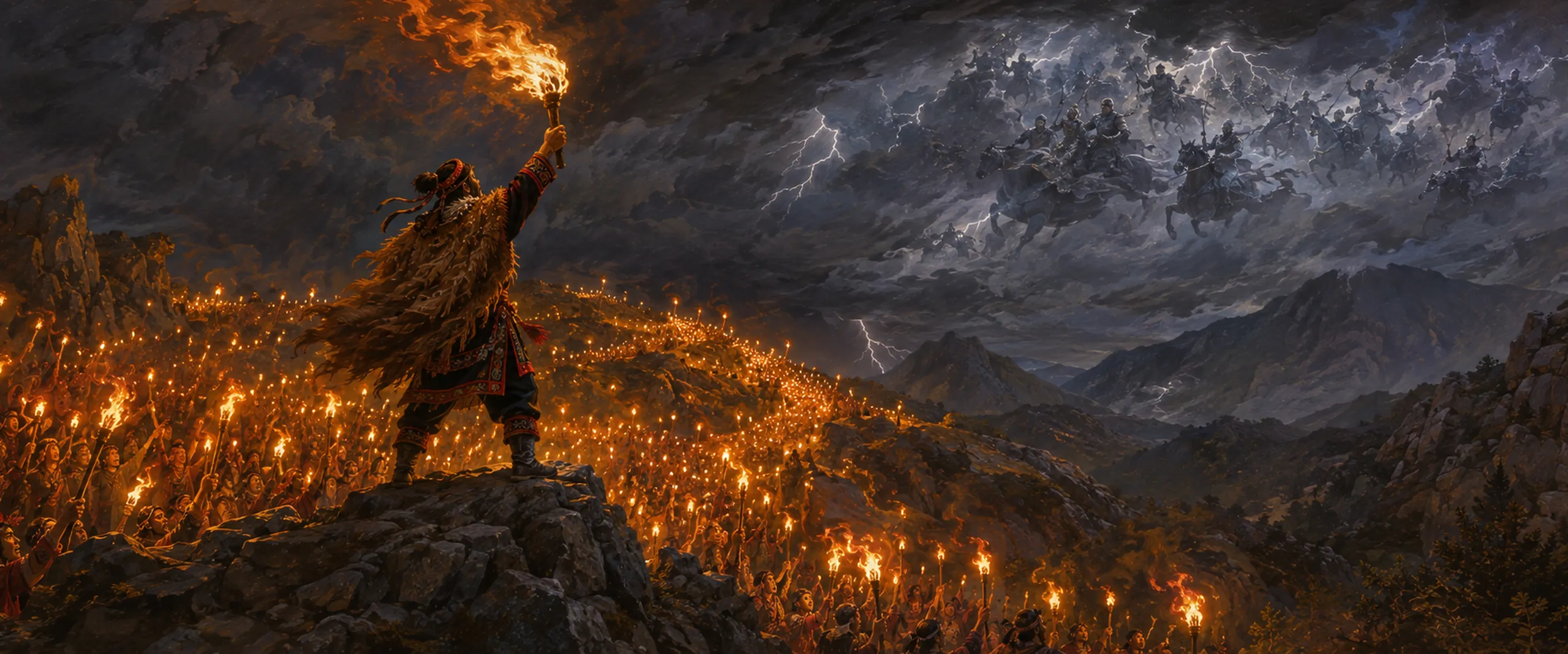
The Torch Festival is closely tied to agricultural civilisation. In the sixth lunar month, rice is earing and corn is tasseling. Before this season, people cut down trees locally called “torch trees,” split one end into several strips, melt pine resin over them, and thus prepare their torches. Before the “torch procession” sets out, a certain ritual is performed. When the time comes, all villagers—men, women, old and young—raise their torches high and run along the designated route. As they run, they chant sacrificial texts aloud, most of which are about killing pests and ensuring a good grain harvest. The “torch procession” on the ridges looks like a winding fire dragon; the torches illuminate the whole field, and the roaring shouts shake heaven and earth with magnificent momentum. The Torch Festival arose from the primitive belief in fire deities and the prayer for a good harvest in an agrarian society. Its original practical function was to drive away field pests and protect the crops. In times when science was underdeveloped, people paraded through the fields with burning torches, using flame and smoke to repel insects—this act had practical effect and also provided spiritual comfort. The scene of torches lighting up the fields not only dispelled pests but also banished people’s fear of crop failure.

The Ten‑Month Solar Calendar

To understand the origin of the Torch Festival, one must first understand the Yi people’s unique calendrical system. The Torch Festival is not a randomly chosen date; it was calculated by the Yi ancestors through long‑term observation of the sun, moon, and stars, based on a precise astronomical calendar.

The Yi historically developed a relatively advanced astronomy, and their calendar is an important symbol of human civilisation. The “ten‑month solar calendar” is a special calendar created by the Yi ancestors. As a cultural tradition of the Yi forebears, it was once prevalent throughout the vast Yi areas of Sichuan, Yunnan, Guizhou, and Guangxi, and vestiges remain among the folk of the Great and Small Liangshan today. The discovery of the Yi “ten‑month solar calendar” was a remarkable contribution of the Yi historian Liu Yaohan (刘尧汉). This calendar divides the year into ten months, each with 36 days, and further divides the year into five seasons, each with two months of 72 days—this is the origin of the magical numbers “36” and “72” in ancient China. Ten months of 360 days total, with the remaining five or six days set aside as New Year holidays. According to Confucius’s *Xia Xiaozheng* (《夏小正》, an ancient Chinese agricultural calendar text): in the first month, “at dusk, the handle of the Dipper hangs downward”; in the sixth month, “at dusk, the handle of the Dipper points directly upward.” The ancestors precisely determined the length of a year by observing the complete rotation of the Big Dipper. When the “star return” marks the handle of the Dipper pointing upward at the summer solstice, it is time for the Torch Festival; when the handle points downward at the winter solstice, it is time for the Yi New Year. The Yi ten‑month solar calendar put an end to the various theories that Chinese calendars originated from ancient India, Egypt, or Babylon.

The ancient name “Xinghui Jie” (Star‑Return Festival) has the core meaning of “when the stars return to the sky, the old year ends.” In the traditional Yi calendar, the Torch Festival is the beginning of the year. They set the sixth month, when “the handle points upward,” as the Torch Festival, and the first month, when “the handle hangs downward,” as the Star‑Return Festival. Some scholars argue that the Torch Festival is related to the Yi star‑moon calendar, being the New Year’s day determined by observed changes in the stars. In fact, though these views are phrased differently, they all point to the same essence—the origin of the Torch Festival is closely connected to the Yi calendar and annual cycle. The Torch Festival serves as the minor New Year of the Yi ten‑month solar calendar, while the tenth‑month festival is the major New Year. Both the Torch Festival and the tenth‑month New Year developed and evolved from the ancient Yi religious belief system, and both equally manifest a diachronic evolution from indigenous ritual activities to folk festivals. The Torch Festival is primarily characterised by fire worship, illuminating the year, and praying for harvests, while the Yi New Year centres on ancestral rites. Both festivals aim to pray for abundant harvests, thriving livestock, successful hunting, lush forests, and clean homes; over time they developed into traditional festivals with ethnic and trans‑regional significance. The relationship between the Torch Festival and the Yi ten‑month solar calendar reveals the astronomical and calendrical dimension of its origin. The festival is fixed on the 24th day of the sixth lunar month, which falls around the Great Heat (major summer heat) after the summer solstice—the hottest season of the year. The Yi ancestors chose this time node as the beginning of the year, reflecting both their precise astronomical observations and their wisdom in converting astronomical time into social time.

Heroic Legends

Among the Yi people, many moving legends about the origin of the Torch Festival are widely circulated. Though these legends may not correspond to historical facts, they vividly interpret the festival’s cultural connotations through storytelling and serve as an important window for understanding the festival.

The Hero Hetielaba (赫铁拉巴, also transliterated as Heitilaba or Atilaba)

In the Liangshan Yi region, the most widely spread legend is that of the hero Hetielaba (also called Heitilaba or Atilaba) who fought against a celestial deity. According to the legend, one summer long ago, the heavenly god Entigu Zi (恩体古兹) sent his envoy Sire Abi (斯惹阿比) to collect rent from the human world. It was a time of shortage between harvests, and the people had no grain to pay rent or debts. Sire Abi’s behaviour enraged the human hero Hetielaba, who decided to challenge Sire Abi to a wrestling match, with the wager that if he won, the rent debt would be forgiven. On the appointed day, Hetielaba had his mother serve Sire Abi “iron cakes and bronze cakes” as a ruse, frightening him into hiding inside a hollow tree; Hetielaba caught up, uprooted the tree, and killed him. To take revenge on humanity, the heavenly god released “heavenly insects” to devour all the crops on earth. On that very day, Hetielaba led the people to light torches and burn away the “heavenly insects,” achieving victory over heaven. Ever since, the people have celebrated this victory by lighting torches and singing and dancing on the 24th day of the sixth lunar month each year. Over generations, this became today’s Torch Festival. This legend integrates the festival’s core function—insect extermination and crop protection—into a grand narrative of “human triumph over the divine.” Hetielaba is not only a warrior who fought the heavenly god but also a leader who guided his people through disaster. In this story, torches are no longer ordinary lighting tools but sacred weapons against natural calamities and for defending the homeland. Among the numerous Torch Festival legends, the most widespread and representative is precisely the story of the Yi hero Heitilaba defeating the heavenly god and the demon, and uniting the people against disaster. In this legend, fire is used to drive away the insects sent by the heavenly god and to protect the crops.

The Flaming Sheep Attack on the Demon King

In the Yi area around Lunan (路南), another legend about the origin of the Torch Festival is told. In ancient times, a demon king cruelly persecuted the people. The masses could no longer bear it and rose up in revolt. But the demon king’s fortress was difficult to capture after prolonged siege, so they switched to a flaming‑sheep attack—tying torches to the horns and hind legs of each sheep and driving the flock forward. They succeeded and won the battle. To commemorate this victory, people have since played with torches on the 24th day of the sixth lunar month each year, thus forming the Torch Festival. A similar legend among the Axi (阿细) branch of the Yi tells that to defeat the brutal slave owner Na Tiaotiao (那迢迢), the hero A Zhen (阿真) tied countless torches to the horns of a hungry flock of sheep, drove the sheep as vanguard, led the masses into the castle, and burned Na Tiaotiao alive; thereafter, they lit torches every year to celebrate the victory. This legend merges the tactical wisdom of “fire assault” with the spirit of resistance against oppression. The detail of the flaming sheep attack shows both the military ingenuity of the Yi ancestors and the national character of unity and overcoming the strong with the weak in extreme adversity. The torch here is not merely a farming tool but becomes a weapon for resisting oppression and fighting for freedom.

The Maiden Xique (喜鹊姑娘, Magpie Maiden)

In the ancient Luowu (罗武) mountain village, a love story is told about a maiden named Xique (Magpie) and her beloved Along (阿龙哥). Xique’s beauty was renowned far and wide. The sons of twelve tribal chieftains all wanted to marry her, and they sent matchmakers with betrothal gifts, threatening to massacre the village if refused. Her parents were in a dilemma. Xique thought for a while and then readily agreed, but stipulated that she would choose her suitor on the 24th of the sixth month at a mountaintop meeting. On that day, Along built a large fire on the mountaintop. Xique arrived. She detested the twelve powerful suitors; she loved Along. To protect her village, Xique gave Along a sorrowful look and leaped into the fire. Along grabbed for her but only caught a strip of her cloth. Calling her name, he too jumped into the flames. Since then, the Luowu mountain village has observed the Torch Festival to commemorate this young couple who sacrificed their lives for the safety of the village and for their eternal love. This is a legend of faithfulness, sacrifice, and everlasting love. Fire here is both a destructive force and an eternal witness—Xique and Along died together in fire, and the annual lighting of torches serves as an eternal guardian of their souls.

The origin legends of the Yi Torch Festival are rich and diverse, and can be roughly categorised into the following types: Hero‑fighting‑god type—Hetielaba defeats the heavenly deity and uses fire to expel insects, emphasising human courage and wisdom; resistance‑against‑oppression type—the flaming‑sheep attack on the demon king and the slave revolt against the slave owner, imbuing the festival with political‑resistance overtones; faithful‑love type—the tragic love of Xique and Along, adding romantic emotion to the festival; agricultural‑insect‑expelling type—using fire to illuminate fields, expel insects, and pray for harvests, directly reflecting the festival’s close connection to agricultural production. Though the plots differ, all centre on the image of “fire” and together construct the collective memory of the Torch Festival. As Dr. Bamo Qubumo (巴莫曲布嫫) has pointed out, from the perspective of folklore genesis, the original form of the Torch Festival can essentially be classified as a seasonal ritual activity, always closely connected to the religious life and folk beliefs of the mountainous region.
Historical Records

Origins & Anecdotes · Tracing the Past

The Torch Festival is not only rich in folklore but also extensively documented in historical texts. These records provide valuable written evidence for tracing its history.

Yuan Dynasty

The earliest record of the Yi Torch Festival is found in the *Yunnan Gazetteer Brief* (《云南志略》, a Yuan‑dynasty local record) of the Yuan dynasty. It records that on the 24th day of the sixth month, people would hold up bamboo poles with torches and flambeaus all night long for illumination; children too would carry small torches and run everywhere, “playing at burning each other, calling it exorcism,” until dawn. Though brief, this passage already outlines the core elements of the festival—torches, exorcism, and all‑night revelry—indicating that by the Yuan dynasty, the Torch Festival had already assumed a fairly mature form in the Yunnan region.

Ming Dynasty

Local gazetteers of the Ming and Qing dynasties contain more detailed accounts. According to the *Nanjing Prefecture Gazetteer* (《南安州志》, a Ming‑period local history): “On the 24th day of the sixth month, pine boughs are bound into torch bundles, and grasses and flowers over a zhang high are burnt; animals are slaughtered to sacrifice to ancestors; old and young sit around the fire, eating meat and drinking wine. This is done from official offices to village fields alike.” This record reveals two important features: first, the sacrificial function of “slaughtering animals to honour ancestors”; second, the communal feasting function of “old and young sitting around the fire, eating meat and drinking wine.” From official offices to village fields alike—the Torch Festival was already a festival participated in by all.

The *Longqing Chuxiong County Gazetteer · Rites* (《隆庆楚雄县志·设礼》) records: “The 24th day of the sixth month is the Star‑Return Festival; pine torches are lit to illuminate houses and fields, and at each paddy water inlet and each buckwheat plot a chicken is sacrificed to pray for a good harvest.” This record highlights the agricultural function of “illuminating fields, expelling insects, and praying for a bountiful harvest.” The sacrificial act of “killing a chicken” reflects the religious belief of the Yi ancestors in communicating with spirits through animal sacrifice to pray for a good year.

Li Zhongxi of the Ming dynasty, in his *Yunnan Gazetteer* (《云南通志》), records: “On the 25th day of the sixth month, pine flambeaus are gathered as torches to illuminate the fields, and the harvest is divined by the colour of the fire.” The phrase “divining the harvest by the colour of the fire” is a noteworthy detail—people not only used torches to illuminate fields and expel insects but also observed the colour of the flames to divine crop yields. Fire here is not merely a tool but a medium for communicating with heaven.

Qing Dynasty

Wu Daxun of the Qing dynasty, in his *Records of Sight and Hearing in Yunnan* (《滇南闻见录》), says: “On the 25th day of the sixth month, villagers gather for the Torch Festival in the fields, burning torches together with straw to pray for a good year.” Qing‑dynasty records further confirm the festival’s core function of “praying for a good year.”

Among the many accounts of the festival’s origin, the legend of “Burning the Pine‑and‑Camphor Pavilion” (火烧松明楼) is the most widely circulated and influential. According to the *Nanzhao Unofficial History* (《南诏野史》) and the *Dianxi* (《滇系》) by Shifan, “The Nanzhao chieftain Piluoge (皮罗阁) planned to annex the other five zhaos (诏, local kingdoms). He summoned the five zhao lords to a banquet at the Pine‑and‑Camphor Pavilion on the Star‑Return Festival (24‑25 June) and then set fire to it, burning them to death. The wife of the Dengdan Zhao lord, Lady Cishan (慈善), advised her husband not to go, but he disobeyed and was killed. Lady Cishan closed the city gates and died. The people of Yunnan have since lit torches on that day to mourn her.” The gist of the story is: Piluoge, the king of Nanzhao, with the permission of the Tang dynasty, intended to unify the six zhaos. He devised a scheme to invite all five zhao lords to a banquet at the Pine‑and‑Camphor Pavilion on the 24th‑25th day of the sixth month (the Star‑Return Festival), and then set fire to the pavilion, killing them. Lady Cishan, wife of the Dengdan Zhao lord, advised her husband not to go, but he refused; she then placed an iron ring on his arm. After the pavilion was burnt, Lady Cishan identified her husband’s body by the iron ring and brought it back for burial. When Piluoge heard of Lady Cishan’s virtue and wanted to marry her, she closed the city gates and committed suicide. The people of Yunnan lit torches on that day to commemorate Lady Cishan. This legend links the Torch Festival to the historical event of Nanzhao’s unification of the six zhaos, giving the festival political and historical dimensions beyond its agricultural origins. In places like Weishan, Yunnan, the festival is especially connected to Nanzhao history—Weishan is the ancestral land of Nanzhao, and the legend is linked to King Piluoge. The Yi people’s veneration of torches apparently represents Piluoge’s Pine‑and‑Camphor Pavilion; and celebrating the Torch Festival is a celebration of the establishment of a unified Nanzhao, of national unity and social progress, which is why it has become such a vital ethnic festival.

In addition, historical records also mention the legend of “Yi Woman Anan” (夷妇阿南, dating back over two thousand years), and the story of “Zhuge Liang’s southern expedition, where the elders greeted him with torches,” among others. These varied historical sources together constitute a rich historical narrative of the Torch Festival.

Contemporary Transmission

Origins & Anecdotes · Tracing the Past

Intangible Cultural Heritage Status

In May 2006, the Yi Torch Festival was approved by the State Council and included in the first batch of China’s National Intangible Cultural Heritage list. In 2011, the Yi Torch Festival declared by Hezhang County, Guizhou Province, was added to the third batch of National Intangible Cultural Heritage extension items. The Liangshan Yi Torch Festival has the project number Ⅸ‑10, and its protection unit is the Liangshan Prefecture Intangible Cultural Heritage Protection Centre in Sichuan Province.

The Yi Torch Festival also has multiple nationally recognised representative inheritors of intangible cultural heritage. Pu Shunfa (普顺发) is a representative inheritor of the Torch Festival (Yi Torch Festival) in Chuxiong Yi Autonomous Prefecture, Yunnan. Wang Xiuping (王秀平, Yi name Ahu Bujie 阿侯布杰) is a representative inheritor of the Torch Festival (Yi Torch Festival) in Hezhang County, Guizhou. These inheritors safeguard the core cultural memory of the festival, keeping this ancient celebration vibrant in contemporary society. In 2019, the Liangshan Yi Torch Festival was selected as one of the “Top Ten Outstanding Cases of Intangible Heritage and Tourism Integration” nationwide. The Torch Festival is not only a manifestation of Yi cultural creativity but also a reflection of human cultural diversity.

Contemporary Scale

In contemporary society, the Torch Festival has not declined but has shown a growing trend. During the 2024 Liangshan Yi Torch Festival (July 19 to August 19), the entire prefecture received 13,577,000 tourists, a year‑on‑year increase of 31.95%, with tourism revenue of 11.839 billion yuan, up 44.18% year‑on‑year. The Torch Festival has become the largest, most content‑rich, most spectacular, most participated‑in, and most ethnically distinctive traditional festival in Liangshan.

The main venue for the 2024 Liangshan Yi Torch Festival’s torch carnival night was in Xichang City, with an activity area stretching about 3 kilometres, featuring 60 small bonfires and 2 large bonfires, with an expected capacity of 100,000 people. The flames reached about 8 metres high; there were three such giant bonfires in total, linking 88 smaller bonfires along the route, with a total line length exceeding 4 kilometres. Viewed from above, the entire festival site resembled a “fire dragon.” The 2025 Liangshan Yi Torch Festival series of events began on July 11 and lasted until August 18, involving all 17 counties and cities of Liangshan Prefecture in a coordinated effort.

The festival’s influence is expanding. The Liangshan Yi Torch Festival not only attracts domestic tourists but also hundreds of thousands of international visitors who come to “play with fire” and experience the charm of ethnic culture. The Torch Festival has become an important cultural bridge connecting the Yi people with the outside world, and a vital vehicle for promoting inter‑ethnic exchange, interaction, and integration.

Tradition and Modernity

With the changing times, the Torch Festival faces trends such as the dilution of traditional concepts and customs, the urbanisation of festive activities, and the commercialisation of folk customs. Associate Professor Bi Xuling (毕旭玲) points out that the most notable change is the evolution of its functions. Traditionally, the festival’s core was sacrifice and agricultural prayers; modern celebrations increasingly take on functions of cultural display, tourism attraction, and economic promotion. The 2024 Liangshan Yi Torch Festival not only highlighted authentic Yi cultural characteristics but also broke conventions with innovative forms, using modern audio‑visual technology to create more new scenes. How to maintain the traditional core while adapting to modern needs, and how to preserve the festival’s cultural authenticity amid commercialisation, are important issues facing its contemporary transmission. Yet no matter how the forms change, the core cultural spirit—reverence for fire, gratitude to ancestors, hope for a good harvest, and love for the community—remains unchanged. Like the torches lit year after year, it burns brightly through thousands of years.

Cultural Spirit

Cultural Core
Torch Festival carries the Chinese people’s longing for a better life and their devotion to family, embodying the cultural spirit of reunion, harmony, gratitude and blessing — it is one of the most enduring traditional festivals in Chinese culture.
Fire Worship
From Fire Worship to Fire Play
Community Cohesion and Identity
View of Life, Death, and Time

Fire Worship

The core cultural spirit of the Torch Festival is fire worship. In the Yi cosmology, fire is not only a source of light that dispels darkness and cold, but also a sacred medium connecting heaven, earth, humans, and gods. The Torch Festival is a sacrificial festival for praying for a good year and exorcising evil. The Yi believe that torches can drive away disasters and evil, and thus regard fire as a protective force for bountiful harvests and thriving livestock. In ritual songs such as *Sacrifice to the Fire God* and *Sacrifice to the Hearth Stone*, the deeds of the fire god Ayi Diegu are recited. The Yi ancestors’ primitive worship of fire elevated fire from a natural phenomenon to a cultural symbol—representing light, strength, purification, and hope.

From Fire Worship to Fire Play

The Torch Festival possesses a dual character of “worshipping fire” and “playing with fire.” The former is religious and solemn—people sacrifice to the fire god to pray for harvests and ward off disasters; the latter is recreational and festive—people sing, dance, compete, and socialise in the firelight. This dual nature enables the festival to maintain the sacredness of religious ritual while being full of the joyous atmosphere of a secular festival. This evolution from “fire worship” to “fire play” reflects a functional transformation over the festival’s historical development. In its early days, the festival was a solemn religious ritual: people communicated with the gods through striking stones for fire, Bimo (毕摩, the Yi priest) chanting scriptures, and animal sacrifices. Over time, the solemnity of religious ritual gradually faded, and the recreational function grew more prominent. However, “playing with fire” is not a negation of “worshipping fire”; rather, it is an extension of worship into secular life—people still maintain reverence for fire in their revelry, and still pass down the memory of their ancestors through entertainment.

Community Cohesion and Identity

The Torch Festival also serves the important function of strengthening community cohesion and ethnic identity. During the festival, Yi people scattered across various places gather together to participate in sacrificial rites, singing and dancing, and competitive sports. This collective, periodic gathering reinforces emotional bonds and cultural identity within the ethnic group. The Torch Festival is deeply rooted in the local folk world and its experience of time; in the interaction between people and nature, environment, and history, it has long served the social functions of transmitting humanistic spirit, enhancing community interaction, and promoting inter‑ethnic exchange. The festival is not only a manifestation of Yi cultural creativity but also a reflection of human cultural diversity. The Torch Festival has become an important vehicle for promoting interaction, exchange, and integration among all ethnic groups.

View of Life, Death, and Time

The Torch Festival also embodies the Yi people’s unique views of life, death, and time. In the Yi language, the festival is called “Dutzie” (都则), meaning “fire sacrifice.” The festival lasts three days, unfolding in three stages: “worshipping fire – celebrating fire – sending off fire.”

Day One: Worshipping Fire (祭火). Every Yi family slaughters cattle and sheep, shares the meat collectively, and prepares wine and meat for ancestral offerings. At nightfall, people from neighbouring villages gather at a site chosen by the elders to erect an altar; they ignite the sacred flame by the traditional method of striking stones to make fire, and the Bimo (Yi priest) chants scriptures to worship the fire. The core of this day is “reverence”—reverence for the fire god, for ancestors, and for heaven and earth. Through sacrifice, people establish connection with the spirits, expressing awe and gratitude toward supernatural forces.

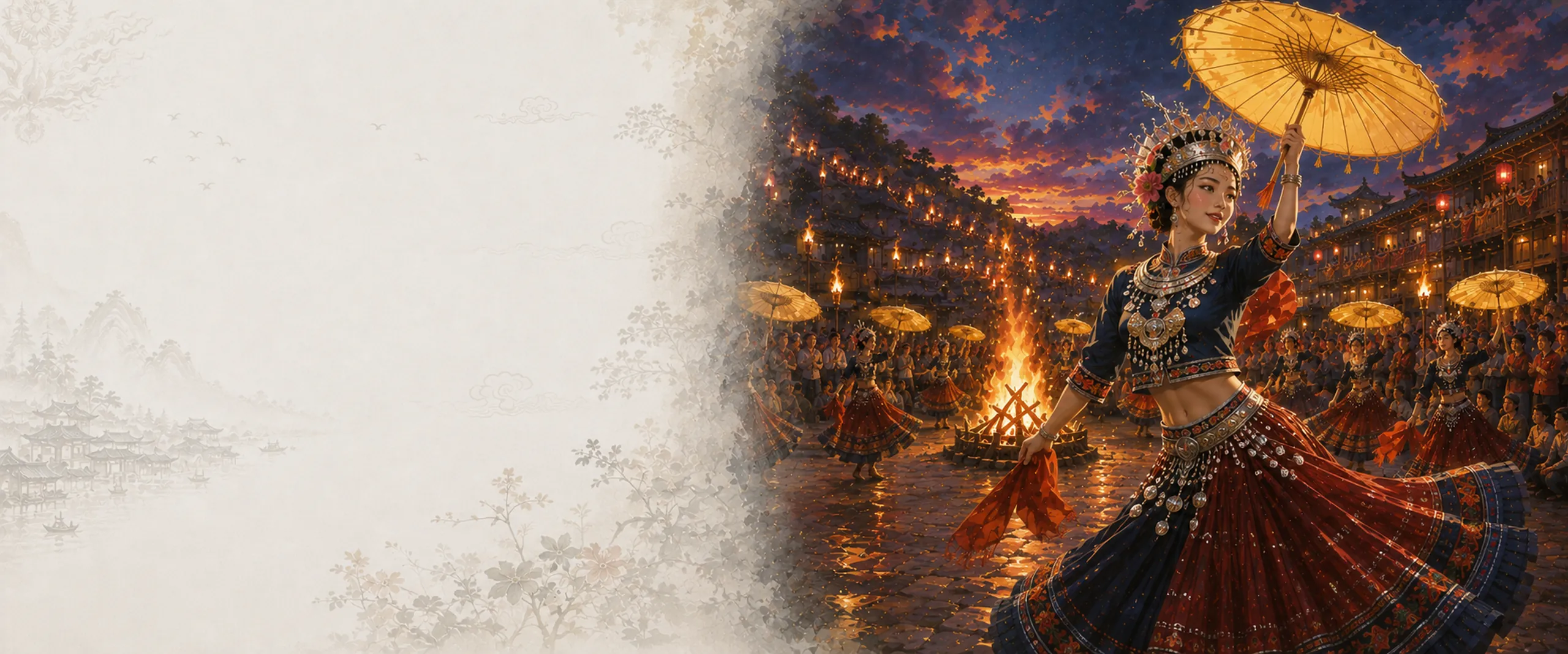
Day Two: Playing with Fire (玩火) or Celebrating Fire (庆火). This is the climax of the festival—people walk along the edges of fields with torches, following the legend of Ashimo (阿什嫫) who used fire to expel insects. The young men emulate the legendary Atilaba (阿体拉巴) by horse racing, wrestling, singing, bullfighting, ramfighting, and cockfighting. The young women, emulating the legendary Ashimo, dress in their finest, sing and dance, and participate in beauty contests. The core of this day is “joy”—people sing, dance, compete, and socialise in the firelight, enjoying the pleasures of the festival.

Day Three: Sending Off Fire (送火). People gather their torches together to form a huge bonfire, dance around it, and then uniformly extinguish the fire, symbolising the sending away of all inauspicious things. The core of this day is “sending away”—sending away disasters, illnesses, and all the misfortunes of the old year, to welcome the new year.

The three‑day structure of the Torch Festival—worshipping fire, celebrating fire, and sending off fire—constitutes a complete ritual cycle. It is not only the Yi people’s tribute to fire but also their understanding of time: at the turn of the old and new years, through the burning and extinguishing of fire, they accomplish a collective spiritual purification and temporal transition.

Conclusion

Afterglow

The formation of the Torch Festival is the result of thousands of years of cultural accumulation by the Yi people, continuously infused with the spirit of the times. It originated from the Yi ancestors’ primitive worship of fire—fire as light, strength, purification, and hope—gained precise temporal coordinates from the Yi’s unique ten‑month solar calendar (when the handle of the Big Dipper points upward at the Great Heat), acquired the practical function of “illuminating fields, expelling insects, and praying for a good harvest” from agricultural civilisation, obtained the spiritual narrative of “Hetielaba fighting the heavenly god” from heroic legends, absorbed the political memory of “Burning the Pine‑and‑Camphor Pavilion” from Nanzhao history, and received the love tribute of the “Magpie Maiden” from folk tales.

From the early awe and worship of fire by the Yi ancestors, to the precise calculation of the festival date by the ten‑month solar calendar; from the Yuan‑dynasty record in the *Yunnan Gazetteer Brief* of “playing at burning each other, calling it exorcism,” to the Ming‑dynasty description in the *Nanjing Prefecture Gazetteer* of “slaughtering animals to honour ancestors, old and young sitting around the fire, eating meat and drinking wine”; from the three‑day‑three‑night ritual structure of “worshipping fire – celebrating fire – sending off fire,” to the contemporary participation of millions of people in Liangshan, Chuxiong, Hezhang, and beyond—the Torch Festival has undergone a long evolution from primitive worship to religious ritual, from religious ritual to folk festival, and from folk festival to cultural symbol. It carries both the Yi ancestors’ reverence and gratitude toward natural forces and the Yi people’s most simple and sincere aspirations for harvest, peace, and happiness.

From its inclusion in the first batch of the National Intangible Cultural Heritage list in 2006, to its selection as one of the “Top Ten Outstanding Cases of Intangible Heritage and Tourism Integration” in 2019, and then to attracting 13.577 million tourists in 2024—the Torch Festival, spanning thousands of years, has not been extinguished by the tide of modernisation but, on the contrary, has ignited the passion of more and more people with its unique cultural allure. The Liangshan Yi Torch Festival has the project number Ⅸ‑10 and is protected by the Liangshan Prefecture Intangible Cultural Heritage Protection Centre; the Hezhang Yi Torch Festival in Guizhou was also added to the national intangible heritage list in 2011; the Chuxiong Yi Torch Festival in Yunnan has an extremely broad mass base, covering all Yi villages in the prefecture.

In the Yi language, the Torch Festival is called “Dutzie,” meaning “fire sacrifice.” Its original form is ancient fire worship. The famous Ming‑dynasty literatus Yang Shen’an (杨升庵, i.e., Yang Shen), while staying overnight at Mount Lu near Xichang, Liangshan, happened to be there on the night of the Torch Festival and was moved to compose this poem:

> 老夫今夜宿泸山,惊破天门夜未关。 > 谁把太空敲粉碎,满天星斗落人间。

(Note: The poem paints a vivid picture of the torchlit scene—the poet feels as if the heavenly gate has been thrown open, and the countless torches on the mountains look like shattered stars raining down upon the earth.)

This poem vividly depicts the magnificent scene of the Torch Festival—the torches spread across the mountains seem like stars fallen from the heavens onto the earth. The Torch Festival is a culture of fire, a faith in fire, a carnival of fire—it is the ethnic epic of the Yi people written in fire. The torches that have traversed millennia not only illuminate the night skies of Yi mountain villages but also illuminate a nation’s cultural confidence and spiritual heritage.

—

[es]

Continue exploring Torch Festival culture

Readers’ Comments

Calendar and traditional culture enthusiasts from around the world, sharing the same moon.

Sign in or register to join the conversation. Your comment account is created automatically the first time you use a connected account.