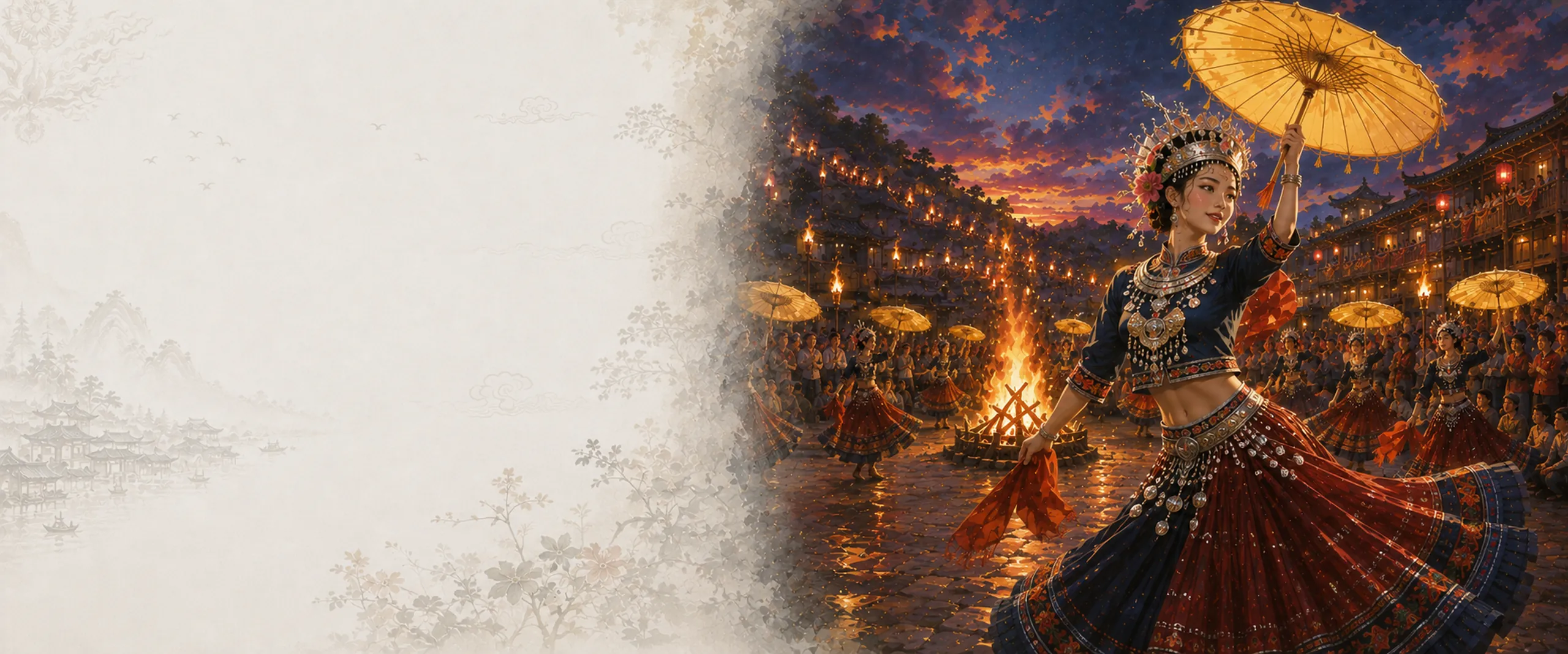
The Torch Festival is one of the most important traditional festivals of the Yi, Bai, Naxi, Jino, Lahu, and other ethnic groups, and is widely known as the “Carnival of the East.” Around the twenty-fourth day of the sixth lunar month each year, people light torches, drive away insects, and pray for good harvests, using brilliant flames to convey their hopes for light and abundance.
In 2006, the Torch Festival was included in the first national list of intangible cultural heritage.
As Chinese culture has reached an increasingly global audience, the Torch Festival has gradually become an important vehicle for cultural exchange between China and the wider world. In 2024, the inaugural UK Yunnan Culture Festival brought the Torch Festival to Camden Market in London, where visitors from around the world experienced this vibrant Eastern celebration together. In 2026, photographs from the Shilin Torch Festival appeared in Britain’s *The Times* and Brazil’s *South America Overseas Chinese News*, carrying the festival’s fiery energy and joy onto the international stage. The Chinese ambassador to the United States also introduced the Torch Festival to global audiences through social media.
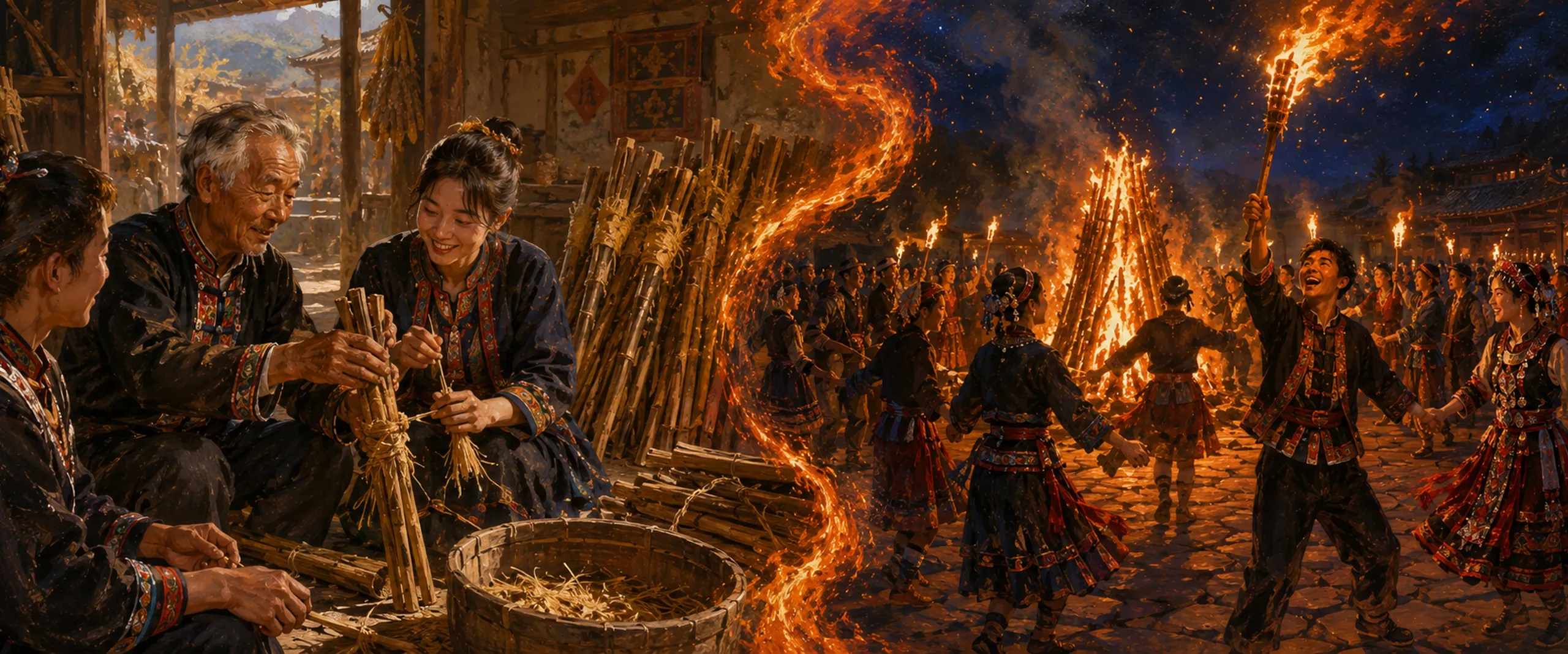
Event Schedule and Venues
### Core Torch Festival Dates
The Torch Festival is held each year around the twenty-fourth day of the sixth lunar month, corresponding to the period from late July to mid-August in the Gregorian calendar.
Liangshan Prefecture recognizes the Torch Festival as a statutory holiday, generally falling between late July and early August. Celebrations begin with traditional fire-kindling ceremonies and continue through the end of August, with the main climax concentrated in early August.
The core schedule is as follows:
| Time | Activity | Description |
|---|---|---|
| Mid- to Late July | Fire-kindling ceremonies begin in different regions | Puge County lights the “First Flame” at Ridudisa, marking the beginning of the festival |
| Late July to Early August | Folk activities begin across different areas | Horse racing, wrestling, silver ornament and costume showcases, and other traditional competitions |
| Early August — around the twenty-fourth day of the sixth lunar month | Grand Fire-Worship Ceremony and Torch Carnival Night — main climax | Bonfire celebrations and mass dances reach their peak |
| Mid- to Late August | Some activities continue | Festivals gradually conclude in different regions |
### Traditional Torch Festival Customs
The Torch Festival is a ritual festival centered on praying for abundant harvests and warding off disasters and evil. Its folk traditions include reverence for Heaven and ancestors, burning insects and driving away epidemics, and praying for good harvests.
Its main customs include:
| Custom | Description |
|---|---|
| Fire-Kindling Ceremony | At traditional fire-kindling sites such as Ridudisa in Puge County, the Bimo, or ritual priest, conducts ancient rites and lights the “First Flame” |
| Grand Fire-Worship Ceremony | Solemn ceremonies are held at places such as the October Solar Calendar Cultural Park in Chuxiong, formally opening the festival |
| Bonfire Celebration | After nightfall, people sing and dance around bonfires, with traditional dances such as Dati Dance and Left-Foot Dance performed in succession |
| Torch Parade | Participants carry torches through the streets, with tens of thousands of flames forming a “flowing golden fire dragon” |
| Traditional Competitions | Horse racing, Yi-style wrestling, bullfighting, and other traditional athletic contests |
| Traditional Beauty Contests | Yi beauty competitions selecting titles such as “Golden Soma” and “Golden Eagle” |
| Intangible Cultural Heritage Performances | Duolehe Yi costume shows, silver ornament and costume displays, intangible heritage parades, and other performances |
### Recommended Activities by Region
Liangshan Yi Autonomous Prefecture, Sichuan — Core Main Venue:
The 2026 Liangshan Yi Torch Festival begins on July 19 with the fire-kindling ceremony in Puge County and continues through the end of August.
Across all 17 counties and cities of the prefecture, 98 distinctive cultural and tourism activities are organized.
Puge County lights the “First Flame” and simultaneously holds traditional competitions such as horse racing and wrestling. Butuo County organizes silver ornament and costume performances, folk competitions, and Torch Carnival Night. Yuexi County presents the “Terraced Fields Spark” Torch Show. Huili hosts an ancient-city light-and-shadow show and a torch night tour along Binhe Road.
The “Liangshan · Xichang Torch Festival Opening Ceremony and Sound of the Mountains Music Festival” opens grandly at Xingyue Lake Park, while the central climax, Torch Carnival Night, takes place along the eastern extension of Hangtian Avenue.
Chuxiong Yi Autonomous Prefecture, Yunnan — Core Main Venue:
The Chuxiong Yi Torch Festival is held each year in early August under the theme “China’s City of Fire · Songs of Blazing Joy.”
As the main venue, Chuxiong City presents more than ten major activities, including the Grand Fire-Worship Ceremony, mass Left-Foot Dance, dragon-boat races, intangible heritage parades, Yi costume shows, and Rock Night.
All ten counties and cities of Chuxiong Prefecture simultaneously organize their own festival programs.
Shilin, Yunnan:
The Shilin Torch Festival is held every year in early August under the theme “Passionate Torches · Joyful Shilin.”
Activities include:
* Millennia-old fire-kindling ceremony at Guishan
* Mass Great Sanxian Torch Parade
* Bull-King Championship
* Electronic-music carnival evening
* Ashima ceremonial costume show
Yeyuhai, Guizhou:
The Yeyuhai · Haiping Yi Torch Season begins each year in mid-July and continues until mid-August.
More than 30 regular featured activities in six categories are planned, creating a program in which there are “performances every day and themes every week.”
The festival also introduces an innovative dual-IP model combining the “Haiping Yi Torch Season” with the “Yushe Forest Camping Music Festival.”
Pre-Trip Preparation
### Visas and Entry
Major Torch Festival destinations, including Liangshan in Sichuan and Chuxiong in Yunnan, are subject to China’s unified visa policies:
* 240-Hour Visa-Free Transit for Citizens of 54 Countries: Travelers may enjoy visa-free transit for up to 240 hours, with permitted stay areas covering administrative regions including Sichuan and Yunnan.
* Tour Groups from ASEAN Countries: Organized groups may enter visa-free through designated ports.
* Other Nationalities: Apply in advance for a tourist visa, or L visa, through the relevant Chinese embassy or consulate, and ensure your passport remains valid for more than six months.
* Latest Policies: Before departure, consult the official website of China’s National Immigration Administration or the relevant Chinese embassy or consulate.
### Adapting to the Climate
The Torch Festival falls in midsummer, but climate conditions differ across destinations:
* Liangshan Prefecture — Xichang: Average annual temperature is around 17°C. Summers are cool, earning the region the name “Cool Liangshan.” Temperatures may fall below 20°C during nighttime Torch Festival activities, so a light jacket is recommended.
* Chuxiong Prefecture: Average annual temperature is 17.9°C, with warm summer days and cool nights.
* Yeyuhai, Guizhou: Average summer temperature is only around 19°C, making it a popular summer retreat.
Special Reminder: Torch Festival venues contain concentrated bonfires and dense crowds, so the perceived temperature can rise significantly. Layered clothing is recommended: wear a short-sleeved shirt underneath and carry a light jacket so you can adjust easily as temperatures change.
### Travel Insurance
It is strongly recommended to purchase travel insurance covering:
* Accidental injury and medical treatment for acute illness, including outpatient care
* Loss of or damage to personal belongings
* Travel delays or cancellations
### Currency and Payment
* Currency: Renminbi (CNY).
* Cash: Carry a reasonable amount of cash. Network coverage at some remote event sites may be poor, making cash more reliable.
* Cards: Visa and MasterCard are accepted at major hotels and shopping centers.
* Mobile Payment: Alipay and WeChat Pay are widely used and can be linked to overseas bank cards.
### Communications and Internet
* Local SIM cards with short-term data packages can be purchased at airports using a passport.
* Hotels, restaurants, and scenic areas generally provide free Wi-Fi.
* Important: Torch Festival venues attract very large crowds, and 4G/5G networks may become severely congested. It is strongly recommended to download offline maps in advance. Baidu Maps or AutoNavi are recommended; download maps of your destination to your phone while connected to Wi-Fi.
How to Get There
### Core Venue 1: Xichang, Liangshan, Sichuan
| Transportation | Details |
|---|---|
| Air | Xichang Qingshan Airport serves Chengdu, Beijing, Shanghai, Guangzhou, and other major Chinese cities. Tickets are scarce during the Torch Festival, so booking 1–2 months in advance is recommended |
| High-Speed Rail | Direct trains from Chengdu reach Xichang West Station in about 3 hours; trains also connect directly from Kunming and other cities |
| Driving | Beijing–Kunming Expressway provides direct access, but traffic controls apply in the city during the festival. Park at designated parking areas outside the city |
High-Speed Rail Ticket Tip: Tickets are extremely difficult to obtain during the Torch Festival. China Railway Chengdu Group adds temporary passenger trains in addition to regular services. Booking in advance through the Railway 12306 App is recommended.
Airport Transfer: After arriving at Xichang Qingshan Airport, use DiDi or AutoNavi ride-hailing to book a vehicle.
### Core Venue 2: Chuxiong, Yunnan
| Transportation | Details |
|---|---|
| Air | Fly to Kunming Changshui International Airport, then transfer by high-speed rail or coach to Chuxiong. High-speed rail from Kunming to Chuxiong takes about 1 hour |
| High-Speed Rail | Frequent high-speed rail services operate from Kunming to Chuxiong, with a journey time of around 1 hour |
| Driving | Hangzhou–Ruili Expressway provides direct access; traffic controls apply to some urban roads during the festival |
### Urban Transportation During the Festival
Strict traffic controls are implemented in major Torch Festival destinations.
Xichang:
* Traffic controls apply in the carnival area along the eastern extension of Hangtian Avenue.
* Free Shuttle Services: Xichang deploys large numbers of free shuttle buses on multiple dedicated routes.
* Free Parking: Some parking areas are opened free of charge during the festival.
Travel Recommendations:
* Rely primarily on walking and free shuttle buses.
* Drivers should check official parking guidance in advance.
* Private vehicles are prohibited from entering core activity areas.
Accommodation Reservations
| Key Point | Recommendation |
|---|---|
| When to Book | Accommodation becomes extremely scarce during the Torch Festival. Book 1–2 months in advance. Hotel occupancy across Xichang exceeds 98% |
| Recommended Areas in Xichang | Around Qionghai Lake — lake views and concentrated attractions; Hangtian Avenue / city center — close to the main venue; Qionghai 17 Degrees · Xingyue Lake — near the main carnival venue |
| Recommended Areas in Chuxiong | Around the China Yi October Solar Calendar Cultural Park and Yi Ancient Town Scenic Area |
| Butuo County — Original Homeland of the Torch Festival | Budget hotels in the county town; book at least half a month in advance |
| Price Reference | Prices rise during the festival: budget around RMB 200–400 per night, mid-range RMB 400–800, high-end above RMB 800 |
| Booking Platforms | Major platforms such as Ctrip, Qunar, and Meituan; rooms with free cancellation are preferable |
Pre-Trip Packing Checklist
| Category | Essential Items | Special Notes |
|---|---|---|
| Clothing | Long sleeves and long pants, preferably older clothing; quick-dry underlayers | Extremely important: Sparks can burn holes in pale-colored or lightweight fabrics. Short skirts, shorts, and other lightweight flammable clothing are strictly prohibited |
| Shoes | Non-slip athletic shoes / hiking shoes | Venues are crowded and require long periods of standing and walking |
| Protection | Face mask for heavy bonfire smoke, sunscreen, sun hat | Smoke can be dense at event sites; a mask is recommended |
| Electronics | Power bank, phone | Charging facilities may not be available at venues |
| Storage | Small bag / waist pouch for documents and cash | Do not carry large bags containing valuables; items can easily be lost in dense crowds |
| Other | Tissues / wet wipes, rain gear | Summer weather can change quickly |
Cultural Respect
### Responsible Participation — Mandatory Official Regulations
According to Torch Festival management notices issued by local governments:
* Safe Use of Fire: Use safe, simple torches. Gasoline, alcohol, and other highly dangerous accelerants are strictly prohibited.
* No Throwing or Spraying: Throwing rosin powder toward crowds, vehicles, or buildings is strictly prohibited. Spraying flammable or explosive products such as artificial “snow,” streamers, or hair mousse is also prohibited within activity areas.
* Designated Fire Areas: Lighting torches and bonfire activities may only take place in officially designated areas. Privately lighting torches in forests, near homes, around piles of dry grass or firewood, beneath power lines, or in similar areas is strictly prohibited.
* Prohibited Items: Flammable and explosive materials, controlled knives, and other dangerous items may not be brought into event sites.
* Follow Management Instructions: Cooperate with security checks and crowd management. Do not push, create disturbances, or climb over barriers.
> Anyone violating these regulations will be punished according to law. Those who cause fires, injuries, or deaths will be held criminally responsible according to law.
### Safety Guidelines
* Fire Safety: Fire is the central element of the Torch Festival. Always maintain a safe distance from open flames. Parents must keep elderly family members and children away from open-fire areas to prevent burns, falls, and other injuries.
* Fire Prevention: Throwing ignition sources or other flammable and explosive items into bonfires is strictly prohibited.
* Crowd Safety: Stay alert in densely packed areas and avoid dangerous congestion.
* Property Safety: Store valuables in the hotel safe and keep the items you carry at the festival to a minimum.
* Health Protection: In crowded event areas, wear a mask according to your own circumstances. Wash your hands frequently and avoid touching your nose or mouth with dirty hands.
### Cultural Etiquette
* Respect Tradition: The Torch Festival is a ritual festival among the Yi and other ethnic groups centered on praying for abundant harvests and warding off disasters and evil. Participate with respect and goodwill.
* Photography Etiquette: Before photographing local people wearing ethnic clothing or a Bimo, or ritual priest, smile and ask permission first.
* Follow Local Customs: When participating, observe local traditions and ceremonies in an orderly manner and respect festival etiquette.
* About “Blackening the Face”: In some areas, smearing soot or charcoal on the face represents a blessing. If you do not wish to take part, you may politely decline.
* Environmental Awareness: Do not litter; keep festival venues clean.
Emergency Information
| Item | Contact / Notes |
|---|---|
| Emergency Numbers | Police 110, Fire 119, Ambulance 120 |
| Major Hospitals | Xichang: Liangshan First People’s Hospital, Xichang People’s Hospital; Chuxiong: Chuxiong Prefecture People’s Hospital |
| Tourist Police / Lost Property | Permanent police offices are located at major venues. If valuables are lost, report immediately to the nearest police office |
| Tourist Information | Official platforms of local culture and tourism authorities |
| Time Zone | UTC+8, China Standard Time |
| Voltage / Plugs | 220V; plug types A / C / I |
Special Reminders
* Torch Festival Dates: The festival takes place each year around the twenty-fourth day of the sixth lunar month, corresponding to late July through mid-August. The duration of activities varies by destination, so confirm exact dates before departure.
* Main Venue Reservations: The main venue on Hangtian Avenue in Xichang uses a real-name registration system, and places are limited. Check through official channels before traveling to determine whether advance reservation is required.
* Traffic Controls: Strict traffic controls are implemented in all festival destinations. Plan routes in advance and prioritize public transportation or walking.
* Fire Safety: Fire is the heart of the Torch Festival, so safety must always come first — do not carry flammable materials, do not light fires privately, and do not throw rosin toward crowds.
* Weather Awareness: August falls in the rainy season. Check weather conditions closely before departure and carry rain gear.
* Clothing Reminder: Sparks are common at festival venues. Short skirts, shorts, and other lightweight flammable garments are strictly prohibited. Long sleeves and long pants are recommended, preferably older clothing.
*May you experience the distinctive charm of ethnic culture in the glow of the flames and receive the beautiful blessing: “May the torch illuminate the road ahead, and may good fortune accompany you for life.”*
—-
Cultural Background:
The Torch Festival originated in ancient fire worship and can be traced back to prehistoric times. The ancestors of the Yi people regarded fire as a symbol of life, capable of driving away evil and bringing light.
Around the twenty-fourth day of the sixth lunar month each year, people lit torches and carried them through fields, using firelight to drive away insects and pray for good harvests. Over time, these practices developed into the tradition known as the Torch Festival.
Torch Festival customs are rich and varied:
* Lighting Torches: The central ritual of the festival. People raise burning torches and parade through villages and fields.
* Bonfire Celebrations: After nightfall, people gather around bonfires to sing and dance.
* Grand Fire-Worship Ceremony: Presided over by a Bimo, or ritual priest, in a solemn ceremony honoring fire.
* Left-Foot Dance: A traditional Yi dance in which participants hold hands, form a circle, and dance to music.
* Bullfighting and Wrestling: Traditional competitions that display strength and courage.
* Blackening the Face: In some regions, people smear one another’s faces with charcoal ash from the bonfire, symbolizing the warding off of evil and the welcoming of good fortune.
As China’s ethnic cultures have reached the world, the Torch Festival has become an important symbol of cultural exchange between China and other countries.
In 2024, the inaugural UK Yunnan Culture Festival brought the Torch Festival to London, introducing international audiences to the distinctive appeal of this Eastern carnival. In 2026, photographs from the Shilin Torch Festival appeared in Britain’s *The Times* and Brazil’s *South America Overseas Chinese News*. The Chinese ambassador to the United States promoted the festival to audiences worldwide through social media, inviting friends from different countries to experience the celebration together.
The Bishan Torch Festival in Chongqing has also attracted international visitors from countries including Russia, Spain, and Lithuania.
Overview of Global Activities:
Physical Torch Festival celebrations overseas are still at an early stage. They currently appear mainly in the forms of cultural-exchange activities, media coverage, and digital experiences:
| Type | Country / Region | Core City | Content |
|---|---|---|---|
| Cultural Exchange Event | United Kingdom | London | UK Yunnan Culture Festival — Torch Festival-themed market, ethnic song and dance, AR interactive game |
| Media Coverage | United Kingdom | London | Shilin Torch Festival photographs published in *The Times* |
| Media Coverage | Brazil | São Paulo | Shilin Torch Festival photographs published in *South America Overseas Chinese News* |
| Social-Media Promotion | United States | — | Chinese ambassador to the United States posts about the Torch Festival |
| Online Livestreaming | Global | — | CCTV, Xinhua, and other media livestream Torch Festival-themed galas worldwide through Facebook and YouTube |
| Symphonic Concert | United Kingdom | London | “Between East and West” symphonic concert performs the piece *Torch Festival* |
Recommended Activities by Region:
### London, United Kingdom
The United Kingdom is one of the overseas countries most closely connected with cultural exchange surrounding the Torch Festival.
In 2024, the inaugural UK Yunnan Culture Festival was held at Camden Market in London, bringing the Torch Festival to the British capital. Camden is one of London’s best-known multicultural districts and receives around 30 million visitors each year.
Activities:
* Torch Festival AR Interactive Game: Uses modern technology to create virtual torches and spectacular digital fireworks.
* Ethnic Song and Dance Performances: Including a guzheng performance of *Yi Dance*, the Yi dance *Calling for Green Shoots*, and Yunnan folk datiao dancing.
* Yunnan Market: Featuring crossing-the-bridge rice noodles, flower cakes, Yunnan coffee, Pu’er tea, and handicrafts made by ethnic minority communities.
* Ethnic Costume Showcase: Young Chinese and international participants present traditional clothing from China’s ethnic minority groups.
* Paper-Art Installation *Flowing Fire*: A giant Torch Festival flame constructed from alternating red and yellow paper.
* Yunnan Photography Exhibition: Photographs presenting Yunnan’s natural scenery and folk festivals.
London has also hosted the “Between East and West” Symphonic Concert, at which the London Philharmonic Orchestra performed the distinctly Chinese orchestral piece *Torch Festival*.
### Global Dissemination
During the 2026 Torch Festival, striking moments from the Shilin Torch Festival were shared around the world through major overseas media.
Britain’s *The Times* published a photograph of young Yi women dancing beside a bonfire during the opening ceremony of the Shilin Torch Festival. The accompanying caption stated:
> “At the opening ceremony of a festival in Shilin Yi Autonomous County, Yunnan Province, southwest China, young Yi women are dancing. The ethnic group numbers around nine million and lives in southwest China, mainly in mountainous regions.”
Brazil’s *South America Overseas Chinese News* published two photographs from the Shilin Torch Festival opening ceremony in its “Visual Focus” section, showing young Yi men and women performing the Great Sanxian Dance and the Sani Drum Dance in front of the main torch.
In addition, Chinese-language media including Cambodia’s *Chinese Commercial Daily* and Macau’s *Overseas Chinese Journal* also reported on and republished coverage of the event.
CCTV, Xinhua News Agency, *China Daily*, and other media livestreamed Torch Festival-themed evening galas to worldwide audiences through platforms including Facebook and YouTube.
### Social-Media Promotion by the Chinese Ambassador to the United States
In August 2026, the Chinese ambassador to the United States introduced the Torch Festival to global audiences through social media.
The post read:
> “Welcome to the Torch Festival, the Carnival of the East! Beneath the glow of blazing torches, traditions thousands of years old spring to life, as people of different ethnic groups come together through music, dance and their shared cultural heritage.”
### Other Related Activities
* Bishan Torch Festival, Chongqing — March 2026: Attracted international visitors from Russia, Spain, Lithuania, and other countries.
* Online Digital Experience: The Yi digital-art exhibition “Flame Phenomenon” previously appeared at the UK Yunnan Culture Festival, allowing visitors to explore Torch Festival culture through digital artworks.
Pre-Trip Packing Checklist
| Category | Recommended Items | Notes |
|---|---|---|
| Clothing | Prepare according to the local climate — August in the UK is cool, so bring a light jacket | Outdoor activities may last a long time |
| Shoes | Comfortable athletic shoes | Markets and performances may involve long periods of standing |
| Camera / Phone | For photographing cultural performances and AR experiences | Bring a power bank |
| Cash | Small amount of local currency | Market stalls may not accept cards |
| Translation App | Google Translate or similar | Useful for communicating with local Chinese participants or vendors |
Participation Etiquette:
### Etiquette for Torch Festival Cultural Experiences
* Participate Actively: Cultural festivals may include interactive song-and-dance sessions, such as Yunnan folk datiao. Feel free to join in and follow the rhythm.
* Respect Performances: Remain quiet when watching ethnic song-and-dance performances and do not disturb the performers.
* Clothing Etiquette: If participating in an ethnic-costume experience, respect the cultural meaning of the clothing and avoid exaggerated or inappropriate gestures.
### AR Interactive Experience Etiquette
* Queue Properly: If many people are waiting for AR interactive games, line up in an orderly manner.
* Follow Instructions: Complete interactive activities according to staff guidance.
### Market Etiquette
* Communicate Politely: Maintain a friendly attitude when speaking with vendors.
* Do Not Waste Food: Take only what you need when sampling food.
### Photography Etiquette
* Ask Permission: Before photographing performers or participants in ethnic clothing, smile and ask permission first.
* Respect Portrait Rights: Do not use photographs of others commercially without consent.
Travel Tips:
| Item | Description |
|---|---|
| Best Time to Follow the Festival | Early August each year, around the twenty-fourth day of the sixth lunar month, is the core Torch Festival period |
| UK Yunnan Culture Festival | Usually held at Camden Market in London in early August |
| Check in Advance | Event information can be obtained through the official channels of the UK Yunnan Culture Festival |
| Transportation | Camden Market can be reached from Camden Town station on the Northern line |
| Weather | August weather in the UK is cool; check the local forecast before departure |
Special Reminders:
* Overseas Torch Festival Celebrations Are Still at an Early Stage: Unlike traditional festivals such as the Spring Festival and Mid-Autumn Festival, physical Torch Festival celebrations overseas remain relatively limited and are presented mainly through cultural-exchange activities and media coverage.
* The United Kingdom Is a Major Overseas Experience Destination: The UK is one of the countries most closely connected with Torch Festival cultural exchange. London has hosted both the Yunnan Culture Festival, which included Torch Festival-themed experiences, and the “Between East and West” symphonic concert, which performed the piece *Torch Festival*.
* Follow Online Livestreams: During the Torch Festival each year, CCTV, Xinhua News Agency, and other media livestream Torch Festival-themed galas around the world through platforms such as Facebook and YouTube.
* Media Coverage Is Worth Following: Photographs from the Shilin Torch Festival have appeared in Britain’s *The Times* and Brazil’s *South America Overseas Chinese News*. You can follow relevant local media coverage during the festival period.
* Torch Festival Dates: The festival generally takes place around the twenty-fourth day of the sixth lunar month each year, corresponding to late July through mid-August in the Gregorian calendar.
* Cultural Diversity: The Torch Festival is not only a Yi festival; it is also celebrated by the Bai, Naxi, Jino, Lahu, and several other ethnic groups.
*May you experience the distinctive charm of the Torch Festival in different corners of the world and receive beautiful blessings of “light and abundant harvests” amid blazing firelight, music, and dance!*
Readers’ Comments
Calendar and traditional culture enthusiasts from around the world, sharing the same moon.
Sign in or register to join the conversation. Your comment account is created automatically the first time you use a connected account.
No comments yet
Share your thoughts with readers around the world.