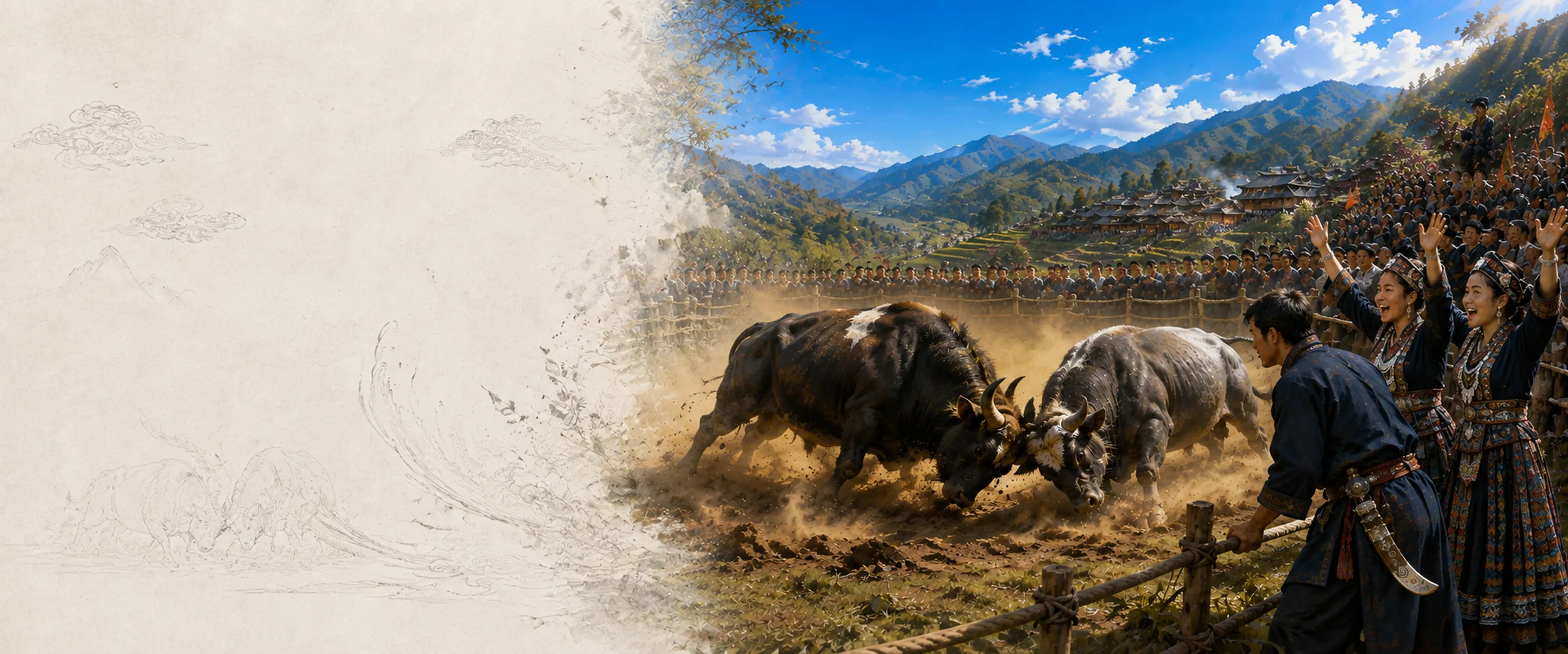
During the Miao New Year, families slaughter pigs and sheep, prepare abundant festive foods, and use their finest glutinous rice to make New Year rice cakes, which are served at banquets and exchanged as gifts. Ancestor worship is the most important ritual of the festival. Lusheng courtyard dancing takes place in the village’s designated lusheng ground: men play the lusheng while women dance in step with the music, and the crisp ringing of silver ornaments blends with the reed-pipe melodies to create one of the festival’s most distinctive soundscapes. People travel from village to village, receiving and visiting one another, sharing reunion meals and drinking together. Traditional sporting competitions are also held during the festival, including bullfighting, horse fighting, bird fighting, shooting, and pole climbing, among which bullfighting is especially distinctive. In 2008, the Miao New Year was included in the second batch of China’s National Intangible Cultural Heritage.
Main Customs
Preparations Before the Festival: From House Cleaning to Slaughtering the New Year Pig
Preparations for the Miao New Year begin several days in advance, and the entire village becomes immersed in the busyness and joy of welcoming the new year.
Cleaning the House and Preparing Firewood
In the days before the Miao New Year, every household thoroughly cleans its home and actively prepares festival supplies. People sweep the areas in front of and behind their houses and remove the dust accumulated over the year, symbolizing bidding farewell to the old and welcoming the new. They also stock sufficient firewood and prepare enough fodder for livestock. According to traditional Miao custom, these preparations must be completed before the New Year so that homes are clean and provisions abundant when the new cycle begins.
Slaughtering the New Year Pig
Slaughtering the New Year pig is one of the most important preparations for the festival. During the winter and twelfth lunar months, families slaughter pigs, smoke and cure pork, and prepare New Year provisions. Pig slaughter is often organized in rotation among members of the same clan, with families taking turns sharing the New Year pork feast. In places such as Leishan, the day before the mao or Rabbit Day is a Tiger Day. Villagers traditionally believe that the tiger overcomes the pig, making it an auspicious day for slaughtering pigs and eating freshly cooked pork. On the following Rabbit Day, households steam glutinous rice and pound rice cakes.
On pig-slaughtering days, hosts and guests eat meat and drink together in a lively atmosphere. Wealthier households may also make sausages and blood tofu. Slaughtering the New Year pig is therefore more than food preparation; it is a communal activity. Clans take turns slaughtering animals and hosting one another, strengthening social ties and sharing the joy of the harvest through the process.
Pounding Glutinous-Rice Cakes and Brewing Rice Wine
Glutinous rice plays an essential role in Miao New Year food traditions. Every household makes glutinous-rice cakes, or ciba (糍粑), and brews rice wine. Pounding ciba is one of the most ceremonial preparations of the festival. Steamed glutinous rice is poured into a stone mortar and repeatedly pounded with wooden pestles until it becomes soft, elastic, smooth, and cohesive. The finished rice cake is pinched into smaller portions and rolled in peanut powder, sesame powder, or similar coatings. It serves both as an offering to ancestors and as a gift for relatives and friends. Traditionally, the first and last pieces are made slightly larger and specially marked for ancestor worship.
Rice-wine brewing is equally important. Miao families use home-grown glutinous rice to produce a sweet and mellow rice wine. The drink is indispensable both at festive banquets and as an offering in ancestral rites. Brewing itself is a process of waiting: from soaking the rice to fermentation, several days or even weeks of patience may be required, and this period of preparation becomes part of the anticipation of the New Year.
Preparing New Year Supplies
In addition to pounding rice cakes and brewing wine, people make tofu, sprout beans, and usually slaughter a pig or purchase pork. Wealthier families traditionally prepare new clothing for household members. Before the festival, Miao women work to finish family members’ ceremonial attire, including embroidered garments, pleated skirts, and silver ornaments. Because traditional Miao formal dress involves highly demanding craftsmanship, every stage—from weaving and bleaching to dyeing, sewing, and embroidery—is completed by hand. A single full outfit may take two or three years to finish. Traditionally, a Miao woman might prepare only one complete ceremonial costume in her lifetime and wear it exclusively on important festive occasions. The Miao New Year is therefore one of the most concentrated public displays of Miao clothing culture.
Ancestor Worship: The Most Solemn Core of the Miao New Year
Ancestor worship is the central and most solemn ritual of the Miao New Year and runs through the festival as a whole.
New Year’s Eve Ancestor Worship
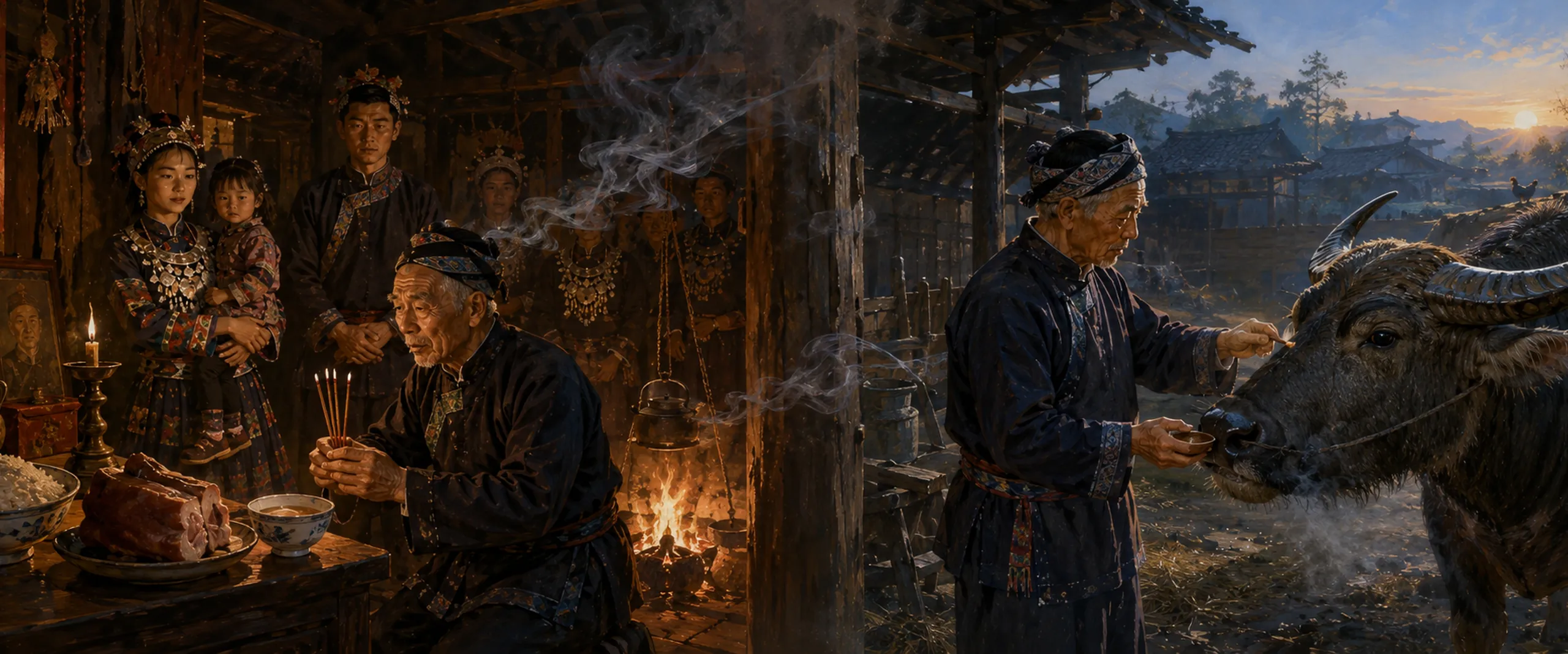
On the night of Miao New Year’s Eve, the entire family eats the New Year meal at home and stays awake until midnight. Only then is the door opened and firecrackers set off, symbolically welcoming the dragon into the household. A ritual table is placed beside the hearth or in the main room. Offerings may include a bowl of glutinous rice, sour fish, sour duck, chicken, pork, and wine. During the ritual, an elder of the family recites sacrificial words and calls the names of the ancestors one by one, proceeding from the more recent generations to the more distant. Each time an ancestor is named, several grains of rice are scattered outside the doorway. After the recitation is complete, spirit money is burned and wine poured in offering.
The details vary by region. Some villages begin ancestor worship before dawn, while others do so in the afternoon. At first light, each household may have an elder preside over the ritual. Before a table piled with a pig’s head, chickens and ducks, fish, wine, and glutinous rice, the male head of household solemnly offers wine and addresses the ancestors in the Miao language, while the female head of household and children stand nearby in ceremonial dress. The atmosphere is grave and respectful. In some places, no ritual specialist is invited and no shamanic text is recited; the ancestors are simply called in the Miao language and invited to receive the offerings.
After ancestor worship, ceremonies known as “honoring the ox” and “honoring the fields” may be performed. To honor the ox, wine is rubbed on the animal’s nose as a reward for its year of labor in the fields. Honoring the fields involves household elders carrying offerings to the edges of the farmland, making sacrifices, and speaking auspicious words.
Worshipping the “Rice Soul”
The ritual of worshipping the “Rice Soul”, also known as “Rice Maiden”, is a distinctive feature of Miao New Year worship. According to legend, the Rice Maiden brought rice from her maternal family and taught the local Miao people how to cultivate it. During the ceremony, the Song of the Rice Maiden is recited. The ritual reflects the gratitude of a rice-growing people toward the crop that sustains them: rice is not merely food but a source of life.
Worshipping Nature Spirits
Miao religious traditions include reverence for ancestral spirits and natural sacred beings, including maple trees, bamboo and other trees, sacred rocks, and wells. Maple trees occupy a particularly important place in Miao culture and are sometimes regarded as dwelling places of the ancestors. Bamboo groves, sacred stones, wells, and other natural features may likewise be understood as protective forces of the village. During the Miao New Year, incense is burned and offerings made to these beings in gratitude for their protection during the previous year.
Guzang Festival — The Most Elaborate Ancestral Rite
When the Miao New Year coincides with a year in which the Guzang Festival (鼓藏节) is held, the celebrations become even more solemn. Here, “gu” carries the sense of a large clan group, while “guzang” refers to a major collective ancestral ceremony conducted by the lineage. It is held only once every several years, sometimes after seven or eight years and sometimes after more than a decade. Before the ceremony, guzang cattle—large bulls raised for several years specifically for the ritual deity—may be arranged for contests. The Guzang Festival is among the oldest and most sacred forms of ancestor worship in Miao culture and, when it coincides with the Miao New Year, constitutes one of the festival’s most important moments.
Lusheng Courtyard Dancing: The Musical and Dance Soul of the Miao New Year
Lusheng courtyard dancing is one of the most iconic activities of the Miao New Year and one of the most concentrated artistic expressions of Miao culture.
The Lusheng and the Form of Courtyard Dancing
Lusheng dancing is held in the village’s designated lusheng ground, with men playing and women dancing, though both sexes participate. A player of a small lusheng first performs a brief opening phrase, after which players with instruments of different sizes join in together. Young women dressed in Hundred-Bird garments, silver ornaments, and silver floral crowns dance gracefully to the music. The bright chiming of silver jewelry blends with the lusheng melodies, creating one of the most moving sounds of the festival.
The making of the lusheng is itself a refined craft. The instrument is constructed from bamboo pipes of different lengths inserted into a wooden wind chamber. When played, it produces a resonant, far-reaching sound. Lusheng players often dance as they perform, with strong and agile movements. Young women form curved lines and dance to the music. The rhythms and steps of the dance are transmitted from generation to generation, and individual movements carry specific traditional meanings.
In Rongshui Miao Autonomous County, lusheng courtyard dancing is among the grandest activities of the Miao New Year. Music and dance fill village after village, with men playing and women dancing. Every settlement has its own lusheng ground. At such gatherings, “hundred-household glutinous-rice wine” may be served in cattle horns to honor relatives and guests, forming the custom known as “horn wine.”
Drum Dancing: Raising the Drum and Dancing Around It
On the Monkey Day or a nearby zodiac day during the Miao New Year, villages may also hold a formal ceremony of “raising the drum.” Men and women in ceremonial dress dance around it in an activity known as “stepping the drum.” The bronze drum is one of the oldest musical instruments associated with the Miao and is regarded in some traditions as a ritual object capable of communicating with the spiritual world. The opening ceremony is solemn: a village elder or other highly respected person strikes the first beat, after which the sound carries throughout the settlement.
During the drum dance, people in ceremonial clothing form several concentric circles around the instrument and move to its rhythm. The deep resonance of the bronze drum combines with the bright jingling of silver ornaments to create a distinctive Miao New Year soundscape. The dance is not merely entertainment; it may also be understood as a form of communication with the ancestors, with the drumbeat symbolically crossing the boundary between the living and the dead and carrying the joy of the living to those who have passed away.
Lusheng Visits Between Villages
Village-to-village lusheng visits are an important form of intercommunity exchange during the festival. Larger Miao settlements organize lusheng ensembles that travel to neighboring villages for performances and competitions. The teams play as they move from village to village, receiving one another in turn and creating a lively atmosphere. These visits are not merely musical exchanges but also a means of maintaining social bonds and strengthening friendship between settlements.
Miao Great Songs and Flying Songs
Miao singing is indispensable during the New Year. Miao Great Songs preserve ancient oral narratives that record creation myths, migration histories, and heroic legends. Flying Songs are among the most distinctive forms of Miao mountain song, characterized by a high, powerful voice that carries across valleys. During the festival, people sing ancient ritual songs, love songs, and joyful songs praising the harvest. Accompanied by lusheng and bronze drums, the singing carries the celebration toward its climax. Elders also transmit Miao history, tradition, and values to younger generations through song.
Bullfighting: The Miao New Year’s Celebration of Strength
Bullfighting is one of the most distinctive competitive activities of the Miao New Year and is often understood as a remnant of traditional Miao reverence for the ox. Miao bullfighting differs from better-known forms elsewhere and is sometimes described as “Eastern-style bullfighting.”
The Bullfighting Ritual
On the day of the contest, villages feed and decorate their bulls before leading them to the arena. Before fighting, the animals are walked around the grounds in a ceremonial inspection. They are then matched according to such factors as physique and age. After a respected elder sprinkles gourd wine on the arena and announces the beginning, two strong bulls are brought forward by village men with their eyes covered. Once the animals meet, the handlers quickly remove the coverings, and the contest begins.
Bullfighting grounds are usually located in valleys or open spaces near villages, with surrounding hillsides forming natural spectator stands. Audiences may number five or six thousand and sometimes tens of thousands. In Fanpai Village, Taijiang County, the Miao New Year traditionally draws more than a hundred fighting bulls from over ten surrounding villages, with enormous crowds gathering to watch.
Rules of Bullfighting
Miao bullfighting is governed by strict rules. Bulls are divided into groups such as A, B, C, and D according to chest circumference, waist measurement, body weight, age, and other criteria. There are also requirements concerning horn length and width, and animals that do not meet the standards are not permitted to compete. Each match lasts only about five minutes, reducing the likelihood of serious injury. Guizhou Miao bullfighting is a contest between bulls rather than between humans and bulls, and the fight is stopped once one animal retreats. The first bull to flee is considered defeated. For this reason, it has sometimes been praised as a form of “civilized Eastern bullfighting.”
The victorious buffalo is honored as the “Bull King,” and its owner receives public respect. Winners may be decorated with red cloth and festive ornaments, and a bonfire celebration may be held that evening with lusheng dancing and storytelling. Suona, drums, and other music accompany the competitions.
Cultural Meaning of Bullfighting
Miao bullfighting is often interpreted as a surviving expression of the ox’s totemic and sacred significance. In Miao culture, cattle are not only essential agricultural labor but also symbols of wealth and important sacrificial animals. Bullfighting expresses admiration for strength, courage, and vitality. A Qing-period source, Records of Things Seen and Heard in the Miao Frontier, described people selecting a broad, level place for the bullfighting ground and men and women from near and far arriving in ceremonial dress to watch.
Village Visits and “Same-Year” Alliances: Community Bonds of the Miao New Year
The practice of visiting villages and establishing “same-year” relationships is among the warmest and most socially significant customs of the Miao New Year. It strengthens friendship and ties between villages and between individuals.
Meaning of “Same-Year” Relationships
“Da Tongnian” (打同年) is a Miao village custom in which friendly settlements visit one another for New Year celebrations and call the people of the partner village their “same-year” companions. The custom carries the sense of visiting relatives, making friends, and forming fraternal bonds. It is not simply a social call. Traditional Miao culture places great importance on etiquette, and proper ritual exchange is understood as an expression of genuine friendship.
During the Miao New Year, villages take turns acting as hosts and guests and form these same-year relationships. Groups of dozens or even more than a hundred men and women from an entire village put on festival dress, bring lusheng instruments, and travel with gongs and drums to their partner settlement. Before entering, they play three lusheng pieces to announce their arrival. The host village then comes out collectively to welcome them. At the lusheng ground, the visitors perform again and dance as an entry ritual, and the hosts respond with their own lusheng playing and dancing. Once these exchanges are complete, the visitors are invited into individual households for hospitality. Guests commonly stay for three days, performing lusheng dances and competitions by day and participating in performances at night.
New Year Visits Between Villages
Beginning on the first day of the New Year, people visit relatives and friends and exchange greetings. After breakfast, young and middle-aged men go to neighboring homes to offer New Year congratulations, a practice called duiyang (donfniangx) in the Miao language. Elderly men and women may also carry wine, meat, glutinous-rice cakes, and other gifts to visit relatives and friends, while others remain at home receiving guests.
During these visits, people exchange blessings, discuss the harvest and experiences of the year just passed, and share festival joy. Visiting groups often travel with lusheng players, filling the route with music. Firecrackers sound wherever they arrive. Throughout the villages, bursts of firecrackers and lusheng music create an atmosphere of celebration and happiness.
Receiving Guests
During the Miao New Year, households are often filled with visitors. Hosts serve their finest foods, including sour-soup fish, cured pork, glutinous rice, and rice wine. When guests depart, the hosts may give them rice cakes, cured meat, or other foods as gifts. This continuous exchange of visits reinforces emotional ties between families, clans, and villages.
Food Culture of the Miao New Year
The Miao New Year table is a feast of flavors. Sourness, heat, fragrance, and glutinous textures are central characteristics, and each dish reflects generations of Miao culinary knowledge and hospitality.
Sour-Soup Fish: The Soul of the Banquet
Sour-soup fish is one of the central dishes of a Miao New Year feast. Fresh fish from rice paddies is cooked in a traditional Miao sour broth made through the fermentation of ingredients such as tomatoes and chili peppers and flavored with litsea. The fish remains tender while absorbing the fragrant, sour, and spicy broth. The dish stimulates the appetite and symbolizes a prosperous life. A Miao saying holds that “after three days without sour food, one walks in circles.” Sour-soup fish is therefore not merely a dish but an expression of an old culinary tradition in which sour flavors historically substituted in part for salt.
Long-Table Banquets: The Highest Form of Miao Hospitality
The Miao thousand-person long-table banquet is one of the grandest forms of ceremonial dining and hospitality and is described as having a history extending back thousands of years. The most spectacular long-table banquets are associated with the Miao New Year. Families bring out tables and chairs and connect them into lines tens or even hundreds of meters long, serving dozens of dishes such as Miao King fish, Guzang meat, sour-soup fish, fish sauce, plain-cut chicken, chicken porridge, rice tofu, vegetables and pickles, millet preparations, cured pork, sausages, chive root, fish mint, and many others.
At the banquet, the freshness of sour-soup fish, the deep flavor of cured pork, the softness of glutinous rice, and the sweetness of rice wine combine into a rich festive meal. Lusheng music accompanies the feast, and amid laughter and conversation, people raise their cups together and experience the warmth and hospitality associated with Miao village life.
Cured Pork and Sausages
Miao cured pork carries the flavor of the household hearth. After the New Year pig is slaughtered, pork is made into cured meat and sausages and hung above the stove, where it is slowly smoked. The resulting meat is firm and deeply aromatic. It can be preserved for more than half a year and traditionally forms an important source of meat throughout the year.
Glutinous-Rice Foods
Glutinous rice plays an essential part in festival food. In addition to ciba, families prepare glutinous-rice meals, often eaten by hand. One folk explanation says that eating rice cakes can “block mouse holes.” Glutinous-rice wine is likewise indispensable, with its sweet and mellow flavor making it essential for entertaining guests.
Jellied Fish
In areas such as Leishan, people also prepare “jellied fish” to eat as an early New Year meal the following morning. Fresh fish is cooked and then allowed to cool and set into a jelly-like form, creating a distinctive texture. It is one of the characteristic foods found on the Miao New Year table.
Youfang: Youth and Romance During the Miao New Year
Youfang (游方) is one of the most important social activities for young men and women during major festivals such as the Miao New Year and one of the most romantic aspects of Miao cultural life.
Forms of Youfang
Youfang usually takes place at relatively fixed locations such as grassy slopes near villages, riverbanks, or lusheng grounds. Young men from neighboring settlements travel together to the vicinity of a village where young women live and use whistling, leaves used as musical instruments, lusheng playing, or other signals to invite the young women to gather at the social grounds.
Young men from outside the village and local women sing antiphonally at night, sometimes continuing for several days. Through song, they express admiration and affection. Youfang is at once singing, conversation, acquaintance, and courtship. Through their songs, young people learn about one another’s intelligence, personality, talents, and feelings.
Cultural Meaning of Youfang
Marriage and courtship in Miao communities have often been closely associated with major festivals. During the Miao New Year, some young people play lusheng and dance within their own villages, perform bronze-drum dances, or attend bullfighting events, while young men may travel to social grounds in other settlements. Groups of young people may then move on to the next village celebrating its Miao New Year and continue the festivities there.
Youfang is not merely romance; it is also a major process of social learning and personal development. Young men and women learn how to communicate with the opposite sex, express emotion, and assume responsibility. Antiphonal singing requires improvisation and verbal fluency and therefore tests intelligence and talent. Miao marriage traditions have often placed considerable value on freely chosen relationships, and youfang has historically provided an important setting for such courtship.
Married Daughters Returning Home: The Warm Return of Family Affection
The return of married daughters to their natal homes is one of the warmest customs of the Miao New Year and an important expression of Miao kinship culture.
The Tradition of Returning Home
The custom of “aunts returning to their natal homes” has long existed in Miao society. During the New Year, married women from villages in Leishan County agree on a date and return home with their families and gifts to show filial respect to their parents, thank the elders, and celebrate the festival together.
The women dress in beautiful Miao ceremonial clothing and carry chickens, ducks, wine, and other gifts, forming a long procession back to their home village. The women carry presents, while their husbands may carry children, and laughter fills the journey. At the village entrance, the natal family sets up gate-blocking wine, plays the lusheng, fires ceremonial firecrackers, and welcomes the returning women with several rounds of drinking rituals.
Twelve Rounds of Gate-Blocking Wine
Women who married into the village may set up twelve rounds of gate-blocking wine at the entrance to welcome women originally from the village who married elsewhere and are returning for the New Year. The twelve rounds represent one of the highest forms of Miao hospitality, and each carries symbolic meaning—some express blessing, some gratitude, and others longing and remembrance.
The returning women must drink through the twelve rounds before entering the village. Afterward, everyone forms a circle and dances to lusheng music. Parents, relatives, in-laws, and friends then gather to host the returning women, sharing a long-table banquet and drinking the ceremonial style known as “High Mountain and Flowing Water” wine.
Cultural Meaning of Returning Home
The custom is a large-scale display of Miao kinship traditions, clothing and silver ornament culture, music and dance, and foodways. As living standards have improved, the event has increasingly become a means of presenting and transmitting Miao culture. Returning home is not merely a return to family affection but also a return to cultural roots: a married daughter comes back not only to visit her parents but also to re-enter the cultural environment in which she grew up.
Intangible-Cultural-Heritage Parades and Contemporary Performances
The Miao New Year is one of the most concentrated occasions for presenting Miao clothing, silver ornaments, traditional crafts, and other forms of tangible culture. In recent years, intangible-cultural-heritage parades have become among the festival’s most visually striking activities.
The Scale of the Intangible-Cultural-Heritage Parade
During the 2025 Leishan Miao New Year, nearly ten thousand Miao participants formed more than fifty intangible-cultural-heritage performance contingents, including large lusheng formations, Yang’ousang formations, high-row lusheng formations, long-skirt and large-silver-horn lusheng formations, long-skirt and medium-silver-horn lusheng formations, and Nanmeng lusheng formations. Altogether, 56 parade teams involving more than 5,200 performers participated. In addition to local groups, there were five teams from places such as Hunan and Zhejiang and seven lusheng ensembles from nearby counties including Congjiang, Rongjiang, and Liping.
One especially striking performance came from Zhangpi Village in Datang Town, Leishan County, where an agricultural shoulder-pole dance was performed. Its props were not refined musical instruments but ordinary tools used in daily labor—shoulder poles and sickles. Men, women, elders, and children danced to the sounds created by striking the tools together. The dance imitates farming actions such as harrowing fields, transplanting rice, and harvesting, integrating generations of agricultural memory into rhythm and movement. It has become a distinctive cultural symbol recording both Miao migration history and mountain farming civilization.
Cultural Meaning of the Parade
According to Bai Zhien, head of the Leishan County Miao Studies Association, local Miao communities regard the tenth lunar month as the end of the year; once the grain has been brought home, the agricultural year is complete. In his description, the event “is New Year, but it is also a great stage for displaying Miao culture, moving the everyday customs of Miao life onto the stage so that audiences can directly see fragments of village life.”
After entering the main venue, the parade groups presented five major themed sections: Celebrating the Harvest, Interwoven Colors, Celebrating the Miao New Year, Sounds of Nature, and Unity and Progress. Near the conclusion, all participants performed the Lusheng Unity Dance while moving forward, with the circle growing increasingly large as a symbol of drawing a shared “concentric circle” of ethnic unity and collective endeavor.
Regional Variations
Leishan
Intangible-cultural-heritage parades, mass lusheng performances, thousand-person long-table banquets, married daughters returning home, bullfighting and horse racing
Danzhai
Distinctive New Year customs among four Miao sub-branches
Taijiang
Greater and lesser New Year celebrations; large-scale bullfighting in Fanpai Village
Rongshui
“Same-year” village alliances, Manggao blessings, horse fighting, lusheng courtyard dancing
Contemporary Transmission
### Recognition as National Intangible Cultural Heritage
On June 7, 2008, the Miao New Year was approved by the State Council for inclusion in the second batch of China’s National Intangible Cultural Heritage. Its list sequence number is 990, its project number is Ⅹ-83, and its safeguarding organization is the Danzhai County Intangible Cultural Heritage Protection Center of Guizhou Province.
### The Contemporary Scale of the Miao New Year
Far from declining in modern society, the Miao New Year has continued to expand in scale. The 2025 Leishan Miao New Year activities are scheduled to continue until mid-to-late December. During the festival period, the county introduced eleven themed tourism routes, designed according to the distinctive characteristics and distances of different villages and centered on the county seat to connect major cultural destinations. On the opening day alone, the county received 51,526 visitor trips, an increase of 19.46 percent year on year, and generated comprehensive tourism revenue of 54.4929 million yuan.
After years of development, the Leishan Miao New Year has evolved from an “ethnic cultural symbol” into a widely recognized cultural phenomenon and, more recently, an important driver of consumption and product promotion. It has become not only a major symbol of Leishan’s cultural identity but also an important engine for promoting cultural, sporting, and tourism consumption and supporting higher-quality economic development.
### Integration of Tradition and Innovation
In recent years, the Miao New Year has also developed into a cultural celebration combining tradition and modernity. Alongside ancestral rites, bullfighting, lusheng dancing, and the return of married daughters, modern activities such as basketball tournaments, tug-of-war competitions, long-distance running, Chinese chess, and ethnic square dancing have been introduced. The 2025 Leishan Miao New Year even included a basketball competition for returning married women. The festival therefore preserves its traditional cultural core while continuously adapting to the needs of contemporary society and demonstrating considerable vitality.
### Cultural Value of the Miao New Year
The Miao New Year is a concrete expression of the continuing transmission of Miao culture. It is not merely a grand celebration but also an important setting for cultural education. During the festival, elders teach younger generations about Miao history, traditions, and values, while song and dance performances provide major channels for cultural transmission.
As socioeconomic development advances and rural urbanization accelerates, younger generations who have left Miao villages do not always return home for the festival. As a result, the festive atmosphere has weakened in some places, and traditional customs face risks of decline and require active safeguarding and revitalization. Nevertheless, as one of the most important traditional festivals of the Miao people, its cultural value is increasingly recognized and cherished.
Closing Note
The folk traditions of the Miao New Year form a long cultural narrative about “ancestor worship” and “celebration.” From the busy preparations of house cleaning and pig slaughter to the solemn rituals of honoring ancestors and sacred beings, from the music and dance of lusheng courtyard celebrations to the contests of strength in bullfighting, from the community bonds created through village visits and same-year alliances to the youthful romance of antiphonal courtship singing, and from the emotional return of married daughters to the culinary abundance of long-table banquets, the customs of the Miao New Year bring together gratitude toward ancestors, celebration of the harvest, love of life, and hopes for the future.
The Miao New Year is a festival of ancestor worship. From the tragic memories associated with the legends of Chiyou to the solemn ancestral ceremonies of New Year’s Eve, from gratitude expressed through worship of the Rice Soul to the lineage rites of the Guzang Festival, the festival is consistently structured around the traditional principle of honoring the deceased and remembering one’s origins. It is a time when Miao communities commemorate their ancestors and express gratitude toward Heaven and Earth. Through ancestral rites, people reaffirm their place within family genealogies and strengthen their memory of and identification with Miao history.
The Miao New Year is also a festival of collective celebration. The flowing melodies of the lusheng, the deep resonance of bronze drums, the shouts from bullfighting grounds, and the laughter of long-table banquets all express the vitality of life and the joy of the festival. The Miao New Year is a time to celebrate the harvest and enjoy life. After a year of hard agricultural labor, people reward themselves through the liveliest gatherings and express their love of life through the most joyful forms of song and dance.
The customs of the Miao New Year achieve a close integration of ancestor worship and celebration. Ancestor worship is a tribute to the past, while celebration embraces the present; ancestor worship forms the cultural foundation, while celebration expresses the vitality of life. Like the resonant sound of the lusheng, the festival is simultaneously a call to the ancestors and a song of praise for living. In 2008, the Miao New Year was included in the second batch of China’s National Intangible Cultural Heritage. From ancient agricultural calendrical traditions to contemporary national heritage protection, the festival has crossed centuries while continuing to flourish deep within the Miao mountain regions. Its customs are both a concentrated expression of the Miao tradition of revering Heaven and honoring ancestors and a vivid expression of a cultural wisdom that embraces life with acceptance and joy. Between ancestor worship and collective celebration, the Miao New Year continues to renew a profound cultural dialogue about history, life, and hope.
—–
Readers’ Comments
Calendar and traditional culture enthusiasts from around the world, sharing the same moon.
Sign in or register to join the conversation. Your comment account is created automatically the first time you use a connected account.
No comments yet
Share your thoughts with readers around the world.