Miao New Year

Miao New YearCuisine of the Miao New Year

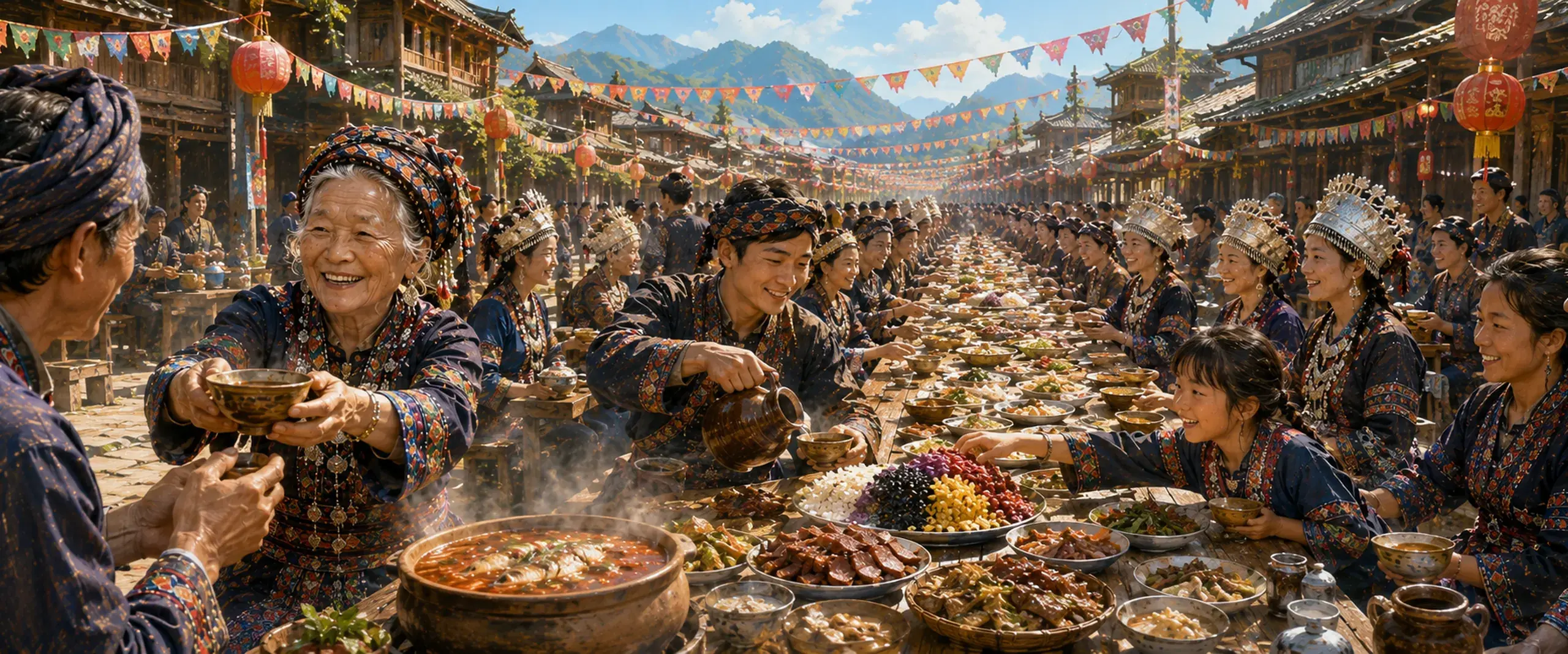
「 长桌宴上糯飘香。 」

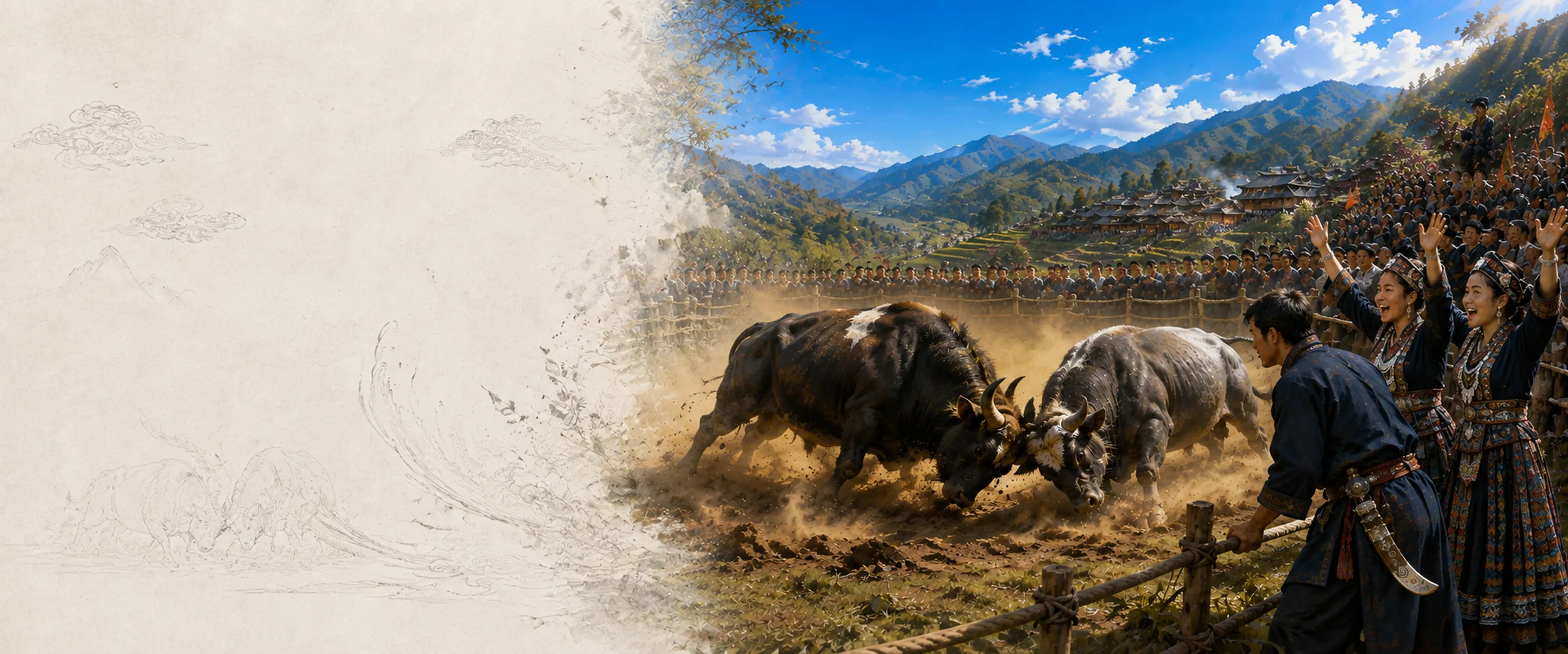
The Miao New Year is the most solemn festival of the year for the Miao people. The dates vary across regions, but it is generally held after the autumn harvest, around the tenth month of the lunar calendar. During the festival, Miao people dress in…

Miao New Year is the grandest traditional festival of the Miao people, and its food traditions are rich and varied. In the days leading up to the festival, every household pounds glutinous-rice cakes, brews rice wine, makes tofu, sprouts beans, slaughters pigs, and prepares meat. Wealthier families also make sausages and blood tofu. Ciba is the most representative food of Miao New Year. It is said that eating ciba can seal up mouse holes and help protect the crops for a plentiful harvest in the following year. Preparing oil tea is also an indispensable part of Miao everyday food culture. The long-table banquet is the most distinctive dining form of Miao New Year: dozens of tables are joined in a row and covered with handmade ciba, fish in sour soup, Miao-style cured pork, braised pork belly with preserved mustard greens, steamed pork coated with rice flour, and many other dishes, while the entire village gathers around to eat together. During Miao New Year, guests are welcomed with fragrant rice wine and abundant food, and everyone shares the reunion meal amid lively toasting songs. Miao New Year cuisine is the most direct expression of the Miao people’s joy in the harvest and the warmth of reunion.

Miao New Year / Cuisine of the Miao New Year

Festival Food Gallery

Seasonal Menu

Food in Detail

Seeking the True Flavor

Fish in Sour Soup

Soups, Broths & Congee

Basic Information

  • Category: Soup pot / hot pot
  • Popular regions: Southeastern Guizhou, especially Leishan and Kaili
  • Main ingredients: Rice-paddy fish (daohuayu, 稻花鱼), a local wild tomato known as maolaguo (毛辣果), litsea, chili
  • Also known as: Miao-style fish in sour soup, Kaili fish in sour soup

Historical Origins

Fish in sour soup is unquestionably the “soul of the banquet” during Miao New Year and is also one of Guizhou’s most representative dishes. Its history is closely connected with the migrations and survival wisdom of Miao ancestors. During their long migrations, Miao ancestors discovered that fermented sour soup not only preserved food for long periods but also gave ingredients a distinctive flavor. Traditional Miao sour soup is made by fermenting and simmering tomatoes, chilies, and litsea, producing a fragrant and intense sourness. This wisdom of “preserving through sourness” is one of the deepest foundations of Miao food culture.

A moving folk legend is also told among the Miao about the origin of fish in sour soup. According to the story, in ancient times a Miao woman traveling during a migration cooked fish in the sour soup she carried with her to satisfy her hunger, only to discover that it tasted exceptionally delicious. From then on, cooking fish in sour soup was passed down from generation to generation in Miao villages, eventually becoming an indispensable signature dish at Miao New Year banquets.

Cultural Meaning

Fish in sour soup is made with daohuayu (稻花鱼), fish raised in rice paddies whose flesh is fresh and tender and free from an earthy smell. The broth is a red sour soup fermented from maolaguo (毛辣果), small local wild tomatoes, together with litsea and chili. Making the sour broth itself is a lengthy process: fresh tomatoes, chilies, litsea, and other ingredients are placed in a jar, sealed, and fermented for several months until they develop into a rich, fragrant sour base. The fish remains tender while the broth penetrates its flesh, creating an appetizing combination of sourness and heat. Bean sprouts, a local cabbage known as lianhuabai (莲花白), and other vegetables may also be added during cooking. The flavor is full and mellow: the sourness carries the freshness of mountain spring water, while the fish contains the fragrance of rice blossoms. Fresh, aromatic, properly seasoned, refreshing, and deeply satisfying, the soup is so sour and fragrant that its aroma alone can stimulate the appetite.

Fish in sour soup carries several layers of cultural meaning. First, “a flourishing life.” The red color of the broth symbolizes a prosperous and thriving life, while its sour and spicy flavor represents the richness and variety of everyday existence. Second, “the highest hospitality.” Fish in sour soup is one of the highest forms of hospitality in Miao households and occupies a central place at Miao New Year long-table banquets. Third, “memory of migration.” Its preparation is closely linked to the migratory history of Miao ancestors, and every mouthful of sour soup carries forward their wisdom. Fourth, “abundance year after year.” Rice-paddy fish symbolizes the harvest, and eating fish during Miao New Year expresses the wish for surplus and abundance every year.

Simple Preparation

  • Ingredients: 2–3 rice-paddy fish, or crucian carp, about 500 g; 500 ml red sour soup, or homemade tomato sour soup; litsea; chilies; sliced ginger; garlic; tomatoes; bean sprouts; lianhuabai (莲花白) cabbage; salt
  • Steps:
  1. Scale and gut the fish, remove the gills, wash thoroughly, and make several shallow cuts along the body. Cut the tomatoes into pieces.
  2. Pour the red sour soup into a pot, add ginger, garlic, litsea, and chilies, and bring to a boil over high heat.
  3. Add the fish and cook until the flesh changes color and is fully cooked, about 5–8 minutes.
  4. Add the tomatoes, bean sprouts, and cabbage, cook until the vegetables are just tender, and season with salt.
  5. The dish may be eaten directly from the pot as it cooks or served with zhanshui (蘸水), a local dipping sauce.

Tip: Rice-paddy fish is the soul of fish in sour soup and offers the most tender flesh. Litsea is an indispensable seasoning and gives the dish its distinctive fresh fragrance. The longer the sour soup ferments, the deeper and mellower its flavor becomes.

Guzang Meat

Meat & Seafood

Basic Information

  • Category: Meat dish / boiled meat
  • Popular regions: Leishan, Taijiang, and other areas of Guizhou
  • Main ingredient: Black-pig pork belly
  • Also known as: Guzang Festival meat, ritual meat

Historical Origins

Guzang Meat is one of the most distinctive traditional foods eaten during both Miao New Year and the Guzang Festival. The Guzang Festival is the oldest and most sacred ancestral ritual of the Miao people and one of their most solemn festivals. It belongs to the first group of China’s national intangible cultural heritage. As such an important festival, it naturally has its own defining dish: Guzang Meat, which is essential to the Guzang Festival.

The origins of Guzang Meat are closely connected with the ancient Miao ritual of Guzang (鼓藏). Here, gu (鼓) carries the meaning of a “large clan,” while Guzang (鼓藏) refers to an ancestral ceremony held collectively by members of the clan. It is performed only once every several years—sometimes after seven or eight years, sometimes after more than a decade. During the Guzang Festival, a “Guzang ox” (guzangniu, 鼓藏牛) or “Guzang pig” (guzangzhu, 鼓藏猪) that has been raised for many years is slaughtered, and its meat is used in offerings to the ancestors. When Miao New Year coincides with a year of chi Guzang (吃鼓藏), the celebrations are even grander. Guzang Meat is therefore the culinary expression of this ancient ritual tradition.

Cultural Meaning

Guzang Meat is mainly prepared from pork belly from the chest or other large fatty cuts of black pig, each about two cun wide and two liang in weight. The meat comes from a black pig raised by the household, with pork belly taken from the upper abdomen. It is boiled in plain water and eaten dipped in chili water. The method is extremely simple: wash the whole piece of pork belly, place it in cold water, boil until fully cooked, remove it, and cut it into large square chunks. At the table, it is dipped in chili water or in roasted chili powder known as hulajiaomian (糊辣椒面). The flavor is fragrant, mellow, and lingering.

Guzang Meat does not rely on complicated seasoning. Instead, it presents the natural flavor of the meat in the simplest possible way. This culinary philosophy is expressed by the phrase “大道至简”, conveying the idea that the greatest truths are found in simplicity. It reflects both the Miao people’s confidence in the quality of their ingredients and their reverence for ancestral rites. At the Miao New Year long-table banquet, Guzang Meat stands alongside fish in sour soup and Miao King Fish as part of the core repertoire of traditional Miao dishes.

Guzang Meat carries several layers of cultural meaning. First, “honoring the ancestors.” It is a central offering in the ancestral rites of the Guzang Festival, and eating it is a way of remembering and commemorating the ancestors. Second, “gold, silver, and wealth.” Guzang Meat symbolizes “gold, silver, and wealth.” Third, “the thirteen-year appointment.” The Guzang Festival is held only once every thirteen years, making Guzang Meat a “special delicacy available only once every thirteen years.” Fourth, “simple and original flavor.” Boiling the meat in plain water and eating it with chili reflects the Miao culinary philosophy of “大道至简”.

Simple Preparation

  • Ingredients: 500 g black-pig pork belly, salt, roasted chili powder hulajiaomian (糊辣椒面), ground Sichuan pepper
  • Steps:
  1. Wash the pork belly whole, place it in cold water, bring to a boil over high heat, then reduce to medium heat and cook for 40–50 minutes until fully done.
  2. Remove, allow to cool, and cut into square chunks about two cun wide and two liang in weight.
  3. Mix the hulajiaomian with ground Sichuan pepper and salt to make the dipping seasoning.
  4. Dip the meat in the chili mixture when eating.

Tip: Black-pig pork belly with alternating layers of fat and lean meat is ideal. Avoid adding too many seasonings while boiling so that the natural flavor of the meat remains intact. Eating Guzang Meat with hulajiaomian is the most traditional method.

Five-Colored Glutinous Rice

Grains & Staples

Basic Information

  • Category: Grain staple
  • Popular regions: Miao communities in southeastern Guizhou, Rongshui in Guangxi, and other areas
  • Main ingredients: Glutinous rice, natural plant dyes—maple leaves, sappanwood, a yellow rice-coloring flower known as huangfanhua (黄饭花), indigo, and others
  • Also known as: Five-color glutinous rice, flower rice, Sisters’ Rice

Historical Origins

Five-colored glutinous rice is an indispensable traditional food for Miao festivals and is especially important during Miao New Year. The Miao commonly prepare it on festive occasions and regard it as a symbol of good fortune and abundant harvests. Its origins are closely connected with the way Miao ancestors observed and made use of nature. They discovered that natural plants such as maple leaves, sappanwood, huangfanhua (黄饭花), and indigo could produce juices of different colors. Soaking glutinous rice in these liquids not only created vivid colors but also gave the rice a distinctive fragrance of plants and herbs. This wisdom of coloring food with materials “taken from nature” is a vivid expression of the harmonious relationship between Miao ancestors and the natural world.

Several legends are told among the Miao about five-colored glutinous rice. One holds that the five colors represent the deities of the five directions: black symbolizes the north, red the south, yellow the center, white the west, and purple the east. Eating five-colored glutinous rice during Miao New Year is therefore a way of showing respect to the deities of the five directions. Another tradition says that the food was invented by Miao ancestors during migration. Different branches of the Miao used different colors of glutinous rice as markers of group identity so that they could recognize one another while traveling.

Cultural Meaning

Each of the five colors comes from a natural plant dye: black, red, yellow, white, and purple. Black is obtained from maple leaves; red from sappanwood or a flower known as jiemeihua (姊妹花); yellow from huangfanhua (黄饭花) or mimenghua (密蒙花); white is the natural color of glutinous rice; and purple comes from indigo or zicao (紫草). To prepare the rice, the plants are simmered separately to extract their juices. Portions of glutinous rice are then soaked in the different liquids for one or two days so that the colors fully penetrate the grains. The rice is removed and drained separately, rinsed with clean water to wash away excess surface color, mixed together, and steamed in a traditional zeng steamer (甑), producing glossy, fragrant five-colored glutinous rice.

Five-colored glutinous rice is bright, fragrant, flavorful, and can be kept for a long time without spoiling. With practiced hands, Miao women carefully arrange the rice after the many stages of soaking, coloring, and steaming, then pair it with cured pork, sour fish, sour meat, blood-and-rice sausage, taro, sweet potatoes, peanuts, and other foods. The result is a boji yan (簸箕宴), a banquet served in a large traditional flat bamboo tray and filled with auspicious meanings.

Five-colored glutinous rice carries rich auspicious symbolism. First, “abundant harvests.” The five colors symbolize plentiful crops and favorable weather. Second, “good fortune and fulfilled wishes.” The Miao regard five-colored glutinous rice as a symbol of good luck. Third, “group identity.” The combination of five colors reflects the cultural spirit of unity among the different branches of the Miao people. Fourth, “nature’s gift.” The use of natural plant dyes reflects the Miao ecological wisdom of “taking from nature while respecting nature.”

Simple Preparation

  • Ingredients: 500 g glutinous rice, maple leaves for black, sappanwood for red, huangfanhua (黄饭花) for yellow, indigo for purple, with white as the natural color of the rice
  • Steps:
  1. Simmer the maple leaves, sappanwood, huangfanhua, and indigo separately in water to extract their juices, then let them cool.
  2. Divide the glutinous rice into five portions and soak each one separately in the different liquids for 4–6 hours.
  3. Remove and drain each colored portion separately, then combine them in the desired proportions.
  4. Steam in a traditional zeng steamer (甑) for about 30–40 minutes.

Tip: The depth of the natural colors can be adjusted by changing the soaking time. After the colored rice is mixed and steamed, avoid excessive stirring so that the colors do not bleed into one another. Five-colored glutinous rice is best eaten hot, when it is soft, sticky, and fragrant.

Miao King Fish(鱼剁辣椒)

Others

Basic Information

  • Category: Cold dish / dipping condiment
  • Popular regions: Leishan, Taijiang, and other areas of Guizhou
  • Main ingredients: Daohuayu (稻花鱼), or carp, green chilies, red chilies, minced garlic
  • Also known as: Yuduo lajiao (鱼剁辣椒), Miao-style fish with chopped chilies

Historical Origins

Miao King Fish, also known as yuduo lajiao (鱼剁辣椒), is a well-known Miao specialty from Leishan. Its very name carries deep historical meaning. “Miao King” both commemorates the leaders of Miao ancestors and reflects the distinguished position this dish occupies within Miao food culture. According to tradition, it was once favored by ancient Miao tribal leaders and later spread among ordinary households, eventually becoming an essential dish for major festivals such as Miao New Year.

Cultural Meaning

The preparation of Miao King Fish is distinctive. The fish is steamed and then pounded, after which it is mixed with finely chopped green chilies, red chilies, and garlic. With the first bite, the freshness of the fish and the heat of the chilies unfold in layers, creating a rich flavor and texture. Miao King Fish can be served as a side dish or used as a dipping condiment with glutinous rice, ciba, and other staples. At Miao New Year long-table banquets, it stands alongside fish in sour soup and Guzang Meat as one of the central traditional Miao dishes.

Miao King Fish carries the meaning of “the flavor of kings.” Naming the dish after the “Miao King” reflects its supreme position in Miao culinary culture. The freshness of the fish and the heat of the chilies unfold in successive layers on the tongue, symbolizing the Miao character of “combining strength with gentleness.”

Simple Preparation

  • Ingredients: 2 daohuayu (稻花鱼), or carp, 3 green chilies, 3 red chilies, minced garlic, salt
  • Steps:
  1. Scale and gut the fish, remove the gills, wash, and steam for about 10–15 minutes.
  2. Remove the flesh, take out the bones, and pound the fish into a paste.
  3. Finely chop the green and red chilies and mix them into the fish with minced garlic.
  4. Season with salt and mix evenly.

Tip: Pound the fish while it is still hot for the best texture. The amount of chili can be adjusted to taste. Miao King Fish can be refrigerated, and its flavor improves after chilling.

Miao-Style Cured Pork

Meat & Seafood

Basic Information

  • Category: Cured meat product
  • Popular regions: Miao communities in southeastern Guizhou, Rongshui in Guangxi, and other areas
  • Main ingredients: Black-pig pork belly, salt, Sichuan pepper, pinewood
  • Also known as: Black-pig cured pork, smoked cured pork

Historical Origins

Miao-style cured pork is the dish that brings the “smoke and warmth of the hearth” to the Miao New Year table. After the annual pig is slaughtered at the end of the year, the meat is rubbed with salt, Sichuan pepper, and other spices, then hung above the hearth and slowly smoked with pinewood for several months. The smoked meat develops a glossy red color and may be sliced and steamed or stir-fried with garlic shoots, carrying with it the wish for “abundance year after year.” Miao-style cured pork is a treasured food for entertaining guests. Prepared at year’s end, it has a springy yet tender texture and a deep, mellow flavor.

The making of cured pork is closely connected with the survival wisdom of Miao ancestors. In the days before refrigeration, every Miao household had to solve the problem of how to keep pork for long periods without spoilage. Smoking became the best solution they found. Pinewood smoke not only gives cured pork its distinctive aroma but also helps inhibit bacterial growth, allowing the meat to be stored for several months or even a year. This wisdom of “preserving through smoke” is the culinary expression of the Miao tradition of “winter storing.”

Cultural Meaning

Miao-style cured pork is made from black-pig pork belly. The pork belly is first cut into long strips, rubbed with salt, Sichuan pepper, and other spices, and cured for several days. The seasoned meat is then hung above the hearth and slowly smoked with pinewood. The hearth is the center of Miao household life, and the meat hanging above it is exposed each day to smoke and warmth, gradually turning glossy red and developing an increasingly rich aroma. The longer it is smoked, the deeper the flavor becomes.

During Miao New Year, cured pork is an indispensable ingredient at the long-table banquet. It may be sliced and steamed or stir-fried with garlic shoots, fiddlehead ferns, and other vegetables. What makes Miao-style cured pork distinctive is its “smoke-and-hearth aroma.” It is not merely a smoky flavor but also the warm memory of a family gathered around the hearth.

Miao-style cured pork carries several layers of cultural meaning. First, “abundance year after year.” Cured pork is a product of autumn harvest and winter storage, so eating it during Miao New Year symbolizes the wish for lasting abundance. Second, “memories of smoke and hearth.” Hanging above the hearth and absorbing smoke day after day, every bite carries the flavor of home. Third, “a treasured food for guests.” Cured pork is a prized dish in Miao hospitality. Fourth, “the taste of time.” Its preparation requires months of patient waiting, reflecting the Miao philosophy that careful work takes time.

Simple Preparation

  • Ingredients: 1,000 g black-pig pork belly, 30 g salt, 10 g ground Sichuan pepper
  • Steps:
  1. Cut the pork belly into long strips and rub evenly with salt and ground Sichuan pepper.
  2. Place in an earthenware jar and cure for 5–7 days, turning the meat several times during the process.
  3. Remove and hang above the hearth or in a well-ventilated place, smoking slowly with pinewood for 15–30 days.
  4. Before eating, wash, slice, and steam, or stir-fry with garlic shoots.

Tip: Pinewood smoke is the source of Miao-style cured pork’s characteristic flavor. The longer the smoking period, the deeper the flavor. Good Miao-style cured pork should be glossy red with a springy, tender texture.

Ciba

Pastries & Snacks

Basic Information

  • Category: Grain-based snack
  • Popular regions: Miao communities in southeastern Guizhou, Rongshui in Guangxi, and other areas
  • Main ingredient: Glutinous rice
  • Also known as: Glutinous-rice cake nuomiba (糯米粑), New Year cake nianba (年粑)

Historical Origins

Ciba is the indispensable “taste of reunion” during Miao New Year. As the festival approaches, every household pounds glutinous-rice cakes. Pounding ciba is one of the most ritual-filled activities in the preparations for Miao New Year. The family’s own glutinous rice is steamed, taken out, and poured into a specially made wooden trough. Two people wield specially made wooden mallets and pound the rice. The work must be “fast, precise, steady, and forceful” so that the grains are evenly worked into a dense, sticky, elastic mass.

Ciba occupies a special place in Miao culture. During Miao New Year, it serves both as an offering to the ancestors and as a gift for relatives and friends. When shaping the ciba, the first and last pieces are made slightly larger and marked for use in honoring the ancestors. Ciba can be roasted, fried, or boiled. It is fragrant, glutinous, soft, and not overly rich.

Cultural Meaning

Making ciba requires the participation of the whole family. The glutinous rice is first washed and soaked overnight, drained, and steamed in a traditional zeng steamer (甑). While still hot, the cooked rice is poured into an oiled stone mortar or wooden trough, where two young men take turns pounding it with wooden mallets. The rice must be pounded repeatedly until it becomes smooth, soft, and sticky. It is then moved onto a table dusted with flour or coated with oil. Women and children gather around—some pinch off portions while others shape them. Skilled Miao women coat their hands with oil, quickly pull off small white balls of rice paste, and flatten them into round ciba. Freshly made ciba can be dipped in white sugar or chili and is soft, sticky, and delicious.

Ciba carries several layers of cultural meaning. First, “the taste of reunion.” Its sticky texture binds the rice into one mass, symbolizing harmony and unity within the family. Second, “a rite of honoring the ancestors.” The first cake is used in ancestral offerings and reflects the traditional ethic of “serving the dead as one serves the living.” Third, “the joy of harvest.” Ciba made from newly harvested glutinous rice is the first sweetness tasted after the autumn harvest. Fourth, “community cohesion.” Pounding ciba requires the participation of the entire family and becomes a ritual of reunion in itself.

Simple Preparation

  • Ingredients: 500 g glutinous rice
  • Steps:
  1. Wash the glutinous rice, soak overnight, and drain.
  2. Steam in a traditional zeng steamer (甑) for about 30–40 minutes.
  3. While still hot, pour the cooked rice into a stone mortar or wooden trough and pound repeatedly with wooden mallets until smooth and sticky.
  4. Oil the hands to prevent sticking, pinch off small portions, and flatten them into round cakes.
  5. Eat immediately, or let cool before roasting or frying.

Tip: Ciba must be pounded while hot; once it cools, it becomes difficult to work. Oiling the hands prevents sticking. It can be roasted, fried, or boiled, offering a variety of ways to enjoy it.

Chicken Congee

Soups, Broths & Congee

Basic Information

  • Category: Congee / thick soup
  • Popular regions: Leishan, Taijiang, and other areas of Guizhou
  • Main ingredients: Free-range chicken, rice
  • Also known as: Miao-style chicken congee, “nutritious congee”

Historical Origins

Miao-style chicken congee is a homestyle dish combining appealing color, fragrance, and flavor. Known as “nutritious congee,” it is considered a superior dish for receiving honored guests and a highly nourishing food. Chicken congee occupies an important place at Miao New Year long-table banquets and stands alongside fish in sour soup and Guzang Meat as part of the core repertoire of traditional Miao cuisine.

Its origins are closely connected with the practical circumstances of Miao life in mountainous regions. The Miao live in mountain and hill country, where almost every household raises free-range chickens. In times of material scarcity, one chicken and one pot of rice could make enough nourishing congee to feed the whole family while helping restore strength. The “thinness” of chicken congee reflects the Miao wisdom of “making full use of everything.”

Cultural Meaning

Miao-style chicken congee is simple but carefully prepared. A free-range farm chicken is selected, slaughtered, cleaned, and placed in a pot with rice and an appropriate amount of water. It is simmered slowly until the chicken becomes tender and the rice grains open. The savory aroma of the chicken blends completely with the creamy texture of the rice, creating a rich and nourishing congee. Chopped scallions may be sprinkled on top when serving, and it can also be accompanied by zhanshui (蘸水), a local dipping sauce.

Chicken congee carries the meaning of “the highest hospitality.” It is a superior dish served to honored guests and is known as “nutritious congee.” The Chinese character “鸡” (jī, chicken) is a homophone of “吉” (jí, auspicious), symbolizing good fortune. The thick, mellow texture of chicken congee also symbolizes warmth and abundance in life.

Simple Preparation

  • Ingredients: Half a free-range chicken, 100 g rice, sliced ginger, salt, chopped scallions
  • Steps:
  1. Wash and cut the chicken into pieces, and rinse the rice.
  2. Add water to a pot, then add the chicken, ginger, and rice. Bring to a boil over high heat, then simmer over low heat for 1.5–2 hours.
  3. Cook until the chicken is tender and the grains of rice have opened, then season with salt.
  4. Sprinkle with chopped scallions before serving.

Tip: A free-range farm chicken gives the best flavor. Slow simmering is the key to the rich texture of the congee.

Sour Fish

Meat & Seafood

Basic Information

  • Category: Fermented fish product
  • Popular regions: Miao communities in southeastern Guizhou, Rongshui in Guangxi, and other areas
  • Main ingredients: Rice-paddy fish (daohuayu, 稻花鱼), glutinous rice, salt, chili
  • Also known as: Miao-style sour fish, cured fish, sour-cured fish

Historical Origins

Sour fish is one of the most distinctive traditional foods of the Miao people and occupies an important place in ancestral rites and banquets during Miao New Year. Before ancestral worship at Miao New Year, every household carefully prepares abundant offerings, among which sour fish, sour duck, chicken, and pork are indispensable. The techniques used to make Miao sour fish have a long history and represent preservation wisdom developed by Miao ancestors through long periods of migration and settled life.

The preparation of sour fish is closely related to the Miao food philosophy of “preserving through sourness.” In hot and humid tropical conditions, fresh fish spoils very easily. Miao ancestors discovered that lactic fermentation could preserve fish for long periods while also creating a distinctive flavor. The “sourness” of sour fish does not come from vinegar but from lactic acid produced through natural fermentation, preserving the freshness of the fish while adding a deep and mellow sour aroma.

Cultural Meaning

Sour fish is made with daohuayu (稻花鱼) from rice paddies. The fish are gutted, washed, and drained. Glutinous rice is toasted and ground into powder, then mixed with salt and chili and rubbed over the fish inside and out. The fish are arranged in layers inside a jar, with rice powder and seasonings sprinkled between each layer. The jar is sealed and left to ferment for several months. During fermentation, the flesh gradually becomes sour and develops an increasingly deep flavor. Sour fish can be stored for more than half a year and is an important winter food reserve for Miao households.

Sour fish carries the meaning of “the taste of time.” Its preparation requires several months of patient waiting, making it a “delicacy matured by time.” Sour fish also plays an important role in ancestral rites during Miao New Year, expressing respect for the ancestors and commitment to tradition.

Simple Preparation

  • Ingredients: 500 g rice-paddy fish, or carp, 100 g glutinous rice flour, 30 g salt, 20 g chili powder
  • Steps:
  1. Scale and gut the fish, remove the gills, wash, and drain.
  2. Toast the glutinous rice and grind it into powder, then mix with salt and chili powder.
  3. Rub the seasoning inside and outside the fish and arrange the fish in layers in a jar.
  4. Seal the jar and leave it in a cool place to ferment for 1–3 months.
  5. When ready to eat, steam, fry, or eat directly.

Tip: Rice-paddy fish is preferred because its flesh is firm. The longer it ferments, the deeper the sourness becomes. Water may be added around the rim of the jar to help isolate the contents from the air.

Miao Rice Wine

Drinks & Fine Wines

Basic Information

  • Category: Fermented alcoholic drink
  • Popular regions: Miao communities in southeastern Guizhou, Rongshui in Guangxi, and other areas
  • Main ingredients: Glutinous rice, fermentation starter
  • Also known as: Glutinous rice wine, sweet rice wine, homemade Miao rice wine

Historical Origins

Miao rice wine is an indispensable drink on the Miao New Year table. As the festival approaches, every household brews rice wine. Glutinous rice plays an important role in Miao New Year food: it is used not only to make rice wine but also to prepare ciba. Miao rice wine is brewed from fermented glutinous rice. It has a sweet, mellow flavor and relatively low alcohol content, making it suitable for men and women, young and old.

Rice wine holds a special place in Miao culture. During Miao New Year, it serves both as an offering to the ancestors and as a fine drink for entertaining guests and friends. Fragrant Miao rice wine, paired with fish in sour soup, Guzang Meat, and other specialties, allows diners to experience the “Miao flavor” on the palate in a gentle state of intoxication.

Cultural Meaning

Miao rice wine carries the meaning of “a brew of reunion.” Its “sweetness” symbolizes the sweetness of life, while its “mellowness” represents the depth of family bonds. During Miao New Year, members of the clan sit together and share rice wine, blending the warmth of reunion into its fragrance.

Simple Preparation

  • Ingredients: 500 g glutinous rice, an appropriate amount of fermentation starter
  • Steps:
  1. Wash the glutinous rice, soak for more than 4 hours, and steam in a traditional zeng steamer (甑).
  2. Let the cooked rice cool to about 30°C, then mix in the fermentation starter.
  3. Place in a clean container, press down firmly, and make a small hollow in the center.
  4. Seal the container and leave it in a warm place to ferment for 3–7 days.
  5. Once fermentation is complete, drink directly or strain and bottle for storage.

Tip: Mix in the fermentation starter only after the rice has cooled enough that it no longer feels hot to the touch. Excessive heat can kill the yeast in the starter. The longer the fermentation period, the stronger the wine flavor becomes.

Long-Table Banquet

Others

Basic Information

  • Category: Full banquet
  • Popular regions: Southeastern Guizhou, especially Leishan
  • Main foods: Fish in sour soup, Guzang Meat, Miao King Fish, chicken congee, cured pork, five-colored glutinous rice, rice wine, and others
  • Also known as: Thousand-person long-table banquet, ten-thousand-person long-table banquet, long-street banquet

Historical Origins

The Miao long-table banquet is the highest form of Miao feasting and one of its most solemn forms of hospitality, with a history spanning several thousand years. Traditionally, it is held for marriage celebrations, welcoming a bride, full-month celebrations for newborns, and social banquets between villages. The long-table banquet held during Miao New Year is its grandest form. Nothing surpasses the banquet held to celebrate Miao New Year: every household brings out tables and chairs and links them together into long rows stretching from a dozen meters to more than a hundred meters, serves dozens of dishes, celebrates the festival, and welcomes honored guests from near and far.

At the 2025 Leishan Miao New Year celebration, a five-hundred-meter-long table wound through the festivities amid laughter and conversation, creating a living panorama of Miao folk culture. Guests sat side by side, while the tables were laden with traditional Miao dishes such as fish in sour soup and cured pork.

Cultural Meaning

The banquet centers on two distinctive elements: a hot pot featuring yujiangsuān (鱼酱酸), an intangible-cultural-heritage preparation, and a traditional boji yan (簸箕宴), served in a large flat bamboo tray. The main pot, pork ribs with yujiangsuān (鱼酱酸排骨), is an intangible cultural heritage specialty unique to Leishan County. It is made by naturally fermenting small mountain fish known as payanyu (爬岩鱼), gathered in remote mountain areas, together with chili, ginger, and other ingredients. The accompanying boji yan retains one of the Miao people’s most traditional serving vessels, a large flat tray woven from bamboo, and contains classic foods such as an assortment of Miao cured meats, white-cut chicken, Guzang Meat, Miao glutinous rice, and Miao chive roots. Guests are also offered auspicious Miao eggs—red eggs—Miao glutinous rice, and the “高山流水” toasting ritual.

The long-table banquet carries the highest cultural spirit of Miao food traditions. First, “gathering and sharing.” It is the fullest expression of the Miao ideal of “bringing all things together and sharing food.” Second, “community cohesion.” Thousands of people dining together offer the most direct expression of communal unity. Third, “the highest hospitality.” The long-table banquet represents the highest form of Miao hospitality. Fourth, “cultural transmission.” It brings together Miao dining etiquette, song and dance, and brewing techniques, making it one of the most concentrated settings for presenting Miao culture.

Lanmenjiu (拦门酒) and “高山流水”

Drinks & Fine Wines

Basic Information

  • Category: Wine ritual
  • Popular regions: Miao communities in southeastern Guizhou
  • Main elements: Miao rice wine, buffalo-horn cups
  • Also known as: Road-blocking wine lanlujiu (拦路酒), “高山流水” toasting ritual

Historical Origins

Lanmenjiu (拦门酒) is a renowned, widely practiced, highly distinctive, and especially solemn welcoming ritual found in Miao villages. When honored guests arrive, the Miao form welcoming lines at the entrance to the village or at the lusheng square. Men and women in ceremonial dress play the sheng, beat drums, sing and dance, and use buffalo horns filled with wine to block the path and urge visitors to drink. Wine served from buffalo horns is considered a high-ranking form of Miao toasting etiquette and appears mainly during important festivals such as Miao New Year and the Guzang Festival. A single buffalo horn can hold about half a jin of wine.

Since 2008, villagers in the Miao village of Xijiang have actively carried forward local traditions of hospitality while remaining rooted in their cultural foundations, and they developed the innovative ritual known as “高山流水”, described as “the world’s most enthusiastic toasting ritual.” As the ancient saying goes, “高山流水遇知音”. This way of offering wine symbolizes the Miao people’s welcome to their guests and their wish for friendship to endure forever.

Cultural Meaning

Lanmenjiu and “高山流水” carry the deeper meaning of “making friends through wine.” Wine is a wordless song of courtesy among the Miao and an indispensable ritual in friendship and social exchange. Through its distinctive form and beautiful symbolism, “高山流水” has become the highest expression of Miao hospitality through wine. Every bowl of Lanmenjiu is a culinary expression of the Miao people’s warm and hospitable character.

Food Culture

Foodways

Looking across the food traditions of Miao New Year, several cultural ideas run through them from beginning to end:

I. Sourness as the soul. Sour flavors lie at the heart of Miao cuisine, and during Miao New Year especially, “no sourness, no banquet.” The Miao particularly enjoy pickled vegetables and sour soups. Fish in sour soup is the soul of the feast: live fish from the rice paddies is paired with an old-style Miao sour broth made by fermenting and simmering tomatoes, chilies, and litsea, producing a fragrant, sharp, and lively sourness. Yujiangsuān (鱼酱酸), a fermented sour fish preparation unique to Leishan County and recognized as intangible cultural heritage, is naturally fermented from small mountain fish known locally as payanyu (爬岩鱼), together with chilies, ginger, and other ingredients. Its broth is sour, fresh, and deeply mellow. Sourness is not merely a source of pleasure at the table; it is also part of the survival wisdom developed by Miao ancestors for preserving food in a hot and humid environment. Acidity can inhibit the growth of spoilage bacteria, allowing food to be kept for long periods without refrigeration. This wisdom of “preserving through sourness” is one of the deepest foundations of Miao food culture.

II. Glutinous rice as the foundation. The Miao are a rice-growing people, and glutinous rice holds an irreplaceable place in Miao New Year cuisine. As the festival approaches, every household cleans the home, slaughters pigs and sheep, and prepares abundant food. Glutinous rice plays an important role in the festival table: it is used not only to brew glutinous rice wine but also to make ciba, which is offered to the ancestors. Five-colored glutinous rice is a traditional Miao specialty. Every color comes from natural plant dyes—black, red, yellow, white, and purple. The Miao commonly prepare it for festivals and regard it as a symbol of good fortune and abundant harvests. Glutinous rice provides the underlying taste and texture of Miao New Year food and serves as a culinary expression of the Miao people’s “rice-growing civilization.”

III. The banquet as the form. The Miao long-table banquet is the highest form of Miao feasting and one of its most solemn forms of hospitality, with a history stretching back thousands of years. During Miao New Year, each household brings out tables and chairs and joins them end to end, creating long tables stretching from a dozen meters to more than a hundred meters. Dozens of dishes are served, including Miao King Fish, Guzang Meat, fish in sour soup, fish sauce, white-cut chicken, chicken congee, rice tofu, fresh and pickled vegetables, a farmhouse millet preparation known as xiaomizha (小米渣), cured pork and sausages, chive roots, Houttuynia cordata roots, and many other dishes. At the 2025 Leishan Miao New Year celebration, a five-hundred-meter-long table wound through the festivities amid laughter and conversation, forming a living panorama of Miao folk culture. The long-table banquet brings the spirit of “sharing” in Miao New Year cuisine to its fullest expression: thousands of people dining together at the same banquet offer the most direct culinary expression of community cohesion.

IV. Preservation as wisdom. Miao New Year falls just after the autumn harvest and marks the beginning of “winter storing.” Cured pork carries the aroma of smoke and hearth. After the annual pig is slaughtered at year’s end, the meat is rubbed with salt, Sichuan pepper, and other spices, then hung above the household hearth and slowly smoked with pinewood for several months. Sour fish and sour meat ferment for several months or even a full year, developing a deep and mellow flavor. Every method of “storing” food found in Miao New Year cuisine reflects preservation knowledge created by Miao ancestors during times of scarcity. Cured pork develops a glossy red color and may be sliced and steamed or stir-fried with garlic shoots, carrying with it the wish for “abundance year after year.”

Regional Distribution

Foodways
Region Characteristic Miao New Year Foods
Southeastern Guizhou — Leishan, Taijiang, etc. Fish in sour soup, Guzang Meat, Miao King Fish, chicken congee, five-colored glutinous rice, yujiangsuān (鱼酱酸), Leishan rice noodles with minced pork, niubie/yangbie (牛瘪/羊瘪), an soup — 盦(ǎn)汤
Western Hunan — Fenghuang, Huayuan, etc. fried oil cakes known as zhayoutuobaba (炸油粑粑), pao tang rou (泡汤肉), Miao-style fish, handmade tofu, chilled rice tofu salad, cured pork
Guangxi — Rongshui, etc. Sour fish, ciba, glutinous rice wine

The most ceremonial feast during Miao New Year is the long-table banquet. Tables and chairs are linked together to form rows stretching for dozens or even hundreds of meters, and the tables are covered with dozens of dishes such as Guzang Meat, chicken congee, cured pork, and sausages. During the banquet, Miao women offer wine through the ritual known as “高山流水”, literally “High Mountains and Flowing Water.”

Additional note: The dates of Miao New Year vary from region to region. The New Year meal usually begins in the afternoon, and people must first make offerings to their ancestors and to the deities of heaven and earth before the feast can begin.

Closing Reflections

Foodways

Miao New Year, called “能央” in the Miao language, is the grandest traditional festival of the year for the Miao people. After the autumn harvest, when most agricultural work has come to an end, Miao families celebrate the harvest, worship their ancestors, and give thanks to heaven and earth through a grand festival. In 2008, Miao New Year was included in China’s second national list of intangible cultural heritage. Unlike the Han Chinese Spring Festival, whose central theme is “family reunion,” the core of Miao New Year is “ancestral worship”—commemorating Chiyou, the primordial ancestor from more than five thousand years ago, and making offerings to ancestral spirits and protective deities associated with maple trees, bamboo and other trees, as well as Yanma (岩妈), wells, and other protective beings. All of this ultimately converges at the long-table banquet, the highest form and most solemn ritual of Miao feasting, handed down for more than a thousand years.

The foremost protagonist of Miao New Year cuisine is undoubtedly fish in sour soup. The base is a red sour broth fermented from maolaguo (毛辣果), litsea, and chilies, into which daohuayu (稻花鱼)—fish raised in rice paddies and feeding among the rice blossoms—is added. The Miao have a saying: “三天不吃酸,走路打罗圈”. The sourness of the broth carries the crisp sweetness of mountain spring water, while the freshness of the fish holds the delicate fragrance of rice blossoms. Alongside fish in sour soup, five-colored glutinous rice is another major taste-symbol of the festival. Its black, red, yellow, white, and purple colors all come from natural plant dyes, and the Miao regard it as a symbol of good fortune and abundant harvests. Guzang Meat is likewise an indispensable centerpiece of Miao New Year, made by boiling black-pig pork belly in plain water and eating it with chili water, creating a fresh, fragrant, and mellow flavor. Miao-style chicken congee, known as “nutritious congee,” is a superior dish for entertaining honored guests, while ciba is pounded in a wooden trough until sticky and elastic, following the principle “快、准、稳、狠”. Dozens of tables are joined end to end in a formation like a long dragon, while young women in ceremonial dress hold large wine vessels and line up from higher to lower positions—this is the renowned “高山流水” toasting ritual. Rice wine flows into the guests’ mouths like a waterfall, while toasting songs echo through the banquet, symbolizing affection and friendship that endure like high mountains and flowing waters. At that moment, the long-table banquet is no longer simply a meal but a moving feast: fish in sour soup boils in the pot while the echoes of the toasting songs linger in the air. To eat the foods of Miao New Year is to taste the vivid intensity of sourness, heat, freshness, and fragrance; to savor them is to feel the Miao people’s respect for their ancestors, gratitude for the harvest, and most sincere embrace of guests who have come from afar.

—

Continue exploring Miao New Year culture

Readers’ Comments

Calendar and traditional culture enthusiasts from around the world, sharing the same moon.

Sign in or register to join the conversation. Your comment account is created automatically the first time you use a connected account.