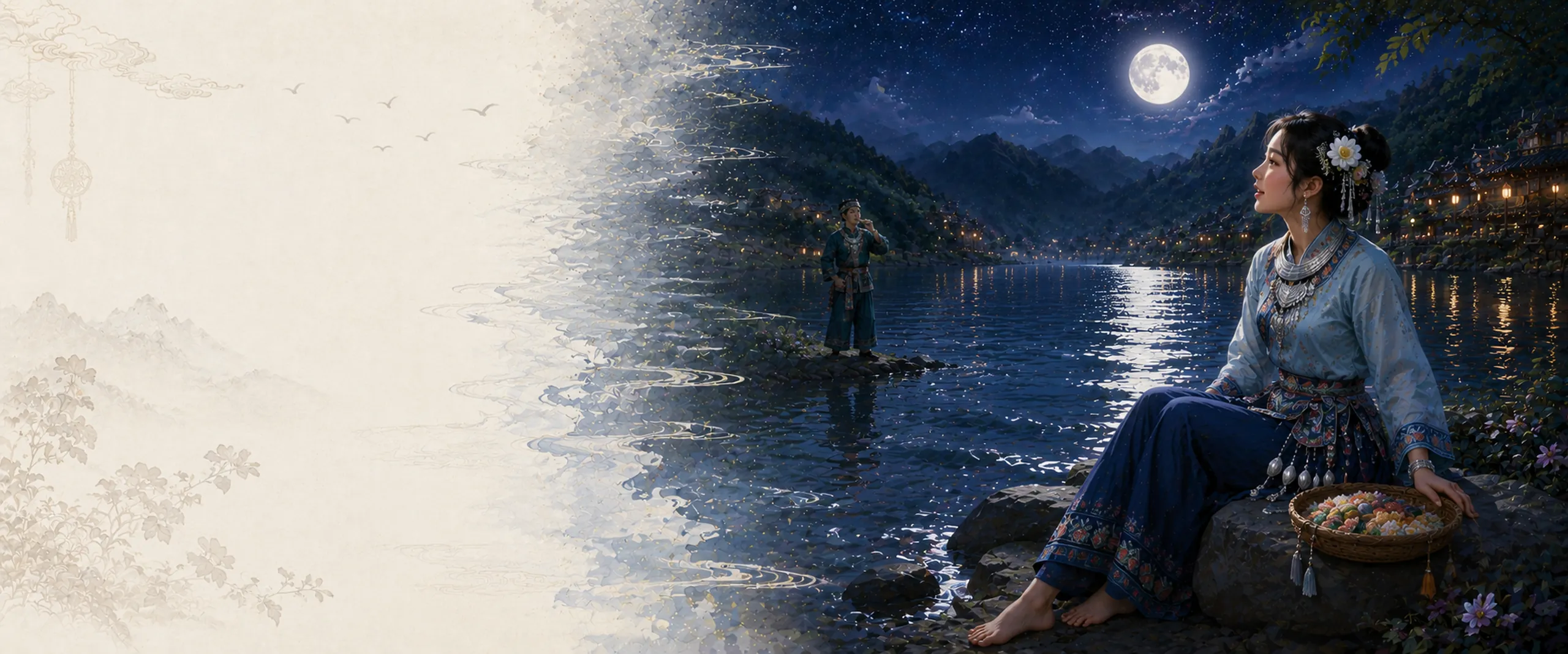
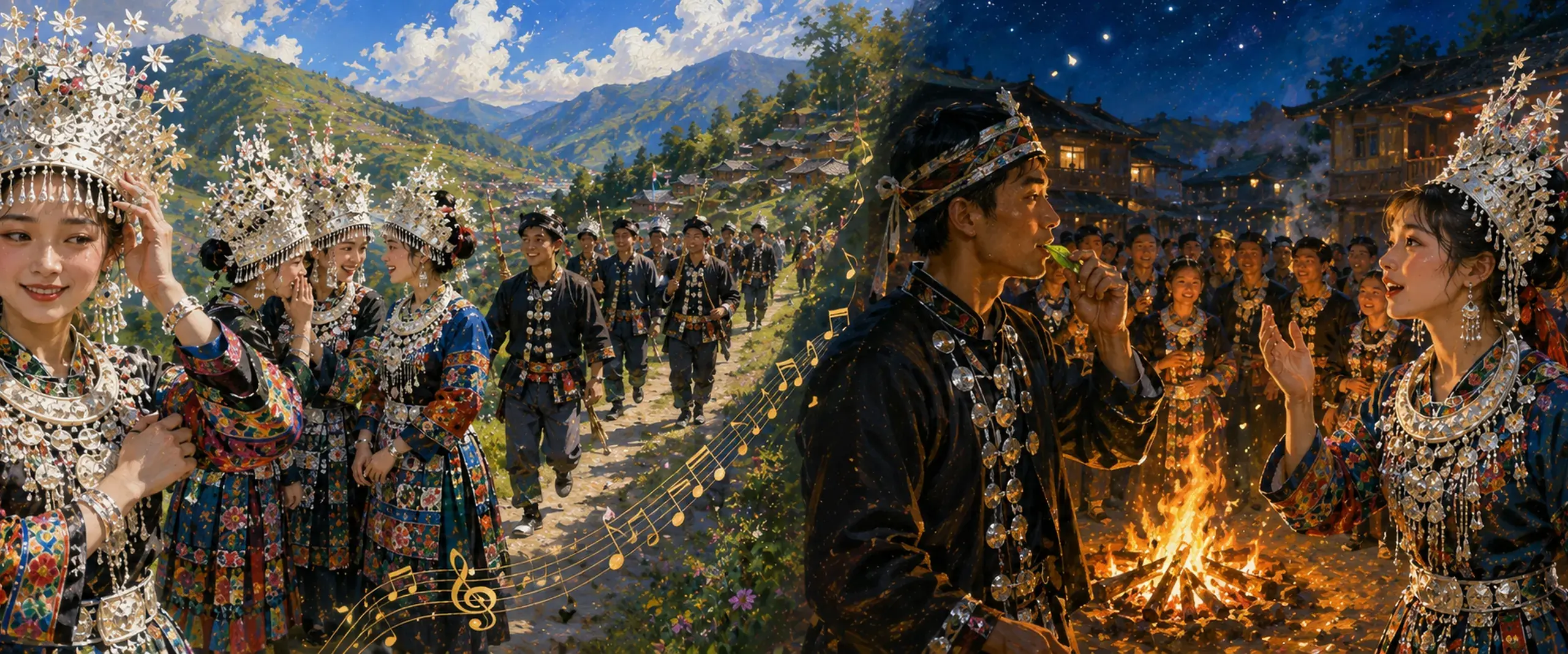
The Sisters’ Festival is a festival for young Miao women. During the festival, girls go into the fields to catch fish and shrimp and prepare “Sisters’ Rice.” Sisters’ Rice is glutinous rice in five colors—red, blue, yellow, black, and purple. Girls give Sisters’ Rice to young men they admire, with different colors or different objects wrapped inside the rice conveying different feelings and intentions. Youfang antiphonal singing is an important activity of the Sisters’ Festival—young men and women express their feelings through song and come to know and understand one another through their singing. People also perform Lusheng and wooden-drum dances, exchange tokens of affection, and make marriage engagements. According to ancient Miao songs, the custom of celebrating the Sisters’ Festival once existed wherever Miao communities lived and has a history of more than a thousand years.
Main Customs
The Name of the Sisters’ Festival: A Thousand-Year Tradition from “Nongx Gad Liangl” to “Eastern Valentine’s Day”
“Nongx Gad Liangl”: The Festival Code in the Miao Language
The Sisters’ Festival is called “Nongx Gad Liangl” in the Miao language. In Miao, “Nongx” means “to eat,” “Gad” means “rice,” and “Liangl” means “to fulfill the wish for sisters and friends to gather together.” Taken together, “Nongx Gad Liangl” means “eating Sisters’ Rice to fulfill the wish for reunion.” This name precisely summarizes the festival’s dual meaning—eating Sisters’ Rice is its material vehicle, while the reunion of sisters and social interaction between young men and women form its spiritual core.
The Sisters’ Festival is also known as the “Sisters’ Rice Festival.” In Chinese-language contexts, it is also called “the oldest Eastern Valentine’s Day.” “Sisters’ Rice Festival” emphasizes the festival’s most distinctive food culture, while “Valentine’s Day” highlights its theme of free courtship and love.
From “Slope Gatherings” to the “Sisters’ Festival”: The Evolution of the Festival
The Sisters’ Festival did not emerge from nowhere. Its predecessor was the ancient Miao “slope gathering.” The “slope gathering” was a traditional form of Miao social interaction, an occasion when young men and women gathered on hillsides to sing antiphonally and socialize. Over time, the “slope gathering” gradually evolved into the Sisters’ Festival, centered on women and marked by the eating of Sisters’ Rice.
The Sisters’ Festival covers a broad area. Across several hundred villages and among more than one hundred thousand Miao people, ritual customs vary in complexity while remaining broadly similar, and the legends also differ slightly. Different Miao branches within Taijiang County celebrate the Sisters’ Festival at different times, mostly between the first and fifth lunar months. Among them, the Sisters’ Festival in the Shidong area of Taijiang County is the most representative and influential. Since ancient times, Shidong Town has been an important center in Guizhou. With convenient transportation and a large population, it serves as an important festival gathering place for Miao communities from the surrounding villages and townships.
The Multiple Meanings of “Sisters”
The word “sisters” in the Sisters’ Festival has multiple meanings. Its most direct meaning refers to sisters themselves—married sisters return to their natal homes for reunion. At a deeper level, it also points to romantic relationships between young men and women—in the Miao language, “sisters” can be used to refer to couples or lovers. Through Sisters’ Rice as a token of affection, the Sisters’ Festival ingeniously links sisterly bonds with romantic love between men and women.
*The Song of the Sisters’ Festival*: A Love Epic of Resistance to Arranged Marriage
The origin of the Sisters’ Festival is closely connected with the Miao folk narrative The Song of the Sisters’ Festival. This narrative poem of more than five hundred lines is the festival’s most central cultural narrative.
Jindan and Ajiao: Pioneers of Free Love
According to The Song of the Sisters’ Festival, long ago there were two children of maternal aunts—the boy was named Jindan and the girl Ajiao. They had grown up together as childhood sweethearts, innocent companions from an early age, and when they grew older they fell in love with one another. Jindan was determined to marry Ajiao, and Ajiao was equally determined to marry no one but Jindan.
Their love, however, was opposed by their parents and clanspeople. Ajiao’s parents wanted her to marry back into her maternal uncle’s family—an ancient Miao custom known as “returning to the maternal uncle’s line.” Under the traditional Miao marriage system, a maternal uncle held a preferential right over the marriage of his niece. A niece had to obtain her maternal uncle’s consent before marrying and was often expected to marry his son. Ajiao did not want to marry into her uncle’s family and insisted on marrying Jindan; Jindan likewise refused to marry anyone else and continued waiting for Ajiao.
For the sake of their faithful love, they secretly met every day. Fearing discovery by their parents and village elders, they arranged to meet in the countryside to talk of love. Each time, Ajiao secretly hid food inside the bamboo basket she used for her sewing supplies and brought it to Jindan. Year after year, after enduring hardships and carrying on an unyielding struggle, they finally became husband and wife. This gave rise to the story of “Sisters’ Rice”: in the Miao language, food carried secretly to a lover is called “hidden rice,” while its Chinese free translation became “sisters.”
The Legend of Eight Hundred Men and Women: The Formation of the Sisters’ Festival
Later, after an unknown number of years, legend says that in the Shidong area of Taijiang County there were eight hundred girls who could not find boyfriends and therefore could not marry. In Sanbing Datang, there were also eight hundred young men who remained single because they could not find wives. The elders remembered the story of Ajiao and Jindan and their “Sisters’ Rice” and taught the girls to follow their example, inviting the eight hundred young men of Sanbing Datang to come and eat “Sisters’ Rice.” In this way, everyone found the person they loved, and pair after pair became married couples. From then on, eating “Sisters’ Rice” evolved into a festival activity whose main purpose was for young men and women to choose romantic partners.
Young Miao men and women admired Ajiao and Jindan’s devotion to love and began imitating them by meeting on the hillsides, giving rise to the Sisters’ Festival. This story directly connects the love legend of Jindan and Ajiao with the formation of the Sisters’ Festival, transforming the festival from a simple occasion of migration and reunion into a romantic festival centered on free love.
The Legend of the Geyi Area: Sisters Open Fields to Attract Visitors
In the Geyi area of Taijiang County, another legend about the origin of the Sisters’ Festival is widely told. It is said that there was once a large Miao village in Geyi whose men went every year to hunt in places very far away and did not return for long periods. The village had seventy beautiful young sisters. They climbed the mountains to gather fruit, worked in the fields, spun yarn, wove cloth, made appliqué, and embroidered, yet they could never feel entirely cheerful because they had already reached marriageable age. The sisters therefore invited one another to open up farmland. They cultivated a very large field, raised many fish, and sowed glutinous-rice seed. In autumn, the harvested glutinous rice filled granary after granary, and they brewed jar after jar of glutinous-rice wine. They had food, drink, and clothing, yet the sisters still felt that something was missing, and songs and laughter were rarely heard. This legend connects the Sisters’ Festival with Miao agricultural life and the spirit of female independence and autonomy, reflecting the multiple cultural functions of the festival in Miao society.
A Legacy of Matrilineal Clan Society: The Ancient Origins of the Sisters’ Festival
The oldest origins of the Sisters’ Festival can be traced back to the period of primitive matrilineal clans and matriarchal society. This is the deepest cultural gene of the festival.
Echoes of Matriarchal Society in the Festival
The origins of the Miao Sisters’ Festival can be traced back to primitive matrilineal clan society and matriarchal society. During the period of matrilineal clan society, women occupied a dominant position in social life. Marriage forms were based primarily on visiting relationships and paired marriage, and interaction between men and women was relatively free. The Sisters’ Festival is precisely a surviving remnant of this ancient social form within festival culture.
The Sisters’ Festival centers on young women. It is collectively planned, presided over, participated in, and transmitted by women; mothers pass it orally and personally to their daughters; and through gatherings held at fixed times, it has been transmitted generation after generation to the present day. Judging from the various rituals and customs of the Sisters’ Festival, sisters occupy the leading role: they are the planners and organizers of the festival, and men must act according to the girls’ wishes. This female-centered festival structure is a living continuation of the cultural genes of matrilineal clan society.
From Matriarchy to Patriarchy: A Witness to Changes in Courtship and Marriage Customs
The Sisters’ Festival vividly reveals the emotional and romantic lives of men and women during humanity’s transition from matrilineal clan society to patrilineal clan society. In matrilineal clan society, women possessed the initiative in choosing spouses. With the establishment of patrilineal clan society, systems such as arranged marriage and marriage by purchase gradually replaced free courtship. The Sisters’ Festival is a living witness to this social transformation—it preserves the matrilineal tradition in which women actively chose their spouses while also reflecting women’s struggles for marital freedom under patriarchal society. The Sisters’ Festival is a living fossil of the ancient Miao marriage system. Its central theme—resistance to arranged marriage and pursuit of free love—is a vivid portrayal of changes in the marriage system during the transition of Miao society from matriarchy to patriarchy.
Preparations Before the Festival: Careful Arrangements for Welcoming the Celebration
Preparations for the Sisters’ Festival begin several days or even several months before the festival, and the entire Miao village becomes immersed in anticipation and busyness as the celebration approaches.
Preparing Silver-Ornament Festive Dress
The Sisters’ Festival is the most important occasion for Miao women to display their full silver-ornament festive dress. To prepare for the annual Sisters’ Festival, older family members begin several months, or even half a year, in advance to acquire additional silver ornaments and embroidered garments for their daughters. A Miao woman’s complete silver-ornament costume is a work of art combining family wealth, craft inheritance, and aesthetic expression. A complete ensemble includes dozens of silver ornaments such as a silver headdress, silver horns, silver neck rings, silver bracelets, a silver belt, and silver earrings, and may weigh several kilograms.
For families with limited financial means, such elaborate “full ceremonial adornment,” often costing tens of thousands of yuan, may require several years or even several generations to accumulate. A few days before the Sisters’ Festival, older women in the household begin taking out the various silver ornaments to clean, organize, and assemble them. Married daughters also return to their natal homes for the festival. With the help of their mothers and sisters, the girls dress themselves, put on complete sets of silver ornaments, and prepare for the arrival of the festival.
Wu Shuigen, a silversmith from Shidong Town and an inheritor of intangible cultural heritage, has long produced silver ornaments for the festival. Miao silver-forging craftsmanship is a form of national-level intangible cultural heritage, and its techniques preserve thousands of years of Miao cultural memory.
Making Five-Colored Sisters’ Rice
Five-colored Sisters’ Rice is an indispensable food and symbol of the Sisters’ Festival. As the festival approaches, Miao girls go into the mountains and countryside to gather various flowers, leaves, and plants, including Chinese blueberry leaves, “sister flowers,” and butterfly-bush flowers. Chinese blueberry leaves are used to dye the rice black, sister flowers are used to produce red or yellow, and butterfly-bush flowers are used for yellow.
There are two methods of preparation: soaking in cold water and boiling in hot water. The girls process the various plants separately to produce juices of different colors. The glutinous rice is then soaked separately in these liquids. After one or two days, the coloring has completely penetrated the rice. The rice is then removed and strained separately, rinsed with clean water to wash away excess coloring liquid on the surface, and the different batches of colored glutinous rice are mixed evenly and steamed in a wooden steamer, producing glossy and fragrant five-colored Sisters’ Rice.
This Sisters’ Rice, colored with the juices of various wild flowers and plants, is not only brilliantly colored, fragrant, and delicious, but can also be stored for a long time without spoiling and is believed to have the benefits of improving eyesight and strengthening the body.
Catching Fish and Shrimp in the Fields
Early in the morning on the day of the festival, girls arrange to go together into the fields to catch fish and shrimp. Girls from one village arrange to meet young men from another village, using the occasion of catching fish and shrimp to court and express affection. No matter whose fields they enter to catch fish, they are welcomed. Early in the morning, the girls go to a neighboring village and enter the fields with the young men there to catch fish, play in the water, and talk of love. Fish have many eggs and therefore symbolize abundance; local people believe that eating fish symbolizes a flourishing population.
Drum Dancing: A Grand Stage for Beauty and Social Interaction
Drum dancing is one of the most emblematic collective activities of the Sisters’ Festival and the best occasion for Miao women to display beauty, ingenuity, and family wealth.
The Origins and Meaning of Drum Dancing
The drum dance performed during the Sisters’ Festival is one of its sacrificial rituals, expressing reverence for the ancestors through collective dancing around and to the drum. Miao ancestors believed that the souls of their forebears had not died but lived within maple-wood drums. They beat the wooden drums and enthusiastically performed dances such as the “Four-Direction Dance,” “Six-Direction Dance,” “Eight-Direction Dance,” and “Shrimp-Catching and Fish-Catching Dance” in order to please the ancestors and thereby gain their protection for future generations. Drum dancing is also an activity through which young Miao men and women display their intelligence and abilities before the public.
The Drum-Dancing Scene
After the morning activities of catching and eating fish have ended, Miao girls, with the help of their mothers, dress and adorn themselves in their complete silver-ornament festive costumes in preparation for the afternoon drum dance. Drum dancing is a collective social activity through which Miao women in Shidong engage in courtship. During the three days from the fifteenth to the seventeenth day of the third lunar month, three drum-dancing gatherings are held successively at Laotun Township, Yangjiazhai in Shidong, and Pianzhai.
People disregard both the long journey and the heavy weight of their silver ornaments, traveling from homes dozens of li away to reach the drum-dancing grounds. During the dance, participants form concentric circles spreading outward from a wooden drum at the center. Unmarried young women stand in the inner circles, while middle-aged women who have already become mothers occupy the outermost circles. Accompanied by the beat of the drum, the girls dance in measured steps, enjoying the sense of honor and attraction brought by the silver ornaments covering their bodies.
Beauty Display and Spouse Selection
The area surrounding the drum ground is also crowded with unmarried young men, who use the occasion to search for the woman they desire. A girl who is beautiful, dances well, and wears particularly abundant or impressive silver ornaments is more likely to become the object of male attention. From the drum grounds, one can see whose clothing is the most splendid and whose silver ornaments are both the most beautiful and the most numerous. In this way, the Miao display their clothing culture. Drum dancing is therefore not merely a dance but a grand stage on which Miao women display beauty, intelligence, and family wealth.
Youfang Antiphonal Singing: Words of Love Beneath the Moon and the Search for Romance
Youfang antiphonal singing is the most romantic activity of the Sisters’ Festival and the central means through which young men and women meet and fall in love.
The Form of Youfang
Whenever the Sisters’ Festival arrives and night falls, young men from distant places go to the girls’ village’s fixed “Youfang grounds,” where they signal by blowing leaves, whistling, and other means to invite the girls to gather. The two sides communicate through antiphonal love songs, one side singing and the other replying in turn. If they are mutually attracted, they may continue singing until the moon sets behind the hills.
The Youfang process is divided into several stages. It begins with tentative antiphonal singing to learn basic information about the other person; this is followed by deeper exchanges in which the two express their feelings; finally, they exchange tokens of affection and establish a romantic relationship. The content of the songs is extremely rich—some praise the other person’s appearance, some express admiration and affection, some test the other person’s feelings, and some speak of the pain of longing. Every love song is a dialogue of the heart, and every exchange of song is an exchange of emotion.
The Cultural Meaning of Youfang
Youfang is an important form of social interaction and spouse selection among young Miao men and women. In traditional society, Miao youth used Youfang to meet members of the opposite sex, establish emotional bonds, and make marriage engagements. Youfang is not only about courtship and romance; it is also an important occasion for young men and women to display talent and learn social skills. During Youfang antiphonal singing, participants improvise lyrics and compose lines spontaneously, testing their intelligence and talent. Miao marriages are largely based on free courtship, and Youfang is the cradle of free love.
After a certain degree of affection has developed through Youfang activities, a young man asks the woman he loves for Sisters’ Rice on the day of the “Sisters’ Rice Festival.” The Sisters’ Festival thus becomes an important point in the progression from first acquaintance to courtship and finally to the establishment of a romantic commitment.
Sisters’ Rice: A Five-Colored Token of Love
Sisters’ Rice is the most central symbol of the Sisters’ Festival and a token of affection given by girls to their romantic partners to express their feelings.
The Symbolism of the Five Colors of Sisters’ Rice
Each color in five-colored Sisters’ Rice has its own distinctive symbolic meaning. Traditionally, Sisters’ Rice appears in five colors: green, red, yellow, purple, and white. Green represents one’s beautiful homeland or the Qingshui River; red symbolizes prosperity and flourishing development; yellow symbolizes abundant harvests of the five grains; purple symbolizes wealth and plenty; and white symbolizes pure love. Every color speaks of a Miao girl’s attachment to her homeland, her longing for a good life, and her pursuit of pure love.
Five-colored Sisters’ Rice is dyed with natural plant-based coloring. It is not only brilliantly colored, fragrant, and delicious, but also healthy and environmentally friendly. This practice of coloring Sisters’ Rice with the juices of wild flowers and plants reflects the ecological wisdom through which the Miao people live in harmony with nature.
The Love Codes Hidden in Sisters’ Rice
Sisters’ Rice is also a token of affection given by girls to romantic partners to express their feelings and is the most important symbol of the festival. Girls hide different tokens inside the Sisters’ Rice to express different feelings toward the young men. This method of “conveying emotion through objects” perfectly combines food with love.
There are many different kinds of tokens placed inside Sisters’ Rice, each with a specific meaning. Pine needles hint at asking for embroidery needles; Chinese toon shoots indicate a marriage proposal; chili peppers convey the message of ending a relationship; and objects such as a single forked twig, a bamboo hook, scallions and garlic, and leaves also carry specific meanings.
There are also specific forms of etiquette governing the “asking for” and “giving” of Sisters’ Rice. A young man asks a young woman for Sisters’ Rice, and according to her feelings toward him, she hides different tokens in the rice. The following year, the man is expected to return the gift with a bamboo basket or other present, and repeated exchanges may eventually lead to marriage. This way of communicating affection through Sisters’ Rice is both subtle and romantic, reflecting the distinctive Miao aesthetic of “entrusting emotion to objects.”
Etiquette for Eating Sisters’ Rice
Eating Sisters’ Rice is an important ritual practice of the Sisters’ Festival. According to local people, eating Sisters’ Rice helps prevent insect bites. During the festival, the girls bring fine food and wine and five-colored Sisters’ Rice from their homes and arrange them on long-table banquets to warmly entertain the young men they have taken notice of at the drum-dancing grounds. Sisters’ Rice is not merely food; it is a vehicle of emotion and a witness to love.
Long-Table Banquets and Gate-Blocking Wine: Warm Festival Hospitality
During the Sisters’ Festival, the Miao people welcome guests from afar with the greatest enthusiasm.
Long-Table Banquets: A Shared Feast
The long-table banquet is an important food-centered activity during the Sisters’ Festival. The girls bring fine food, wine, and five-colored Sisters’ Rice from their homes and arrange them on long banquet tables. At the banquet, the freshness of fish in sour soup, the richness of cured pork, the softness of glutinous rice, and the sweetness of rice wine all embody the warmth and hospitality of Miao families. After the young men arrive at the girls’ homes, the host girls invite other sisters from the village to accompany them, and everyone drinks, eats Sisters’ Rice, and sings antiphonally.
In collective events, groups of men and women from neighboring villages arrange to meet. After informing the elders of both villages, the men bring a pig or a cow to the women’s village for Youfang courtship and to eat at the long-table banquet. The women, in turn, go into the fields to catch fish, steam glutinous rice, and prepare other foods for their guests. During the banquet, antiphonal singing begins with an ancient song recounting the origins of the Sisters’ Festival; only afterward may the singers improvise freely.
Twelve Rounds of Gate-Blocking Wine
The traditional Miao ritual for welcoming guests is “gate-blocking wine.” The welcoming process consists of twelve themed rounds of gate-blocking wine. These twelve rounds represent the highest form of Miao hospitality. Each round carries its own meaning—some represent blessings, some gratitude, and some remembrance. Guests must drink through all twelve rounds before entering the village. This ritual embodies the traditional Miao virtue of warm hospitality.
Gifts and Return Gifts
During the Sisters’ Festival, young men and women communicate their feelings through tokens placed inside Sisters’ Rice. Before leaving, each young man asks the girl he admires for a ball of glutinous rice. The girls hide objects symbolizing different intentions inside the rice, and the men interpret the girls’ feelings according to the tokens they receive. The following year, the men are expected to return gifts such as bamboo baskets, and repeated exchanges may eventually lead to marriage. This custom of exchanging gifts in both directions reflects the Miao social ethic of reciprocity.
Grand Costume Parades and Intangible Cultural Heritage Performances: A Contemporary Flourishing of the Sisters’ Festival
In recent years, the Sisters’ Festival has become one of the most concentrated showcases of Miao intangible cultural heritage, including traditional clothing, silver ornaments, and embroidery. Grand costume parades involving thousands of people have become the festival’s most visually striking activity.
Grand Costume Parade of Thousands
The grand costume parade of thousands is one of the most emblematic activities of the contemporary Sisters’ Festival and a concentrated display of Miao clothing culture, silverwork craftsmanship, and folk customs. During the festival, thousands of Miao participants dress in full silver-ornament costumes and form a magnificent procession. In the parade, the girls’ silver headdresses glitter in the sunlight, pleated skirts sway gracefully with each step, and the crisp sounds of silver ornaments mingle with the melodious music of the Lusheng, creating a moving scroll of Miao culture.
The parade is not merely a display of clothing but also an important practice of cultural transmission. Using the festival as a medium and culture as a force for cohesion, it both revitalizes thousand-year-old Miao traditions and brings new vitality to the integration of culture and tourism. The grand costume parade of thousands has become one of the activities most popular with visitors during the Sisters’ Festival.
Display and Transmission of Intangible Cultural Heritage Skills
The Sisters’ Festival is an important platform for showcasing traditional Miao clothing, silver-forging techniques, hand embroidery, and other forms of intangible cultural heritage. During the festival, traditional crafts such as Miao silverwork, Miao embroidery, and batik are displayed together. Visitors can not only appreciate exquisite traditional handicrafts but also watch artisans carrying out the production process firsthand.
Miao silver-forging craftsmanship is a form of national-level intangible cultural heritage. During the Sisters’ Festival, silversmiths demonstrate the full process, from melting and hammering silver to engraving and inlaying. Miao embroidery is a craft passed down through generations of Miao women; with its exquisite patterns and rich colors, it is an important component of Miao culture.
The Cultural Showcase Function of the Sisters’ Festival
The Sisters’ Festival is not only a festival of love but also a major gathering that displays the colorful arts of Miao song, dance, and dress together with the rich and profound cultural heritage of the Miao people. The ancient and enduring arts of Miao singing, dancing, and dress, the vigorous and thrilling entertainment of dragon dances and bullfighting, the quiet warmth of rural life in the fields, and modern tourism activities seeking a return to simplicity all intertwine and interact.
The Sisters’ Festival is also a stage for community members to visit relatives and friends, enjoy cultural entertainment, and engage in social interaction. It serves as a bond that strengthens cohesion and solidarity within the ethnic community. Through the Sisters’ Festival, the Miao people not only transmit their own cultural traditions but also present the distinctive appeal of Miao culture to the wider world.
Other Folk Activities
Bullfighting
Bullfighting is an important competitive activity during the Sisters’ Festival. Miao bullfighting is known as “Eastern-style bullfighting.” It is a contest between bull and bull and stops once a winner is determined; whichever bull flees first is considered defeated. Bullfighting is accompanied by suona, drum, and other musical performances. It is not merely a contest of strength but also a remnant of Miao bull-totem worship, reflecting the Miao people’s admiration for strength, courage, and vitality.
Miao Song Competition
The Miao song competition is an important cultural activity during the Sisters’ Festival. The Miao people express feelings through song and make friends through singing. In the competition, singers improvise lyrics and compose verses spontaneously, displaying the Miao people’s outstanding oral literary talent. Miao songs cover historical legends, love stories, philosophies of life, and other subjects and are an important vehicle of Miao culture.
Boating
In Miao areas along the Qingshui River, boating is a traditional Sisters’ Festival activity. People paddle dugout canoes or small wooden boats on the river, chasing one another and playing. Boating is not only a recreational activity but also an occasion for young men and women to socialize.
Lusheng Dancing
Lusheng dancing is an important dance activity during the Sisters’ Festival. The Lusheng is one of the most important traditional Miao musical instruments, with a melodious and far-reaching tone. During Lusheng dancing, men play the Lusheng while women dance alongside them, forming a common style of male-female paired dancing during the festival.
Regional Variations
Shidong
The most representative; three drum-dancing gatherings over three days, Youfang antiphonal singing, exchanging tokens of affection, and making marriage engagements
Laotun
One of the places of origin of the Sisters’ Festival, with traditional rituals preserved in complete form
Geyi
Area where the legend of the sisters opening fields to attract visitors is transmitted
Other Miao branches in Taijiang
Dates vary from the first to the fifth lunar month, each with its own characteristics
Contemporary Transmission
### Recognition as National-Level Intangible Cultural Heritage
On May 20, 2006, the Miao Sisters’ Festival was approved by the State Council for inclusion in the first national list of intangible cultural heritage. Its item sequence number is 470, its project number is X-22, and its safeguarding institution is the Taijiang County Intangible Cultural Heritage Protection Center.
The Sisters’ Festival has been praised by scholars in China and abroad as “the world’s oldest Eastern Valentine’s Day” and “a festival hidden within the heart of a flower.” It is a core vehicle of Miao culture in Taijiang and an important platform for presenting the image of Taijiang, transmitting the cultural lineage of the ethnic group, witnessing beautiful romantic bonds, and promoting ethnic unity.
### The Flourishing of the Contemporary Sisters’ Festival
Far from declining in contemporary society, the Sisters’ Festival has continued to expand. The 2026 Miao Sisters’ Festival took “Sisters’ Flowers Bloom · Love Is Sealed in Taijiang” as its theme. The entire opening ceremony was structured around four major chapters, with fourteen high-quality cultural and artistic programs staged in succession, perfectly integrating Miao historical legends, song and dance arts, intangible cultural heritage, and the vitality of the present era.
This edition of the Sisters’ Festival was rooted in local Miao culture while taking into account both the transmission of traditional cultural lineages and innovative contemporary forms of expression. Through forms such as original-style Miao antiphonal singing and folk-custom performances, it integrated the thousand-year cultural heritage of the Miao people with the spirit of the new era, allowing outstanding ethnic culture to gain new vitality and demonstrate renewed energy.
Since the festival was included in the first national list of intangible cultural heritage in 2006, it has continued to display the profound heritage and contemporary vitality of Miao culture, attracting visitors from all directions to join the Sisters’ Festival. The festival has become an important platform for showcasing Miao culture, promoting ethnic unity, and advancing the integration of culture and tourism.
### The Integration of Tradition and Innovation
As times have changed, the Sisters’ Festival has continued to incorporate new elements while preserving its traditional core. Its activities include traditional central events such as grand costume parades, mass antiphonal singing involving thousands of people, and long-table banquets, as well as newly added sports competitions and commercial activities such as intangible cultural heritage performances and Village BA basketball games.
Centering on the integration of Miao culture and fashion, the Sisters’ Festival displays the local character of Taijiang and the spirit of the times, creating a cultural feast that crosses ethnic boundaries. Tradition and modernity are organically combined within the festival—it retains traditional core content such as ritual activities, singing and dancing, and Youfang while also introducing new elements such as modern artistic performances and sporting competitions.
Closing Note
The folk activities of the Miao Sisters’ Festival form a long cultural scroll about “love” and “beauty.” From the love codes of five-colored Sisters’ Rice to words of affection exchanged beneath the moon during Youfang antiphonal singing, from the shimmering silver of drum-dancing beauty displays to the warm hospitality of long-table banquets, from the visual spectacle of grand costume parades involving thousands of people to the heavenly voices of Miao song competitions—the customs of the Sisters’ Festival bring together the Miao people’s pursuit of free love, longing for a better life, respect for the value of women, and commitment to cultural transmission.
The Sisters’ Festival is a festival of “love.” The story of Jindan and Ajiao, who secretly met in resistance to arranged marriage and pledged their love through “hidden rice,” has inspired generation after generation of young Miao people to courageously pursue their own love. Every grain of rice and every token hidden within five-colored Sisters’ Rice carries a girl’s most sincere feelings for the person she loves. Every lyric and every note in Youfang antiphonal singing is a passionate expression of love by young men and women. The Sisters’ Festival is a festival of affection and love, a folk-cultural scroll depicting humanity’s romantic and emotional life.
The Sisters’ Festival is also a festival of “beauty.” The dazzling brilliance of silver-ornament festive dress, the graceful movement of pleated skirts, the brilliant colors of five-colored Sisters’ Rice, and the elegant postures of the drum dance—the Sisters’ Festival is a stage on which Miao women display beauty, intelligence, and talent. Just as the festival has been described as “a festival hidden within the heart of a flower,” it is like a blossom concealed within the flower’s heart, subtle and beautiful, waiting to be discovered and appreciated at the most appropriate moment and with the most reverent spirit.
The customs of the Sisters’ Festival achieve a perfect integration of “love” and “beauty.” Love is the inner essence of beauty, while beauty is the expression of love; love gives beauty its soul, and beauty gives love its form. In 2006, the Miao Sisters’ Festival was included in the first national list of intangible cultural heritage. From its ancient legacy in matrilineal clan society to its contemporary status as national-level intangible cultural heritage, from the love legend of Jindan and Ajiao to its reputation as “the world’s oldest Eastern Valentine’s Day,” the Sisters’ Festival has crossed thousands of years and continues to flourish along the banks of the Qingshui River through its distinctive cultural vitality. The customs of the Sisters’ Festival are both a concentrated expression of the Miao tradition of “free courtship” and a lived expression of the aesthetic wisdom of “entrusting emotion to objects.” Between love and beauty, the Sisters’ Festival carries out, time and again, profound dialogues about love, life, and culture.
——
Readers’ Comments
Calendar and traditional culture enthusiasts from around the world, sharing the same moon.
Sign in or register to join the conversation. Your comment account is created automatically the first time you use a connected account.
No comments yet
Share your thoughts with readers around the world.