Sisters’ Festival

Sisters’ FestivalCuisine of the Sisters’ Festival

「 姊妹节里姊妹饭,五彩斑斓寄深情。 」

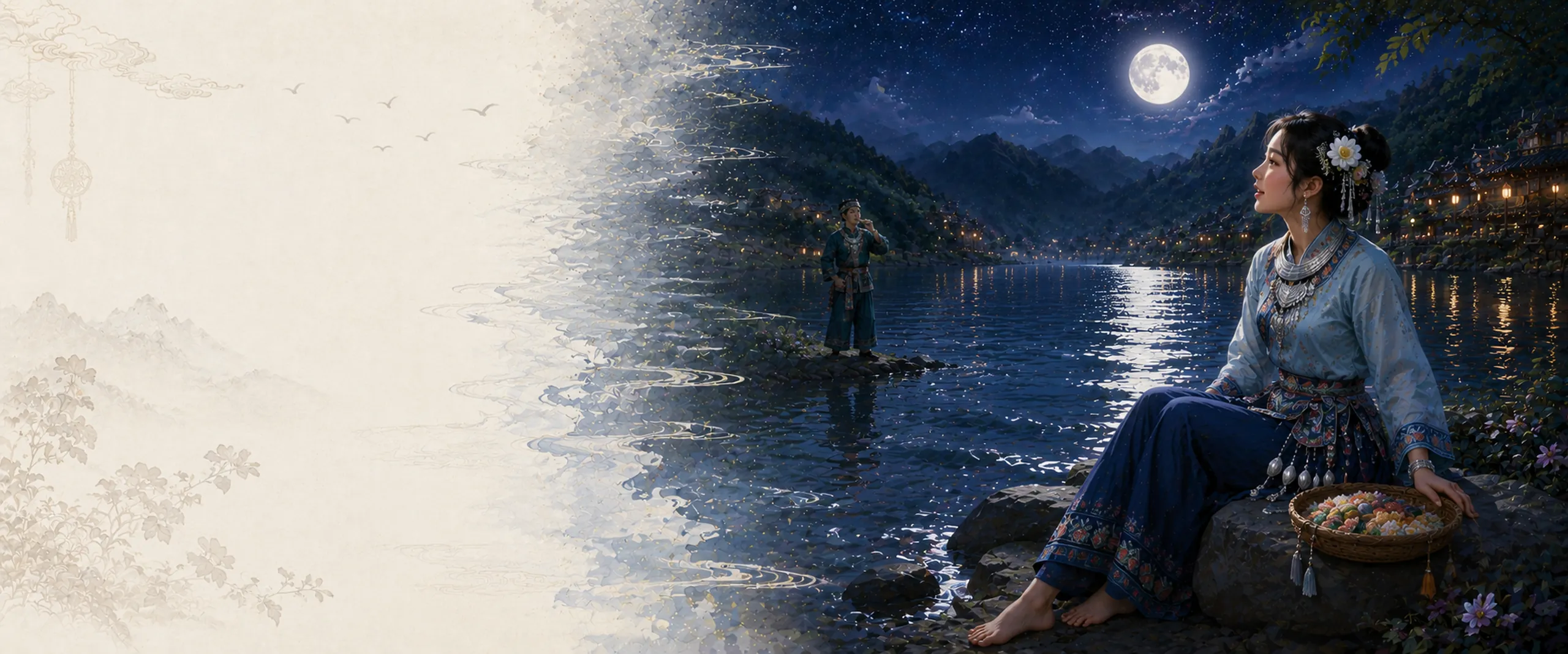
The Sisters' Festival is a traditional festival of the Miao people, celebrated in the Qiandongnan Miao and Dong Autonomous Prefecture of Guizhou, generally held around the 15th day of the third lunar month. The most distinctive custom of the…

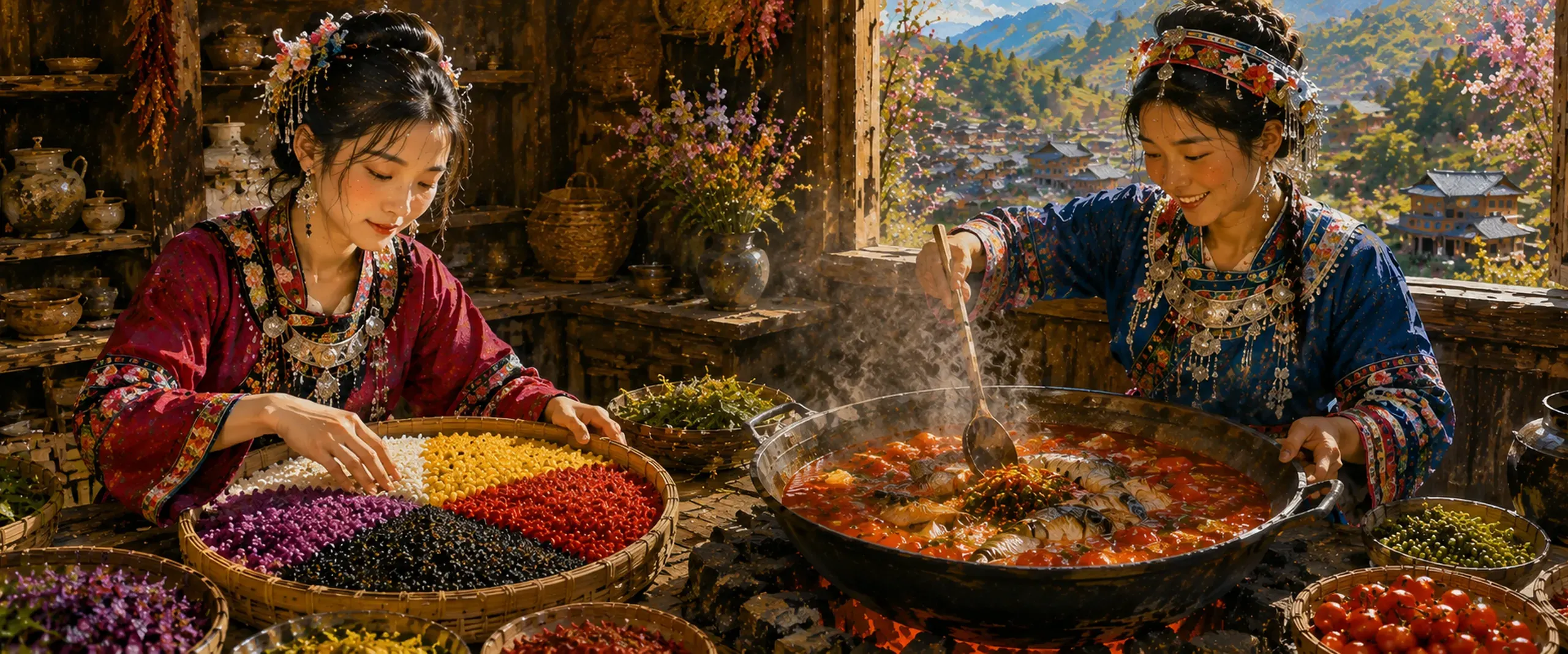
Five-Colored Sisters’ Rice is the most iconic food of the Sisters’ Festival. Before the celebration begins, Miao girls head into the mountains to gather leaves of Nanzhu shrubs, Sisters’ Flowers, and other plants. The leaves and blossoms are chopped, their natural pigments extracted, and separate portions of glutinous rice are soaked in the resulting juices before being steamed into five colors: black, red, yellow, blue, and white. The finished rice carries a fresh, delicate fragrance.

Each color has its own meaning. Yellow symbolizes prosperity within the household and abundant harvests, while green represents the beauty of the homeland. The girls then present Sisters’ Rice to young men they admire, using either the color of the rice or small objects hidden within it to convey different emotions and intentions.

The festival table extends well beyond Sisters’ Rice. It may also include tuotuo meat boiled simply in water, fish and shrimp, cured pork, pickled vegetables, and rice wine. As the saying goes, “吃了一餐姊妹饭,了却一年相思情”—after sharing one meal of Sisters’ Rice, a year’s longing is finally eased. Through its delicacy and restraint, Five-Colored Sisters’ Rice gives one of the most romantic expressions to Miao traditions of courtship, affection, and culinary wisdom.

Sisters’ Festival / Cuisine of the Sisters’ Festival

Festival Food Gallery

Seasonal Menu

Food in Detail

Seeking the True Flavor

Five-Colored Sisters’ Rice

Grains & Staples

Basic Information

  • Category: Grain staple
  • Popular Areas: Miao communities in Taijiang County, Shibing County, and other parts of Qiandongnan, Guizhou
  • Main Ingredients: Glutinous rice; Sisters’ Flower (Mimeng flower); Wufanshu leaves; azalea; sappanwood; and other natural plant dyes
  • Also Known As: Sisters’ Rice, Five-Colored Glutinous Rice, Sisters Rice, Longgalang

Historical Origins

Five-Colored Sisters’ Rice is, without question, the central food of the Sisters’ Festival and one of the most romantic expressions of Miao culinary culture.

In the Miao language, it is called “垄嘎粮.” “垄” means to eat, “嘎” means rice, and “粮” refers to fulfilling the wish for sisters and friends to gather together. The Sisters’ Festival has a long history, preserving traditions associated with matrilineal clan society, and its origins can be traced back to early matrilineal and matriarchal social forms.

The origin of Sisters’ Rice is closely linked to a Miao love legend. According to one story, a young man named Jindan and a young woman named Ajiao grew up together and fell in love. Ajiao’s parents, however, intended to marry her into her maternal uncle’s family. Refusing to accept the arrangement, Ajiao often hid Five-Colored Glutinous Rice inside the bamboo basket she used for sewing supplies and secretly met Jindan.

Over time, her persistence finally moved her parents, and she and Jindan were eventually allowed to marry. The name “Sisters’ Rice” is said to have arisen from this story.

Another legend tells of eight hundred unmarried girls in Shidong who could not find husbands, while eight hundred young men in Sanbing Datang remained single because they could not find wives. The elders recalled the story of Ejiao and Jindan and taught the girls to invite the young men to eat Sisters’ Rice in the same way. In the end, everyone found the person they wished to marry.

An ancient Miao Song of the Sisters’ Festival sings:

Cultural Meaning

Five-Colored Sisters’ Rice is dyed with plants and typically appears in red, yellow, green, purple, and white, with each color carrying symbolic meaning.

As the festival approaches, Miao girls enter the mountains and fields to gather Nanzhu leaves, Jiniang or Sisters’ Flowers, Mimeng flowers, and other plants. The Miao call Mimeng flower Sisters’ Flower and use it to dye glutinous rice yellow. Mimeng flowers bloom each year around the third and fourth lunar months and are traditionally regarded as having the effects of clearing heat, nourishing the liver, reducing internal fire, and improving the eyes.

To prepare the dyes, the different plants are either soaked in cold water or simmered in hot water to extract their juices. Separate portions of glutinous rice are then immersed in the different liquids for one or two days, allowing the colors to penetrate fully.

The rice is removed and drained separately, rinsed in clean water to wash away excess pigment from the surface, then mixed in the desired proportions and steamed in a traditional steamer. The result is Five-Colored Sisters’ Rice: glossy, translucent, fragrant, soft, and pleasantly glutinous.

The most distinctive feature of Sisters’ Rice lies in its hidden “secrets.” Young women give Five-Colored Sisters’ Rice containing different tokens to young men in order to express their feelings.

If the hidden object is a pine needle, it tells the young man that he should repay the girl with an embroidery needle and silk thread. If it is a pair of chopsticks or red flower petals, the message is that he should hurry and arrange to marry her. If chili pepper or garlic is hidden in the rice, it tells him that the two are not meant for one another and that he should not waste his effort.

Cotton and coriander indicate an urgent wish to marry. A live duck may be attached as a sign that the giver hopes to receive a piglet in return at a later date.

Through these tokens, young men can understand the different feelings being conveyed without a word being spoken. Everything remains unspoken, yet everything is held within a veil of mystery. Sisters’ Rice is like a wordless love letter and has helped bring together countless happy marriages.

Five-Colored Sisters’ Rice carries several layers of cultural meaning. First, “a token of love.” It is given by young women to those they favor and represents one of the fullest expressions of “communicating feeling through food.” Second, “abundant harvests.” The five colors symbolize plentiful grain and favorable weather. Third, “reunion among sisters.” As the song says, “年年来吃姊妹饭,不忘我们姊妹情”—year after year we eat Sisters’ Rice, never forgetting the bonds among sisters. The rice is therefore also a vessel for reunion and the expression of longing. Fourth, “the gifts of nature.” The use of natural plant dyes reflects the Miao ecological wisdom of “taking from nature and respecting nature.”

Regional Evolution

The song makes clear that the Sisters’ Festival is not only a festival of love, but also one of reunion among sisters.

Simple Preparation

  • Ingredients: 500 g glutinous rice; Sisters’ Flower (Mimeng flower); Wufanshu leaves; azalea; sappanwood; and other natural plants
  • Steps:
  1. Gather Sisters’ Flowers, Wufanshu leaves, azalea, sappanwood, and the other plants separately.
  2. Simmer each plant separately to extract its color, or soak it in cold water, producing black, yellow, red, purple, and white liquids.
  3. Divide the glutinous rice into five portions and soak each in a different liquid for 4–6 hours.
  4. Drain each portion separately, then combine them in the desired proportions.
  5. Steam for approximately 30–40 minutes until the rice becomes glossy and translucent.

Fish in Sour Broth

Soups, Broths & Congee

Basic Information

  • Category: Soup pot / hot pot
  • Popular Areas: Qiandongnan, Guizhou, especially Taijiang and Kaili
  • Main Ingredients: Rice-field carp, or sturgeon or snakehead fish; white sour broth; red sour broth; small tomatoes; mujiangzi
  • Also Known As: Miao Fish in Sour Broth, Kaili Fish in Sour Broth

Historical Origins

Fish in Sour Broth is one of the soul dishes of the Sisters’ Festival long-table banquet and a concentrated expression of Miao “sour-food culture.”

Guizhou has a folk saying: “三天不吃酸,走路打蹿蹿。” Among the many dishes of Miao cuisine, sour broth is particularly renowned. Rich in sour fragrance, it is one of the traditional signature flavors of the Miao table.

Living in the mountains, Miao communities have long treated Fish in Sour Broth as an essential main dish for receiving relatives, friends, travelers, and other guests.

Its origins are closely tied to the survival knowledge of Miao ancestors. During long periods of migration, they discovered that fermented sour broth could not only help preserve food for extended periods, but could also give ingredients a distinctive flavor.

The principal ingredients used in Fish in Sour Broth—rice-field carp, white sour broth, red sour broth, small tomatoes, and mujiangzi—all come from the local area. The Miao people of Taijiang particularly enjoy sour and spicy flavors. Miao women traditionally ferment rice water into sour broth, then use it to cook fish from the rice fields.

Cultural Meaning

Rice-field carp raised directly in paddy fields is considered especially suitable because its flesh is tender and free of muddy odor.

The broth is made from local white sour broth or red sour broth and seasoned with small tomatoes, mujiangzi, and other ingredients. Preparing the sour base itself takes time. Rice water may be fermented into sour broth, or tomatoes, chili peppers, mujiangzi, and other ingredients may be sealed in jars and naturally fermented until a deeply aromatic sour broth develops.

At long-table banquets during the Sisters’ Festival, Fish in Sour Broth rolls through waves of red liquid, while sour-broth hot pots bubble steadily beside it.

Fish in Sour Broth carries several cultural meanings. First, “a flourishing life.” The red color of the broth symbolizes days filled with prosperity and vitality. Second, “sour and spicy to awaken the appetite.” Its bright combination of sourness, heat, and freshness reflects the Miao culinary principle that “no banquet is complete without sourness.” Third, “surplus year after year.” Because the Chinese words for “fish” and “surplus” are homophones, fish carries wishes for a plentiful and beautiful life.

Simple Preparation

  • Ingredients: 2–3 rice-field fish, carp, or snakehead fish; 500 ml white or red sour broth; mujiangzi; small tomatoes; sliced ginger; garlic; salt
  • Steps:
  1. Scale and gut the fish, remove the gills, wash thoroughly, and make several cuts across the body.
  2. Pour the sour broth into a pot, add ginger, garlic, and mujiangzi, and bring to a boil over high heat.
  3. Add the fish and cook until the flesh changes color and is fully done, about 5–8 minutes.
  4. Add the chopped small tomatoes and cook until just softened. Season with salt.
  5. The dish may be eaten directly from the simmering pot with chili dipping sauce.

Long-Table Banquet

Others

Basic Information

  • Category: Composite banquet
  • Popular Areas: Miao communities in Taijiang, Shibing, and other parts of Guizhou
  • Main Ingredients: Five-Colored Sisters’ Rice, Fish in Sour Broth, Miao King Fish, miancai ba, zhalazi, water-pickled vegetables, pickled fish, cured pork, free-range farm chicken
  • Also Known As: Ten-Thousand-Person Miao Long-Table Banquet, Thousand-Person Long-Table Banquet

Historical Origins

The long-table banquet represents the highest form and most solemn etiquette of Miao feasting and has a history of several thousand years. A thousand-person Miao long-table banquet is generally set out only for major festivals, collective social gatherings, receptions for distinguished guests, and other important occasions.

During the Sisters’ Festival, the thousand-person long-table banquet becomes one of its grandest expressions.

Tables are arranged in long, continuous lines through Taijiang County town, Shidong Town, and other places. During the 2024 Sisters’ Festival alone, long-table banquets in the county seat and surrounding towns received more than 6,800 diners.

At the vast Miao long-table banquet, visitors sit along tables stretching like a dragon and experience the spectacle of thousands of people sharing wine and food together.

Cultural Meaning

The range of dishes is exceptionally rich. Among the principal foods are Sisters’ Rice, plain-cut chicken served with slices of boiled pork, tofu with bamboo shoots, Miao King Fish, chicken congee, zhalaba, and dozens of other dishes.

The banquet may also include miancai ba, zhalazi, water-pickled vegetables, free-range farm chicken, and other local specialties. The distinctive Miao long-table banquet attracts visitors from across China to experience its food.

Yet the banquet is not only about sharing dishes; it is also a site of cultural exchange. As visitors join thousands of others in eating and drinking together, they sing antiphonal drinking songs with local Miao residents and listen to the melodious sound of the lusheng.

Laughter and conversation continue throughout the meal, while Miao girls warmly pour wine for the guests.

The long-table banquet carries some of the highest ideals of Miao food culture. First, “gathering and sharing.” Thousands of people seated together and sharing a meal represent the fullest expression of the Miao ideal of “gathering all things and sharing the harvest.” Second, “community cohesion.” The banquet brings together Miao people from villages scattered across the region and renews communal bonds through shared food. Third, “food as a medium.” As the saying goes, “以美食为介,共叙团结情”—using fine food as a bridge, people speak together of unity. The banquet continues the tradition of “using food as a medium and the feast to gather affection.”

Lanmen Wine

Drinks & Fine Wines

Basic Information

  • Category: Drinking etiquette
  • Popular Areas: Miao communities across Qiandongnan, Guizhou
  • Main Ingredients: Miao rice wine, ox-horn cups
  • Also Known As: Twelve-Round Lanmen Wine, Road-Blocking Wine

Historical Origins

Lanmen Wine is one of the highest forms of Miao hospitality. During the Sisters’ Festival, Miao girls dressed in ceremonial clothing stand at the village entrance holding ox-horn cups, setting out lanmen wine to welcome each guest with fragrant rice wine and melodious toasting songs.

The twelve rounds of lanmen wine derive from the Miao Twelve-Road Ancient Songs and represent the “highest etiquette” used by the Miao when receiving guests.

Young women holding ox-horn cups line the path to welcome travelers from afar. They offer wine, mark guests with red flowers, hang colored eggs, and present Sisters’ Rice, fully expressing the warmth of Miao hospitality.

Guests are expected to finish the wine in their cups before entering the village. The act conveys blessing and respect and displays the generous hospitality of Miao custom.

Cultural Meaning

“High Mountains and Flowing Water” is one of the most distinctive forms of toasting during the Sisters’ Festival. This Miao style of pouring wine represents the warmth and generosity of their drinking culture.

For honored guests, Miao hosts prepare lanmen wine and the distinctive “High Mountains and Flowing Water” ceremony, offering auspicious blessings that may also include hanging red eggs—a symbol of good fortune, healthy growth, auspiciousness, safety, and happiness.

Lanmen wine and “High Mountains and Flowing Water” carry the deeper meaning of “making friends through wine.” First, “the highest etiquette.” The twelve rounds of lanmen wine represent the highest form of welcome extended to guests. Second, “wine of blessing.” Every bowl is an expression of sincere good wishes from the Miao people. Third, “the soul of hospitality.” Wine is the unspoken ceremonial song of the Miao household, and “High Mountains and Flowing Water,” through its distinctive form and auspicious symbolism, has become one of the most honored ways of offering a toast.

Pickled Fish

Meat & Seafood

Basic Information

  • Category: Fermented fish product
  • Popular Areas: Miao communities in Qiandongnan, Guizhou
  • Main Ingredients: Rice-field carp, salt, chili powder, Sichuan peppercorn, glutinous rice, sweet rice wine
  • Also Known As: Miao Pickled Fish, Sour-Pickled Fish

Historical Origins

Pickled fish is one of the most distinctive traditional Miao foods and holds an important place on the Sisters’ Festival long-table banquet.

Taijiang pickled fish is a traditional dish for receiving guests. Each year, Miao families raise carp in their rice fields, and once the fish reach maturity, the freshly caught carp are made into pickled fish.

The technique has a long history and follows the traditional method of “three cures, three dryings, and glutinous-rice fermentation.” In the first curing stage, the fish is cleaned and seasoned with salt, Sichuan peppercorn, and shancangzi for three days. In the second, glutinous rice, chili powder, and rice wine are mixed in before the fish is packed tightly into an earthenware jar. In the third, the jar is sealed and left to ferment naturally for six months to a year.

Cultural Meaning

To make pickled fish, fresh fish is washed, seasoned with an appropriate amount of salt, chili powder, Sichuan peppercorn, and other seasonings, then dried over heat until half-dry.

Sweet rice wine, glutinous-rice flour, and fermented sweet-rice lees are then spread over the fish before it is packed into a jar and tightly sealed.

Once fermentation is complete, the fish may be steamed before eating. Its aroma is rich and mellow, while the balance of salt and heat remains moderate.

Pickled fish and pickled meat combine sourness, spice, fragrance, and sweetness. They may be eaten hot or cold and can also be steamed, braised, roasted, or grilled. The spiciness is moderate, the skin crisp, and the bones soft.

Pickled fish carries the meaning of “the flavor of passing years.” Its preparation requires six months to a full year of patient waiting, making it a food whose flavor is quite literally brewed by time.

It is both an everyday food of Qiandongnan and an important main dish for entertaining guests. During the Sisters’ Festival, when young men and women gather together, pickled fish becomes an indispensable “taste of time” on the long-table banquet.

Miao Cured Pork

Meat & Seafood

Basic Information

  • Category: Salt-cured and smoked meat
  • Popular Areas: Miao communities in Qiandongnan, Guizhou
  • Main Ingredients: Black-haired pork belly, salt, Sichuan peppercorn, pine wood
  • Also Known As: Black-Haired Pork Cured Meat, Smoked Cured Pork

Historical Origins

Miao cured pork brings one of the strongest notes of “烟火气”—the warmth and lived-in atmosphere of the hearth—to the Sisters’ Festival long-table banquet.

Once a food prepared simply to sustain everyday life, smoked cured pork has become a valued dish for entertaining guests. Through its distinctive smoky flavor, it also conveys the affection with which the Miao welcome honored visitors arriving from afar.

During the Sisters’ Festival, glutinous rice in red, blue, yellow, black, and purple, tuotuo meat boiled in plain water, abundant fish and shrimp, cured pork, pickled greens, and rice wine come together to form the broader world of the Miao Sisters’ Festival meal.

Cultural Meaning

Miao cured pork carries several layers of cultural meaning. First, “memory of hearth smoke.” The meat hangs above the fire pit and is shaped by smoke and flame; every bite carries the flavor of home. Second, “a treasured food for guests.” Cured pork is one of the characteristic dishes served to visitors. Third, “the flavor of time.” Months of patient waiting are required, embodying the wisdom of “exchanging time for flavor.”

Miancai Ba

Pastries & Snacks

Basic Information

  • Category: Grain snack
  • Popular Areas: Miao communities in Qiandongnan, Guizhou
  • Main Ingredients: Glutinous rice, non-glutinous rice, miancai herb, also known as Qingming grass
  • Also Known As: Miancai ba, miancai ba

Historical Origins

Miancai ba is one of the characteristic snacks served at Sisters’ Festival long-table banquets.

It is made from glutinous rice, non-glutinous rice, and miancai, a wild edible plant. The finished cake is soft and glutinous, carries a fresh herbal fragrance, and has a distinctive texture.

At the vast Miao long-table banquet during the Sisters’ Festival, miancai ba appears alongside Sisters’ Rice, zhalazi, water-pickled vegetables, and other local specialties, together forming the rich landscape of Miao festival food.

Cultural Meaning

Miancai ba carries the meaning of “the beauty of wild greens.” Miancai is one of the most common wild plants found in spring fields. By working it into food, the Miao quite literally knead the breath of spring into the dish, reflecting the culinary wisdom of “taking from nature.”

Zhalazi

Others

Basic Information

  • Category: Condiment / side dish
  • Popular Areas: Miao communities in Qiandongnan, Guizhou
  • Main Ingredients: Chili peppers, glutinous-rice flour
  • Also Known As: Zhalaba

Historical Origins

Zhalazi is one of Taijiang’s most distinctive local foods. Smooth without being greasy, it is an indispensable side dish at Sisters’ Festival long-table banquets.

Made from chili peppers and glutinous-rice flour and fermented before serving, it is sour, spicy, and appetite-opening. At the festival banquet, zhalaba is one of the many dozens of characteristic dishes set along the table.

Cultural Meaning

Zhalazi carries the meaning of “the soul of sourness and spice.” Chili is an indispensable seasoning in Miao cuisine, and the preference for heat is closely connected to the geographical environment in which Miao communities live.

The character “渣” in zhalazi is also a homophone of “炸”, giving the food an additional auspicious association with a life that is “红红火火、热热闹闹”—flourishing, lively, and full of warmth.

Food Culture

Foodways

Viewed as a whole, the cuisine of the Miao Sisters’ Festival reveals a cultural logic that runs consistently through the celebration:

I. Feeling concealed within food. Five-Colored Sisters’ Rice is the festival’s most recognizable food, yet what makes it truly distinctive is not its color, but the “secrets” hidden inside it.

Young women place different tokens within the rice. Pine needles tell the young man that he should repay her with an embroidery needle and silk thread. A pair of chopsticks or red flower petals means, in effect, “Hurry and make arrangements to marry me.” Chili peppers or garlic, by contrast, communicate that the two are not suited to one another.

Sisters’ Rice is therefore like a wordless love letter, one that has helped bring together countless couples. The wisdom of “concealment” lies in the particular way Miao girls express emotion: nothing is spoken directly, yet everything is understood through suggestion and mystery. The food of the Sisters’ Festival is, at its heart, a way of hiding “feeling” inside “food.”

II. Beauty revealed openly. Corresponding to the “concealment” of Sisters’ Rice is the “revelation” embodied in festival dress. During the Sisters’ Festival, young women put on their most elaborate ceremonial clothing and present their finest selves.

A full set of Miao women’s festive dress can be worth close to 100,000 yuan, while silver ornaments are traditionally admired according to the principle that “the larger, heavier, and more numerous, the more beautiful.” During grand processions of thousands in ceremonial dress, members of nine Miao branches display their traditional clothing, silverwork, embroidery, and other forms of indigenous ethnic culture in all their richness.

The festival’s culture of “revealing” is therefore also a public stage on which Miao women display beauty, intelligence, and the wealth of their families.

III. Affection made into a banquet. The food of the Sisters’ Festival is more than sensory pleasure; it is also a vehicle for emotion. The festival is a major social gathering where young Miao men and women “express affection through food and meet friends through song.”

At the vast Miao long-table banquets, local specialties appear in abundance: Sisters’ Rice, miancai ba, zhalazi, water-pickled vegetables, free-range farm chicken, and many other dishes.

As visitors share wine and food with thousands of others, they also trade drinking songs with local Miao residents and listen to the clear, resonant music of the lusheng. The long-table banquet brings the festival’s spirit of “sharing” to its fullest expression: thousands of people seated at one communal table, eating together, create one of the most immediate sensory expressions of social cohesion.

IV. Sourness as the soul. Guizhou has a folk saying: “三天不吃酸,走路打蹿蹿。” Among Miao communities living in the mountains, sour broth is one of the defining traditional flavors.

At Sisters’ Festival long-table banquets, fish in sour broth surges through waves of red, while sour-broth hot pots bubble steadily at the table. Sourness is not merely a taste preference. It also reflects the food-preservation knowledge developed by Miao ancestors in a warm and humid environment: acidic fermentation inhibits the growth of spoilage organisms and allows food to keep for longer periods.

This wisdom of “using sourness to preserve food” lies deep within the foundations of Miao culinary culture.

Regional Distribution

Foodways
Region Distinctive Sisters’ Festival Foods
Taijiang County (Core Area) Five-Colored Sisters’ Rice in black, red, yellow, blue, and white, naturally dyed with plants; pickled fish and sour broth, eaten alongside Sisters’ Rice; tuotuo meat, boiled simply in water; fish and shrimp, caught and cooked during the festival and symbolizing flourishing descendants; sturgeon in sour broth, appetizingly sour and spicy; wood-fire free-range chicken, stewed from locally raised birds; specialty yellow ba; long-table banquet, with “Six Sour” dishes as a principal feature
Shibing County Five-Colored Glutinous Rice—sweetgum leaves for black, bitter-plum bark or purple-blue grass for purple, bayberry bark or red grass for red, and yellow rice flowers for yellow; Sisters’ Rice, with hidden romantic “codes” such as pine needles, chili peppers, and chopsticks; long-table banquet; lanmen wine
Jianhe County Five-Colored Sisters’ Rice, similar to the versions found in Taijiang and Shibing
Zhenyuan County Five-Colored Sisters’ Rice
Leishan County Five-Colored Sisters’ Rice
Kaili City Five-Colored Sisters’ Rice

Additional Notes:

  • Five-Colored Sisters’ Rice is the most iconic food of the festival. Young women gather Nanzhu leaves, Sisters’ Flowers, Mimeng flowers, and other plants, extracting differently colored juices in which glutinous rice is soaked before steaming. Each of the five colors has its own meaning: green represents the homeland, red symbolizes prosperity, yellow stands for abundant harvests, purple evokes “紫气东来”, and white symbolizes pure love.
  • The romantic “codes” hidden in Sisters’ Rice: During the festival, young women give Sisters’ Rice to men they favor, concealing tokens within it to communicate their feelings. A pine needle means “you should repay me with an embroidery needle and silk thread”; a Chinese toon shoot means “I am willing to marry you,” amounting to a proposal; a chili pepper signals rejection. Sisters’ Rice is therefore known as a “wordless love letter.”
  • Catching and eating fish is an important festival custom. Young women and men enter the fields together to catch fish and splash in the water before cooking and eating their catch, an activity locally called “打平伙.” Because fish produce many eggs, they symbolize flourishing descendants.
  • Long-table banquets are an important form of festival dining. Taijiang, Shibing, and other places hold them to welcome guests from near and far. Taijiang County also organizes特色 events such as the “情定姊妹节·醉美苗家菜” food competition.

Closing Reflections

Foodways

On the fifteenth day of the third lunar month, when the Miao villages along the Qingshui River lie beneath morning mist and cooking smoke, young women lift bamboo baskets onto their backs and head into the hills to gather Nanzhu leaves, Sisters’ Flowers, Mimeng flowers, and red-and-blue grasses. These seemingly ordinary plants are transformed in their hands into natural dyes of black, red, yellow, blue, and white. Glutinous rice rests in the colored infusions overnight and is steamed the following day. From this process emerges the defining food of the Sisters’ Festival: Five-Colored Sisters’ Rice.

Five-Colored Sisters’ Rice is the soul of the festival. Each color carries meaning: yellow symbolizes abundant grain, while green represents the beauty of the homeland. Yet the most moving quality of the rice lies elsewhere—in the fact that it becomes a “wordless love letter that can be eaten.” A Miao girl gives Sisters’ Rice to the young man she favors, hiding within it a token: a pine needle means “you should repay me with an embroidery needle and silk thread”; a Chinese toon shoot is the courageous declaration “I am willing to marry you”; a chili pepper offers a tactful refusal. Sisters’ Rice has therefore also been called the “festival hidden inside a flower’s heart,” one of the gentlest sensory expressions of what is described as the world’s oldest “Eastern Valentine’s Day.”

Sisters’ Rice never stands alone. Catching fish and shrimp in the fields is itself an important festival custom. Fresh rice-field fish simmer in sour broth, accompanied by tuotuo meat boiled in clear water, abundant cured meats, and pickled vegetables. Fish serves both as offering and food, carrying the memory and respect that Miao descendants hold for the river-and-lake life of their ancestors. And when a long-table banquet hundreds of meters in length unfolds through the village, the soft sweetness of Five-Colored Sisters’ Rice, the bright sour heat of sturgeon in sour broth, and the mellow sweetness of specialty yellow ba pass from place to place along the tables. Miao girls sing toasting songs and pour rice wine for their guests in the “High Mountains and Flowing Water” style. On such a night, the Sisters’ Festival belongs not only to the Miao, but to everyone who takes a seat at the long table.

To eat the food of the Sisters’ Festival is to taste colors drawn from plants, but also the private thoughts of young women hidden inside grains of rice and the memory of a people carried forward across a thousand years. Just as the Sisters’ Festival has been included in the First National List of Intangible Cultural Heritage, the meaning borne by Sisters’ Rice extends far beyond flavor alone. It preserves an ancient Miao wisdom in which rice becomes the medium and food becomes the language of affection.

—-

Continue exploring Sisters’ Festival culture

Readers’ Comments

Calendar and traditional culture enthusiasts from around the world, sharing the same moon.

Sign in or register to join the conversation. Your comment account is created automatically the first time you use a connected account.