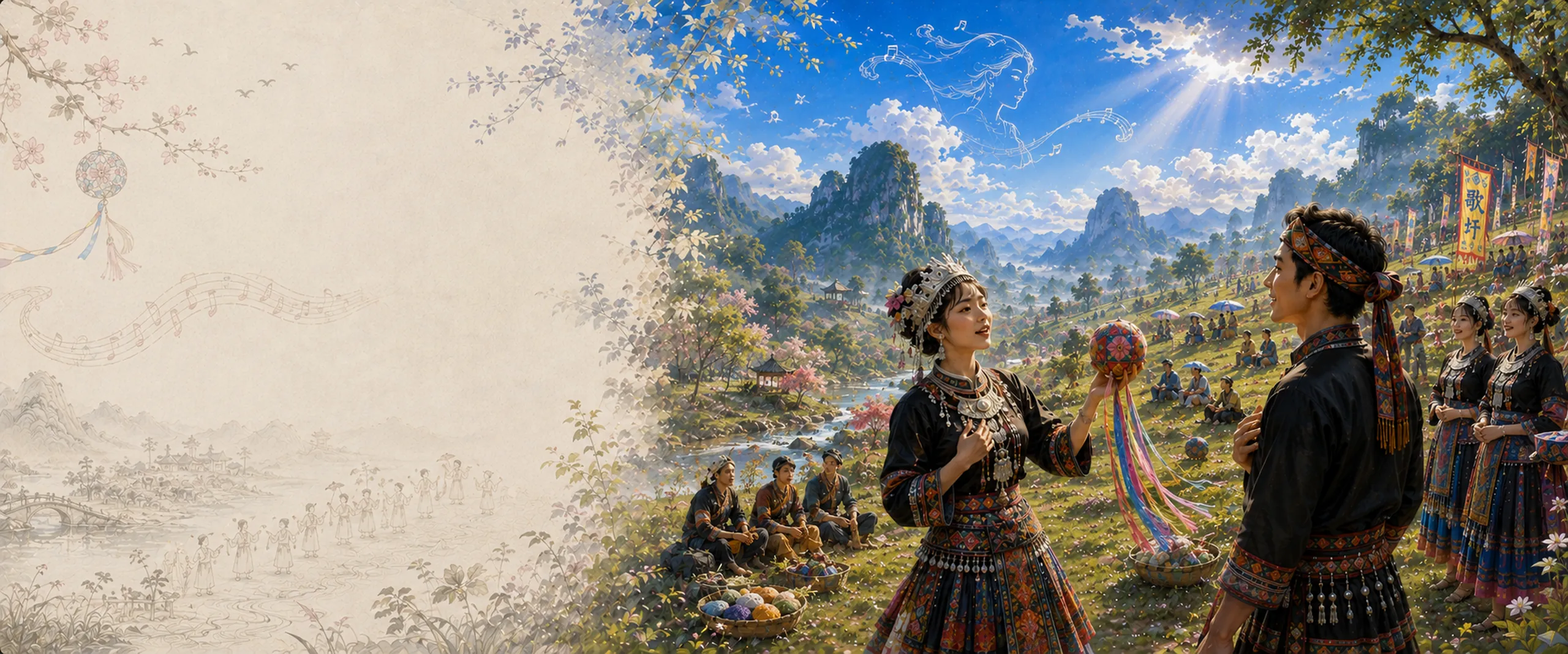
Sanyuesan is the most important traditional festival of the Li people of Hainan and is held each year on the third day of the third lunar month. During the festival, Li people dress in festive attire, honor their ancestors, sing antiphonally and dance, and lay out long-table banquets, creating a grand and exuberant atmosphere. Sanyuesan not only carries forward the ancient cultural traditions of the Li people, but has also become an important cultural festival brand of Hainan International Tourism Island, drawing large numbers of domestic and international visitors each year to experience Li culture. Distinctive Li foods such as Shanlan rice wine, three-colored rice, and bamboo-tube rice, together with traditional Li songs and dances, present the distinctive appeal of Li culture to the world. Through antiphonal singing and fine wine, Sanyuesan tells the world of the Li people’s reverence for their ancestors and their pursuit of a better life.
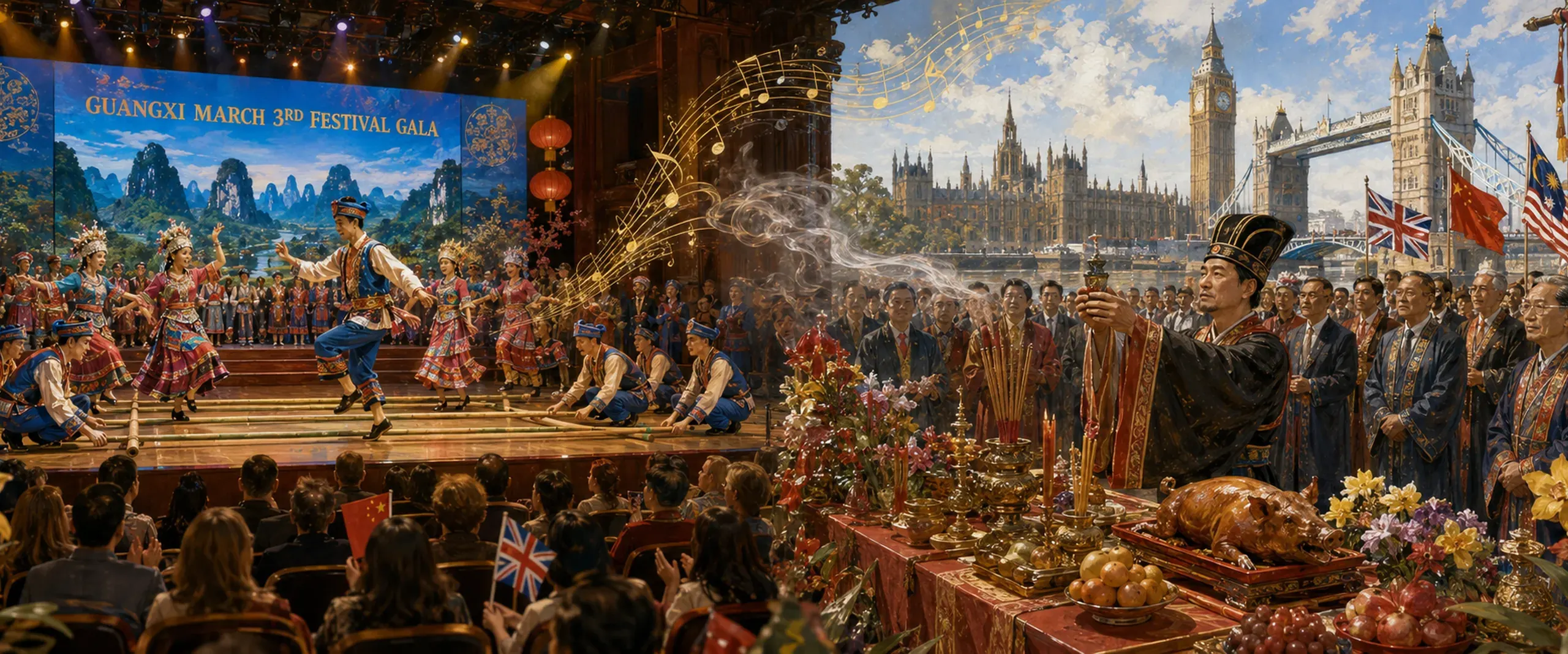
Celebrated Worldwide
Li Brocade
The most dazzling step in bringing Li Sanyuesan to the world was the appearance of Li brocade on the runway at Paris Fashion Week.
Li brocade has been praised as “culture worn on the body” and a “living fossil in the history of Chinese textiles.” The traditional Li techniques of spinning, dyeing, weaving, and embroidery have been passed down for thousands of years and constitute a world-class intangible cultural heritage safeguarding project. In 2006, the traditional Li techniques of spinning, dyeing, weaving, and embroidery were included in China’s national intangible cultural heritage list.
On March 11, 2025, the Véronique Leroy 2025–2026 Autumn/Winter Li Brocade Masters Collaboration Collection, jointly organized by internationally renowned designer brand Véronique Leroy and the government of Wuzhishan City, Hainan, was presented at the historic Cordeliers complex in central Paris during Paris Fashion Week. The garments featuring Li brocade elements incorporated motifs such as the Ganggong Bird, the Strongman, and the dove from Li culture, combined with one-piece tailoring, revealing the profound cultural foundations of the traditional Li techniques of spinning, dyeing, weaving, and embroidery as a representative element of the intangible cultural heritage of humanity.
At the opening ceremony of the main venue for Hainan’s 2025 traditional Li and Miao festival of Sanyuesan, garments incorporating Li brocade elements once again appeared on stage. Combined with technologies involving sound, lighting, and electricity, they created a visual feast for the audience. Holographic projection produced a stage effect blending the real and the virtual, perfectly presenting interaction between live models and virtual characters, while light, shadow, and physical forms merged to reveal the beauty of Li brocade. Dong Yujing, a young Li man from Sanya, said: “It is something to be proud of that ethnic clothing can step onto the international stage.”
The journey of Li brocade from Wuzhishan to Paris offers one of the most vivid illustrations of Li culture “going global.” From rainforest villages in central Hainan to the runway of the world’s fashion capital, Li brocade has demonstrated that traditional craftsmanship can not only be protected in museums, but can also be reinterpreted and recreated within the language of contemporary fashion.
Li Songs
If Li brocade is the most dazzling visual symbol through which Li Sanyuesan reaches the world, then Li songs are its most moving sonic calling card.
The Wuzhishan Li and Miao Children’s Choir: from Wuzhishan to Paris and Seoul. At the opening ceremony of the main venue for Hainan’s 2025 traditional Li and Miao festival of Sanyuesan, a children’s choral performance from deep within the mountains of Wuzhishan, Hainan, drew particular attention. In May 2024, these children traveled abroad for the first time, going to Paris, France, to participate in a series of events marking the 60th anniversary of the establishment of diplomatic relations between China and France, where they performed together with the Paris Polysons Children’s Choir. The choir later traveled to Jeju City, South Korea, to participate in the 63rd Tamna Cultural Festival. Yu Qian, a member of the Standing Committee of the Wuzhishan Municipal Party Committee and head of its Publicity Department, said: “This May, we are preparing to return to Paris to reunite and exchange with the children of the Paris Polysons Children’s Choir.”
The appeal of Li and Miao culture is drifting toward the international stage through song, entering into dialogue with the world. From the Li and Miao villages of Wuzhishan to performances in front of the Louvre in Paris, from the depths of Hainan’s rainforests to the Tamna Cultural Festival on Jeju Island in South Korea—these “little leaves” from the deep mountains are now flying toward the great international stage.
The voice of the “Li skylark.” Folk singer Huang Tingdan, known as the “Li skylark,” performed the Li folk song 捡螺歌 during the Sanyuesan parade. She said: “We welcome everyone who comes to Wuzhishan with our songs.” At the opening ceremony of Sanyuesan in 2026, Li folk-song inheritor Fu Huajin sang 欧欧调, an ancient melody long passed down beneath Exian Ridge. Beginning on the stage of Sanyuesan and traveling through international communication channels, these voices are now being heard by more and more people.
International Visitors
The most direct way for Li Sanyuesan to reach the world is to “invite” the world into Hainan’s rainforest landscapes, allowing international visitors to take part personally in the exuberance of this thousand-year-old festival.
The journey of overseas influencers to Baoting. In April 2024, overseas “big V” influencers from around the world visited Baoting Li and Miao Autonomous County to experience its distinctive customs and culture together with the Li and Miao people. At the “Thousand-Person Long-Table Banquet” held beside the Qixian River in Baoting, the overseas influencers sang folk songs and drank Shanlan wine with Li and Miao participants as they celebrated Sanyuesan together. Natan Colombo from Italy described his impressions after watching the opening ceremony of Baoting Sanyuesan in three words: “Colorful! Exciting! Culture!” The vibrant folk performances, rich intangible heritage traditions, and distinctive long scroll of Li brocade captured everyone’s attention. Balena from Russia said: “The folk festival is very interesting and eye-opening. At the same time, I also felt the warmth of the Li and Miao people of Baoting.”
A bonfire evening for overseas communication officers. As the grand Li and Miao festival of Sanyuesan approached, overseas communication officers participated in a bonfire evening deep in the mountains of Baoting. “The starry sky, the grassland, and the bonfire—this is a shared romance belonging to the Li and Miao people and to the overseas communication officers who have come to visit.”
International student experience officers in Baisha. During Sanyuesan in 2025, Baisha Li Autonomous County launched the video VLOG | Baisha‘s San Yue San Festival: International Students Immersed in Vibrant Ethnic Culture. Aijia, a Kazakh international student from Hainan International College of Beijing Language and Culture University, and Huang Yiheng from Hainan International College of Minzu University of China became “Hainan international student experience officers.” Under the guidance of Zhang Chaoying, a representative inheritor of the traditional Li spinning, dyeing, weaving, and embroidery techniques, they danced the bamboo-pole dance, tasted three-colored rice, searched for treasures in tea gardens, and more, completing a double feast for both palate and spirit. At Baisha’s Sanyuesan activities, foreign cultural promotion officers were active across such zones as the “parade ceremony,” “bonfire carnival,” “intangible heritage treasure hunt,” and “long-table banquet,” immersing themselves in ethnic culture.
Participation by tens of thousands of visitors. During Sanyuesan, Baisha launched a rich variety of activities, including a ceremonial parade enlivening the mountain town, wedding customs in which newlyweds tossed lucky pouches, and a bonfire carnival ethnic-style party, attracting more than 50,000 visitors from Shanghai, Guangdong, and many other places. On Sanyuesan Avenue in Wuzhishan City, the “Together We Draw the Concentric Circle” joyful grand parade drew enormous crowds, turning the streets into a sea of celebration and attracting large numbers of residents and tourists. After personally taking part in Sanyuesan, these visitors from around the world carried the appeal of Li culture to destinations across the globe through travel writing, photographs, and videos.
Overseas Media
Among the achievements in the global dissemination of Li Sanyuesan, one of the most striking has been the extensive attention and reporting it has received from overseas media.
Coverage by more than 960 media outlets across 28 countries. The Wuzhishan main-venue activities for Hainan’s 2025 traditional Li and Miao festival of Sanyuesan attracted considerable attention. Xinhua’s overseas platforms released information about the event in multiple languages, including English, Japanese, Korean, Thai, Italian, Spanish, and Portuguese. To date, the material has been widely republished by more than 960 media outlets in 28 countries, including the United States, United Kingdom, France, Japan, South Korea, Singapore, Ireland, Germany, Thailand, Italy, Canada, India, South Africa, New Zealand, Sweden, Australia, Denmark, and the Netherlands, as well as outlets including the Associated Press, Agence France-Presse, Kyodo News, Yonhap News Agency, Yahoo Finance, the official website of Fox Television in the United States, and Washington Daily News, reaching more than 250 million people.
Five-language releases through the Global Alliance of News Agencies. The Global Alliance of News Agencies released the article Wuzhishan in Hainan, China, Celebrates the Culture of Ethnic Groups in the March 3rd Festival (中国海南五指山举办“三月三”少数民族文化盛典) in English, Japanese, Korean, Thai, and Italian, allowing audiences around the world to experience the appeal of the traditional Li and Miao cultures of Hainan, China.
Baisha’s Li and Miao culture attracts 736 overseas media outlets. After a video of the Sanyuesan celebrations in Baisha Li Autonomous County was released, it was widely republished across 736 media and information platforms, including the Associated Press, France’s Le Figaro, the United Kingdom’s Financial Times, Canada’s National Post, and Vietnam News, reaching nearly 300 million people worldwide. The video was distributed through a comprehensive media matrix including the Xinhua app, Ban Yue Tan app, Reference News app, China National Radio’s website, Hainan Daily, and large screens at Haikou Meilan International Airport and Sanya Phoenix International Airport.
Attention from The Huffington Post in the United States and an appearance in Times Square. The traditional Sanyuesan folk festival of Lingshui Li Autonomous County, Hainan, attracted strong attention and coverage from The Huffington Post, described as one of the five most popular news websites in the United States because of the festival’s distinctive character. This subsequently prompted republication by more than 200 authoritative media outlets, including the three major commercial broadcasting companies in the United States, and the festival appeared on the giant screens of New York’s Times Square, known as “the crossroads of the world.” From the depths of Hainan’s rainforests to Times Square in New York, images of Li Sanyuesan were displayed to the world at the “crossroads of the world”—one of the most iconic moments in the international communication of Li culture.
Dissemination through Xinhua’s overseas social media platforms. Xinhua successively published illustrated posts on the Spanish- and Portuguese-language accounts of overseas social platforms such as Facebook and X, formerly Twitter, presenting overseas audiences with highlights of Wuzhishan’s celebrations of Hainan’s traditional Li and Miao festival of Sanyuesan.
Compatriots Across the Taiwan Strait
Li Sanyuesan is not only a festival of Hainan’s Li and Miao peoples, but also an important cultural bond connecting ethnic minority compatriots on both sides of the Taiwan Strait.
Every year on the third day of the third lunar month, Li and Miao communities in Hainan hold grand celebrations. Delegations of ethnic minority compatriots from Taiwan have repeatedly traveled to Ledong, Wuzhishan, and other places in Hainan to celebrate the festival together with local compatriots and experience its folk traditions.
Chen Chengsan, executive director of the Chinese Cross-Strait Association for Ethnic Minority Cultural and Economic Exchange in Taiwan, wrote the words “The peoples on both sides of the Chinese Strait are one family” while attending Sanyuesan celebrations. He said: “By taking part in Hainan’s Sanyuesan celebrations, we felt the fiery warmth of our Li and Miao compatriots. Being together with Hainan’s ethnic minorities feels especially close—just like family meeting again!”
A cross-Strait Sanyuesan celebration involving different ethnic groups and themed “Joy, Harmony, One Family” was once held in Wuzhishan City, Hainan. Ethnic minority compatriots from Taiwan and Li compatriots shared wine and songs all along the way, immersing themselves in a sea of joy. Li young women sang 欢迎你到黎寨来, while visitors from Taiwan sang and danced together with local residents.
International Academic Attention
Li Sanyuesan has also attracted attention from the international academic community. Britannica lists Sanyuesan as the most important festival of the Li people. According to its introduction, the festival is regarded as a commemoration of the legendary origins of the Li people, and sacrificial rites and various kinds of competitions are held during the festival.
Hainan’s official English-language tourism website, en.explorehainan.com, has established a dedicated introduction page for the Sanyuesan Festival. The website notes that Sanyuesan is a traditional festival of Hainan’s Li people, during which participants dress in traditional clothing and gather together carrying bamboo baskets of rice wine and fragrant rice cooked in bamboo tubes. The English-language website of the Sanya municipal government has also published dedicated coverage of Sanyuesan activities.
International travel guides and platforms also list Sanyuesan as an important cultural experience in Hainan. Tourism platforms such as Trip.com have specifically promoted the Wuzhishan Sanyuesan Folk Festival. Inclusion in these international academic and tourism resources has brought Li Sanyuesan into the global field of cultural and tourism awareness.
Mutual Learning Among Civilizations
Dialogue with Global “Valentine’s Days”
Li Sanyuesan has been called an “Festival of Love” and a “Day for Talking of Love.” These descriptions themselves create a dialogue with Valentine’s Day cultures around the world.
Globally, Valentine’s Day takes many forms. In the West, Valentine’s Day on February 14 is primarily marked by the giving of roses and chocolates. China’s Qixi Festival centers on the legend of the Cowherd and the Weaver Girl and emphasizes steadfast and enduring love. What distinguishes Li Sanyuesan is that it is not merely a festival for couples, but a collective celebration of the entire people—young men and women meet through antiphonal singing, fall in love through dance, and gather together around long-table banquets. It is not a private moment shared by two people, but a celebratory feast of the entire community.
Sanyuesan “is a traditional festival through which the Li people of Hainan commemorate their hardworking and courageous ancestors and express their longing for happiness in love.” It combines “gratitude toward the ancestors” with “the pursuit of love”—this dual theme of “ancestor worship + love” stands apart among the world’s festivals.
Dialogue with Global “Living Transmission of Intangible Heritage”
From the inclusion of Li Sanyuesan in the national intangible cultural heritage list in 2006, to Li brocade appearing at Paris Fashion Week, and then to the attention of more than 960 media outlets across 28 countries, this trajectory itself constitutes a profound dialogue with the global system for safeguarding intangible cultural heritage.
UNESCO’s Convention for the Safeguarding of the Intangible Cultural Heritage emphasizes that intangible cultural heritage “contains the cultural genes, spiritual characteristics, and values of the world’s peoples.” Li Sanyuesan is precisely this kind of intangible cultural heritage “containing cultural genes.” It carries the gratitude of Li ancestors toward their forebears, their pursuit of love, and their passion for life.
The safeguarding and dissemination of Li Sanyuesan provide a noteworthy case for the “living transmission” of intangible cultural heritage worldwide—it does not lock intangible heritage inside museums, but allows it to live on festival stages, to be worn on people’s bodies, to be sung in people’s songs, and to step onto the runways of Paris. The journey of Li brocade from the looms of Wuzhishan to Paris Fashion Week has demonstrated that traditional culture can not only survive in contemporary society, but can also acquire renewed vitality within the context of globalization.
Dissemination Alongside the Hainan Free Trade Port
The global dissemination of Li Sanyuesan has developed a distinctive resonance with the construction of the Hainan Free Trade Port.
Hainan is building a free trade port oriented toward the world, and Sanyuesan is precisely an important window through which Hainan presents its cultural soft power internationally. As reflected in Sanyuesan activities, the festival not only “demonstrates the profound foundations of Hainan’s ethnic cultures, but through innovative forms such as fashion shows and international exchange also brings China’s traditional intangible cultural heritage onto the world stage.”
From the giant screens of Times Square in New York to the runway of Paris Fashion Week, from reports by the Associated Press to attention from Agence France-Presse, Li Sanyuesan is becoming a vivid calling card for Hainan’s international communication. What it presents to the world is not only Li culture, but also an image of Hainan as open, diverse, and inclusive. The main-venue activities for Sanyuesan in 2026 took “Strengthening the Sense of Community for the Chinese Nation and Together Embarking on a New Voyage for the Hainan Free Trade Port” as their theme, closely linking the transmission of ethnic culture with the development of the Hainan Free Trade Port.
Dialogue with the “Belt and Road”
The international dissemination of Li Sanyuesan also resonates with people-to-people and cultural exchanges under the Belt and Road Initiative.
In 2025, the “Nihao! China” 2025 World Cultural Heritage-Themed Overseas Tourism Promotion Season included Hainan Sanyuesan as an important promotional feature. Through the five-language releases of the Global Alliance of News Agencies—in English, Japanese, Korean, Thai, and Italian—Sanyuesan reached multiple countries along the Belt and Road. The performances of the Wuzhishan Li and Miao Children’s Choir in Paris, France, and Jeju Island, South Korea, also provided vivid examples of Belt and Road people-to-people and cultural exchange.
From Southeast Asia to Europe, from East Asia to North America, the dissemination footprint of Li Sanyuesan is extending along the Belt and Road. It is not only the transmission of culture, but also a bridge of friendship. As one compatriot from Taiwan said, “Being together with Hainan’s ethnic minorities feels especially close—just like family meeting again.” This feeling of “family meeting again” is precisely one of the warmest expressions of mutual learning among civilizations.
Closing Note
The global dissemination of Li Sanyuesan follows a distinctive path from the depths of the rainforests of central Hainan to the five continents of the world. Its inclusion in the national intangible cultural heritage list in 2006 marked the transition of Sanyuesan from a folk festival into a nationally safeguarded heritage tradition; while the widespread republication by more than 960 media outlets across 28 countries in 2025, the appearance of Li brocade at Paris Fashion Week, and the performances of the Wuzhishan Li and Miao Children’s Choir in Paris and Seoul marked Sanyuesan’s emergence as an important window through which the world comes to understand the cultures of China’s ethnic minorities.
Unlike the exuberance of “water” in the Water-Splashing Festival, the passion of “fire” in the Torch Festival, or the spirit of “competition” in Naadam, the global dissemination of Li Sanyuesan takes “Li brocade” as its most recognizable visual symbol, “Li songs” as its most moving sonic calling card, and “the long-table banquet” as its warmest memory of taste. Li brocade needs no translation for the world to see its beauty; Li songs need no explanation for the world to hear their emotion; the long-table banquet needs no introduction for the world to taste its flavors.
On the stage of international fashion, Li brocade has traveled from the looms of Wuzhishan to the runway of Paris Fashion Week, demonstrating that traditional craftsmanship can acquire renewed vitality within the language of contemporary fashion. On the international music stage, the Wuzhishan Li and Miao Children’s Choir has sung its way from Li and Miao villages to Paris and Seoul, demonstrating that children’s voices can cross linguistic barriers and touch the heart. Across the international media matrix, widespread republication by more than 960 outlets in 28 countries demonstrates that Li culture can attract the attention of the entire world. In the experiences of international visitors, the firsthand journeys of overseas influencers and international students into Baoting and Baisha demonstrate that “inviting people in” is the most effective form of communication. In exchanges across the Taiwan Strait, the joint celebration of Sanyuesan by ethnic minority compatriots from Taiwan and Li compatriots demonstrates that a shared festival is the warmest cultural bond connecting compatriots on both sides of the Strait.
More moving still is the fact that, throughout its journey toward the world, Sanyuesan has always maintained a profound connection with the rainforest landscapes of Hainan. The Li people still sing the ancient O’ou Tune (《欧欧调》), long passed down beneath Exian Ridge; they still perform the Dachai Dance (打柴舞) beside the Nansheng River in Wuzhishan; they still raise cups of Shanlan wine at long-table banquets to welcome guests from every direction. Sanyuesan has not diluted the richness of its culture in order to “go out into the world”—through “inviting people in,” it allows the world to enter Hainan; through “going out,” it allows the story of Sanyuesan to travel across the globe.
Like the Li brocade passed down for a thousand years—it has endured the rise and fall of dynasties and remains radiant with color; it has crossed cultural boundaries and remains unmistakably distinctive. The songs, dances, and looms of Li Sanyuesan are flourishing without cease, among the rainforests of Hainan and within the world’s field of vision.
—-
Readers’ Comments
Calendar and traditional culture enthusiasts from around the world, sharing the same moon.
Sign in or register to join the conversation. Your comment account is created automatically the first time you use a connected account.
No comments yet
Share your thoughts with readers around the world.