Finding Maguai
At dawn on the first day of the first lunar month, villagers beat bronze drums and set out in groups for the fields to search for hibernating frogs. Men and women, young and old, spread out across nearby fields and stream banks, searching everywhere for the desired “Yaguai” (雅拐), locally known as the “Maguai Mother” (蚂拐婆).
According to local belief, the first person to find a frog is especially fortunate. He is honoured as the “son-in-law of the Thunder King”, or Maguai Lang (蚂拐郎)—literally, the “Maguai Groom”—and becomes the leader of that year’s Maguai rites. The leader then guides the villagers in setting off ceremonial firecrackers to report to the Thunder King the joyful news that the human world is preparing to worship Maguai. The frog is ceremonially welcomed back to the village and placed in a decorated sedan chair before being put into a specially prepared bamboo tube known as the “Maguai coffin” (蚂拐棺).
Worshipping Maguai
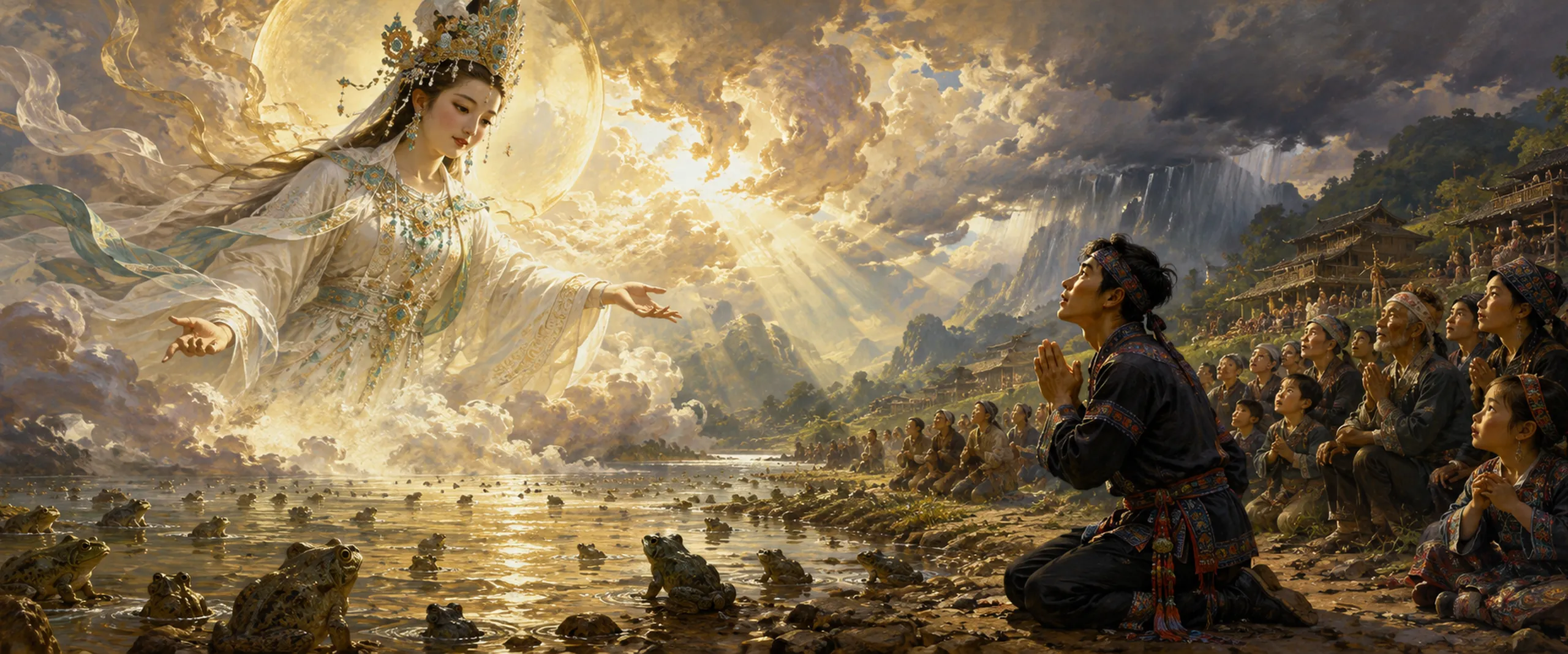
The principal rites of worship are held on the fifteenth day of the first lunar month and include erecting ritual banners, making offerings, and holding Maguai song gatherings. Villagers arrange offerings, beat bronze drums, burn incense, and worship Maguai. The ceremony is presided over by a highly respected elder of the village. The Maguai coffin is placed inside the Maguai pavilion (蚂拐亭), where offerings including the traditional three sacrificial animals (三牲), five-coloured glutinous rice, and wine are presented. The officiant recites ritual invocations, asking the Frog Goddess to bless the entire village with favourable weather, abundant grain harvests, and prosperity for people and livestock.
The erection of ceremonial banners is an important part of the worship of Maguai. Every year on the fifteenth day of the first lunar month, the people of Baying Village conduct the traditional ritual of “erecting the banner” (立幡), literally “raising a pole and suspending a banner,” known locally in Zhuang as “Yaotonggan” (曜筒竿). Beside the traditional Maguai burial ground at the entrance to the village, villagers erect colourful paper banners five or six metres high, arrange offerings, beat bronze drums, set off firecrackers, and worship Maguai. The banner-raising ceremony is associated with the symbolic cycle of the 365 days of the year. According to local belief, this is a day on which the Jade Emperor shows special mercy, allowing farmers to offer rats so that the heavenly gods may punish them and prevent them from damaging the crops, thereby protecting the New Year with favourable weather, abundant grain, and prosperity for people and livestock.
Mourning and Honouring Maguai
The rite known as “mourning Maguai” (孝蚂拐) is one of the most deeply human elements of the festival. In Zhuang culture, xiao (孝)—filial devotion—is directed not only toward one’s parents but can also be extended toward divine beings. Mourning Maguai therefore reflects a traditional Zhuang conception in which sacred beings of nature are treated almost as members of the human family.
After the rites of vigil and village procession have continued for twenty-five days, the festival enters its climactic stage. People perform the Maguai Dance and sing Maguai songs as a way of keeping vigil for Maguai. Throughout the vigil, villagers remain with Maguai through the night, expressing reverence and gratitude through song and dance. In the evening, the decorated sedan chair is carried beneath the Maguai pavilion, where people again perform Maguai dances and sing Maguai songs as part of the vigil. The sound of bronze drums continues throughout the night, while songs and dances follow one another without interruption. In the most fervent way possible, the community accompanies Maguai through its final hours.
Carrying Maguai Through the Village
From the first day until the end of the first lunar month, children carry the frog through the village during the daytime, visiting household after household to offer New Year congratulations. They carry the Maguai coffin, beat bronze drums, and process through the village, stopping briefly in front of each home to recite words of blessing together before eventually returning the coffin to its designated resting place.
This village procession is essentially a house-to-house ritual of paying respects to Maguai. At each home, participants loudly recite blessings, wishing the household success in all things during the New Year, thriving livestock, and abundant grain harvests. The head of the household welcomes them with firecrackers and gives rice, glutinous-rice cakes, red-dyed eggs, red envelopes, or other gifts in return. The gifts collected during the procession are known as “blessings of fortune and longevity” (福寿品). The food offered to Maguai by individual households becomes part of the “Maguai meal” (蚂拐饭), and according to traditional custom the entire village shares a communal feast after the festival rites have concluded.
Burying Maguai
The burial of Maguai is the festival’s most mysterious ritual and also one of its great climaxes. On this day, the villagers choose an auspicious hour and carry the decorated sedan chair to the frog burial ground, where they open the precious coffin containing the frog buried the previous year. If the frog’s bones have turned golden yellow, this is interpreted as a sign that the coming year will be prosperous; at once, bronze drums resound and the entire gathering erupts in celebration. If the bones appear grey or black, however, this is taken as a sign that the coming year may be unfavourable, and the villagers burn incense and pray for calamity to be removed and blessings to descend.
When the new Maguai is buried, everyone stands solemnly and reverently. The Maguai Groom (蚂拐婿) first lowers the coffin into the earth in the prescribed east-facing-west orientation, after which the assembled villagers eagerly add earth to build the burial mound. Offerings are placed around the grave. The burial of the new frog is carried out with great solemnity: the Maguai coffin for the current year is placed inside the grave and the community performs its final farewell.
After Maguai has been buried, men and women, young and old, gather around a bonfire to sing and dance, sending the spirit of Maguai back to heaven. The celebration continues throughout the night until dawn.
Maguai Song Gatherings and the Maguai Dance
The Maguai song gathering (蚂拐歌会) is one of the most important activities of the festival. During the Maguai Festival, villagers beat gongs and drums and invite singers from surrounding communities to gather together. Everyone dresses in festival clothing, and songs fill the countryside. Unmarried young men and women from nearby Zhuang villages arrive in large numbers, gathering around bonfires or meeting in the fields in pairs, where they sing antiphonal Maguai songs (蚂拐歌)—traditional courtship songs—in search of a potential partner.
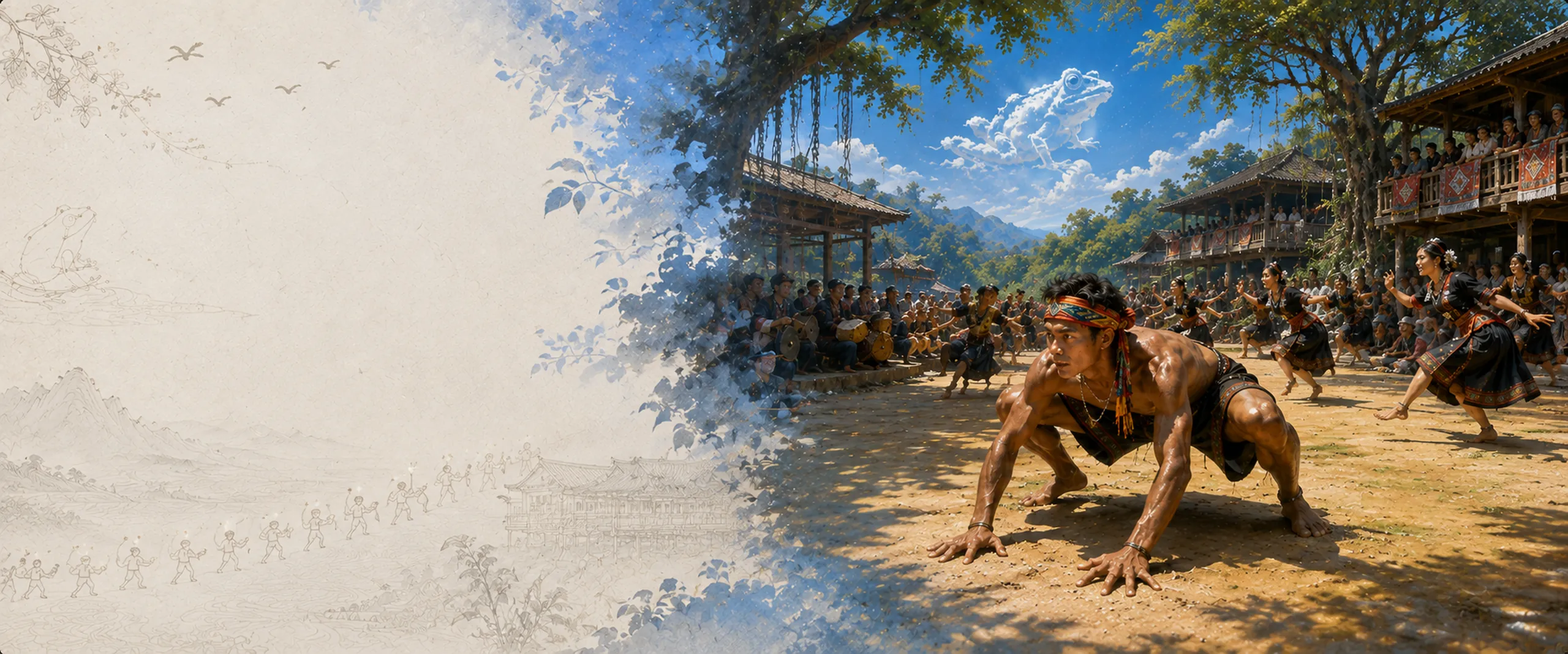
The Maguai Dance (蚂拐舞) is the festival’s most representative dance form. Many of its movements imitate frogs, including deep squats, leaning backward while supported by a staff, quick sideways shuffling steps, and trembling stamping movements. The dance is full of the rhythms of everyday life and often possesses a humorous, playful quality. On the climactic night of the festival, participants put on ancient masks and perform a wide range of folk dances, including dances worshipping the Maguai deity, dances honouring the bronze drum, dances depicting harrowing and ploughing, rice transplanting, fishing and catching shrimp, spinning and weaving, and harvest rituals dedicated to Maguai. Each dance is an artistic transformation of a different aspect of Zhuang agricultural life.
Food of the Maguai Festival
Preparing five-coloured glutinous rice (五色糯米饭) is one of the most important culinary traditions of the Maguai Festival. The rice is dyed with natural plant pigments, producing vivid colours, a rich fragrance, and a distinctive flavour. Pounding ciba (糍粑)—glutinous-rice cakes—is another communal activity during the festival, while red-dyed eggs symbolise good fortune and celebration. On the day of the festival, villagers slaughter pigs and chickens and prepare elaborate festive banquets. The Maguai meal consists of offerings contributed by individual households and, according to traditional custom, the entire village gathers for a communal feast once the festival activities have concluded.
Readers’ Comments
Calendar and traditional culture enthusiasts from around the world, sharing the same moon.
Sign in or register to join the conversation. Your comment account is created automatically the first time you use a connected account.
No comments yet
Share your thoughts with readers around the world.