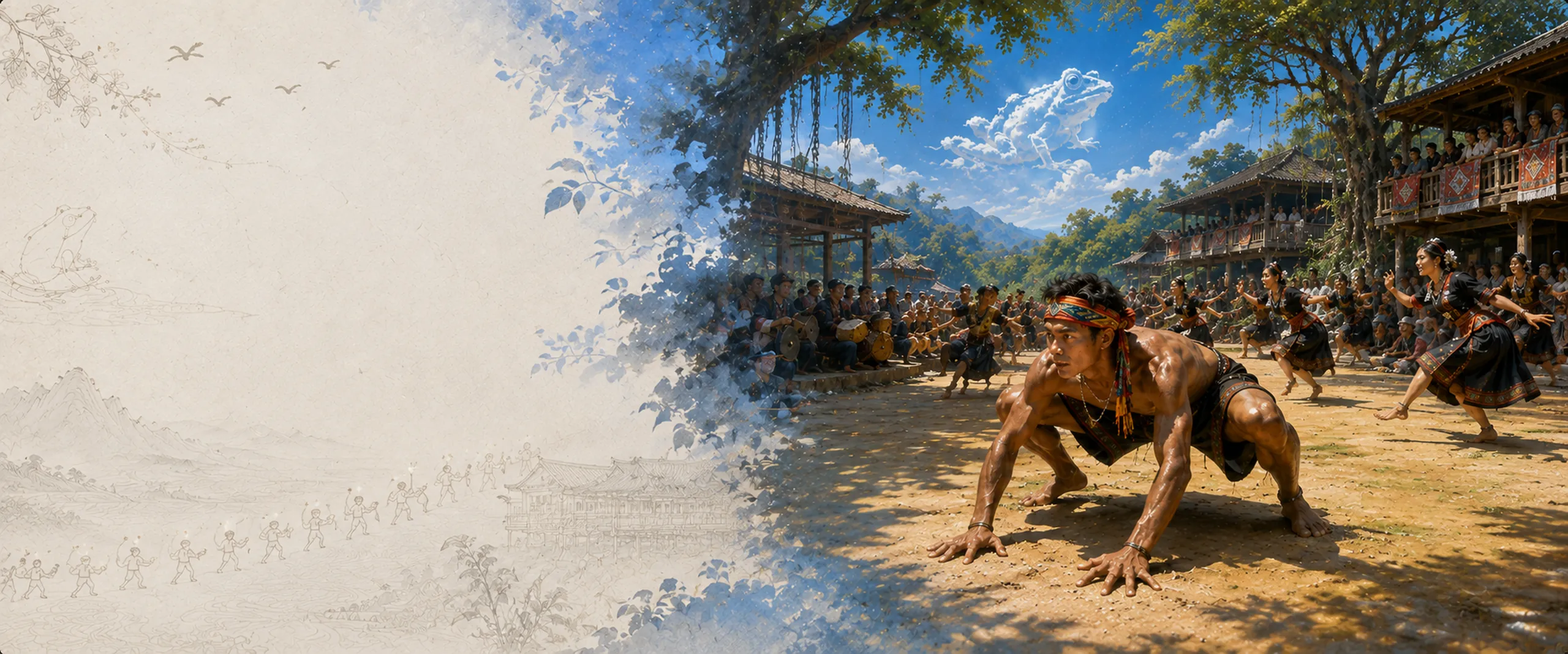
The Magwai Festival is one of the Zhuang people’s oldest and most enigmatic ritual traditions. In the Zhuang language it is called Yagui, and it is also known as the Frog Festival or Frog-Mother Festival. *Magwai* is the customary name used in Zhuang communities for the frog.
In local legend, the frog is a divine being associated with rainfall. By honouring the magwai, Zhuang communities pray for favourable winds and timely rains, abundant crops and prosperity.
In 2006, the Zhuang Magwai Festival was inscribed in the first group of China’s National List of Representative Intangible Cultural Heritage Projects.
The festival begins each year on the first day of the first lunar month and concludes on the second day of the second lunar month, extending over roughly a full month. Its principal climax falls on the first and second days of the second lunar month, with major celebrations centred on Baying Village, Bachou Township, Donglan County, Hechi, Guangxi, regarded as the festival’s place of origin, as well as Bandeng Village in Changle Town.
Along the banks of the Hongshui River, the deep resonance of bronze drums evokes a living tradition carried through generations. Within the mysterious rites of the Magwai Festival and the exuberance of its evening bonfires lies the enduring blessing at the heart of the celebration: favourable weather, timely rain and a bountiful harvest.
Event Schedule and Venues
### Core Dates
The Magwai Festival generally begins on the first day of the first lunar month and ends on the second day of the second lunar month, lasting approximately one month.
The precise starting date varies by locality: some villages begin on the first day of the first lunar month, while others begin on the second.
The principal climaxes fall on the first day of the second lunar month in Bandeng Village and the second day of the second lunar month in Baying Village.
| Date | Activity | Notes |
|---|---|---|
| From the first day of the first lunar month | Villages gradually begin the Magwai Festival. Residents beat bronze drums as they go into the fields in search of hibernating frogs | Celebrations begin progressively in villages along the Hongshui River |
| Around the fifth day of the first lunar month | Magwai Folk Culture Festival | Held in Nadong Village, Tian’e County, and other locations |
| First day of the second lunar month | Magwai Festival in Bandeng Village, Changle Town — blessing rituals and folk-cultural performances | Bandeng Village, Changle Town, Donglan County |
| Second day of the second lunar month | Baying Village Magwai Festival — the festival’s greatest climax: one hundred bronze drums, the complete ritual sequence, and an evening bonfire celebration | Baying Village, Bachou Township, Donglan County |
### Cultural Background
The Magwai Festival grew from the Zhuang people’s traditional reverence for frogs.
According to legend, the Frog Goddess governs wind and rain. The ancestral figure Buluotuo instructed local people to beat bronze drums, invite the Frog Goddess back to the village for the New Year, and conduct funeral rites for frogs that had died. Their devotion moved Heaven, and the Zhuang villages were blessed with favourable weather, prosperous livestock and thriving communities.
| Custom | Description |
|---|---|
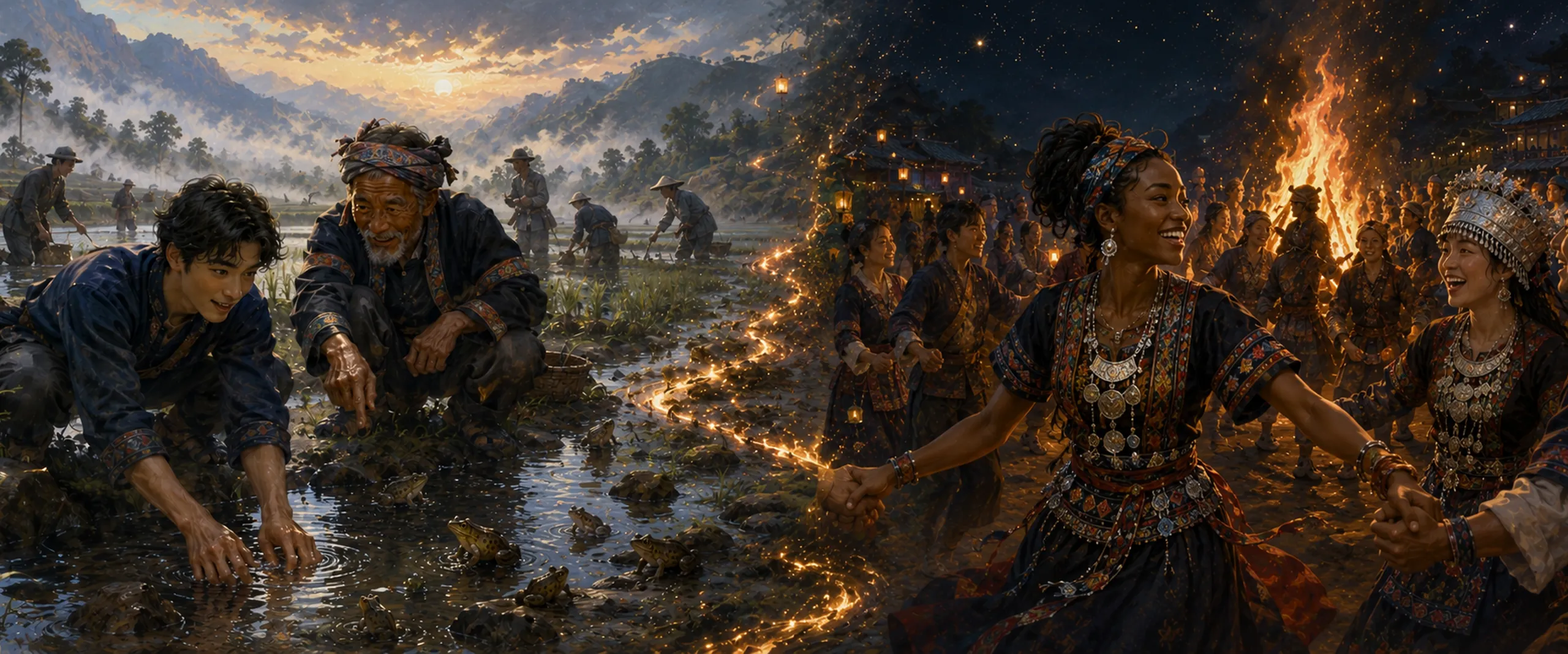
| Searching for the Magwai | On the first day of the first lunar month, villagers beat bronze drums and go into the fields in search of hibernating frogs. The first person to find one is honoured as the “Magwai Lang”, a title associated with good fortune |
| Offering to the Magwai | The discovered frog is placed in a “Magwai coffin”, and a recognised inheritor of the tradition presides over the ritual offerings |
| Procession and Worship of the Magwai | The Magwai coffin is carried from household to household while participants sing “Magwai songs”, offering blessings to each family |
| Burial of the Magwai | The coffin from the previous year is opened and the colour of the frog bones examined. Golden-yellow bones are regarded as auspicious and a sign of a good harvest; black bones are taken as an ill omen |
| Bronze Drum Culture | Hechi lies at the heart of the National Experimental Zone for the Ecological Preservation of Bronze Drum Culture. During the Magwai Festival, the simultaneous sounding of one hundred bronze drums is among its most powerful spectacles |
| Magwai Dance | The movements frequently imitate a frog’s leaping and insect-catching gestures |
### Recommended Activities by Location
Baying Village — The Festival at Its Most Complete and Dramatic:
Baying Village is regarded as the birthplace of the Zhuang Magwai Festival and serves as a national-level base for the transmission of this intangible cultural heritage tradition.
It preserves the complete ritual cycle, from searching for the magwai on the second day of the first lunar month to the final act of honouring it on the second day of the second lunar month.
On the second day of the second lunar month, the banks of the Baying River resound with bronze drums like spring thunder. At Bronze Drum Square, one hundred drums are arranged in formation.
The ceremonial cycle comprises four principal stages:
* Searching for the magwai
* Offering sacrifice to the magwai
* Honouring the magwai
* Burying the magwai
Folk-cultural performances include 《铜鼓阵》, 《丰收舞》, 《鼓鸣蛙舞》 and 《壮家婚嫁习俗》.
As night falls, a great bonfire rises in Tongxin Square. Villagers set out from the Magwai Temple in procession, guided by the “Magwai Gong” and “Magwai Po”. Carrying torches and forming a long, illuminated line, they symbolically invite the Frog Deity into the human world.
Bandeng Village — Blessing Ceremonies:
Bandeng Village is a Hechi City base for the transmission of Zhuang bronze-drum customs.
On the first day of the second lunar month, Magwai blessing activities unfold around the Magwai Pavilion and Magwai Square.
The ritual sequence includes inviting the Magwai Deity out of the pavilion, entering homes to bestow blessings, processing through the village, erecting ceremonial banners and conducting sacrificial rites.
Pre-Trip Preparation
### Visa and Entry
The Magwai Festival is held in Hechi, Guangxi, where China’s unified visa policies apply:
* 240-Hour Visa-Free Transit for Citizens of 54 Countries: Eligible travellers may use 240-hour visa-free transit, with the permitted area of stay covering the administrative region of Guangxi Zhuang Autonomous Region
* Tour Groups from ASEAN Countries: Groups organised through travel agencies may enter visa-free through designated ports
* Other Nationalities: Apply in advance for a tourist visa, or L visa, through the relevant Chinese embassy or consulate and ensure that your passport is valid for more than six months
* Latest Policies: Before departure, consult the official website of China’s National Immigration Administration or the relevant embassy or consulate
### Adapting to the Climate
The Magwai Festival runs from the first day of the first lunar month to the second day of the second lunar month, corresponding approximately to late January through mid-to-late March in the Gregorian calendar.
At this time of year, Hechi generally has the following conditions:
* Temperature: Average daily temperatures of 12°C–22°C. Early spring alternates between warmth and chill, with a noticeable difference between morning and evening temperatures. By the second day of the second lunar month, conditions are generally becoming milder, though mountain areas can still be cool at night.
* Rainfall: Spring is often overcast and rainy, with relatively high humidity and occasional prolonged light rain.
* Clothing: Dress in layers — a long-sleeved T-shirt or light sweater underneath, with a windproof jacket or outdoor shell on top. Choose water-resistant, non-slip hiking or athletic shoes, as village lanes include stone paving and earth tracks that become slippery in wet weather. Carrying a folding umbrella or lightweight raincoat is recommended.
### Travel Insurance
It is strongly recommended to purchase travel insurance covering:
* Accidental injury and medical treatment for acute illness, including outpatient care
* Loss of or damage to personal belongings
* Travel delays or cancellations
### Currency and Payment
* Currency: Renminbi (CNY).
* Cash: Carry a reasonable amount. Mobile signal may be unreliable in village areas, making cash transactions more dependable.
* Cards: Visa and MasterCard may be accepted at larger hotels and supermarkets in Donglan County town; village businesses generally do not accept cards.
* Mobile Payment: Alipay and WeChat Pay are widely used in the county town, while some village stalls also accept them.
### Communications and Internet
* Important: Visitor numbers rise considerably during the Magwai Festival, and 4G/5G reception in the villages may be weak.
* It is strongly recommended to download offline maps in advance. Baidu Maps and AutoNavi are recommended; download the Hechi area to your phone while connected to Wi-Fi.
How to Get There
### Core Venue: Donglan County, Hechi, Guangxi
| Transport | Details |
|---|---|
| Air | Fly first to Nanning Wuxu International Airport, Guangxi’s largest aviation hub, then continue to Donglan by high-speed rail or road |
| High-Speed Rail | Hechi West Station is served by the Guiyang–Nanning High-Speed Railway. The journey from Nanning East Station takes approximately 1 hour; from Hechi West, continue by road to Donglan County town, approximately 1.5 hours |
| Coach | Nanning Anji Bus Station operates services to Donglan County, with a journey time of approximately 3 hours |
| Driving | From Nanning, travel directly to Donglan via National Highway G323; from the Guiyang direction, approach Donglan via the Guibei Expressway |
High-Speed Rail Tickets: Tickets around the core festival period and adjacent weekends can be in high demand. Advance purchase through the Railway 12306 App is recommended.
### Main Festival Villages
| Village | Township | Distinctive Feature |
|---|---|---|
| Baying Village | Bachou Township | Birthplace of the Magwai Festival; national-level intangible heritage transmission base; preserves the most complete ritual sequence |
| Bandeng Village | Changle Town | Hechi City base for the transmission of Zhuang bronze-drum customs |
Location of Baying Village:
Baying Village lies near the meeting point of Donglan, Fengshan, Tian’e and Nandan counties, a location traditionally described as “one step across four counties, one cockcrow heard by a hundred villages.”
The Donglan–Tian’e secondary road passes directly through the village, with access to the Guibei Expressway approximately ten minutes away.
### Transport During the Festival
* From Donglan County Town to the Villages: Take a taxi or shared car from Donglan Bus Station to Baying or Bandeng Village, approximately 20–30 minutes. There is no direct public bus, so arranging a transfer through your accommodation or sharing a vehicle with other visitors is recommended.
* Around the Villages: Temporary parking areas are set up near the festival sites. Village roads are narrow and passing oncoming vehicles can be difficult. Depart early and follow staff instructions when parking.
* Getting Around: The heart of the Magwai Festival is experienced within the villages themselves. After parking in designated areas, it is best to explore the festival primarily on foot.
Accommodation Reservations
| Key Point | Recommendation |
|---|---|
| When to Book | Mid-March is a minor local tourism peak. Book accommodation 2–3 weeks in advance |
| Donglan County Town | Hotels and guesthouses in central Donglan offer the broadest choice and the best facilities; the festival villages are only 20–30 minutes away by taxi |
| Baying / Bandeng Villages | Village guesthouse capacity is extremely limited and must be booked well in advance |
| Central Hechi | If accommodation in Donglan is limited, consider staying in Jinchengjiang District, Hechi, and travelling to Donglan early the following morning, approximately 1.5 hours |
| Indicative Prices | Budget accommodation in the county town: approximately RMB 80–150 per night; mid-range: approximately RMB 200–400 |
| Booking Platforms | Major platforms such as Ctrip, Qunar and Meituan |
Pre-Trip Packing Checklist
| Category | Essential Items | Special Notes |
|---|---|---|
| Clothing | Long-sleeved T-shirts, light sweater, windproof jacket / outdoor shell, long trousers | Early spring alternates between warmth and chill; mountain areas can feel damp and cold, especially mornings and evenings |
| Shoes | Water-resistant, non-slip hiking / athletic shoes | Village routes include stone paving and muddy paths; wet weather can make them slippery, so good footwear is essential |
| Rain Gear | Folding umbrella or lightweight raincoat | Spring is often overcast and rainy, with frequent showers |
| Sun Protection | SPF30+ sunscreen, sun hat | Spring UV exposure should not be overlooked |
| Medicine | Cold medicine, gastrointestinal medicine, adhesive bandages, insect repellent | Useful for changes in climate and diet |
| Electronics | Power bank, phone, camera | Charging facilities in the villages are limited |
| Storage | Small bag / waist pouch for documents and cash | Take care of personal belongings in crowded areas |
| Other | Tissues / wet wipes, insulated bottle | Village facilities can be limited |
Cultural Respect
### Respect for Ritual Beliefs and Ceremonial Etiquette
The Magwai Festival is one of the Zhuang people’s most mysterious ritual traditions. Its central rites embody a deep reverence for nature and the spiritual world.
* Maintain Solemnity During Rituals: During the searching, offering and burial rites associated with the magwai, remain quiet and respectful. Do not shout, joke or behave disruptively.
* Do Not Interfere: Do not obstruct or disturb the normal proceedings of the ceremonies.
* Viewing Etiquette: Remain in designated viewing areas. Do not move freely through the ritual space or touch the Magwai coffin, offerings or ritual implements.
* Photography Restrictions: Certain stages of the ritual may prohibit photography. Confirm with on-site staff or recognised tradition bearers beforehand.
### Etiquette When Participating in Activities
* Watching the Bronze Drums: The simultaneous sounding of one hundred bronze drums is among the festival’s most dramatic moments. Keep an appropriate distance and do not touch the drums.
* Magwai Procession: When the Magwai coffin is carried through the village, watch from either side of the procession and do not step into its route.
* Joining the Bonfire Celebration: During the evening bonfire, visitors may join the communal circle dance hand in hand. Follow the rhythm and steps of local participants and immerse yourself in the festive atmosphere.
* Magwai Dance: The dance imitates frogs leaping and catching insects. If invited to join, participate freely and respectfully.
### Photography Etiquette
* Ask Permission: Before photographing Zhuang people in ceremonial dress, recognised tradition bearers, elderly residents or children, smile and ask first.
* Respect Portrait Rights: Do not use another person’s photograph for commercial purposes without consent.
* Drone Regulations: Drone flights over the villages must be registered in advance with the local public-security authorities.
### Safety Guidelines
* Crowd Safety: Rituals and bonfire celebrations can attract dense crowds. Remain alert and take particular care of elderly companions and children.
* Property Safety: Store valuables in the hotel safe and carry only what you need.
* Road Safety: Village roads are narrow. Follow on-site traffic instructions and never park in a way that obstructs the roadway.
* Cold and Rain Protection: Mountain areas in spring can be damp, chilly and rainy. Keep warm and protect yourself from getting wet.
* Food Hygiene: Village dining focuses on local specialities. Choose food that has been thoroughly cooked.
Emergency Information
| Item | Contact / Description |
|---|---|
| Emergency Numbers | Police 110, Fire 119, Ambulance 120 |
| Major Hospitals | Donglan County People’s Hospital; Hechi City People’s Hospital in Jinchengjiang District |
| Tourist Police / Lost Property | Temporary police posts are set up at festival villages. Report lost valuables immediately to the nearest post |
| Tourist Information | Official platforms of the Donglan County Bureau of Culture, Radio, Television, Sports and Tourism and the Hechi City Bureau of Culture, Radio, Television, Sports and Tourism |
| Time Zone | UTC+8, China Standard Time |
| Voltage / Plugs | 220V; plug types A / C / I |
Special Reminders
* The Festival Lasts for a Full Month: The Magwai Festival runs from the first day of the first lunar month through the second day of the second lunar month, lasting approximately one month. Confirm the exact programme of your chosen village before travelling.
* Baying Village Is the Festival’s Birthplace: Baying Village is the birthplace of the Zhuang Magwai Festival and a national-level intangible cultural heritage transmission base, preserving the most complete rituals and the grandest celebrations. If your time is limited, prioritise Baying Village on the second day of the second lunar month.
* Local Transport: There is no direct public bus from Donglan Bus Station to the festival villages. Arrange transport with your accommodation in advance or share a car with other visitors.
* Accommodation Is Limited: Guesthouse capacity within the villages is extremely small. Staying in Donglan County town is generally the most practical option, offering more choice and better facilities, with the villages only 20–30 minutes away by taxi.
* Respect the Sacred Character of the Festival: The Magwai Festival is one of the Zhuang people’s most mysterious ritual traditions. Maintain a solemn manner during ceremonies and always seek permission before taking photographs.
* Watch the Weather: Early spring in Hechi is often overcast and rainy, with temperatures shifting between warmth and chill. Check conditions before travelling and bring adequate protection from both cold and rain.
* Intangible Heritage Bearers: Baying Village is home to nationally recognised inheritors of this intangible cultural heritage tradition. If you have the opportunity to speak with them, do so with appropriate respect.
*May the resonance of bronze drums along the Hongshui River lead you into the living heritage of the Zhuang people, and may the mystery of the Magwai rites and the warmth of the bonfire celebrations bring you the enduring blessing of “风调雨顺、五谷丰登” — favourable weather, timely rains and an abundant harvest.*
—–
Readers’ Comments
Calendar and traditional culture enthusiasts from around the world, sharing the same moon.
Sign in or register to join the conversation. Your comment account is created automatically the first time you use a connected account.
No comments yet
Share your thoughts with readers around the world.