Frog Festival

Frog FestivalCuisine of the Frog Festival

「 五彩糯饭祭蛙神。 」

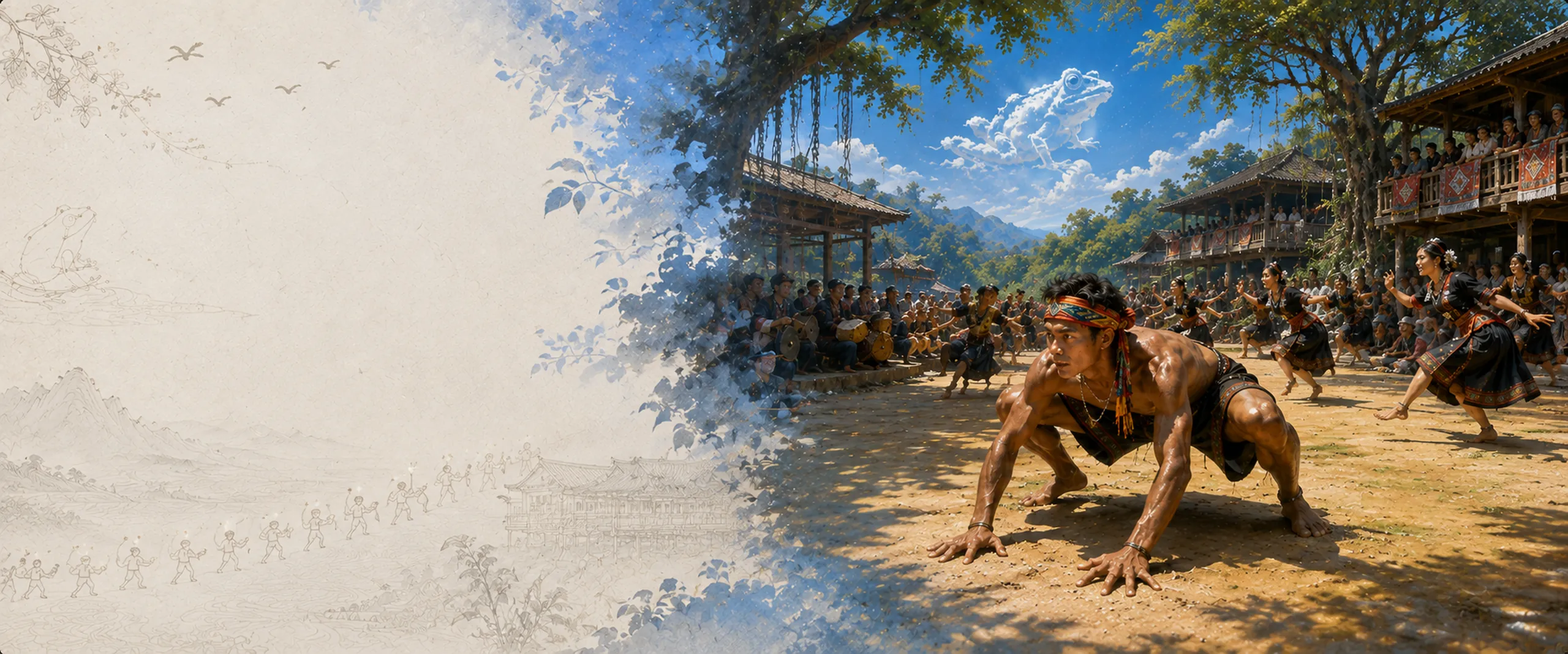
The Maguai Festival is a unique traditional festival of the Zhuang people, celebrated in the Hongshui River basin of Guangxi Zhuang Autonomous Region. “Maguai” is the Zhuang term for frog. The Zhuang ancestors believed that frogs were the sons of…

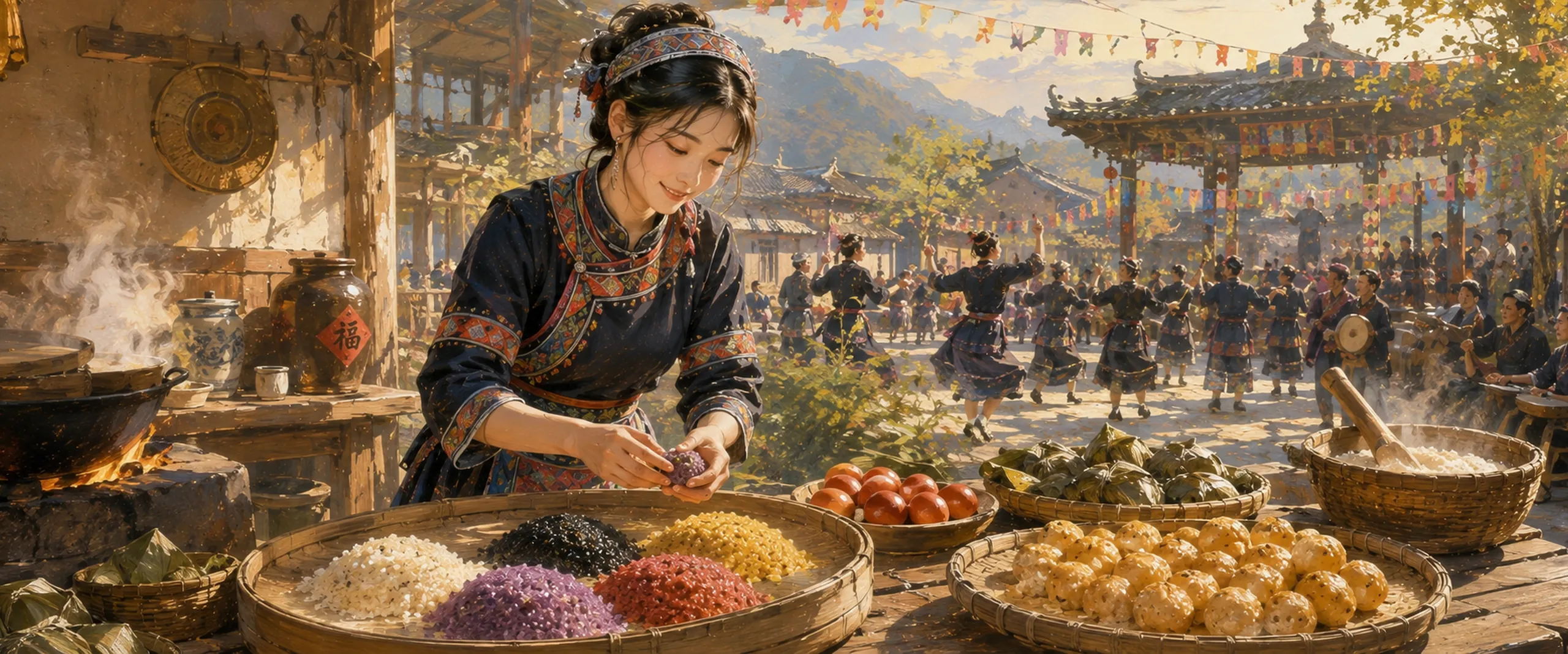
The Maguai Festival is a Zhuang festival centered on the worship of frogs, and food plays an important role in both sacrifice and celebration. Five-Colored Glutinous Rice is the festival’s most iconic food. Glutinous rice is dyed with natural plant juices into a range of colors, then steamed until fragrant and vividly hued.

On the day of the festival, villagers follow traditional customs by slaughtering pigs and chickens, steaming Five-Colored Glutinous Rice, pounding ciba, frying tofu balls, and dyeing eggs red. Every household busies itself preparing offerings to be taken to the “Maguai Pavilion” for worship of the Frog Goddess.

Ciba is soft, glutinous, and sweet; red eggs symbolize auspiciousness and celebration; tofu balls signify reunion and completeness. During the Maguai Festival, long-table banquets also offer opportunities to experience distinctive Zhuang foods.

These dishes are at once devout offerings presented to the Frog Goddess and a festival feast shared by young and old throughout the village, carrying the Zhuang people’s hopes for favorable weather and abundant harvests.

Frog Festival / Cuisine of the Frog Festival

Festival Food Gallery

Seasonal Menu

Food in Detail

Seeking the True Flavor

Five-Colored Glutinous Rice

Grains & Staples

Basic Information

  • Category: Grain staple
  • Popular Areas: Zhuang communities along the Hongshui River basin in Guangxi, especially Donglan, Tian’e, and Nandan
  • Main Ingredients: Glutinous rice, natural plant dyes including red-blue grass, turmeric, maple leaves, purple fanteng vine, and others
  • Also Known As: Five-Colored Glutinous Rice, Five-Colored Rice, Flower Rice

Historical Origins

Five-Colored Glutinous Rice is the most iconic seasonal food of the Maguai Festival and one of the central offerings used by the Zhuang in worship of the Maguai Goddess.

During the festival, local Zhuang villagers slaughter pigs and chickens, steam Five-Colored Glutinous Rice, pound ciba, dress in festive clothing, play suona horns and long brass horns, beat bronze drums, and sing mountain songs as they welcome visitors from afar.

In sacrificial activities, villagers offer pig’s heads, Five-Colored Glutinous Rice, and rice wine to Maguai.

Five-Colored Glutinous Rice is at once a sacrificial offering, a festival food, and a gift exchanged among relatives and friends. Zhuang communities also arrange the rice to form the Chinese characters “板隆蚂拐节”, bringing festival culture and food together.

The technique of making Five-Colored Glutinous Rice has a long history and is a chromatic expression of the Zhuang ecological principle “取于自然、敬于自然”—taking from nature and respecting nature.

All five colors come from natural plants: red from red-blue grass, yellow from turmeric, black from maple leaves, purple from purple fanteng vine, and white from the natural color of the glutinous rice itself.

The Zhuang believe that the five colors symbolize abundant harvests and favorable weather. Eating Five-Colored Glutinous Rice during the Maguai Festival is regarded as one of the most devout offerings to the Frog Goddess.

Cultural Meaning

The preparation of Five-Colored Glutinous Rice is highly meticulous.

Red-blue grass, turmeric, maple leaves, purple fanteng vine, and other natural plants are first separately pounded or simmered to extract their juices, producing red, yellow, black, and purple liquids.

The glutinous rice is divided into five portions and soaked separately in the four colored liquids and in clear water. It is left for several hours so that the colors can penetrate fully.

Each portion is then removed and drained separately, after which the colors are mixed in suitable proportions and the rice is steamed in a traditional steamer.

Once cooked, the rice is brilliant in color, fragrant, and flavorful, and can keep for a relatively long time without spoiling.

At Maguai Festival long-table banquets, Five-Colored Glutinous Rice is an indispensable staple.

Five-Colored Glutinous Rice carries several layers of meaning. First, “abundant harvests.” The five colors symbolize plentiful grain and favorable weather. Second, “auspiciousness and good fortune.” Five-Colored Glutinous Rice represents the Zhuang people’s hopes for good fortune. Third, “an offering to honor the divine.” It is one of the central offerings made to the Frog Goddess during the Maguai Festival. Fourth, “the gift of nature.” The use of natural plant dyes reflects the Zhuang ecological wisdom of “取于自然、敬于自然”—taking from nature and respecting nature.

Tofu Balls

Soy & Egg Dishes

Basic Information

  • Category: Fried food / tofu product
  • Popular Areas: Zhuang communities along the Hongshui River basin in Guangxi
  • Main Ingredients: Tofu, pork, mushrooms, chopped scallions, and other ingredients
  • Also Known As: Tofu Rounds, Fried Tofu Balls, Tofu Meatballs

Historical Origins

Tofu balls are a favored traditional food during the Maguai Festival.

As the festival approaches, people throughout the village slaughter chickens and ducks, steam fragrant Five-Colored Glutinous Rice, pound ciba, make tofu balls, and dye eggs red in lively preparation for the celebration.

Following local Zhuang custom, villagers rise early to slaughter pigs and chickens, steam Five-Colored Glutinous Rice, pound ciba, fry tofu balls, and dye eggs red, preparing the offerings that will be used to honor the Maguai Goddess.

The “roundness” of tofu balls joins the roundness of ciba and red eggs to form a distinctive “aesthetics of the circle” within Maguai Festival food.

Tofu balls are made by crumbling tofu and mixing it with minced meat, mushrooms, and other fillings, then shaping the mixture into spheres and frying them until golden.

Crisp on the outside and tender within, with a rich fragrance, tofu balls are widely enjoyed at Maguai Festival long-table banquets.

At a festival devoted to prayers for healthy descendants, favorable weather, and abundant harvests, the tofu ball carries the auspicious meaning of “团团圆圆”—complete and joyful reunion.

Cultural Meaning

Tofu balls carry the meaning of “团团圆圆”, reunion and wholeness.

Their circular form symbolizes family reunion, community cohesion, and the completeness of life.

In Chinese, “腐” (fǔ) in 豆腐—tofu—is homophonically associated with “福” (fú), meaning good fortune. Tofu balls therefore also symbolize “福气圆满”—good fortune brought to fullness.

During the Maguai Festival, when people pray for favorable weather and abundant harvests, tofu balls embody the Zhuang people’s deep hopes for family reunion and a fulfilled life.

Black-Rice Colorful Zongzi and Black-Rice Wine

Grains & Staples

Basic Information

  • Category: Grain staple / fermented alcoholic drink
  • Popular Areas: Donglan County, Guangxi, and Zhuang communities along the Hongshui River basin
  • Main Ingredients: Donglan black rice, also known as black glutinous rice, zongzi leaves, pork, mung beans, fermentation starter, and other ingredients
  • Also Known As: Black-Rice Zongzi, Black Glutinous-Rice Zongzi, Black-Rice Wine

Historical Origins

Black-Rice Colorful Zongzi and Black-Rice Wine are among the most mysterious seasonal foods of the Maguai Festival, and their origins are closely connected with the legend of Donglan black rice.

According to tradition, in ancient times the Hongshui River region suffered a severe drought. A young Zhuang man named Donglin, distraught after his mother’s death, accidentally injured a frog and angered the Thunder God. As a result, no grain could be harvested along either bank of the Hongshui River in Donglan.

Following the guidance of the deity Buluotuo, Donglin apologized to the Frog Goddess. On the first day of the first lunar month, he beat a bronze drum to recover the frog’s body and gave it an elaborate burial. He then sowed the black-colored rice seeds bestowed by the Thunder God.

From soil soaked in the frog’s blood grew a purple-black grain known as black rice. When cooked, its rice water resembled blood, and eating it was said to strengthen the body. From then onward, black rice became a sacred substance used by Zhuang communities to honor the Frog Goddess.

To give thanks to the Frog Goddess, Zhuang communities welcome the deity with bronze drums and perform frog dances during the Maguai Festival each year, while using black rice to make colorful zongzi and rice wine as offerings.

During the frog-burial ceremony, if the frog bones appear golden, this is taken as a sign that black rice will enjoy an abundant harvest. If the bones appear dull, wine must be brewed in prayer.

Black rice and the Maguai Festival are thus closely connected through a shared cultural meaning of reverence for nature and prayers for abundance, becoming a “code of life” passed down for a thousand years in Zhuang areas.

Cultural Meaning

Black-Rice Colorful Zongzi use black rice as the principal ingredient, together with fillings such as pork and mung beans. The mixture is wrapped in zongzi leaves and boiled.

The distinctive purple-black color of the rice gives the zongzi their unusual appearance and flavor.

Black-Rice Wine is made by fermenting black rice. The finished liquor is amber-colored, rich, mellow, and sweet, and is described as possessing distinctive nutritional value.

During the Ming dynasty period of resistance against Japanese raiders, Donglan tusi Wei Huchen led the Lang soldiers into battle, and members of his community offered Black-Rice Wine to the troops before their departure.

When the Guangxi Zhuang Autonomous Region was established in 1958, Donglan Black-Rice Wine was selected as a ceremonial wine.

Black-Rice Colorful Zongzi and Black-Rice Wine carry deep meanings within Zhuang food culture. First, “a sacred substance for honoring the divine.” Black rice is regarded as a sacred gift bestowed by the Thunder God, and Black-Rice Zongzi and Black-Rice Wine are special offerings used in worship of the Frog Goddess during the Maguai Festival. Second, “an omen of harvest.” The color of the frog bones determines whether black rice will enjoy an abundant harvest, closely linking black rice and the Maguai Festival through the cultural idea of reverence for nature. Third, “historical memory.” Black-Rice Wine carries the historical memory of the Zhuang—from the departure wine of the Lang soldiers in the Ming dynasty to the ceremonial wine of the Guangxi Zhuang Autonomous Region, it has witnessed changes in Zhuang history.

Red Eggs

Soy & Egg Dishes

Basic Information

  • Category: Eggs
  • Popular Areas: Zhuang communities along the Hongshui River basin in Guangxi
  • Main Ingredients: Eggs, red plant dyes such as red-blue grass
  • Also Known As: Colored Eggs, Red Eggs, Auspicious Eggs

Historical Origins

Red eggs are one of the most symbolically charged seasonal foods of the Maguai Festival.

Following traditional custom, every household slaughters pigs and chickens, steams Five-Colored Glutinous Rice, pounds ciba, fries tofu balls, and dyes eggs red while preparing sacrificial offerings.

Red eggs are used both to honor the Maguai Goddess and as auspicious gifts for relatives and friends.

During the Maguai Festival, whenever the sedan-chair bearers arrive at a household, they sing Maguai songs together and wish the family good fortune and peace. Each household then gives rice, zongzi, colored eggs, and other foods to those who bring the good tidings.

In Zhuang culture, red symbolizes auspiciousness, celebration, and prosperity.

Dyeing eggs red during the Maguai Festival is therefore both an offering to the Frog Goddess and a way of passing auspicious blessings to others through the brightly colored eggs.

Red eggs are among the most recognizable seasonal foods of the Maguai Festival, their vivid color echoing the joyful atmosphere of the celebration.

Cultural Meaning

Red eggs carry the meaning of “吉祥红火”—auspiciousness and flourishing prosperity.

Red symbolizes good fortune, celebration, and a thriving life, making the red egg one of the festival’s most direct auspicious symbols.

Eggs symbolize the origin and continuation of life. During the Maguai Festival, when people pray for favorable weather, abundant harvests, and flourishing descendants, red eggs carry hopes for the vitality and continuation of life.

The exchange of red eggs also conveys the Zhuang people’s blessing of “吉祥如意”—good fortune and the fulfillment of one’s wishes.

Ciba

Pastries & Snacks

Basic Information

  • Category: Grain snack
  • Popular Areas: Zhuang communities along the Hongshui River basin in Guangxi
  • Main Ingredients: Glutinous rice, peanuts, sesame, brown sugar, and other ingredients
  • Also Known As: Glutinous-Rice Cake, Ciba, Pounded Ciba

Historical Origins

Ciba is an indispensable seasonal food of the Maguai Festival.

Around the second day of the second lunar month each year, villagers voluntarily choose a date to hold the solemn “祭葬蚂拐”—sacrifice and burial of Maguai. Following custom, every household slaughters pigs and chickens, steams Five-Colored Glutinous Rice, pounds ciba, fries tofu balls, and dyes eggs red while preparing offerings.

Ciba serves both as an offering to the Maguai Goddess and as food at the festival long-table banquet, as well as a gift for relatives and friends.

During the festival, local Zhuang villagers slaughter pigs and chickens, steam Five-Colored Glutinous Rice, and pound ciba. When honoring Maguai, people may also present vegetarian foods such as ciba as offerings.

Pounding ciba is one of the most collective and ceremonially charged activities in preparing for the Maguai Festival.

Each family places freshly steamed glutinous rice into a stone mortar, where young and middle-aged men repeatedly pound it with wooden mallets until it becomes smooth, soft, and glutinous.

Women then divide the rice paste into small portions and press them into round cakes.

The circular form of ciba symbolizes reunion and completeness. During the Maguai Festival, when people pray for favorable weather and abundant harvests, ciba embodies their profound hopes for “圆满丰收”—a complete and abundant harvest.

Cultural Meaning

Making ciba requires the participation of the whole family.

Glutinous rice is first washed and soaked overnight, then steamed in a traditional steamer.

While still hot, the cooked rice is poured into a stone mortar coated with oil. Young and middle-aged men repeatedly pound it with wooden mallets until the rice becomes smooth, soft, and glutinous.

It is then transferred to a work surface dusted with flour or coated with oil. Women pinch off small portions of the glutinous rice mixture and flatten them into round cakes.

Ciba may be eaten directly, dipped in sugar or sesame powder, or pan-fried or deep-fried before serving.

Ciba carries several layers of cultural meaning. First, “the taste of reunion.” Its sticky texture binds together into a single mass, symbolizing family unity and community cohesion. Second, “a complete harvest.” Its circular shape represents hopes for a full and abundant harvest. Third, “an offering to honor the divine.” Ciba is an important offering made to the Frog Goddess during the Maguai Festival. Fourth, “communal sharing.” Pounding ciba requires participation by the whole family and expresses the Zhuang communal spirit of “合聚共享”—gathering together and sharing.

Maguai Rice — Long-Table Banquet

Others

Basic Information

  • Category: Composite banquet
  • Popular Areas: Zhuang communities along the Hongshui River basin in Guangxi, especially Baying Village in Donglan
  • Main Ingredients: Five-Colored Glutinous Rice, ciba, tofu balls, red eggs, Black-Rice Zongzi, chicken, duck, fish, meat, rice wine, and other foods
  • Also Known As: Long-Table Banquet, Maguai Festival Long-Table Banquet, Hundred-Family Banquet

Historical Origins

The long-table banquet is the form of dining that most strongly embodies community cohesion during the Maguai Festival.

Throughout the festival, each household prepares abundant offerings and food. After the Frog Goddess has been honored, the entire village sits together to share the feast.

Maguai Festival cultural parks may include food streets, and visitors can also reserve long-table banquets to experience distinctive Zhuang glutinous-rice dishes and other foods.

The origins of the long-table banquet are closely connected to the Zhuang communal tradition of “sharing and eating together.”

During the Maguai Festival, a major occasion for praying for favorable weather and abundant harvests, Zhuang communities scattered among villages on both sides of the Hongshui River gather together. The long-table banquet becomes an ideal setting for sharing food and exchanging feelings.

Cultural Meaning

At the banquet, traditional Zhuang foods are brought out one after another: Five-Colored Glutinous Rice, ciba, tofu balls, red eggs, Black-Rice Zongzi, chicken, duck, fish, meat, rice wine, and more.

As people eat, they sing mountain songs and beat bronze drums, while laughter and conversation continue without interruption.

During the Maguai Festival, Zhuang communities in Baying, Bandeng, and other villages along the Hongshui River voluntarily organize traditional folk celebrations.

The long-table banquet combines the sharing of food with cultural exchange. Maguai worship, frog dances, intangible cultural heritage performances, and other folk activities unfold one after another.

The long-table banquet carries some of the highest ideals of Zhuang food culture. First, “gathering and sharing.” It is the fullest expression of the Zhuang principle “合聚万物、共享丰收”—gathering all things and sharing the harvest. Second, “a banquet of honoring the divine.” Food moves from sacrificial offering to communal feast, completing the transition from “敬神”—honoring the divine—to “爱人”—loving people. Third, “community cohesion.” The banquet brings together Zhuang people scattered across different villages, strengthening the community through sharing. Fourth, “cultural transmission.” The long-table banquet brings together Zhuang food culture, song and dance, and the bronze-drum tradition, making it one of the most concentrated platforms for presenting Maguai Festival culture.

Collecting Maguai Rice

Others

Basic Information

  • Category: Communal custom / assorted food ingredients
  • Popular Areas: Zhuang communities along the Hongshui River basin in Guangxi
  • Main Ingredient: Rice and grain contributed by individual households
  • Also Known As: Blessing Rice, Hundred-Family Rice

Historical Origins

“讨蚂拐米”, literally “collecting Maguai rice,” is a distinctive communal custom of the Maguai Festival.

During traditional Maguai Festival activities held in Danlu Hamlet, Changli Village, Wu’ai Town, Nandan County, villagers first honor Maguai with a pig’s head, Five-Colored Glutinous Rice, and rice wine, then conduct activities including 牛角报春, 蚂拐闹春, 四季农歌, and 讨蚂拐米.

The custom reflects the Zhuang communal spirit of “聚沙成塔、共享福气”—many small contributions gathering into something greater, with good fortune shared by all.

Each household contributes rice and grain. These are gathered together, used collectively to prepare festival foods, and then shared.

This custom of “取之于众、食之于众”—taking from the community and feeding the community—passes festival blessings to everyone through the gathering and sharing of food.

Food Culture

Foodways

Viewed as a whole, the food traditions of the Zhuang Maguai Festival reveal a cultural logic that runs consistently through the celebration:

I. Color as beauty. The most iconic food of the Maguai Festival is Five-Colored Glutinous Rice. Its five colors come from natural plant dyes including red-blue grass, turmeric, maple leaves, and purple fanteng vine. Red, yellow, black, white, and purple interweave to create rice that is vivid in color, fragrant, and appetizing.

Five-Colored Glutinous Rice is used not only to honor the Maguai Goddess, but also at festival long-table banquets and as a gift for relatives and friends. The five colors symbolize auspiciousness, good fortune, and abundant harvests.

During the Maguai Festival, people also arrange Five-Colored Glutinous Rice to form the Chinese characters “板隆蚂拐节”.

II. Roundness as form. Another defining form in Maguai Festival foods is the “circle.” Ciba is round, tofu balls are round, red eggs are round, and colorful zongzi may be round or triangular.

Roundness symbolizes reunion, completeness, and the cyclical rhythm of life. The Maguai Festival is a time when the Zhuang pray for favorable weather and abundant harvests, and round foods embody a deep longing for “complete and abundant harvests.”

In the festival’s sacrificial ceremonies, round offerings are among the most devout gifts presented to the Frog Goddess. At long-table banquets, round foods become an expression in taste of family reunion and communal sharing.

III. Sacrifice as origin. The origins of Maguai Festival food lie in sacrificial worship.

Around the second day of the second lunar month each year, Zhuang communities in different villages voluntarily organize Maguai Festival activities. Every household slaughters pigs and chickens, steams Five-Colored Glutinous Rice, pounds ciba, fries tofu balls, and dyes eggs red, preparing offerings to be taken to the Maguai Pavilion for the worship of the Frog Goddess.

Pig’s heads, Five-Colored Glutinous Rice, and rice wine are used to honor Maguai. Black rice is made into colorful zongzi and rice wine for sacrificial offerings.

After the ceremony, the food is transformed from an offering into a shared banquet, completing a transition from “敬神”—honoring the divine—to “爱人”—loving people.

IV. Sharing as courtesy. During the Maguai Festival, whenever the sedan-chair bearers arrive at a household, they sing Maguai songs together, praising Maguai’s virtues and wishing the household good fortune and peace.

Each family, in turn, gives rice, zongzi, colored eggs, and other foods to those who bring the festival tidings.

Through this custom of “sharing food,” festival blessings are passed to every person by means of food. Eating these foods together is believed to help ensure health and well-being.

Regional Distribution

Foodways
Region Distinctive Maguai Festival Foods
Bandeng Village, Changle Town, Donglan County Five-Colored Glutinous Rice, ciba, tofu balls, red eggs, chicken and duck
Baying Village, Bachou Township, Donglan County Five-Colored Glutinous Rice, ciba, red eggs, pork and chicken, farmhouse foods and local specialties
Banlong Village, Changjiang Town, Donglan County Long-table banquet featuring a variety of traditional Zhuang foods
Nadong Village, Liupai Town, Tian’e County Five-Colored Glutinous Rice, ciba, pork and chicken
Nadi Village, Wu’ai Town, Nandan County Ciba, vegetarian wine dishes, vegetarian rice

Additional Notes:

  • Five-Colored Glutinous Rice is the most iconic food of the Maguai Festival. Glutinous rice is dyed black, red, yellow, purple, white, and other colors using natural plant juices, then steamed. It is both a central offering to the Maguai Goddess and a staple served to guests during the festival.
  • Ciba is a traditional food pounded in every household for the Maguai Festival. In places such as Nandan, ciba is an important offering to Maguai. Because Maguai is believed to “eat vegetarian food,” offerings there consist mainly of vegetarian ciba, vegetarian wine dishes, and other meatless foods.
  • Red eggs form an important part of the festival offerings. Dyeing them red symbolizes auspiciousness and festive joy.
  • Tofu balls are one of the distinctive Maguai Festival foods of Donglan County. Made primarily from tofu and shaped into spheres, they signify reunion and completeness.
  • The long-table banquet is an important form of festival dining. Places such as Banlong Village in Donglan County set out long-table banquets during the Maguai Festival, while visitors can also reserve such banquets at Maguai Festival cultural parks to experience distinctive Zhuang cuisine.

Closing Reflections

Foodways

The Hongshui River winds through the mountains of northwestern Guangxi, and every first lunar month the Zhuang villages along its banks welcome an ancient feast offered to the Frog Goddess. Maguai, the Zhuang name for the frog, is revered as a goddess who governs wind and rain. According to legend, a young Zhuang man named Donglin angered Heaven after scalding a frog to death, bringing three years of severe drought. Only after he followed the guidance of the divine ancestor and honored the frog with generous offerings did favorable weather return. This legend has circulated along the Hongshui River for centuries, shaping the culinary landscape of the Maguai Festival.

Before dawn on the day of the festival, every household is already busy. Five-Colored Glutinous Rice is the festival’s most iconic food, its black, red, yellow, white, and purple colors all derived from natural plants and solemnly arranged upon the altar. Ciba is pounded again and again in stone mortars until sticky and soft; tofu balls are fried until golden, crisp outside and tender within; red eggs are dyed the auspicious color of celebration and placed alongside slaughtered pigs and chickens as offerings to the Maguai Goddess. Once the sacrificial rites are complete, “蚂拐饭”, the Maguai feast, becomes the centerpiece of the celebration. As long tables extend through the village, the fragrance of Five-Colored Glutinous Rice, the soft glutinous texture of ciba, the crispness of tofu balls, and the faint bitterness followed by sweetness of mugwort cakes come together across the feast. In Maguai Festival cultural parks, the colors of Five-Colored Glutinous Rice mingle with the sounds of bronze drums and mountain songs. In Banlong Village, Donglan County, the long-table banquet is even combined with Lantern Festival celebrations, with a hundred tables seated together and a thousand people sharing the same feast.

The Maguai Festival has been included in the first batch of the National List of Intangible Cultural Heritage. Its foods extend far beyond the boundaries of a single meal: the brilliance of Five-Colored Glutinous Rice is the Zhuang ancestors’ devout prayer for abundant harvests; the roundness of tofu balls is the unspoken hope for healthy and flourishing descendants; and the vivid red of the eggs is the most passionate celebration of life and reproduction. When long tables spread out beside the Hongshui River and the sounds of bronze drums and drinking songs echo through the night, the foods of the Maguai Festival cease to be merely pleasures of taste. They become the simplest and most steadfast covenant through which a rice-growing people, using food as a medium, maintain their bond with Heaven and Earth, with the divine, and with their ancestors.

—-

Continue exploring Frog Festival culture

Readers’ Comments

Calendar and traditional culture enthusiasts from around the world, sharing the same moon.

Sign in or register to join the conversation. Your comment account is created automatically the first time you use a connected account.