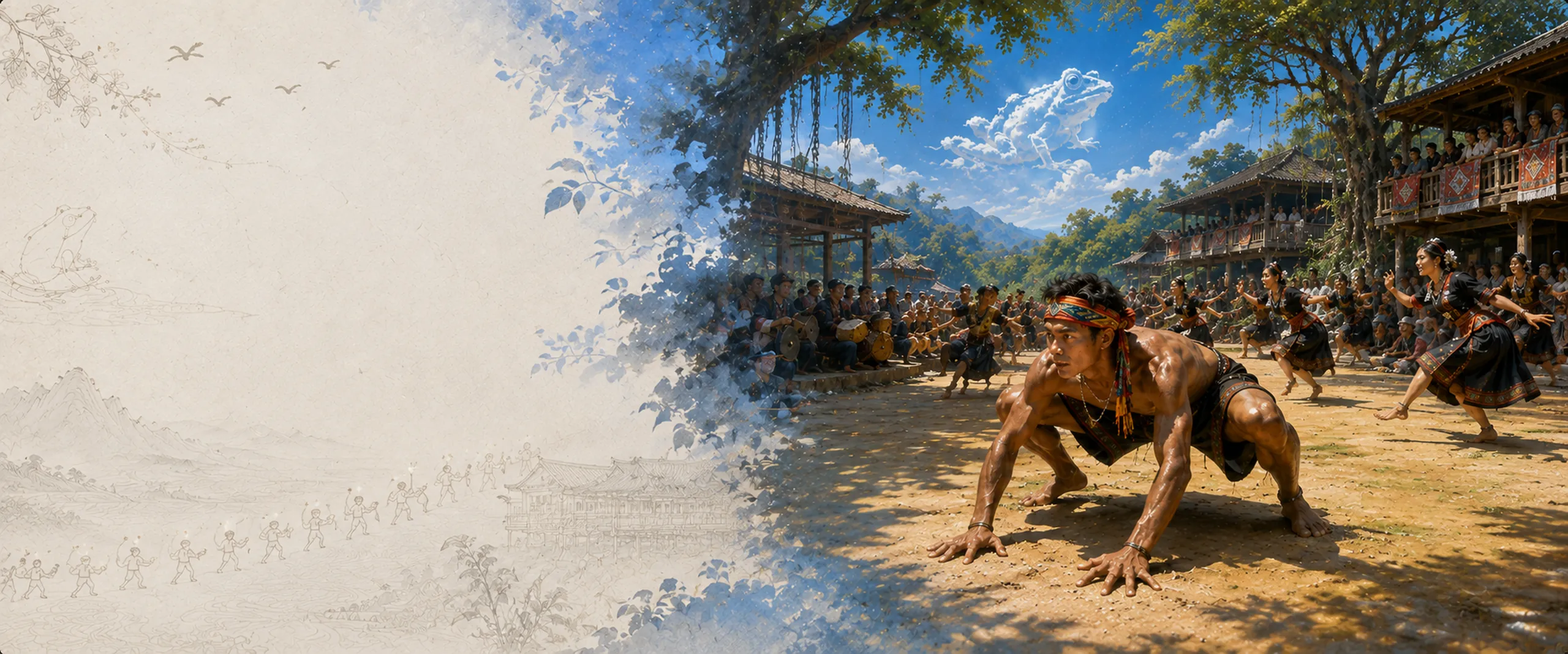
The Maguai Festival generally begins on the first day of the Lunar New Year and ends on the second day of the second lunar month. Zhuang ancestors believed that frogs were the children of the Thunder God and rain-bringing spirits who governed wind and rain. By worshipping the Maguai, people sought to predict the year ahead and pray for a good harvest. The first stage is “finding the Maguai,” when people search the fields for frogs newly awakened from hibernation. The second stage, “worshipping the Maguai,” involves sacrificial rites. The third stage, “observing filial rites for the Maguai,” includes singing Maguai songs and performing Maguai dances. The fourth stage, “burying the Maguai,” consists of ceremonially interring the frog. The movements of the Maguai Dance largely imitate those of frogs. During the festival there are also bronze-drum gatherings, folk-song gatherings, food exhibitions, agricultural culture experiences, bonfire carnivals, and other activities. The Zhuang Maguai Festival is mainly practiced in the Hongshui River basin of northwestern Guangxi.
Main Customs
Finding the Maguai
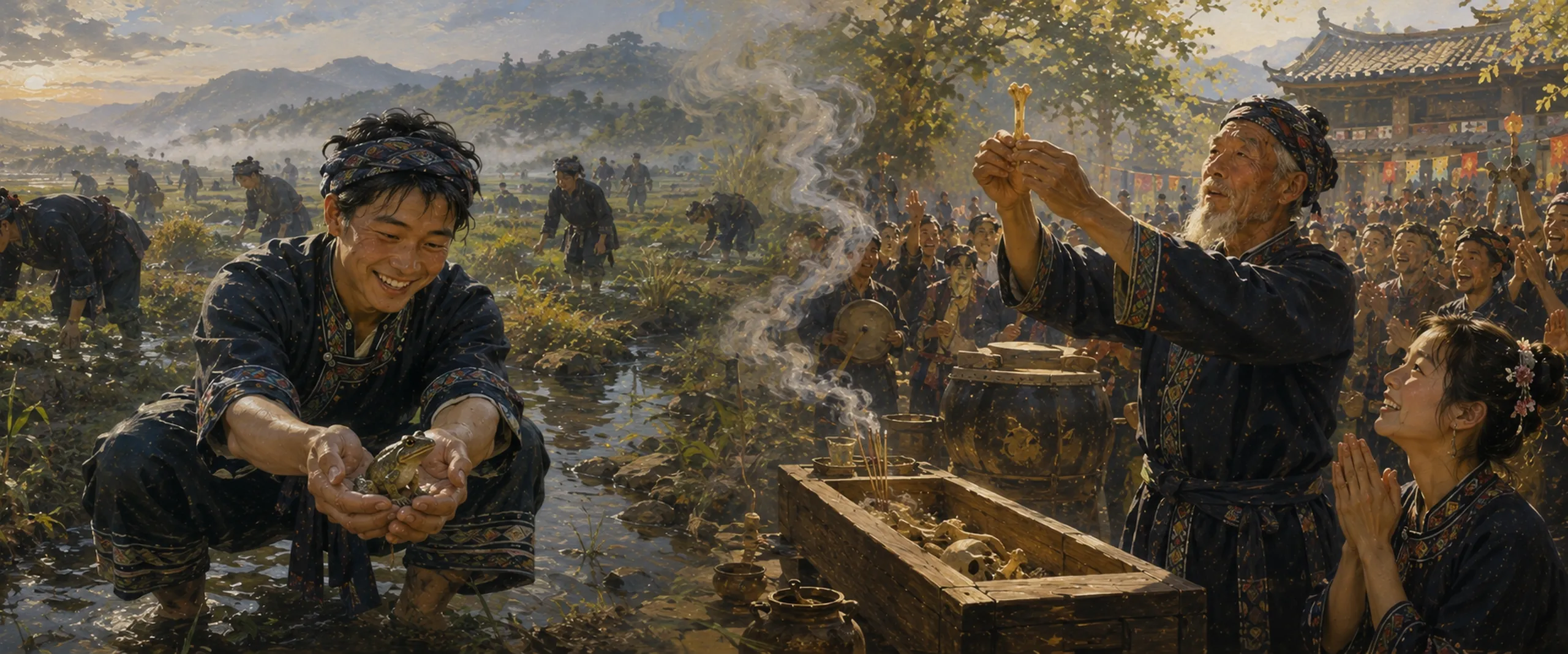
At dawn on the first day of the first lunar month, people beat bronze drums and go in groups to the fields to search for frogs still emerging from hibernation. Men and women, young and old, from the entire village spread out across nearby fields and stream banks, searching everywhere for the desired “Yaguai,” locally known as the “Maguai Mother.”
It is said that the first person to find a frog is especially fortunate and is honored as the “son-in-law of the Thunder King,” the “Maguai Lang,” becoming the leader of that year’s Maguai observances. The leader takes everyone to ignite firecrackers and smoke signals to report to the Thunder King the joyful news that the human world is worshipping the Maguai. The frog is then welcomed back to the village and placed in a flower sedan chair. The discovered Maguai is placed inside a specially prepared bamboo tube known as the “Maguai coffin.”
Worshipping the Maguai
Worshipping the Maguai mainly takes place on the fifteenth day of the first lunar month. The principal activities include erecting ritual banners, conducting sacrificial rites, and holding Maguai song gatherings. People arrange offerings, beat bronze drums, burn incense, and worship the Maguai. The ceremony is presided over by a highly respected elder in the village. The Maguai coffin is placed in the Maguai pavilion, and offerings such as the three sacrificial animals, five-color glutinous rice, and wine are presented. The officiant recites sacrificial texts, praying that the Maguai Goddess will bless the whole village with favorable weather, abundant harvests, and thriving people and livestock.
Erecting ritual banners is an important part of Maguai worship. Every year on the fifteenth day of the first lunar month, residents of Baying Village hold the Maguai Festival folk custom of “erecting the banner.” This means “raising a pole and suspending a banner,” specifically a paper banner, called “Yaotonggan” in Zhuang. Villagers erect a colorful paper banner five or six meters high beside the fixed Maguai burial site at the entrance to the village, arrange offerings, beat bronze drums, set off firecrackers, and worship the Maguai. The banner-raising ritual is said to symbolize the 365 days of the year. On this day, the Jade Emperor grants special mercy, allowing farmers to offer mice as sacrifices so that the celestial gods may punish them, preventing them from damaging crops again and blessing the new year with favorable weather, abundant harvests, and prosperous people and livestock.
Observing Filial Rites for the Maguai
Observing filial rites for the Maguai is one of the most emotionally resonant stages of the festival. In Zhuang culture, “filial piety” is not directed only toward parents but also toward deities. This rite reflects the traditional Zhuang concept of treating natural deities as members of the family.
After twenty-five days of vigil and village procession activities, the Maguai Festival reaches its climax. People perform Maguai dances and sing Maguai songs as a form of keeping vigil for the Maguai. During the vigil, people remain with the Maguai throughout the night, expressing respect and gratitude through song and dance. In the evening, the flower sedan chair is carried beneath the Maguai pavilion, where people again perform Maguai dances and sing Maguai songs to keep vigil. Throughout the night, the sound of bronze drums continues without interruption, while song and dance rise one after another. People accompany the Maguai through its final hours in the most fervent manner possible.
Village Procession and Maguai Worship
From the first day of the first lunar month until the end of that month, children carry the frog through the village during the daytime and offer New Year greetings to every household. Carrying the “Maguai coffin” and beating bronze drums, they parade through the village, pausing briefly before each household and reciting blessings in unison until the coffin is finally carried back to its designated place.
The village procession is an activity in which the Maguai is taken from household to household for worship. At each home, people loudly recite words of blessing, wishing the host family good fortune in the new year, flourishing livestock, and abundant harvests. The household head welcomes them by setting off firecrackers and offers rice, glutinous-rice cakes, red eggs, red envelopes, and other gifts in thanks. The gifts collected during the procession are called “blessings and longevity goods.” Maguai rice consists of the ritual offerings contributed by each household. According to traditional custom, once the Maguai Festival activities conclude, the whole village gathers for a communal meal.
Burying the Maguai
Burying the Maguai is the most mysterious ritual of the festival and also its climax. On this day, people choose an auspicious time, carry the flower sedan chair to the frog burial ground, and open the sacred coffin containing the frog buried the previous year. If the frog bones have turned golden yellow, this is believed to predict a good year, and bronze drums immediately sound throughout the gathering as everyone cheers together. If the frog bones are gray or black, this is taken as a sign of a poor year, and people burn incense and pray for disasters to be removed and blessings to descend.
When the new Maguai is buried, everyone stands reverently in silence. First, the “Maguai son-in-law” places the coffin in the ground in an east-facing-west orientation, after which everyone eagerly adds soil and builds up the grave. Offerings are placed around the burial mound. The burial ceremony for the new frog is extremely solemn. The year’s Maguai coffin is placed into the grave and a final farewell is performed.
After the Maguai is buried, men and women, young and old, gather around a bonfire to sing and dance, sending the Maguai’s soul back to heaven. That night, people celebrate without restraint until dawn.
Maguai Song Gatherings and Maguai Dance
The Maguai song gathering is one of the festival’s important activities. During the festival, people beat gongs and drums and invite singers from all directions. Everyone puts on festive attire and gathers together, with songs resounding across the fields. Unmarried young men and women from nearby Zhuang villages arrive in large numbers, gather around bonfires, pair off in the fields, and seek desired partners through antiphonal singing of “Maguai songs,” or love folk songs.
The Maguai Dance is the festival’s most representative dance form. Its movements largely imitate frogs, with principal actions including deep squats, leaning backward while supporting the body with a staff, moving sideways with quick small steps, and lifting, stamping, trembling, and tapping movements. The dance is full of everyday vitality and humorous charm. On the climax night of the Maguai Festival, people put on ancient masks and perform folk dances such as the Maguai-God Worship Dance, Bronze-Drum Worship Dance, Harrowing and Plowing Dance, Rice-Transplanting Dance, Fishing and Shrimp-Catching Dance, Spinning and Weaving Dance, and Harvest Maguai-Worship Dance. Every dance is an artistic expression of Zhuang agricultural life.
Food of the Maguai Festival
Steaming five-color glutinous rice is one of the most important food preparations for the Maguai Festival. The rice is dyed with natural plant colorants and is bright in color, fragrant, and flavorful. Pounding glutinous-rice cakes is a collective activity during the festival, while red eggs symbolize auspiciousness and celebration. On the day of the event, villagers slaughter pigs and chickens and prepare abundant festival banquets. Maguai rice consists of ritual offerings contributed by each household. According to traditional custom, after all festival activities have ended, the whole village gathers for a communal meal.
Regional Variations
Baying Village, Donglan
Core place of origin, most complete preservation, more than 400 years of history, from the first day of the Lunar New Year to the second day of the second lunar month
Wuai Town, Nandan
More than 2,000 years of history; especially prevalent in Nadi Village, Danlu Hamlet, and Dutian Village
Nadong Village, Tian’e
Base for the transmission of the Maguai Dance and a protected ecological area for bronze-drum culture
Bama
Ancient Maguai songs and festive bronze-drum sounds have been transmitted for generations
The Frog Goddess in the Zhuang Language
“Maguai” is the Zhuang-language term for frog. In Zhuang culture, the Maguai is not an ordinary animal but a deity governing wind and rain, one of the children sent to the human world by the Thunder King. Zhuang villages along the Hongshui River worship the Maguai in order to pray for favorable weather, abundant harvests, and the prosperity of both people and livestock.
The Maguai Festival is also known as the “Frog Festival,” “Frog Goddess Festival,” and “Frog-Worship Festival.” The name “Frog Goddess Festival” is especially meaningful. In Zhuang, the word translated as “goddess” or “grandmother” is an honorific for female ancestors and deities. “Frog Goddess” therefore means a female frog deity, showing that Zhuang ancestors regarded the frog as a female divinity. Zhuang legends hold that the frog goddess governs wind and rain, and frogs are called Maguai. The term “Frog Goddess Festival” reflects the profound integration of maternal worship and frog worship in Zhuang society.
In Baying Village, Bachou Township, Donglan County, Guangxi, the Maguai Festival is called “Yagui” in the local dialect. As a core place of origin and a model village for the transmission of the “Zhuang Maguai Festival,” Baying Village still preserves the festival’s ancient and mysterious rituals in a relatively complete form, making it a vivid example of the living transmission of Zhuang agricultural civilization.
Diverse Alternative Names and Forms of Address
The Maguai Festival has different names in different regions. In some places it is called the “Frog Festival,” in others the “Frog-Worship Festival,” and elsewhere the “Frog Goddess Festival.” These different names reflect subtle regional variations within the same festival, but all revolve around the same central theme: the worship and ritual veneration of frogs.
The name “Frog Goddess Festival” also suggests the festival’s ancient gendered characteristics. In Zhuang mythology, the Maguai Goddess is the daughter of the Thunder King and governs rainfall, bringing favorable weather to the earth. This idea of viewing the frog as a female deity may be connected with ancient forms of maternal worship, or with the frog’s biological characteristic of producing many offspring. Whatever the explanation, the term “Frog Goddess” reflects the early Zhuang tendency to personify and gender natural forces.
The Legend of Donglin and Buluotuo
The Maguai Festival originated in the Zhuang people’s worship of frogs. Its central legend concerns the Zhuang progenitor Buluotuo and a filial son named Donglin.
Long ago, it is said, there was a young man named Donglin in a Zhuang village who had lived with his mother since childhood. One day his mother died, and Donglin was overwhelmed with grief, keeping mourning rites with tears in his eyes. Outside the house, frogs croaked ceaselessly day and night. Donglin grew increasingly irritated and worried that the noise would disturb his mother’s spirit, so he boiled water and poured it over the frogs. Frogs died and were injured everywhere. From that time onward, no rain fell from the sky, and lamentation filled the human world. Donglin was terrified and went to seek help from the divine ancestor Buluotuo and the divine mother Meiluojia. Buluotuo told him that the frogs were not ordinary creatures: they were the children of the Thunder God in heaven, and only when they called would sweet rain descend. Whenever people needed rain, the frogs would raise their heads and call; after the Thunder King heard the sound of the frogs on earth, he would send down rain. Donglin therefore had to apologize to them.
Donglin immediately began beating a bronze drum on the first day of the Lunar New Year, inviting the Frog Goddess back to the village for the New Year, and he also asked a thousand people to conduct a funeral for the dead frogs. From then on, the human world once again received the blessing of the Frog Goddess, and wind and rain came at the proper times. Since that time, the Zhuang people living along the Hongshui River in western Guangxi have celebrated the Maguai Festival every year and worshipped the Maguai.
The Relationship between Maguai Festival Legends and Bronze-Drum Culture
The Maguai Festival arose together with Zhuang bronze-drum culture in the Hongshui River basin and has been passed down from generation to generation. The bronze drum is the most important musical instrument and ritual vessel of the festival. In the legend, Donglin followed Buluotuo’s instructions and beat the bronze drum to invite the Frog Goddess back to the village for the New Year. The resonant sound of the bronze drum is believed to be sacred, capable of reaching both heaven and earth. When the bronze drum sounds, the Frog Goddess can hear the call of the human world and descend from heaven. Bronze drums cast by Zhuang ancestors often feature three-dimensional frog sculptures on their drumheads, a material expression of Maguai worship.
The History and Transmission of the Maguai Festival
The exact time when the Maguai Festival originated cannot currently be determined because there is insufficient documentary evidence and written record. According to oral transmission by bearers of the tradition, however, the Baying Maguai Festival has a long history and deep roots and is said to have existed for more than 400 years. In areas such as Donglan, Bama, Fengshan, and Tian’e in the Hongshui River basin, Maguai worship has historically been especially prevalent. Around 300 Maguai communal shrines were once built there, together with countless Maguai burial slopes.
There are many folk legends about the origin of the Maguai Festival among the Zhuang people of the Hongshui River basin. One of the most widely circulated versions comes from Donglan County. Donglin followed Buluotuo’s instructions, beat the bronze drum, invited the Frog Goddess back to the village for the New Year, and invited a thousand people to bury the dead frogs. Donglin’s filial devotion moved Heaven, and from that time onward, the Zhuang villages along the Hongshui River enjoyed timely wind and rain every year, abundant harvests, and flourishing people and livestock in all four seasons.
The origins and history of the Baying Maguai Festival are not preserved in detailed written records, but its ritual procedures, lines of transmission, and techniques for making ritual implements have been passed on through direct oral teaching and demonstration by tradition bearers. The Baying Maguai Festival is a cultural activity independently organized by folk tradition bearers in Zhuang communities and is a major traditional festival of the Zhuang people in the Hongshui River basin.
From the Pre-Qin Period to the Tang and Song Dynasties
The origins of the Maguai Festival can be traced back to the period of frog-totem worship among the ancestors of the Zhuang people. The Zhuang are an ancient people of the Lingnan region, and their ancestors were already engaged in rice cultivation on this land several thousand years ago. Frogs are closely connected with rice production: frog calls signal the coming of rain, while the abundance or scarcity of frogs directly affects the degree of insect infestation in rice fields. Through long-term agricultural practice, Zhuang ancestors gradually developed a form of frog worship and regarded frogs as deities governing wind and rain.
During the pre-Qin period, historical records already mention customs among the ancestors of the Zhuang, one branch of the ancient Yue peoples, such as “cutting the hair and tattooing the body” and “worshipping snakes and frogs.” The rise of bronze-drum culture in the Lingnan region provided the most important ritual medium for the Maguai Festival. Bronze drums cast by Zhuang ancestors often bore three-dimensional frog sculptures on their surfaces, a material embodiment of frog worship. With the spread and popularization of bronze-drum culture, rituals using bronze drums to worship frogs gradually became established.
During the Tang and Song dynasties, as the central dynasties increasingly developed the Lingnan region, the social structure of the Zhuang ancestors underwent profound changes. Rice agriculture developed further, and the connection between the Maguai Festival and agricultural production became even closer. Although Tang and Song documents contain little direct record of the Maguai Festival, the flourishing of bronze-drum culture and the widespread practice of frog worship among the Zhuang provided fertile cultural soil for the festival’s formation. By the Tang and Song periods, the Maguai Festival may already have gradually evolved from a purely sacrificial event into a comprehensive festival integrating ritual worship, song and dance, and social interaction.
Ming and Qing Dynasties
The Ming and Qing periods were important stages in which the Maguai Festival took shape and flourished in the Hongshui River basin. From the late Ming to the early Qing, as the Zhuang population increased and villages expanded, the festival’s ritual system became further enriched and standardized. According to oral transmission, the Baying Maguai Festival is said to have a history of more than 400 years, placing its earliest period roughly in the late Ming and early Qing. In Donglan, Bama, Fengshan, Tian’e, and other areas of the Hongshui River basin, Maguai worship was especially widespread. Historically, around 300 Maguai communal shrines were built, along with countless Maguai burial slopes. The construction of these shrines and burial sites indicates that by the Ming and Qing periods, the Maguai Festival had already developed fixed ritual spaces and a complete sacrificial system.
During the Qing dynasty, Zhuang regions were relatively stable and rice agriculture continued to develop. As an important festival for praying for favorable weather and abundant harvests, the Maguai Festival was widely transmitted among Zhuang villages in the Hongshui River basin. Its basic ritual sequence—finding the Maguai, worshipping the Maguai, observing filial rites for the Maguai, and burying the Maguai—had largely taken shape by the Qing period. Maguai song gatherings and Maguai dances also became richer during this time, emerging as some of the most vivid artistic expressions of Zhuang agricultural culture.
Modern and Contemporary History
During the Republican period, with the introduction of Western culture and the development of modern education, traditional Zhuang society underwent profound changes. Although the Maguai Festival experienced some disruption during this period, it retained strong vitality in remote villages of the Hongshui River basin. During the War of Resistance against Japanese Aggression and the Chinese Civil War, social unrest affected the holding of the festival to some extent, but its core rituals and cultural memories continued among the people.
After the founding of the People’s Republic of China, the social system in Zhuang regions underwent fundamental transformation. During the Cultural Revolution, however, the Maguai Festival was denounced as “feudal superstition” and was disrupted and prohibited, causing a temporary interruption in its transmission. Maguai communal shrines were demolished, Maguai burial slopes were leveled, and many ritual details and sacrificial texts were lost during that period.
After the beginning of reform and opening up, with the restoration and implementation of ethnic policies, the Maguai Festival was revived and transmitted once again. Zhuang villages in different areas resumed holding Maguai Festival activities, and the ancient rituals regained vitality along the Hongshui River. The Maguai Festival not only returned to village life but also entered the field of academic research, becoming an important subject in ethnology and folklore studies.
Contemporary Period
In 2006, the Zhuang Maguai Festival was included in the first batch of representative national-level intangible cultural heritage projects. Its sequence number is 463, its project number is X-15, the declaring region or institution is Hechi City, Guangxi Zhuang Autonomous Region, and the safeguarding institution is the Hechi Intangible Cultural Heritage Protection Center. In both 2013 and 2014, it received the “Most Distinctive Ethnic Festival Award” among China’s Outstanding Ethnic Festivals.
In contemporary society, the Maguai Festival has not declined; instead, it has continued to expand. In February 2023, the Zhuang Maguai Festival held in Bachou Township, Donglan County included Maguai Dance, bronze-drum gatherings, folk-song gatherings, food exhibitions, folk performances, agricultural culture experiences, and a bonfire carnival evening, attracting 100,000 Chinese and international visitors. On March 1, 2025, the second day of the second lunar month, Baying Village in Bachou Township, Donglan County, Hechi City welcomed the annual Zhuang Maguai Festival, where tens of thousands of visitors joined an intangible cultural heritage gathering spanning nearly four centuries.
As society develops, the Maguai Festival has continued to adapt to contemporary needs. In recent years, Bachou Township in Donglan County has used the Maguai Festival as an opportunity to organize innovative characteristic folk celebrations under the agricultural cultural tourism program “One Theme Each Month, One Brand for Each Village.” The Maguai Festival has become an important platform for presenting Zhuang culture, promoting ethnic unity, and advancing the integration of culture and tourism.
Finding the Maguai
At dawn on the first day of the first lunar month, people beat bronze drums and go in groups to the fields to search for frogs still emerging from hibernation. Men and women, young and old, from the entire village spread out across nearby fields and stream banks, searching everywhere for the desired “Yaguai,” locally known as the “Maguai Mother.”
It is said that the first person to find a frog is especially fortunate and is honored as the “son-in-law of the Thunder King,” the “Maguai Lang,” becoming the leader of that year’s Maguai observances. The leader takes everyone to ignite firecrackers and smoke signals to report to the Thunder King the joyful news that the human world is worshipping the Maguai. The frog is then welcomed back to the village and placed in a flower sedan chair. The discovered Maguai is placed inside a specially prepared bamboo tube known as the “Maguai coffin.”
Worshipping the Maguai
Worshipping the Maguai mainly takes place on the fifteenth day of the first lunar month. The principal activities include erecting ritual banners, conducting sacrificial rites, and holding Maguai song gatherings. People arrange offerings, beat bronze drums, burn incense, and worship the Maguai. The ceremony is presided over by a highly respected elder in the village. The Maguai coffin is placed in the Maguai pavilion, and offerings such as the three sacrificial animals, five-color glutinous rice, and wine are presented. The officiant recites sacrificial texts, praying that the Maguai Goddess will bless the whole village with favorable weather, abundant harvests, and thriving people and livestock.
Erecting ritual banners is an important part of Maguai worship. Every year on the fifteenth day of the first lunar month, residents of Baying Village hold the Maguai Festival folk custom of “erecting the banner.” This means “raising a pole and suspending a banner,” specifically a paper banner, called “Yaotonggan” in Zhuang. Villagers erect a colorful paper banner five or six meters high beside the fixed Maguai burial site at the entrance to the village, arrange offerings, beat bronze drums, set off firecrackers, and worship the Maguai. The banner-raising ritual is said to symbolize the 365 days of the year. On this day, the Jade Emperor grants special mercy, allowing farmers to offer mice as sacrifices so that the celestial gods may punish them, preventing them from damaging crops again and blessing the new year with favorable weather, abundant harvests, and prosperous people and livestock.
Observing Filial Rites for the Maguai
Observing filial rites for the Maguai is one of the most emotionally resonant stages of the festival. In Zhuang culture, “filial piety” is not directed only toward parents but also toward deities. This rite reflects the traditional Zhuang concept of treating natural deities as members of the family.
After twenty-five days of vigil and village procession activities, the Maguai Festival reaches its climax. People perform Maguai dances and sing Maguai songs as a form of keeping vigil for the Maguai. During the vigil, people remain with the Maguai throughout the night, expressing respect and gratitude through song and dance. In the evening, the flower sedan chair is carried beneath the Maguai pavilion, where people again perform Maguai dances and sing Maguai songs to keep vigil. Throughout the night, the sound of bronze drums continues without interruption, while song and dance rise one after another. People accompany the Maguai through its final hours in the most fervent manner possible.
Village Procession and Maguai Worship
From the first day of the first lunar month until the end of that month, children carry the frog through the village during the daytime and offer New Year greetings to every household. Carrying the “Maguai coffin” and beating bronze drums, they parade through the village, pausing briefly before each household and reciting blessings in unison until the coffin is finally carried back to its designated place.
The village procession is an activity in which the Maguai is taken from household to household for worship. At each home, people loudly recite words of blessing, wishing the host family good fortune in the new year, flourishing livestock, and abundant harvests. The household head welcomes them by setting off firecrackers and offers rice, glutinous-rice cakes, red eggs, red envelopes, and other gifts in thanks. The gifts collected during the procession are called “blessings and longevity goods.” Maguai rice consists of the ritual offerings contributed by each household. According to traditional custom, once the Maguai Festival activities conclude, the whole village gathers for a communal meal.
Burying the Maguai
Burying the Maguai is the most mysterious ritual of the festival and also its climax. On this day, people choose an auspicious time, carry the flower sedan chair to the frog burial ground, and open the sacred coffin containing the frog buried the previous year. If the frog bones have turned golden yellow, this is believed to predict a good year, and bronze drums immediately sound throughout the gathering as everyone cheers together. If the frog bones are gray or black, this is taken as a sign of a poor year, and people burn incense and pray for disasters to be removed and blessings to descend.
When the new Maguai is buried, everyone stands reverently in silence. First, the “Maguai son-in-law” places the coffin in the ground in an east-facing-west orientation, after which everyone eagerly adds soil and builds up the grave. Offerings are placed around the burial mound. The burial ceremony for the new frog is extremely solemn. The year’s Maguai coffin is placed into the grave and a final farewell is performed.
After the Maguai is buried, men and women, young and old, gather around a bonfire to sing and dance, sending the Maguai’s soul back to heaven. That night, people celebrate without restraint until dawn.
Maguai Song Gatherings and Maguai Dance
The Maguai song gathering is one of the festival’s important activities. During the festival, people beat gongs and drums and invite singers from all directions. Everyone puts on festive attire and gathers together, with songs resounding across the fields. Unmarried young men and women from nearby Zhuang villages arrive in large numbers, gather around bonfires, pair off in the fields, and seek desired partners through antiphonal singing of “Maguai songs,” or love folk songs.
The Maguai Dance is the festival’s most representative dance form. Its movements largely imitate frogs, with principal actions including deep squats, leaning backward while supporting the body with a staff, moving sideways with quick small steps, and lifting, stamping, trembling, and tapping movements. The dance is full of everyday vitality and humorous charm. On the climax night of the Maguai Festival, people put on ancient masks and perform folk dances such as the Maguai-God Worship Dance, Bronze-Drum Worship Dance, Harrowing and Plowing Dance, Rice-Transplanting Dance, Fishing and Shrimp-Catching Dance, Spinning and Weaving Dance, and Harvest Maguai-Worship Dance. Every dance is an artistic expression of Zhuang agricultural life.
Food of the Maguai Festival
Steaming five-color glutinous rice is one of the most important food preparations for the Maguai Festival. The rice is dyed with natural plant colorants and is bright in color, fragrant, and flavorful. Pounding glutinous-rice cakes is a collective activity during the festival, while red eggs symbolize auspiciousness and celebration. On the day of the event, villagers slaughter pigs and chickens and prepare abundant festival banquets. Maguai rice consists of ritual offerings contributed by each household. According to traditional custom, after all festival activities have ended, the whole village gathers for a communal meal.
The Central Role of the Bronze Drum in the Maguai Festival
Throughout the Maguai Festival, the bronze drum is a central element from beginning to end. From the sound of bronze drums when people search for the Maguai on the first day of the first lunar month, to the drum accompaniment during village processions, to the use of bronze drums in the rituals of worshipping and burying the Maguai, the resonant clang of bronze drums forms the festival’s most distinctive soundscape. A major highlight of the Baying Maguai Festival is the Baying Bronze-Drum Gathering, where visitors from around the world and local residents beat 300 bronze drums together, creating a grand and powerful scene.
The Sacred Meaning of the Bronze Drum
Bronze drums cast by Zhuang ancestors often feature three-dimensional frog sculptures on their surfaces. These frog sculptures are material expressions of Maguai worship. The sound of the bronze drum is believed to be sacred and capable of reaching both heaven and earth. When the drum sounds, the Maguai Goddess can hear the call of the human world and descend from heaven. In the Maguai Festival, the bronze drum is therefore not only a musical instrument but also a medium linking heaven, earth, humans, and deities.
The Hongshui River is an important upper tributary of the Xijiang River. For thousands of years, it has nourished the fertile lands along both banks and given rise to rich and brilliant ethnic cultures, including rice-growing culture, stilt-house culture, folk-song fair culture, and bronze-drum culture. It has been praised as the “Mother River of the Zhuang” and the “Cradle of Zhuang Civilization.” Baying Village in Donglan County is one of the Zhuang villages where traditional Maguai Festival customs are best preserved. It retains a complete set of ancient rituals, from searching for the Maguai in the fields on the second day of the first lunar month and worshipping the Maguai, to observing filial rites for and honoring the Maguai on the second day of the second lunar month.
Revering Frogs and Worshipping Water
The central cultural spirit of the Maguai Festival lies in reverence for frogs and worship of rainwater. In the Zhuang belief system, frogs are deities governing wind and rain and are the children sent to the human world by the Thunder King. The Zhuang are traditionally a rice-growing people, and the abundance or scarcity of rainfall directly determines the year’s harvest. Every ritual of the Maguai Festival, from finding the Maguai to burying it, revolves around “praying for rain” and “praying for abundance.” This belief in “revering frogs and worshipping water” reflects the Zhuang ancestors’ deep understanding of natural patterns and their close concern with agricultural production.
Sacrifice to Heaven and Divination
The core of the Maguai Festival lies in “sacrifice” and “divination.” Sacrifice expresses reverence toward the Frog Goddess who governs wind and rain. Through ritual worship, the Zhuang people express gratitude toward natural forces and hopes for abundant harvests. Divination takes place through the inspection of frog bones to predict the coming year. In an age before scientific knowledge was well developed, people used this mysterious ritual to foresee the future, obtain psychological comfort, and strengthen confidence in what lay ahead. Through bone divination, the Maguai Festival expresses the Zhuang people’s concern for and expectations of the future. Golden-yellow bones symbolize abundance, while gray or black bones symbolize poor harvests. This simple form of divination reflects the survival wisdom of agricultural peoples whose livelihoods depended heavily on the weather.
Rice-Growing Agriculture
The Maguai Festival is a cultural symbol of rice-growing agricultural civilization. It originated in the Zhuang people’s frog worship, and frogs are closely connected with rice production. Dances within the Maguai Festival, such as the Harrowing and Plowing Dance, Rice-Transplanting Dance, Fishing and Shrimp-Catching Dance, Spinning and Weaving Dance, and Harvest Maguai-Worship Dance, are artistic expressions of Zhuang agricultural life. Every aspect of the festival, from its timing between the first day of the first lunar month and the second day of the second lunar month, to its ritual content of praying for rain and abundance, to its dance forms imitating agricultural labor, is closely connected with rice cultivation.
Community Cohesion
The Maguai Festival takes clans and villages as its core and individual households as its foundation, bringing together the strength of the entire lineage and village and naturally forming a bond of community cohesion. From the whole village setting out together to search for the Maguai, to the house-to-house village procession, to the communal village meal after the Maguai burial, every stage of the festival reinforces solidarity and shared identity within the community. In recent years, Baying Village has used the Maguai Festival as an opportunity to organize innovative characteristic folk celebrations, attracting more than 500,000 domestic and international visitors and generating 10 million yuan in consumption.
Closing Note
The formation of the Maguai Festival is the result of thousands of years of accumulated rice-growing civilization and religious culture among the Zhuang people. It originated in the ancient frog worship of Zhuang ancestors—frog calls signaled rain, while frogs protected the rice fields. In the legend of Donglin and Buluotuo, it acquired its spiritual core of reverence for nature; in bronze-drum culture, it gained a ritual medium linking heaven and earth; in the rice-growing agriculture of the Hongshui River basin, it found its deepest foundation for survival; and through its systematic and complete ritual chain, it acquired its most vivid cultural expression.
From frog-totem worship in the pre-Qin period to the flourishing of 300 Maguai communal shrines in the Hongshui River basin during the Ming and Qing periods; from the silence and interruption of the Cultural Revolution to recognition as national-level intangible cultural heritage in 2006; from spontaneous village sacrificial gatherings to a culture-and-tourism celebration attracting tens of thousands of visitors in 2025—the Maguai Festival has undergone a long transformation from totem to deity, from sacrifice to carnival, from village to nation, and from tradition to modernity. It carries both the Zhuang ancestors’ reverence for natural forces and their hopes for agricultural abundance, while also embodying the Zhuang people’s simplest and most sincere aspirations for favorable weather, abundant harvests, and flourishing people and livestock.
In 2006, the Zhuang Maguai Festival was included in the first batch of the National List of Intangible Cultural Heritage, under number X-15. The Maguai Festival beside the Hongshui River has crossed a thousand years and continues to flourish among the green mountains and clear waters of western Guangxi through its mysterious and distinctive cultural charm. Its customs are both a concentrated expression of the Zhuang ancestors’ belief in “revering frogs and worshipping water” and a lived expression of the survival wisdom of rice-growing civilization, in which people “depended on Heaven for their food.” Just like the resonant bronze drums and ancient Maguai songs, the festival has passed through a thousand years of wind and rain and still echoes along the Hongshui River with the Zhuang people’s eternal prayer for favorable weather and abundant harvests.
——–
Readers’ Comments
Calendar and traditional culture enthusiasts from around the world, sharing the same moon.
Sign in or register to join the conversation. Your comment account is created automatically the first time you use a connected account.
No comments yet
Share your thoughts with readers around the world.