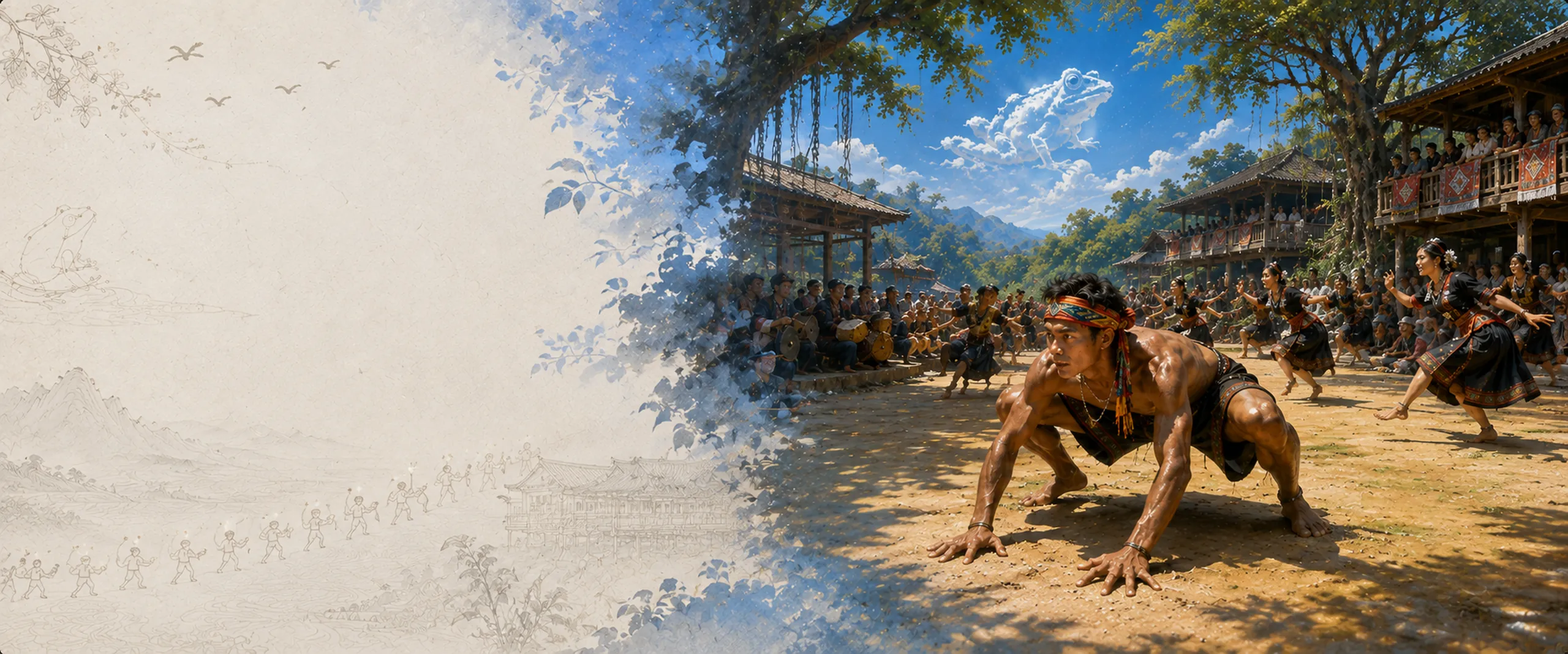
The Maguai Festival is a distinctive traditional festival of the Zhuang people in the Hongshui River basin of northwestern Guangxi. Centered on the worship of the frog, or maguai (蚂拐), it is generally held between the first and second lunar months each year. The festival follows four stages—finding the maguai, worshipping the maguai, honoring the maguai, and burying the maguai—accompanied by the Maguai Dance and Maguai songs. In 2006, the Maguai Festival was included in the first group of China’s national intangible cultural heritage list. In recent years, it has become an important cultural tourism brand of Guangxi, attracting numerous domestic and international visitors and researchers each year to observe and experience the celebrations. Through its distinctive worship of the frog deity and its ancient, unadorned ritual traditions, the Maguai Festival presents to the world the ancient wisdom and cultural heritage through which Zhuang ancestors revered nature and prayed for abundant harvests.
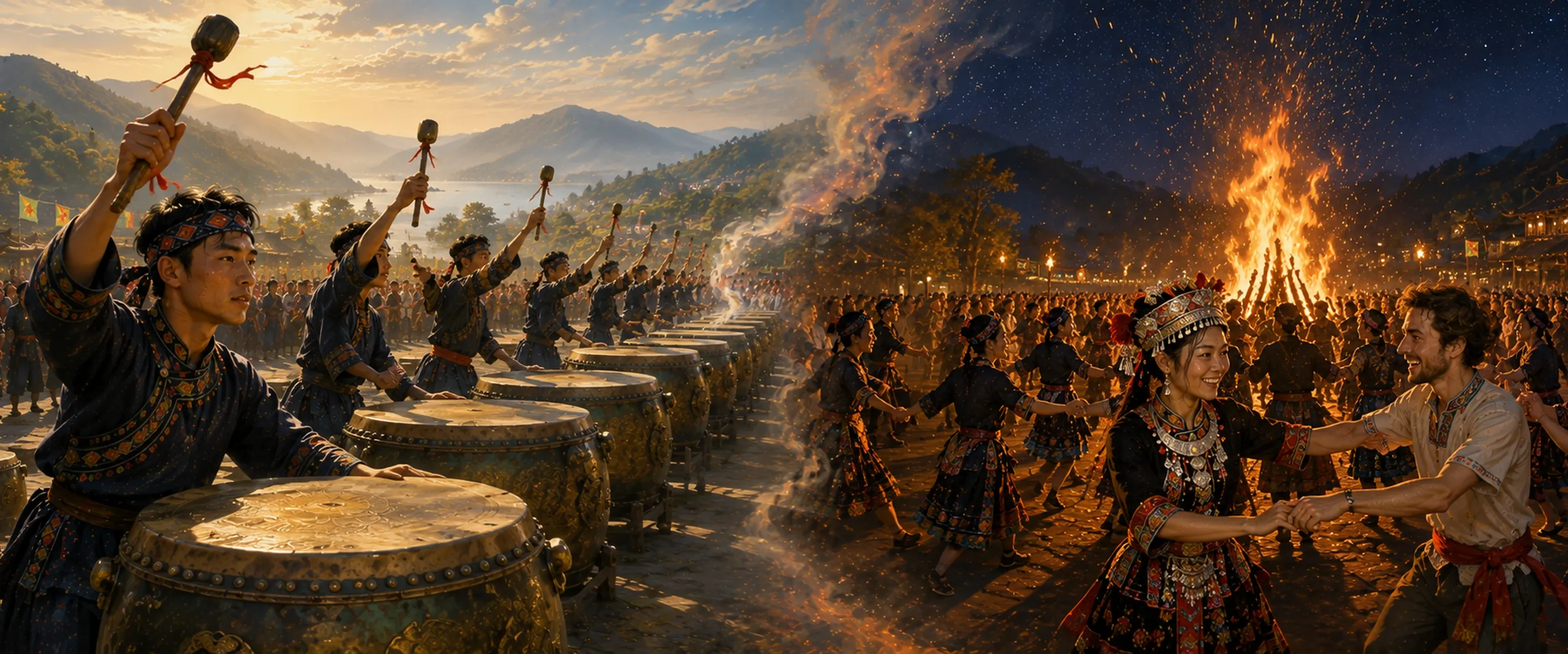
Celebrated Worldwide
Asia
Asia is the most active region in the international dissemination of the Maguai Festival. Southeast Asian countries such as Thailand, Laos, and Cambodia are connected with Guangxi through geography and cultural affinities, and the Maguai Festival has generated strong cultural resonance among visitors from Southeast Asia.
Thailand: linguistic affinity, cultural closeness
Thailand provides one of the most striking examples of the Maguai Festival’s international reach. On the second day of the second lunar month in 2025, more than ten thousand people gathered to celebrate in Baying Village, Bachou Township, Donglan County, Hechi City, Guangxi—the birthplace of Zhuang Maguai Festival culture. At the venue, hundreds of bronze drums were arranged along the riverside walkway of the Baying River to welcome guests, their thunderous sound resounding into the sky.
Thai visitor Nacha made a special journey to Baying Village to experience the Maguai Festival. She deliberately dressed in Zhuang attire and tried both weaving Zhuang brocade and playing the bronze drum. “This is my first time in Guangxi. Seeing people in the Zhuang village worship the maguai and perform the ‘Maguai Dance’ left a deep impression on me and gave me a deeper understanding of Chinese culture,” Nacha said. She found Zhuang clothing exquisite and the folk culture of the Zhuang region novel and interesting, and hoped to return to Guangxi again.
Another Thai visitor, Sun Jiayan, found a sense of familiarity in the similarities of language and culture: “The Zhuang language, a Guangxi dialect, is very similar to Thai. Traveling in a Zhuang village makes me feel especially at home even though I am in a foreign country. People in northern Thailand also have a tradition of playing bronze drums. Thailand and China share affinities in language and ethnic culture, bringing us closer together.”
This Southeast Asian cultural resonance is not accidental. The Zhuang, Thai, Lao, and related peoples all belong to the Tai-Kadai language family and share deep historical connections in language, agricultural culture, and bronze-drum traditions. The frog worship and rice-farming culture embodied in the Maguai Festival possess an intrinsic affinity with the belief traditions of many Southeast Asian peoples.
Ming Meiying, a retired teacher from Bangkok, Thailand, was likewise drawn to the mysterious culture of the maguai: “The Zhuang customs here are very appealing to me, and the Zhuang Maguai Festival is also highly distinctive. Baying Zhuang Village has fresh air and is beautiful and pleasant to live in. It is wonderful to see how happy the elderly and children are here.”
Participation by Southeast Asian international students
The Maguai Festival has attracted not only Thai visitors who make special trips for the occasion, but also Southeast Asian students studying in China. International students from the United States, Thailand, Indonesia, and other countries have attended Maguai Festival activities after hearing of its reputation. At the venue, they performed with an auspicious dragon and offered blessings to local residents and visitors. Their participation has helped extend the influence of the Maguai Festival into Southeast Asian countries through the social networks of international students.
Reflections of a Pakistani international student
After experiencing the Maguai Festival, Niz, an international student from Pakistan, remarked: “It is truly very lively. The Zhuang clothing is beautiful and the singing is extremely pleasant. Although I do not understand what they are singing, what belongs to an ethnic people belongs to the world. I have gained a deeper understanding of Chinese culture.”
Cultural connections with Cambodia
The Maguai Festival has also attracted attention in Cambodia. The Zhuang Maguai Festival and Cambodia’s traditional agricultural culture share similarities at the level of their spiritual core—both are rooted in rice-growing civilizations and both contain prayers for rainfall and abundant harvests. The ecological wisdom of “harmonious coexistence between humanity and nature” carried by the Maguai Festival likewise finds cultural resonance in Cambodia.
The Americas
The influence of the Maguai Festival has crossed the Pacific and reached the American continent.
Visits by scholars and online personalities from multiple countries
During the 2023 Maguai Festival, folk performances in Donglan County attracted international visitors from countries including the United States, Iran, Bangladesh, and South Africa. Scholars and online personalities from different countries celebrated the Zhuang Maguai Festival together with the warmly welcoming local Zhuang people, personally experiencing the distinctive appeal of this ancient ritual tradition along the Hongshui River.
Participation by American visitors
The Maguai Festival has attracted not only scholars but also ordinary American visitors. At the festival venue in Baying Village, visitors from the United States joined Zhuang residents in performing bamboo-pole dances, playing bronze drums, and experiencing the appeal of intangible cultural heritage. For American visitors, the ancient Zhuang tradition of revering frogs and praying for blessings—a belief system deeply bound to nature—offers a worldview markedly different from that of Western culture.
International online communication breaks beyond its circle
In February 2023, Donglan County organized and planned coordinated external communication, strengthening international online dissemination and helping publicity for the “Donglan Zhuang Maguai Festival” become widely popular online. Scholars and online personalities from Iran, the United States, the United Kingdom, South Africa, Nigeria, Bangladesh, Cambodia, Kazakhstan, and other countries participated and reported on the festival. Through their own social media accounts and media coverage, these participants and reporters carried the spectacle of the Maguai Festival back to their respective countries.
Coverage by Bangladesh National Television
An important milestone in the international online dissemination of the Maguai Festival was its first appearance on Bangladesh National Television. This marked the first time the festival entered mainstream television media in a South Asian country. Coverage by Bangladesh National Television brought the Maguai Festival broad public attention in Bangladesh.
Europe
The Maguai Festival has spread in Europe primarily through two channels: visits by scholars and media reporting.
Participation by British scholars
During the 2023 Maguai Festival, scholars from the United Kingdom traveled deep into Baying Village in Donglan County to explore its folk performances. Together with local Zhuang residents, they took part in ritual activities, watched Maguai Dance performances, and listened to the thunderous sound of bronze drums. For these European scholars, the Maguai Festival provided a distinctive window onto Zhuang agricultural civilization and folk beliefs.
Attention from mainstream European media
A number of mainstream media outlets in China and abroad republished scenes from the Baying Maguai Festival in different languages. The reputation of the Baying Maguai Festival in Bachou Township, Donglan, consequently spread further. European media coverage brought this ethnic festival from southwestern China into the public view of European audiences.
Oceania
The influence of the Maguai Festival has also extended to Oceania. During the 2023 Maguai Festival, international visitors from countries including South Africa traveled to explore and experience the celebrations. Although the festival’s dissemination in Oceania is still at an early stage, personal experiences by international visitors and the spread of content through social media are allowing more and more people in Oceania to learn about the Maguai Festival.
As cultural exchange between Guangxi and Oceanian countries such as Australia and New Zealand grows increasingly close, the Maguai Festival is expected to gain wider visibility in Oceania through cultural exhibitions, tourism promotion, and other channels.
Compatriots Across the Taiwan Strait
The Maguai Festival is not only a festival of the Zhuang people, but also an important cultural bond connecting ethnic minority compatriots on both sides of the Taiwan Strait.
More than one hundred Taiwan compatriots celebrate the Maguai Festival together
On the second day of the second lunar month in 2024, more than one hundred people from Nantou County and Hualien County in Taiwan traveled to Baying Village, Bachou Township, Donglan County, Hechi City, Guangxi, to participate in the Zhuang Maguai Festival. That day, people from Guangxi and Taiwan took part in activities such as celebrating the maguai and honoring the maguai, alongside showcases of outstanding intangible cultural heritage and folk cultural performances. Ethnic minority visitors from Taiwan presented local residents with performances including 拍手歌, 回家吧, and the Dance of the Ocean through song and dance.
“It feels as warm as coming home”
“Welcome home, welcome to Donglan.” Local residents called out loudly, warmly welcoming visitors from Taiwan. Wu Yizhen from Hualien, Taiwan, said: “I learned several years ago that Donglan has a Maguai Festival and had always wanted to find an opportunity to see it. Today is my first time experiencing the festival atmosphere in person. Everyone holds hands and dances, hearts connected and never separated. It moves me deeply.”
Song Donglong from Nantou County, Taiwan, said: “Our Zhuang compatriots are extremely warm and hospitable, and we were all deeply moved by it. Although this is my first time in Donglan, it feels as warm as coming home, and I am very happy. Everyone dances this distinctive Maguai Dance to the sound of the bronze drums. I truly feel that it is very similar to the cultures of Taiwan’s ethnic minorities.”
Cultural affinities across the Strait
In the bronze-drum cultural experience area, one hundred bronze drums formed a circular matrix. Drummers swung their beaters and struck the bronze drums, symbols of happiness and auspiciousness, producing earthshaking sound in a spectacular scene. Guided by the drummers, visitors from Taiwan eagerly joined the ensemble.
During breaks in the activities, ethnic minority visitors from Taiwan also engaged warmly with local Zhuang, Miao, and Yao residents. Wu Yizhen said: “This Maguai Festival is, in fact, a way of connecting with our ancestors. Taiwan also has similar festivals. The ethnic minorities on both sides of the Strait share affinities in song and dance culture, drinking culture, food culture, reverence for nature, and warm hospitality. Even the patterns on everyone’s clothing are very similar.”
Experience and dissemination by Taiwan visitors
Bao Lei, chair of the Cross-Strait Economic, Trade, Cultural Development and Exchange Association, said: “This is the first time I have witnessed the powerful scene of Zhuang people worshipping the maguai and praying for favorable weather and abundant harvests. Every stage is full of ritual significance, and through the exchange and experience, I felt as though I too had received a blessing.” She added: “This place is so much fun. It has shown me a completely different Zhuang region. I want to introduce this distinctive Guangxi folk culture to more people.”
Song Donglong, a representative of the township residents’ assembly of Xinyi Township, Nantou County, Taiwan, experienced the pleasure of playing the bronze drums. He said that Zhuang bronze drums have a deep, resonant tone, and that everyone forming a circle and striking them together creates a joyful and rhythmic experience that strongly resonates with people.
Chen Weiyong, a visitor from New Taipei City, Taiwan, was likewise deeply moved: “This is my first time attending the Maguai Festival of the Zhuang people in Guangxi. It feels especially rich in culture. The inheritance of ethnic folk traditions reaches far back through history, and the sonorous bronze drums are as beautiful as music. I really love the traditional folk culture here.”
A “two-way journey” among ethnic minorities across the Strait
The Maguai Festival has become an important platform for cultural exchange among ethnic minorities on both sides of the Strait. As one Taiwan compatriot observed, ethnic minorities on both sides share common ground in song and dance culture, food culture, and reverence for nature. These cultural affinities have made the Maguai Festival one of the warmest cultural bonds connecting compatriots on the two sides of the Strait.
Media and Digital Dissemination
International online dissemination “breaks out of its circle”
The global dissemination of the Maguai Festival made a leap forward in 2023. Donglan County seized key moments to launch integrated-media products and trending topics, helping publicity for the “Donglan Zhuang Maguai Festival” become widely popular online.
Short videos ignite the internet
Promotional videos introducing Donglan County’s Maguai Festival and bronze-drum customs were pushed by mainstream media across Guangxi. After being released on February 27, 2023, through the official Douyin account of @Guangxi Department of Culture and Tourism, they sparked widespread online discussion and praise, receiving more than one million views and 82,000 likes. Videos such as “Zhuang Maguai Festival” and “Donglan County Culture and Tourism Bureau Director Passionately Conducts” became trending searches on Douyin.
Coordinated livestream by one hundred media outlets nationwide
Building on this momentum, the director of the Donglan County Culture and Tourism Bureau participated on March 21 in the large-scale coordinated livestream “The Culture and Tourism Bureau Director Takes You Around,” serving as a guide to introduce Donglan’s tourism and cultural resources. One hundred media outlets and platforms nationwide joined the livestream and video coverage, generating a major online traffic trend. More than 50,000 viewers watched online.
Participation by scholars and online personalities from multiple countries
Scholars and online personalities from Iran, the United States, the United Kingdom, South Africa, Nigeria, Bangladesh, Cambodia, Kazakhstan, and other countries took part and reported on the festival. Through their own social media and media coverage, these participants and reporters brought the spectacle of the Maguai Festival to their respective countries.
Extensive coverage by mainstream media in China and abroad
A number of mainstream media outlets in China and abroad republished scenes from the Baying Maguai Festival in different languages.
Central media
China News Service has repeatedly carried in-depth coverage of the Maguai Festival. China Media Group’s CRI Online has also produced dedicated reports on the festival. CCTV and other mainstream media have conveyed the spectacle of the Maguai Festival to audiences across China and around the world through video, images, and written reports.
Overseas media
The Maguai Festival appeared for the first time on Bangladesh National Television. As the first time the festival entered mainstream television media in a South Asian country, this represented a milestone.
Independent content creators
Donglan has seen the emergence of a number of independent content creators who work together to tell the stories of the county. Photography creator “Qiqi” has devoted herself to promoting Donglan’s folk culture and cuisine, and more than ten high-quality video works—including 巴英蚂拐节, 东兰铜鼓, and 歌舞三弄—have been selected by the Xuexi Qiangguo platform. Through their creative work, these content creators have brought the cultural appeal of the Maguai Festival to a wider audience.
Academic Attention
The Maguai Festival has also attracted attention from the international academic community. A number of international scholars have conducted fieldwork and academic research on the festival. The paper 《广西少数民族非物质文化遗产的保护与传承策略探究——以壮族蚂拐节为例》 examines the basic conditions, cultural significance, and transmission value of the Maguai Festival from the perspective of intangible cultural heritage. The United Nations intangible cultural heritage status of the Huashan rock paintings and the national intangible cultural heritage status of the Maguai Festival in Donglan County echo one another, allowing this wisdom spanning a thousand years to become cultural wealth shared by all humanity.
Integration of Culture and Tourism
The international dissemination of the Maguai Festival has formed a mutually reinforcing relationship with local cultural and tourism development.
Visitor numbers continue to grow
Each year, the Maguai Festival attracts more than ten thousand domestic and overseas visitors who “rush to the county” to celebrate together. At the Hongshui River Zhuang Maguai Folk Culture Festival held in Tian’e County in 2023 alone, 16,000 tourists and local residents from across China gathered in Nadong Village. Taking the Maguai Festival as an opportunity, Bachou Township in Donglan County innovatively developed the Bachou Zhuang Village Agricultural Culture Tourism Festival under the concept of “one theme each month, one brand for each village,” creating distinctive folk celebrations that attracted more than 500,000 domestic and international visits and generated 10 million yuan in consumption.
Revitalizing intangible heritage transmission
The Maguai Festival has won admirers among both domestic and international visitors. This has not only stimulated local tourism development, but has also inspired greater enthusiasm among young people to learn ancient ways of playing bronze drums and encouraged people to engage with agricultural culture. Local authorities have built projects such as the Bronze Drum Square, Maguai Square, and Wind-and-Rain Bridge, while also bringing intangible cultural heritage into schools so that more people can learn about the Zhuang Maguai Festival.
Mutual Learning Among Civilizations
Dialogue with Global Cultures of “Frog Worship”
Frog worship is an ancient and widespread phenomenon in human civilization. Across the world, frogs and toads hold important symbolic meanings in many cultures—in ancient Egypt, the frog-headed goddess Heqet symbolized fertility; in Mesopotamia, frogs were associated with abundance; in Hinduism, frogs were linked with the rain god Indra; in Japan, frogs symbolize good fortune and a safe return because the word for frog, kaeru (蛙), sounds the same as the verb kaeru (帰る), “to return.”
The frog worship embodied in the Zhuang Maguai Festival forms an important part of this global cultural spectrum of frog worship. Zhuang ancestors regarded frogs as envoys controlling wind and rain and as divine beings capable of communicating between the human world and the thunder god. This belief logic of “frog—rain—harvest” closely resembles the spiritual core of frog worship found in many agricultural civilizations around the world. The existence of the Maguai Festival provides a distinctive living example for global research into cultures of frog worship.
Dialogue with Global “Agricultural Ritual” Festivals
The Maguai Festival is a typical agricultural ritual festival. Around the world, countless festivals and rituals center on prayers for favorable weather and abundant harvests—the rainmaking rituals of many African tribes, corn festivals among Indigenous peoples of the Americas, and rice-spirit festivals across Southeast Asia. All share with the Maguai Festival a common human sentiment: dependence on the land, longing for a good harvest, and reverence for nature.
What makes the Maguai Festival distinctive is its use of the frog as its central symbol. Frogs are common creatures in rice paddies, and their calls are closely associated with the arrival of the rainy season. Through observation and reverence for frogs, Zhuang ancestors developed a complete belief system of “frog—rain—abundant year.” This cultural logic of “elevating everyday observation into spiritual belief” is one of the Maguai Festival’s most distinctive cultural values.
Bronze-Drum Sounds Across Borders
The most recognizable cultural symbol of the Maguai Festival is the bronze drum. Hundreds of bronze drums line the riverside walkway to welcome guests, their sound resounding into the sky. The sound of a bronze drum needs no translation—its thunder is itself a language, conveying solemnity, festivity, and strength.
Bronze-drum culture is not unique to the Zhuang people. In northern Thailand, Laos, Myanmar, Vietnam, and other Southeast Asian countries, bronze drums are likewise important cultural symbols. As Thai visitor Sun Jiayan observed: “People in northern Thailand also have a tradition of playing bronze drums.” This transnational distribution of bronze-drum culture gives the Maguai Festival a natural sense of cultural closeness in Southeast Asian countries.
Dialogue with Global “Safeguarding of Intangible Cultural Heritage”
From its inclusion in China’s national intangible cultural heritage list in 2006, to its consecutive receipt in 2013 and 2014 of the “Most Distinctive Ethnic Festival Award among China’s Outstanding Ethnic Festivals,” and then its receipt in 2017 of the “China Ethnic Festival Award for Greatest Innovative Value,” the development of the Maguai Festival itself constitutes a profound dialogue with the global system for safeguarding intangible cultural heritage.
The safeguarding practices surrounding the Maguai Festival provide “Chinese experience” for the protection of similar cultural heritage around the world. Local communities have built the Bronze Drum Square, Maguai Square, Wind-and-Rain Bridge, and other projects, while also bringing intangible cultural heritage into schools, allowing ancient Maguai culture to gain new vitality in contemporary society.
Dialogue with Global “Rural Revitalization”
The international dissemination of the Maguai Festival has developed a distinctive resonance with local rural revitalization. The festival is not only a cultural feast, but also an important engine driving local economic development. Through distinctive folk celebrations built around “one theme each month, one brand for each village,” Bachou Township in Donglan County attracted more than 500,000 domestic and international visits and generated 10 million yuan in consumption.
This “culture + tourism + rural revitalization” model offers a point of reference for similar cultural heritage sites around the world. When an ancient ritual festival can attract visitors from countries such as the United States, Iran, and Bangladesh, and when a village folk celebration can appear on Bangladesh National Television, the power of culture is being transformed into tangible economic momentum.
Closing Note
The global dissemination of the Zhuang Maguai Festival follows a distinctive path from ancient villages along the Hongshui River to the five continents of the world. Its inclusion in the national intangible cultural heritage list in 2006 marked the transition of the Maguai Festival from a folk ritual into nationally safeguarded heritage; while in recent years, special visits by Thai tourists, in-depth explorations by scholars from multiple countries, its first appearance on Bangladesh National Television, and widespread coverage by mainstream media in China and abroad have marked the festival’s movement from an ethnic celebration in southwestern China toward a broader international stage.
Unlike the exuberance of “water” in the Water-Splashing Festival or the passion of “fire” in the Torch Festival, the global dissemination of the Maguai Festival takes the “bronze drum” as its most recognizable sonic symbol, the “Maguai Dance” as its most distinctive visual language, and “prayers for agricultural blessings” as its most universal cultural resonance. The sound of the bronze drum needs no translation to move the heart; the frog-like movements of the Maguai Dance need no explanation to be understood; and the prayer for favorable weather and abundant harvests is a longing shared by all agricultural civilizations.
In Asia, Thai visitors have found familiarity in linguistic and cultural similarities; Southeast Asian international students have come after hearing of the festival’s reputation; and a Pakistani student reflected that “what belongs to an ethnic people belongs to the world.” In the Americas, scholars and visitors from the United States and other countries have explored the Maguai Festival in depth. In Europe, British scholars have taken part in its reporting, while mainstream media outlets have republished scenes of the festival in different languages. Across the Taiwan Strait, more than one hundred Taiwan compatriots traveled specially to Baying Village to experience this feast of intangible cultural heritage, describing it as “as warm as coming home.” In the digital world, international online dissemination made publicity for the “Donglan Zhuang Maguai Festival” break beyond its usual circles, and the festival appeared for the first time on Bangladesh National Television.
More moving still is the fact that, throughout its journey toward the world, the Maguai Festival has maintained a profound connection with the Zhuang villages along the Hongshui River. The ancient ritual of “burying the maguai” is still solemnly performed in Baying Village; the thunder of bronze drums still echoes along the Hongshui River; the rhythm of the Maguai Dance still pulses through Zhuang villages. The Maguai Festival has not diluted its cultural intensity in order to “go out into the world”—through “inviting people in,” it brings the world into Zhuang villages; through “going out,” it carries the story of the Maguai Festival across the globe.
Like the sound of those bronze drums passed down for a thousand years—it has crossed the rise and fall of dynasties and remains as deep and powerful as ever; it has crossed national borders and languages and still moves the heart. The drumbeats and dance steps of the Zhuang Maguai Festival continue without cease, along the Hongshui River and within the world’s field of vision.
—-
Readers’ Comments
Calendar and traditional culture enthusiasts from around the world, sharing the same moon.
Sign in or register to join the conversation. Your comment account is created automatically the first time you use a connected account.
No comments yet
Share your thoughts with readers around the world.