Frog Festival

Frog FestivalOrigins of the Frog Festival

「 <p>雷神之子,青蛙传信,孝子东林,蚂拐成祭。</p> 」

The Maguai Festival (蚂拐节) grew out of ancient frog worship in the Hongshui River basin (红水河流域). “Maguai” (蚂拐) is the Zhuang name for the frog. Zhuang ancestors believed that frogs were children of the Thunder God, able to call down rain…

The Zhuang people’s reverence for Maguai (蚂拐) has a long history. Rooted in frog-totem worship along the Hongshui River, the festival reflects the belief that the Frog Goddess governs wind and rain. Zhuang villages along the river worship Maguai in the hope of favourable weather, abundant grain, and prosperity for both people and livestock. Several legends explain the festival’s origin. In the version widely told in Donglan, the filial son Donglin angered the frogs while mourning his mother and brought drought upon the human world; only after he learned to honour them did rain return, giving rise to the custom of worshipping Maguai. The festival is practised chiefly in the Hongshui River basin of northwestern Guangxi and, according to oral accounts preserved by local tradition bearers, has a history of more than four hundred years.

Frog Festival / Origins of the Frog Festival

The Name of the Maguai Festival

Origins & Anecdotes · Tracing the Past

The Frog Goddess in the Zhuang Language

“Maguai” (蚂拐) is the Zhuang word for the frog. In Zhuang culture, however, Maguai is not regarded as an ordinary animal, but as a divine being associated with wind and rain and as one of the children sent into the human world by the Thunder King (雷王). Zhuang villages along the Hongshui River therefore worship Maguai in the hope of favourable winds and timely rain, abundant grain harvests, and prosperity for both people and livestock.

The Maguai Festival is also known as the Frog Festival (青蛙节), the Festival of Honouring the Frog (敬蛙节), and the Frog Goddess Festival (蛙婆节). The last of these names is particularly revealing. In Zhuang usage, “Po” (婆) is an honorific associated with female ancestors and divine female figures. “Wapo” (蛙婆) therefore refers not simply to a frog, but to a revered female frog deity—the Frog Goddess. Zhuang legends hold that wind and rain are governed by this Frog Goddess, whom the people call Maguai. The name “Frog Goddess Festival” thus reflects a deep interweaving of maternal veneration and frog worship within Zhuang society.

In Baying Village (巴英村), Bachou Township, Donglan County, Guangxi, the Maguai Festival is known in the local dialect as “Yagui” (雅圭). Baying is regarded as one of the principal places associated with the origin and transmission of the Zhuang Maguai Festival. To this day, the village preserves a remarkably complete sequence of ancient and mysterious Maguai rituals and has become a vivid example of the living transmission of Zhuang agricultural civilisation.

Different Names and Local Traditions

The Maguai Festival has different names in different places. Some communities call it the Frog Festival, some the Festival of Honouring the Frog, and others the Frog Goddess Festival. These different names reflect subtle regional variations within the same festival, but all revolve around a common core: reverence for and ritual worship of the frog.

The name Frog Goddess Festival (蛙婆节) also hints at an ancient gendered dimension within Maguai belief. In Zhuang mythology, the Maguai Goddess is the daughter of the Thunder King. She governs rainfall and ensures favourable weather for the earth. The idea of the frog as a female deity may be related to ancient traditions of maternal worship, or perhaps to the frog’s strong reproductive capacity and its association with fertility. Whatever the explanation, the figure of the Frog Goddess reflects an early way of understanding nature in which the Zhuang ancestors personified natural forces and gave them both gender and divine identity.

Origins of the Festival

Origins & Anecdotes · Tracing the Past

The Legend of Donglin and Buluotuo

The Maguai Festival originated in the Zhuang people’s reverence for frogs. Its central origin legend is closely associated with Buluotuo (布洛陀), the great ancestral and culture-hero figure of Zhuang tradition, and a filial son named Donglin (东林).

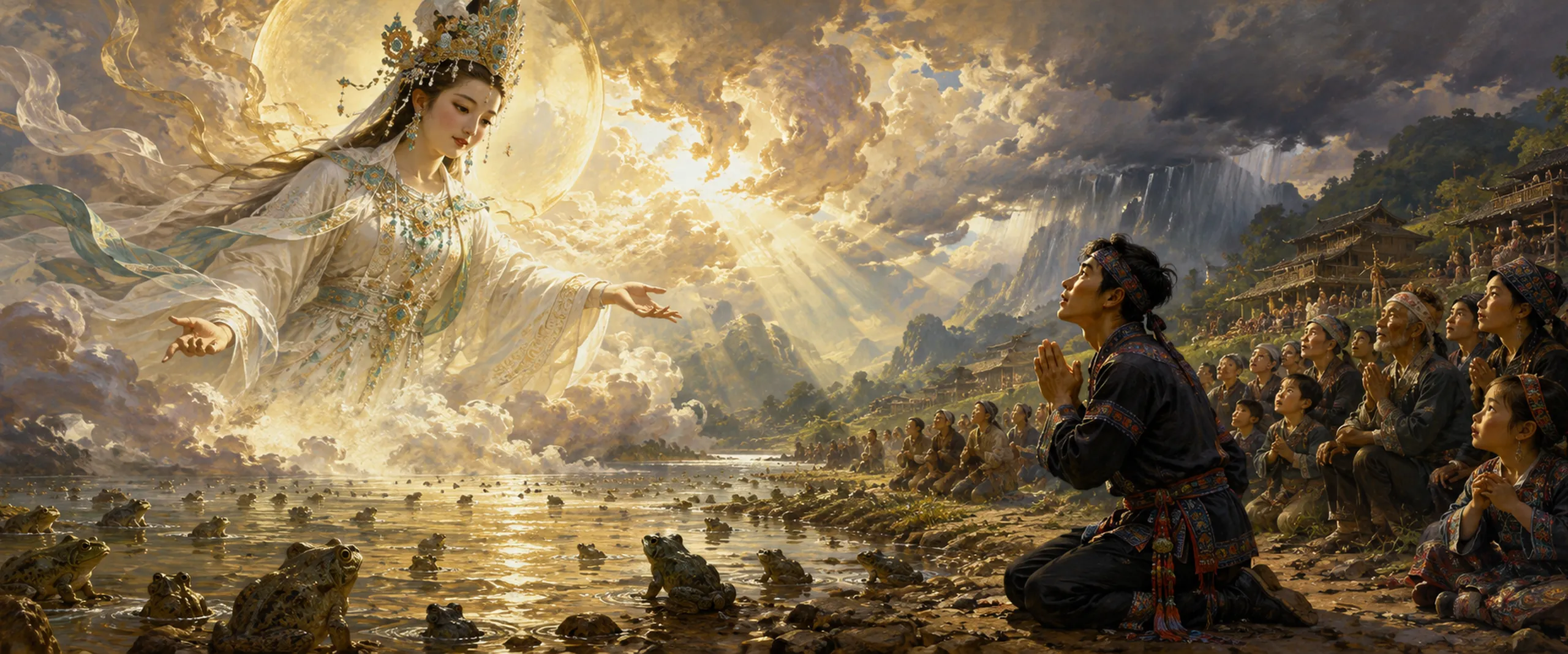
According to legend, long ago there lived a young man named Donglin who had depended on his mother since childhood. One day his mother died, leaving him overwhelmed with grief, and he kept vigil for her in tears. Outside the house, frogs croaked continuously day and night. Donglin became deeply irritated and, fearing that the constant croaking would disturb his mother’s spirit and prevent her from resting in peace, boiled water and poured it over the frogs. Frogs lay dead and injured everywhere. From that time onward, no more rain fell from the sky, and cries of suffering spread across the human world. Terrified by what he had done, Donglin went to seek help from the ancestral deity Buluotuo (布洛陀) and the divine mother Muluojia (妹洛甲). Buluotuo told him that the frogs were no ordinary creatures of the mortal world: they were the children of the Thunder God in heaven, and only when they called out would heaven send down nourishing rain. Whenever the human world needed rain, the frogs would raise their heads and cry out; when the Thunder King heard the calls of the frogs rising from the earth, he would send rain. Donglin therefore had to apologise to the frogs and make amends for what he had done.

Donglin immediately beat a bronze drum (铜鼓) on the first day of the New Year, inviting the Frog Goddess back to the village to celebrate the New Year. He also called upon a thousand people to hold funeral rites for the frogs that had died. Thereafter, the human world once again received the protection of the Frog Goddess, and favourable winds and timely rains returned. From that time onward, the Zhuang people living along the Hongshui River in western Guangxi observed the Maguai Festival (蚂拐节) every year and performed rituals in honour of Maguai.

The Maguai Legend and Bronze-Drum Culture

The Maguai Festival developed alongside the bronze-drum culture (铜鼓文化) of the Zhuang people in the Hongshui River basin and has been passed down from generation to generation to the present day. The bronze drum is both the festival’s most important musical instrument and one of its principal ritual objects. In the legend, Donglin follows Buluotuo’s instructions and beats a bronze drum to invite the Frog Goddess back to the village for the New Year. The resonant metallic voice of the bronze drum is believed to be a sacred sound capable of travelling between heaven and earth. When the bronze drum is struck, the Frog Goddess can hear the call of the human world and descend from heaven to earth. Bronze drums cast by Zhuang ancestors frequently bear three-dimensional frog figures on their surfaces; these sculpted frogs are a material embodiment of Maguai worship.

History and Transmission of the Maguai Festival

Because sufficient documentary evidence and written records have not survived, the precise date of origin of the Maguai Festival cannot currently be established. According to oral traditions preserved by local inheritors, however, the Baying Maguai Festival (巴英蚂拐节) has a long history and is said to date back more than 400 years. Maguai worship was particularly widespread in Donglan, Bama, Fengshan, Tian’e, and other areas of the Hongshui River basin. Historically, the region is said to have contained around 300 Maguai communal shrines (蚂拐社亭), together with countless hillsides and burial grounds dedicated to Maguai.

Many legends concerning the origin of the festival circulate among the Zhuang communities of the Hongshui River basin, with one of the most widely known versions originating in Donglan County. According to this account, Donglin followed Buluotuo’s instructions by beating a bronze drum to invite the Frog Goddess back to the village for the New Year and calling upon a thousand people to conduct funeral rites for the dead frogs. Donglin’s filial devotion moved Heaven, and from that time onward the Zhuang villages along the Hongshui River were blessed year after year with favourable weather, abundant grain harvests, and prosperity for both people and livestock.

Although there are no detailed written records documenting the early history of the Baying Maguai Festival, its ritual procedures, lines of transmission, and techniques for making ceremonial objects have been preserved through oral instruction and direct demonstration by tradition bearers. The Baying Maguai Festival is organised by local folk inheritors themselves and remains one of the great traditional festivals of the Zhuang people in the Hongshui River basin.

Historical Development

Origins & Anecdotes · Tracing the Past

From the Pre-Qin Period to the Tang and Song Dynasties

The origins of the Maguai Festival can be traced to the period of frog-totem worship among the ancestors of the Zhuang people. The Zhuang are an ancient people of the Lingnan region, and their ancestors were already practising rice agriculture on this land several thousand years ago. Frogs were intimately connected with rice cultivation: their calls heralded the arrival of rain, while the abundance or scarcity of frogs directly affected the level of insect pests in the paddies. Through long experience in agricultural production, Zhuang ancestors gradually developed a reverence for frogs and came to regard them as divine beings with power over wind and rain.

During the Pre-Qin period, records concerning the ancestors of the Zhuang, who belonged to the ancient Yue peoples, describe customs such as “cutting the hair and tattooing the body” (断发文身) and worshipping snakes and frogs. The rise of bronze-drum culture in the Lingnan region subsequently provided the Maguai Festival with its most important ritual medium. Bronze drums cast by Zhuang ancestors frequently featured three-dimensional frog sculptures on their surfaces, a material expression of frog worship. As bronze-drum culture spread and became more deeply established, rituals in which bronze drums were used in the worship of frogs gradually took on more stable and recognisable forms.

During the Tang and Song dynasties, as the central dynasties expanded their administration and development of the Lingnan region, the social structure of the ancestors of the Zhuang underwent profound changes. Rice agriculture developed further, and the relationship between the Maguai Festival and agricultural production became increasingly close. Although surviving Tang and Song documents contain little direct information about the festival itself, the flourishing of bronze-drum culture and the prevalence of frog worship among Zhuang communities provided fertile cultural ground for its formation. By the Tang and Song periods, the Maguai Festival may already have been developing from a purely sacrificial rite into a more comprehensive festival combining ritual worship, song and dance, and social interaction.

The Ming and Qing Dynasties

The Ming and Qing periods were an important stage in which the Maguai Festival became more firmly established and widely practised throughout the Hongshui River basin. From the late Ming into the early Qing period, as the Zhuang population increased and villages expanded, the festival’s ritual system became progressively richer and more standardised. According to the oral traditions of local inheritors, the Baying Maguai Festival is said to have a history of more than four hundred years, placing its approximate beginnings in the late Ming or early Qing period. Maguai worship was especially widespread in Donglan, Bama, Fengshan, Tian’e, and other parts of the Hongshui River basin, where approximately 300 Maguai communal shrines and countless Maguai burial slopes (蚂拐坟坡) are said to have existed historically. The construction of these shrines and burial grounds indicates that by the Ming and Qing periods the festival had already developed fixed ritual spaces and a relatively complete system of worship.

During the Qing dynasty, Zhuang society in these regions was comparatively stable, while rice agriculture continued to develop. As an important festival for praying for favourable weather and abundant harvests, the Maguai Festival was widely transmitted among Zhuang villages throughout the Hongshui River basin. Its central ritual sequence—finding Maguai, worshipping Maguai, mourning Maguai, and burying Maguai—had largely taken shape by the Qing period. Maguai song gatherings and the Maguai Dance also became increasingly elaborate during this period, developing into some of the most vivid artistic expressions of Zhuang agricultural culture.

The Modern Period

During the Republican period, the introduction of Western culture and the development of modern education brought profound changes to traditional Zhuang society. Although the Maguai Festival experienced a degree of disruption during this era, it retained considerable vitality in the more remote villages of the Hongshui River basin. During the War of Resistance against Japanese Aggression and the Chinese Civil War, social upheaval affected the organisation of festival activities, but the festival’s core rituals and cultural memory nevertheless continued to survive among local communities.

Following the founding of the People’s Republic of China, the social system of Zhuang regions underwent fundamental change. During the Cultural Revolution (文化大革命), however, the Maguai Festival was condemned as “feudal superstition” (封建迷信), and its celebration was suppressed and prohibited. Transmission of the festival was interrupted for a period. Maguai communal shrines were demolished, Maguai burial grounds were levelled, and many details of the traditional rituals and sacrificial texts were lost during those years.

After the beginning of Reform and Opening Up (改革开放), as policies concerning ethnic minority cultures were restored and implemented, the Maguai Festival was gradually revived and transmitted once again. Zhuang villages in different areas resumed their festival activities, and the ancient rituals came back to life along the banks of the Hongshui River. The festival not only returned to the villages but also entered the field of academic research, becoming an important subject in ethnology and folklore studies.

The Contemporary Era

In 2006, the Zhuang Maguai Festival was inscribed on the first national list of representative items of China’s Intangible Cultural Heritage (第一批国家级非物质文化遗产代表性项目名录). It is listed as item 463, under project number Ⅹ-15, with Hechi City, Guangxi Zhuang Autonomous Region as the submitting locality and the Hechi Intangible Cultural Heritage Protection Center as its safeguarding institution. In both 2013 and 2014, the festival received the award for “Most Distinctive Ethnic Festival” among China’s outstanding ethnic festivals.

Far from declining in contemporary society, the Maguai Festival has continued to expand in scale. In February 2023, the Zhuang Maguai Festival held in Bachou Township, Donglan County included Maguai dances, bronze-drum gatherings, folk-song gatherings, food exhibitions, folk performances, agricultural-culture experiences, and an evening bonfire celebration, attracting approximately 100,000 visitors from China and abroad. On 1 March 2025, the second day of the second lunar month, Baying Village in Bachou Township, Donglan County, Hechi City once again welcomed its annual Zhuang Maguai Festival, with tens of thousands of visitors gathering for a living intangible-cultural-heritage tradition spanning nearly four centuries.

As society has developed, the Maguai Festival has continued to adapt to contemporary needs. In recent years, Bachou Township in Donglan County has used the festival as an opportunity to develop innovative agricultural cultural-tourism programmes under the model “one theme each month, one distinctive brand for each village” (一月一主题,一村一品牌). The Maguai Festival has thus become an important platform for presenting Zhuang culture, strengthening ethnic unity, and promoting the integration of culture and tourism.

Core Rituals

Origins & Anecdotes · Tracing the Past

Finding Maguai

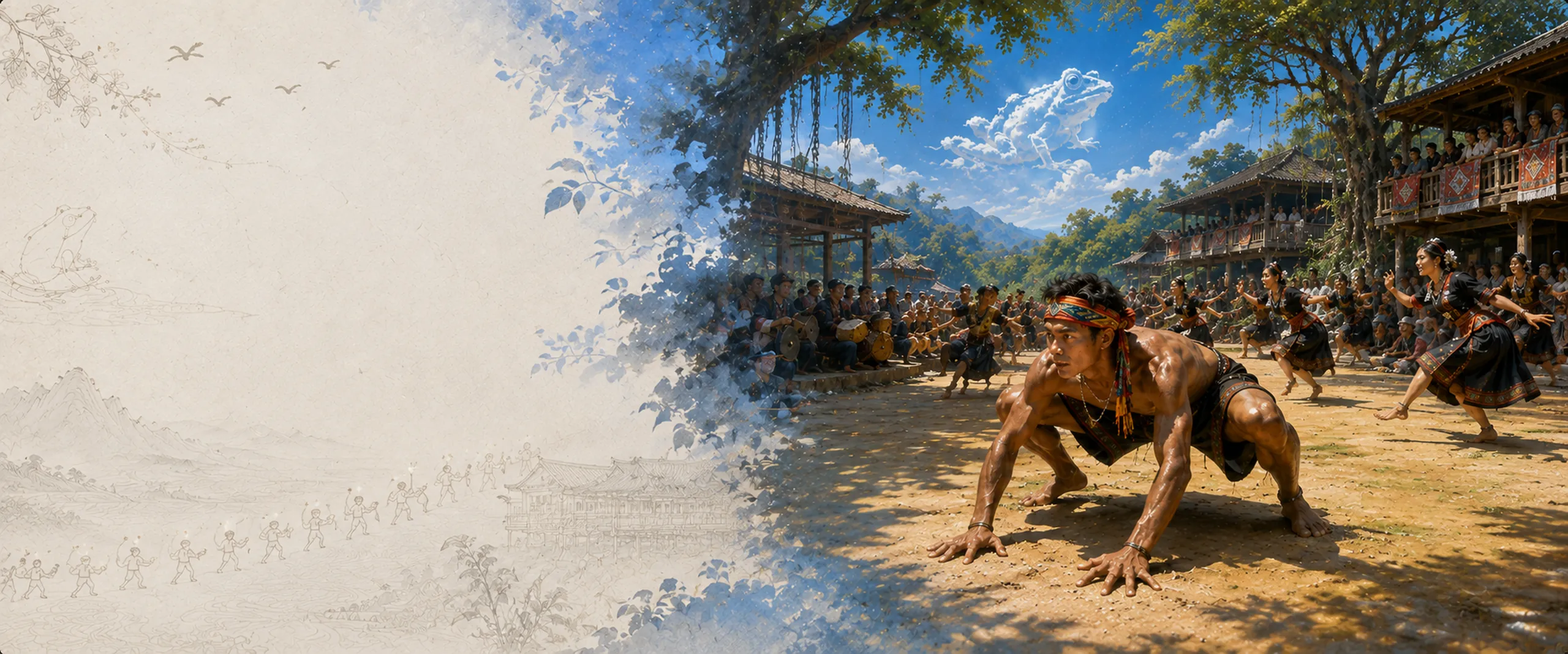
At dawn on the first day of the first lunar month, villagers beat bronze drums and set out in groups for the fields to search for hibernating frogs. Men and women, young and old, spread out across nearby fields and stream banks, searching everywhere for the desired “Yaguai” (雅拐), locally known as the “Maguai Mother” (蚂拐婆).

According to local belief, the first person to find a frog is especially fortunate. He is honoured as the “son-in-law of the Thunder King”, or Maguai Lang (蚂拐郎)—literally, the “Maguai Groom”—and becomes the leader of that year’s Maguai rites. The leader then guides the villagers in setting off ceremonial firecrackers to report to the Thunder King the joyful news that the human world is preparing to worship Maguai. The frog is ceremonially welcomed back to the village and placed in a decorated sedan chair before being put into a specially prepared bamboo tube known as the “Maguai coffin” (蚂拐棺).

Worshipping Maguai

The principal rites of worship are held on the fifteenth day of the first lunar month and include erecting ritual banners, making offerings, and holding Maguai song gatherings. Villagers arrange offerings, beat bronze drums, burn incense, and worship Maguai. The ceremony is presided over by a highly respected elder of the village. The Maguai coffin is placed inside the Maguai pavilion (蚂拐亭), where offerings including the traditional three sacrificial animals (三牲), five-coloured glutinous rice, and wine are presented. The officiant recites ritual invocations, asking the Frog Goddess to bless the entire village with favourable weather, abundant grain harvests, and prosperity for people and livestock.

The erection of ceremonial banners is an important part of the worship of Maguai. Every year on the fifteenth day of the first lunar month, the people of Baying Village conduct the traditional ritual of “erecting the banner” (立幡), literally “raising a pole and suspending a banner,” known locally in Zhuang as “Yaotonggan” (曜筒竿). Beside the traditional Maguai burial ground at the entrance to the village, villagers erect colourful paper banners five or six metres high, arrange offerings, beat bronze drums, set off firecrackers, and worship Maguai. The banner-raising ceremony is associated with the symbolic cycle of the 365 days of the year. According to local belief, this is a day on which the Jade Emperor shows special mercy, allowing farmers to offer rats so that the heavenly gods may punish them and prevent them from damaging the crops, thereby protecting the New Year with favourable weather, abundant grain, and prosperity for people and livestock.

Mourning and Honouring Maguai

The rite known as “mourning Maguai” (孝蚂拐) is one of the most deeply human elements of the festival. In Zhuang culture, xiao (孝)—filial devotion—is directed not only toward one’s parents but can also be extended toward divine beings. Mourning Maguai therefore reflects a traditional Zhuang conception in which sacred beings of nature are treated almost as members of the human family.

After the rites of vigil and village procession have continued for twenty-five days, the festival enters its climactic stage. People perform the Maguai Dance and sing Maguai songs as a way of keeping vigil for Maguai. Throughout the vigil, villagers remain with Maguai through the night, expressing reverence and gratitude through song and dance. In the evening, the decorated sedan chair is carried beneath the Maguai pavilion, where people again perform Maguai dances and sing Maguai songs as part of the vigil. The sound of bronze drums continues throughout the night, while songs and dances follow one another without interruption. In the most fervent way possible, the community accompanies Maguai through its final hours.

Carrying Maguai Through the Village

From the first day until the end of the first lunar month, children carry the frog through the village during the daytime, visiting household after household to offer New Year congratulations. They carry the Maguai coffin, beat bronze drums, and process through the village, stopping briefly in front of each home to recite words of blessing together before eventually returning the coffin to its designated resting place.

This village procession is essentially a house-to-house ritual of paying respects to Maguai. At each home, participants loudly recite blessings, wishing the household success in all things during the New Year, thriving livestock, and abundant grain harvests. The head of the household welcomes them with firecrackers and gives rice, glutinous-rice cakes, red-dyed eggs, red envelopes, or other gifts in return. The gifts collected during the procession are known as “blessings of fortune and longevity” (福寿品). The food offered to Maguai by individual households becomes part of the “Maguai meal” (蚂拐饭), and according to traditional custom the entire village shares a communal feast after the festival rites have concluded.

Burying Maguai

The burial of Maguai is the festival’s most mysterious ritual and also one of its great climaxes. On this day, the villagers choose an auspicious hour and carry the decorated sedan chair to the frog burial ground, where they open the precious coffin containing the frog buried the previous year. If the frog’s bones have turned golden yellow, this is interpreted as a sign that the coming year will be prosperous; at once, bronze drums resound and the entire gathering erupts in celebration. If the bones appear grey or black, however, this is taken as a sign that the coming year may be unfavourable, and the villagers burn incense and pray for calamity to be removed and blessings to descend.

When the new Maguai is buried, everyone stands solemnly and reverently. The Maguai Groom (蚂拐婿) first lowers the coffin into the earth in the prescribed east-facing-west orientation, after which the assembled villagers eagerly add earth to build the burial mound. Offerings are placed around the grave. The burial of the new frog is carried out with great solemnity: the Maguai coffin for the current year is placed inside the grave and the community performs its final farewell.

After Maguai has been buried, men and women, young and old, gather around a bonfire to sing and dance, sending the spirit of Maguai back to heaven. The celebration continues throughout the night until dawn.

Maguai Song Gatherings and the Maguai Dance

The Maguai song gathering (蚂拐歌会) is one of the most important activities of the festival. During the Maguai Festival, villagers beat gongs and drums and invite singers from surrounding communities to gather together. Everyone dresses in festival clothing, and songs fill the countryside. Unmarried young men and women from nearby Zhuang villages arrive in large numbers, gathering around bonfires or meeting in the fields in pairs, where they sing antiphonal Maguai songs (蚂拐歌)—traditional courtship songs—in search of a potential partner.

The Maguai Dance (蚂拐舞) is the festival’s most representative dance form. Many of its movements imitate frogs, including deep squats, leaning backward while supported by a staff, quick sideways shuffling steps, and trembling stamping movements. The dance is full of the rhythms of everyday life and often possesses a humorous, playful quality. On the climactic night of the festival, participants put on ancient masks and perform a wide range of folk dances, including dances worshipping the Maguai deity, dances honouring the bronze drum, dances depicting harrowing and ploughing, rice transplanting, fishing and catching shrimp, spinning and weaving, and harvest rituals dedicated to Maguai. Each dance is an artistic transformation of a different aspect of Zhuang agricultural life.

Food of the Maguai Festival

Preparing five-coloured glutinous rice (五色糯米饭) is one of the most important culinary traditions of the Maguai Festival. The rice is dyed with natural plant pigments, producing vivid colours, a rich fragrance, and a distinctive flavour. Pounding ciba (糍粑)—glutinous-rice cakes—is another communal activity during the festival, while red-dyed eggs symbolise good fortune and celebration. On the day of the festival, villagers slaughter pigs and chickens and prepare elaborate festive banquets. The Maguai meal consists of offerings contributed by individual households and, according to traditional custom, the entire village gathers for a communal feast once the festival activities have concluded.
Bronze-Drum Culture

Origins & Anecdotes · Tracing the Past

The bronze drum (铜鼓) is an indispensable musical and ritual instrument of the Maguai Festival. The festival developed alongside the bronze-drum culture of the Zhuang people in the Hongshui River basin and has been transmitted from generation to generation to the present day.

The Central Role of the Bronze Drum

Bronze drums are a central element throughout the entire Maguai Festival. Their sound accompanies the search for Maguai on the first day of the first lunar month, the village procession in which people pay respects to Maguai, and the ceremonies of worship and burial. The resonant metallic voice of the bronze drum forms the festival’s most distinctive soundscape. One of the major highlights of the Baying Maguai Festival is the Baying Bronze Drum Gathering (巴英铜鼓会), during which local residents and visitors from around the world beat 300 bronze drums together, creating a scene of extraordinary scale and power.

The Sacred Meaning of the Bronze Drum

Bronze drums cast by the ancestors of the Zhuang people often feature three-dimensional frog sculptures on their surfaces. These frog figures are a material embodiment of Maguai worship. The sound of the bronze drum is believed to be a sacred sound capable of reaching both heaven and earth. When the bronze drums are struck, the Maguai Goddess can hear the calls of the human world and descend from heaven to earth. Within the Maguai Festival, therefore, the bronze drum is not merely a musical instrument but a ritual medium connecting heaven, earth, humanity, and the divine.

The Hongshui River (红水河) is an important upper tributary of the Xijiang River. For thousands of years, its waters have nourished the fertile lands along both banks and fostered a rich array of ethnic cultural traditions, including rice-farming culture, ganlan stilt-house culture (干栏文化), song-fair culture (歌圩文化), and bronze-drum culture. It has therefore been celebrated as the “Mother River of the Zhuang People” and the “Cradle of Zhuang Civilisation.” Baying Village in Donglan County is one of the Zhuang villages where the traditional customs of the Maguai Festival have been preserved most completely. It retains the full sequence of ancient rites, from searching for Maguai in the fields on the second day of the first lunar month and conducting ceremonies of worship, to mourning and honouring Maguai on the second day of the second lunar month.

Closing Reflections

Origins & Anecdotes · Tracing the Past

The formation of the Maguai Festival is the result of thousands of years of accumulated Zhuang rice-farming civilisation and religious culture. It arose from the Zhuang ancestors’ ancient reverence for frogs—the frog’s call heralded rain, while frogs protected the rice fields. Through the legend of Donglin and Buluotuo, the festival acquired a spiritual core centred on reverence for the forces of nature; through bronze-drum culture, it acquired a ritual medium believed to connect heaven and earth; through the rice-farming civilisation of the Hongshui River basin, it acquired its deepest foundation in everyday survival; and through its systematic and complete chain of rituals, it acquired its most vivid cultural expression.

From the frog-totem worship of the Pre-Qin period to the flourishing of some 300 Maguai communal shrines throughout the Hongshui River basin during the Ming and Qing dynasties; from suppression and interruption during the Cultural Revolution to recognition as national intangible cultural heritage in 2006; from village-organised sacrificial gatherings to a cultural-tourism festival attracting tens of thousands of visitors in 2025—the Maguai Festival has undergone a long transformation from totem to deity, from sacrifice to celebration, from village to nation, and from tradition to modernity. It carries both the Zhuang ancestors’ reverence for the powers of nature and their hopes for agricultural abundance, while also embodying the Zhuang people’s most fundamental and sincere wishes for favourable weather, plentiful harvests, and prosperity for people and livestock.

In 2006, the Zhuang Maguai Festival was inscribed on the first national list of China’s Intangible Cultural Heritage under project number Ⅹ-15. Having endured across centuries along the banks of the Hongshui River, the festival continues to thrive amid the green mountains and clear waters of western Guangxi, sustained by its mysterious and distinctive cultural appeal. Its customs are both a concentrated expression of the Zhuang ancestors’ belief in “revering frogs and honouring water” (敬蛙崇水) and a living expression of the survival wisdom of a rice-farming civilisation whose fortunes were deeply tied to the rhythms of heaven and weather. Like the resonant beating of the bronze drums and the ancient Maguai songs, this tradition has travelled through centuries of wind and rain and still echoes along the Hongshui River today, carrying the Zhuang people’s enduring prayer for favourable weather and abundant harvests.

—-

Cultural Spirit

Cultural Core
Frog Festival carries the Chinese people’s longing for a better life and their devotion to family, embodying the cultural spirit of reunion, harmony, gratitude and blessing — it is one of the most enduring traditional festivals in Chinese culture.
Reverence for Frogs and Water
Sacrifice and Divination
Rice-Farming Civilisation
Community Cohesion

Reverence for Frogs and Water

At the heart of the Maguai Festival lies reverence for frogs and reverence for water (敬蛙崇水). Within the Zhuang belief system, the frog is a divine being that governs wind and rain and is regarded as one of the children sent into the human world by the Thunder King. The Zhuang are traditionally a rice-farming people, and the abundance or scarcity of rainfall directly determines the success of the year’s harvest. Every ritual of the Maguai Festival—from finding Maguai to burying Maguai—therefore revolves around praying for rain and praying for abundance. This belief in revering frogs and water reflects both the Zhuang ancestors’ deep understanding of the rhythms of nature and their close attention to agricultural production.

Sacrifice and Divination

At the centre of the Maguai Festival are two ideas: sacrifice (祭) and divination (卜). Sacrifice expresses reverence for the Frog Goddess who governs wind and rain; through ritual offerings, the Zhuang people express gratitude toward the forces of nature and their hopes for an abundant harvest. Divination is performed by examining the frog’s bones in order to predict the fortunes of the coming agricultural year. In an age before modern scientific knowledge, people used this mysterious ritual to anticipate the future, gain psychological reassurance, and strengthen their confidence in what lay ahead. Through the examination of the frog bones, the Maguai Festival expresses the Zhuang people’s concern for and expectations of the future. Golden-yellow bones symbolise abundance, while grey or black bones signify a poor harvest. This simple form of divination reflects the survival wisdom of an agricultural people whose livelihood depended profoundly upon the weather.

Rice-Farming Civilisation

The Maguai Festival is a cultural symbol of rice-farming civilisation (稻作农耕文明). It originated in the Zhuang people’s worship of frogs, animals intimately connected with rice production. The dances performed during the festival—including dances depicting harrowing and ploughing, transplanting rice seedlings, fishing and catching shrimp, spinning and weaving, and harvest rituals dedicated to Maguai—are all artistic expressions of Zhuang agricultural life. Every aspect of the festival, from its timing between the first day of the first lunar month and the second day of the second lunar month, to its ritual purpose of praying for rain and abundance, to its dance forms that imitate agricultural labour, is closely connected with wet-rice cultivation.

Community Cohesion

The Maguai Festival is organised around clans and villages while drawing upon the participation of individual households, bringing together the strength of the entire lineage and the entire village and naturally creating powerful bonds of community cohesion. From the mobilisation of the whole village to search for Maguai, to the house-to-house procession paying respects to the frog, to the communal meal after the burial of Maguai, every stage of the festival reinforces solidarity and shared identity within the village. In recent years, Baying Village has used the Maguai Festival as an opportunity to develop innovative folk-festival activities, attracting more than 500,000 visitors from China and abroad and generating approximately 10 million yuan in consumer spending.

Continue exploring Frog Festival culture

Readers’ Comments

Calendar and traditional culture enthusiasts from around the world, sharing the same moon.

Sign in or register to join the conversation. Your comment account is created automatically the first time you use a connected account.