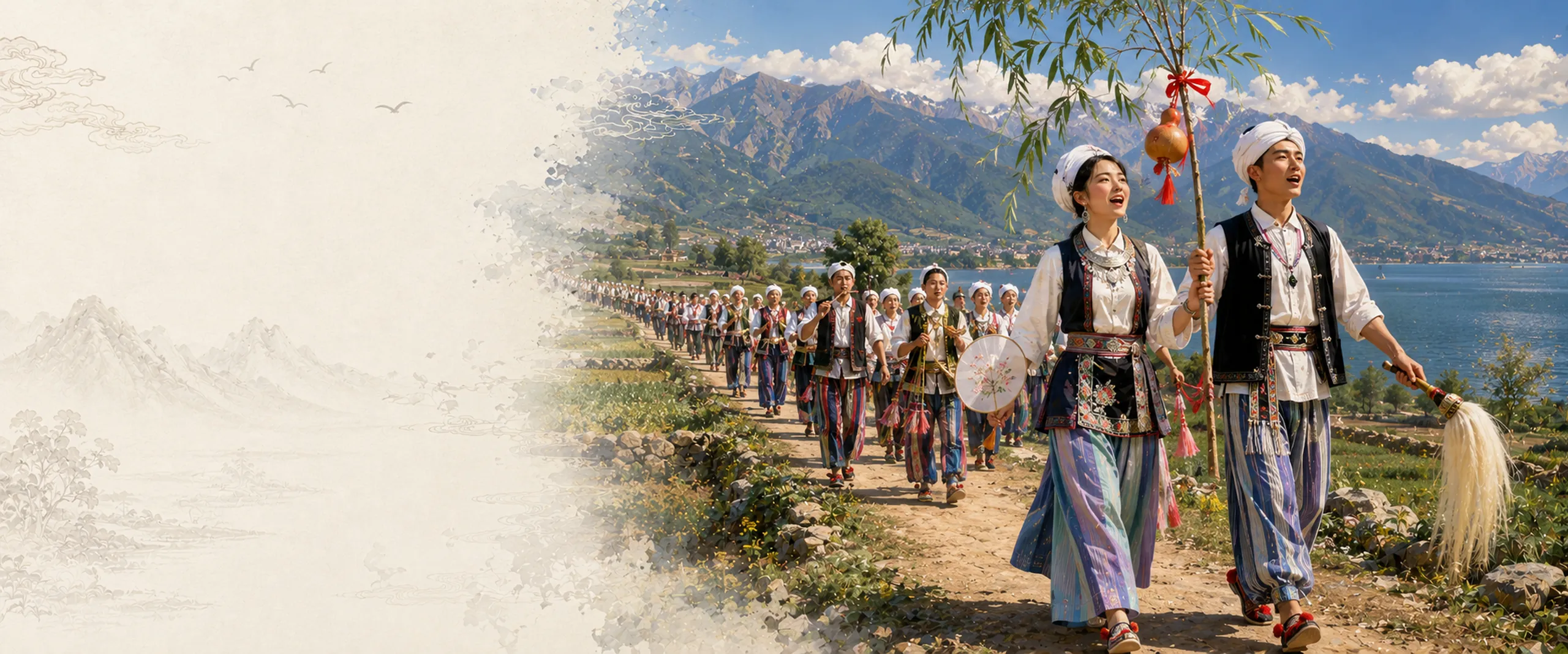
The “Three Sacred Sites” (三灵) refer to three important temples on the western shore of Erhai Lake: the Buddha Capital at Chongsheng Temple, the Divine Capital at Shengyuan Temple, and the Immortal Capital at the Erhe Deity Shrine in Heyicheng Village. During the festival, men and women of all ages from Bai villages around Erhai Lake dress in festive clothing and form processions led by elaborately costumed singers. Singing and dancing as they go, they set out from Chongsheng Temple and travel along the foothills of the Cangshan Mountains toward Shengyuan Temple. During the day, religious activities such as prayers for a favorable agricultural year are held at Shengyuan Temple. At night, people camp in the fields and perform Dabenqu, a traditional Bai narrative singing art, often continuing antiphonal singing until dawn. Raosanling is a traditional folk cultural activity formed through the Bai people’s long history of agricultural life. It combines the entertainment of deities and people, with song, dance, and ritual worship serving as its principal forms of expression.
Main Customs
The Origin of the Name “Raosanling”
The “Three Sacred Sites”: Three Major Holy Places in Bai Belief
The “Three Sacred Sites” represent three sacred powers on the western shore of Erhai Lake. They include important figures within the distinctive Bai system of Benzhu worship (本主崇拜) as well as Buddhist deities introduced into the Dali region. The temples in which they are enshrined are traditionally known as the Buddha Capital, Divine Capital, and Immortal Capital.
The “Buddha Capital” — Chongsheng Temple, located west of Dali Ancient City beside the Three Pagodas, is the most influential center of Buddhist activity in the Dali region. Chongsheng Temple was first established during the Nanzhao period and later served as a royal monastery of both the Nanzhao and Dali kingdoms. Its iconic Three Pagodas are among Dali’s best-known cultural landmarks.
The “Divine Capital” — Shengyuan Temple, also known as the Qingdong Benzhu Temple, lies in Qingdong Village, Xizhou Town, at the foot of the Cangshan Mountains. It is called the Divine Capital because it enshrines Duan Zongbang, a Qingping official of Nanzhao revered as the Central Benzhu. In Bai folk belief, the temple enshrines Duan Zongbang as the greatest Benzhu in the Dali region, known as the “King of Five Hundred Deities.” Shengyuan Temple is the principal center of Raosanling activities.
The “Immortal Capital” — Jingui Temple, also known as the Erhe Shrine or the Benzhu Temple of Heyicheng Village, is located on the northwestern shore of Erhai Lake. It enshrines the Bai hero Duan Chicheng, and people worship the Sacred Emperor of the Erhe River there.
The term “Three Sacred Sites” first appears in inscriptions from the Ming dynasty concerning temples associated with the three sacred places. Raosanling developed around pilgrimage to these three sites and incorporates Benzhu worship, song and dance performed for the deities, spring outings, and prayers for blessings into a major traditional folk festival and ethnic gathering.
The Meaning of “Rao”: A Procession of Song and Dance
The word “rao” refers to moving forward while singing and dancing. This procession is the central form of the festival: participants arrange themselves in long groups and follow a fixed route between Cangshan and Erhai, singing and dancing while visiting the three temples.
The traditional route has remained essentially unchanged for generations. On the first day, participants travel from the City God Temple in Dali Ancient City to Chongsheng Temple, the Buddha Capital. On the second day, they proceed to the Qingdong Benzhu Temple, the Divine Capital. On the third day, they continue to the Benzhu Temple in Heyicheng, the Immortal Capital, before concluding at the Benzhu Temple in Majiuyi Village. A Bai saying summarizes the itinerary: “On the third day, wander north; on the fourth, wander south; on the fifth, return home.”
Other Names for Raosanling
Raosanling has also been written or referred to as Raoshanlin, Raosanglin, or Guangshanlin. In the Bai language, it is known as Guanshanglan, or in another transcription, Guaishangna, and has also been called the Rain-Praying Gathering. In Bai, guai means to roam or wander, while shangna is an old Bai term referring to a place associated with courtship and relations between men and women; there is no precise equivalent in modern usage. Most modern scholars regard Raosanling as both an agricultural festival intended to pray for favorable weather and a surviving cultural expression of older traditions in which men and women pursued greater freedom in love and sexuality.
Preparations Before the Festival: Devotion and Activity Before Raosanling
Preparations begin on the twenty-second day of the fourth lunar month.
Dressing in Festive Attire
During Raosanling, participation traditionally transcends social status, wealth, and ethnic background. Men and women, young and old, decorate themselves with flowers, wear elaborate makeup, and put on their finest festive clothing. Bai women wear the distinctive headdress associated with the imagery of “wind, flowers, snow, and moon”, brightly colored Bai garments, and silver ornaments that ring at the waist as they move.
Participants approach the festival with enthusiasm and devotion, hoping that sincere worship will bring favorable winds and timely rains, abundant harvests in autumn, and peace and security for their families.
Preparing Luggage and Offerings
People organize themselves by village into groups ranging from several dozen to more than a hundred participants. They bring ritual implements, simple luggage, food, cooking utensils, and other supplies before traveling from every direction to the gathering. On the morning of the twenty-second day of the fourth lunar month, they assemble at the City God Temple in Dali Ancient City, light incense and candles, and make final preparations.
Each procession prepares props such as willow branches, gourds, colored silk, fly-whisks, fans, and white towels. Various offerings are also carried along the route. Some groups additionally carry statues of their Benzhu deity in the procession.
Day One: From the Buddha Capital to the Divine Capital — The Beginning of the Pilgrimage
On the first day of Raosanling, the twenty-third day of the fourth lunar month, the procession departs from the City God Temple in Dali Ancient City.
Gathering at the City God Temple
Early in the morning, adult men and women, including middle-aged and elderly participants from surrounding villages, put on festive attire. Many wear elaborate makeup. They spontaneously form singing and dancing groups organized by village communities, eventually bringing together thousands of participants at the City God Temple near the southern gate of Dali Ancient City.
There they light incense and candles and offer worship to the City God before setting out on three days of procession, music, and dance.
Chongsheng Temple, the “Buddha Capital”: Buddhist Worship
On the first day, participants pass through the Three Pagodas area of Chongsheng Temple, the Buddha Capital, and then travel northward along the foot of the Cangshan Mountains toward Shengyuan Temple in Qingdong, near Xizhou and beneath Wutai Peak. Chongsheng Temple is the most influential Buddhist center in the Dali region. Participants worship and pray there, completing the first stage of their pilgrimage within a sacred Buddhist space.
Shengyuan Temple, the “Divine Capital”: Center of Benzhu Worship
Shengyuan Temple is called the Divine Capital because it enshrines Duan Zongbang, the Nanzhao Qingping official honored as the Central Benzhu. The temple serves as the central venue of Raosanling.
A widely circulated explanation holds that representatives from the seventy-one villages of Dali symbolically represent their own local Benzhu deities and travel to the Divine Capital to pay homage to the Central Benzhu, praying for a prosperous agricultural year. Bai communities traditionally regard Duan Zongbang, the King of Five Hundred Deities, as the greatest Benzhu of the Dali region.
Ritual and Celebration at the Divine Capital
Participants first burn incense and perform prostrations at Shengyuan Temple, chant sacred texts, and pray for favorable weather, long life, and abundant harvests. Afterward, the temple grounds and surrounding areas become spaces of music and dance. People perform the Bawangbian whip dance, play the money drum, perform fan dances, and sing Bai melodies.
At dusk, cooking fires are set up around the Divine Capital. People prepare meals and spend the night in and around Qingdong Temple, in nearby fields, woods, and open spaces. Singing and dancing may continue throughout the night.
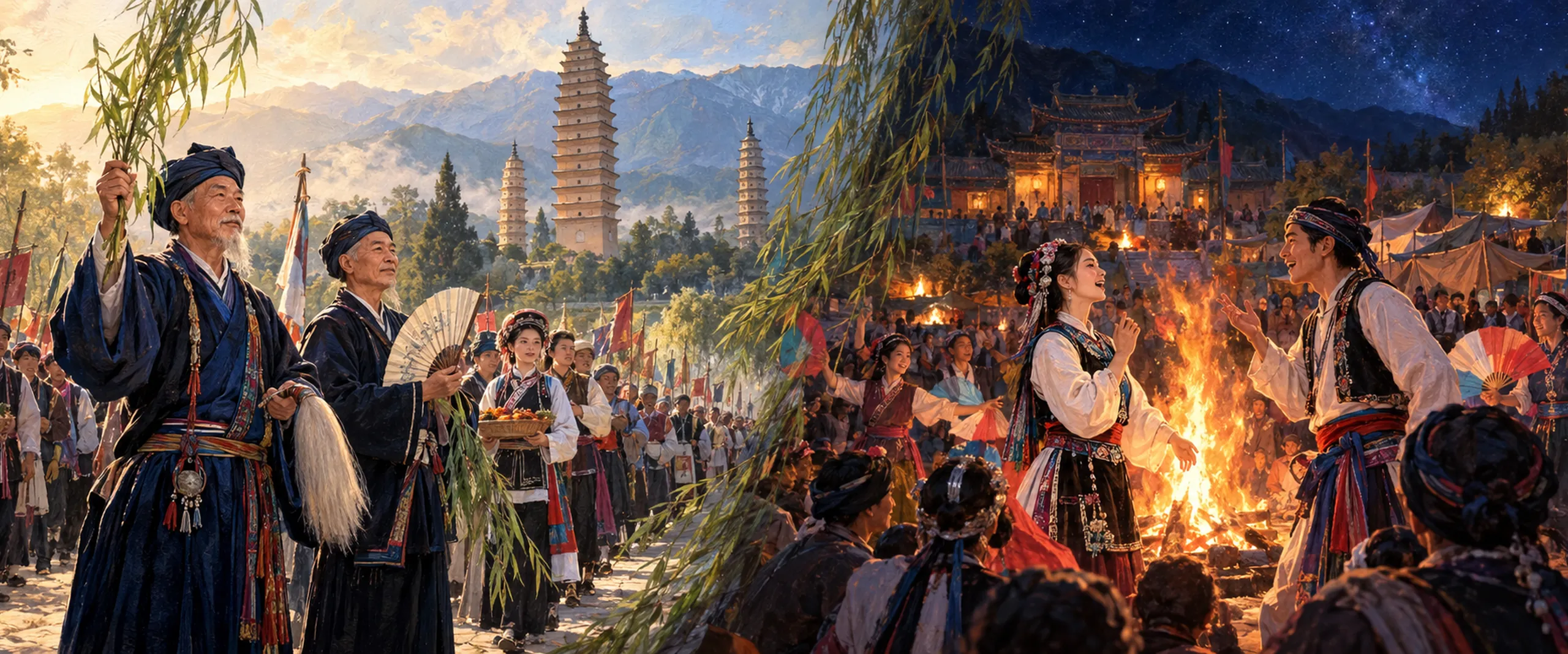
In the evening, young Bai men and women light bonfires on hillsides and among the woods near Qingdong Village, sing Bai songs, and perform the Bawangbian dance. Small groups build fires in fields and forests, boil tea, and cook meals. After eating, older participants may drink tea, play the sanxian, and perform Dabenqu, while young men and women leave with their chosen companions for secluded parts of the woods, where they talk and court one another until dawn.
Day Two: From the Divine Capital to the Immortal Capital — A Celebration of Song and Dance
On the second day, the twenty-fourth day of the fourth lunar month, the procession departs from the Divine Capital, passes through villages around Xizhou, and continues toward Jingui Temple in Heyicheng Village beside Erhai Lake, known as the Immortal Capital.
Singing Along the Route
Throughout the day, participants walk, sing, and dance, accompanied by music and laughter. Friends meet and reminisce, while lovers take the opportunity to express their feelings. The procession is large and energetic.
When the group reaches a village, local residents may deliberately block its progress and send out their best singers and dancers to challenge the visitors in antiphonal singing and dancing. Only after both sides have sung and danced to their satisfaction are the visitors allowed to continue. These encounters often involve teasing, improvisational humor, and playful exchanges that repeatedly provoke laughter from the crowd.
Jingui Temple, the “Immortal Capital”: Worship of the Sacred Emperor of the Erhe River
Still singing and dancing, the procession eventually reaches Jingui Temple in Heyicheng Village on the shore of Erhai Lake. The temple, known as the Immortal Capital, enshrines the Bai hero Duan Chicheng, and people worship the Sacred Emperor of the Erhe River there. Ritual worship takes place, while singing and dancing again continue throughout the night as forms of entertainment for both deities and people.
Jingui Temple is also known as the Erhe Shrine and enshrines Duan Chicheng as a Benzhu deity. In Bai folk tradition, Duan Chicheng is remembered as a hero who killed a giant serpent and was subsequently revered as a local protective deity. Here, participants pray to the Sacred Emperor of the Erhe River for safety on the waterways and abundance in fishing and related livelihoods.
The Second Night of Celebration
During the second night, festivities continue around the Immortal Capital. Villages in the surrounding area hold their own Benzhu worship ceremonies, adding further intensity to the festival atmosphere. People sing and dance through the night, while young men and women engage in antiphonal singing and courtship under the moonlight, expressing strong emotions through music and dance.
Day Three: From the Immortal Capital to Majiuyi — Completing the Journey Home
On the third day, the twenty-fifth day of the fourth lunar month, participants depart from the Immortal Capital and travel south along the western shore of Erhai Lake toward the Benzhu Temple in Majiuyi Village.
Traveling Along Erhai Lake
The procession returns southward along Erhai’s western shore. Against the bright spring landscape of Cangshan and Erhai, long groups of singers and dancers form a winding single-file “long-snake formation.” Led by the Flower-and-Willow Elders, they continue with music, song, and laughter.
In the villages along the way, travelers purchase objects made by local residents, including imitation copper coins symbolizing protection from evil, sun ointment used for similar protective purposes, small embroidered shoes and garments for children symbolizing women’s health, and flower strings or small angular ornaments symbolizing abundant grain harvests. Participants apply sun ointment to their foreheads and hang floral ornaments from their chests.
Majiuyi Village: The Final Destination
The procession finally reaches Majiuyi Village, east of Dali, where participants sing, dance, and pray at the local Benzhu Temple before dispersing. Majiuyi is the final destination of Raosanling and brings the entire circuit to completion. After the last act of worship, participants return to their respective villages.
Over the three days, Raosanling participants travel more than forty kilometers while playing instruments, singing, dancing, and answering one another in antiphonal song.
The Raosanling Route
The route that has become established today begins on the first morning at the City God Temple in Dali Ancient City and proceeds to Chongsheng Temple, the Buddha Capital. After worship and prayers there, participants move north to the Qingdong Benzhu Temple, the Divine Capital. On the second day, they leave Qingdong, reach Xizhou, then turn south toward the Benzhu Temple of Heyicheng, the Immortal Capital. On the third day, they proceed along the western shore of Erhai Lake from Heyicheng to Majiuyi Village and conclude with a final act of worship. Other folk explanations associate the festival with gratitude toward mountains and forests, celebration of harvests, the funeral procession of a benevolent emperor, and prayers for rain and blessings.
The Structure of the Raosanling Procession: A Long-Snake Formation of Celebration
Raosanling groups are organized by village and traditionally consist of three main sections.
The Front: Flower-and-Willow Elders and the Flower-and-Willow Song
At the head of each procession are usually one man and one woman, though sometimes two men or two women, known as the Flower-and-Willow Elders. They wrap their heads in large white cloths, wear snow-white front-opening jackets, brightly colored silk trousers, and colorful sandals decorated with red pom-poms, creating an intentionally humorous and theatrical appearance.
Together they support a willow branch from which hang a gourd and a piece of colored silk. The gourd symbolizes the womb, while the red silk symbolizes menstrual blood. One elder carries a fly-whisk, while the other holds a red fan or waves a white towel. As they dance, they sing a Bai Flower-and-Willow Song in antiphonal form, with humorous and playful lyrics. The melody is known as huo’enku, literally “Flower-and-Willow Song,” and is performed in a lively call-and-response style.
The Middle: Bawangbian, Octagonal Drum, and Double Flying Swallows
The middle section consists of a flute player and dozens of male and female dancers. Some sing melodies, some perform with Bawangbian bamboo whips, some play octagonal money drums, and others perform the Double Flying Swallows dance.
The Bawangbian is made from hollow bamboo approximately one meter long and divided into four sections. Three groups of copper coins are attached near the upper end and two groups near the lower end. The money drum consists of a wooden frame shaped as an octagon or hexagon, with sheepskin stretched across one side and a diameter of approximately eighteen centimeters. Small rectangular openings are cut into the wooden sections, each containing two copper coins that strike together during movement.
In the dance, women hold the center of the Bawangbian while men hold one corner of the money drum and dance opposite them. The bamboo whip produces sound by striking the ground, being kicked with the feet, and brushing against parts of the body. The money drum is struck with the palms and shoulders, producing a rhythmic booming sound. Men and women bend, stretch, turn, and shift continuously—at times facing heart to heart, at other times standing back to back.
The Bawangbian dance is one of the representative dances of the Bai people and carries rich historical and cultural memory. The octagonal drum dance is often performed together with the Bawangbian and Double Flying Swallows dances, forming the core dance suite of Raosanling.
The Rear: Leaf-Blowing and Singing While Dancing
At the end of the procession is a musician who plays melodies by blowing on a tree leaf, followed by dozens of women who sing and dance while carrying fans or straw hats. Together, all participants form a long single-file snake-like procession, led by the Flower-and-Willow Elders, producing a spring outing that may involve tens of thousands of participants.
Complete Order of the Procession
The Raosanling dance suite includes four principal forms: the Tree-Holding Dance, Bawangbian Dance, Octagonal Drum Dance, and Double Flying Swallows Dance. The procession follows a fixed order. Two people holding the willow branch lead the group; one sings while the other jokes and teases, forming the Tree-Holding Dance, also popularly known as the Daboqu or Dabaiqu. The willow they carry is itself called the Dabo.
Behind them come several people singing Bai melodies, playing short flutes, or producing music by blowing on leaves. These performances are collectively referred to in folk usage as the Flower-and-Willow Songs. The main body of dancers follows behind.
Songs and Dances of Raosanling
Flower-and-Willow Songs: Humorous and Playful Love Songs
The Flower-and-Willow Song is one of the most characteristic forms of antiphonal singing in Raosanling. The male and female Flower-and-Willow Elders sing Bai Flower-and-Willow Songs to one another while dancing, using humorous and playful lyrics. These songs are generally love songs sung or exchanged outdoors, often improvised and transmitted orally. Their themes frequently contain openly romantic and erotic elements, and the call-and-response performance is lively and witty.
Bai Melodies: Singing Contests Across the Countryside
Raosanling is a major spring gathering of song and dance held by Bai communities around Erhai Lake before the busiest agricultural season begins. Participants sing traditional Bai melodies, especially love songs. When two processions encounter one another, they may challenge each other to antiphonal singing competitions. The sound of Bai songs echoing between Cangshan and Erhai forms one of the festival’s most memorable soundscapes.
Dabenqu: Sung Narratives of Long Stories
Dabenqu is a traditional Bai narrative performing art from the Dali region in which long stories are sung or recited to the accompaniment of the sanxian. Older participants sit drinking tea while playing the instrument and singing Dabenqu. Its repertoire includes historical legends, love stories, and reflections on life, making it an important vehicle for Bai cultural memory.
Zhao Piding, born in 1942 and a Bai native of Dali Bai Autonomous Prefecture in Yunnan, is a representative inheritor of Bai Raosanling in the second group of national-level intangible cultural heritage inheritors. He was born into a family of Bai folk performers: his great-grandfather, grandfather, and father were all Dabenqu artists. Growing up in this environment, he developed a strong interest in Bai folk culture and arts from an early age and began performing publicly in 1964. He has mastered the principal ritual procedures of Raosanling as well as male-female antiphonal singing. In 2022, Zhao Piding was included among the 100 nominees for China’s Intangible Cultural Heritage Person of the Year.
Bawangbian Dance: A Representative Bai Dance
The Bawangbian dance is the most representative dance form of Raosanling. In the Bai language, the Bawangbian is known as Dawangbian or Dedidouxue. Dancers hold the bamboo whip and produce rhythmic sounds by striking it against the ground, kicking it, and brushing it across various parts of the body. Typical movements include men and women standing back to back, facing chest to chest, or hooking feet together, expressing strong emotion in a free and uninhibited manner.
Octagonal Drum Dance and Double Flying Swallows Dance
The octagonal drum dance is known in Bai as Jinjigu, or “urgent drum.” During the dance, performers strike the money drum with their palms and shoulders, producing repeated resonant beats. The Double Flying Swallows Dance is known in Bai as Shuangfeiyi. Together with the Bawangbian dance, these forms make up the principal body of the Raosanling dance procession.
Transmission and Development of the Dances
The Raosanling dance suite is a mass-participation combination dance closely associated with the festival and remains widely practiced in Bai rural communities around Erhai Lake. Different props distinguish the individual dance forms. Movements recorded in Qing-period texts, such as “rotating the arms” and “striking the body to receive the beat,” developed over time into additional techniques such as wrist turns and shoulder sways, eventually producing more than ten standardized movement sequences with names such as “the snake shedding its skin” and “heart to heart.”
Free Expression of Love Between Men and Women
In addition to prayers to Benzhu deities for favorable weather, one of the distinctive characteristics of Raosanling is the unusually open and uninhibited expression of romantic and sexual feelings through song and dance. Some unofficial Ming-period writings describe the custom as having been transmitted for thousands of years and speak of people “honoring ancestors and remembering their origins, continuing future generations, men and women delighting in love, singing by day and night without distinction of age, all joining in song between Cangshan and Erhai.”
Most modern scholars regard Raosanling as both an agricultural festival praying for favorable weather and a surviving cultural trace of older traditions in which men and women pursued greater freedom in sexuality and courtship.
Food Customs of Raosanling
Thousand-Person Long-Street Banquet
One of the largest food-related events during Raosanling is the thousand-person long-street banquet held before the Divine Capital. Qingdong Village is transformed into an open-air theater, and participants enjoy Bai specialties such as hot-and-sour fish and carved-plum wine.
The banquet is not merely a shared meal but also a ritual of community cohesion. More than a thousand people sit around long rows of tables, sharing food and celebrating the festival together.
Cooking in the Open
Participants carry food, cooking utensils, and other necessities with them. At dusk, they set up cooking fires around the Divine Capital. Small groups light bonfires in fields and woods, boil tea, and cook meals. This form of outdoor cooking transforms Raosanling into not only a religious pilgrimage and celebration of song and dance but also a large communal picnic and spring excursion.
Traditional Bai Foods
Hot-and-sour fish is one of the most representative Bai dishes. Fresh fish from Erhai Lake is cooked with sour papaya, chili peppers, and other ingredients, producing an appetizing balance of sourness and heat.
Carved-plum wine is a traditional Bai fruit wine prepared by soaking green plums carved with decorative patterns in distilled liquor. It has a sweet and mellow flavor. Long-street banquets also feature Bai specialties such as rushan cheese, erkuai rice cakes, and cold chicken rice noodles.
The Cultural Spirit of Raosanling
Benzhu Worship: The Core of Bai Folk Belief
Raosanling is one of the most representative festivals associated with Bai Benzhu culture. The term Benzhu is an abbreviation of expressions meaning the “lord of blessings of this locality” or “lord of the land of this locality.” Benzhu worship is a distinctive Bai folk religious tradition in which every village has its own protective deity. A Benzhu may be a historical figure, ethnic hero, nature deity, or Buddhist divinity and serves as the guardian of the community.
Most of the principal sites visited during Raosanling enshrine major Benzhu deities worshipped by the Bai people of Dali. Raosanling originally developed as a form of ancient Bai religious ritual and incorporates multiple layers of ethnic cultural tradition.
From one perspective, its earliest form has been associated with ancient Bai female worship, forming a foundation for elements of primal religion and sexuality within the festival’s complex belief system. With the development of agrarian society, prayers for rain became attached to Raosanling. During the Tang period, as Buddhism flourished, the festival could also serve as a means of promoting Buddhist belief. When Benzhu worship became especially influential, Raosanling developed as a ceremonial pilgrimage in which local Benzhu deities paid homage to the Central Benzhu.
Agricultural Culture: A Festival Expression of Rice-Growing Civilization
Archaeological evidence and ancient textual records indicate that inhabitants of the Haimenkou site in Jianchuan had already mastered rice cultivation more than three thousand years ago. Agricultural culture therefore has a very long history in Bai regions.
Raosanling prominently expresses prayers and reverence for agricultural forces associated with rain, sunlight, and the land. The festival takes place from the twenty-third to the twenty-fifth day of the fourth lunar month, immediately before the busy season of rice cultivation. People understood the close relationship between spring and summer rainfall, sunlight, and rice production and believed that sincere worship and the entertainment of deities could bring favorable conditions for agriculture.
Unrestrained Song and Dance: A Celebration of Life
Raosanling reflects the Bai people’s energetic, open, and strongly musical cultural character. Its song and dance traditions allow romantic feelings between men and women to be expressed with unusual freedom and spontaneity.
A Bai folk song from the Ming period praises the festival: “Sing all the joyful songs beneath Heaven; men and women, old and young, share the delight; the gathering of the three capitals was established by those of old; when hearts agree, intentions too are joined.”
Traditional Bai dance, antiphonal singing, Dabenqu, Dongjing music, clothing, foodways, and handicrafts are all transmitted and developed within the special cultural space of Raosanling, a space emphasizing relative freedom and equality between people as well as harmony between humanity, nature, and the sacred.
Contemporary Transmission
### Recognition as National Intangible Cultural Heritage
On May 20, 2006, Bai Raosanling was approved by the State Council for inclusion in the first batch of China’s National Intangible Cultural Heritage, under project number Ⅹ-41.
Dali City has 61 intangible cultural heritage safeguarding projects, including seven at the national level: Bai Raosanling, Bai tie-dyeing techniques, the Dali Third-Month Fair, decorative painting of Bai residential architecture, Bai opera, Xiaguan Tuocha tea-making techniques, and the Bai Three-Course Tea tradition.
### National-Level Representative Inheritors
Bai Raosanling has nationally recognized representative inheritors. Zhao Piding, born in 1942, is a Bai native of Dali Bai Autonomous Prefecture in Yunnan and a representative inheritor of Bai Raosanling in the second group of national-level intangible cultural heritage inheritors. Born into a family of Bai folk artists, he has mastered the various ritual protocols of Raosanling as well as male-female antiphonal singing.
Since Bai Raosanling was placed on the first national intangible cultural heritage list in 2006, organizations including cultural and sports authorities in Dali Prefecture and the Dali Bai Studies Association have organized donations from heritage bearers and applied for government subsidies. These efforts have supported environmental improvements at the principal Raosanling sites and formal protection through heritage signage. Specialized surveys have been conducted, related audiovisual materials and inheritor archives collected, and representative inheritors such as Zhao Piding have established training classes and transmission centers in local communities to teach performance skills associated with Raosanling.
### Contemporary Revival of Raosanling
In recent years, extensive field research has been combined with work involving villages along the festival’s core route and representative inheritors at different administrative levels. This has gradually supported the restoration of sixteen Raosanling troupes in areas including Xiaguan, Dali, Haidong, Xizhou, Wanqiao, Yinqiao, and Shangguan in the Cangshan-Erhai region, all of which preserve relatively complete traditional forms.
Communities and schools in places such as Dali Town and Qingdong Village in Xizhou regularly organize transmission activities on their own initiative and encourage younger generations to learn traditional cultural knowledge and performance arts related to Raosanling. These measures have helped protect and transmit the rich range of intangible cultural heritage embedded within the festival’s living cultural space.
### Contemporary Value of Raosanling
Raosanling brings together an unusually high concentration of Bai intangible cultural heritage and vividly reflects the people’s everyday life and spiritual outlook. Transmitted for more than a thousand years, the festival constitutes a living historical memory of Bai communities and a form of cultural nostalgia, expressing the Bai people’s love of life and reverence for nature.
Raosanling allows more people to learn about the long history, culture, and creative vitality of the Bai people and increases the visibility and public recognition of the heritage. It also promotes dialogue and exchange not only between Bai communities and neighboring groups such as the Yi and Naxi, but also among different peoples more broadly, contributing to harmonious coexistence within human cultural diversity.
As its explicitly religious character has gradually weakened, the range of cultural activities has become increasingly diverse. Today, Raosanling has also developed into an important spring excursion and social festival for the Bai people.
Closing Note
The folk traditions of Raosanling form a long cultural narrative about “pilgrimage” and “unrestrained celebration.” From the gathering at the City God Temple to worship at the Buddha Capital, from ritual and celebration at the Divine Capital to all-night singing and dancing at the Immortal Capital, and from the final completion of the journey at Majiuyi to the continuous music and dancing along the route, Raosanling brings together the Bai people’s reverence for Benzhu deities, hopes for agricultural abundance, release of human emotion, and love of a good life.
Raosanling is a festival of pilgrimage. Over three days and three nights, participants travel more than forty kilometers and visit the three great sacred centers of the Buddha Capital, Divine Capital, and Immortal Capital. From the Buddhist sacred space of Chongsheng Temple to the Benzhu worship center of Shengyuan Temple and the heroic cult of Jingui Temple, every step forms part of a devotional journey and every act of worship expresses reverence. Raosanling originated in religious rituals of the Nanzhao period and has a history of more than a thousand years. Through pilgrimage to these three sacred temples, Bai communities pray to Benzhu deities for favorable weather, abundant grain harvests, and peace for their families. Through pilgrimage, they reaffirm their relationship with the Benzhu, their ancestors, and the land.
Raosanling is also a festival of unrestrained celebration. As people proceed in song and dance, they openly express intense emotions. Traditional descriptions speak of “men and women delighting in love, singing by day and night without distinction of age.” The humor of the Flower-and-Willow Songs, the graceful melodies of Bai songs, the powerful rhythms of the Bawangbian, and the light elegance of the Double Flying Swallows dance all become forms of emotional release. Every song expresses feeling, and every dance step becomes a celebration of life. A Bai folk song from the Ming period declares: “Sing all the joyful songs beneath Heaven; men and women, old and young, share the delight.”
The customs of Raosanling achieve a close integration of pilgrimage and unrestrained celebration. Pilgrimage expresses reverence for the sacred, while celebration expresses love of life; pilgrimage is an expression of faith, while celebration allows human emotion to unfold freely. Like the long, winding single-file snake formation moving between Cangshan and Erhai, the festival is simultaneously an act of worship and a celebration of living. This cultural quality—giving equal importance to honoring the gods and entertaining people, and allowing devotion and joy to coexist—is one of the central reasons Raosanling has remained vibrant for more than a thousand years.
In 2006, Bai Raosanling was included in the first batch of China’s National Intangible Cultural Heritage. From the religious rituals of the Nanzhao period to contemporary national heritage protection, and from ancient Benzhu pilgrimage to today’s broad public celebration, Raosanling has crossed more than a millennium while continuing to flourish between the Cangshan Mountains and Erhai Lake. Its customs are both a concentrated expression of the Bai tradition of revering Heaven and honoring the ancestors and a vivid expression of a cultural wisdom that embraces life with acceptance and joy. Between pilgrimage and unrestrained celebration, Raosanling continually renews a profound cultural dialogue about faith, life, and culture.
—-
Readers’ Comments
Calendar and traditional culture enthusiasts from around the world, sharing the same moon.
Sign in or register to join the conversation. Your comment account is created automatically the first time you use a connected account.
No comments yet
Share your thoughts with readers around the world.