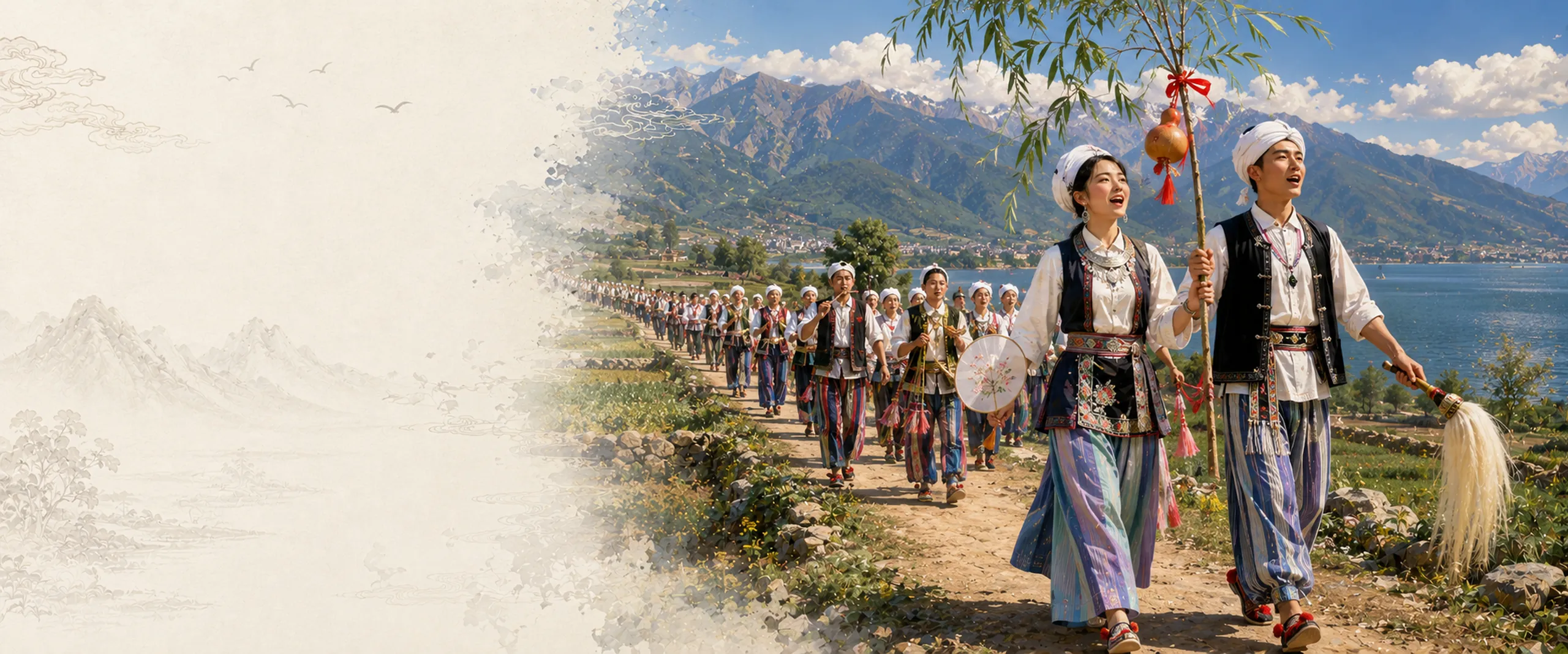
Raosanling is one of the Bai people’s oldest and most distinctive folk festivals. In the Bai language, it is called “Guanshanglan” or “Guangsanglan,” literally meaning “circling the three sacred sites.” The tradition has a history of more than one thousand years.
In 2006, Raosanling was included in the first national list of intangible cultural heritage of China, under designation X-41.
The “Three Sacred Sites” refer to:
* Chongsheng Temple, known as the Buddhist Capital
* Shengyuan Temple, the Divine Capital, located at the Benzhu temple in Qingdong Village
* Erhe Shrine, the Immortal Capital, in Heyicheng Village
Every year, from the twenty-third to the twenty-fifth day of the fourth lunar month, Bai people from hundreds of villages between Cangshan and Erhai dress in ceremonial clothing and form village-based processions. Following a traditional route that has been used for centuries, they sing and dance as they travel, often continuing through the night until dawn.
You can join the procession of thousands as it crosses fields and villages, and feel the uninterrupted pulse of a thousand-year-old culture through Bai songs and the sounds of the sanxian.

Event Schedule and Venues
### Core Dates of Raosanling
Raosanling is celebrated each year from the twenty-third to the twenty-fifth day of the fourth lunar month, corresponding approximately to late May through early June in the Gregorian calendar.
The festival lasts three days. Bai participants organize themselves by village, with groups ranging from several dozen to more than one hundred people. They travel from different directions carrying ritual implements, simple luggage, food, cooking utensils, and other necessities.
The core schedule is as follows:
| Date | Route | Core Activities |
|---|---|---|
| Day 1 — 23rd day of the fourth lunar month | Dali Ancient City City God Temple → Chongsheng Temple (Buddhist Capital) → Qingdong Village Benzhu Temple (Divine Capital / Shengyuan Temple) | Worship and prayers for blessings, incense burning and kowtowing, chanting scriptures; crowds gather before the central Benzhu temple amid drifting incense |
| Day 2 — 24th day of the fourth lunar month | Qingdong Village → Xizhou Town → Erhe Shrine in Heyicheng Village (Immortal Capital) | Bawangbian dance, octagonal-drum dance, singing and antiphonal exchanges along the way; the procession moves between Cangshan and Erhai |
| Day 3 — 25th day of the fourth lunar month | Heyicheng → Majiuyi Village Benzhu Temple | Singing and walking along Erhai’s western shore, celebrating freely through the night until dawn |
### Traditional Customs of Raosanling
Raosanling originated during the Nanzhao period. It began as a springtime religious activity through which Bai ancestors prayed for rainfall and abundant harvests.
At the heart of the festival is Benzhu worship. The Benzhu (本主) tradition is a distinctive religious belief of the Bai people. Every Bai village has its own Benzhu deity, regarded as the protective guardian of the community.
Composition of the Procession:
* At the front: an elderly man and woman carrying willow branches and ox tails, known as the “Flower-and-Willow Elders”
* In the middle: one flute player, together with dozens of male and female dancers carrying bawangbian sticks and money drums
* At the rear: one person playing a leaf whistle, followed by dozens of women carrying fans or straw hats, singing and dancing as they walk
| Custom | Description |
|---|---|
| Benzhu Worship | The central religious activity of Raosanling, with worship and prayers at Chongsheng Temple, Shengyuan Temple, and Erhe Shrine |
| Bawangbian Dance | One of the Bai people’s most representative traditional dances. Dancers hold decorated sticks and rhythmically strike the shoulders, elbows, hands, knees, and other parts of the body |
| Octagonal-Drum Dance | A traditional dance accompanied by the octagonal drum, performed in coordination with the bawangbian |
| Antiphonal Singing | Bai participants improvise Bai melodies in call-and-response form, using song to express emotion and build friendships; it is one of the festival’s liveliest cultural scenes |
### Major Recommended Activities
Dali Raosanling — Main Celebration, 23rd to 25th day of the fourth lunar month:
Raosanling lasts for three days, with Bai people from hundreds of villages between Cangshan and Erhai taking part spontaneously.
Visitors may follow any procession they encounter along the traditional route and experience a festival atmosphere in which “every step reveals another scene of local life, and every song and dance carries forward a tradition.”
Good places to pause and observe the ceremonies include:
* Dali Ancient City City God Temple
* Chongsheng Temple
* Xizhou Town
* Heyicheng Village
“Raosanling Intangible Heritage Folk Gathering” at Yunnan Ethnic Village — May 1–5, Alternative Experience:
If you cannot travel to Dali during the twenty-third to twenty-fifth days of the fourth lunar month, you may instead visit the Bai Village at Yunnan Ethnic Village in Kunming during the May Day holiday for the “Raosanling Intangible Heritage Folk Gathering.”
The event opens with a grand procession led by elders carrying willow branches. Bai participants in festive attire sing and dance as they advance, accompanied by dragon dancing and antiphonal singing between men and women.
The event also brings together multiple forms of intangible cultural heritage, including:
* Jianchuan woodcarving
* Heqing silverwork
* Bai tie-dyeing
A new story-based interactive experience, “A Peng Looks for Jin Hua” (阿鹏找金花), allows visitors to step into scenes inspired by the classic film *Five Golden Flowers*.
Pre-Trip Preparation
### Visas and Entry
Dali in Yunnan, where Raosanling is celebrated, is subject to China’s unified visa policies:
* 240-Hour Visa-Free Transit for Citizens of 54 Countries: Travelers may enjoy up to 240 hours of visa-free transit, with permitted stay areas covering Yunnan Province.
* Tour Groups from ASEAN Countries: Groups organized through travel agencies may enter visa-free through designated ports.
* Other Nationalities: Apply in advance for a tourist visa, or L visa, through the relevant Chinese embassy or consulate and ensure that your passport remains valid for more than six months.
* Latest Policies: Before departure, consult the official website of China’s National Immigration Administration or the relevant embassy or consulate.
### Adapting to the Climate
Raosanling takes place from the twenty-third to the twenty-fifth day of the fourth lunar month, corresponding to late May through early June.
At this time, Dali is entering early summer:
* Temperature: Average daily temperatures of around 15°C–25°C. Days are warm and comfortable, while mornings and evenings are cooler.
* Sunlight: Ultraviolet exposure can be strong, so sun protection is important on clear days.
* Rainfall: By June, the early rainy season has begun. Occasional showers occur, so carrying rain gear is recommended.
* Clothing: Use a layered system — short sleeves or a light long-sleeved top during the day, with a thin jacket or sun-protective layer for mornings and evenings.
Shoes should be comfortable and non-slip, preferably athletic or hiking shoes.
The Raosanling procession covers more than 40 kilometers over three days, and walking is the primary way to participate.
### Travel Insurance
It is strongly recommended to purchase travel insurance covering:
* Accidental injury and acute illness treatment, including outpatient care
* Loss of or damage to personal belongings
* Travel delays or cancellations
### Currency and Payment
* Currency: Renminbi (CNY).
* Cash: Carry a reasonable amount of cash. Network signals in rural areas may be unstable, making cash transactions more reliable.
* Cards: Visa and MasterCard may be used at larger hotels and supermarkets in Dali Ancient City and Xiaguan, but are generally not accepted in villages and rural markets.
* Mobile Payment: Alipay and WeChat Pay are widely used in Dali’s urban areas and ancient city.
### Communications and Internet
* Important: Visitor numbers are high along the Cangshan–Erhai route during Raosanling, and 4G/5G signals may be weak on some rural sections.
* It is strongly recommended to download offline maps in advance. Use Baidu Maps or AutoNavi and download the Dali Prefecture map to your phone while connected to Wi-Fi.
How to Get There
### Core Venue: Dali Bai Autonomous Prefecture
| Transportation | Details |
|---|---|
| Air | Dali Fengyi Airport has flights to Beijing, Shanghai, Guangzhou, Chengdu, Chongqing, Kunming, and other major Chinese cities. June is peak tourism season, so booking flights one month in advance is recommended |
| High-Speed Rail | High-speed trains between Kunming and Dali run frequently, with a travel time of about 2–2.5 hours. Dali Station is located in Xiaguan; from there, take a bus or taxi to Dali Ancient City |
| Driving | Hangzhou–Ruili Expressway, G56, provides direct access to Dali. Traffic restrictions apply in and around Dali Ancient City during the festival, so use designated parking areas |
High-Speed Rail Ticket Tip: Tickets can be difficult to obtain during Raosanling and the nearby Dragon Boat Festival holiday. Booking in advance through the Railway 12306 App is recommended.
### Distribution of Core Festival Areas
The traditional Raosanling route runs between Cangshan and Erhai and includes the following key locations:
* Day 1 — June 8: Depart from the City God Temple in Dali Ancient City, travel south to Chongsheng Temple, the Buddhist Capital, for worship and prayers, then head north to the Qingdong Village Benzhu Temple, the Divine Capital / Shengyuan Temple
* Day 2 — June 9: Depart Qingdong Village, pass through Xizhou Town, then turn south toward Erhe Shrine in Heyicheng Village, the Immortal Capital
* Day 3 — June 10: Travel south from Heyicheng along Erhai’s western shore to the Majiuyi Village Benzhu Temple
### Transportation Tips During the Festival
* Dali Ancient City: Traffic is heavy in and around the ancient city during the festival. Prioritize walking or public transportation.
* Xizhou Town: The second-day route passes through Xizhou. Roads inside the town are relatively narrow, so drivers should locate parking in advance.
* Erhai Circuit Roads: Rural roads along Erhai contain many bends and narrow sections. Drive carefully.
* Travel Recommendation: The core experience of Raosanling lies in walking with the procession. Consider leaving your vehicle in Dali Ancient City or Xizhou Town and participating mainly on foot.
Accommodation Reservations
| Key Point | Recommendation |
|---|---|
| When to Book | June is peak tourism season in Dali, and Raosanling may overlap with the Dragon Boat Festival holiday. Book more than one month in advance |
| Dali Ancient City | Stay inside or around the ancient city for maximum convenience; the first day begins at the City God Temple and is accessible on foot |
| Xizhou Town | The route passes through Xizhou on Day 2. Staying in a Bai-style traditional guesthouse in the old town offers a more locally rooted experience |
| Caicun / Longkan | Lakeside villages on Erhai’s western shore, with quieter surroundings and views directly over the lake |
| Xiaguan Urban Area | Convenient transportation, many hotel options, and relatively affordable prices, but farther from the core festival route |
| Price Reference | Budget around RMB 200–400 per night, mid-range RMB 400–800, high-end lake-view accommodation above RMB 800 |
| Booking Platforms | Major platforms such as Ctrip, Qunar, and Meituan; rooms with free cancellation are preferable |
| Guesthouse Experience | Staying in a guesthouse converted from a traditional Bai residence offers an opportunity to experience Bai architecture and local hospitality |
Pre-Trip Packing Checklist
| Category | Essential Items | Special Notes |
|---|---|---|
| Clothing | Quick-drying T-shirts, light jacket / sun-protective outer layer, long trousers | Dali is cool in the morning and evening but warm during the day. Dress in layers. Comfortable old clothing is recommended, as the three-day route covers more than 40 kilometers |
| Shoes | Comfortable non-slip athletic shoes / hiking shoes | Essential — Raosanling involves extensive walking, and a good pair of shoes can determine the quality of the experience |
| Sun Protection | SPF50+ sunscreen, sun hat, sunglasses | Strong highland UV exposure requires comprehensive protection on clear days |
| Rain Gear | Folding umbrella or lightweight raincoat | June marks the beginning of the rainy season and showers are frequent |
| Medicine | Cold medicine, gastrointestinal medicine, adhesive bandages, motion-sickness medicine | Useful for climate changes and dietary differences |
| Electronics | Power bank, phone, camera | Walking distances are long and charging facilities are limited |
| Storage | Small bag / waist pouch for documents and cash; lightweight backpack | Keep personal belongings as minimal as possible |
| Other | Insulated bottle, tissues / wet wipes | Rural facilities may be limited |
Cultural Respect
### Respect for Religious Belief and Benzhu Worship
Raosanling centers on Benzhu worship. When participating, observe the following:
* Remain Solemn During Rituals: At Chongsheng Temple, Shengyuan Temple, Erhe Shrine, and other ritual sites, remain quiet and respectful. Do not shout, laugh loudly, or play around.
* Do Not Interfere: Do not obstruct or disturb the normal conduct of ritual ceremonies.
* Viewing Etiquette: If visitors are permitted to observe a ceremony, remain in designated areas, do not walk around freely, and do not touch offerings or ritual objects.
* Photography Restrictions: Ritual ceremonies generally prohibit photography. Confirm with on-site staff in advance.
### Etiquette When Following a Procession
* Joining a Procession: Raosanling processions are formed spontaneously by Bai villagers. If you wish to walk with a group, maintain an appropriate distance and do not crowd or cut into the procession.
* Respect the Procession Leaders: The “Flower-and-Willow Elders” at the front play a central guiding role. Respect their directions.
* Antiphonal Singing and Dance: Bai participants sing and respond to one another throughout Raosanling. If invited to sing or dance, feel free to participate; it is a traditional way for local people to express friendliness.
### Photography Etiquette
* Ask Permission: Before photographing Bai participants in festive clothing, ritual ceremonies, elderly people, or children, smile and ask first.
* Respect Portrait Rights: Do not use photographs of other people commercially without permission.
* Drone Regulations: Flying drones in the Cangshan–Erhai area requires advance registration with local public-security authorities. Clearly designated no-fly zones exist around religious sites such as Chongsheng Temple.
### Safety Guidelines
* Walking Safety: The full three-day Raosanling route exceeds 40 kilometers. Participate according to your physical condition, wear comfortable non-slip shoes, stay hydrated, and protect yourself from the sun.
* Traffic Safety: When processions cross roads, pay attention to passing vehicles and do not play or linger in traffic lanes.
* Property Safety: Store valuables in the hotel safe and minimize what you carry.
* Heat and Sun Protection: Dali receives strong sunlight in June, so protect yourself from the sun and drink enough water.
* Food Hygiene: Rural markets focus on local specialties. Choose food that has been thoroughly cooked and heated.
Emergency Information
| Item | Contact / Description |
|---|---|
| Emergency Numbers | Police 110, Fire 119, Ambulance 120 |
| Major Hospitals | Dali Bai Autonomous Prefecture People’s Hospital in Xiaguan; Dali First People’s Hospital |
| Tourist Police / Lost Property | Permanent police posts are located in Dali Ancient City and Xizhou Town. If valuables are lost, report immediately to the nearest police office |
| Tourist Information | Official platforms of the Dali Prefecture Culture and Tourism Bureau and Dali Ancient City Scenic Area |
| Time Zone | UTC+8, China Standard Time |
| Voltage / Plugs | 220V; plug types A / C / I |
Special Reminders
* Extensive Walking: The full three-day route covers more than 40 kilometers — a good pair of shoes is essential. Choose sections according to your own stamina; there is no need to follow the entire route.
* Respect Belief: Raosanling combines Bai religious worship with springtime communal outings. Remain solemn at ritual sites and always ask permission before taking photographs.
* Confirm the Dates: Raosanling follows the lunar calendar and is held each year from the twenty-third to the twenty-fifth day of the fourth lunar month, usually between late May and early June. Confirm the exact dates for the year of your visit before departure.
* Yunnan Ethnic Village Alternative: If you cannot travel to Dali during the traditional dates, you can experience the “Raosanling Intangible Heritage Folk Gathering” at Yunnan Ethnic Village in Kunming from May 1 to 5.
* Transportation Planning: Traffic controls apply in and around Dali Ancient City during the festival. Plan routes in advance.
* Weather Awareness: June marks the beginning of the rainy season. Check weather conditions before departure and carry rain gear.
*May you experience the distinctive charm of a thousand years of Bai intangible cultural heritage between Cangshan and Erhai, and amid the swaying willow branches and rhythmic sounds of the bawangbian, receive the beautiful blessing of “favorable weather, good fortune, and peace.”*
—-
Readers’ Comments
Calendar and traditional culture enthusiasts from around the world, sharing the same moon.
Sign in or register to join the conversation. Your comment account is created automatically the first time you use a connected account.
No comments yet
Share your thoughts with readers around the world.