
Ghost Festival

Ghost FestivalZhongyuan Festival Cuisine

「 七月半,鸭压邪。 」

The Ghost Festival falls on the 15th day of the seventh lunar month. It is associated with the Daoist “Three Yuan” doctrine — the day when the Earth Official pardons sins — and also merged with the Buddhist Yulanpen Assembly, becoming a festival…

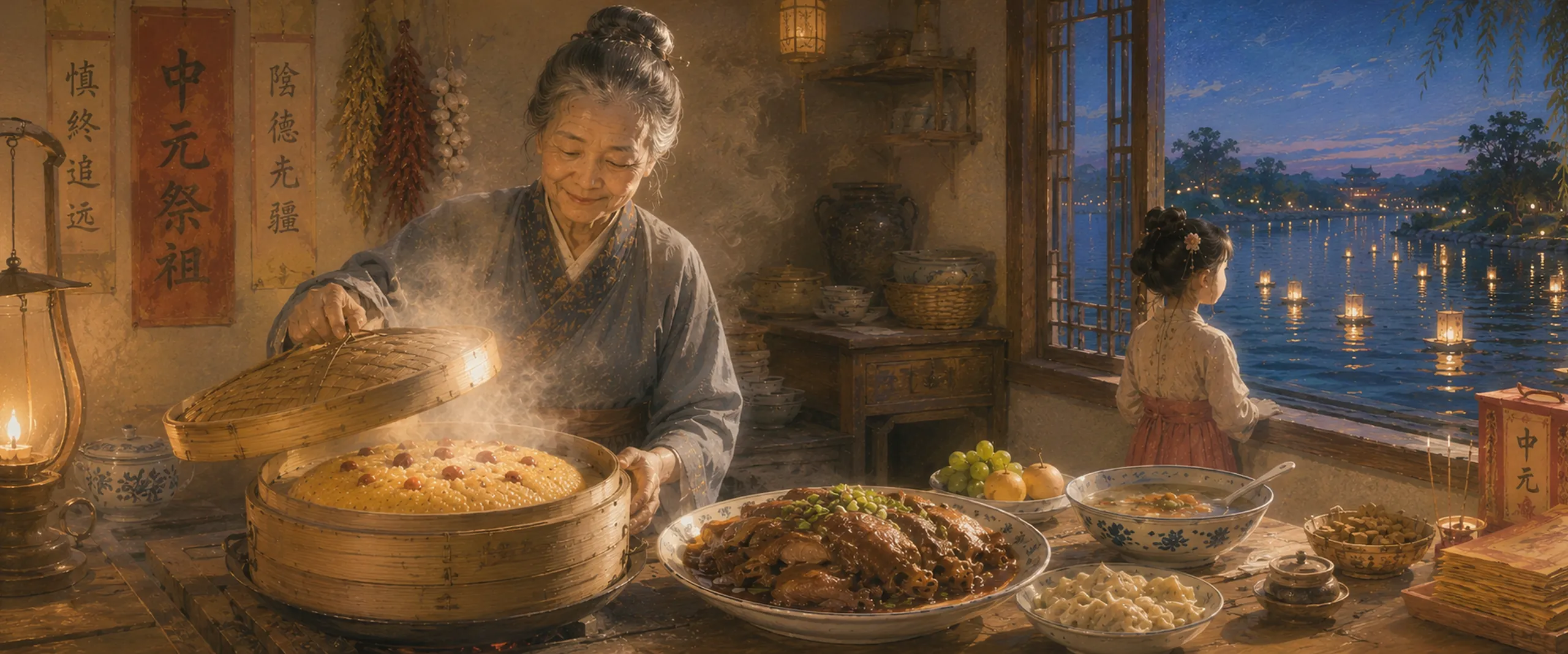
The food customs of the Zhongyuan Festival are rich and varied, with distinctive traditions across different regions. Duck is the festival’s most representative food—one explanation is that ya (鸭, “duck”) and ya (压, “to suppress”) are homophones, so eating duck symbolizes suppressing misfortune. In northern China, there is also the custom of eating mutton during the final period of the dog days to “put on autumn weight.” Eggplant cakes are another traditional Zhongyuan Festival food. Fresh eggplants are shredded, mixed with flour, and pan-fried; according to tradition, these cakes can serve as provisions for deceased ancestors on their journey to the Ullambana assembly. Bianshi, a type of dumpling, is also commonly eaten during the festival, with both meat and vegetable fillings and particular attention paid to their combinations. In Jiangxi and other regions, steamed buns are indispensable during Zhongyuan, while in Taizhou, Zhejiang, some communities prepare the “Eight Bowls” as ancestral offerings. Through flavor, Zhongyuan Festival foods carry emotion, transmitting the cultural tradition of honoring ancestors and remembering loved ones between ritual sacrifice and family reunion.

Ghost Festival / Zhongyuan Festival Cuisine
297 days until Ghost Festival August 16, 2027 · Lunar 七月十五

Festival Food Gallery

Seasonal Menu

Food in Detail

Seeking the True Flavor

Laifen (濑粉)

Grains & Staples

Basic Information

  • Category: Rice-noodle staple
  • Popular regions: Dongguan, Guangdong, and the Pearl River Delta
  • Main ingredients: Rice flour, water
  • Other names: Laifen, longevity noodles

Historical Origins

In Dongguan, eating laifen during the Zhongyuan Festival is a widespread custom practiced across almost the entire city. In Guangdong, eating laifen at Zhongyuan represents a prayer for peace and safety. Laifen is a distinctive local snack of Guangdong. Its name comes from the method of preparation: rice slurry is pressed into long strands and dropped into hot water, and this pressing action is called “lai” (濑). Dongguan is especially famous for roast-goose laifen.

Laifen is also a traditional food served at birthday banquets in Dongguan, symbolizing enduring longevity, abundant blessings, and a long life. People in Guangdong also eat it when celebrating birthdays, giving it the meaning of increasing both fortune and lifespan. Eating laifen during the Zhongyuan Festival likewise symbolizes long-lasting prosperity, abundant blessings, and longevity.

Cultural Meaning

The central symbolism of laifen is “lasting for a long, long time.” Its long, supple strands symbolize longevity and endurance. Eating laifen during Zhongyuan is both an act of remembrance for ancestors and a prayer for the health and long life of family members. The lai (濑) in laifen also sounds like lai (赖, “to rely on”), suggesting reliance upon the protection of one’s ancestors.

Simple Preparation

  • Ingredients: 500 g rice flour, water as needed, 100 g roast goose (or char siu), chopped scallions
  • Steps:
  1. Mix the rice flour with water into a thin slurry. A small amount of wheat starch may be added to increase elasticity.
  2. Bring water to a boil. Transfer the slurry to a piping bag or a special laifen press and squeeze it directly into the boiling water.
  3. When the rice noodles float to the surface, they are cooked. Remove and rinse in cold water.
  4. Top with roast goose, char siu, or other toppings, pour over hot broth, and sprinkle with chopped scallions.

Tip: The key to laifen lies in the act of “lai”—the thickness of the slurry and the speed of pressing determine the thickness and texture of the noodles. Dongguan’s classic version is roast-goose laifen, known for its savory broth and silky noodles.

Zhongyuan Duck

Meat & Seafood

Basic Information

  • Category: Meat dish
  • Popular regions: Nationwide, especially in southern China
  • Main ingredients: Duck, including local breeds such as mallard-type and Muscovy ducks
  • Other names: Seventh-Month Duck

Historical Origins

Eating duck during the Zhongyuan Festival is a shared custom in many regions across China. A popular saying goes, “七月半吃只鸭,万事不用怕”. Because ya (鸭, “duck”) and ya (压, “to suppress”) are homophones, eating duck is believed to suppress ghosts and evil influences. In Dongguan, people commonly eat lotus root braised with duck. In Guangxi, the custom is particularly strong, and duck becomes the centerpiece of the festival table. Ducks also swim through water, connecting them symbolically with the prayers and universal deliverance associated with floating river lanterns.

Several folk explanations circulate regarding the custom of eating duck at Zhongyuan. The first explanation is connected with the Naihe Bridge: according to legend, deceased ancestors return home to visit their families on the Zhongyuan Festival and must cross the Naihe Bridge, but without a boat they cannot make the crossing. The living therefore send ducks down to them so that the ducks can swim them back, and over time this became a tradition. The second explanation comes from the homophone “ya” (压): duck is eaten to suppress wandering spirits. The third explanation relates to the agricultural season: in rural Guangxi, ducks are raised from spring and are fully grown by Zhongyuan. In earlier times, when life was poorer, families were generally willing to slaughter a duck only for a festival. The fourth explanation is associated with warfare: according to one legend, ancient northerners attacking the south encountered a river they could not cross for a long time, so they killed ducks and ate them as an auspicious act, hoping they would become better adapted to water.

After the Zhongyuan Festival, the coolness of autumn is soon to arrive. In seasonal terms, foods said to clear heat, generate fluids, and nourish yin may be eaten regularly. Duck meat is considered neither warming nor heating and is said to clear heat and reduce internal fire, making it especially suitable for the transition between summer and autumn. A folk saying goes, “七月半吃鸭,万事不用怕”. People hope that by eating duck they can suppress bad luck and make life safer and smoother.

Cultural Meaning

The central symbolism of duck is “suppressing evil and praying for blessings.” Because ya (鸭, “duck”) and ya (压, “to suppress”) are homophones, duck is eaten to suppress ghosts and evil influences and to protect the family. At the same time, because ducks are strong swimmers, legends give them the task of carrying ancestral spirits across the Naihe Bridge. Eating duck during the Zhongyuan Festival is therefore both a way of seeing ancestors off and a form of protection for the family.

Regional Evolution

Duck is prepared in many different ways across China:

  • Dongguan, Guangdong: Lotus root braised with duck, simmering lotus root and duck together into a clear, mellow broth.
  • Fujian: Smoked duck, made by placing boiled duck on a rack and smoking it with glutinous rice, tea leaves, and other ingredients. Fujian families also celebrate Zhongyuan with duck alongside steamed cakes and red rice cakes.
  • Guangxi: Lemon duck, white-cut duck, beer duck, and many other preparations make duck the centerpiece of the Zhongyuan table. Huanjiang fragrant duck is a Guangxi specialty, mainly free-ranged along rivers and fields, with firm, fresh-tasting meat that is sweet without being greasy.
  • Nationwide: Roast duck, soy-braised duck, salted duck, old-duck soup, and other preparations.

Simple Preparation

  • Ingredients: Half an old duck (about 750 g), 500 g lotus root, ginger slices, red dates, goji berries, salt
  • Steps:
  1. Chop the duck into pieces, place in cold water, blanch to remove blood and foam, then remove and rinse clean.
  2. Peel the lotus root and cut into thick slices or irregular chunks.
  3. Bring water to a boil, add the duck, lotus root, ginger, and red dates. Return to a boil over high heat, then reduce to low heat and simmer for 1.5–2 hours.
  4. Add the goji berries 10 minutes before serving and season with salt.

Tip: An older duck produces a richer soup than a young duck. Powdery lotus root is best, as it becomes soft and floury after stewing. Soup is one of the most classic ways to eat duck at Zhongyuan: clear and mellow, it suits the dietary needs traditionally associated with the transition from summer to autumn.

Bianshi (扁食)

Grains & Staples

Basic Information

  • Category: Grain-based staple
  • Popular regions: Jiangsu, Zhejiang, and other parts of Jiangnan
  • Main ingredients: Flour, fillings of meat or vegetables
  • Other names: Huntun, chaoshou, wonton

Historical Origins

Bianshi is an important Zhongyuan Festival food tradition in Jiangnan. In Dongxian Township, Jiangsu, many local residents eat bianshi on the day of the festival. Bianshi is described as a food made from flour and sugar in the shape of a dustpan. It resembles a dumpling, but its wrapper is as thin as a cicada’s wing and almost translucent. Cooking and eating bianshi during Zhongyuan symbolizes driving away bad luck and eliminating negative energy. It is also an indispensable staple in the ancestral rites performed at noon on Zhongyuan by people in Rugao.

Today some people also call bianshi “dumplings,” but the two are actually quite different. Bianshi wrappers are thinner than dumpling wrappers, their shape is narrower and longer, and their fillings also differ greatly. Bianshi shares its origins with dumplings and wontons; it is more delicate than dumplings and more generously filled than wontons. In the middle and lower reaches of the Yangtze River, especially Jiangsu and Zhejiang, it is eaten on the Zhongyuan Festival.

Cultural Meaning

Bianshi carries the meaning of “driving away bad luck.” Cooking and eating it during Zhongyuan symbolizes dispelling misfortune and clearing away negative energy. Its shape resembles a silver ingot, giving it the additional meaning of “attracting wealth and treasure.” The bian (扁) in bianshi also sounds like bian (变, “to change”), symbolizing a turn in fortune and the arrival of better times after hardship.

Simple Preparation

  • Ingredients: 200 g flour, 150 g minced pork, 50 g shrimp, chopped scallion and ginger, light soy sauce, salt, sesame oil
  • Steps:
  1. Add water to the flour and knead into a smooth dough. Rest for 20 minutes, then roll extremely thin and cut into trapezoids or squares.
  2. Finely chop the pork and shrimp together, then mix with scallion, ginger, light soy sauce, salt, and sesame oil.
  3. Place a small amount of filling on each wrapper, fold, and pinch closed. It may also be shaped like a silver ingot.
  4. Add the bianshi to boiling water. Once they float, remove and serve in clear broth or with chili oil.

Tip: The wrapper should be rolled extremely thin—“as thin as a cicada’s wing” is one of the defining features of bianshi. The filling should not be excessive, so that the delicacy of the wrapper remains prominent.

Jiaobing (Jiaobing Tube)

Grains & Staples

Basic Information

  • Category: Grain-based staple
  • Popular regions: Tiantai County, Taizhou, Zhejiang, and surrounding areas
  • Main ingredients: Thin wrappers; fillings such as sliced meat, pork liver, egg strips, fish, tofu, daylily buds, wood ear mushrooms, glass noodles, shredded bamboo shoots, carrots, bean sprouts, celery, and more
  • Other names: Shibingtong, maibingtong, mitong, maiyouzhi, maijiao, wuhu qinyang, Jigong rolled pancake, xibing

Historical Origins

In Tiantai, Taizhou, Zhejiang, people eat jiaobing tubes during the Zhongyuan Festival. Jiaobing is a food similar to a spring roll. According to legend, it was left behind by the monk Jigong. When Jigong lived as a monk at Guoqing Temple, he noticed that large amounts of food were left over after every meal and considered this wasteful. He therefore wrapped the leftovers in hulatuo wrappers and saved them for the next meal. The other monks enjoyed this method, and it later spread among the people. For this reason, eating jiaobing also carries the meaning of following the Buddha and doing good.

The name “jiaobing tube” comes from its appearance: the vegetables are wrapped like a jiao (饺), the outer layer is a bing (饼, “pancake”), and the rolled shape resembles a tong (筒, “tube”). The dish has different names throughout Taizhou, including shibingtong, maibingtong, mitong, maiyouzhi, maijiao, wuhu qinyang, Jigong rolled pancake, and xibing. A particularly elaborate version is called “Five Tigers Seizing the Sheep,” in which sliced meat, pork liver, strips of egg, fish, tofu, and other ingredients are combined in a set order with daylily buds, wood ear mushrooms, glass noodles, shredded bamboo shoots, carrots, bean sprouts, celery, and more, then rolled inside a hulatuo wrapper. Once wrapped, the jiaobing tube is placed on an ao, a traditional griddle, and pan-fried until the outside turns golden and glossy with oil.

Cultural Meaning

Jiaobing carries the dual meanings of “cherishing food and blessings” and “following the Buddha and doing good.” The legend of Jigong wrapping leftover dishes in a pancake embodies the traditional virtue expressed in the idea that “for every bowl of porridge and every meal, one should remember how hard they were to obtain.” The name “Five Tigers Seizing the Sheep” also carries auspicious associations with abundant harvests and plentiful produce.

Simple Preparation

  • Ingredients: 200 g flour, water as needed to make a thin batter; fillings such as shredded pork, egg strips, bean sprouts, bamboo shoots, shredded carrot, dried tofu strips, glass noodles, and more
  • Steps:
  1. Mix flour and water into a thin batter. Heat a frying pan, lightly oil it, and spread the batter into a thin wrapper known as hulatuo skin.
  2. Cook the different fillings separately and set aside.
  3. Take one wrapper, arrange the fillings in order—shredded pork, egg strips, bean sprouts, bamboo shoots, and others—and roll tightly into a tube.
  4. Lightly oil a frying pan and pan-fry the jiaobing tube until golden on both sides.

Tip: The more varied the fillings, the better. “Five Tigers Seizing the Sheep” emphasizes the combination of many different ingredients. Roll tightly so the shape holds during frying. The wrapper should be thin yet resilient enough to contain the generous filling.

Decorative Steamed Buns (Dough Sheep)

Grains & Staples

Basic Information

  • Category: Wheat-based food
  • Popular regions: Shanxi, Hebei, northern Shaanxi, and other northern regions
  • Main ingredients: Flour, red dates, dried fruits and nuts
  • Other names: Dough sheep, decorative steamed buns, dough sculpture

Historical Origins

Decorative steamed buns are an important Zhongyuan Festival food tradition in northern China. The festival falls around the autumn grain harvest, and many northern households use flour milled from newly harvested wheat to steam buns in a wide variety of decorative shapes, either to distribute among relatives and friends or to eat at home. In northern Shaanxi, people eat decorative steamed buns during Zhongyuan. These are white-flour buns enriched with dried fruits and nuts and shaped into various forms symbolizing peace, filial devotion, abundant descendants, surplus year after year, and other blessings. The fifteenth day of the seventh lunar month has become a time when local rural women display their craftsmanship.

In Shanxi, there is a custom of steaming dough sheep during the Zhongyuan Festival. Because yang (羊, “sheep”) sounds like xiang (祥, “auspicious”), the sheep carries the meaning of good fortune. Steaming dough sheep during Zhongyuan symbolizes peace and smooth fortune. In Qinghe County, Hebei, steamed dough sheep are given to daughters. In Guangping County, fruit, vegetables, and steamed sheep are prepared for grandchildren in a custom known as “sending sheep.” Before Zhongyuan, dough-sculpting activities are widespread among women in many northern regions and are especially prominent in northern Shanxi.

Legends surrounding dough sheep are also associated with the story of “Chenxiang Splitting the Mountain to Save His Mother.” In old Beijing and rural parts of northern China, it was customary on the fifteenth day of the seventh lunar month for maternal grandfathers and uncles to give live sheep to young nephews. According to tradition, this custom is connected with the legend of Chenxiang rescuing his mother by splitting open a mountain. In Yonghe County, Shanxi, sheep were slaughtered during Zhongyuan; poorer families with few sheep would instead steam dough in the shape of sheep as a substitute.

Steaming decorative buns during the Zhongyuan Festival symbolizes steady progress and flourishing prosperity, carrying wishes for peace and an increasingly smooth and fortunate life.

Cultural Meaning

Decorative steamed buns carry several layers of meaning. First, “auspiciousness and peace.” Because yang (羊, “sheep”) sounds like xiang (祥, “auspicious”), dough sheep symbolize good fortune, peace, and success in all things. Second, “flourishing descendants.” Decorative buns are fashioned into many shapes—fish symbolize surplus year after year, pomegranates symbolize many children and many blessings, and peaches symbolize longevity. Third, “displaying craftsmanship.” Decorative bun-making is a stage on which rural women display their skills during Zhongyuan; the more refined the design, the more clearly it reveals the maker’s ingenuity. Fourth, “transmitting filial devotion.” Maternal grandparents give dough sheep to grandchildren as an expression of care and blessings for younger generations.

Simple Preparation

  • Ingredients: 300 g flour, 3 g yeast, about 150 g warm water, several red dates, dried fruits and nuts such as walnuts and peanuts
  • Steps:
  1. Mix the flour with yeast and warm water, knead into a smooth dough, and leave to rise until doubled in size.
  2. Knead again to release the air, then shape into sheep, fish, pomegranates, peaches, or other forms. Scissors may be used to create textures.
  3. Use red dates to decorate eyes or patterns and embed dried fruits and nuts into the dough.
  4. Once the steamer is producing steam, place the buns inside and steam over high heat for 15–20 minutes.

Tip: Scissors, combs, and other tools can help create decorative patterns. Red dates are among the most common decorations and symbolize “prosperity and auspiciousness.” Zhongyuan decorative buns are often round, symbolizing completeness and fulfillment.

Eggplant Cakes

Meat & Seafood

Basic Information

  • Category: Fried dish
  • Popular regions: Nanjing and the Jiangnan region
  • Main ingredients: Eggplant, flour, filling
  • Other names: Stuffed eggplant, eggplant pockets

Historical Origins

Making eggplant cakes during the Zhongyuan Festival is a traditional food custom in Nanjing and the Jiangnan region. Households throughout Nanjing prepared them, and wealthy families might make hundreds or even thousands, sending some to relatives in the city. Eggplant cakes were traditionally filled with shredded eggplant; when made for ordinary consumption, other vegetarian, meat, or sweet fillings could also be used. Preparing eggplant cakes was one of the established Zhongyuan customs.

Their preparation is closely connected with ancestral worship. Eggplant is cut into slices, filled with meat or vegetarian fillings, coated with batter, and fried until golden and crisp before being offered to ancestors. The golden appearance of the cakes resembles “gold ingots,” symbolizing wealth, nobility, and good fortune.

Cultural Meaning

Eggplant cakes carry the meaning of “honoring ancestors and respecting those who came before.” Preparing them as ancestral offerings during Zhongyuan is a distinctive Jiangnan food tradition. The qie (茄, “eggplant”) of qiebing sounds like qie (且, “for the time being”), giving rise to the idea of “for now, let this delicacy be offered to the ancestors” as an expression of filial devotion. Their golden, crisp appearance and resemblance to ingots also symbolize respect for ancestors and blessings for future generations.

Simple Preparation

  • Ingredients: 2 long eggplants, 150 g minced pork, 100 g flour, 1 egg, chopped scallion and ginger, light soy sauce, salt
  • Steps:
  1. Mix the minced pork with chopped scallion and ginger, light soy sauce, and salt.
  2. Wash the eggplants and cut into thick slices, leaving every pair of slices connected at one edge rather than cutting all the way through.
  3. Place the meat filling between each pair of eggplant slices and press gently.
  4. Mix flour, egg, and an appropriate amount of water into a batter.
  5. Coat the stuffed eggplant in batter and pan-fry over medium-low heat until both sides are golden.

Tip: The thinner the eggplant is sliced, the crisper the texture. Do not cut completely through each paired slice, so that the characteristic “eggplant pocket” shape remains intact. Traditional Nanjing eggplant cakes use shredded eggplant as the filling rather than meat.

Huijianguo (灰煎果)

Pastries & Snacks

Basic Information

  • Category: Rice-based snack
  • Popular regions: Shangrao, Jiangxi
  • Main ingredients: Rice, glutinous rice, plant ash
  • Other names: Huijianguo, Seventh-Month-Half Guo

Historical Origins

Huijianguo is a Han Chinese snack from the Shangrao region of Jiangxi, where people traditionally prepare it during the Zhongyuan Festival, also known locally as the “Seventh-Month Half.” It is made by combining rice and glutinous rice, grinding them into a slurry, allowing it to settle, filtering it with plant ash, and then steaming it in a traditional rice steamer. The finished food carries a faint flavor of wood and plant ash.

The origins of Shangrao huijianguo are now difficult to establish. According to elderly residents of Raocheng, Zhongyuan traditionally fell during the autumn harvest season. Steaming huijianguo and offering it to one’s ancestors served as a ritual and method of remembering those who came before while encouraging oneself. Today, people in Shangrao no longer eat huijianguo only during the Zhongyuan Festival; it has long since become an everyday food. During the three festivals of Shangyuan, Zhongyuan, and Xiayuan in particular, Shangrao residents are especially eager to enjoy several bowls.

According to old Shangrao custom, on the day of the Seventh-Month Half every household prepared a rich spread of food and drink for the spirits of the dead. One dish was indispensable on the offering table: the local specialty huijianguo. According to legend, ghosts were particularly fond of huijianguo with its faint grassy-ash flavor.

Cultural Meaning

Huijianguo carries the dual meanings of “tasting the autumn harvest and worshipping ancestors” and “remembering those who came before.” Zhongyuan traditionally coincided with the autumn harvest, and steaming huijianguo as an ancestral offering was both a ritual of remembrance and a means of self-encouragement. The unique process of filtering the rice slurry through plant ash gives the dish its faint ash-like flavor, and this rustic taste becomes a direct sensory expression of “memories of the native soil.” The folk belief that ghosts especially enjoy huijianguo with its grassy-ash flavor also gives the food a mysterious role in connecting the worlds of yin and yang.

Simple Preparation

  • Ingredients: 500 g rice, 200 g glutinous rice, plant ash as needed
  • Steps:
  1. Mix rice and glutinous rice in the desired proportion and soak for at least 4 hours.
  2. Grind the soaked rice into a slurry.
  3. After the slurry settles, filter it through plant ash by spreading the ash over gauze and allowing the rice slurry to flow slowly through it.
  4. Transfer the filtered slurry to a traditional rice steamer and steam until fully cooked.

Tip: Filtering through plant ash is the key technique that gives huijianguo its distinctive ash-like flavor. The ash should be clean rice-straw ash or rice-husk ash. Use sufficient heat during steaming to ensure the rice slurry cooks completely.

Ruobing (箬饼)

Pastries & Snacks

Basic Information

  • Category: Rice-based snack
  • Popular regions: Yongfeng County, Ji’an, Jiangxi
  • Main ingredients: Japonica rice, glutinous rice, ruo leaves, brown sugar
  • Other names: Ruo-leaf rice cake, ruoguo, ruo-leaf rice guo

Historical Origins

Ruobing is a traditional seasonal food of the Zhongyuan Festival—locally called the Seventh-Month Festival—in Yongfeng County, Ji’an, Jiangxi. This distinctive food is made by wrapping rice-paste dough in ruo leaves, shaping it by hand, tying it with palm leaves, and steaming it. Together with zongzi, it is an indispensable local festival food and holds an equally important place in celebratory cuisine. In the upper Yongfeng area, households still preserve the tradition of making a bundle of ruobing for the Zhongyuan Festival, maintaining in full this ancient craft that carries the region’s seasonal food culture.

The preparation of ruobing is elaborate. Plants are gathered and burned into ash, and ash water is then used to soak the glutinous rice. Soaked japonica and glutinous rice are ground into a rice slurry. After settling, sugar is added and the mixture is kneaded into small portions, wrapped in ruo leaves, tightly bound with palm leaves, and steamed. The fragrance of the ruo leaves permeates the rice cake, giving it a soft, resilient, fragrant, and sweet texture. It may be eaten hot or cold, or sliced into pieces and pan-fried or deep-fried.

The Bencao Gangmu (《本草纲目》) records that ruo leaves are sweet in flavor, cold in nature, and non-toxic, and that they can promote urination, benefit lung qi, reduce swelling, clear heat, and stop bleeding. Rice cakes wrapped in ruo leaves therefore not only have a distinctive flavor but are also described as having certain health-preserving effects.

Cultural Meaning

Ruobing carries the meaning of “offering the new harvest to the ancestors.” Zhongyuan falls in early autumn, when newly harvested rice becomes available. People use fresh japonica and glutinous rice to make ruobing and first offer it to their ancestors, expressing the meaning of “presenting the new.” Together with zongzi, ruobing is an indispensable festival food in the region and reflects the traditional ethic of “revering Heaven and following the ancestors.” The fragrance of ruo leaves permeating the rice cake is one of the most direct sensory expressions of memories of one’s native place.

Simple Preparation

  • Ingredients: 500 g japonica rice, 200 g glutinous rice, several fresh ruo leaves, brown sugar as needed, palm leaves for tying
  • Steps:
  1. Pick fresh ruo leaves, wash, and set aside. Mix the japonica and glutinous rice and soak overnight in plant-ash water.
  2. Grind the soaked rice into a slurry. Let it settle and pour off the water on top.
  3. Add brown sugar, knead, pinch off small portions, and roll into flat strips.
  4. Place the rice dough on a ruo leaf, fold the leaf around it, and bind securely around the center with thin strips of palm leaf.
  5. Place the uncooked rice cakes in a steamer and steam over high heat until fully cooked.

Tip: Fresh ruo leaves should be used, as older leaves crack easily. Plant-ash water is essential to the characteristic flavor of ruobing. Do not tie the cakes too tightly; leave some room for the rice cake to expand.

Rice Cake

Pastries & Snacks

Basic Information

  • Category: Rice-based snack
  • Popular regions: Fujian and other parts of southern China
  • Main ingredients: Rice flour, white sugar
  • Other names: Rice cake, fagao

Historical Origins

In Fujian custom, rice cake is eaten during the Zhongyuan Festival. Its sweet taste symbolizes “rising higher step by step,” and square or round rice cakes are prepared for ancestral worship. Because Zhongyuan falls in early autumn when new rice becomes available, making rice cakes from freshly harvested rice and offering them to ancestors reflects the tradition of “presenting the new.”

Rice cakes are common ancestral offerings in many parts of southern China. Fagao is particularly popular in Zhongyuan rituals because the character fa (发) carries meanings such as “to become wealthy” and “to prosper as a family.” In Guangxi, Fujian, and other regions, offering tables during Zhongyuan are filled with fagao, ciba, glutinous rice, and other foods.

Cultural Meaning

Rice cake carries the meaning of “rising higher step by step.” Gao (糕, “cake”) and gao (高, “high”) are homophones, so rice cake symbolizes the steady improvement of one’s quality of life year after year. The fa (发) in fagao also evokes facai (发财, “to become wealthy”), fajia (发家, “to prosper as a household”), and fazhan (发展, “to develop”). Offering rice cake to ancestors during Zhongyuan is therefore both an act of respect and a prayer for the prosperity of the family.

Simple Preparation

  • Ingredients: 200 g rice flour, 50 g white sugar, 3 g yeast, 150 ml warm water
  • Steps:
  1. Mix the rice flour with white sugar and dissolve the yeast in warm water.
  2. Add the yeast water to the flour and stir into a thin batter. Leave to ferment for 1–2 hours, until bubbles appear on the surface.
  3. Pour the fermented rice batter into a mold. Red dates or sesame may be scattered on top as decoration.
  4. Once the steamer is producing steam, place the mold inside and steam over high heat for 20–25 minutes.

Tip: Fermentation is crucial. If the batter does not ferment long enough, the fagao will not become light and fluffy. A small amount of glutinous rice flour may be added to increase stickiness and improve the texture.

Ciba (糍粑)

Pastries & Snacks

Basic Information

  • Category: Rice-based snack
  • Popular regions: Southern China
  • Main ingredients: Glutinous rice
  • Other names: Baba, maci

Historical Origins

Eating ciba during the Zhongyuan Festival is a custom found in southern China. Glutinous rice is widely grown in the south, and its mild, soft, sticky texture and ready availability make it suitable as an offering. The stickiness of ciba also symbolizes emotional bonds. In Guangxi, Fujian, and other regions, offering tables during Zhongyuan are filled with ciba, glutinous rice, and other foods.

Cultural Meaning

Ciba carries the meaning of “emotional connection.” Because it clings together into a single mass, ciba symbolizes family unity and close emotional bonds. Offering ciba to ancestors during Zhongyuan expresses the wish that the connection between ancestors and descendants will remain joined without interruption, just like the sticky texture of ciba. Its fragrant sweetness also symbolizes a sweet and happy life.

Simple Preparation

See the ciba recipe in the Mid-Autumn Festival food feature.

Beixiang Tangyuan

Pastries & Snacks

Basic Information

  • Category: Grain-based snack
  • Popular regions: Beixiang, Longyou County, Quzhou, Zhejiang
  • Main ingredients: Glutinous rice flour, fillings such as shredded radish, tofu, chili sauce, and more
  • Other names: Beixiang tangtuan, Seventh-Month-Half tangyuan

Historical Origins

People in Beixiang, Longyou County, Quzhou, Zhejiang, make their local tangyuan not for the Lantern Festival but for the Zhongyuan Festival on the fifteenth day of the seventh lunar month and for the Winter Solstice. Beixiang tangtuan are large and savory, with pointed tops and rounded bellies; just three are enough to fill a small bowl. The fillings are not the traditional sweet sesame fillings associated with ordinary tangyuan, but savory fillings more like those used in dumplings—shredded radish, finely chopped tofu, and homemade chopped-chili sauce. This distinctive “pointed top and round belly” shape is one of the defining features that distinguishes Beixiang Zhongyuan tangyuan from ordinary tangyuan.

Cultural Meaning

Beixiang tangyuan carries the meaning of “reunion and remembrance.” The round form of tangyuan symbolizes family reunion—the spiritual reunion of the living with their ancestors. The distinction between savory and sweet tangyuan also reflects the regional character of Zhongyuan food customs: foods for Zhongyuan are often savory, unlike the sweet tangyuan associated with the Lantern Festival.

Simple Preparation

  • Ingredients: 200 g glutinous rice flour, about 150 g warm water, 1 radish (shredded), 100 g dried tofu, chopped chili to taste, salt
  • Steps:
  1. Shred the radish, salt it until it releases water, then squeeze dry. Finely chop the dried tofu.
  2. Mix the shredded radish, chopped tofu, and chopped chili, then season with salt.
  3. Add warm water to the glutinous rice flour and knead into a smooth dough.
  4. Roll a piece of dough into a ball, flatten it, add the filling, close it, and shape it with a pointed top and rounded belly.
  5. Add the tangyuan to boiling water and cook until they float.

Tip: The “pointed top and round belly” form is the defining feature of Beixiang tangyuan. Pinch the top into a point while keeping the lower portion rounded. The savory filling is the key distinction between Beixiang tangyuan and ordinary tangyuan.

Food Culture

Foodways

Looking across the food traditions of the Zhongyuan Festival, several cultural themes run consistently throughout them:

I. Sacrifice as the origin. The roots of Zhongyuan Festival food lie in ancestral rites. The Zhongyuan Festival originally coincided with the season known as “Little Autumn,” when several crops reached maturity. By custom, people worshipped their ancestors and presented newly harvested rice and other foods as offerings, reporting the success of the autumn harvest to those who had passed away. Whether duck, bianshi, eggplant cakes, decorative steamed buns, huijianguo, or ruobing, these foods were originally offerings for ancestral worship. Newly harvested grain and recently raised livestock and poultry were prepared into fine dishes and first placed before ancestral tablets. Only after the ancestors had “enjoyed” them would the entire family share the food. Zhongyuan Festival cuisine uses the aroma of food to connect the realms of yin and yang and to create a bond between the living and the dead.

II. Homophones as a source of meaning. Homophonic wordplay is one of the most important forms of cultural expression in Zhongyuan Festival food. Ya (鸭, “duck”) and ya (压, “to suppress”) are homophones, so eating duck symbolizes suppressing ghosts and evil influences; yang (羊, “sheep”) sounds like xiang (祥, “auspicious”), so steamed dough sheep symbolize good fortune and peace; fu (腐, “bean curd”) sounds like fu (福, “blessing”), so tofu products represent good fortune; and suan (蒜, “garlic”) and suan (算, “to calculate / settle accounts”) are homophones, giving garlic in some regions the additional meaning of settling old accounts. By placing auspicious hopes in the homophonic meanings of foods, people add warmth and hope to the solemn ritual atmosphere of the Zhongyuan Festival.

III. Freshness and the new harvest as ideals. Zhongyuan falls in early autumn, when new grain and fresh fruits begin to appear. Each ingredient used in Zhongyuan Festival foods comes from the freshest seasonal produce—newly harvested wheat is milled into flour for decorative steamed buns and dough sheep; freshly harvested rice is made into huijianguo and ruobing; newly available lotus root is used in eggplant cakes; and newly raised ducks become the centerpiece of the table. Zhongyuan Festival food is therefore also a ritual of “tasting the new harvest”: ancestors are invited to taste the fruits of the season, while family members share the flavor of newly harvested grain, expressing gratitude for the autumn harvest through the practice of “offering the new.”

IV. Reunion as a function. Although the Zhongyuan Festival is centered on ritual sacrifice, it is also a time for family reunion. In many places, families observe the custom of eating a “Half-Month Meal,” gathering together for dinner. Zhongyuan Festival foods are not only ancestral offerings but also part of the family reunion meal. The expression “guo yueban” (过月半, “observing the half-month festival”) is especially common among Tujia communities in Enshi, Hubei, where it emphasizes family reunion. Zhongyuan Festival cuisine blends the solemnity of ritual with the warmth of gathering together, reflecting the Chinese festival concept of “the living and the dead sharing together.”

Regional Distribution

Foodways
Region Distinctive Zhongyuan Festival Foods
Nationwide Duck (because ya (鸭, “duck”) is homophonous with ya (压, “to suppress”), it symbolizes suppressing evil influences and bad luck; duck is also at its plumpest and most flavorful at this time and is said to nourish the five internal organs and relieve autumn dryness. Preparations vary by region—lotus root braised with duck in Guangdong, smoked duck in Fujian, lemon duck / vinegar-blood duck / white-cut duck in Guangxi, and more)
Beijing Vegetarian dumplings (symbolizing small boats drifting upon the “sea of karmic suffering,” saving wandering and hungry spirits)
Hebei Guangping County: steamed sheep (fruit, vegetables, and steamed sheep are prepared and given to grandchildren, a custom called “sending sheep”); Qinghe County: steamed dough sheep (given to daughters); Botou and Nanpi County: fruit, preserved meat, wine, and other foods are taken for ancestral grave visits
Shanxi Decorative steamed buns / dough sculpture (especially popular in northwestern Shanxi, where nearly every household fashions flour into people, animals, flowers, and many other designs. Those given to younger generations are called “dough sheep,” invoking the image of a lamb kneeling to suckle and symbolizing gratitude for parental care; those given to elders are called “dough figures,” symbolizing abundant descendants, good fortune, and longevity)
Shandong Duling County calls the festival the “Pinched-Mouth Festival” and eats plain, simple fare such as sweet potato and radish soup; watermelon is indispensable in ancestral offerings because of a homophonic association with “reluctant farewell,” alongside dumplings, steamed buns, and seasonal fruits and melons
Jiangsu In Dongxian Township, people eat bianshi (made from flour and sugar in the shape of a dustpan, resembling dumplings but with wrappers as thin as cicada wings); some regions eat eggplant cakes (sliced eggplant coated in batter and fried)
Zhejiang Tiantai, Taizhou: jiaobing tubes (similar to spring rolls and said to have been created by the monk Jigong); Yiwu and Dongyang: tangxing (rice-flour cakes wrapped in lotus leaves for added fragrance); Linhai and Tiantai: maiyouzhi; Longyou County, Quzhou: Beixiang tangyuan (large savory glutinous-rice balls filled with radish and tofu)
Fujian Putian: jingua (glutinous rice steamed with edible alkali until golden, primarily used as a Zhongyuan offering); Youxi: buya, gengmi guo, jiuceng guo; Fuzhou: ci (餈, zē) and se (䭣, sè) (foods made from ground glutinous-rice slurry and used as ancestral offerings); steamed cakes and red rice cakes
Jiangxi Steamed buns (symbolizing that women will bear children in the coming year and that children will not be frightened); Youxi: panggao
Guangdong Dongguan: laifen (rice slurry pressed into long strands and dropped into hot water, symbolizing lasting longevity, abundant blessings, and long life); Chaoshan: qianzaiguo (soft glutinous-rice cakes eaten with ground peanut, sesame, and white sugar); Shanwei: layered rice cakes (nine or even more than ten layers, in sweet and savory versions); Deqing Prefecture: jiaqiao (cakes wrapped in dong leaves and used for ancestral offerings); lotus root braised with duck
Guangxi The Zhongyuan Festival is also called the “Duck Festival,” and duck is the undisputed centerpiece of the table—lemon duck, vinegar-blood duck, white-cut duck, sour-plum duck, beer duck, and many other variations; Guilin: goushe ba / sorghum-leaf ba
Sichuan / Chongqing Duck (as in many other regions nationwide)
Guizhou Duck (as in many other regions nationwide)
Nanjing Eggplant cakes (sliced eggplant coated in batter and fried; according to legend, they served as an “energy bar” for ancestors traveling through the night); Five-Seed Platter (longan, red dates, peanuts, melon seeds, hazelnuts)

Additional Notes:

  • Duck is the most widely recognized seasonal food of the Zhongyuan Festival, and the custom of eating it is found across most parts of China. Three explanations are commonly given: first, ya (鸭, “duck”) and ya (压, “to suppress”) are homophones, symbolizing the suppression of evil influences and bad luck; second, legend says ducks can swim and therefore carry ancestors across the Naihe Bridge so they can return home to visit their families; third, duck is at its plumpest and most flavorful in the seventh lunar month and is therefore especially seasonal.
  • There is a major difference between northern and southern traditions: in southern China, the Zhongyuan Festival is observed with great ceremony—especially in Guangxi, where the celebrations can be as lively as the Spring Festival—whereas in northern China it is comparatively subdued. Southern food traditions center on rice products such as guo, cakes, and laifen, together with duck; northern traditions center on wheat-based foods such as decorative steamed buns, dough sheep, bianshi, and dumplings.
  • The Zhongyuan Festival and the tradition of “autumn tasting”: the seventh lunar month is a time when melons, fruits, and grains newly ripen. Offering freshly harvested seasonal foods to ancestors both marks the completion of the autumn harvest and expresses gratitude for ancestral protection. For this reason, ancestral offerings across different regions commonly include seasonal fruits such as watermelon and grapes, together with wheat foods and rice cakes made from freshly harvested grain.

Closing Reflections

Foodways

On the fifteenth day of the seventh lunar month, when “the Earth Official absolves sins and the gates of the spirit world open,” incense from the Zhongyuan Festival rises gently through the lingering heat of late summer. This festival, centered on ancestral worship and the deliverance of departed spirits, takes strikingly different forms in northern and southern China—the south observes it with a grandeur approaching that of the New Year, while the north tends toward quiet restraint. Yet wherever it is celebrated, the foods of Zhongyuan point toward the same theme: food becomes an offering, comforting those who came before while also bringing solace to the living.

Duck is the seasonal food with the broadest recognition across Zhongyuan traditions. From lotus root braised with duck in Guangdong to smoked duck in Fujian, and from Guangxi’s lemon duck and vinegar-blood duck to white-cut duck, countless flavors of duck appear across southern tables. Ya (鸭, “duck”) and ya (压, “to suppress”) are homophones, giving duck the meaning of suppressing evil influences and misfortune; legend also says ducks can swim and carry ancestors across the Naihe Bridge so they may return home to visit their families; and in the seventh lunar month, duck is at its plumpest and most flavorful, making it perfectly seasonal. The Zhongyuan Festival is observed with particular grandeur in southern China—especially in Guangxi, where its liveliness can rival the Spring Festival. In Dongguan, laifen is the soul of the celebration: rice slurry is pressed into slender strands that slip into hot water, while the wish for lasting longevity rises with the steam from the bowl. In Chaoshan, qianzaiguo is coated in ground peanut and sesame, leaving behind the gentle sweetness of glutinous rice. In Fujian, the golden color of jingua and the many layers of jiuceng guo become a golden expression of reverence offered to the ancestors. Northern traditions are more restrained. Vegetarian dumplings symbolize small boats drifting upon the “sea of karmic suffering,” carrying salvation to wandering and hungry spirits; in Shandong, the “Pinched-Mouth Festival” expresses inward devotion through plain fare such as sweet potato and radish soup. Decorative steamed buns are among Shanxi’s grandest Zhongyuan food traditions—the “dough sheep” given to younger generations invokes the image of a lamb kneeling to suckle, reminding them never to forget the care of their parents, while “dough figures” given to elders symbolize abundant descendants, good fortune, and longevity. Hebei’s steamed dough sheep express the same simple and heartfelt emotion.

Zhongyuan Festival food is closely connected with the tradition of “autumn tasting.” In the seventh lunar month, melons and fruits ripen and newly harvested grain enters the granary. Offering fresh seasonal foods to ancestors marks both the completion of the autumn harvest and gratitude for ancestral protection. Grapes, watermelons, newly harvested rice and wheat, together with duck, guo, and cakes, are placed upon offering tables, completing a dialogue between the worlds of yin and yang amid curling incense smoke. Zhongyuan Festival foods may not be as abundant as those of the Spring Festival or as refined as those of the Mid-Autumn Festival, yet between incense and spirit money they complete a distinctive form of expression—food as sacrifice, flavor as remembrance. Every dish and every bowl of rice carries the living’s deepest longing for those who have passed away.

—-

Continue exploring Ghost Festival culture

Readers’ Comments

Calendar and traditional culture enthusiasts from around the world, sharing the same moon.

Sign in or register to join the conversation. Your comment account is created automatically the first time you use a connected account.