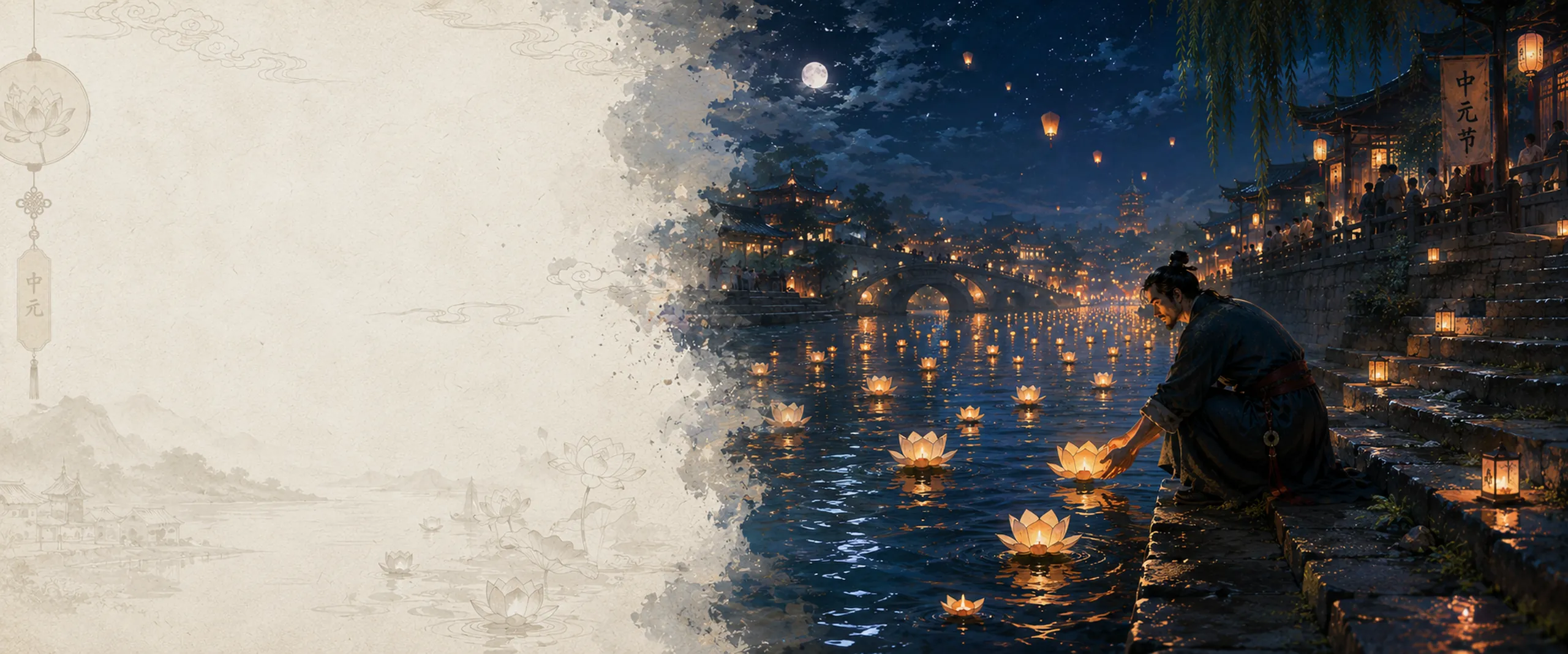
Honoring ancestors is the most important activity of the Zhongyuan Festival. People commemorate the dead through a wide range of ritual practices and express remembrance, gratitude, and mourning. Among the most recognizable customs is releasing river lanterns (放河灯): small lights are set afloat on rivers, lakes, or other bodies of water to illuminate the path home for wandering spirits.
The festival’s deeper roots can be traced to the ancient Chinese practice of “autumn tasting” (秋尝, qiūcháng). During the harvest season, people first offered newly ripened crops and seasonal delicacies to their ancestors, then partook of the harvest themselves while praying for abundance in the coming year. By the Song dynasty, the fifteenth day of the seventh lunar month had developed into a festival in which three major traditions overlapped: Daoists worshipped the Earth Official (地官) and prayed for the judgment and remission of human sins; ordinary households honored ancestors and wandering spirits; and Buddhists held the Ullambana Assembly (盂兰盆会).
Together with the Qingming Festival (清明节) and the Cold Clothes Festival (寒衣节), Zhongyuan is often regarded as one of China’s three major festivals devoted specifically to mourning and remembrance of the dead.
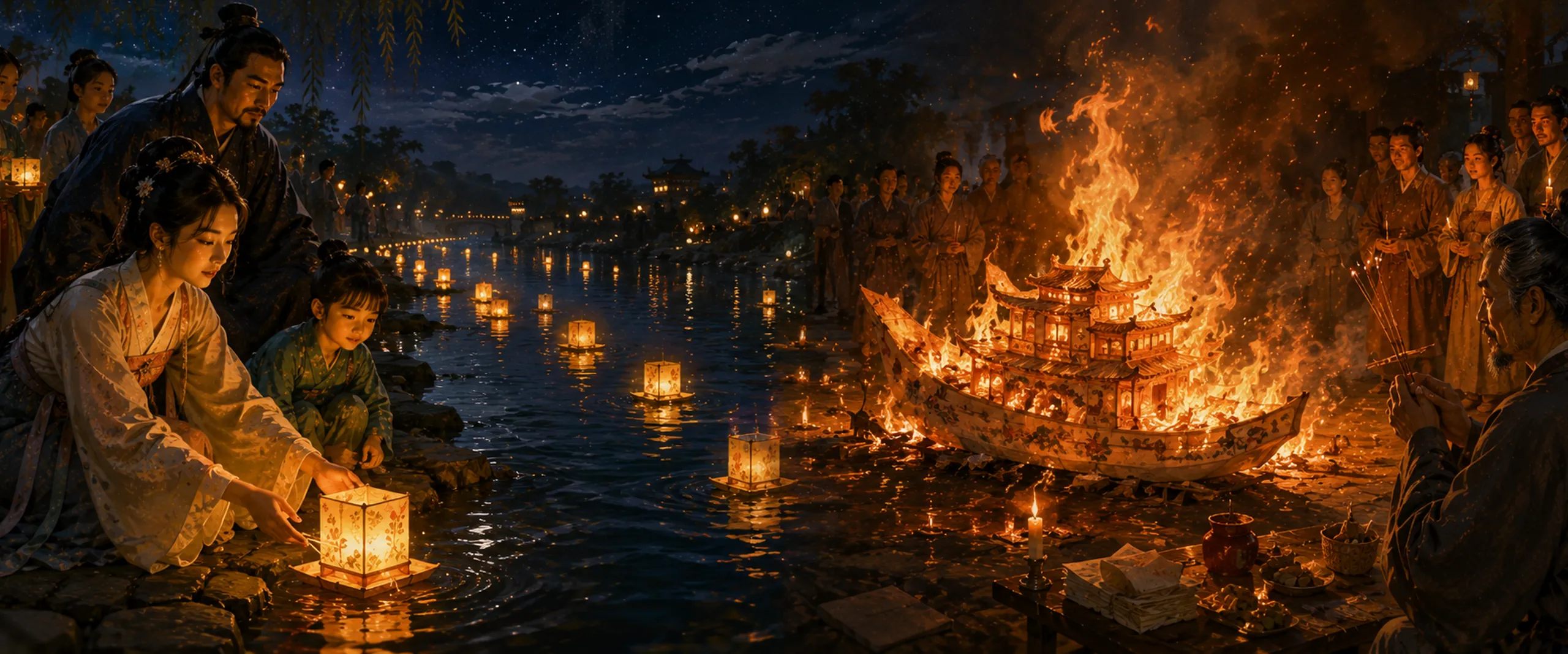
Main Customs
Preparations Before the Festival and Welcoming the Ancestors
The ritual life of Zhongyuan is not confined to the fifteenth day of the seventh lunar month. In many regions, observances begin near the start of the month and unfold over roughly half a month, forming an extended cycle of preparation, welcome, offering, and farewell.
The First Day of the Seventh Month: “Opening the Ghost Gate”
In Fujian, Guangdong, and neighboring regions, popular belief holds that the first day of the seventh lunar month is when “the gates of the underworld open” (开地狱门). According to folk tradition, the underworld releases wandering and unclaimed spirits into the human realm so that they may receive offerings, and the gates remain open until the thirtieth day, when they are closed again. For this reason, the entire seventh lunar month is often called “Ghost Month” (鬼月).
In southern Fujian, the ritual cycle of Zhongyuan begins from the first day of the month. Households gradually prepare offerings and make arrangements to welcome both ancestral spirits and wandering souls.
Welcoming the Ancestors Home
A widespread belief holds that ancestral spirits return during Zhongyuan to visit their descendants, making a ritual of “welcoming the ancestors” (接祖) necessary. This usually takes place between the tenth and fourteenth days of the seventh lunar month. Through ritual invitations, ancestral spirits are welcomed home at night, and tea and meals may be offered three times a day—morning, noon, and evening—until the time comes to send them back.
The precise method varies by region. Some households set up incense tables at home, arrange offerings, burn incense, and formally invite the ancestors to return. Where portraits or spirit tablets exist, the ancestral tablets are brought out one by one and respectfully placed on a dedicated altar, with incense inserted before each. Elsewhere, family members go directly to ancestral graves, burn incense and paper, and invite the spirits to return with them.
After the ancestors are welcomed, households may offer tea and food three times daily as though the deceased were still living members of the family. This practice reflects the traditional ethical ideal of “serving the dead as one serves the living” (事死如事生).
Zhongyuan and the Tradition of Autumn Tasting
The emergence of the “Seventh-Month Half” (七月半) can be traced to ancient ancestor worship and harvest rituals. The seventh lunar month was once regarded as an “early autumn”, when certain crops were already ripening. Families therefore offered newly harvested rice and other seasonal foods to ancestors and reported the autumn harvest to them.
In ancient ritual language, this practice was known as “autumn tasting” (秋尝) or “offering the new harvest” (荐新). In a traditional ritual society that emphasized filial piety and “serving the dead as one serves the living,” autumn tasting meant inviting one’s ancestors to share in the fruits of the harvest before the living themselves enjoyed them.
Autumn is the season of harvest, and the seventh lunar month came to be viewed as an auspicious month associated with filial devotion. The fifteenth day became a folk occasion for celebrating the early autumn harvest and thanking the earth. Newly ripened crops were first offered to gods and ancestors, then consumed by the family, while prayers were made for abundance in the coming year.
Zhongyuan ancestral rites are therefore deeply rooted in indigenous Chinese culture. Over time, however, the festival became more complex, combining the folk autumn ancestral sacrifice, the Daoist Zhongyuan Festival, and the Buddhist Ullambana Festival into a single layered cultural observance.
Honoring the Ancestors
Ancestor worship is the central and most important custom of Zhongyuan.
Meaning of Ancestral Worship
Zhongyuan, together with Lunar New Year’s Eve, Qingming, and the Double Ninth Festival, is often counted among China’s four major traditional occasions for ancestral worship. Zhongyuan ancestor rites embody the ethic of 慎终追远—“treat death with solemn care and remember those who came before”—as well as the idea of remaining conscious of one’s roots.
The practice expresses gratitude toward ancestors and reflects the traditional ethic of honoring the dead as though they were still alive. Ancestral worship is therefore simultaneously remembrance, gratitude, recognition of family lineage, and transmission of family identity.
Within a social world that emphasized filial piety, autumn tasting and offering the new harvest meant allowing ancestors to partake symbolically in the household’s harvest. Because every person belongs to a chain of parents and forebears, the emotions and responsibilities attached to ancestry have helped ensure that Zhongyuan continues to be transmitted across generations.
The Ancestral Ritual
Ancestral ceremonies generally take place before or around the fifteenth day and are not necessarily limited to a single fixed date. Around dusk, families prepare paper clothing and spirit money, incense, candles, firecrackers, sacrificial animals, wine, tea, cooked food, rice, and other offerings. In an open area before the house, facing the direction of ancestral graves, they light incense and candles, burn paper offerings, set off firecrackers, bow, and pay respect.
Where ancestral portraits or tablets are preserved, the tablets may be brought out individually and respectfully placed on a dedicated altar. Incense is inserted before each tablet, and tea and meals may be presented three times a day—morning, noon, and evening—until the spirits are formally sent back, in some regions on the thirtieth day of the seventh month.
Burning Spirit Parcels and Sending the Ancestors Back
The final stage of ancestral worship is “sending the ancestors” (送祖). At the time of farewell, bundles of spirit money and paper clothing are burned. These bundles are often called “baoyi” (包衣) or spirit parcels. They are made by wrapping paper money into packages marked with the names of deceased relatives, symbolically sending wealth and clothing to the ancestors in the other world.
In the past, male family members might personally stamp and manufacture the household’s paper money before burning it and kneeling to the ancestors. Some communities distinguished between “newly deceased” (新亡人) and “long-deceased” (老亡人) relatives: those who had died within three years were honored earlier, while those dead for more than three years were commemorated on the fifteenth.
When the ancestors were sent back, paper money, clothing, and ritual parcels were burned, sometimes accompanied by Buddhist or Daoist rites. Elderly family members might also speak farewell words aloud, expressing gratitude, affection, and reluctance to part.
Regional Variations in Ancestral Worship
Zhongyuan ancestral rites take many forms across China. In northern regions, women often make dough sculptures before the festival: flour sheep (面羊) for younger family members symbolize gratitude, flour people (面人) for elders express wishes for longevity, and flour fish (面鱼) for peers represent hopes for abundance.
Old Beijing residents sometimes called Zhongyuan the “Festival of Filial Devotion” (孝亲节). Families burned incense, arranged offerings, and steamed sheep-shaped bread from newly harvested wheat. The sheep symbolized the saying “the lamb kneels to drink its mother’s milk,” a metaphor for filial gratitude.
In places such as Nanjing, families make eggplant cakes, once believed to be provisions for ancestors but now also eaten as an everyday dish. In parts of Jiangxi, pregnant women traditionally avoided folding spirit paper because of a belief that ghosts would be unable to carry paper money folded by pregnant hands.
Historically, Zhongyuan was not only a solemn religious festival. It was also a highly participatory community occasion with strong elements of public entertainment, including performances held in gratitude to the gods.
Releasing River Lanterns
Releasing river lanterns (放河灯) is one of the most visually striking and emotionally powerful customs of Zhongyuan and perhaps the festival’s best-known public ritual.
Origins of the River-Lantern Tradition
The tradition has a long history. Song-period Daoist prescriptions stated that Zhongyuan should include releasing river lanterns, aiding wandering spirits, performing fang yankou, and staging Mulian plays. As Daoism and Buddhism spread, river lanterns became popular across different regions of China.
By the Ming and Qing dynasties, people commonly combined grave worship and the burning of spirit paper with river-lantern ceremonies on the fifteenth day of the seventh month.
Song-period religious and festival culture also helped formalize lantern practices more generally. Zhongyuan came to be associated in many local traditions with river lanterns, salvation rites for unclaimed spirits, fang yankou ceremonies, and performances of the Mulian story, and poets left descriptions of lantern spectacles on Hangzhou’s West Lake.
In Zigong, Ullambana ceremonies and river-lantern releases traditionally begin two days before the fifteenth. Vegetarian offerings are prepared for the Buddha, prayers and prostrations are performed, and bodhisattvas are asked to save ancestors and deliver the dead from suffering.
Some traditions also trace the releasing of lamps on water to Indian Buddhist practices associated with the era of Śākyamuni Buddha.
Making River Lanterns
River lanterns are also called “lotus lamps” (荷灯 / 荷花灯). A small oil lamp or candle is placed on a floating base, and on Zhongyuan night the lantern is released into rivers, lakes, or the sea and allowed to drift with the current. The practice is sometimes described as having developed from the lantern-lighting traditions of the Lantern Festival (上元节 / 元宵节).
Craft traditions vary widely. In Ziyuan County, Guangxi, early river lanterns were mainly of three types: “river-god lamps” (敬神灯), lotus lamps, and zongzi lamps (粽子灯).
The river-god lamp was made from a four-post frame covered with translucent paper and auspicious inscriptions. It was offered to the river deity to request safe passage and protection from capsizing. The lotus lamp used colored paper cut into lotus petals and pasted around a bowl-shaped frame, evoking the Buddhist symbolism of purity and serving to deliver spirits from suffering. The zongzi lamp was made by wrapping fragments of pine resin into a zongzi-like shape and placing them on a wooden board. Symbolically, it supplied provisions for wandering spirits unable to return home, allowing them to continue their journey toward their native place.
After 1949, lantern forms became increasingly diverse, including dragon-and-phoenix lanterns, revolving lanterns, arhat lanterns, octagonal lanterns, and palace lanterns. Lotus lanterns have also been made from silk, gauze, colored paper, and glass.
The broader tradition of decorative lanterns has existed in China for more than two thousand years. During the Qianlong reign of the Qing dynasty, the emperor, imperial consorts, and palace women are recorded as viewing silk lotus lanterns around the maze in the Western Mansions of the Yuanmingyuan on the night of the fifteenth day of the seventh lunar month.
Meaning of River Lanterns
The purpose of releasing river lanterns is both universal salvation and prayer. The lantern serves as a guiding light, illuminating the road for spirits wandering far from home and directing them toward their destination.
Initially, river lanterns were particularly associated with saving spirits who had drowned and other unclaimed dead. Over time, the practice expanded into a broader expression of remembrance for deceased relatives and blessing for the living.
The Old Capital Autumn Verses (《旧京秋词》) contains a description of children, candlelight, and lotus lanterns illuminating Zhongyuan night. On the fifteenth, lanterns drift across dark water while candlelight shines along streets and riverbanks. The warm points of light carry the prayers and hopes of the living into the depths of the night, symbolically toward the unseen realm where the ancestors dwell.
The Ziyuan River Lantern Festival: National Intangible Cultural Heritage
The Ziyuan River Lantern Festival (资源河灯节) in Guangxi is a long-standing folk tradition and was included in the national intangible cultural heritage list in 2014. The custom emerged from the history of navigation on the Zi River (资江) and developed partly as a memorial for boatmen, sailors, and log rafters who died on the river.
It is therefore both a ritual inherited by river workers and sailors and part of the everyday cultural life of communities along the river, giving it strong regional identity and historical value.
Before the Xiang–Gui railway opened, the Zi River was a major transport artery linking northern Guangxi with Hunan. Every year during the seventh-month Zhongyuan period, communities spontaneously conducted ritual services for those who had died in the river and then released several river lanterns. The practice honored the dead while also seeking protection from evil and misfortune for the living.
In 1852, Hunan merchants built a large Hunan Guild Hall at Hepu Street, about two kilometers from the county seat. Thereafter, the guild allocated funds each year from communal property and private donations to invite prominent Daoist masters and Buddhist monks during the seventh-month period. Altars were erected, scriptures chanted, and large Water-and-Land Dharma Assemblies (水陆道场)—also called Ullambana Assemblies—were held to deliver the spirits of those who had died on land and water.
On Zhongyuan night, the guild hall organized the public release of river lanterns. Over time, this evolved into today’s River Lantern Festival.
Modern Ziyuan river-lantern customs encompass ancestor worship, lantern making, lantern release, and wish making. The tradition combines general Zhongyuan elements with local riverine culture, and lantern forms have expanded from the early river-god, lotus, and zongzi lamps to dragon lamps, palace lamps, and many other designs.
Burning Spirit Money and “Drawing a Circle Before Burning”
Burning spirit money (纸钱) is one of the most widespread Zhongyuan customs and perhaps the most direct folk expression of ancestral sacrifice.
Origins of Spirit Money
The tradition is very old. A traditional account states that paper itself was invented by Cai Lun during the Later Han, while the use of paper money for the dead appeared by the Wei and Jin periods. At first, such paper currency was often buried rather than burned.
Over time, burning different forms of paper money as offerings to gods and comfort for the dead became a widespread custom. Archaeological sites, including ruins of the ancient Gaochang Kingdom in the Western Regions, have yielded buried forms of funerary money.
Burning Paper at Zhongyuan
Popular belief holds that ancestors are released from the underworld for half a month beginning in early July. This gives rise to the paired customs of welcoming ancestors at the beginning of the month and sending them back around the fifteenth.
Rich and poor alike traditionally prepared wine, food, and spirit paper to commemorate deceased relatives and express remembrance.
The burning of paper money can therefore belong either to welcoming the ancestors or sending them away. When welcoming them, incense and paper are burned to invite the ancestors home. When sending them back, paper money is sealed into parcels and burned as baoyi.
On the fifteenth, families prepare abundant offerings so that ancestors and wandering ghosts may eat their fill. Before the spirits depart, additional paper may be burned as symbolic spending money, while descendants ask the ancestors to bless the household with peace and safety.
Drawing a Circle and Burning Paper
The custom still visible at some urban street corners today—drawing a circle on the ground and burning paper inside it—is a surviving echo of older Zhongyuan practice. In northern China, people often use white powder to draw the circle and write the intended recipient’s family name, ensuring that wandering spirits do not steal the offering.
Other Incense-Burning Customs
In the past, households also burned incense outside their doors at night during Zhongyuan. The incense sticks were inserted densely into the earth, the greater the number the better, symbolizing a plentiful grain harvest. This practice was called “butian” (布田, literally “laying out the fields”).
Shops might also close for the festival. Along the center of the street, an incense table could be placed every hundred paces, bearing fresh fruit and a type of “ghost bun.” Behind the table, Daoist ritual specialists chanted songs for the spirits. This rite was known as “Shige’er” (施歌儿).
Universal Salvation of Wandering Spirits
Zhongyuan differs fundamentally from Qingming. Qingming is primarily organized around individual families honoring their own ancestors, whereas Zhongyuan extends ritual concern beyond the family to include unclaimed and wandering spirits.
Giving to Lonely Spirits and Universal Salvation
“Giving to lonely spirits” (施孤) is one of the festival’s central customs. It means offering food to ghosts who have no descendants to worship them.
According to popular tradition, wandering spirits are released from the underworld during Zhongyuan. The living therefore prepare abundant offerings, burn incense and paper, honor their own ancestors, worship the Earth Official, and provide food for spirits without descendants.
Ancestors who have children and grandchildren are believed to return to family tombs that their descendants have prepared, where they receive steamed bread, incense, wine, and meat. Those who have no descendants are instead cared for collectively by the wider community.
This custom gives Zhongyuan a form of compassion that transcends lineage and blood ties.
The Ullambana Assembly
The Ullambana Assembly (盂兰盆会) is an important Buddhist form of universal salvation during Zhongyuan. According to the Ullambana Sutra (《佛说盂兰盆经》), the Buddha’s disciple Mahāmaudgalyāyana (目连 / 摩诃目犍连) discovered that his deceased mother had fallen into the realm of hungry ghosts. He asked the Buddha how to save her, and the Buddha instructed him to make offerings of many kinds of food and fruit to the monastic community on the fifteenth day of the seventh month.
Through the merit generated by these offerings, his mother was delivered from the hungry-ghost realm. Buddhist communities therefore began holding major assemblies on Zhongyuan, placing seasonal fruit and other foods in vessels known as yu and pen (盂、盆) and offering them to monks. The monks chanted scriptures and transferred merit to the ancestors of worshippers.
Temples around China hold Ullambana Assemblies or Water-and-Land Dharma Assemblies during Zhongyuan to save and deliver the dead. In Ziyuan County, Guangxi, for example, the Hunan Guild Hall traditionally invited renowned Daoist masters and Buddhist monks to erect altars, chant scriptures, and hold large water-and-land ceremonies for spirits who had died on land and water.
Zhaigu: Offerings to Unclaimed Spirits
Zhaigu (斋孤) is another Zhongyuan custom for worshipping wandering and unclaimed spirits. It emerged from the broader seventh-month ritual tradition and from the belief that the gates of the underworld open during the month.
In earlier periods, wealthy households might sponsor scripture chanting and fang yankou ceremonies to deliver spirits. Later, the practice was simplified in many regions into burning paper for unclaimed ghosts near the end of the seventh month.
The custom transforms individual filial piety into a broader form of social charity toward the forgotten dead.
Other Folk Activities
Over the course of its long development, Zhongyuan absorbed many other customs in addition to ancestor worship, river lanterns, paper offerings, and universal salvation.
Performing Mulian Opera
Mulian Opera (目连戏) is an important ritual performance associated with Zhongyuan. Song-period religious prescriptions stated that the festival should include river lanterns, aid for wandering spirits, fang yankou, and performances of the Mulian story.
The drama is based on “Mulian Saves His Mother” (目连救母) and presents a Buddhist religious narrative in the accessible form of popular theater.
Mulian performance traditions can be traced to before the guiwei year of Emperor Huizong of the Northern Song, and one of the earliest written records appears in Meng Yuanlao’s Dongjing Meng Hua Lu under the section on Zhongyuan.
Mulian Opera was never merely entertainment. It also served a didactic function, communicating Buddhist ideas of karma, retribution, filial piety, and salvation to ordinary audiences. Its presence allowed Zhongyuan to combine solemn ritual with entertainment and moral instruction.
Procession of the City God
Qing-period local gazetteers record Zhongyuan customs involving the City God (城隍) leaving his temple in procession.
A traditional source describes the fifteenth day as Zhongyuan, popularly called a day for the dead, when ancestors are worshipped, temples hold Ullambana Assemblies, and unclaimed ghosts receive relief. Local officials also welcomed the City God out of the city gate to perform sacrifices for violent or untended spirits (厉).
As guardian of the city, the City God’s procession reflected an official concern with local social order and the proper settlement of the dead.
Making Ritual Boats
Constructing ritual paper boats (法船) is another component of Zhongyuan worship in some regions. People make paper boats, load them with offerings, light them, and release them onto the water, symbolically transporting offerings and blessings into the spirit world.
Dough Sculpture
In the north, women often make flour sculptures before Zhongyuan. Flour sheep for children express gratitude, flour people for elders symbolize longevity, and flour fish for peers represent wishes for a plentiful year.
These objects function both as ancestral offerings and as expressions of emotion among living family members. The flour sheep evokes the image of “a lamb kneeling to suckle”, a classical symbol of gratitude toward parents; the human figure conveys wishes for long life; and the fish echoes the auspicious idea of “surplus year after year” (年年有余).
Eating Eggplant Cakes
In Nanjing and neighboring areas, Zhongyuan includes the custom of making eggplant cakes. In the past, these were imagined as provisions for returning ancestors; today they have also become an ordinary household dish.
Slices of eggplant are stuffed with minced meat, coated in batter, and fried until crisp outside and tender within. Traditionally, families believed that ancestors returning home during Zhongyuan would taste the cakes and experience the filial devotion of their descendants.
Burning “Nine Reflections Incense”
In the Hangzhou–Jiaxing–Huzhou region, there is a custom of burning “Nine Reflections Incense” (九思香). From the seventh to the fifteenth day of the seventh month, one stick of incense is burned each night for nine consecutive nights to deliver the dead.
The term “Nine Reflections” (九思) comes from the Confucian teaching that “the gentleman has nine considerations”: in seeing, think of clarity; in hearing, think of acuity; in expression, think of warmth; in demeanor, think of respect; in speech, think of loyalty; in affairs, think of reverence; in doubt, think of asking; in anger, think of consequences; and in gain, think of righteousness.
Burning Nine Reflections Incense is therefore both a religious rite and a symbol of moral self-cultivation.
Regional Variations
North China
Beijing:In old Beijing, Zhongyuan observances were exceptionally elaborate, giving rise to the saying “Zhongyuan grave worship surpasses even Qingming” (中元祭扫,尤胜清明). Daoist temples conducted fasting and ritual ceremonies and burned ritual boats; Buddhist monasteries held Ullambana Assemblies and fang yankou (放焰口, rituals for feeding hungry ghosts). People also constructed brightly decorated paper ritual boats and burned them to aid wandering spirits. Children from ordinary households made lotus-leaf lanterns, mugwort lanterns, eggplant lanterns, watermelon lanterns, and other playful lights for lantern contests. From the thirteenth to the seventeenth day of the seventh lunar month, spontaneous lantern competitions took place, with the fifteenth as the climax.
Hebei:In Botou and Nanpi, people visit ancestral graves on the fifteenth day of the seventh lunar month carrying fruit, dried meat, wine, and spirit money. They may also take hemp or grain stalks to the field ridges in a ritual known as “offering the new harvest” (荐新). In Guangping, newly harvested foods are offered to ancestors, while fruit, vegetables, and steamed sheep-shaped bread are prepared for grandchildren in a custom called “sending the sheep” (送羊). In Qinghe, families sweep ancestral graves and give steamed flour sheep to married daughters.
Shanxi:In Datong, urban residents traditionally preferred ancestral worship after the Beginning of Autumn (立秋), based on a belief that worshipping too early might bring foolishness to children. Rural areas often followed the rule of “three before, four after” (前三后四)—that is, worshipping within the three days before or four days after the fifteenth. Urban offerings commonly include spirit money, fruit, incense, and flowers, while rural households may make elaborate dough sculptures, with neighboring families helping one another steam decorative buns. In Zhangzi County, sheep-raising families slaughter sheep as offerings to the gods and believe the rite will increase the fertility of their flocks, later sharing meat with relatives. In Yangcheng, farmers shape wheat bran into cats, tigers, and the forms of the five grains and offer them to the field gods in a rite called “going through the fields” (行田). In Xin County, farmers hang five-colored paper along field ridges to worship field deities. In Yonghe, scholars traditionally worship the Kui Star (魁星). In Mayi, flour figures shaped like children are exchanged as gifts. At Hongdong’s Great Pagoda Tree, a large Zhongyuan ancestral ceremony brings together descendants of historical migrants from China and overseas.
Inner Mongolia:Customs resemble those of other northern regions and focus mainly on ancestral worship and burning spirit paper.
Northeast China
Liaoning:During the Liao and Jin periods, Khitan and Jurchen communities already placed importance on Zhongyuan rituals. From the early Qing through the Republican era, the Ullambana Assembly at Goubangzi became a famous temple fair beyond the Great Wall, devoted to honoring ancestors and delivering spirits from suffering. Jinzhou’s Tianhou Temple also held Ullambana ceremonies. In Tieling, water was placed in a courtyard on the night before the festival, and at noon needles were floated on the surface to observe their shadows in a custom called “liaohua needle divination” (撩花针). Rural communities steamed buns for grave offerings, added earth to family graves, and released river lanterns at night. Today, cities such as Shenyang also hold public memorial ceremonies around Zhongyuan.
Jilin:Releasing river lanterns on the Songhua River is an important tradition. According to the Yongji County Gazetteer (《永吉县志》), officials stationed at the shipyard once erected high ritual platforms during Zhongyuan and residents released lanterns onto the river to mourn the dead and deliver departed souls. The river-lantern tradition has been included in China’s national intangible cultural heritage system.
Heilongjiang:The main customs are ancestral worship and river lanterns. Some places, including Daqing, also organize Zhongyuan blessing ceremonies.
East China
Shanghai:Qibao Ancient Town holds a Zhongyuan “Lanpen Grand Assembly” (兰盆盛会). Releasing river lanterns on the Suzhou River is another distinctive feature.
Jiangsu:In Wu County, residents fold tin foil into ingot shapes and burn them along roadsides, calling the practice “forming affinities with ghosts” (结鬼缘). In Yizheng, people traditionally made paper ghost figures containing bowl-shaped lamps, including figures such as gambling ghosts and drunken ghosts. In Yixing, four boats were traditionally released onto the river during Zhongyuan. In Nanjing, large-scale river-lantern activities take place around the Qinhuai River and other waterways.
Zhejiang:In Jiashan, rain on Zhongyuan is considered a sign of a good rice harvest. In Tonglu, people strike gongs and scatter rice outdoors at night in a rite called “food offering” (施食). In eastern Zhejiang, Ullambana Assemblies may invite twenty-four elderly women to perform “walking the eight knots” (走八结) while chanting scriptures. In Tiantai, people eat jiaobing (饺饼), a food similar to spring rolls, and also maintain a road-lantern custom: groups of six scatter salt and rice along the route, light incense and candles, and arrange tofu and rice balls as offerings. Shaoxing holds river-lantern activities.
Anhui:Zhongyuan is regarded as a festival for remembering ancestors, expressing filial devotion, and reflecting on family lineage. The main customs are ancestral worship and burning spirit paper.
Fujian:In Fuzhou, Zhongyuan is called the “Festival of Burning Paper Clothes” (烧纸衣节) in local speech. Married daughters prepare ceremonial garments and accessories for their parents and send them home in special boxes. In Yongfu, married women are expected to return to their natal homes to honor ancestors. In southern Fujian, universal salvation rites are divided into “public pudu” (公普), organized by temples or villages, and “private pudu” (私普), organized by families or institutions. Tall bamboo poles bearing lamps are raised before temples to summon wandering spirits, and ritual altars are constructed. Communities near rivers, lakes, and the sea may also conduct “water pudu” (水普) by releasing river lanterns. In central Fujian, pudu rituals were traditionally held in both towns and villages, with expenses collected household by household. A local saying warns: “If you do not contribute to pudu, illness is before your eyes” (普度不出钱,瘟病在眼前). In Gutian, families prepare livestock, wine, and other offerings for ancestors and burn spirit money and paper clothing. In Longyan, associations once prepared five-colored paper garments called “clothes for the lonely spirits” (孤衣) and burned them for the unclaimed dead.
Jiangxi:In Ji’an, people burn paper ingots, but pregnant women traditionally avoid folding them because of a folk belief that ghosts cannot carry ingots folded by pregnant women. During fang yankou ceremonies, ritual masters throw buns and fruit to the crowd; women who seize a bun are said to bear a child the following year, while children who obtain one are believed to avoid fright throughout life. In Anyuan, incense and tea are offered morning and evening beginning on the twelfth day of the seventh month, while paper clothing and spirit money are burned on the fifteenth night to send off the dead.
Shandong:In Changdao, fishermen make small boats from wooden boards and sorghum stalks, attach slips reading “for the use of so-and-so” or tablets for those who drowned at sea, load the boats with food and clothing, light candles, and have married men release them into the sea. In Zhanhua, hemp stalks and fresh grass are used to build a “hemp hut” (麻屋), inside which ancestral tablets are placed for worship. In Duling, Zhongyuan is called the “Pinching-Mouth Festival” (掐嘴节), and households eat simple meals.
Central China
Henan:In Shangqiu, paper flags are hung at household entrances while worshipping the Earth Official, said to protect against insects. In Mengjin, people fly kites during Zhongyuan. In Lai County, ash circles are drawn in front of the house and spirit paper is burned inside them for ancestors. In Guangshan, Zhongyuan is called “Guo Yueban” (过月半, “celebrating the half-month”) and centers on worshipping deities, burning paper for the dead, and releasing river lanterns to guide spirits toward rebirth.
Hubei:In Wuhan, rich and poor alike traditionally purchased spirit paper and gold foil, folded them into paper ingots, and packed them into thick paper envelopes marked with the deceased’s birth date and family name. These parcels are called “baofu” (包袱). They are burned within lime circles drawn in front of houses, behind buildings, or in quiet lanes, to prevent wandering ghosts from stealing them. River lanterns were once especially popular on Zhongyuan night; today the practice has increasingly become a memorial for relatives and a prayer for blessings. In Macheng, livestock is slaughtered around the fifteenth, and married paternal aunts are invited home for family reunion and ancestor worship. Among Tujia communities in Enshi, Yidu, and elsewhere, there is a saying that “New Year is small, Yueban is great” (年小月半大), reflecting the festival’s importance; married women return home for reunion and ancestral rites. In parts of western Hubei, the festival is observed on the twelfth day of the seventh month. In some areas of Xiaogan, the term “Zhongyuan Festival” may unusually refer to the Lantern Festival on the fifteenth day of the first lunar month.
Hunan:In Shaoyang, families “receive the old guests” (接老客) around the twelfth day of the seventh month, then burn paper packets, incense, and offerings on the fifteenth night to “send the old guests away” (送老客). In Ningyuan, households purchase paper candles, gold and silver ingots, paper boxes, and spirit parcels to burn for the dead.
South China
Guangdong:In Cantonese-speaking regions such as Guangzhou, Foshan, and Dongguan, Zhongyuan is often observed on the fourteenth day of the seventh lunar month, with ancestral worship, grave visitation, and offerings to wandering spirits as the main customs. Families purchase gold and silver paper, paper clothing, and ingots, seal them in paper packets called “baofu”, and burn them after worship. In Chaoshan, Zhongyuan is regarded as second in importance only to the Spring Festival and Qingming. The central rituals are pudu and offerings to wandering spirits. Villages set up pudu altars with sacrificial animals, ritual lamps, and other offerings; ritual specialists chant scriptures and scatter offerings in fang yankou, after which crowds compete for them in a practice called “qianggu” (抢孤, “scrambling for ghost offerings”). Water lanterns are released along rivers. Chaoyang preserves special rites associated with the memory of Ming-period uprisings; some villages maintain shamanic customs known as “dragging the dead ghost” (拖死鬼). Other activities include ancestor worship, theatrical performances, lantern processions, and prayers for harvest. In Huizhou, the fourteenth day is marked by a “Yulan jiao ritual” (打盂兰醮), involving temporary stages, performances of ghost dramas, and the burning of paper clothes and spirit money. In Qujiang, Yao communities worship ancestors and the Dog-Head King, while boys and girls dress in bright clothes, sing, and dance to thank the gods. Guishan also observes Zhongyuan on the fourteenth. In Hengdong Yao Village in western Guangdong, people stop drying clothes outdoors after noon on the fourteenth, leaving the space symbolically for ancestors from the underworld.
Guangxi:Zhongyuan is also called the “Duck Festival” (鸭子节) because of a belief that spirits can stand on ducks and travel between the realms of yin and yang. Worship is divided into family rites (家祭) for ancestors or newly deceased relatives and wild rites (野祭) for wandering ghosts. Festival foods include duck, chicken, glutinous-rice cakes, red eggs, rice-flour foods, and banana-leaf cakes. Married daughters returning to their natal homes is a major custom; they bring their children, ducks, and other foods to visit parents and siblings. If the parents have died, returning home for ancestor worship is regarded as especially important. For this reason, Zhongyuan is also called the “Reunion Festival” or “Sisters’ Festival” in some communities. Guilin holds large-scale river-lantern events.
Hainan:In Qionghai, residents of Xitou Village in Jiaji release river lanterns onto the Wanquan River, while residents may also release sky lanterns near Wanquan River Square.
Hong Kong and Macao:In Hong Kong, Zhongyuan is usually called the Hungry Ghost Festival or Yulan Festival (盂兰节). On the fourteenth day, households honor ancestors and burn roadside spirit clothing (烧街衣). Districts across Hong Kong organize Yulan Grand Assemblies (盂兰胜会) or Zhongyuan ritual festivals during the seventh lunar month. On Peng Chau, the Zhongyuan jiao lasts four consecutive days from the twelfth through the fifteenth, with the fifteenth as the climax. Rituals include zou wuchao (走午朝), dragon-boat processions, releasing water-and-land lanterns, arranging celestial banquets, scrambling for offerings, and burning the King of Ghosts (大士王) effigy. The Hong Kong Chiu Chow Yulan Festival (香港潮人盂兰胜会) lasts about a month and includes burning roadside offerings, Chiu Chow opera performed for the gods, burning the King of Ghosts, distributing peace rice, and charity auctions. It was included in China’s third batch of national intangible cultural heritage in 2011. Macao follows customs similar to those of Cantonese-speaking Guangdong, especially ancestor worship and burning roadside spirit offerings.
Southwest China
Sichuan:In Chengdu, customs include household ancestor rites, burning spirit parcels, giving offerings to wandering ghosts, processions of the City God, and releasing river lanterns. Spirit parcels are burned according to seniority within the family. After ancestral worship, households prepare “water rice” (水饭) for unclaimed spirits, and releasing river lanterns forms the final climax. In western Sichuan, people also burn spirit parcels for ancestral spirits and for the “landholder spirits” of the locality and prepare water rice for wandering ghosts. In Lezhi, Suining, and neighboring areas, the “road candle” (路烛) custom is practiced during Zhongyuan.
Chongqing:In places such as Wushan, the road-candle custom is observed. Fengdu also hosts distinctive Zhongyuan activities.
Guizhou:Customs center on ancestor worship and burning spirit paper, with minority traditions in some areas.
Yunnan:Customs center mainly on ancestral worship and burning spirit paper.
Tibet:Customs center mainly on traditional ancestor remembrance.
Northwest China
Shaanxi:In Lintong, paper is burned to worship Magu (麻姑) on the fifteenth. In Chenggu, farming households drink together during Zhongyuan in a custom called “hanging up the hoe” (挂锄), marking a pause in agricultural labor. In Yanhuan Town, farmers select the tallest and fullest rice stalks in the fields on Zhongyuan morning and attach five-colored paper banners called “field banners” (田旛). In Yan’an, Zhongyuan is also called the “Magu Festival” (麻谷节). Before the festival, households grind wheat and rice, slaughter sheep, and divide the meat; men and children gather melons and fruit to offer at ancestral graves, while women shape steamed dough into figures of children, lions, chickens, rabbits, and other forms. In Fugu, grave worship follows the principle “worship before, never after” (祭前不祭后): families may visit graves early, but should do so no later than the afternoon of the fifteenth and never after the sixteenth. In Xixiang, almost every household wraps bianshi (扁食, dumplings) at noon during the seventh-month festival and uses them as the main offering for deceased relatives, together with burned spirit money. In parts of Guanzhong, Zhongyuan is observed on the fourteenth day.
Gansu:In Wuwei, people sweep graves and honor ancestors on the fifteenth, while some families burn spirit money in front of the house or at street intersections. In the past, the wooden image of the City God was carried from the temple for three days in a procession called “the City God goes out” (城隍出行), and residents attended a temple fair at his temporary residence. In Guangling County, some areas observe related rituals on the seventh day of the seventh month.
Ningxia:Customs focus mainly on ancestral worship and grave sweeping.
Qinghai:Customs focus mainly on ancestral worship and burning spirit paper.
Xinjiang:Customs focus mainly on traditional ancestor remembrance.
Taiwan:Zhongyuan customs share deep roots with those of southern Fujian. Pudu is divided into public pudu (公普) and private pudu (私普). A pudu banner (普渡旗) is erected on the offering table, and a stick of incense is inserted into each offering. Soap, towels, and clean water are placed beneath the table so that the spirits—often euphemistically called “good brothers” (好兄弟)—can wash and refresh themselves. Large pudu ceremonies are held throughout Taiwan.
North China: Ancestor Worship at the Center
Northern Zhongyuan places particular emphasis on honoring ancestors. Old Beijing residents sometimes called it the “Festival of Filial Devotion.” Families burned incense, arranged offerings, and steamed sheep-shaped bread from newly harvested wheat to honor ancestors, drawing on the image of “the lamb kneeling to drink its mother’s milk” as a symbol of gratitude.
In Hebei, Shandong, and other areas, people also made river lanterns in many shapes—lotuses, watermelons, ducks, and others—and released them after nightfall in what was interpreted as “the compassionate vessel of universal salvation.”
Northerners traditionally treated the burning of spirit money with great care. A circle was drawn in white powder, and the intended recipient’s surname was written inside so that wandering ghosts could not steal the offering.
In many northern regions, ancestor worship is concentrated around the fifteenth, although some places rotate communal salvation rites across different days. Rural households may light small lamps around their courtyards, creating an atmosphere that is warm rather than frightening.
Dough sculpture is another prominent northern feature: flour sheep for younger relatives, flour people for elders, and flour fish for peers.
South China: Greater Emphasis on Universal Salvation
Southern customs tend to place more emphasis on pudu—the universal salvation of wandering spirits. In Fujian and Guangdong, Zhongyuan observances can be among the most elaborate in China.
Southern Fujian commonly calls the seventh lunar month “Ghost Month.” The underworld gates are believed to open on the first and close on the thirtieth, with the fifteenth as the ritual climax.
Households set up incense tables at their entrances with sacrificial meats, fruit, rice, and other foods in ceremonies called pudu. In Quanzhou, communities may practice “rotating pudu” (轮普), with different streets or neighborhoods taking turns conducting rituals in an orderly sequence.
In the water towns of Jiangnan, releasing water lanterns is especially popular. Suzhou residents have made lamps from melon rind, while Nanjing communities traditionally constructed colorful paper boats, lit them, and placed them on the water in a custom known as “illuminating the dark realm” (照冥).
The Hangzhou–Jiaxing–Huzhou region also preserves the custom of Nine Reflections Incense, burned nightly from the seventh to the fifteenth.
In Hunan, Jiangxi, and some other areas, Zhongyuan may even be regarded as more important than Qingming or the Double Ninth Festival. In parts of South China, paper clothing may be burned throughout the first half of the month, but traditionally not later than the fourteenth.
Some southern communities hang lanterns at entrances or release lotus lamps onto rivers, explaining that the lights guide ancestral spirits while also bringing smoothness and peace to the household.
The Convergence of Three Traditions: Zhongyuan’s Cultural Foundation
Zhongyuan is one of the clearest examples in the Chinese festival system of the convergence of the “Three Teachings” (三教合流)—Daoism, Buddhism, and Confucian ritual culture.
Religious integration is one of the festival’s defining characteristics.
#### Daoism: “Zhongyuan”
The name “Zhongyuan” (中元) arose within Daoist tradition and is generally traced to the Northern Wei period.
Daoist texts divide the year into the Three Yuan:
- the fifteenth day of the first lunar month is Shangyuan (上元), the day on which the Heaven Official bestows blessings;
- the fifteenth day of the seventh month is Zhongyuan (中元), when the Earth Official grants remission of sins;
- the fifteenth day of the tenth month is Xiayuan (下元), when the Water Official relieves misfortune.
The Record of Cultivation (《修行记》) states:
“七月中元日,地官降下,定人间善恶,道士于是夜诵经,饿节囚徒亦得解脱。” On the Zhongyuan day of the seventh month, the Earth Official descends and determines good and evil among humankind. Daoist priests chant scriptures that night, and imprisoned or suffering spirits may also obtain release.
For this reason, people prepare generous offerings on the fifteenth to worship both the Earth Official Emperor (地官大帝) and their ancestors.
The Daoist term Zhongyuan became widely adopted in popular culture, while Daoist fasting and ritual ceremonies gradually moved from imperial rites of blessing toward popular rituals for averting calamity.
#### Buddhism: Ullambana
Buddhist Ullambana (盂兰盆) introduced another major layer to the festival.
According to the Ullambana Sutra, the Buddha’s disciple Mulian discovered that his mother had fallen into the hungry-ghost realm after death. He asked the Buddha how to rescue her, and the Buddha instructed him to present many kinds of food and fruit to the monastic community on the fifteenth day of the seventh month.
The merit of the offering would free his mother from suffering.
Buddhist believers therefore began holding major ritual assemblies on Zhongyuan and placing seasonal foods in bowls and basins as offerings to monks, known collectively as Ullambana offerings. Monks chanted scriptures and transferred merit to the ancestors of participating families.
Buddhism also contributed lotus symbolism and the Mulian salvation story, helping generate customs such as river lanterns and Mulian Opera. The story of Mulian saving his mother gave Zhongyuan a powerful dual theme of filial piety and compassion.
#### Confucian Tradition: Autumn Tasting
The oldest layer of Zhongyuan lies in the ancient custom of autumn tasting (秋尝). During the autumn harvest, families first offered newly ripened foods to ancestors, then ate the harvest themselves and prayed for abundance in the coming year.
These ancestral rites already existed in pre-Qin times. They first belonged primarily to the ritual systems of rulers and aristocrats but gradually spread into ordinary society.
Over time, the date became increasingly focused on the first full moon after the Beginning of Autumn—the fifteenth day of the seventh lunar month.
Confucian ideals of filial piety became deeply integrated into Zhongyuan and reinforced its ancestral tradition. The result was a cultural structure in which Daoist, Buddhist, and Confucian elements coexist and reinforce one another, making Zhongyuan one of the most inclusive and culturally layered festivals in the Chinese tradition.
Closing Note
The folk customs of the Zhongyuan Festival form a long cultural narrative about “honoring the ancestors” and “universal salvation.” From the reverent welcome extended to ancestors returning home to the gratitude expressed through autumn harvest offerings; from the points of light drifting across rivers to the rising smoke of spirit paper; from the chanting of Ullambana assemblies to the compassion embodied in offerings for wandering spirits—Zhongyuan brings together gratitude toward one’s ancestors, sympathy for the unclaimed dead, reverence for life, and a longing for harmony.
Zhongyuan is first and foremost a festival of ancestral remembrance. From the ancient autumn tasting sacrifices to later customs of welcoming, feeding, and sending the ancestors home, the ethical principle of 慎终追远—“treat death with solemn care and remember those who came before” runs continuously through the festival. Honoring ancestors is an act of gratitude: gratitude for life itself and for the protection of the family line. It is also an act of family cohesion, because shared ritual strengthens identity and connection among living members of the lineage. At the same time, it is an act of cultural transmission, through which ideals of filial piety are passed from one generation to the next.
Zhongyuan is also a festival of universal salvation. Unlike Qingming, it does not concern only one’s own ancestors. It also extends food, ritual care, and compassion to wandering spirits who have no descendants to remember them. This concern beyond lineage and blood relationship reflects both the Buddhist ideal of “great compassion without precondition and shared compassion with all beings” (无缘大慈,同体大悲) and the Daoist aspiration to save and deliver all beings (普度众生).
On Zhongyuan, the living therefore remember not only their own family dead but also those forgotten by everyone else. It is this compassion that gives the festival a broader humanistic significance.
The customs of Zhongyuan ultimately unite ancestral remembrance and universal salvation. Honoring the ancestors affirms the continuity of family bloodlines; universal salvation extends moral concern toward society as a whole. Ancestral worship expresses filial piety (孝), while universal salvation extends that ethic toward humaneness and compassion (仁).
The river lantern drifting with the current is perhaps the most powerful symbol of this union. It is at once a light guiding one’s ancestors home and a compassionate lamp illuminating the road for lonely spirits. This cultural movement—from family outward to society, from those closest to us toward those with whom we have no kinship—is one of the deepest reasons Zhongyuan has remained culturally meaningful across centuries.
Beginning in 2010, different Zhongyuan-related traditions were successively included in China’s national intangible cultural heritage system. From the ancient autumn harvest sacrifices to contemporary heritage protection, from the convergence of the Three Teachings to the enduring ethic of remembering one’s roots, Zhongyuan has crossed thousands of years while retaining both cultural depth and profound human warmth.
Its customs are at once a concentrated expression of the Chinese tradition of 慎终追远—remembering and honoring those who came before—and a lived expression of compassion toward others. Between honoring ancestors and offering universal salvation, Zhongyuan continues to sustain a profound cultural dialogue about life, filial piety, remembrance, compassion, and the bonds between the living and the dead.
—-
Readers’ Comments
Calendar and traditional culture enthusiasts from around the world, sharing the same moon.
Sign in or register to join the conversation. Your comment account is created automatically the first time you use a connected account.
No comments yet
Share your thoughts with readers around the world.