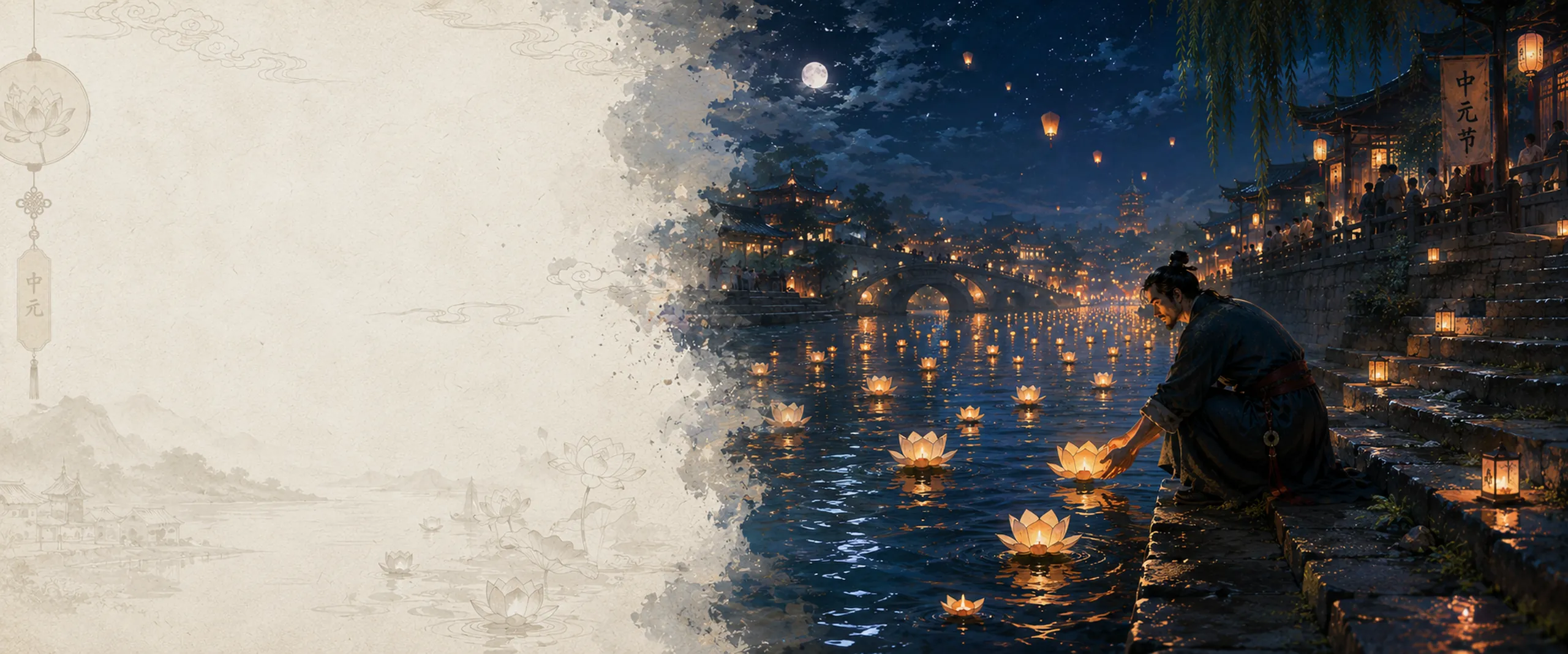
The formation of the Ghost Festival did not originate from a single tradition but from the gradual fusion of three cultural threads over a long historical period. These three threads are: the “Autumn Tasting” ancestor worship of the seventh month in the pre‑Qin period — this is the oldest cultural gene of the festival; the Daoist belief in the Three Officials from the late Eastern Han dynasty — which provided the festival with the name “Zhongyuan”; and the translation of the Buddhist Yulanpen Sutra in the Western Jin dynasty — which infused the festival with the story of “Mulian saving his mother.” They converged from different directions and merged in the long river of history, ultimately forming the Ghost Festival as we know it today.
Autumn Tasting Ancestor Worship
The oldest origin of the Ghost Festival can be traced back to the “Autumn Tasting” ancestor worship of the seventh month in the pre‑Qin period. This is the deepest and most essential cultural root of the festival.
Long before the birth of state civilisation, the Chinese ancestors chose an agrarian path of economic production and were particularly sensitive to the changes of the four seasons. By the Xia, Shang, and Zhou dynasties, the ritual tradition of “four‑season ancestor worship” had already been established — ancestors were worshipped in every season: spring, summer, autumn, and winter. The Book of Rites · Royal Regulations records: “The sacrifices in the ancestral temples of the Son of Heaven and the feudal lords were called Ci in spring, Di in summer, Chang in autumn, and Zheng in winter.” This means that the Son of Heaven and the feudal lords sacrificed to their ancestors in every season, with different names for different seasons. “Autumn was called Chang” — the autumn sacrifice was called “Chang” (Tasting). Dong Zhongshu of the Han dynasty further explained in his Luxuriant Dew of the Spring and Autumn Annals · Four Sacrifices: “Chang meant tasting millet and other grains in the seventh month.” The Luxuriant Dew of the Spring and Autumn Annals · Four Sacrifices also states: “In ancient times, there were four seasonal sacrifices… spring was called Ci, summer was called Yue, autumn was called Chang, winter was called Zheng… Chang meant tasting millet and other grains in the seventh month.” The ancients offered sacrifices to their ancestors in all four seasons, and in the seventh month they presented newly harvested melons, fruits, vegetables, and grains such as millet — this was called “Autumn Tasting” (秋尝), also known as “Offering the New” (荐新) or “Tasting the New” (尝新) — meaning letting the ancestors taste the new harvest in autumn.
In the first month of autumn, crops ripened one after another. The ancients often presented the newly harvested millet, grains, vegetables, and fruits to their ancestors at this time — this was “Autumn Tasting,” also known as “Offering the New” or “Tasting the New.” The Book of Rites · Monthly Ordinances records: “In this month, the farmers bring in the grain; the Son of Heaven tastes the new and first offers it in the sleeping temple.” This means that in the first month of autumn, farmers harvested the ripened grains, and the Son of Heaven offered the newly harvested grains in the sleeping temple to sacrifice to his ancestors. The Son of Heaven also performed the “Tasting the New” ritual, offering the new grains to his ancestors. From the Son of Heaven to the feudal lords to ordinary people, all were required to first honour their ancestors after the autumn harvest before tasting the new food themselves.
The deep logic of “Autumn Tasting” is that “all things have their origin in heaven, and humans have their origin in ancestors.” In ancient times when productivity was low, the success of agriculture was entrusted to the protection of spirits and ancestors. After the harvest, offering first to ancestors was both an expression of gratitude and a prayer for continued blessings in the coming year. As folklorist Xiao Fang has said, in the seventh lunar month, when new grains ripened, the ancients would first offer the new rice of the year to their ancestors, reporting and giving thanks to them; the 15th of the seventh month was originally an autumn festival of ancestor worship.
Initially, the date of the “Autumn Tasting” ancestor worship was not fixed. In the first month of autumn, the Son of Heaven tasted the new and offered it in the temple, but the specific day was not prescribed. Later, this ritual gradually became fixed around the 15th of the seventh month — generally the first full moon day after the Beginning of Autumn. This process of focusing was closely related to the time‑knowledge system of the lunisolar calendar. In the lunisolar calendar, the wangri (full moon day, the 15th) was the most important time node — the full moon shone brightly, making it the best time for early peoples to arrange important life rituals such as sacrifices and celebrations. The first wangri of each season was even more important than other wangri. The wangri of the seventh month thus became the best time for “Autumn Tasting” ancestor worship. As scholars have pointed out, “Autumn Tasting” ancestor worship was China’s earliest seventh‑month sacrificial ritual, and it can be said that Autumn Tasting ancestor worship was the earliest origin of the Ghost Festival. The ancestor worship and clan ethics represented by “Autumn Tasting” became the core content of Confucian “filial piety.” The “Autumn Tasting” ritual had the function of uniting the clan, honouring ancestors, and strengthening family bonds.
The Daoist Thread
If “Autumn Tasting” ancestor worship is the “root” of the Ghost Festival, then the Daoist belief in the Three Officials is the “name” of the festival — it was Daoism that named the 15th of the seventh month “Zhongyuan,” giving the festival its most important cultural marker.
The Daoist belief in the Three Officials can be traced back to the late Eastern Han dynasty. The Way of the Five Pecks of Rice, an important Daoist sect of the late Han, held that the Heavenly Official bestows blessings, the Earth Official pardons sins, and the Water Official relieves calamities. Daoism reveres the Three Officials of Heaven, Earth, and Water as great deities who govern human fortune and misfortune. According to the Daoist theory of Yin‑Yang and the Five Elements, the three full moon nights of the 15th of the first, seventh, and tenth months were designated as Shangyuan, Zhongyuan, and Xiayuan, respectively, as the birthdays of the Heavenly Official, the Earth Official, and the Water Official. From the Han dynasty onwards, the belief in the Three Officials circulated between the people and religious orders, and through the Northern and Southern Dynasties, the Tang, and the Song, it became increasingly mature, eventually forming a belief practice centred on the Three Prime festivals. According to the Daoist Xuan du da xian jing, on the 15th of the seventh month, the Earth Official holds the register of human souls, reviews good and evil, and grants pardons.
In Daoist belief, the Earth Official is in charge of pardoning sins, specifically monitoring good and evil in the human world, assessing merits and demerits, and on the 15th of the seventh month, the Zhongyuan Festival, descending to the human world to pardon the sins of the deceased and relieve their suffering. Daoist followers would prepare vegetarian offerings on this day, sacrifice to their ancestors, and pray for the Earth Official to pardon their ancestors’ sins. The core meaning of the name “Zhongyuan” is “pardon of sins” — not only pardoning the sins of the living but also the sins of the deceased. This concept of “pardon” infused folk ancestor worship with deeper religious meaning — ancestor worship was not only about remembrance but also about seeking forgiveness and liberation for one’s ancestors.
After development during the Six Dynasties period, the Three Assemblies days combined with the Three Prime concept, and with official promotion in the Tang dynasty, the Three Prime days of Shangyuan, Zhongyuan, and Xiayuan became standardised as festivals for blessing, ancestor worship, and deity worship, with the emperor leading officials in the rituals. The Tang dynasty designated Daoism as the state religion, and Daoism listed heaven, earth, and water as the three major elements of space. By the mid‑to‑late Tang, “Zhongyuan Festival” had replaced “Yulanpen Festival” as a fixed festival name, and the ideological connotations of ancestor worship, reverence for the Buddha, and respect for Daoism were consolidated. In the mid‑to‑late Tang, the “Zhongyuan Festival” became a fixed name. The Daoist term “Zhongyuan” was widely accepted among the people, and Daoist rituals also spread from imperial blessing ceremonies to folk disaster‑relief practices.
Buddhist Integration
If “Autumn Tasting” ancestor worship is the “root” of the Ghost Festival and Daoist belief in the Three Officials is its “name,” then the Buddhist Yulanpen Festival is its “soul” — the story of “Mulian saving his mother” provided the festival with its most moving emotional core.
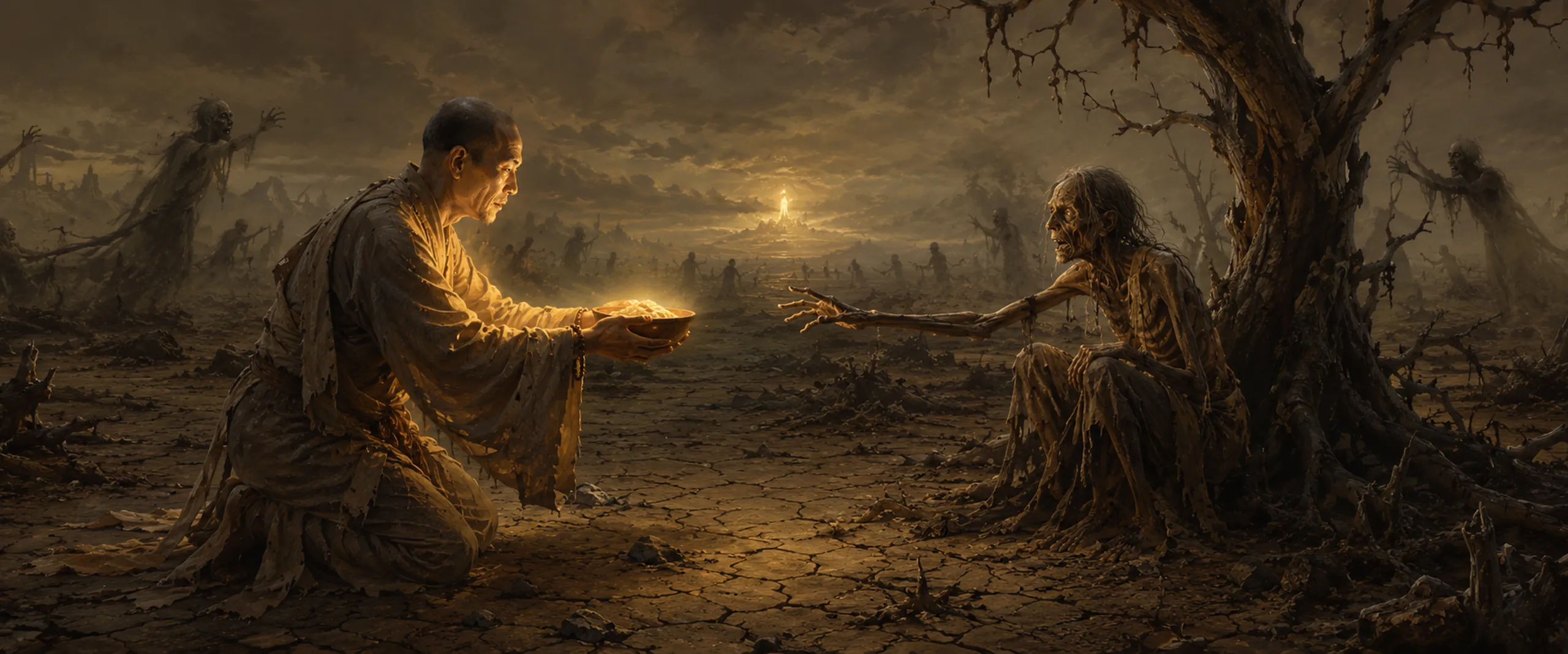
The term “Yulanpen Festival” comes from the Buddhist story of Mulian saving his mother and is a transliteration of the Sanskrit “Ullambana,” originally meaning “saving those hung upside down.” According to the Buddha Speaks the Yulanpen Sutra translated by Dharmaraksa of the Western Jin dynasty, Mulian (also known as Maudgalyayana), one of the ten great disciples of Sakyamuni, after attaining arhatship, used his divine eye to see his deceased mother suffering in the realm of hungry ghosts, emaciated and unable to eat. Mulian was deeply grieved and sent her food in a bowl, but as soon as the food reached his mother’s hands, it turned into burning charcoal. Mulian sought help from the Buddha. The Buddha told Mulian that his mother’s sins were so deep that he alone could not save her; he must, on the 15th of the seventh month — the day when the monastic community ended its summer retreat — prepare a hundred flavours of food and offerings to the monastic community of the ten directions, and rely on their collective power to save her. Mulian followed the Buddha’s instructions and successfully rescued his mother from the realm of hungry ghosts. Thereafter, Mulian extended this to others and suggested to the Buddha that all monastic and lay disciples wishing to practice filial piety could make Yulanpen offerings on the 15th of the seventh month to redeem their parents of the present life and for seven generations past, thus establishing the Yulanpen Festival on the 15th of the seventh month. The Yulanpen Sutra is therefore known as the Buddhist Classic of Filial Piety and is the true origin of the “Yulanpen Festival.”
When Buddhism first entered China, it adhered to the original doctrine of not honouring kings or parents, which conflicted sharply with the Confucian culture that emphasised blood kinship and human relationships. Later, Buddhism adapted to local customs and combined the Yulanpen assembly with the traditional “Autumn Tasting” custom, forming the Buddhist filial piety festival with Chinese ethical cultural characteristics — the Yulanpen Festival. The moral connotations contained in the Yulanpen Festival — honouring parents, delivering ancestors, and showing compassion to all beings — resonated with Confucian values of benevolence and filial piety and matched the emotions and wishes of the people, thus spreading widely among the populace. The Mulian legend brought by Buddhism gave rise to festival customs such as Mulian opera performances. The story of Mulian saving his mother perfectly integrated Buddhist concepts of deliverance, Confucian spirit of filial piety, and folk ancestor worship traditions, becoming the most deeply ingrained cultural narrative of the Ghost Festival.
Emperor Wu of the Liang dynasty in the Southern dynasties revered Buddhism. In the fourth year of the Datong era (538 CE), he established the “Yulanpen vegetarian feast” at Tongtai Temple, and thereafter “on every 15th of the seventh month, offerings were sent to all temples.” Under the prevailing atmosphere of Buddhist reverence, Buddhist customs merged with the traditional Ghost Festival, evolving into the Yulanpen assembly. According to the Jingchu Suishiji compiled during this period: “On the 15th of the seventh month, monks, nuns, and laypeople all prepare offerings for the temples… with seven‑leaf merits, and send them with banners, flowers, song, drums, and fruits.” This shows that during the Southern dynasties, the Yulanpen assembly had already become a grand festival participated in by both monastics and laypeople.
Readers’ Comments
Calendar and traditional culture enthusiasts from around the world, sharing the same moon.
Sign in or register to join the conversation. Your comment account is created automatically the first time you use a connected account.
No comments yet
Share your thoughts with readers around the world.