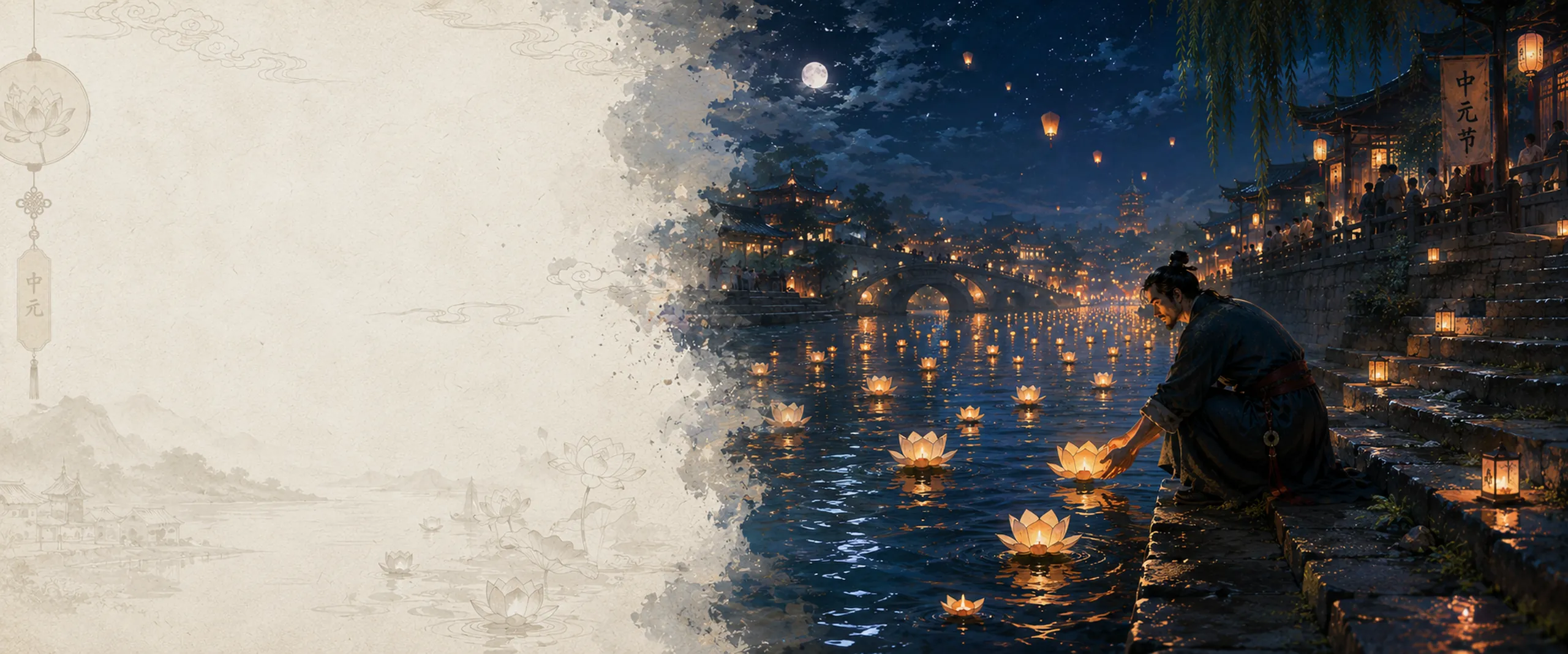
The Zhongyuan Festival is one of China’s three major traditional festivals of ancestor worship. It falls on the fifteenth day of the seventh lunar month and brings together the Daoist Zhongyuan Festival, the Buddhist Ullambana Festival, and folk traditions surrounding the seventh lunar month and the so-called Ghost Festival, forming a tradition that has continued for more than 1,500 years.
Customs such as ancestor worship, releasing river lanterns, universal salvation ceremonies, and burning paper ingots have been passed down to the present day. At their heart are the values of honoring the departed, remembering one’s ancestors, and practicing compassion and generosity.
The Zhongyuan Festival (Chaoshan Ullambana Festival), Zhongyuan Festival (Ziyuan River Lantern Festival), and Zhongyuan Festival (Laiwu Zhongyuan Festival Customs) have all been included in China’s national intangible cultural heritage list.
As Chinese culture has spread around the world, Zhongyuan has become a cultural festival upheld by many Chinese communities overseas—from Kuala Lumpur’s Petaling Street celebration with a 33-year history, to the Singapore Chinese Cultural Centre’s first immersive “Celebrating Zhongyuan” series; from San Francisco’s third “Chinatown Ghost Festival,” which reinterprets tradition through contemporary art, to Chanthaburi Province in Thailand, where a century-old Ullambana charitable tradition continues to assist the poor and vulnerable. Across different regions, communities blend tradition with modern expression to honor and remember their ancestors.
Event Schedule and Venues
### Core Zhongyuan Festival Dates
The Zhongyuan Festival falls each year on the fifteenth day of the seventh lunar month, usually corresponding to mid- or late August in the Gregorian calendar. The entire seventh lunar month, from the first through the twenty-ninth day, is regarded as a period of Zhongyuan rites, with the fifteenth as the main peak.
Activities in different regions usually begin gradually from the first day of the seventh lunar month, reach their height on the fifteenth, and in some places continue until the end of the month.
The core schedule is as follows:
| Time | Activity | Description |
|---|---|---|
| From the first day of the seventh lunar month | Zhongyuan ritual activities begin around the country | Communities, Buddhist temples, and Daoist temples promote responsible and orderly worship |
| 3–5 days before the main day | Zhongyuan universal salvation ceremonies begin | Buddhist and Daoist temples organize Dharma assemblies and rituals |
| Fifteenth day of the seventh lunar month | Zhongyuan Festival Day — ancestor worship, river lanterns, ceremonies | Central day of celebration nationwide |
| Three days before and after the main day | Major concentrated celebrations | Fengdu Zhongyuan Festival, Laiwu welcoming of the ancestral hall, and other activities |
### Traditional Zhongyuan Customs and Cultural Meaning
The Zhongyuan Festival is also known as Qiyueban (七月半), “the Half of the Seventh Month.” It evolved from ancient autumn harvest rituals in which ancestors were honored with newly harvested produce. It incorporates Confucian, Daoist, and Buddhist ideas and developed through the combined influence of all three traditions.
Its varied rituals have endured for thousands of years because of their compassionate spirit of remembering ancestors, illuminating the darkness and rescuing wandering souls, and practicing generosity toward others.
| Custom | Description |
|---|---|
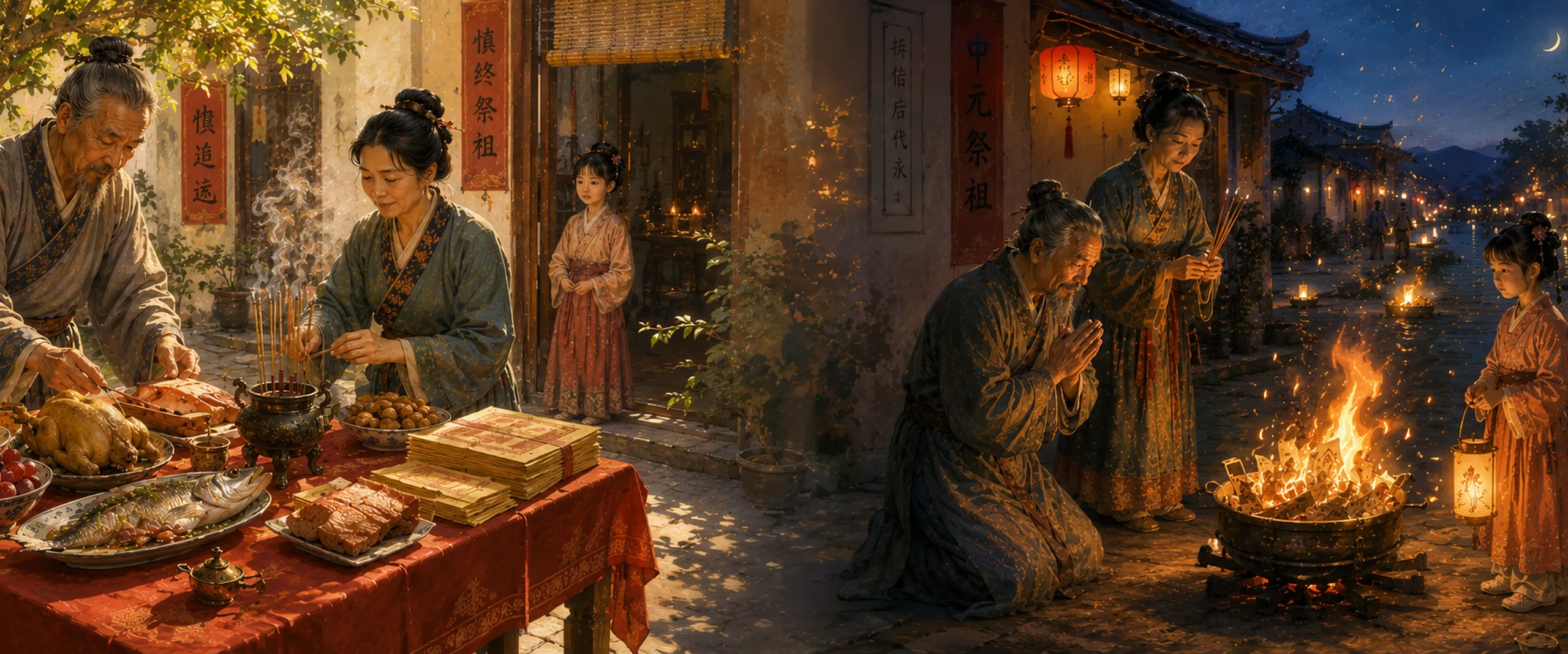
| Ancestor Worship | The festival’s most central custom. People arrange offerings, burn incense and paper offerings, and honor ancestors, expressing remembrance for those who came before |
| Releasing River Lanterns | Also known as lotus lanterns, these are set afloat on rivers, lakes, and seas on Zhongyuan night to symbolically light the way for departed ancestors |
| Universal Salvation Ceremonies | Buddhist Ullambana observances and Daoist Zhongyuan universal salvation rites seek to deliver departed spirits and pray for blessings for all beings |
| Burning Paper Ingots | Spirit money, paper ingots, paper clothing, and candles are burned as symbolic supplies for departed souls |
| Family Reunion | In some regions, Zhongyuan is considered second only to the Spring Festival in ceremonial importance, and families gather together |
### Major Recommended Activities by Region
Fengdu, Chongqing — Fengdu Zhongyuan Night:
The event “Fengdu Zhongyuan Night · Meeting the Departed Once More” is held at Fengdu Mingshan Scenic Area in Chongqing. Fengdu’s Zhongyuan folk customs have been included in the Chongqing municipal representative intangible cultural heritage list.
Unlike the common stereotype of Zhongyuan as eerie or frightening, Fengdu’s traditions consistently revolve around two central ideas: reverence and gratitude toward ancestors, and remembrance of those who came before.
Rooted in a cultural lineage stretching back a thousand years, Fengdu’s Zhongyuan customs trace their origins to ancient autumn harvest rites honoring ancestors and combine Confucian, Buddhist, and Daoist traditions. Here, Zhongyuan has never been merely a symbol of horror. It is found in the warmth of artisans making river lanterns and Kongming lanterns that illuminate the water, and in the Mulian opera performed from generation to generation at temple fairs, carrying the teaching that “of all virtues, filial piety comes first.”
The event integrates three major sections: live ritual ceremonies, immersive night exploration, and stage performances:
* Grand Ceremony of Honoring the Ancestors and Praying for Protection: Held in the plaza before the scenic area, expressing remembrance through Nuo dance and the simultaneous release of Kongming lanterns.
* Night Tour of Fengdu City: An immersive night-tour experience enhanced with modern sound, lighting, and multimedia technology.
* City God Procession: Traditional folk procession.
* Mulian Opera: Folk theater centered on filial devotion.
* Releasing River Lanterns: A warm ritual that lights the river surface.
* “Autumn Offering Night Market” and “Fengdu Blessing Banquet”: Food experiences carrying the cultural depth of local traditions.
Laiwu, Jinan, Shandong — Laiwu Zhongyuan Festival Customs, National Intangible Cultural Heritage:
The Laiwu Zhongyuan Festival customs are included in China’s national representative list of intangible cultural heritage. In Laiwu, Zhongyuan is regarded as a festival whose ceremonial importance is second only to the Spring Festival.
On this day, people from Laiwu try to return home wherever they may be, gathering with the entire family. The customs consist of three major parts: inviting the family ancestors home, ritual worship, and sending the ancestors back.
* Inviting the Ancestors Home: On the fifteenth day of the seventh lunar month, households clean their courtyards, wipe the offering table, prepare offerings, and place ancestral tablets representing four generations. At noon, people light incense, carry a wine pot, and go to the entrance of the village to welcome their ancestors home.
* Ritual Worship: Tea, snacks, fresh fruit, and cooked dishes are arranged, and the whole family eats lunch together before the ancestral offering table.
* Sending the Ancestors Back: Before dinner, the entire family walks to the main road outside the village to see the ancestors off, burning paper, pouring libations, kowtowing, and setting off firecrackers. The scene is especially solemn and grand, with villagers of all ages gathering together amid rising incense smoke, drifting paper ash, and the sound of firecrackers.
Ziyuan, Guilin, Guangxi — Ziyuan River Lantern Festival, National Intangible Cultural Heritage:
The Ziyuan River Lantern Festival was included in the national intangible cultural heritage list in 2014. It developed in connection with the Zhongyuan Festival and displays distinct ethnic and regional characteristics.
The tradition originated along the shipping routes of the Zijiang River. Since the Ziyuan County Government organized the first centralized River Lantern Festival in 1995, it has developed into a local celebration centered on ancestor worship, prayer for blessings, trade, and cultural entertainment.
Shenyang, Liaoning — Zhongyuan Cultural Festival:
The Zhongyuan Cultural Festival opens warmly under the theme “Zhongyuan Cultural Gathering · Lantern Messages by the Water, Blessings through Intangible Heritage.” The festival takes the form of a market, and all activities are free to experience:
* Blessing Plaques: Entrusting blessings and remembrance to the breeze.
* Intangible Heritage Lacquer Fans: Make a unique lacquer fan by hand.
* Chinese Palace Lantern Making: Create a traditional Chinese palace lantern.
* Releasing River Lanterns on Zhongyuan Night: Lanterns illuminate the blue water and gather into a river of stars.
Chaoshan, Guangdong — Chaoshan Ullambana Festival, National Intangible Cultural Heritage:
The Chaoshan Ullambana Festival is included in China’s national intangible cultural heritage list. Every year during Zhongyuan, activities include traditional worship ceremonies, scripture recitation and prayers, universal salvation ceremonies, and the releasing of water lanterns.
Buddhist and Daoist Temples Across China — Zhongyuan Ceremonies of Filial Gratitude:
* Buddhist Temples: Hold Yogacara Flaming-Mouth ceremonies, Ksitigarbha Dharma assemblies, Three-Period Recitation ceremonies, and related rites.
* Daoist Temples: Hold Zhongyuan universal salvation ceremonies.
Pre-Trip Preparation
### Visas and Entry
Zhongyuan destinations throughout China are subject to the country’s unified visa policies:
* 240-hour visa-free transit for citizens of 54 countries: Travelers may enjoy visa-free transit for up to 240 hours, with permitted areas covering most administrative regions of China.
* Tour groups from ASEAN countries: Organized tour groups may enter visa-free through designated ports.
* Other nationalities: Apply in advance for a tourist visa, or L visa, through the relevant Chinese embassy or consulate, and ensure that your passport remains valid for more than six months.
* Latest Policies: Before departure, consult the official website of China’s National Immigration Administration or the relevant Chinese embassy or consulate.
### Adapting to the Climate
The Zhongyuan Festival falls on the fifteenth day of the seventh lunar month, usually corresponding to mid- or late August. China remains in summer at this time:
| Region | Temperature Range | Climate Characteristics | Clothing Recommendations |
|---|---|---|---|
| North China (Beijing, Laiwu in Shandong) | 20°C–30°C | Hot, slightly cooler in mornings and evenings | Short sleeves, light jacket, sun protection |
| East China (Shanghai, Zhejiang) | 25°C–33°C | Hot and humid, with occasional typhoons | Short sleeves, quick-dry clothing, folding umbrella |
| South China (Guangdong, Ziyuan in Guangxi) | 26°C–34°C | Hot and humid, frequent showers | Short sleeves, quick-dry clothing, rain gear, mosquito protection |
| Southwest China (Fengdu in Chongqing, Chengdu) | 24°C–33°C | Hot with relatively high humidity | Short sleeves, lightweight clothing, sun protection |
| Northeast China | 18°C–28°C | Warm and comfortable | Short sleeves, light jacket |
General Advice: Late August remains hot across most of China, so sun protection and hydration are daily essentials. Many Zhongyuan activities take place outdoors in the evening or at night, and winds near the water can be stronger, so carrying a light jacket is recommended.
Mosquitoes are also common near rivers and lakes, making mosquito repellent essential.
### Travel Insurance
It is strongly recommended to purchase travel insurance covering:
* Accidental injury and medical treatment for acute illness, including outpatient care
* Loss of or damage to personal belongings
* Travel delays or cancellations, as summer typhoons and thunderstorms may cause flight disruptions
### Currency and Payment
* Currency: Renminbi (CNY).
* Cash: Ritual items such as flowers, incense, candles, and river lanterns are often purchased at roadside stalls or around temples. Carrying RMB 200–400 in cash is recommended.
* Cards: Visa and MasterCard are accepted at major hotels and shopping centers.
* Mobile Payment: Alipay and WeChat Pay are widely used throughout China.
### Communications and Internet
* Important: Popular temples and Dharma assembly venues can become crowded during Zhongyuan, and 4G/5G networks may become congested. It is strongly recommended to download offline maps in advance. Baidu Maps and AutoNavi are recommended; download the map of your destination city to your phone while connected to Wi-Fi.
How to Get There
### Major Event Destinations
Zhongyuan is celebrated nationwide, with different regions offering distinctive ancestor rites, Dharma assemblies, river-lantern activities, and other traditions. Key recommended destinations include:
| Destination | Featured Activity | Transportation |
|---|---|---|
| Fengdu, Chongqing | Fengdu Zhongyuan Night — ancestor-honoring prayer ceremony, City God procession, river lanterns, Mulian opera | Chongqing Jiangbei Airport; Chongqing West Railway Station, then transfer by road to Fengdu |
| Laiwu, Jinan, Shandong | Laiwu Zhongyuan Festival Customs, national intangible cultural heritage — inviting and sending off the ancestors | Jinan Yaoqiang Airport; Jinan West Railway Station, then transfer by road to Laiwu |
| Ziyuan, Guilin, Guangxi | Ziyuan River Lantern Festival, national intangible cultural heritage — river lanterns on the Zijiang River | Guilin Liangjiang Airport, then transfer by road to Ziyuan County |
| Shenyang, Liaoning | Zhongyuan Cultural Festival — intangible heritage lacquer fans, palace lantern making, river lanterns | Shenyang Taoxian Airport; Shenyang North Railway Station |
| Chaoshan, Guangdong | Chaoshan Ullambana Festival, national intangible cultural heritage — universal salvation ceremonies and water lanterns | Jieyang Chaoshan Airport; Chaoshan Railway Station |
### Special Transportation Reminders
In most years, Zhongyuan falls on a working day and is not a statutory public holiday.
Flights / High-Speed Rail:
* If Zhongyuan falls on a weekday, travel demand is concentrated mainly over the preceding weekend and on the day itself.
* Tickets to popular destinations such as Fengdu in Chongqing, Ziyuan in Guilin, and Laiwu in Jinan can be in high demand. Purchasing tickets in advance through the Railway 12306 App is recommended.
Driving:
* Important: Expressways are not toll-free during Zhongyuan. Toll-free travel applies only during the four national statutory holidays of the Spring Festival, Qingming Festival, Labor Day, and National Day.
* Roads leading to Buddhist temples, Daoist temples, and riverbanks may become congested; depart early.
Urban Transportation Tips:
* During Zhongyuan, traffic controls may be implemented around temples, Daoist sites, and riverfront areas. Public transportation is recommended.
* Popular event locations draw large crowds, so arrive early.
Accommodation Reservations
| Key Point | Recommendation |
|---|---|
| When to Book | Zhongyuan falls near the end of the summer tourism peak, and accommodation in popular destinations can remain limited. Book hotels 2–3 weeks in advance |
| Recommended Areas in Fengdu, Chongqing | Fengdu County town or around Mingshan Scenic Area |
| Recommended Areas in Laiwu, Shandong | Central Laiwu District |
| Recommended Areas in Ziyuan, Guangxi | Central Ziyuan County or along the Zijiang River |
| Recommended Areas in Shenyang, Liaoning | Central Shenyang |
| Price Reference | Late summer peak: budget around RMB 200–500 per night; mid-range RMB 500–1,000; high-end above RMB 1,000 |
| Booking Platforms | Major platforms such as Ctrip, Qunar, and Meituan; rooms with free cancellation are preferable |
Pre-Trip Packing Checklist
| Category | Essential Items | Special Notes |
|---|---|---|
| Upper-Body Clothing | Short-sleeved T-shirts, quick-dry clothing, light jacket | August remains hot nationwide; nights by the water can be windy, so carry a light jacket |
| Lower-Body Clothing | Shorts / lightweight long pants | Suitable for extended outdoor activities |
| Shoes | Comfortable, non-slip athletic shoes / sandals | Surfaces near water and riverbanks may be slippery |
| Sun Protection | SPF50+ sunscreen, sun hat, sunglasses | Strong summer sunlight |
| Rain Gear | Folding umbrella or lightweight raincoat | Summer thunderstorms are common |
| Mosquito Protection | Mosquito repellent / mosquito patches — essential | Mosquitoes are common near water and at night |
| Medication | Cold medicine, gastrointestinal medicine, adhesive bandages, heatstroke medication | Precautions against heat-related illness are necessary |
| Electronics | Power bank, phone, camera | River-lantern photography at night requires sufficient battery |
| Storage | Small bag / waist pouch for documents and cash | Keep belongings secure in crowded places |
| Other | Tissues / wet wipes, portable fan | Useful for cooling down outdoors in summer |
Cultural Respect
### Etiquette at Ritual Sites
Ancestor worship and ritual ceremonies lie at the heart of Zhongyuan. When participating:
* Dress Appropriately: When entering Buddhist temples, Daoist temples, or attending ritual ceremonies, wear modest and dignified clothing that does not expose shoulders or knees.
* Maintain Solemnity: Ritual spaces are solemn places. Remain quiet and respectful and do not laugh loudly or create disturbances.
* Photography Restrictions: Photography is usually prohibited during ritual ceremonies and Dharma assemblies. Confirm with on-site staff in advance.
* Do Not Interfere: Do not obstruct or disrupt the normal progress of rituals or Dharma assemblies.
* Do Not Touch: Do not touch offerings, ancestral tablets, Buddha images, or religious objects.
### Etiquette for Releasing River Lanterns
Releasing river lanterns is one of Zhongyuan’s most romantic customs. When participating:
* Use Designated Areas: Release lanterns only in officially designated areas and do not enter unopened waters.
* Pay Attention to Safety: Watch your footing and stay away from the water’s edge, and keep children under close supervision.
* Environmental Awareness: River-lantern bases are often biodegradable, but plastic packaging and other waste must not be thrown into the water.
* Maintain Order: When many people are releasing lanterns, queue properly and avoid crowding or competing.
### Responsible and Environmentally Conscious Worship
In recent years, many regions have promoted more responsible and environmentally friendly forms of Zhongyuan worship:
* Follow Regulations: Many places prohibit burning offerings or setting off firecrackers in public urban areas during Zhongyuan.
* Use Designated Areas: If burning paper money is necessary, do so only in government-designated areas.
* Floral Memorials: People are encouraged to express remembrance through offering flowers, planting trees, online memorials, or family remembrance gatherings.
* Fire Safety: Bringing fire into forested areas for ritual purposes is strictly prohibited.
### Photography Etiquette
* Ask Permission: Before photographing local people in traditional clothing, intangible cultural heritage bearers, Buddhist monks, Daoist priests, or elderly people, smile and ask permission first.
* Respect Portrait Rights: Do not use photographs of others commercially without consent.
* Drone Regulations: Drone flights over Buddhist temples, Daoist temples, or crowded areas require advance notification to local public security authorities.
### General Responsible Participation
* Protect the Environment: Do not litter; keep event venues and natural environments clean.
* Maintain Order: Queue patiently, do not cut in line, and avoid crowding.
* Waste Sorting: Major Chinese cities have implemented waste sorting. Dispose of rubbish according to local regulations.
Emergency Information
| Item | Contact / Notes |
|---|---|
| Emergency Numbers | Police 110, Fire 119, Ambulance 120 |
| Major Hospitals | Municipal and People’s Hospitals; emergency departments remain open 24 hours during Zhongyuan |
| Tourist Police / Lost Property | Event sites generally have permanent police posts. If valuables are lost, report immediately to the nearest police office |
| Tourist Information | Official platforms of local culture and tourism authorities |
| Time Zone | UTC+8, China Standard Time |
| Voltage / Plugs | 220V; plug types A / C / I |
Special Reminders
* Weekday Reminder: In most years, Zhongyuan falls on a working day. It is not a statutory public holiday and does not involve adjusted days off.
* Expressways Are Not Free: Expressways are not toll-free during Zhongyuan. Toll-free travel applies only during the Spring Festival, Qingming Festival, Labor Day, and National Day.
* National Intangible Cultural Heritage Experiences: Zhongyuan includes several items of national intangible cultural heritage — Laiwu Zhongyuan Festival Customs in Shandong, the Ziyuan River Lantern Festival in Guangxi, and the Chaoshan Ullambana Festival in Guangdong. Fengdu Zhongyuan folk customs are included in Chongqing’s municipal intangible cultural heritage list. These places offer some of the most authentic ways to experience Zhongyuan culture.
* Fengdu Is Especially Recommended: Fengdu, Chongqing is a foremost destination for experiencing Zhongyuan. The “Fengdu Zhongyuan Night · Meeting the Departed Once More” event integrates live ritual ceremonies, immersive night exploration, and stage performances.
* Laiwu Is Especially Recommended: In Laiwu, Shandong, Zhongyuan is considered second only to the Spring Festival in ceremonial importance. The three-part sequence of inviting the ancestors home — ritual worship — sending the ancestors back preserves the traditional structure of Zhongyuan observance in full.
* Responsible Worship: During Zhongyuan, many places strictly prohibit burning offerings in public urban areas. Follow local regulations and conduct ritual activities only in designated areas.
* Waterfront Safety: River-lantern activities take place near water. Stay well away from the water’s edge and supervise children carefully.
* Weather and Mosquito Protection: August remains hot across China. Outdoor activities require sun protection, frequent hydration, and precautions against heatstroke. Mosquitoes are common near water, so mosquito repellent is essential.
*May you experience the distinctive charm of Chinese traditional culture amid the scattered glow of river lanterns and curling incense smoke, and gain a profound cultural understanding through the solemn remembrance of those who came before and the warm compassion extended toward life itself.*
—-
Cultural Background:
The Zhongyuan Festival originated in China and has a history spanning thousands of years. It brings together ideas from Confucianism, Daoism, and Buddhism, shaped through the influence of all three traditions. The reason its rich and varied rituals have endured for millennia lies in their compassionate spirit of remembering ancestors, illuminating the darkness and rescuing wandering souls, and practicing generosity toward others.
Zhongyuan customs are diverse:
* Ancestor Worship: The festival’s most central custom. People arrange offerings, burn incense and paper offerings, and honor their ancestors as an expression of remembrance and reverence for those who came before.
* Releasing River Lanterns: River lanterns, also known as lotus lanterns, are set afloat on rivers, lakes, and seas on Zhongyuan night, symbolically lighting the way for departed ancestors.
* Universal Salvation Ceremonies: Buddhist Ullambana observances and Daoist Zhongyuan universal salvation rituals seek to deliver departed spirits and pray for blessings for all beings.
* Burning Paper Ingots: Spirit money, paper ingots, paper clothing, and candles are burned as symbolic provisions for the deceased.
* Getai and Opera Performances: Folk performances such as getai and ritual operas are staged during Zhongyuan in Singapore, Malaysia, and other places.
* Charitable Giving: Ullambana gatherings emphasize “giving to the departed and aiding the living,” combining rites for spirits with care for socially disadvantaged groups.
As Chinese communities spread around the world, Zhongyuan culture traveled with them. Today, it forms an important part of multicultural life in many countries:
* Asia: Malaysia and Singapore preserve extensive Zhongyuan worship and universal salvation traditions; Chanthaburi Province in Thailand holds a century-old Ullambana charitable event supporting the poor; Chinese associations in Ho Chi Minh City, Vietnam, organize Ullambana universal salvation ceremonies; and a major “Ullambana Gratitude · Thousand Lamps Offering to the Sangha” ceremony is held in Kathmandu, Nepal.
* North America: The Chinese Culture Center of San Francisco has transformed the traditional Zhongyuan Festival into the “Chinatown Ghost Festival,” combining music, art, processions, and ritual.
* Japan: Japan’s Obon (お盆) is observed from August 13 to 16 in the Gregorian calendar, with activities such as Bon Odori dances held throughout the country.
2026 is the lunar Bingwu Year of the Horse (丙午马年).
Major Celebration Cities
| Continent | Country / Region | Core City | Featured Activities |
|---|---|---|---|
| Asia | Malaysia | Kuala Lumpur | 33rd Zhongyuan Celebration at Petaling Street; consecration of an 18.8-foot Da Shi Ye figure; farewell ceremony for Da Shi Ye |
| Malaysia | Johor Bahru | Zhongyuan Universal Salvation Ceremony (8/16); Zhongyuan Peace Banquet (8/21) | |
| Malaysia | Seremban | Rahang Village Ullambana salvation ceremonies (8/21–23); free peace banquet | |
| Malaysia | Kuching | Baoguang Village Zhongyuan worship ceremony (8/27), held for the 15th consecutive year | |
| Malaysia | Penang | Zhongyuan worship guidelines for apartment communities and neighborhood rituals | |
| Singapore | Singapore | Singapore Chinese Cultural Centre “Celebrating Zhongyuan” series (AR game, animation, getai); Yun Yin Temple Zhongyuan ceremonies | |
| Thailand | Chanthaburi Province | Ullambana charitable relief event with a century-old tradition; 7,000 bags of rice distributed free | |
| Vietnam | Ho Chi Minh City | Ullambana universal salvation ceremonies at Fujian Xiazhang Association and Fujian Erfu Association | |
| Nepal | Kathmandu | “Ullambana Gratitude · Thousand Lamps Offering to the Sangha” grand ceremony at Namkha Khungzong Temple | |
| North America | United States | San Francisco | Third “Chinatown Ghost Festival” (8/23) — theme “Demons of Our Time,” Da Shi Wang procession, contemporary art installations |
| United States | Los Angeles | Hsi Lai Temple “North America Ullambana Offering to the Sangha Ceremony” | |
| Europe | — | — | Zhongyuan celebrations are relatively small in European Chinese communities and are centered mainly on Buddhist temple ceremonies |
Major Activities by Region
### Kuala Lumpur, Malaysia
The Kuala Lumpur Hawkers and Petty Traders Association holds the 33rd Zhongyuan Celebration on August 13, the first day of the seventh lunar month, at Petaling Street (Jalan Petaling) in Kuala Lumpur. Petaling Street is a major tourist area in the city and a traditional commercial district lined with shops and hawker stalls.
Core Rituals:
* Consecration of Da Shi Ye: The event enshrines an 18.8-foot-tall Da Shi Ye figure. Association president Hong Xidi stated that Da Shi Ye is regarded as an incarnation of Guanyin Bodhisattva and is also known as the “Ghost King,” responsible for governing wandering spirits and assisting in their deliverance.
* Opening of the Ritual Altar: Held late at night on August 14.
* Universal Salvation Worship Ceremony: Held at 5:00 p.m. on August 14.
* Farewell to Da Shi Ye: Held at 11:00 p.m. on August 14. At the end of the ritual, the Da Shi Ye figure is burned, symbolizing his return to the underworld and his guidance of wandering spirits away from the human realm.
* Peace Banquet: Held at 7:00 p.m. on August 15 at Sheraton Seafood Restaurant in Pudu, Kuala Lumpur, with 50 banquet tables and an auction of auspicious goods.
Significance: This Zhongyuan celebration has been held for 33 years. Hong Xidi stated that its theme is “It is good that you came; come again when things are good; may everything get better and better.” The event seeks to emphasize traditional Chinese sacrificial culture and filial piety while also attracting more visitors to Petaling Street. As the scale of the rites and prayer ceremonies has expanded, more tourists have participated and gained greater awareness of Malaysia’s multicultural character.
Transportation Tip: Petaling Street is located in central Kuala Lumpur and is within walking distance of Pasar Seni LRT station.
### Singapore
The major highlight of Singapore’s 2026 Zhongyuan celebrations is the Singapore Chinese Cultural Centre’s first-ever “Celebrating Zhongyuan” series. The program runs from August 13, the first day of the seventh lunar month, through September 10, the twenty-ninth day of the month.
Core Activities:
“Hehe! Where Is the Little Ghost?” Augmented Reality Game:
* Participants follow the mascot “Little Ghost” and use mobile devices to complete interactive tasks across different floors of the center.
* The game contains six stations, including “Remembering the Ancestors,” “Sharing the Feast,” and “Universal Salvation Ceremony.”
* A bilingual Chinese-English interface is available, suitable for visitors of all ages.
* Participation is completely free, making it suitable for families.
Premiere of the Animated Short *Fried Rice* — August 29:
* Approximately 20 minutes long and created by the award-winning local team Robot Playground Media.
* It is the opening installment of the horror animation anthology *Hungry Ghost Banquet*.
* Four screenings are held on August 29 at 14:30, 16:30, 18:30, and 20:30, with the creative team attending to meet audiences.
* Admission is only SGD 3.
Other Activities:
* “Come Sing Happily” Zhongyuan Special Performance: Recreates the atmosphere of traditional getai, with two performances on August 19 and 20. Tickets for approximately 800 people per show have already sold out.
* “Zhou Gong Talks Ghosts” Special Podcast Segment: Produced in collaboration with radio station LOVE 972.
* Yun Yin Temple Zhongyuan Gathering — August 27 to September 8: Celebrates the temple’s 18th anniversary with ancestral salvation ceremonies and Zhongyuan getai performances.
* Chinatown Zhongyuan Celebration — August 22: Includes getai, traditional opera, and an auspicious-goods auction banquet.
Transportation Tip: The Singapore Chinese Cultural Centre is located downtown and can be reached via Tanjong Pagar MRT station (East-West Line) or Shenton Way station (Thomson-East Coast Line).
### Other Parts of Malaysia
Johor Bahru — August 16 and 21:
* On August 16, the Johor Bahru Hawkers Association holds a Zhongyuan Universal Salvation Ceremony at No. 33 Jalan Trus from 9:00 a.m. to 5:00 p.m.
* On August 21, a Zhongyuan Peace Banquet is held at Long Sheng Buddha Jumps Over the Wall Restaurant in Bukit Indah, featuring an auction of auspicious goods.
Rahang Village, Seremban — August 21–23:
* A 2026 Bingwu Year Zhongyuan Salvation Ceremony is held over three consecutive days from August 21 to 23.
* On the first day, August 21 at 5:00 p.m., the altar-opening invitation of masters and consecration of the banana-faced Ghost King are performed.
* On the second day, August 22 at 5:00 p.m., rites include altar procession and food offerings, receiving the Buddha at the first altar, and breaking the city gates.
* On the third day, August 23 at 4:30 p.m., rituals include altar procession and food offerings, distributing clothing and food, and burning the ritual boat to send off wandering spirits.
* At 9:00 p.m. on the third night, a free peace banquet provides flowing-table dining for 700 to 800 people.
* The Blue Ocean Song and Dance Troupe performs every evening.
Baoguang Village, Kuching — August 27:
* The Zhongyuan worship ceremony is held for the 15th consecutive year.
* It takes place at noon on August 27, the fifteenth day of the seventh lunar month, at the hexagonal pavilion in Baoguang Village.
* The Ling Drum Team and Northern Lion Dance Team from Kuching Chung Hua Middle School No. 4 are specially invited to perform.
Penang — Zhongyuan Worship Guidelines:
* The Batu Lanchang State Assembly Service Centre issues Zhongyuan Worship Guidelines, encouraging residents of apartment complexes to burn offerings only in designated areas determined by building management and to clean the site immediately afterward.
* The guidelines seek to balance traditional customs, fire safety, and residential conditions.
* They are not legally binding and are advisory only.
### Chanthaburi Province, Thailand
On August 18, 2026, the annual Ullambana charitable relief event is held at Dong Ying School in Chanthaburi Province, Thailand. It is organized by Chanthaburi Ming Yi Charity Hall, with provincial governor Mengxi attending and delivering remarks.
Highlights:
* A charity kitchen provides free meals to the public.
* 7,000 bags of rice are distributed free to residents, jointly collected by Ming Yi Charity Hall and members of the wider community.
* Ming Yi Charity Hall chairman Zhan Juncheng stated that the Ullambana gathering has a history of more than one hundred years and is a charitable tradition centered on giving to wandering spirits and “giving to the departed while aiding the living.”
Cultural Significance: Chanthaburi’s governor Mengxi emphasized that the most valuable aspect of the Ullambana gathering lies in how it integrates religious belief with social welfare—remembering ancestors while also caring for vulnerable people in the community. As one of Thailand’s important centers of Chinese settlement, Chanthaburi is a place where Chinese and local cultures have long interacted and blended.
### Ho Chi Minh City, Vietnam
Fujian associations in Ho Chi Minh City hold Ullambana universal salvation ceremonies during Zhongyuan:
* The Fujian Xiazhang Association holds its 2026 Ullambana Universal Salvation Ceremony on the morning of August 21, the ninth day of the seventh lunar month.
* The Fujian Erfu Association opens its ritual altar on the afternoon of August 17, the fifth day of the seventh lunar month, beginning a three-day Ullambana Universal Salvation Gathering.
### San Francisco, United States
The Chinese Culture Center of San Francisco holds the third “Chinatown Ghost Festival” on August 23. Under the theme “破魅而生” (Demons of Our Time), the event transforms the traditional Zhongyuan Festival into a cultural celebration combining music, art, processions, and ritual.
Core Activities:
* Da Shi Wang Procession: Beginning at 4:00 p.m. from 667 Grant Avenue, a 14-foot-tall giant papier-mâché Da Shi Wang figure proceeds through the streets of Chinatown.
* Contemporary Art Installations: Three Hong Kong artists reinterpret traditional culture through contemporary art, including a moving lotus sculpture, flame installation, and ritual forms inspired by exorcism.
* Diverse Music Performances: Featuring Cantonese opera, Indigenous folk punk, queer taiko, and multilingual music ensembles.
* Community altars, outdoor art installations, and pop-up exhibitions.
Historical Significance: The event curator noted that between 1860 and 1920, more than 350 Zhongyuan or Ullambana ceremonies were documented across California. The Ghost Festival holds an important place in Chinese American history in California and offered spiritual comfort to early immigrants who endured exclusion and hardship. The event also launches the Chinese Culture Center’s series of celebrations marking its 60th anniversary.
### Other Regions
Japan — Bon Odori Festival: In 2026, the 50th Japan Bon Odori Festival is held, attracting large crowds, many of whom attend wearing brightly colored Japanese yukata.
Kathmandu, Nepal: On August 27, Namkha Khungzong Temple holds the “盂蘭報恩.千燈供僧” Ullambana Grand Ceremony.
Los Angeles, United States: On July 19, 2026, Fo Guang Shan Hsi Lai Temple holds the “North America Ullambana Offering to the Sangha Ceremony,” presided over by Fo Guang Shan Abbot Venerable Hsin Bao, with more than one thousand participants.
San Francisco, United States: The Los Angeles and San Francisco practice centers jointly hold the “Zhongyuan Gratitude Ksitigarbha Dharma Assembly and Compassionate Samadhi Water Repentance Ceremony” on August 29–30.
Pre-Trip Packing Checklist
| Category | Recommended Items | Notes |
|---|---|---|
| Clothing | Prepare according to local climate — August in the Northern Hemisphere is hot, so bring short sleeves and sun protection; nights may be slightly cooler, so carry a light jacket | Outdoor activities may last for long periods |
| Shoes | Comfortable, non-slip athletic shoes | Temple fairs and processions involve extended standing and walking |
| Sun Protection | Sunscreen, sun hat, sunglasses | Strong outdoor sunlight |
| Rain Gear | Folding umbrella or lightweight raincoat | August is rainy season in Southeast Asia |
| Camera / Phone | For photographing Da Shi Ye figures, processions, and getai performances | Night activities benefit from suitable low-light photography equipment |
| Cash | Small amounts of local currency | Temple fairs and offering stalls may not accept cards |
| Power Bank | Portable charger | Outdoor activities may last a long time |
| Translation App | Google Translate or similar | Useful for communicating with local Chinese communities or vendors |
Participation Etiquette:
### General Etiquette
* Festival Greetings: You may say “中元安康” or “盂兰盆节吉祥.”
* Respect Tradition: Zhongyuan is a solemn festival centered on honoring the departed and remembering ancestors. Participate with an attitude of respect.
* Clothing: Modest, appropriate clothing is recommended; avoid overly bright or revealing attire.
### Etiquette at Ritual Sites
* Maintain Solemnity: Temples, Dharma assemblies, and ritual spaces are solemn places. Remain quiet and respectful; do not laugh loudly or create disturbances.
* Photography Restrictions: Photography is generally prohibited during Dharma assemblies and ritual ceremonies. Confirm with on-site staff in advance. Even where photography is allowed, turn off the flash.
* Do Not Touch: Do not touch offerings, ancestral tablets, Buddha images, or religious objects.
* Dress Appropriately: When entering Buddhist temples or Daoist temples, dress modestly and avoid exposing shoulders and knees.
### Etiquette for Processions and Getai Performances
* Watch from Designated Areas: View processions and performances only from officially designated areas and do not enter the procession route.
* Maintain Order: Follow on-site staff instructions and do not crowd or jeer.
* Watching Getai: Getai performances are an important part of Zhongyuan. Remain respectful while watching and show consideration for performers.
* Child Safety: Processions and temple fairs are places where children can easily become separated. Keep accompanying children under close supervision.
### Etiquette for Charitable Activities
* Participate in an Orderly Manner: When receiving donations or relief supplies, queue properly and do not crowd or compete.
* Receive with Gratitude: Accept donated items with both hands and offer thanks.
### Photography Etiquette
* Ask Permission: Before photographing Chinese participants in traditional dress, monks, Daoist priests, performers, or elderly people, smile and ask permission first.
* Respect Portrait Rights: Do not use photographs of others commercially without consent.
* Drone Regulations: Drone flights over temples or crowded areas require advance notification to local public security authorities.
Travel Tips:
| Item | Description |
|---|---|
| Best Time to Participate | The main activity period runs from the first day of the seventh lunar month, August 13, through the fifteenth day, August 27 |
| Zhongyuan Festival Day | In 2026, Zhongyuan falls on August 27, Thursday |
| Plan Ahead | Popular activities such as those at Petaling Street in Kuala Lumpur and the Singapore Chinese Cultural Centre draw large crowds; plan in advance |
| Transportation | Roads around event venues are often congested; public transportation is recommended |
| Weather | August is rainy in Southeast Asia. Check local forecasts and carry rain gear |
| Local Culture | Zhongyuan celebrations incorporate local cultural elements — Singapore integrates AR technology, San Francisco contemporary art, and Thailand Buddhist charitable traditions |
Special Reminders:
* Zhongyuan Is a Global Festival: You can experience Zhongyuan traditions in major cities around the world. Kuala Lumpur, Singapore, San Francisco, Bangkok, Ho Chi Minh City, Kathmandu, and many other places hold celebrations.
* 2026 Is the Year of the Horse: Some events, including auspicious goods at Malaysian peace banquets, incorporate horse-themed elements.
* The Seventh Lunar Month Is “Zhongyuan Month”: The entire seventh lunar month, from August 13 to September 10, 2026, is a period of Zhongyuan rites. The main day, August 27, marks the peak.
* Petaling Street in Malaysia Is Especially Recommended: Kuala Lumpur’s 33rd Petaling Street Zhongyuan Celebration is one of Malaysia’s most representative Zhongyuan events. The consecration and farewell rituals for the 18.8-foot Da Shi Ye are especially impressive and attract many international visitors.
* Singapore’s Technology-Enhanced Zhongyuan: The Singapore Chinese Cultural Centre launches its first immersive AR game, “Hehe! Where Is the Little Ghost?”, presenting traditional Zhongyuan culture in a new way. Participation is free and the game is bilingual in Chinese and English.
* San Francisco’s Artistic Zhongyuan: San Francisco’s “Chinatown Ghost Festival” uses contemporary art to reinterpret traditional Zhongyuan culture under the theme “Demons of Our Time,” with a 14-foot Da Shi Wang processing through Chinatown.
* Thailand’s Charitable Zhongyuan: The Ullambana gathering in Chanthaburi combines religious belief with social welfare, distributes 7,000 bags of rice free of charge, and continues a charitable tradition more than a century old.
* Responsible Worship: Penang and other parts of Malaysia have introduced Zhongyuan worship guidelines encouraging the burning of offerings only in designated areas and the immediate cleaning of the site afterward. Follow local regulations when participating.
*May you experience the distinctive charm of the Zhongyuan Festival in different corners of the world, and amid curling incense smoke and scattered river lanterns, gain a profound cultural experience of “honoring the departed and remembering those who came before.”*
Readers’ Comments
Calendar and traditional culture enthusiasts from around the world, sharing the same moon.
Sign in or register to join the conversation. Your comment account is created automatically the first time you use a connected account.
No comments yet
Share your thoughts with readers around the world.