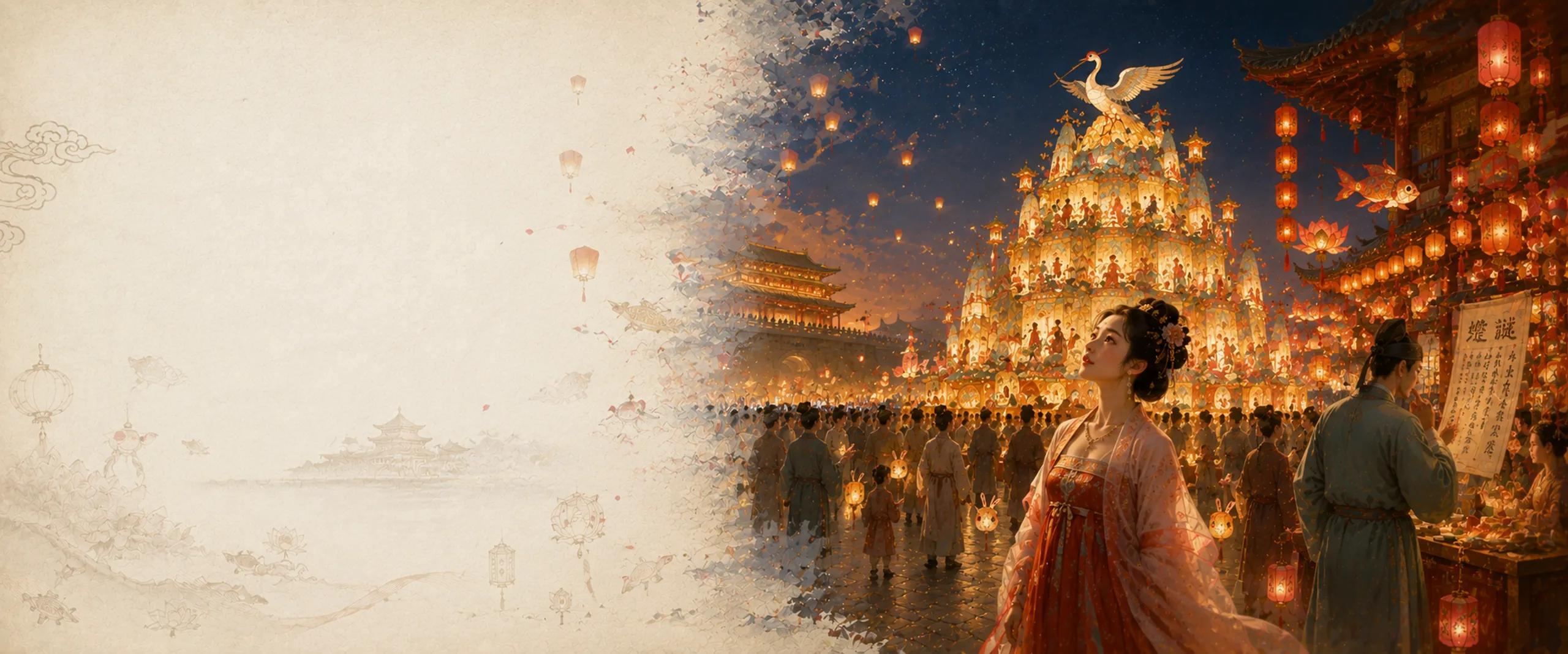

The Lantern Festival originated in the Han dynasty and had become a grand carnival for all by the Tang dynasty. Su Weidao, in his poem “The Night of the 15th of the First Month” (《正月十五夜》), wrote: “火树银花合,星桥铁锁开。” (*The fiery trees and silver flowers blend; the iron chains on the starry bridge are unlocked.*) — a line that captures the dazzling lanterns and the open city gates of Chang’an on that night. The core custom is lantern viewing — as Xin Qiji vividly portrays in his ci poem “The Lantern Festival” (《青玉案·元夕》): “东风夜放花千树,更吹落、星如雨。” (*In the east wind, blossoms of fire burst forth overnight, and then shower down like falling stars.*) Solving lantern riddles and eating yuanxiao (or tangyuan) are also essential; the round shape symbolises reunion and completeness. Ouyang Xiu, in his ci poem “Song of Hawthorn · Lantern Festival” (《生查子·元夕》), adds a romantic hue: “去年元夜时,花市灯如昼。月到柳梢头,人约黄昏后。” (*Last year on this Lantern night, the flower markets were bright as day; the moon rose above the willows, and we met at dusk.*) On this night, lanterns not only illuminate the sky but also warm the hearts and hopes of the people.
Festival Journey
Origins & Legends
History · Evolution · Legend
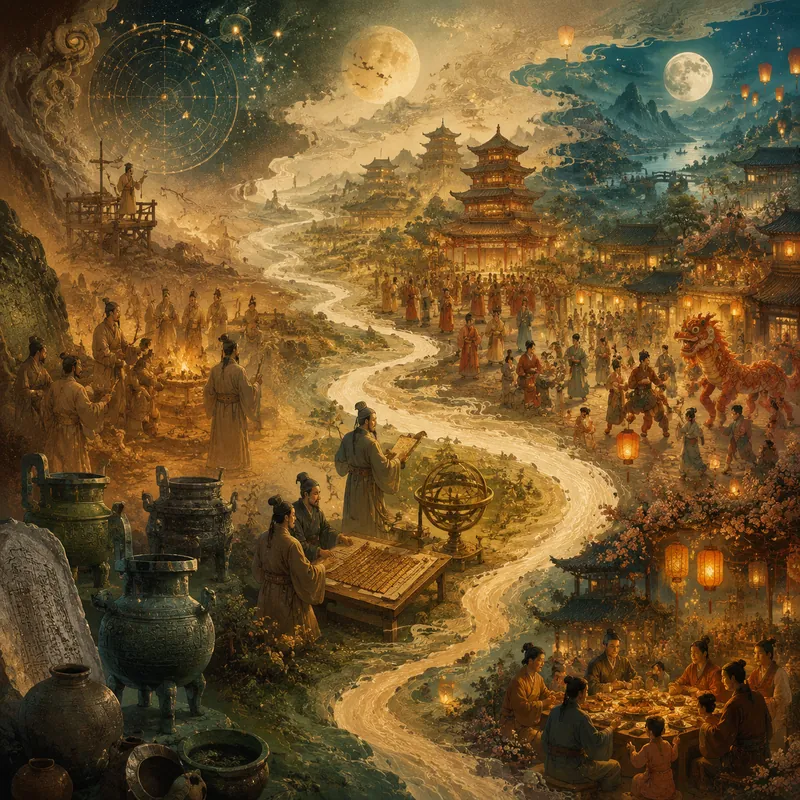
Tracing the Source · Historical Evolution
- Han Dynasty The Han dynasty was the embryonic period of Lantern Festival customs
- Sui and Tang Dynasties The Sui and Tang dynasties were periods of great transformation in Chinese seasonal customs, and also an important formative period for the Lantern Festival
- Song and Yuan Dynasties The Song dynasty was the heyday of Lantern Festival development
- Ming and Qing Dynasties The Ming dynasty fully revived Song institutions, and the Lantern Festival further developed
- Modern Era After the founding of the People’s Republic of China, the Lantern Festival’s customs have been continuously inherited and developed, with folk activities such as lantern‑viewing, eating tangyuan, solving lantern riddles, and setting off fireworks becoming even more diverse and colourful
Festival Customs
Customs · Local Traditions · Everyday Life
Festival Foods
Food Traditions · Local Flavors · Taste
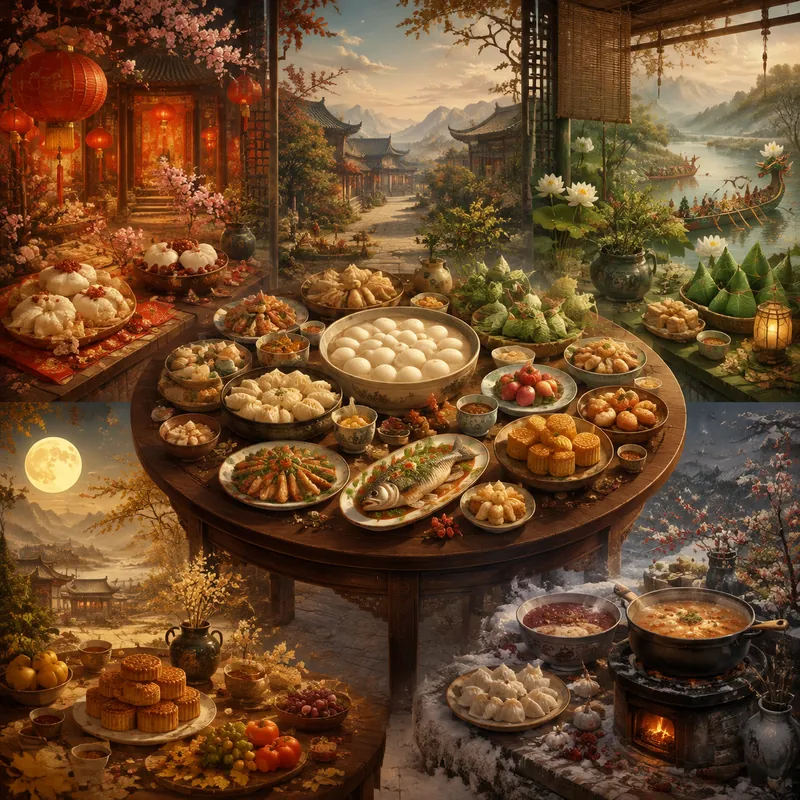
Seasonal Flavours · Seasonal Menu
Poetry & Verse
Classics · Imagery · Legacy
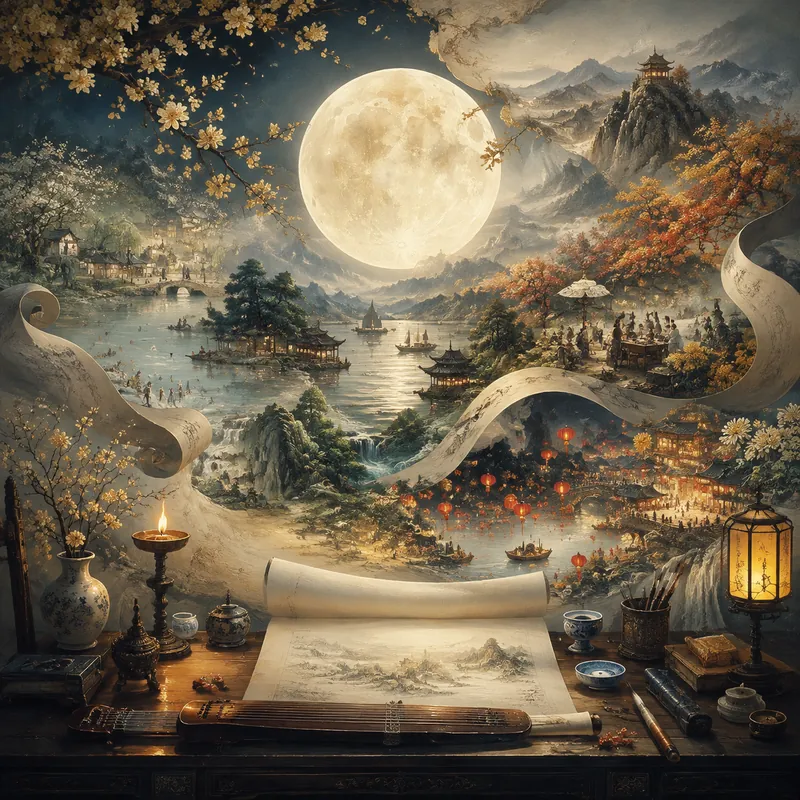
Representative Poems · Classic Selections
「正月十五夜」
火树银花合,星桥铁锁开。
暗尘随马去,明月逐人来。
游伎皆秾李,行歌尽落梅。
金吾不禁夜,玉漏莫相催。
Global Features
Overseas · Chinese Communities · Celebrations
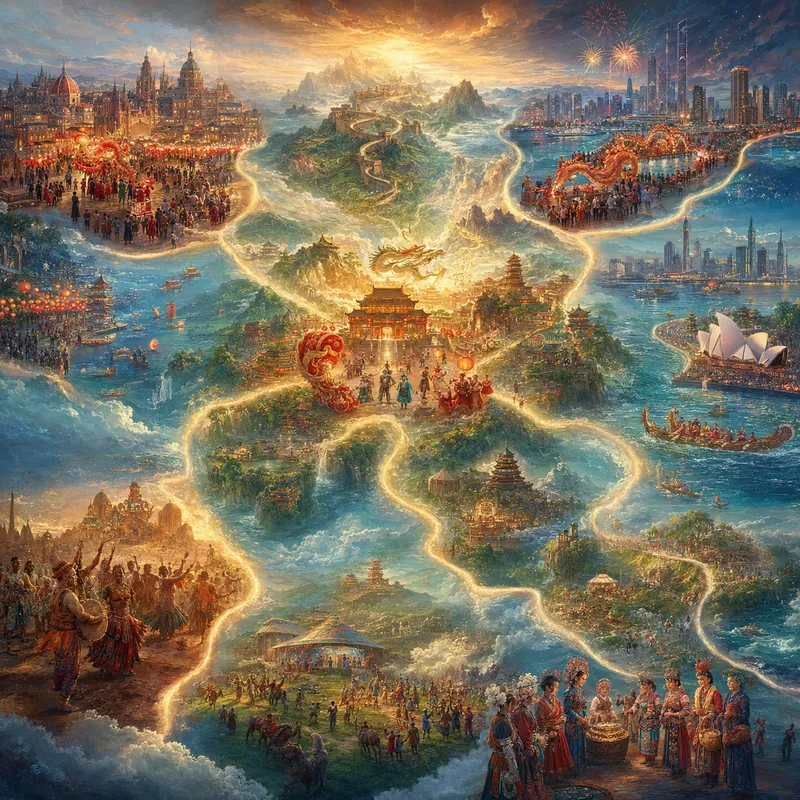
Overseas Celebrations · Lights of Chinese Communities
Cambodia is one of the countries where the overseas Lantern Festival retains the strongest sense of ritual. Chinese ancestors who migrated to Cambodia hundreds and thousands of years ago deeply rooted the traditions of ancestor worship and deity processions from their homelands in the local society. Ancestor worship is the central Lantern Festival ritual among Cambodian Chinese families: households prepare elaborate offerings in advance; roast suckling pig gleams with a glossy sheen, roast chicken gives off a rich aroma, and locally abundant fruits and traditional pastries are carefully arranged on the offering table. Khmer traditional foods and fresh flowers are also often placed on both sides of the table; this seemingly casual combination is precisely a warm portrait of generations of coexistence between Cambodian and Chinese cultures. The most imposing Lantern Festival activity is the “deity procession”. In Phnom Penh’s Orussey commercial district, banners fill the sky and gongs and drums thunder. Wherever the procession passes, lion dancers leap with joy and the public lines the streets to welcome it. The deities respectfully invited by the “乩童” include Tianhou Shengmu, Baosheng Dadi, Nezha the Third Prince, and the Great Sage Equal to Heaven. Following long-standing custom, householders along the route bow devoutly as the divine procession passes, while the 乩童 use traditional movements to bestow blessings and ward off misfortune for merchants and residents. Today, many young Chinese Cambodians have also joined the procession—some carry lanterns, while others beat gongs and drums. The active participation of Khmer residents has further transformed this Chinese tradition into a vehicle for cultural integration between Cambodia and China. The Lantern Festival deity procession is not merely a religious ritual, but also an important bond through which overseas Chinese communities transmit their traditional beliefs and strengthen communal ties.
In Malaysia, the Lantern Festival is a distinctive “grand matchmaking occasion”. Unmarried men and women take part in the activity of “throwing mandarins”: women write their names and contact information on citrus fruits and throw them into rivers or lakes, while men compete to retrieve them with long poles. This matchmaking method, somewhat like “opening a mystery box”, adds an element of fun and is popular among young people. Today, with changing times, variations involving bananas, apples, and even durians have also appeared. Lin Suhui, a Malaysian student from a Chinese family, said that her grandparents came from Chaozhou, Guangdong, and that her family still preserves Spring Festival customs from southern China; for her entire family, the Lantern Festival is one of the most important festivals. In Malaysia, in addition to dragon and lion dances, the custom of “抛柑接蕉” is also highly distinctive: young Chinese men and women write their names and contact information on bananas or citrus fruits. This combination of the Lantern Festival’s “romantic gene” with the local culture of Nanyang has created a distinctive “localized” matchmaking tradition.
Indonesian Chinese Li Fuyuan showed through video the local Lantern Festival deity procession in Tegal: seven deity sedan chairs were carried by the procession from the temple all the way to Tegal Port, with solemnity and devotion permeating the thunder of gongs and drums. He said that people from Minnan regard deity processions as a form of spiritual sustenance; even after “putting down roots and spreading their branches” in Nanyang, the customs of celebrating the Lantern Festival and staging votive operas for the gods have never ceased, and remain the bond that connects them closely to their homeland. Today, he has taken the baton from his father and continues to pass on Minnan customs. On March 2, 2026, the “亲情中华·四海同春” touring performance, jointly organized by the All-China Federation of Returned Overseas Chinese and the Chinese Embassy in Indonesia, was held in Bandung. Artistic groups from China presented wonderful performances to local audiences, while more than a thousand representatives from different sectors of Indonesian society and members of the overseas Chinese community celebrated the Lantern Festival together. Zhuang Junqin, chairman of the West Java branch of the Indonesian Chinese Chamber of Commerce, said: “I thought it was wonderful. I hope a program like this can come to Bandung again next time. It is a source of pride for us Chinese.”
Chen Yaohua, a member of the Chinese community in Thailand, took part in a Lantern Festival activity organized by the Chinese community in Bangkok and was captivated by the Teochew opera performed there. Teochew opera contains many classic scenes depicting Lantern Festival lantern viewing—the audience watches the play, but what it savors is the full range of human life. In addition to listening to opera, older members of the overseas Chinese community shared Lantern Festival customs from their ancestral hometowns; community members gathered to steam “寿桃包” and paint lanterns, kneading their hopes for the coming year into the dough and painting them onto the lantern surfaces. Zeng Yuanjian, a member of the Chinese community in Vietnam, told reporters that the Lantern Festival atmosphere in Vietnam is strong. In addition to dragon and lion dances and lantern viewing, many Chinese chambers of commerce also organize Qiong opera and Teochew opera performances, bringing to those far from home the sounds and sentiments of their ancestral homeland. The Lantern Festival in Hoi An Ancient Town is renowned far and wide—lanterns are among the most popular decorations in Vietnam, and people believe that red lanterns are not merely decorative, but can also bring good luck and happiness.
Visitor Guide
Preparation · Etiquette · Take Part with Confidence
Readers’ Comments
Calendar and traditional culture enthusiasts from around the world, sharing the same moon.
Sign in or register to join the conversation. Your comment account is created automatically the first time you use a connected account.
No comments yet
Share your thoughts with readers around the world.